


Market Overview
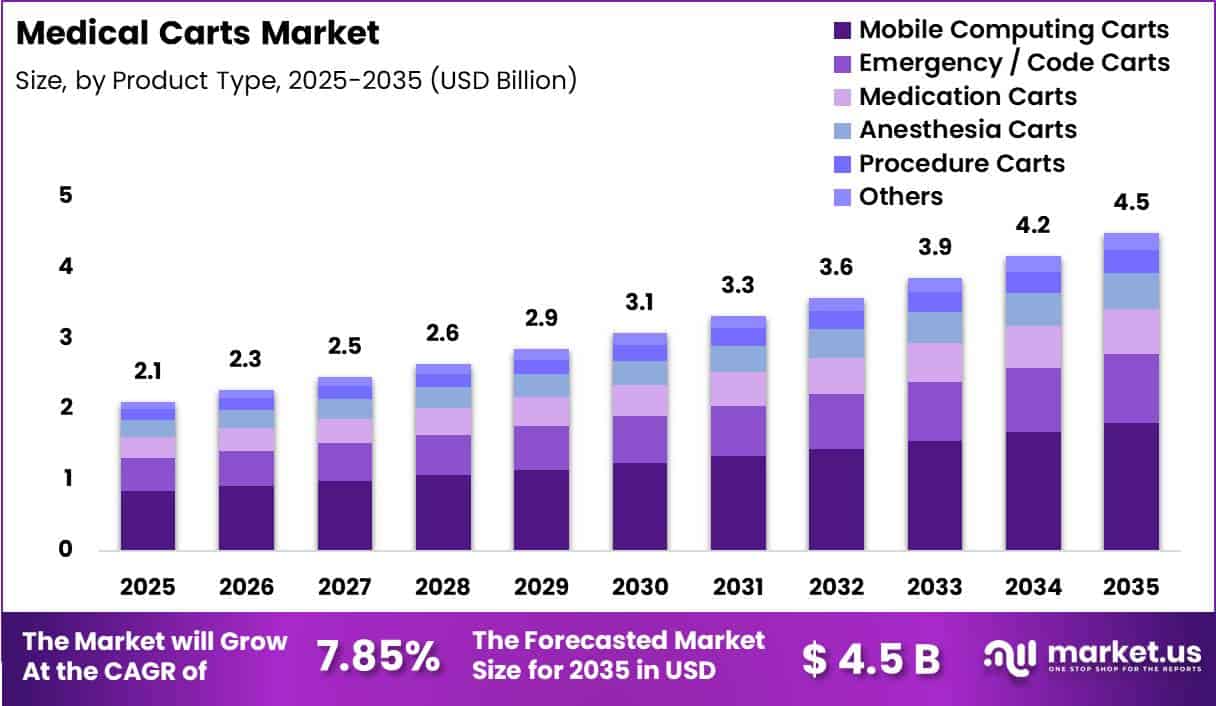
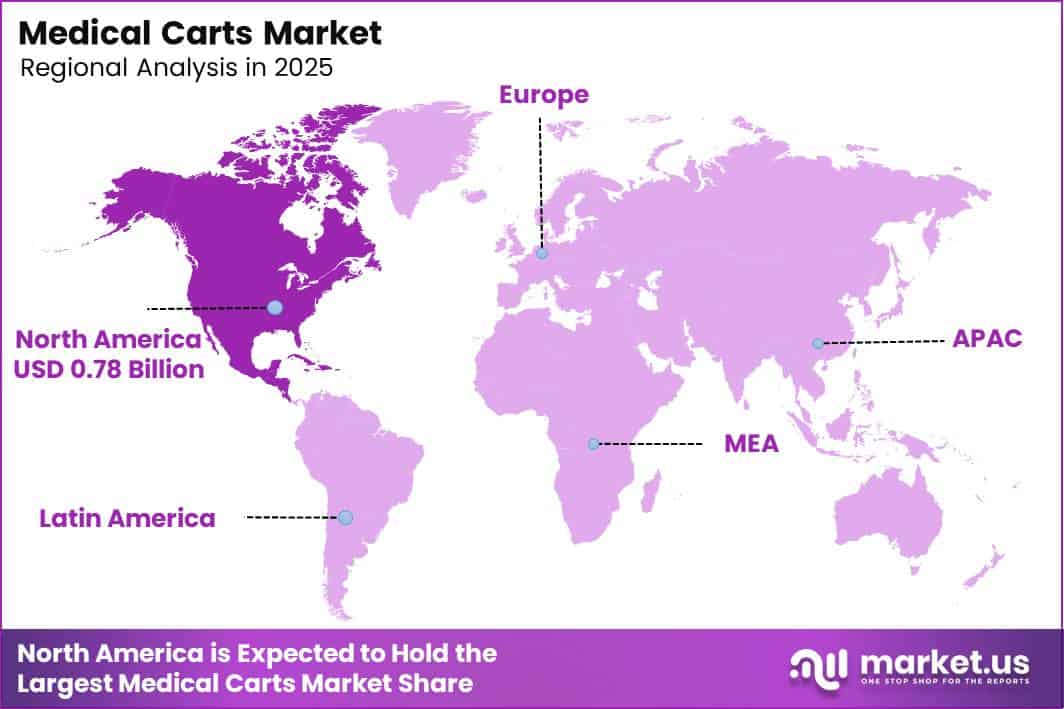
Global Medical Carts Market size is expected to be worth around US$ 4.49 Billion by 2035 from US$ 2.11 Billion in 2025, growing at a CAGR of 7.85% during the forecast period from 2026 to 2035. In 2025, North America led the market, achieving over 37.30% share with a revenue of US$ 0.78 Billion.
The global medical carts market is experiencing steady growth as healthcare systems continue investing in digital care delivery, patient safety, and efficient clinical workflows.
Medical carts have become essential in hospitals, outpatient clinics, emergency departments, and long-term care facilities, enabling healthcare professionals to access electronic health records, administer medications, and transport medical equipment directly to the point of care. Rising adoption of electronic medical record (EMR) systems and mobile healthcare technologies is further supporting demand for advanced mobile workstations.
According to the World Health Organization (WHO), digital health technologies are playing an increasingly important role in strengthening health systems, improving care quality, and expanding access to healthcare services. Governments across several countries are also investing in healthcare digitalization to improve efficiency and patient outcomes.
Meanwhile, the U.S. Centers for Medicare & Medicaid Services (CMS) continues to encourage interoperability and electronic health information exchange, driving greater utilization of mobile computing solutions in clinical settings.
Numerical indicators also highlight the need for healthcare infrastructure that supports mobile medical equipment. The WHO estimates that by 2030, 1 in 6 people worldwide will be aged 60 years or older, increasing demand for hospital admissions, chronic disease management, and long-term care services.
Additionally, the Centers for Disease Control and Prevention (CDC) reports that 6 in 10 adults in the United States live with at least one chronic disease, while 4 in 10 have two or more chronic conditions. These trends are increasing the need for efficient bedside care, medication management, and mobile clinical documentation, all of which support wider adoption of medical carts across modern healthcare facilities.
Key Takeaways
- Market Size : Global Medical Carts Market size is expected to be worth around US$ 4.49 Billion by 2035 from US$ 2.11 Billion in 2025.
- Market Share : The market is growing at a CAGR of 7.85% during the forecast period from 2026 to 2035.
- Product Type Analysis : The Mobile Computing Carts / Workstations on Wheels segment dominated the global medical carts market in 2025, accounting for 40.30% of the total market share.
- Modality Analysis : The Powered / Electric Carts segment held the largest share of the medical carts market in 2025, representing 69.30% of the global market.
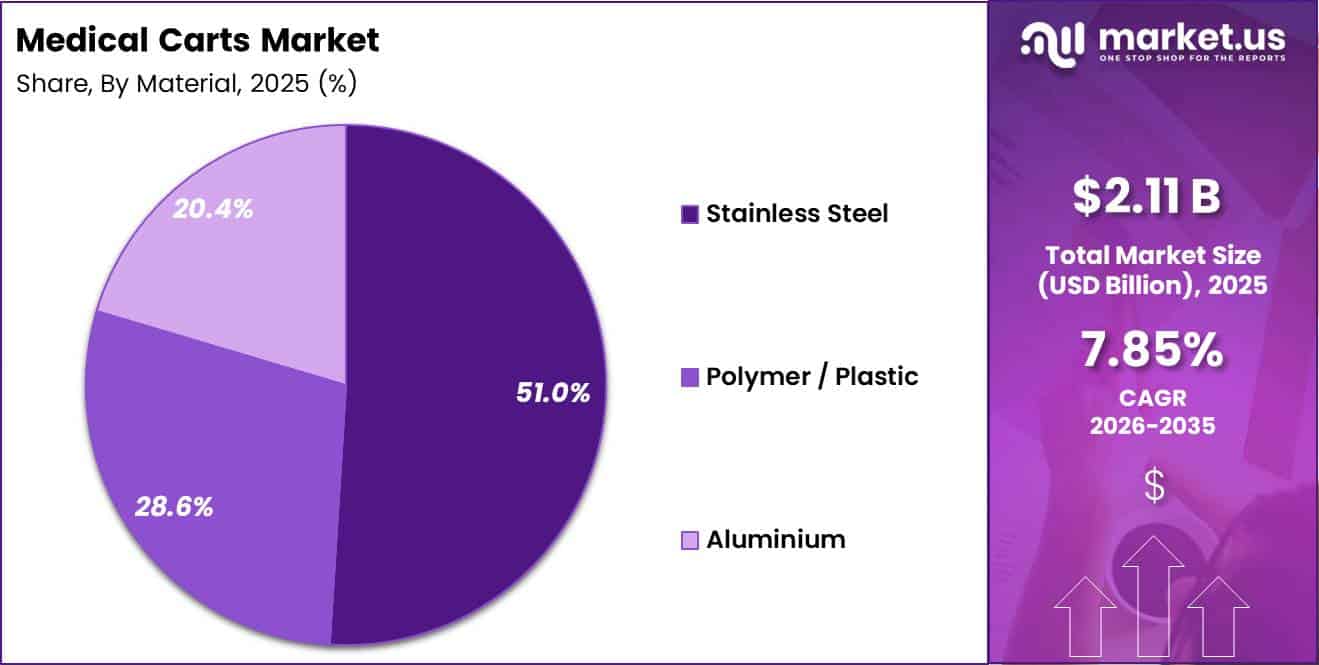
- Material Analysis : The Stainless Steel segment dominated the global medical carts market in 2025, capturing 51.00% of the market share.
- End User Analysis : The Hospitals & Clinics segment accounted for the largest share of the medical carts market in 2025, representing 55.70% of total revenue.
- Regional Analysis : In 2025, North America led the market, achieving over 37.30% share with a revenue of US$ 0.78 Billion.
Product Type Analysis
The Mobile Computing Carts / Workstations on Wheels segment dominated the global medical carts market in 2025, accounting for 40.30% of the total market share. The segment leads because hospitals and healthcare facilities are increasingly adopting mobile digital workflows that allow clinicians to access electronic health records (EHRs), update patient information, perform barcode medication administration, and communicate in real time at the bedside.
Powered workstations equipped with batteries, scanners, and computing devices help improve clinical efficiency while reducing documentation errors and unnecessary staff movement. Healthcare providers also prefer these carts because they support flexible point-of-care services and enhance patient engagement.
Emergency/Code Carts remain essential for rapid emergency response, offering organized storage for life-saving equipment and medications. Medication Carts continue to gain demand due to increased focus on secure drug dispensing and medication safety.
Anesthesia Carts are widely used in operating rooms, providing dedicated storage for anesthesia supplies and monitoring equipment. Procedure Carts support surgical suites, diagnostic centers, and treatment rooms by improving instrument organization and workflow efficiency.
The Others category includes isolation carts, phlebotomy carts, treatment carts, and specialty carts designed for specific clinical applications.
Growing hospital modernization, increasing healthcare digitalization, and rising emphasis on workflow optimization continue to drive demand across all product categories, while mobile computing carts remain the preferred choice because of their versatility and integration with healthcare IT systems.
Modality Analysis
The Powered / Electric Carts segment held the largest share of the medical carts market in 2025, representing 69.30% of the global market. These carts are widely preferred because they provide continuous onboard power for computers, monitors, barcode scanners, printers, and other clinical devices used throughout long hospital shifts.
Powered carts allow healthcare professionals to access patient records, administer medications, and document care without returning to fixed workstations. Their long battery life, mobility, and compatibility with electronic health record systems significantly improve workflow efficiency and patient care while reducing staff fatigue.
As hospitals continue investing in digital healthcare infrastructure, powered workstations remain the primary choice for point-of-care computing.
Non-powered Carts continue to play an important role, particularly in departments where electronic equipment is not required. These carts are lighter, require less maintenance, and have lower operating costs, making them suitable for transporting medical supplies, instruments, and medications.
They are commonly used in outpatient clinics, nursing homes, laboratories, and support departments. While they lack integrated power systems, their durability, ease of movement, and cost-effectiveness make them valuable for many routine healthcare tasks.
Growing investments in healthcare infrastructure continue to support demand for both modalities, although powered carts are expected to maintain market leadership due to increasing digitalization across hospitals and clinical facilities.
Material Analysis
The Stainless Steel segment dominated the global medical carts market in 2025, capturing 51.00% of the market share. Stainless steel remains the preferred material because of its exceptional durability, corrosion resistance, high load-bearing capacity, and ease of cleaning.
Healthcare facilities value stainless steel carts for their ability to withstand frequent disinfection while supporting strict infection prevention protocols. These carts are widely used in operating rooms, emergency departments, intensive care units, and sterile environments where long-term performance and hygiene are essential. Their resistance to chemicals and repeated sterilization also makes them suitable for demanding clinical applications.
Polymer/Plastic carts are gaining popularity because they are lightweight, easy to maneuver, and resistant to dents and corrosion. Many modern polymer carts include antimicrobial surfaces that support infection control while reducing overall equipment weight.
Aluminum carts are also widely adopted for applications requiring lightweight construction combined with structural strength. Aluminum offers excellent portability and durability while reducing caregiver effort during transportation.
Manufacturers increasingly combine different materials to improve ergonomics, mobility, and durability according to specific healthcare applications. Despite the growing use of lightweight alternatives, stainless steel continues to dominate because of its superior durability, long service life, and strong performance in high-use hospital environments.
End User Analysis
The Hospitals & Clinics segment accounted for the largest share of the medical carts market in 2025, representing 55.70% of total revenue. Hospitals remain the largest users because they require a wide variety of medical carts for medication delivery, emergency response, patient monitoring, anesthesia, and mobile computing.
The increasing adoption of electronic health records, barcode medication administration, and bedside documentation has significantly increased demand for advanced medical workstations and powered carts.
Large patient volumes, continuous emergency care, and ongoing investments in healthcare infrastructure further support the segment’s leadership. Hospitals also prioritize ergonomic and customizable carts that improve caregiver productivity while enhancing patient safety.
Diagnostic Centers increasingly utilize specialized carts for imaging equipment, laboratory testing, and specimen collection. Ambulatory Surgical Centers continue expanding their use of anesthesia carts, procedure carts, and medication carts as outpatient surgeries increase globally.
Nursing Homes and Long-term Care Facilities rely on medication carts and mobile workstations to improve resident care and medication management while supporting caregivers during daily operations. The Others segment includes physician offices, rehabilitation centers, specialty clinics, and home healthcare providers that use customized carts based on clinical requirements.
Increasing healthcare digitalization, rising patient admissions, and expanding outpatient services continue to support demand across all end-user segments, with hospitals and clinics maintaining their dominant market position.
Market Segmentations
By Product Type
- Mobile Computing Carts / Workstations on Wheels
- Emergency / Code Carts
- Medication Carts
- Anesthesia Carts
- Procedure Carts
- Others
By Modality
- Powered / Electric Carts
- Non-powered Carts
By Material
- Stainless Steel
- Polymer / Plastic
- Aluminum
By End Use
- Hospitals & Clinics
- Diagnostic Centers
- Ambulatory Surgical Centers
- Nursing Homes / Long-term Care
- Others
Drivers
Point-of-care digitization and cyber-ready mobile workstations
Medical carts are gaining demand because care documentation, medication administration, and bedside verification increasingly happen at the point of care rather than at fixed nursing stations, which raises the value of carts that integrate power systems, device mounts, lockable drawers, scanners, and cleanable surfaces.
The FDA’s June 27, 2025 final cybersecurity guidance elevated cybersecurity from a design preference to a lifecycle expectation for connected medical devices, including requirements tied to secure design documentation, SBOM discipline, updateability, and vulnerability management, which indirectly favors newer cart platforms designed to host managed displays, thin clients, powered hubs, and networked peripherals rather than legacy passive trolleys.
In parallel, U.S. hospitals still face a meaningful digital workflow burden while infection surveillance and medication traceability remain intense operational priorities on any given day about 1 in 31 hospital patients has at least one healthcare-associated infection, reinforcing bedside scanning and real-time workflow execution.
The commercial effect is a mix shift from low-ASP non-powered carts to higher-ASP powered computing carts and medication carts, often with battery subsystems, cable management, and authentication accessories, lifting revenue faster than unit growth and supporting roughly +2.1 % points of CAGR upside in 2026-based forecasting.
| Driver | (~) % Impact on CAGR Forecast | Geographic Relevance | Impact Timeline |
|---|---|---|---|
| Point-of-care digitization and cyber-ready mobile workstations | +2.1% | North America core, EU tertiary hospitals, APAC private hospital clusters | Short term |
| Hospital-at-home and decentralized acute care expansion | +1.6% | U.S. core, Canada selective, Western Europe pilots, APAC urban spill-over | Medium term |
| Nursing productivity pressure and ergonomic workflow redesign | +1.9% | North America, EU, Japan, South Korea, Gulf hospitals | Short term |
| Infection control, medication safety, and HAI reduction programs | +1.4% | Global acute-care settings, strongest in U.S. and EU | Short term |
| Higher-acuity specialty carts for infusion, emergency, and procedure mobility | +1.3% | North America core, EU, Middle East hospitals, APAC tertiary centers | Medium term |
| Compliance-led refresh toward secure powered carts and traceable accessories | +1.1% | U.S. core, EU regulated markets, developed APAC | Medium term |
Challenges
Capital Spending Limits Medical Cart Modernization and Deployment
Even though medical carts are relatively small‑ticket items compared with imaging or surgical equipment, powered or specialized carts can cost several thousand dollars each and must compete within constrained capital budgets and multi‑year replacement plans, particularly in mid‑size hospitals and emerging markets.
Carts used for point‑of‑care documentation, medication delivery, and isolation care typically require replacement or major refurbishment every 7–10 years due to wear on surfaces, casters, and power systems, yet budget cycles often defer upgrades, leading to extended use of aging fleets and incremental maintenance spend of 10–20% of the original purchase value per year in later life.
While digitalization of healthcare and EHR adoption push clear demand for computing carts, funding must still be balanced against investments in other devices and infrastructure; this trade‑off can reduce the pace of new cart installations by 10–20% relative to technical potential, especially in lower‑margin health systems and public hospitals.
Strategically, vendors introduce leasing, service contracts, and modular upgrade paths (e.g., replacing power modules or IT hardware while reusing chassis), reducing annual capital outlay by smoothing expenses over 5–7 years, and hospitals experiment with consolidating cart fleets across departments to improve utilization per device by 15–25%.
These financial and lifecycle constraints do not halt sales but temper expansion, plausibly trimming CAGR by about 1.0 % point versus unconstrained capital scenarios until procurement norms fully adapt to viewing carts as long‑term digital infrastructure rather than discretionary supplies.
| Challenge | (~) % CAGR Friction Drag | Geographic Relevance | Mitigation Horizon |
|---|---|---|---|
| Multi-standard compliance load | -1.4% | North America, EU, advanced Asia | Medium term (2–4 years) |
| Infection-control design complexity | -1.2% | Global acute care hubs | Long term (≥ 4 years) |
| Ergonomics & musculoskeletal risk | -0.9% | North America core, EU, ANZ | Medium term (2–4 years) |
| Digital integration & IT security | -1.5% | North America core, EU digital hubs, APAC modern | Long term (≥ 4 years) |
| Capital budgeting & lifecycle costs | -1.0% | Global, more acute in emerging markets | Short–Medium (≤ 4 years) |
| Supply chain & materials volatility | -1.1% | Global, APAC logistics corridors | Medium term (2–4 years) |
Restraints
Raw Material Cost Volatility Pressures Medical Cart Market Growth
Volatility in core inputs stainless and mild steel, aluminum extrusions, engineered plastics, and high‑performance caster systems is acting as a structural brake on the medical carts market by compressing gross margins and forcing list price escalations that outpace hospital budget growth.
U.S. Bureau of Labor Statistics data show that steel mill product indices rose more than 150% between mid‑2020 and late‑2021 before partially normalizing, while stainless steel prices in mid‑2026 in Northeast Asia and Europe remain elevated, at around 1.7–2.7 USD/kg, even after mid‑single‑digit % declines year‑on‑year.
In parallel, global caster wheel demand, including healthcare trolleys and carts, is expanding at mid‑single‑ to high‑single‑digit CAGRs, with healthcare‑grade swivel casters representing over 60% of volume in some segments, creating tightness in polyurethane and precision bearing supply that periodically stretches lead times to 10–14 weeks instead of the typical 4–6 weeks.
For cart OEMs with bill‑of‑materials where metals and casters can constitute 35–45% of variable cost, a 20–25% swing in steel and caster prices translates into 300–500 basis points of unmitigated margin risk if not offset by surcharges or redesign, and many providers are resisting more than 5–7% annual price increases on carts given their own cost‑trend pressures.
This cost–price mismatch leads to either double‑digit reductions in unit profitability or to demand elasticity, where hospitals downgrade to simpler models (fewer drawers, no powered lift, basic casters) or consolidate purchasing across facilities, thereby trimming near‑term revenue growth by an estimated 0.9 % points versus a cost‑stable scenario in the 2026–2028 window, especially in EU and North American markets exposed to both energy‑linked metal cost and tariff volatility.
| Restraint | (~) % Impact on CAGR Forecast | Geographic Relevance | Impact Timeline |
|---|---|---|---|
| Deferred hospital CapEx under margin stress | -1.4% | North America core, Western Europe | Short–Medium term |
| Volatile metals, plastics and caster input costs | -0.9% | EU, North America, APAC manufacturing hubs | Short term |
| Medical device supply chain and component fragility | -0.7% | North America, EU, APAC corridors | Short–Medium term |
| Regulatory and ergonomic compliance cost overhang | -0.8% | North America, EU, selected APAC (Japan, Australia) | Medium–Long term |
| Tight equipment financing and higher rates | -0.6% | North America, Europe, emerging APAC | Short–Medium term |
| Labor shortages and workflow digitalization delays | -0.5% | North America, EU, GCC, high-income APAC | Medium term |
Opportunity
Portable Medical Carts Enable Outpatient Care Market Expansion
Off‑campus outpatient facilities and home‑infusion programs, catalyzed by evolving CMS site‑neutral payment policies and OPPS rule changes, create a distinct white space for portable, compliant medical cart solutions that extend beyond the traditional hospital footprint.
CMS has been progressively refining outpatient payment systems and site‑neutral rules, affecting off‑campus provider‑based departments and shifting more services toward ambulatory and physician office settings, which raises operational complexity around medication transport, documentation compliance, and supply chain management.
Today, many of these settings rely on either repurposed hospital carts or ad hoc solutions, leaving a gap for purpose‑built carts with integrated labeling, secure transport modules for infusible drugs, and embedded digital documentation interfaces that align with OPPS reporting and billing requirements.
Assuming that outpatient and home‑infusion services grow high single‑digit rates annually in North America and Europe through 2035, and that specialized carts capture 20–30% of procedural rooms and mobile infusion units by 2032, vendors could unlock an incremental TAM of roughly USD 1–1.5 billion, with each cart supporting 10–20 procedures per week and enabling compliance workflows that reduce documentation errors by 20–30%.
These carts can support new monetization models leasing arrangements tied to procedure volumes, integrated billing‑workflow software add‑ons, and service contracts based on adherence to CMS coding and OPPS documentation standards improving vendor margins and reducing provider administrative burden.
Because mainstream cart forecasts primarily reflect inpatient hospital demand and generic outpatient usage, capturing this off‑campus and home‑infusion white space is an incremental growth lever; if executed within the next 2–4 years as payment rules mature, it could add about 1 % point of CAGR upside over the baseline through 2035.
| Opportunity | (~) % Potential CAGR Upside | Geographic Relevance | Execution Window |
|---|---|---|---|
| AI-ready smart carts for workflow automation | +2.0% | North America, EU, APAC tier-1 | Medium term (2-4 years) |
| Chronic disease & diabetes management carts | +1.5% | North America, Middle East, APAC emerging | Medium term (2-4 years) |
| Long-term care & ageing-focused cart platforms | +1.3% | Europe, Japan, China, Latin America | Long term (≥ 4 years) |
| Off-campus outpatient & home-infusion cart models | +1.0% | North America, EU | Short–Medium term (≤ 4 years) |
| Data-monetization and compliance-as-a-service on carts | +0.8% | North America, EU, selective APAC | Medium term (2-4 years) |
Regional Analysis
North America dominated the global medical carts market in 2025, accounting for over 37.30% of the total market and generating approximately US$ 0.78 billion in revenue. The region’s leadership is supported by its well-developed healthcare infrastructure, widespread adoption of electronic health records (EHRs), and strong investment in digital healthcare technologies.
Hospitals and healthcare providers across the United States and Canada continue to modernize clinical workflows by deploying mobile workstations and medication carts that improve efficiency, patient safety, and bedside care. The growing prevalence of chronic diseases, an aging population, and increasing demand for point-of-care services are further driving product adoption throughout the region.
In addition, continuous investments in hospital upgrades and healthcare IT systems encourage healthcare facilities to replace conventional carts with advanced, ergonomically designed models equipped with battery-powered computing systems.
Europe represents another significant market, supported by government initiatives promoting healthcare modernization and the expansion of outpatient care services. Countries such as Germany, the United Kingdom, and France are investing in digital hospitals and connected healthcare infrastructure, creating opportunities for advanced medical carts.
The Asia-Pacific region is expected to witness the fastest growth during the forecast period. Rapid healthcare infrastructure development, rising hospital construction, expanding healthcare expenditure, and increasing adoption of digital health technologies in countries including China, India, Japan, and South Korea are contributing to market expansion.
Meanwhile, Latin America and the Middle East & Africa are gradually adopting modern medical equipment as healthcare accessibility and investments continue to improve.
Key Regions and Countries
North America
- The US
- Canada
Europe
- Germany
- France
- The U.K.
- Italy
- Spain
- Russia & CIS
- Rest of Europe
Asia Pacific
- China
- India
- Japan
- South Korea
- ASEAN
- Australia & New Zealand
- Rest of Asia Pacific
Middle East & Africa
- GCC
- South Africa
- Rest of Middle East & Africa
Latin America
- Brazil
- Mexico
- Rest of Latin America
Key Player Analysis
The global medical carts market is moderately competitive, with leading companies focusing on product innovation, mobility, and ergonomic design to meet the changing needs of healthcare providers. Ergotron Inc. is recognized for its ergonomic medical workstations and powered carts that support electronic health record (EHR) access and improve caregiver productivity.
Enovis Corporation strengthens its healthcare portfolio by offering clinical mobility solutions designed to enhance workflow efficiency. Capsa Healthcare and Harloff Medical Products provide a broad range of medication carts, emergency carts, and mobile computing solutions that help hospitals improve patient care and medication management.
Medline Industries LP leverages its extensive healthcare distribution network to supply durable medical carts and storage systems to hospitals and clinics worldwide. Tryten Technologies specializes in customizable medical cart solutions that integrate medical devices and computing equipment for point-of-care applications.
AFC Industries Inc. focuses on flexible and technology-enabled carts for healthcare environments, supporting digital healthcare adoption. Parity Medical Inc. offers specialized medical storage and transport solutions designed to improve clinical organization and operational efficiency.
Collectively, these companies continue investing in product development, ergonomic features, infection control, and integrated technology, helping healthcare facilities enhance workflow efficiency, caregiver comfort, and overall patient care.
Top Key Players
- Ergotron Inc. (Nortek Global HVAC)
- Enovis Corporation (Colfax)
- Harloff Medical Products
- Capsa Healthcare
- Medline Industries LP
- Tryten Technologies
- AFC Industries Inc.
- Parity Medical Inc.
- JACO Inc.
- Waterloo Healthcare
- Advantech Co. Ltd.
- Scott-Clark Medical
Recent Developments
- In June 2026: Capsa Healthcare acquired The Harloff Company (United States), expanding its portfolio of medication carts, emergency carts, clinical storage systems, and healthcare mobility solutions serving hospitals, ambulatory surgery centers, and long-term care facilities.
- In April 2026: Medline Industries LP announced a strategic partnership with the Symbotic to deploy AI-powered warehouse automation across its U.S. distribution network, improving healthcare product availability and supply chain resilience.
- In March 2026: Ergotron Inc. introduced enhanced Mosaic™ Smart Medical Workstations and RhythmConnect™ fleet management software at HIMSS 2026 in Las Vegas, enabling centralized management of powered medical cart fleets, software updates, and cybersecurity monitoring.
- In August 2025: Capsa Healthcare acquired BlueBin, a U.S.-based provider of RFID- and Kanban-enabled inventory management solutions. The acquisition expanded Capsa’s healthcare workflow portfolio by integrating BlueBin’s inventory technology with its medication management and medical cart solutions.
Report Scope
| Report Features | Description |
|---|---|
| Market Value (2025) | US$ 2.11 Billion |
| Forecast Revenue (2035) | US$ 4.49 Billion |
| CAGR (2026-2035) | 7.85% |
| Base Year for Estimation | 2025 |
| Historic Period | 2020-2024 |
| Forecast Period | 2026-2035 |
| Report Coverage | Revenue Forecast, Market Dynamics, Competitive Landscape, Recent Developments |
| Segments Covered | By Product Type (Mobile Computing Carts / Workstations on Wheels, Emergency / Code Carts, Medication Carts, Anesthesia Carts, Procedure Carts, Others), By Modality (Powered / Electric Carts, Non-powered Carts), By Material (Stainless Steel, Polymer / Plastic, Aluminum), By End Use (Hospitals & Clinics, Diagnostic Centers, Ambulatory Surgical Centers, Nursing Homes / Long-term Care, Others) |
| Regional Analysis | North America – The US, Canada; Europe – Germany, France, U.K., Italy, Spain, Russia & CIS, Rest of Europe; Asia Pacific – China, India, Japan, South Korea, ASEAN, Australia & New Zealand, Rest of Asia Pacific; Middle East & Africa – GCC, South Africa, Rest of Middle East & Africa; Latin America – Brazil, Mexico, Rest of Latin America |
| Competitive Landscape | Ergotron Inc. (Nortek Global HVAC), Enovis Corporation (Colfax), Harloff Medical Products, Capsa Healthcare, Medline Industries LP, Tryten Technologies, AFC Industries Inc., Parity Medical Inc., JACO Inc., Waterloo Healthcare, Advantech Co. Ltd., Scott-Clark Medical |
| Customization Scope | Customization for segments, region/country-level will be provided. Moreover, additional customization can be done based on the requirements. |
| Purchase Options | We have three licenses to opt for: Single User License, Multi-User License (Up to 5 Users), Corporate Use License (Unlimited User and Printable PDF) |





































