Report Overview
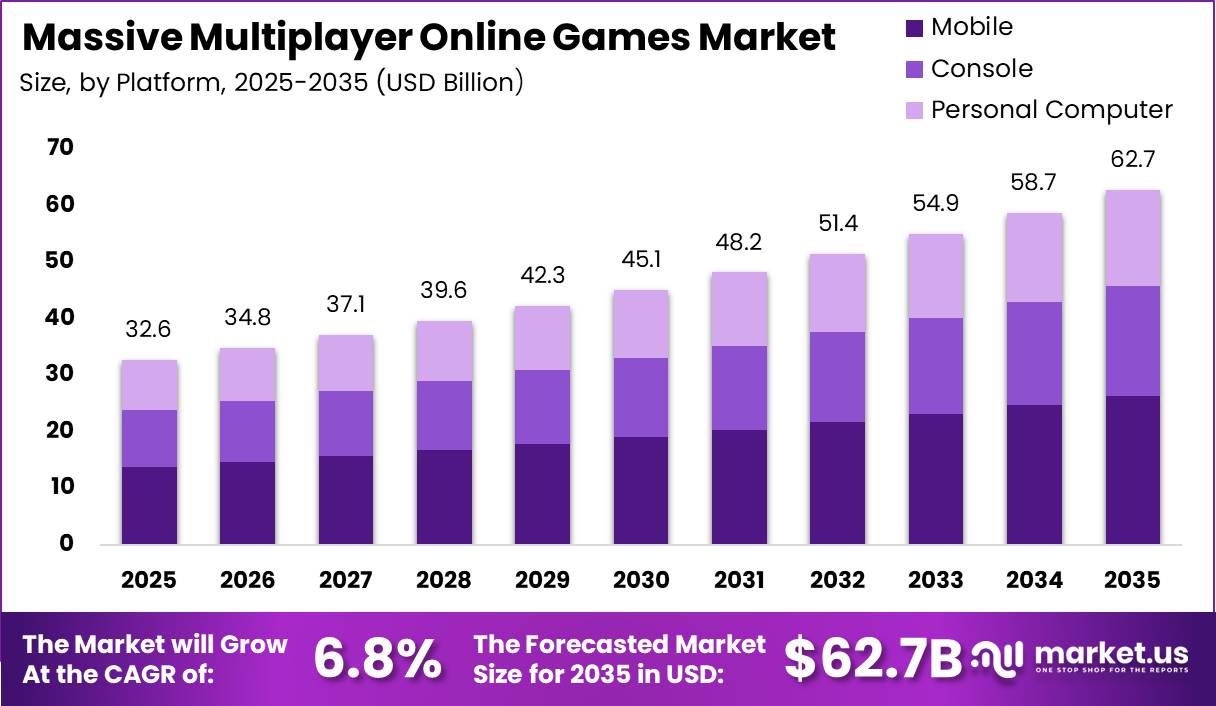
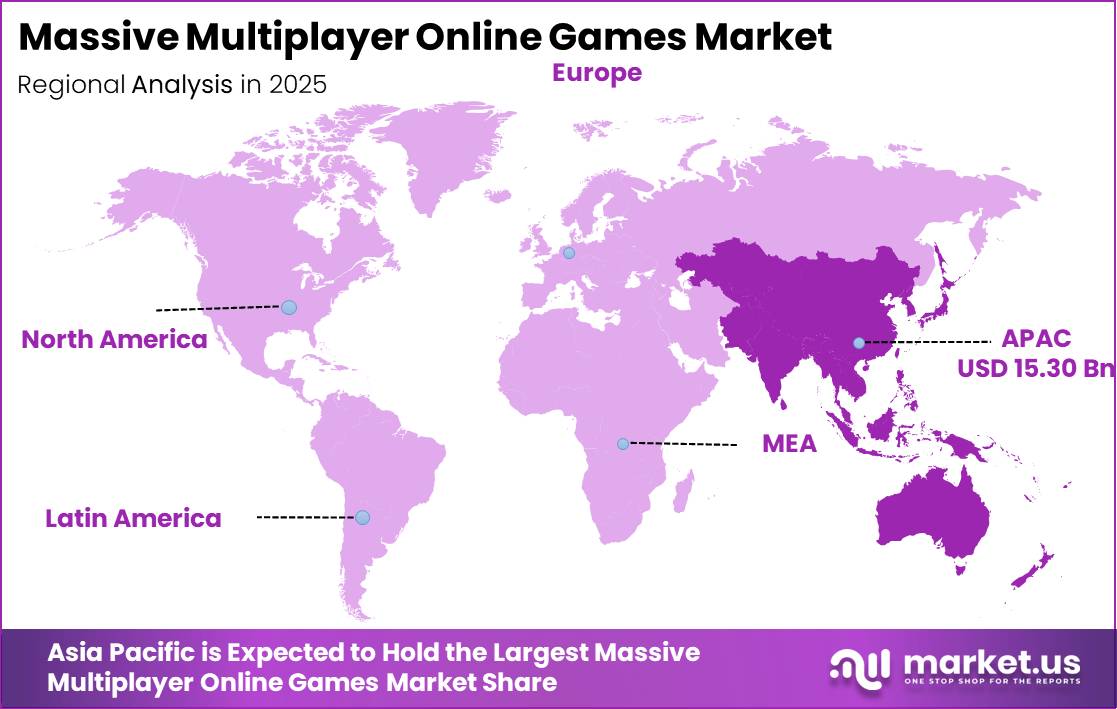
In 2025, the Global Massive Multiplayer Online (MMO) Games Market was valued at USD 32.6 billion. The market is projected to grow at a CAGR of 6.8% during 2026–2035, reaching approximately USD 62.7 billion by 2035. Asia-Pacific dominated the global market in 2025, accounting for more than 46.9% of the total market share and generating approximately USD 15.3 billion in revenue.
Market growth is supported by the steady rise in internet users and better network infrastructure worldwide. According to the International Telecommunication Union (ITU), around 6 billion people, or 74% of the global population, were using the internet in 2025, compared with 5.8 billion in 2024.
A larger online population gives MMO publishers access to more potential players, while improved broadband and mobile connectivity help increase game participation, playing time, and spending on in-game purchases. Rising internet access, increasing disposable income, and growing interest in multiplayer games continue to support player engagement, in-game purchases, and demand for new MMO content, helping sustain long-term market growth.
According to the 2025 China Game Industry Annual Report, China’s domestic game market reached 350.79 billion yuan (around USD 49.8 billion) in 2025, with 683 million gamers, highlighting the strength of online and mobile gaming. In addition, the Asia-Pacific region has the world’s largest youth population, providing a broad base of active online gamers.
Key Takeaway
- The global Massive Multiplayer Online Games (MMOG) market was valued at USD 32.6 billion in 2025 and is projected to reach USD 62.7 billion by 2035.
- The market is expected to expand at a 6.8% CAGR during the forecast period from 2026 to 2035.
- By Type, Role-Playing Games (RPGs) dominated the global Massive Multiplayer Online Games market, accounting for 37.4% of the total market in 2025.
- By Platform, Mobile emerged as the leading segment, capturing 42.1% of the global market in 2025.
- By Business Model, Free-to-Play (F2P) held the largest share, representing 61.7% of the global market in 2025.
- By Gameplay Mode, Player-versus-Player (PvP) accounted for the highest market share at 43.2% in 2025.
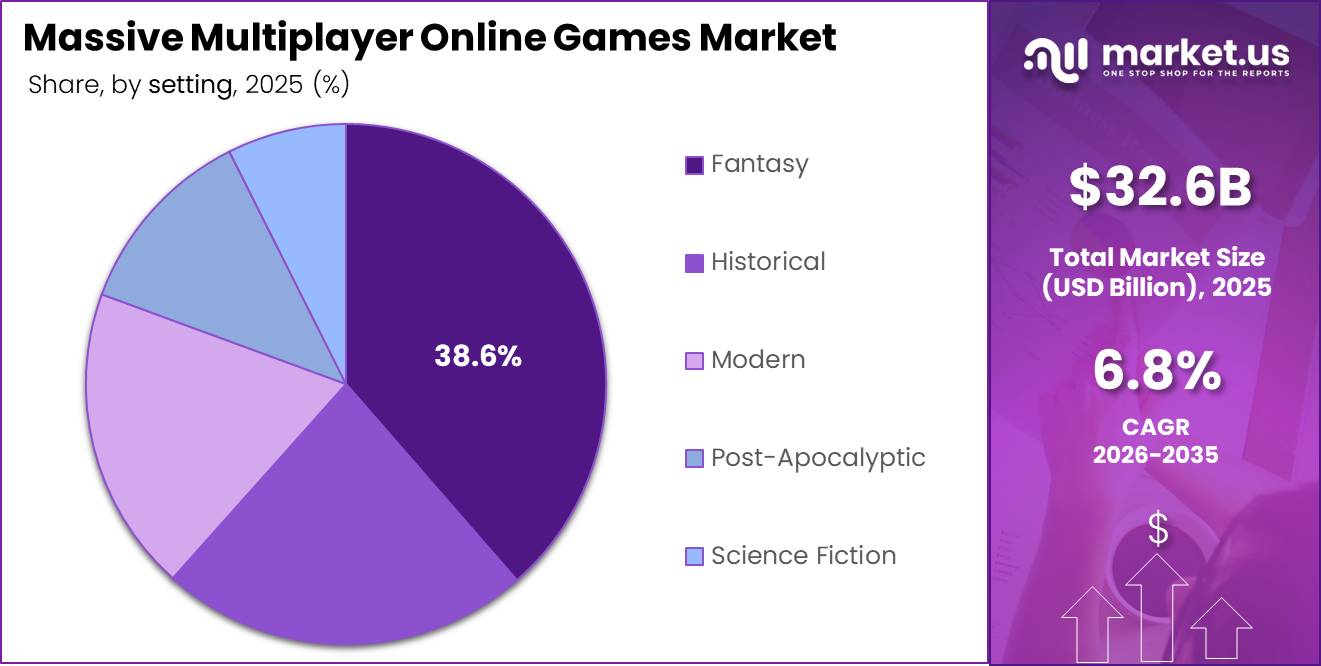
- By Setting, Fantasy led the market with a 38.6% share, making it the largest segment in 2025.
- Asia-Pacific dominated the global Massive Multiplayer Online Games market, accounting for 46.9% of the total market and reaching a value of approximately USD 15.3 billion in 2025.
By Type
Role-Playing Games (RPGs) held the largest share of the global Massive Multiplayer Online (MMO) Games Market, accounting for 37.4% in 2025, while First-Person Shooter (FPS) games are expected to register the fastest growth during the forecast period. RPG MMOs lead the market because they encourage long-term player engagement through character progression, open-world exploration, guilds, and story-based gameplay.
These features increase player retention and create recurring revenue through subscriptions, expansion packs, and in-game purchases. As global internet access continues to expand and the online gaming population grows, developers continue to invest in RPG titles that generate higher lifetime player value through regular content updates and community-driven experiences.
By Platform
The Mobile Platform segment, with a 42.1% share of MMO game revenues, is the clear demand and usage leader among all platforms. This dominance is structurally driven by the sheer scale of global mobile connectivity and smartphone penetration, which makes mobile the default access point for always‑on multiplayer experiences.
High mobile‑cellular and mobile‑broadband subscription densities translate directly into a larger reachable player base, longer daily engagement windows, and more frequent session starts, all of which are critical to MMO business models that rely on real‑time interaction and persistent worlds.
Economically, free‑to‑play mobile MMOs leverage app stores for frictionless distribution, while in‑app purchases, battle passes, and live‑ops events convert a fraction of a very large user base into recurring revenue streams at attractive margins. Combined with low entry hardware costs relative to consoles or gaming PCs, this ecosystem ensures that new MMO launches increasingly prioritize mobile‑first design, reinforcing and expanding the segment’s revenue share over time.
By Business Model
Free-to-play (F2P) massively multiplayer online games, holding a 61.7% share of the MMO market by business model, dominate because they unite low-friction user acquisition with flexible, recurring monetization. By eliminating upfront purchase costs and usually keeping hardware and subscription requirements modest, F2P MMOs attract a much broader base of players than premium or subscription titles can.
Once inside these persistent online worlds, users are monetized through optional microtransactions such as cosmetic items, progression accelerators, season passes, and content packs, which map revenue directly to engagement intensity and playtime. This converts MMOs from one-off products into long-duration services where lifetime value is driven by ongoing participation, social ties, and competitive progression instead of a single purchasing decision.
By Gameplay Mode
Player-versus-Player (PvP) gameplay modes command a dominant 43.2% share of the MMO games market because they are directly aligned with the prize-pool economics and engagement mechanics of modern esports. PvP-focused franchises such as Counter-Strike, Dota 2, League of Legends, Valorant and PUBG Mobile regularly headline global tournament circuits, with individual flagship events offering prize pools from 1 million to nearly 5 million USD and a broader field of tournaments above the 10,000 USD threshold across the year.
In 2025, esports tournaments collectively awarded more than 270 million USD in prize money, the vast majority attached to PvP titles whose core mechanics mirror MMO PvP systems: team-based competition, ranked ladders, and spectator-friendly combat. These economics matter for MMO publishers: high-visibility PvP ecosystems intensify player retention, drive demand for cosmetics and battle passes, and justify ongoing investment in servers and anti-cheat infrastructure.
As global internet penetration approaches 71–75% of the world’s population, real-time matchmaking becomes ubiquitous, structurally favoring PvP modes over purely cooperative gameplay and cementing their leading share in MMO revenues.
By Setting
The Fantasy settings segment accounts for approximately 38.6% of the massive multiplayer online games (MMO) market, making it the leading environment choice for global players and monetization. Fantasy-themed MMORPGs and MMOs sit at the intersection of the fastest‑growing role‑playing genre and the broader expansion of online gaming, which generated around USD 187.7 billion in 2023 and reached 3.4 billion players worldwide.
Fantasy provides a uniquely rich canvas for progression systems, character customization, and virtual economies, all of which are central to MMO revenue models such as subscriptions, free‑to‑play microtransactions, and season passes. Persistent fantasy worlds are also over‑represented within the MMORPG subsegment, which is forecast to grow at double‑digit CAGRs and already contributes tens of billions of dollars in annual revenues.
Key Market Segments
By Type
- Role-Playing Game
- First-Person Shooter
- Action-Adventure
- Simulation
- Strategy
By Platform
- Mobile
- Console
- Personal Computer
By Business Model
- Free-to-Play (F2P)
- Subscription-Based
- Hybrid
By Gameplay Mode
- Player-versus-Environment (PvE)
- Player-versus-Player (PvP)
- Cooperative Multiplayer
By Setting
- Fantasy
- Historical
- Modern
- Post-Apocalyptic
- Science Fiction
Market Dynamics
Challenge
The MMO industry faces a persistent shortage of experienced technical talent despite widespread layoffs across the gaming sector. Since 2022, more than 45,000 jobs have been eliminated globally, including about 14,600 in 2024 and another 3,475 to 5,300 through 2025. At the same time, the 2026 GDC survey found that 28% of over 2,300 respondents had been laid off in the previous two years, rising to 33% in the United States, with two-thirds of layoffs occurring at AAA studios.
The challenge is driven by a shortage of senior engineers with expertise in distributed systems, multiplayer networking, and AI-enabled game design rather than a lack of developers overall. Industry confidence is also weakening, with 74% of game development students expressing concerns about long-term career prospects, while experienced professionals are moving to other technology sectors offering 15 to 25% higher salaries.
As a result, studios require 6 to 9 months on average to fill senior multiplayer engineering positions, with hiring and onboarding costs reaching 1.5 to 2.0 times annual salary. Combined with AAA MMO development budgets of USD 150 to 400 million, these talent shortages slow content production and are estimated to reduce MMO market CAGR by about 1.8 percentage points during 2026 to 2031.
| Challenge | (~) % CAGR | Geographic Relevance | Mitigation Horizon |
|---|---|---|---|
| Skilled Talent Structural Deficit | -1.8% | North America core, EU studios, APAC scaling hubs | Long term (≥ 4 years) |
| Live-Service Content Velocity & Churn | -1.5% | Global; acute in North America & EU | Medium term (2–4 years) |
| Server Infrastructure Scalability & Cost Inflation | -1.2% | APAC logistics corridors, North America, EU | Medium term (2–4 years) |
| Evolving Regulatory & Data-Privacy Compliance Friction | -1.1% | EU regulatory hubs, select US states, APAC jurisdictions | Medium term (2–4 years) |
| AI-Augmented Cheating & Cybersecurity Arms Race | -0.9% | China, Eastern Europe, Global online hotspots | Short term (≤ 2 years) |
| Energy & ESG Infrastructure Overhead | -0.6% | Europe, North America data-center corridors | Long term (≥ 4 years) |
Opportunity
The MMO industry remains highly fragmented, with hundreds of mid-sized studios serving player bases of 100,000 to 2,000,000 monthly active users. Many of these studios have proven live service capabilities but remain constrained by limited scale, single game dependence, and weaker financial resources, creating strong opportunities for strategic consolidation.
Acquiring 5 to 10 mid-tier MMO studios at 4 to 7 times EBITDA and integrating them onto shared technology platforms can generate operational cost synergies of 25 to 40% within 18 to 24 months.
A consolidated platform would benefit from shared server infrastructure, payment systems, customer support, and anti-cheat technologies while enabling cross-promotion across game portfolios and reducing reliance on a single title. Executed over a 3 to 7 year period, this strategy offers a scalable path to stronger market position, improved profitability, and diversified recurring revenue.
| Opportunity | (~) % Potential CAGR | Geographic Relevance | Execution Window |
|---|---|---|---|
| UGC Creator Economy Integration In-Game Monetization Platforms | +2.2% | North America core, EU, APAC (JP, KR) | Short term (≤ 2 years) |
| Programmatic In-Game Advertising on MMO Inventory | +1.8% | North America, EU, APAC emerging | Short term (≤ 2 years) |
| India & South/Southeast Asia ARPU Monetization Uplift | +2.5% | India, SEA (ID, VN, PH, MY), MENA | Medium term (2–4 years) |
| Player-Owned Economy 2.0 Sustainable Tokenized Asset Layer | +1.5% | Global (APAC-led, NA secondary) | Medium term (2–4 years) |
| Silver Demographic Acquisition —45+ MMO Vertical | +1.2% | North America, EU (DE, UK, FR) | Medium term (2–4 years) |
| M&A Roll-Up of Fragmented Mid-Tier MMO Studios | +2.0% | North America, EU, KR/JP | Long term (≥ 4 years) |
Driver
The integration of large language models (LLMs), reinforcement learning, and procedural content generation is reshaping MMO development by enabling more dynamic gameplay and reducing content creation costs. More than 50% of game studios were using generative AI in production by 2025, up from 11% in 2022.
AI-powered NPCs with persistent memory and adaptive behavior are improving player engagement through dynamic storylines and evolving game worlds. The NPC intelligence segment is expected to attract more than USD 3.2 billion in investment between 2025 and 2028, while studies involving over 100 participants have shown measurable improvements in player enjoyment and creative freedom.
This shift allows MMO publishers to move away from fixed content release schedules toward AI-assisted live world generation, lowering development costs while increasing player lifetime value. Venture capital investment in AI gaming startups reached about USD 1.4 billion in 2025, and by 2026 persistent NPC memory and autonomous AI systems are becoming standard components of next-generation MMO game design.
| Driver | (~) % Impact on CAGR | Geographic Relevance | Impact Timeline |
|---|---|---|---|
| AI-Driven NPC & Generative Content Integration LLM-powered NPCs and procedural world-building redefining player engagement and session duration | +1.8% | North America core; EU; APAC (Japan, South Korea, China) | Short–Medium term (1–3 years) |
| Mobile-First Expansion & 5G Infrastructure Rollout Smartphone-native MMOs and sub-20ms 5G edge latency unlocking new user cohorts | +2.2% | APAC corridors (SEA, India, China); South Asia spill-over; LATAM emerging | Short term (≤ 2 years) |
| Live-Service & Subscription Monetization Evolution Shift from perpetual purchase/F2P to battle pass + subscription hybrid models driving predictable ARPUs | +1.5% | North America primary; EU secondary; APAC (premium segment) | Medium term (2–4 years) |
| Cloud Gaming & Edge Computing Infrastructure Scale-Up Serverless rendering and edge node deployment dissolving hardware barriers | +1.6% | North America; EU; APAC urban corridors; India Tier-1 cities | Medium term (2–4 years) |
| Esports Ecosystem & Streaming Platform Flywheel Competitive MMO formats, live streaming viewership, and creator-driven user acquisition reinforcing organic growth loops | +1.2% | North America; EU; South Korea; Southeast Asia | Short–Medium term (1–3 years) |
| Regulatory Formalization & Emerging Market Onboarding India’s Online Gaming Act 2025, EU Digital Fairness Act, and loot box frameworks standardizing market entry | +0.9% | India (South Asia); EU; Germany; Southeast Asia regulatory corridor | Medium–Long term (2–5 years) |
Restraint
MMORPGs are highly dependent on cloud infrastructure for player traffic, game updates, and multi-region server operations, making rising cloud service costs a significant profitability challenge. Public cloud data transfer charges remain around USD 0.09 per GB for outbound traffic, with inter-region transfers typically costing USD 0.01 to 0.02 per GB, while live service development platforms have also introduced usage-based pricing for bandwidth and build distribution.
Large MMO updates often involve multi-gigabyte patches and heavy global traffic, meaning games with 200,000 to 500,000 active players can accumulate six-figure annual bandwidth and content delivery costs. Frequent updates for anti-cheat systems, game assets, and localization further increase operating expenses.
These rising infrastructure costs reduce profit margins, slow content release schedules, encourage content vaulting, and delay server expansion into new regions. Collectively, they are estimated to reduce MMO market CAGR by about 1.2 percentage points over the near term.
| Restraint | (~) % Impact on CAGR | Geographic Relevance | Impact Timeline |
|---|---|---|---|
| Compliance cost inflation | -1.4% | EU, India, UK-linked markets | Short term (≤ 2 years) |
| Live-ops cloud cost pressure | -1.2% | North America core, EU, APAC hubs | Short term (≤ 2 years) |
| Hardware access ceiling | -1.1% | APAC corridors, LATAM, CEE, budget EU | Medium term (2-4 years) |
| Dev labor disruption | -1.0% | North America core, EU studios, Japan, Korea | Short term (≤ 2 years) |
| Engine and toolchain monetization | -0.8% | Global, indie-to-midcore clusters | Medium term (2-4 years) |
| Moderation and trust-safety burden | -0.7% | EU, North America, MENA, India | Medium term (2-4 years) |
Geopolitical Impact Analysis
Rising geopolitical tensions, particularly between the United States and China, are increasing costs across the MMO games ecosystem. Higher U.S. tariffs on many Chinese products in 2025 have raised the cost of key hardware components such as printed circuit boards, cooling systems, server chassis, and other equipment used in gaming devices and data centers.
China has tightened export controls on critical minerals, including rare earth elements, gallium, and germanium, which are essential for manufacturing GPUs, semiconductors, and other gaming hardware. Rising prices for rare earth metals and cobalt are also adding to production costs for gaming peripherals, consoles, and server equipment.
Global shipping disruptions have further increased supply chain costs. Security issues in the Red Sea and reduced traffic through the Suez Canal have forced longer shipping routes, extending delivery times and raising freight rates for hardware transported from Asia to North America and Europe.
These higher logistics costs directly affect gaming hardware suppliers and cloud infrastructure providers that support MMO games. In addition, growing energy demand from data centers is increasing operating expenses as MMO games rely on large-scale server infrastructure for real-time gameplay.
Regional Analysis
Asia-Pacific is the largest and fastest-growing region in the global Massively Multiplayer Online (MMO) Games Market, accounting for 46.9% of the market with a value of USD 15.3 billion in 2025. The region’s leadership is driven by its large gaming population, expanding internet access, strong mobile ecosystem, and continuous investment in digital entertainment.
Asia has more than 1.5 billion gamers, making it the world’s biggest gaming market and creating a strong demand for MMO games across both PC and mobile platforms. China remains the largest contributor to regional revenue due to its huge player base, advanced digital payment systems, and well-established esports industry.
Japan and South Korea further strengthen the market through high-speed internet, experienced game developers, and a long-standing preference for MMORPGs and other online multiplayer games.
Key Regions and Countries
- North America
- US
- Canada
- Europe
- Germany
- France
- The UK
- Spain
- Italy
- Rest of Europe
- Asia Pacific
- China
- Japan
- South Korea
- India
- Australia
- Rest of APAC
- Latin America
- Brazil
- Mexico
- Rest of Latin America
- Middle East & Africa
- GCC
- South Africa
- Rest of MEA
Key Players Analysis
The global Massive Multiplayer Online (MMO) games market is moderately concentrated, with a few major publishers controlling a significant share of global revenue, key game franchises, and live-service infrastructure. Mobile gaming and free-to-play business models generate the largest share of market revenue, while Asia, particularly China and South Korea, remains the largest player and revenue base.
Tencent Holdings and Microsoft are the leading Tier 1 companies, together accounting for an estimated 25% to 30% of global MMO and live service gaming revenue. Tencent reported total revenue of RMB 751.8 billion (approximately USD 109 billion) in FY2025, with gaming revenue exceeding RMB 200 billion, supported by franchises such as Honor of Kings and League of Legends.
Microsoft generated more than USD 23.5 billion in gaming revenue in FY2025 following the Activision Blizzard acquisition, strengthening its position through World of Warcraft, Xbox, and Game Pass. NetEase is a strong Tier 1 challenger, generating mid-teens billion U.S. dollars in gaming revenue and holding a high single-digit share of the MMO market through titles such as Marvel Rivals and Where Winds Meet.
Nexon and NCSoft are Tier 2 challengers, each generating low single-digit billion U.S. dollars in annual revenue while maintaining loyal player communities through franchises such as Dungeon Fighter Online, MapleStory, Lineage, and Aion.
Top Key Players in the Market
- Activision Blizzard Inc.
- Aeria Games
- Amazon Game Studios
- Bright Star Studios
- CCP Games UK Ltd
- Daybreak Game Company
- Electronic Arts Inc.
- Giant Interactive Group Inc.
- Gravity Corporation
- Jagex Limited
- NCSOFT Corporation
- Netease Games Inc.
- Nexon Co. Ltd
- Tencent Holdings Limited
- Ubisoft Entertainment SA
- Others
Recent Developments
- In October 2025, Amazon Game Studios announced that its MMORPG New World will receive no further new content updates from 2026 onward, with Season 10 and the Nighthaven update serving as the final major content release. Servers will remain operational through 2026, with at least six months’ advance notice before any eventual shutdown.
- In March 2026, NCSoft’s board approved a USD 202 million investment to acquire a 70% stake in Berlin-based mobile gaming and rewards platform JustPlay. The company operates more than 40 internally developed casual titles and generated USD 172.8 million in revenue and USD 19.1 million in operating profit during 2025.
Report Scope
| Report Features | Description |
|---|---|
| Market Value (2025) | USD 32.6 Billion |
| Forecast Revenue (2035) | USD 62.7 Billion |
| CAGR (2026-2035) | 6.8% |
| Base Year for Estimation | 2025 |
| Historic Period | 2020-2024 |
| Forecast Period | 2026-2035 |
| Report Coverage | Revenue Forecast, Market Dynamics, Competitive Landscape, Recent Developments |
| Segments Covered | By Type (Role-Playing Game, First-Person Shooter, Action-Adventure, Simulation, Strategy), By Platform (Mobile, Console, Personal Computer), By Business Model (Free-to-Play (F2P), Subscription-Based, Hybrid), By Gameplay Mode (Player-versus-Environment (PvE), Player-versus-Player (PvP), Cooperative Multiplayer), By Setting (Fantasy, Historical, Modern, Post-Apocalyptic, Science Fiction) |
| Regional Analysis | North America – US, Canada; Europe – Germany, France, The UK, Spain, Italy, Rest of Europe; Asia Pacific – China, Japan, South Korea, India, Australia, Singapore, Rest of APAC; Latin America – Brazil, Mexico, Rest of Latin America; Middle East & Africa – GCC, South Africa, Rest of MEA |
| Competitive Landscape | Activision Blizzard Inc., Aeria Games, Amazon Game Studios, Bright Star Studios, CCP Games UK Ltd., Daybreak Game Company, Electronic Arts Inc., Giant Interactive Group Inc., Gravity Corporation, Jagex Limited, NCSoft Corporation, NetEase Games Inc., Nexon Co., Ltd., Tencent Holdings Limited, Ubisoft Entertainment SA, Others |
| Customization Scope | Customization for segments and region/country-level will be provided. Moreover, additional customization can be done based on the requirements. |
| Purchase Options | We have three licenses to opt for: Single User License, Multi-User License (Up to 5 Users), Corporate Use License (Unlimited Users and Printable PDF) |