Report Overview
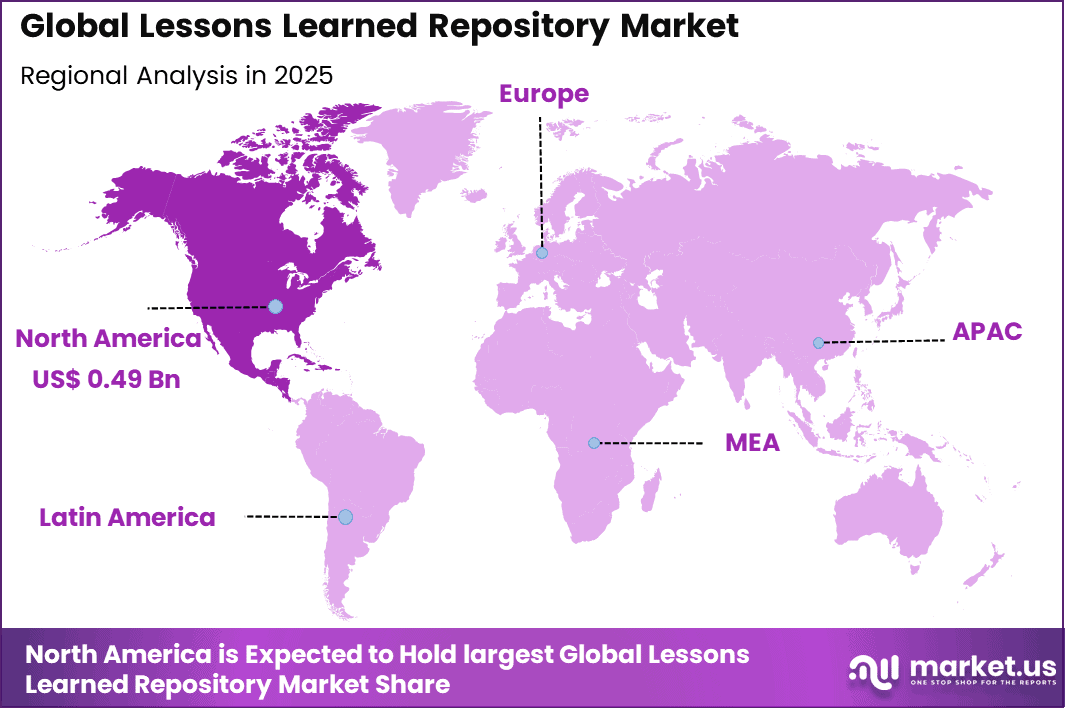
The Global Lessons Learned Repository Market generated USD 1.3 billion in 2025 and is projected to grow from USD 1.5 billion in 2026 to about USD 4.4 billion by 2035, recording a CAGR of 12.8% over the forecast period. In 2025, North America held a dominant market position, capturing more than a 38.1% share and generating USD 0.49 billion in revenue.
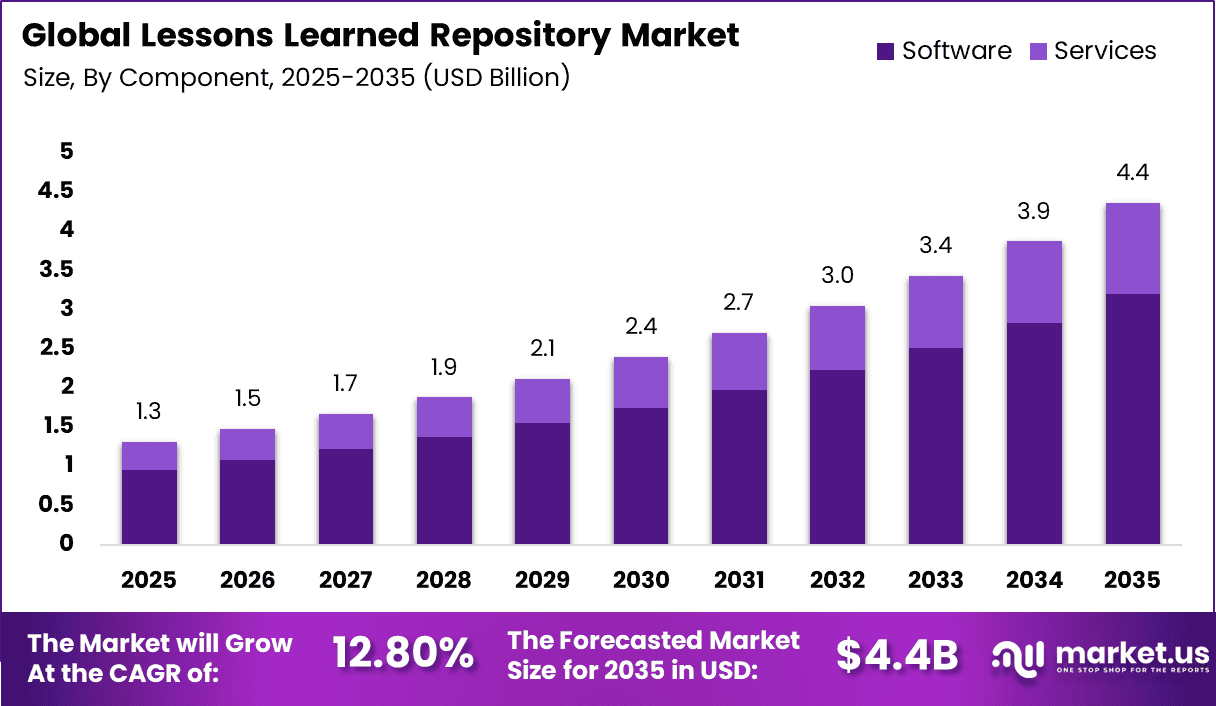
Lessons Learned Repository refers to a structured system used by organizations to capture and store insights gained from completed projects, operational activities, and business processes. These repositories allow teams to document practical experiences, identify what worked well, and record challenges encountered during project execution.
Lessons learned repositories help capture this knowledge and make it available for future teams. The growing complexity of large projects in sectors such as engineering, technology, and construction also encourages organizations to systematically document project outcomes and operational insights. Demand for lessons learned repositories is increasing as organizations recognize the value of experience-based knowledge in improving project outcomes.
Top Market Takeaways
- By Component, software dominates with a 73.2% share, enabling structured capture, semantic tagging, and AI-powered retrieval of post-project insights across enterprise ecosystems.
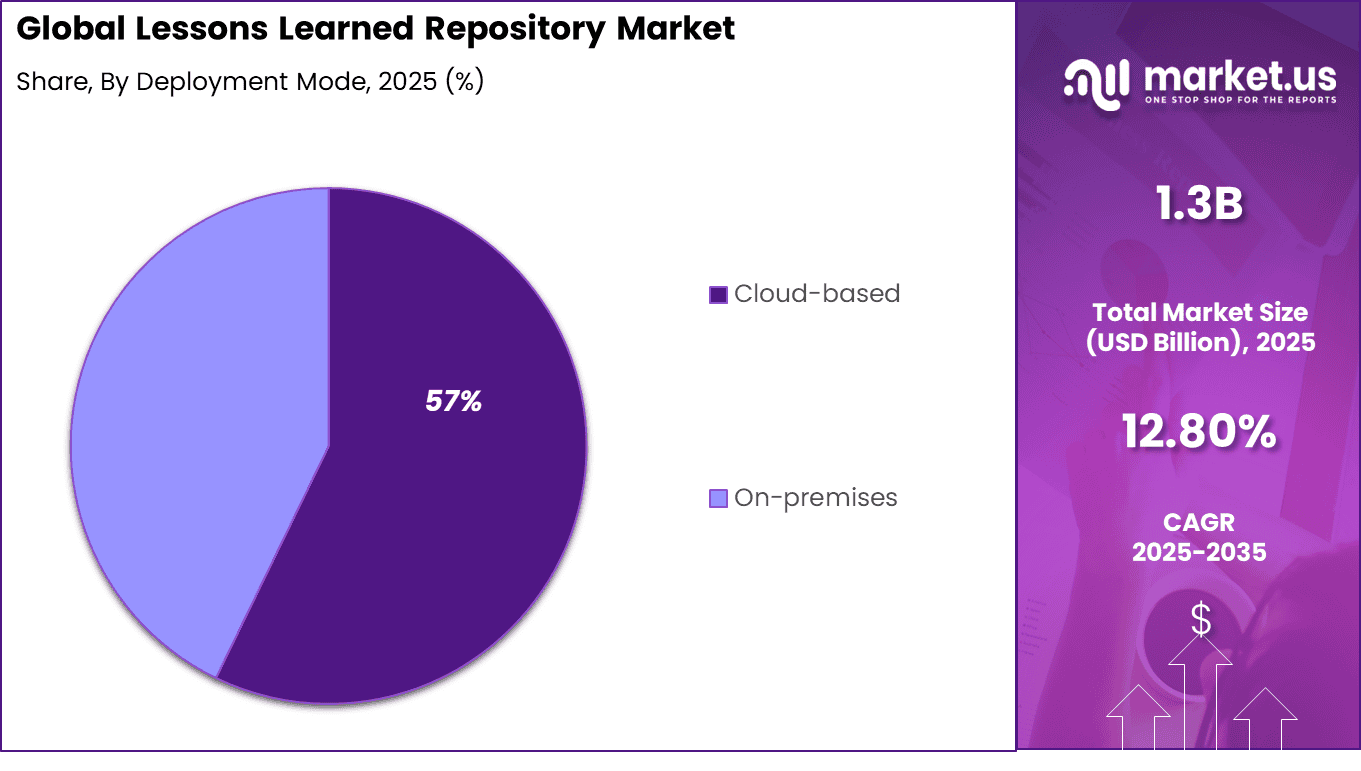
- By Deployment Mode, cloud-based captures 57.2%, delivering collaborative wikis, version-controlled lessons, and federated search spanning global teams and contractors.
- By Organization Size, large enterprises hold 66.3%, orchestrating PMO-governed repositories with mandatory closeout workflows and executive dashboards.
- By Application, project management leads at 40.5%, streamlining retrospective analysis, risk transfer, and continuous improvement cycles.
- By End-User, IT & telecom commands 24.1%, capturing migration lessons, network upgrade failures, and 5G rollout best practices for accelerated deployments.
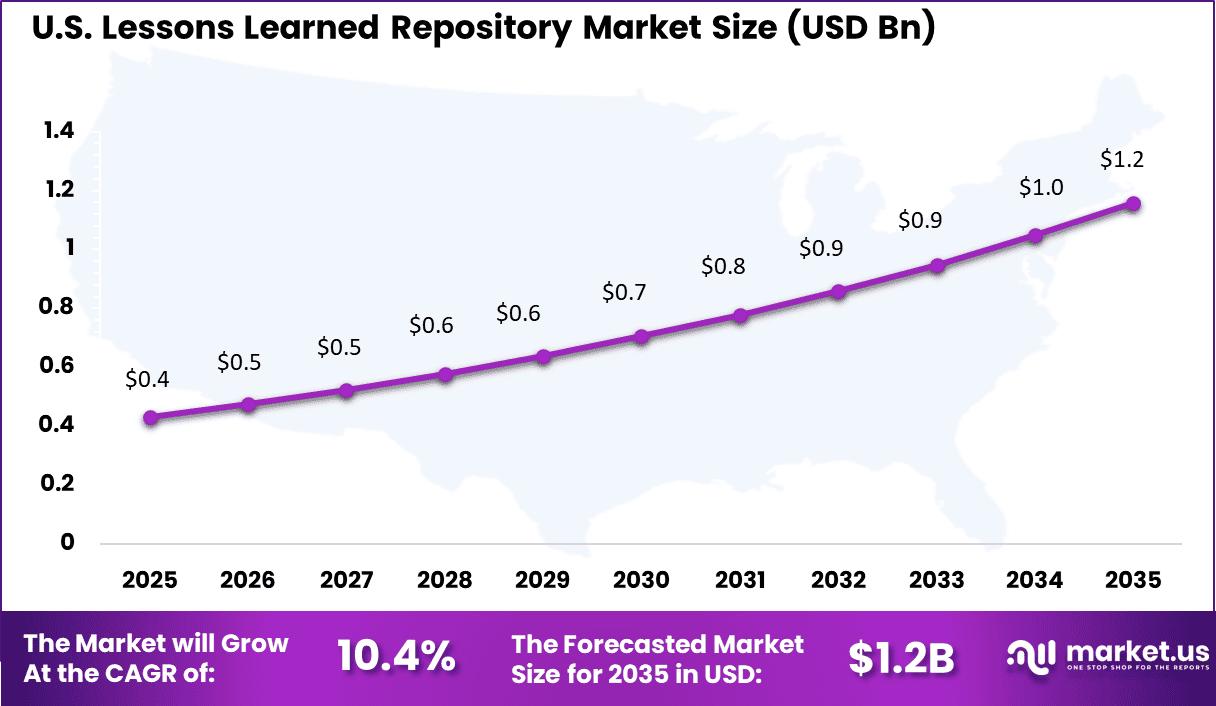
- Regionally, North America accounts for 38.1% global share, with the U.S. market valued at USD 0.43 billion and a CAGR of 10.4%, driven by PMI standards adoption and digital transformation retrospectives.
By Component Analysis
Software held 73.2% of the Lessons Learned Repository Market. Organizations increasingly rely on dedicated software platforms to capture operational knowledge and document project experiences. These tools help teams record important insights, technical observations, and problem-solving methods that support better decision-making in future projects.
The demand for repository software continues to grow as companies aim to preserve institutional knowledge and reduce repeated operational errors. Structured platforms allow employees to easily store and retrieve lessons from previous activities, helping organizations improve workflow efficiency and strengthen long-term knowledge management practices.
By Deployment Mode Analysis
Cloud-based solutions accounted for 57% of the market. Many organizations prefer cloud deployment because it allows employees to access lessons learned repositories from any location. This flexibility supports collaboration among distributed teams and helps companies maintain centralized knowledge storage across different business units.
Cloud platforms also simplify system management and enable faster updates without heavy infrastructure investment. Companies adopting digital transformation strategies increasingly integrate repository systems with cloud collaboration tools, which improves knowledge sharing and supports continuous learning within organizations.
By Organization Size Analysis
Large enterprises represented 66.3% of the Lessons Learned Repository Market. These organizations manage numerous projects across departments, generating large volumes of operational insights that require structured documentation and storage. Lessons learned repositories help enterprises organize this information and make it accessible to different teams.
Enterprises also emphasize knowledge retention to maintain operational stability. When employees transition roles or leave the organization, repository systems help preserve valuable expertise and project knowledge. This supports consistent project execution and reduces the risk of repeating past mistakes.
By Application Analysis
Project management held 40.5% of the market. Project teams use lessons learned repositories to review previous project outcomes and identify strategies that improve planning and execution. Access to past insights helps managers anticipate potential challenges and develop stronger project frameworks.
Organizations also incorporate lessons learned documentation during project closure phases. Capturing key observations from completed initiatives allows companies to refine management practices and improve project performance over time. This approach strengthens organizational learning and enhances project governance.
By End User Analysis
IT and telecom accounted for 24.1% of the market. Companies in this sector frequently manage technology deployments, software development cycles, and network infrastructure projects. Documenting lessons from these activities helps teams improve technical planning and avoid repeating operational challenges.
Continuous innovation in the IT and telecom industry also increases the need for knowledge sharing. Lessons learned repositories allow engineering teams to document technical solutions and operational experiences, helping organizations accelerate problem-solving and improve project execution.
Key Market Segments
By Component
- Software
- Services
By Deployment Mode
- On-Premises
- Cloud-Based
By Organization Size
- Small and Medium Enterprises
- Large Enterprises
By Application
- Project Management
- Knowledge Management
- Risk Management
- Compliance
- Others
By End-User
- IT and Telecom
- Healthcare
- BFSI
- Manufacturing
- Government
- Education
- Others
Regional Analysis
North America accounted for 38.1% of the Lessons Learned Repository Market, reflecting strong adoption of structured knowledge management platforms across enterprises. Organizations across industries increasingly recognize the importance of capturing project insights, operational experiences, and internal best practices in centralized systems.
Large enterprises in sectors such as IT services, consulting, engineering, and government programs continue to implement lessons learned repositories to improve project planning, reduce repeated mistakes, and strengthen institutional knowledge. The growing scale of digital transformation projects across the region further increases the need for systems that store and analyze past project outcomes for better decision-making.
The United States generated about USD 0.43 Bn within the regional market and is projected to expand at a CAGR of 10.4%. Businesses across the country increasingly focus on improving project performance and organizational learning by maintaining structured repositories that document successes and failures from previous initiatives.
Federal agencies, technology companies, and large consulting firms actively integrate lessons learned databases with project management tools to support knowledge sharing across teams. As organizations manage complex digital and infrastructure projects, the demand for platforms that capture and reuse institutional knowledge continues to strengthen across the US market.
Key Regions and Countries
- North America
- US
- Canada
- Europe
- Germany
- France
- The UK
- Spain
- Italy
- Russia
- Netherlands
- Rest of Europe
- Asia Pacific
- China
- Japan
- South Korea
- India
- Australia
- Singapore
- Thailand
- Vietnam
- Rest of APAC
- Latin America
- Brazil
- Mexico
- Rest of Latin America
- Middle East & Africa
- South Africa
- Saudi Arabia
- UAE
- Rest of MEA
Drivers Impact Analysis
| Key Driver | Impact on CAGR Forecast (~%) | Geographic Relevance | Impact Timeline | Strategic Effect |
|---|---|---|---|---|
| Need for knowledge retention | +2.3% | North America, Europe, Asia Pacific | Short to Mid Term (2025–2030) | Improves decision-making and reduces repeat mistakes |
| Digital transformation growth | +2.0% | North America, Asia Pacific | Mid Term (2026–2032) | Supports integration with enterprise management platforms |
| Adoption in government and infrastructure programs | +1.7% | US, Europe, Middle East | Long Term (2027–2035) | Enables documentation of insights from large projects |
| AI-based knowledge management tools | +1.9% | US, China, Europe | Mid to Long Term (2026–2035) | Enhances automation and insight discovery from data |
Restraints Impact Analysis
| Key Restraint | Impact on CAGR Forecast (~%) | Geographic Relevance | Impact Timeline | Strategic Effect |
|---|---|---|---|---|
| Organizational resistance to knowledge sharing culture | -1.6% | Global, particularly traditional industries | Short to Mid Term (2025–2030) | Employees and departments often hesitate to document failures or lessons learned |
| Integration challenges with legacy enterprise systems | -1.3% | North America, Europe | Mid Term (2026–2032) | Older IT infrastructure slows implementation and reduces scalability of repository platforms |
| Data governance and confidentiality concerns | -1.2% | Global, especially regulated sectors | Mid to Long Term (2026–2035) | Sensitive project knowledge requires strict access controls and compliance mechanisms |
| Limited awareness among small and mid-sized organizations | -1.0% | Emerging economies | Short Term (2025–2028) | SMEs prioritize operational tools over structured knowledge management solutions |
Investor Type Impact Analysis
| Investor Type | Growth Sensitivity | Risk Exposure | Geographic Focus | Investment Outlook |
|---|---|---|---|---|
| Venture Capital Firms | Very High | Medium | US, Europe, Israel | Strong startup investment opportunity |
| Private Equity Firms | High | Medium | North America, Europe | Consolidation opportunities in enterprise software |
| Strategic Technology Investors | High | Low to Medium | US, China, South Korea | Platform expansion investments |
| Government and Public Innovation Funds | Medium | Low | Europe, Middle East, Asia Pacific | Public sector digital knowledge programs |
| Corporate Venture Arms (Enterprise Software Firms) | High | Medium | Global | Strategic partnerships and acquisitions |
Technology Enablement Analysis
| Technology Enabler | Impact on CAGR Forecast (~%) | Geographic Relevance | Impact Timeline | Implementation Significance |
|---|---|---|---|---|
| Artificial Intelligence-based knowledge discovery | +2.4% | North America, China, Europe | Mid to Long Term (2026–2035) | Improves insight extraction |
| Cloud-based knowledge management platforms | +2.1% | Global | Short to Mid Term (2025–2030) | Enables scalable repository access |
| Natural language processing and semantic search | +1.8% | US, Europe, Japan | Mid Term (2026–2032) | Improves search accuracy |
| Integration with enterprise collaboration tools | +1.5% | Global | Short to Mid Term (2025–2030) | Increases platform usability |
Key Challenges
- Organizations often face difficulty in collecting practical lessons from employees after project completion because teams quickly move to new tasks and important experiences remain undocumented.
- Employees sometimes hesitate to record mistakes or operational issues in the repository, as they fear criticism or see the process as an additional workload.
- As the repository grows, large volumes of stored information can become difficult to organize and search, which reduces the usefulness of the system during decision-making.
- Integrating a lessons learned repository with existing project management and collaboration platforms can be technically challenging and may require additional system adjustments.
- Maintaining updated and relevant knowledge is difficult because business processes, technologies, and project practices change over time, making older lessons less applicable.
Emerging Trends
Organizations increasingly treat operational knowledge as a strategic asset, which is shaping the evolution of lessons learned repository platforms. Teams across engineering, project management, and service operations now document project experiences in structured digital repositories instead of informal documents or emails. This shift reflects a growing emphasis on knowledge continuity as workforces become more distributed and project cycles become shorter.
Modern repositories also support collaboration by allowing teams to capture insights during project execution rather than only after completion. As organizations seek to prevent repeated mistakes and improve decision-making, the practice of continuously recording and sharing lessons across departments is gaining wider acceptance.
Growth Factors
The expansion of complex projects across sectors such as IT services, infrastructure development, and product engineering is strengthening demand for centralized knowledge management tools. Companies increasingly recognize that capturing practical experiences from completed projects improves planning, risk management, and operational efficiency in future initiatives. Organizations face frequent staff transitions and skill mobility, which creates the need to preserve institutional knowledge.
Lessons learned repositories help maintain continuity by storing valuable insights that new teams can quickly access. The growing culture of data-driven decision-making within enterprises is also encouraging leadership teams to formalize learning processes, which supports steady adoption of repository platforms across large organizations.
Competitive Analysis
The competitive landscape of the Lessons Learned Repository market includes major enterprise technology providers and collaboration software companies. Firms such as IBM Corp., SAP SE, Oracle, Microsoft, and Atlassian provide knowledge management platforms that help organizations store project insights, track past experiences, and improve decision-making. Their solutions often integrate with enterprise software systems, project management tools, and internal collaboration platforms used by large organizations.
Consulting and defense technology companies also play an important role in this market. Organizations such as Wipro, Accenture, CGI, BAE Systems, SAIC, Northrop Grumman, Lockheed Martin, Raytheon Technologies, and Palantir Technologies develop customized knowledge management solutions for government agencies and large enterprises.
Companies like Sopheon and Spigit (Planview) focus on innovation management platforms that support idea sharing and organizational learning. Together, these players support the adoption of structured knowledge repositories across industries.
Top Key Players in the Market
- IBM Corp.
- SAP SE
- Oracle
- Microsoft
- Atlassian
- Sopheon
- Spigit (Planview)
- Wipro
- Capgemini
- Accenture
- CGI
- BAE Systems
- SAIC
- Northrop Grumman
- Lockheed Martin
- Raytheon Technologies
- Palantir Technologies
- Others
Future Outlook
The future outlook for the Lessons Learned Repository Market remains positive as organizations increasingly focus on capturing knowledge from past projects and using it to improve future performance. Businesses are giving more importance to structured knowledge management to reduce repeated errors and support better decision-making.
The wider use of cloud platforms, collaboration tools, and analytics systems is expected to strengthen the adoption of lessons learned repositories across enterprises and government organizations in the coming years.
Recent Developments
- In July 2025, Capgemini acquired WNS for about USD 3.3 billion to strengthen its agentic AI‑powered intelligent operations and business process services, which support enterprise knowledge and lessons‑learned capabilities.
- In August 2025, Wipro acquired HARMAN DTS for around USD 375 million, adding thousands of product‑engineering and AI‑native platform specialists who help build advanced knowledge and lessons‑learned repositories for clients
Report Scope
| Report Features | Description |
|---|---|
| Market Value (2025) | USD 1.3 Billion |
| Forecast Revenue (2035) | USD 4.4 Billion |
| CAGR(2025-2035) | 12.8% |
| Base Year for Estimation | 2024 |
| Historic Period | 2020-2024 |
| Forecast Period | 2025-2035 |
| Report Coverage | Revenue forecast, AI impact on Market trends, Share Insights, Company ranking, competitive landscape, Recent Developments, Market Dynamics and Emerging Trends |
| Segments Covered | By Component (Software, Services), By Deployment Mode (On-Premises, Cloud-Based), By Organization Size (Small and Medium Enterprises, Large Enterprises), By Application (Project Management, Knowledge Management, Risk Management, Compliance, Others), By End-User (IT and Telecom, Healthcare, BFSI, Manufacturing, Government, Education, Others) |
| Regional Analysis | North America – US, Canada; Europe – Germany, France, The UK, Spain, Italy, Russia, Netherlands, Rest of Europe; Asia Pacific – China, Japan, South Korea, India, New Zealand, Singapore, Thailand, Vietnam, Rest of Latin America; Latin America – Brazil, Mexico, Rest of Latin America; Middle East & Africa – South Africa, Saudi Arabia, UAE, Rest of MEA |
| Competitive Landscape | IBM Corp., SAP SE, Oracle, Microsoft, Atlassian, Sopheon, Spigit (Planview), Wipro, Accenture, CGI, BAE Systems, SAIC, Northrop Grumman, Lockheed Martin, Raytheon Technologies, Palantir Technologies, Others |
| Customization Scope | Customization for segments, region/country-level will be provided. Moreover, additional customization can be done based on the requirements. |
| Purchase Options | We have three licenses to opt for: Single User License, Multi-User License (Up to 5 Users), Corporate Use License (Unlimited Users and Printable PDF) |