


Global Integrated Pest Management Pheromones Market Size, Share, And Industry Analysis Report By Product (Sex Pheromones, Aggregation Pheromones, Alarm Pheromones, Others), By Application (Agriculture, Residential, Commercial, Horticulture, Forestry, Storage Facilities, Others), By Mode (Monitoring and Detection, Mating Disruption, Mass Trapping, Others), By Region and Companies - Industry Segment Outlook, Market Assessment, Competition Scenario, Statistics, Trends and Forecast 2025-2034
- Published date: February 2026
- Report ID: 178692
- Number of Pages: 226
- Format:
-
keyboard_arrow_up
Quick Navigation
Report Overview
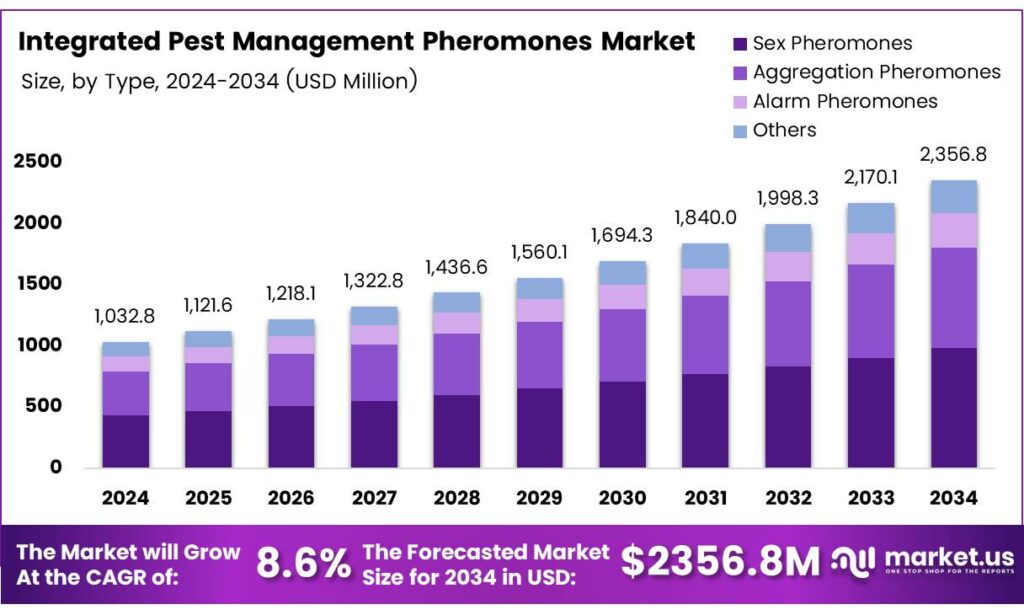
The Global Integrated Pest Management Pheromones Market size is expected to be worth around USD 2,356.8 million by 2034 from USD 1,032.8 million in 2024, growing at a CAGR of 8.6% during the forecast period 2025 to 2034.
The integrated pest management pheromones market covers chemical signaling compounds used to monitor, disrupt, or eliminate insect pest populations. These compounds include sex pheromones, aggregation pheromones, and alarm pheromones. Growers and pest managers deploy them as sustainable alternatives to synthetic insecticides in agriculture, horticulture, and forestry.
Pheromone-based solutions attract strong interest because they target specific pest species without harming beneficial insects or leaving harmful residues. Consequently, food producers and export-focused farms increasingly prefer these tools to meet international market standards. Regulatory agencies across major markets also support their adoption as part of broader integrated pest management frameworks.
- FMC Corporation’s Plant Health category, driven by its pheromones platform, generated revenue of $200.5 million in 2024, up from $186.9 million in 2023. This growth signals rising commercial traction for pheromone-based crop protection within large agrochemical portfolios. It reflects broader market momentum toward biological and low-residue pest management tools.
- Mating disruption using pheromones was applied on approximately 300,000 hectares of vineyards in the European Union. This large-scale adoption confirms that pheromone-based IPM has moved well beyond experimental stages in high-value perennial crops. Such adoption trends strongly support long-term market expansion across global agriculture.
Rising insecticide resistance in key pest species further pushes demand for non-chemical pest management methods. Additionally, the expansion of precision agriculture creates new opportunities for technology-integrated pheromone monitoring platforms. High-value crops such as fruits, vegetables, and specialty grains represent the fastest-growing end-use segments for these solutions.
Key Takeaways
- The Global Integrated Pest Management Pheromones Market is valued at USD 1,032.8 million in 2024 to reach USD 2,356.8 million by 2034, growing at a CAGR of 8.6%.
- Sex pheromones dominate with a 67.9% market share in 2025.
- Agriculture leads with an 81.3% market share in 2025.
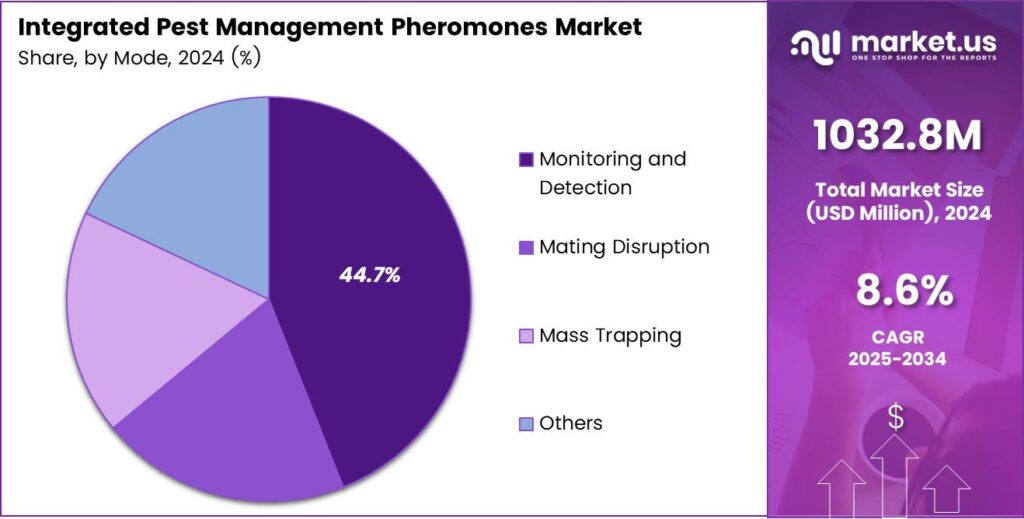
- Monitoring and Detection holds the largest share at 44.7% in 2025.
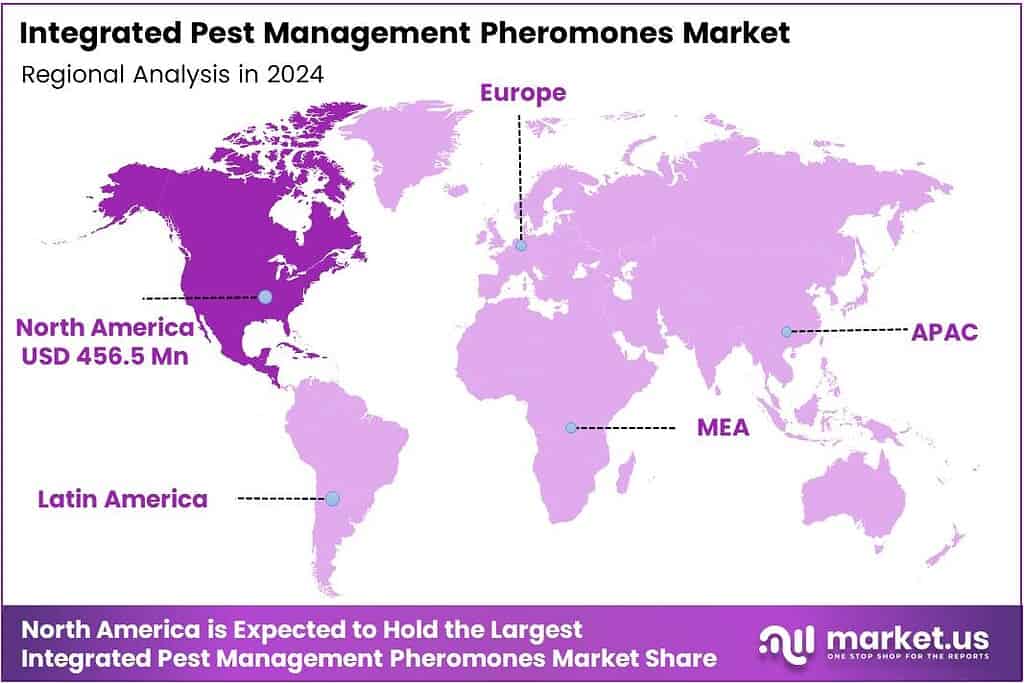
- North America dominates the regional landscape with a 44.2% share, valued at USD 456.5 million.
By Product Analysis
Sex Pheromones dominate with 67.9% due to wide agricultural application in mating disruption and pest monitoring.
In 2025, Sex Pheromones held a dominant market position in the By Product segment of the Integrated Pest Management Pheromones Market, with a 67.9% share. Sex pheromones attract pests to traps or disrupt mating cycles effectively. Their species-specific nature makes them highly reliable for targeted pest monitoring and mating disruption programs across agriculture and horticulture globally.
Aggregation Pheromones capture a meaningful secondary share within the product segment. These compounds attract insects of both sexes toward a single trap or bait station, enabling mass trapping strategies. Pest managers apply aggregation pheromones most commonly in storage facilities and forestry, where concentrated pest pressure demands rapid, scalable population control tools.
Alarm Pheromones represent an emerging product category with growing research interest. These chemical signals trigger dispersal or defensive behavior in pest colonies, offering a novel pest deterrence mechanism. Additionally, the Others sub-segment includes blended and multi-species semiochemical formulations that researchers and companies develop to address complex multi-pest infestation scenarios in modern farming systems.
By Application Analysis
Agriculture dominates with 81.3% due to the large-scale adoption of IPM programs in row and specialty crops.
In 2025, Agriculture held a dominant market position in the By Application segment of the Integrated Pest Management Pheromones Market, with an 81.3% share. Crop producers across the grain, fruit, and vegetable sectors deploy pheromone traps extensively. Moreover, global food safety regulations push farmers toward residue-free pest management tools, reinforcing agriculture as the core demand driver for pheromone-based solutions.
Horticulture and Residential applications follow as significant secondary segments. Horticulture benefits from pheromone-based mating disruption in orchards and vineyards where chemical residues threaten export certifications. The Residential segment grows as homeowners seek non-toxic pest control alternatives. Commercial applications also expand as food processing and retail facilities adopt IPM compliance programs.
Forestry and Storage Facilities represent high-potential niche applications within the market. Forest managers use pheromone traps to monitor bark beetle populations and prevent large-scale timber damage. Storage facility operators deploy pheromone-based monitoring for grain and food storage pest management. The Others sub-segment covers public health and municipal pest management initiatives globally.
By Mode Analysis
Monitoring and detection dominate with 44.7% due to widespread adoption of trap-based pest surveillance systems.
In 2025, Monitoring and Detection held a dominant market position in the By Mode segment of the Integrated Pest Management Pheromones Market, with a 44.7% share. Farmers and pest managers use pheromone traps to track pest population levels before deciding on treatment actions. This data-driven approach reduces unnecessary pesticide use and supports cost-efficient, targeted pest management strategies.
Mating Disruption represents the fastest-growing mode within the segment. This technique floods the crop environment with synthetic pheromones, preventing male insects from locating females for reproduction. Consequently, pest populations decline over seasons without chemical intervention. Mating disruption gains particular traction in high-value crops such as vineyards, orchards, and berry farms globally.
Mass Trapping deploys high-density pheromone lure systems to physically capture and remove large pest populations from fields. This mode suits situations where pest pressure is already high, and population knockdown is urgent. The Others sub-segment includes attract-and-kill techniques and push-pull systems that combine pheromones with repellents or toxic baits for integrated management.
Key Market Segments
By Product
- Sex Pheromones
- Aggregation Pheromones
- Alarm Pheromones
- Others
By Application
- Agriculture
- Residential
- Commercial
- Horticulture
- Forestry
- Storage Facilities
- Others
By Mode
- Monitoring and Detection
- Mating Disruption
- Mass Trapping
- Others
Emerging Trends
Controlled-Release Formulations and Digital Trap Networks Reshape the IPM Pheromones Landscape
Encapsulated and controlled-release pheromone formulations gain significant commercial momentum across agricultural markets. These advanced delivery systems regulate the release rate of active compounds over extended periods, reducing reapplication frequency. Moreover, companies develop microencapsulation technologies that maintain pheromone efficacy across varying temperature and humidity conditions in diverse farming environments.
- Wireless, real-time pheromone trap networks transform how growers monitor pest populations at scale. Connected traps transmit catch data directly to farm management software, enabling rapid decision-making. Provivi reached an estimated annual revenue of $42.2 million with total funding of $190 million, reflecting strong investor confidence in next-generation pheromone-based crop protection platforms.
Organic-certified pheromone solutions attract growing interest from regenerative and export-focused farming operations. Researchers also expand semiochemical research beyond insects to address non-insect pest challenges. Additionally, synthetic biology advances enable companies to produce highly specific, low-dose pheromone compounds that minimize environmental footprint while delivering precision pest management outcomes across diverse cropping systems.
Drivers
Shift Toward Eco-Friendly Crop Protection and Precision Pest Monitoring Drives Market Growth
Farmers and agrochemical buyers increasingly shift toward low-residue, species-specific pest control tools. This shift reflects tightening food safety standards in major importing countries and growing consumer preference for pesticide-free produce. Consequently, pheromone-based solutions gain commercial priority as reliable alternatives to broad-spectrum synthetic insecticides in crop protection programs globally.
- Government incentive programs actively encourage the adoption of eco-friendly pest management tools across key agricultural markets. Regulatory bodies in the EU, US, and Asia-Pacific fund farmer training, product registration pathways, and subsidy programs for biological and pheromone-based IPM adoption. Suterra’s parent company, The Wonderful Company, invested more than $100 million in its Oregon facility, supporting pheromone-based mating disruption products used on over 1 million acres of crops, illustrating the scale of private sector commitment.
Rising insecticide resistance across key agricultural pest species creates an urgent need for alternative management tools. Additionally, precision agriculture platforms integrate pheromone trap data into broader farm management systems, expanding the value proposition of these solutions. High-value crop producers in particular accelerate the adoption of pheromone monitoring systems to protect yields and maintain export market certifications.
Restraints
Limited Awareness and Environmental Variability Constrain Pheromone Market Penetration
Limited awareness of advanced pheromone technologies among small and subsistence farmers represents a significant barrier to market growth. Many smallholder growers rely on familiar chemical pesticide routines and lack access to training or technical support for IPM adoption. Therefore, market penetration in developing agricultural regions remains slower than the technology’s potential would suggest.
Inconsistent field performance due to climate and environmental variability poses a persistent challenge for pheromone product manufacturers. Temperature fluctuations, high humidity, and wind patterns affect pheromone dispersion rates and trap efficacy. Consequently, growers in regions with highly variable weather conditions often report unpredictable results, reducing confidence in pheromone-based solutions compared to conventional chemical controls.
High upfront costs of pheromone dispensers, connected trap networks, and technical installation services further limit adoption among cost-sensitive growers. Additionally, the absence of standardized regulatory frameworks for pheromone product registration across multiple national markets slows international expansion. These structural barriers require coordinated efforts from industry players, governments, and agricultural extension services to overcome effectively.
Growth Factors
Post-Harvest Storage Expansion and AI-Enabled Trap Integration Accelerate Market Opportunities
Multi-species pheromone dispensing platforms open new commercial possibilities by addressing several pest species with a single application system. This technological advancement reduces labor costs and simplifies IPM program management for large-scale farming operations. Moreover, companies invest in platform development to create modular dispensing solutions that growers can customize for specific pest pressure profiles on their farms.
- Post-harvest storage management represents an underserved but high-growth application area for pheromone-based tools. Grain storage operators, food processors, and warehouse managers face increasing regulatory pressure to eliminate chemical fumigants from storage environments. Major Brazilian bio-inputs companies collectively generated over BRL 5 billion in annual revenue in 2024, with Koppert do Brasil reaching approximately BRL 900 million, demonstrating the commercial scale that biological IPM solutions now achieve in key markets.
AI-enabled pheromone trap systems integrate machine learning algorithms to analyze pest catch data and generate predictive treatment recommendations. Export-oriented horticulture sectors in Asia, Latin America, and Africa drive demand for sustainable pest control certification pathways. Additionally, regenerative farming movements globally create a new consumer segment that prioritizes pheromone-based IPM tools as core components of chemical-free production systems.
Regional Analysis
North America Dominates the Integrated Pest Management Pheromones Market with a Market Share of 44.2%, Valued at USD 456.5 Million
North America leads the global market with a 44.2% share, valued at USD 456.5 million in 2025. The region benefits from strong regulatory support for biological pest control, advanced agricultural infrastructure, and high adoption rates of precision farming tools. Moreover, large-scale specialty crop producers in the US actively deploy pheromone-based mating disruption and monitoring systems across orchards, vineyards, and row crops.
Europe represents the second-largest market, driven by strict pesticide reduction mandates under the EU Farm to Fork Strategy. Member states actively fund IPM adoption programs, and vineyards across France, Spain, and Italy deploy pheromone mating disruption at a commercial scale. Consequently, European demand for controlled-release and organic-certified pheromone solutions grows steadily across both conventional and organic farming sectors.
Asia Pacific emerges as the fastest-growing regional market, supported by expanding agricultural output in China, India, and Southeast Asia. Government-backed IPM programs in these countries promote pheromone trap adoption in rice, cotton, and vegetable production systems. Additionally, export-driven horticulture sectors in the region increasingly adopt pheromone-based solutions to meet international food safety and residue standards.
Latin America shows strong growth potential, particularly in Brazil and Mexico, where large-scale row crop and tropical fruit production dominates. Brazil’s booming bio-inputs sector, supported by strong investment in biological crop protection, creates favorable conditions for pheromone market expansion. Furthermore, government programs and private sector partnerships accelerate the commercial deployment of pheromone-based IPM tools across the region.
Key Regions and Countries
North America
- US
- Canada
Europe
- Germany
- France
- The UK
- Spain
- Italy
- Rest of Europe
Asia Pacific
- China
- Japan
- South Korea
- India
- Australia
- Rest of APAC
Latin America
- Brazil
- Mexico
- Rest of Latin America
Middle East & Africa
- GCC
- South Africa
- Rest of MEA
Key Players Analysis
Harmony Ecotech Pvt. Ltd. focuses on developing and manufacturing pheromone-based pest management products tailored for the Indian agricultural market. The company supplies a broad range of sex pheromone lures and traps for major crop pests. Harmony Ecotech positions itself as a cost-effective supplier enabling smallholder farmers to access science-backed, non-toxic IPM tools across diverse cropping systems in India.
Rovensa Next operates as a biologicals and biosolutions division committed to advancing sustainable crop protection globally. The company integrates pheromone-based solutions within its broader portfolio of biostimulants and biocontrol products. Rovensa Next builds partnerships with regional distributors to expand market access across European, Latin American, and African agricultural markets, strengthening its position in the integrated pest management pheromones sector.
Syngenta applies its global agrochemical expertise to pheromone-based mating disruption programs across multiple crop categories. The company integrates pheromone solutions within its broader IPM offering, preserving beneficial insects while delivering effective pest population control. In 2025, Syngenta expanded its partnership with Provivi for exclusive distribution in Brazil of a sprayable pheromone formulation targeting Fall Armyworm, strengthening its biological pest management capabilities.
AgriSense-BCS Ltd. specializes in the design and manufacturing of pheromone lures, traps, and monitoring systems for agricultural and stored product pest management. The company serves pest control professionals, agricultural extension services, and research institutions worldwide. AgriSense-BCS delivers species-specific pheromone solutions that support decision-making in integrated pest management programs across diverse geographic and crop environments globally.
Top Key Players in the Market
- Harmony Ecotech Pvt. Ltd.
- Rovensa Next
- Syngenta
- AgriSense-BCS Ltd.
- ATGC
- Russell IPM Ltd
- Semios
- Shin-Etsu Chemical Co., Ltd.
- Bioline Agrosciences Ltd.
- Trécé, Inc.
Recent Developments
- In 2025, Syngenta expanded its partnership with Provivi for exclusive distribution in Brazil of a new-generation sprayable pheromone formulation combining three pheromones for mating disruption of Fall Armyworm in row crops, integrating the solution into species-specific, non-toxic IPM programs that preserve beneficial insects and biodiversity.
- In 2025, ATGC achieved multiple milestones in pheromone and semiochemical technologies for precision IPM, including ultra-low-dose formulations delivering results at grams per acre per month using waterless, residue-free pheromone solutions that reduce chemical sprays, water use, and carbon footprint through synthetic biology and material science innovations.
Report Scope
Report Features Description Market Value (2024) USD 1,032.8 Million Forecast Revenue (2034) USD 2,356.8 Million CAGR (2025-2034) 8.6% Base Year for Estimation 2024 Historic Period 2020-2023 Forecast Period 2025-2034 Report Coverage Revenue Forecast, Market Dynamics, Competitive Landscape, Recent Developments Segments Covered By Product (Sex Pheromones, Aggregation Pheromones, Alarm Pheromones, Others), By Application (Agriculture, Residential, Commercial, Horticulture, Forestry, Storage Facilities, Others), By Mode (Monitoring and Detection, Mating Disruption, Mass Trapping, Others) Regional Analysis North America (US and Canada), Europe (Germany, France, The UK, Spain, Italy, and Rest of Europe), Asia Pacific (China, Japan, South Korea, India, Australia, and Rest of APAC), Latin America (Brazil, Mexico, and Rest of Latin America), Middle East & Africa (GCC, South Africa, and Rest of MEA) Competitive Landscape Harmony Ecotech Pvt. Ltd., Rovensa Next, Syngenta, AgriSense-BCS Ltd., ATGC, Russell IPM Ltd, Semios, Shin-Etsu Chemical Co., Ltd., Bioline Agrosciences Ltd., Trécé, Inc. Customization Scope Customization for segments, region/country-level will be provided. Moreover, additional customization can be done based on the requirements. Purchase Options We have three licenses to opt for: Single User License, Multi-User License (Up to 5 Users), Corporate Use License (Unlimited Users and Printable PDF)  Integrated Pest Management Pheromones MarketPublished date: February 2026add_shopping_cartBuy Now get_appDownload Sample
 -
-
- Harmony Ecotech Pvt. Ltd.
- Rovensa Next
- Syngenta
- AgriSense-BCS Ltd.
- ATGC
- Russell IPM Ltd
- Semios
- Shin-Etsu Chemical Co., Ltd.
- Bioline Agrosciences Ltd.
- Trécé, Inc.
Our Clients

- 178692
- February 2026






