


Report Overview
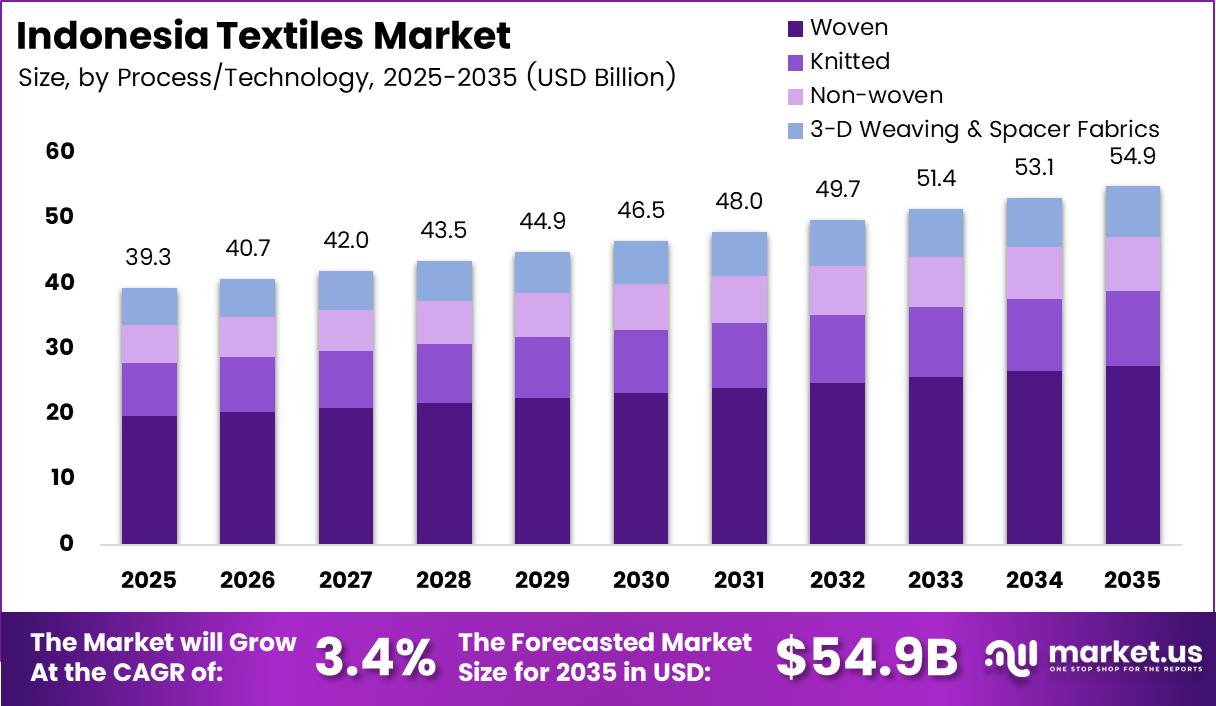
Indonesia Textiles Market size is expected to be worth around USD 54.9 Billion by 2035 from USD 39.3 Billion in 2025, growing at a CAGR of 3.4% during the forecast period 2026 to 2035.
Indonesia’s textile industry holds a structurally important position in Southeast Asia’s manufacturing economy. The country combines abundant labor supply, established export infrastructure, and deep domestic consumption to sustain consistent output across apparel, industrial fabrics, and home textiles. These three pillars together give the market a resilience that few peer economies can replicate at comparable scale.
The fashion and apparel segment anchors demand across the value chain. Domestic retail consumption and international export orders feed into a production system that spans spinning, weaving, dyeing, and garment finishing. This vertical depth means Indonesian manufacturers can capture margin at multiple processing stages, not just at the commodity end.
Government policy actively supports the sector’s expansion. Investment frameworks targeting export diversification and value-added manufacturing have drawn capital into fiber processing and technical textile facilities. In February 2026, Asia Pacific Rayon introduced sustainable lyocell fabric solutions for Indonesia’s batik sector, signaling that premium and traditional textile segments are now attracting product-level innovation from major suppliers.
Natural fiber dominance and synthetic fiber growth are running in parallel. Cotton-based production retains the largest raw material share. However, polyester and recycled fiber adoption is accelerating across export-oriented factories, driven by buyer sustainability requirements from European and North American apparel brands.
According to ARC Group, in Q1 2024, foreign demand for Indonesian textile products by volume rose 7.34% year-on-year, while apparel export volumes increased 3.08% year-on-year. These figures confirm that international buyers were actively expanding order volumes heading into 2025 production cycles, not simply maintaining baseline commitments.
According to Business & Human Rights Resource Centre, Indonesia’s textile industry generates over USD 13 Billion in annual exports and employs over 2.5 million workers. This export volume places Indonesia among Asia’s top-five apparel exporters and signals a manufacturing base large enough to absorb significant capital investment in process upgrades without structural disruption.
Key Takeaways
- The Indonesia Textiles Market is valued at USD 39.3 Billion in 2025 and is forecast to reach USD 54.9 Billion by 2035.
- The market grows at a CAGR of 3.4% during the forecast period 2026 to 2035.
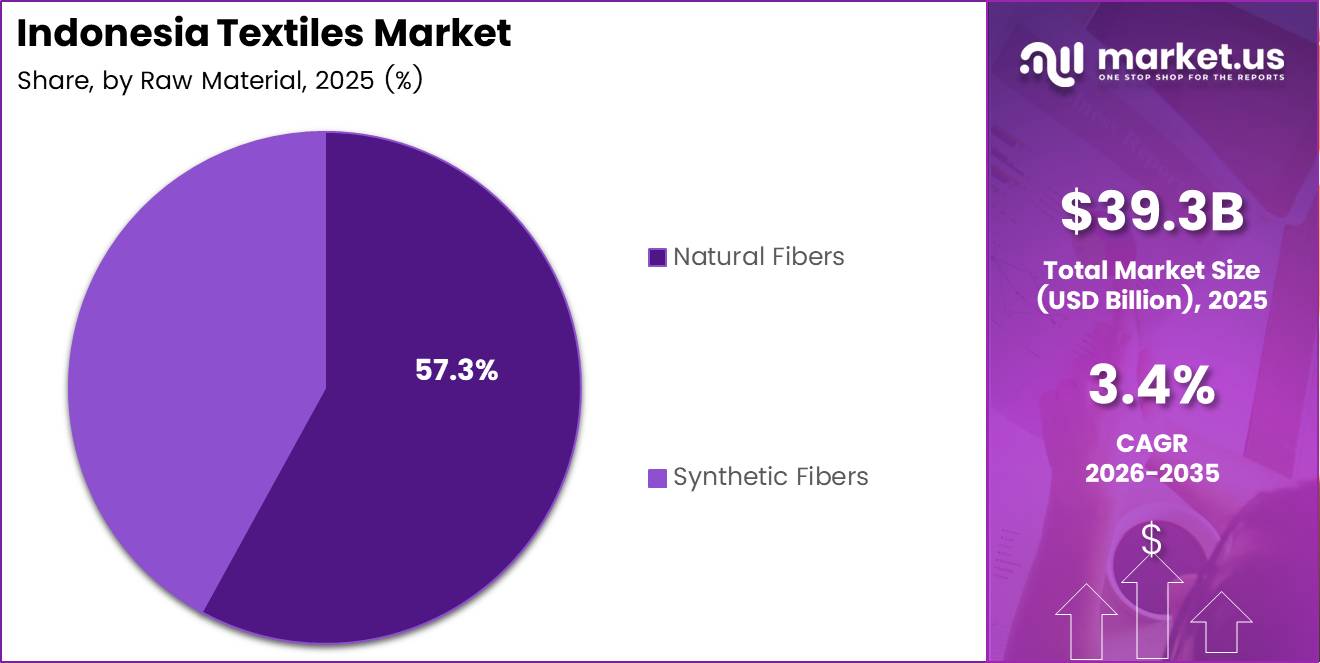
- By Raw Material, Natural Fibers lead with a 57.3% market share in 2025.
- By Process/Technology, Woven holds the dominant position with a 49.9% share in 2025.
- By Application, Fashion & Apparel commands the largest segment at 56.7% share in 2025.
- Indonesia’s textile exports exceed USD 13 Billion annually, supporting over 2.5 million direct jobs.
- Foreign demand for Indonesian textile products grew 7.34% year-on-year in Q1 2024 by volume.
- Danantara, Indonesia’s sovereign wealth fund, plans to invest up to USD 6 Billion into a new textile SOE targeting technology upgrades and export expansion.
Raw Material Analysis
Natural Fibers dominates with 57.3% due to cotton’s deep integration in apparel manufacturing.
In 2025, Natural Fibers held a dominant market position in the By Raw Material segment of the Indonesia Textiles Market, with a 57.3% share. Cotton underpins this position as the primary input for woven fabrics and garments destined for both domestic retail and export buyers demanding natural-fiber content for comfort and certification purposes.
Synthetic Fibers represent the fastest-moving raw material category in terms of product development and export positioning. Polyester, nylon, and rayon/viscose dominate within this group, feeding into fast-fashion supply chains and technical textile applications where cost-per-unit performance is the primary buying criterion.
Process/Technology Analysis
Woven dominates with 49.9% due to its dominance in apparel and export fabric production.
In 2025, Woven held a dominant market position in the By Process/Technology segment of the Indonesia Textiles Market, with a 49.9% share. Woven fabric underpins Indonesia’s apparel and uniform exports, with established mill infrastructure across West Java and Central Java giving this technology a structural cost and capacity advantage over newer production methods.
Knitted fabrics serve activewear, casual apparel, and hosiery production where stretch and comfort are required. International sportswear sourcing has driven knitting capacity expansion at export-oriented factories supplying North American and European brands.
Non-woven production is the highest-growth process category in technical and medical textile applications. Its sub-categories each serve distinct end-use markets with different performance requirements.
3-D Weaving & Spacer Fabrics represent the frontier of Indonesia’s technical textile capability. These advanced structures serve aerospace, automotive, and medical applications where conventional 2-D fabrics cannot meet performance requirements, creating a high-value segment for manufacturers willing to invest in specialist equipment.
Application Analysis
Fashion & Apparel dominates with 56.7% due to deep integration with global fast-fashion supply chains.
In 2025, Fashion & Apparel held a dominant market position in the By Application segment of the Indonesia Textiles Market, with a 56.7% share. Indonesia’s apparel export infrastructure, established trade relationships with European and North American retailers, and competitive labor costs sustain this segment’s commanding position across the textile value chain.
Industrial/Technical Textiles represent the most strategically significant growth application for Indonesian manufacturers. Automotive, construction, and filtration demand for engineered fabrics creates higher-margin opportunities than commodity apparel production, attracting targeted capital investment from both domestic and foreign operators.
Household & Home Textiles serve domestic retail and export markets across bedding, towels, curtains, and upholstery. Indonesian home textile manufacturers benefit from proximity to cotton spinning infrastructure and established private-label relationships with global retail chains.
Medical & Healthcare Textiles gained structural importance following pandemic-driven demand for nonwoven barrier textiles. Ongoing hospital infrastructure investment across Southeast Asia and export demand for medical drapes and wound care substrates sustain this segment’s above-average growth trajectory.
Automotive & Transport Textiles link directly to Indonesia’s vehicle assembly sector and export demand for seat covers, headliners, and filtration media. As domestic automotive production expands, local sourcing of technical fabrics creates a captive demand base for specialist Indonesian textile converters.
Key Market Segments
By Raw Material
- Natural Fibers
- Cotton
- Wool
- Silk
- Synthetic Fibers
- Polyester
- Nylon
- Rayon/Viscose
- Acrylic
- Polypropylene
- Recycled Fibers
- Others
By Process/Technology
- Woven
- Knitted
- Non-woven
- Spunlaid (Spunbond/Melt-blown)
- Dry-laid Hydro-entangled
- Wet-Laid
- Needle-punched
- 3-D Weaving & Spacer Fabrics
By Application
- Fashion & Apparel
- Industrial/Technical Textiles
- Household & Home Textiles
- Medical & Healthcare Textiles
- Automotive & Transport Textiles
- Others
Drivers
Labor Cost Advantage and Export Order Growth Sustain Indonesia’s Textile Output at Scale
Indonesia’s textile industry operates at a scale that few competitors in Southeast Asia can match. According to Surya Cipta, the sector supports nearly 4 million jobs concentrated across industrial hubs in Java. This workforce depth gives manufacturers the operational flexibility to scale output quickly when export orders increase, a structural advantage over smaller regional competitors.
International buyers actively expanded order volumes from Indonesian suppliers heading into 2025. Export demand covering apparel, technical textiles, and fashion products grew measurably in 2024. This reflects buyer decisions to maintain or deepen Indonesia as a sourcing base rather than shift volume to alternative origins.
In May 2025, Indorama Ventures expanded its deja™ textile portfolio with polyester fibers and filament yarns produced entirely from end-of-life textile waste. This signals that export buyers are now pulling sustainability-certified inputs from Indonesian supply chains, adding a compliance dimension to procurement decisions that previously focused only on cost and lead time.
Restraints
Import Dependence and Wage Instability Expose Indonesian Textile Manufacturers to Structural Cost Risk
Indonesian textile factories rely heavily on imported raw materials, particularly synthetic fiber inputs and specialty chemicals. Foreign exchange fluctuations directly raise production costs when the rupiah weakens against the dollar, compressing margins for factories operating on fixed-price export contracts. This exposure limits pricing flexibility at critical negotiation points with international buyers.
Competitive pressure from lower-cost textile-producing countries adds a second layer of structural risk. Vietnam, Bangladesh, and Cambodia have each attracted significant foreign investment in apparel and technical textile manufacturing, directly competing with Indonesian factories for the same export orders from global brands.
According to Business & Human Rights Resource Centre, only 25% of surveyed garment factories paid full wages to dismissed workers during the pandemic period, with Indonesian garment workers losing approximately 40% of normal wages over March-May of the early pandemic months. The cumulative foregone pay reached approximately USD 406 Million. These labor relations strains have a lasting effect on workforce stability, union relations, and factory operational continuity into the mid-decade period.
Growth Factors
Sovereign Capital Allocation and Technical Textile Expansion Create New Revenue Pathways for Indonesian Manufacturers
According to Fortune, Danantara, Indonesia’s sovereign wealth fund, plans to channel up to USD 6 Billion into a new textile state-owned enterprise targeting technology upgrades and export expansion. Capital at this scale changes the competitive equation. It allows Indonesian manufacturers to access automation and advanced processing equipment that would otherwise remain out of reach for private operators.
Technical textile manufacturing for automotive, medical, and industrial applications represents the highest-margin growth path available to Indonesian producers. These applications require specialized equipment and process knowledge, which reduces competition from lower-cost neighbors focused on commodity apparel. Manufacturers that move into technical textiles now will hold a defensible position when the market consolidates.
Digital textile printing and advanced fabric processing are attracting investment from both domestic operators and foreign equipment suppliers. These technologies reduce water consumption, shorten lead times, and enable shorter production runs for fast-fashion and customized textile orders. Factories that adopt digital printing can service buyer segments that conventional screen-printing mills cannot reach competitively.
Emerging Trends
Circular Textile Models and Water-Efficient Processing Define Indonesia’s Next Manufacturing Standard
Recycled fiber adoption is shifting from a voluntary brand commitment to a supply chain requirement. Export buyers in Europe and North America now embed recycled content thresholds directly into sourcing contracts. Indonesian mills that cannot certify recycled fiber inputs risk losing access to premium buyer programs, regardless of their cost competitiveness on conventional materials.
According to Indonesia’s national energy efficiency framework as documented by APEC, the country targets a 1% annual reduction in final energy intensity through 2025 and an overall 17% energy saving by 2025. This policy applies directly to energy-intensive textile operations including dyeing, finishing, and boiler systems. Factories that hit these targets lower operating costs while satisfying the environmental due-diligence requirements of global retailers.
In January 2026, Indorama Ventures launched Trevira CS Eco, a flame-retardant polyester fiber and yarn range manufactured from recycled textile waste, targeting home textile and contract textile applications. This product entry signals that sustainable technical performance fibers are now commercially available for Indonesian converters, removing a previous barrier to eco-certified technical textile production.
Key Company Insights
PT Sri Rejeki Isman Tbk (Sritex) operates as Indonesia’s most vertically integrated textile manufacturer, covering spinning, weaving, dyeing, and finished garment production under one corporate structure. This integration gives Sritex a cost and lead-time advantage over single-process competitors. However, its scale also creates exposure to fixed-cost pressure during demand slowdowns, making working capital management a critical strategic variable for the company.
PT Pan Brothers Tbk positions itself as a large-scale garment manufacturer serving international fashion brands across sportswear, outerwear, and casual apparel categories. Its business model depends heavily on retaining long-term brand relationships, which creates both stability and concentration risk. Pan Brothers’ capacity to absorb sustainability compliance costs will determine whether it retains premium brand accounts as ESG sourcing requirements tighten through the forecast period.
PT Asia Pacific Fibers Tbk focuses on polyester yarn and fiber production, feeding both domestic textile mills and export markets. Its raw material positioning ties its margin performance directly to petrochemical input costs and crude oil price cycles. The company’s ability to shift toward recycled polyester fiber production will be the decisive factor in whether it captures share from brands mandating recycled content in their supply chains.
PT Trisula Textile Industries Tbk operates in the uniform and workwear fabric segment, supplying domestic institutional buyers including government agencies and corporate clients. This end-market insulates Trisula from fast-fashion volatility but also limits exposure to the export growth opportunities that drive revenue at larger peers. Domestic procurement policy and institutional budget cycles are the primary demand levers for this company’s near-term performance.
Key Players
- PT Sri Rejeki Isman Tbk
- PT Pan Brothers Tbk
- PT Asia Pacific Fibers Tbk
- PT Trisula Textile Industries Tbk
- PT Indo-Rama Synthetics Tbk
- PT Tifico Fiber Indonesia Tbk
- PT Ever Shine Tex Tbk
- PT Century Textile Industry Tbk
- PT Polychem Indonesia Tbk
- PT Panasia Group
- PT Tyfountex Indonesia
Recent Developments
- November 2025 – Indorama Ventures formed a joint venture with Jiaren Chemical Recycling, backed by a double-digit million-dollar investment, to develop up to 100,000 tonnes per year of textile-recycled PET fiber and yarn capacity, strengthening textile-to-textile recycling infrastructure.
- January 2026 – Indorama Ventures launched Trevira CS Eco, a flame-retardant polyester fiber and yarn range manufactured from recycled textile waste, targeting sustainable home textile and contract textile applications with certified recycled content.
- May 2025 – Indorama Ventures expanded its deja™ textile portfolio with polyester fibers and filament yarns produced entirely from end-of-life textile waste, supporting circular textile manufacturing and recycled-content sourcing requirements from global brands.
- November 2025 – Jiaren Chemical Recycling commissioned additional recycling capacity through its partnership with Indorama Ventures, enabling large-scale production of recycled polyester feedstock for textile fiber applications at industrial volumes.
- February 2026 – Asia Pacific Rayon introduced sustainable lyocell fabric solutions for Indonesia’s batik sector, expanding the use of man-made cellulosic fibers in traditional textile manufacturing and premium apparel production.
Report Scope
| Report Features | Description |
|---|---|
| Market Value (2025) | USD 39.3 Billion |
| Forecast Revenue (2035) | USD 54.9 Billion |
| CAGR (2026-2035) | 3.4% |
| Base Year for Estimation | 2025 |
| Historic Period | 2020-2024 |
| Forecast Period | 2026-2035 |
| Report Coverage | Revenue Forecast, Market Dynamics, Competitive Landscape, Recent Developments |
| Segments Covered | By Raw Material (Natural Fibers, Synthetic Fibers), By Process/Technology (Woven, Knitted, Non-woven, 3-D Weaving & Spacer Fabrics), By Application (Fashion & Apparel, Industrial/Technical Textiles, Household & Home Textiles, Medical & Healthcare Textiles, Automotive & Transport Textiles, Others) |
| Competitive Landscape | PT Sri Rejeki Isman Tbk, PT Pan Brothers Tbk, PT Asia Pacific Fibers Tbk, PT Trisula Textile Industries Tbk, PT Indo-Rama Synthetics Tbk, PT Tifico Fiber Indonesia Tbk, PT Ever Shine Tex Tbk, PT Century Textile Industry Tbk, PT Polychem Indonesia Tbk, PT Panasia Group, PT Tyfountex Indonesia |
| Customization Scope | Customization for segments will be provided. Moreover, additional customization can be done based on the requirements. |
| Purchase Options | We have three licenses to opt for: Single User License, Multi-User License (Up to 5 Users), Corporate Use License (Unlimited User and Printable PDF) |





































