Report Overview
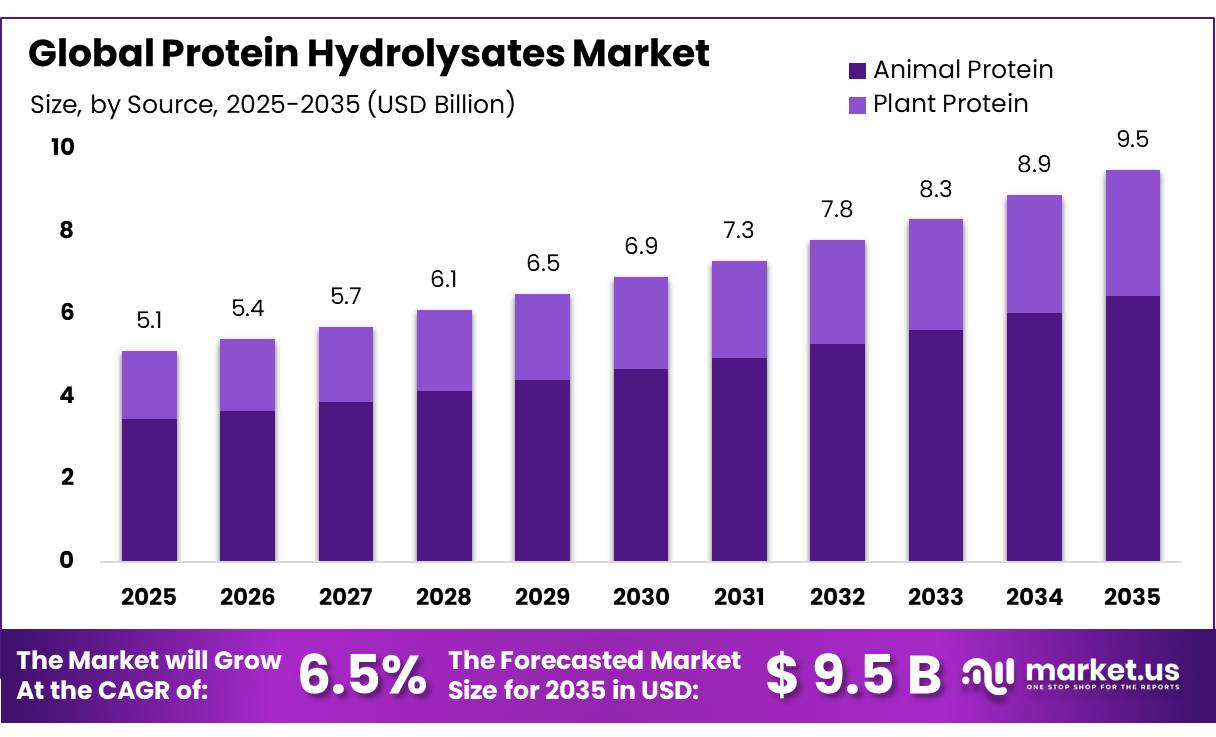
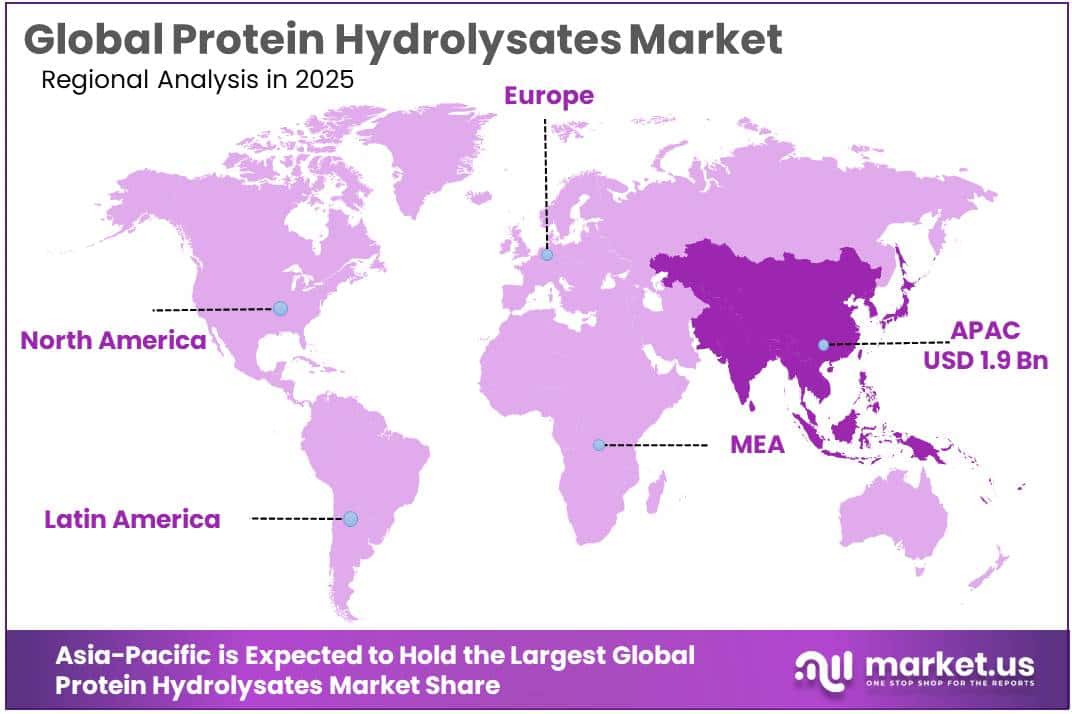
The Global Protein Hydrolysates Market size is expected to be worth around USD 9.5 Billion by 2035, from USD 5.1 Billion in 2025, growing at a CAGR of 6.5% during the forecast period from 2026 to 2035. In 2025, Asia-Pacific held a dominant market position, capturing more than a 38.00% share, holding USD 1.9 Billion revenue.
Protein hydrolysates are specialized protein ingredients produced through the breakdown of intact proteins into smaller peptides and amino acids using enzymatic or chemical hydrolysis. These ingredients are derived from various sources, including whey, casein, soy, wheat, fish, collagen, and other animal and plant proteins. The industrial importance of protein hydrolysates is increasing due to their improved digestibility, solubility, nutritional value, and functional properties. According to the U.S. Food and Drug Administration (FDA), protein hydrolysates contain complex mixtures of peptides, oligopeptides, and free amino acids, making them suitable for specialized nutritional and functional applications.
- Enzymatic processing is gaining industrial preference because it operates under relatively mild conditions and offers better control over peptide composition and product quality. According to research published in Poultry Science in 2024, optimized hydrolysis of poultry processing by-products achieved a protein content of 79–86%, demonstrating the potential for converting underutilized raw materials into valuable ingredients for food and animal nutrition.
The industrial scenario is supported by growing demand for specialized nutritional ingredients and functional food formulations. Protein hydrolysates are increasingly incorporated into sports nutrition, clinical nutrition, infant formula, protein beverages, nutritional supplements, and ready-to-eat products. The U.S. Food and Drug Administration (FDA) has also recognized new applications for hydrolyzed protein ingredients. For example, its 2024 GRAS Notice No. 1166 for fava bean protein hydrolysate covers applications in protein powders, meal replacement beverages, sports drinks, nutrition bars, meat alternatives, and baked goods, with an intended protein contribution of 2.4 grams per serving.
Future growth opportunities are expected to emerge from sustainable protein recovery, precision enzymatic processing, bioactive peptide development, and advanced purification technologies. Companies can explore hydrolysates with targeted molecular weights and specific functional properties for applications in personalized nutrition, medical nutrition, cosmetics, pharmaceuticals, and animal feed. Research published in 2024 demonstrated that hydrolysis of poultry by-products could be optimized at 65°C for 2 hours, while recycling the hydrolysis broth up to 3 times helped reduce enzyme consumption and processing costs.
Key Takeaways
- Protein Hydrolysates Market size is expected to be worth around USD 9.5 Billion by 2035, from USD 5.1 Billion in 2025, growing at a CAGR of 6.5%.
- Animal Protein dominates with a 67.89% market share in 2025.
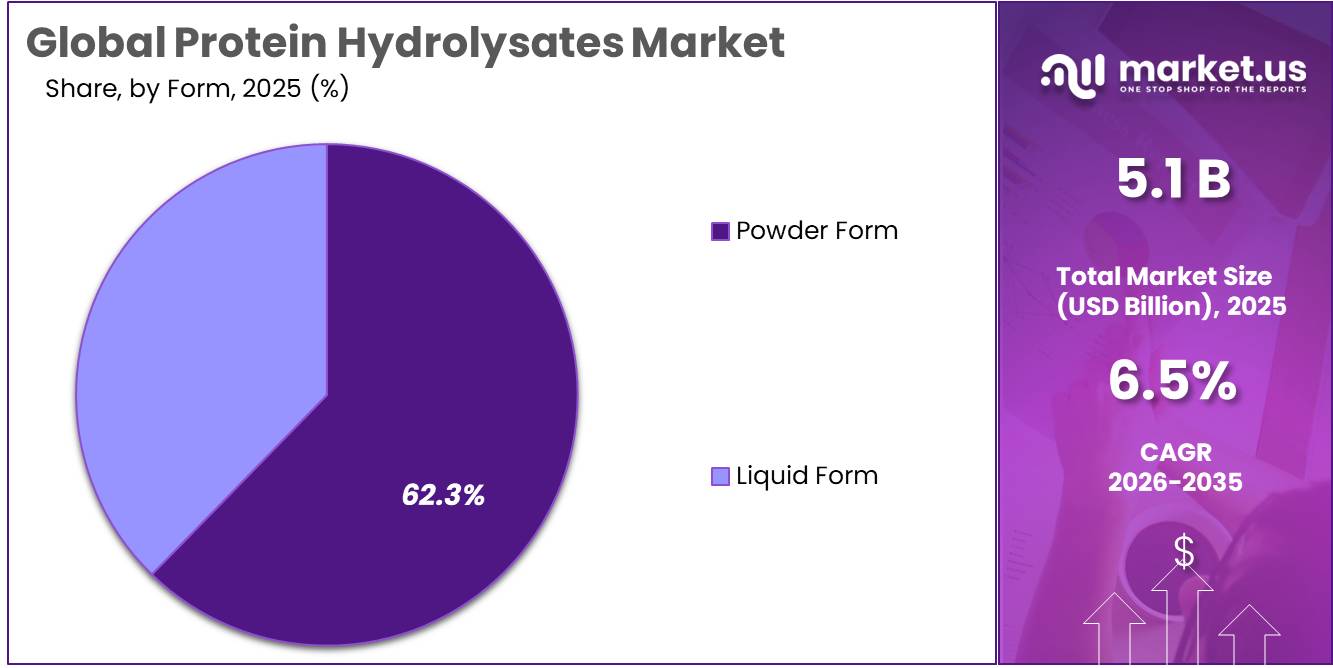
- Powder Form held a dominant market position, capturing more than a 62.23% share.
- Dairy Products held a dominant market position, capturing more than a 42.00% share.
- Asia-Pacific dominated the Protein Hydrolysates Market, accounting for a 38.00% share and reaching USD 1.9 billion.
By Source Analysis
Protein Hydrolysates Market by Source of Animal Protein
Animal Protein dominates with a 67.89% market share in 2025, supported by its established use in nutritional formulations, sports nutrition, clinical nutrition, and food processing. Animal-derived protein hydrolysates, particularly those obtained from dairy, whey, casein, and collagen, are widely used because of their protein quality, digestibility, and functional properties. Their established processing infrastructure and availability of raw materials support consistent industrial production. In 2025, the segment maintained its leading position as manufacturers increasingly focused on protein-rich formulations and specialized nutritional applications.
Dairy Protein remains an important source of protein hydrolysates because of its nutritional quality, functional properties, and widespread use in food and nutritional products. Whey and casein-derived hydrolysates are commonly incorporated into sports nutrition, infant nutrition, medical nutrition, and protein-enriched beverages. According to the U.S. Department of Agriculture (USDA), milk contains approximately 3.3% protein, including whey and casein, making dairy a valuable raw material for protein ingredient manufacturing.
By Form Analysis
Protein Hydrolysates Market by Form: Powder Form
In 2025, Powder Form held a dominant market position, capturing more than a 62.23% share. Powder-form protein hydrolysates are widely preferred due to their convenient storage, longer shelf life, easy transportation, and suitability for large-scale manufacturing. They are commonly used in sports nutrition, infant formula, dietary supplements, clinical nutrition, and protein-enriched food products. Their flexibility in blending with other dry ingredients and compatibility with spray-drying processes further support their adoption.
Liquid Form is gaining attention due to its convenient handling in industrial processing, easy integration into liquid food formulations, and suitability for ready-to-use nutritional products. Liquid protein hydrolysates are used in beverages, clinical nutrition, food processing, and specialized nutritional formulations. They eliminate the need for reconstitution and can support efficient ingredient incorporation during manufacturing. According to the U.S. Food and Drug Administration (FDA), liquid food products must comply with established food safety and manufacturing requirements, supporting quality control across commercial applications.
By Application Analysis
Protein Hydrolysates Market by Application: Dairy Products
In 2025, Dairy Products held a dominant market position, capturing more than a 42.00% share. Dairy applications lead due to the increasing use of protein hydrolysates in yogurt, milk-based beverages, cheese, and specialized dairy formulations. These ingredients improve protein enrichment, solubility, and functional performance, making them suitable for developing value-added dairy products. Their incorporation also supports the development of nutritional products for consumers seeking convenient protein intake.
Meat and Poultry Products represent an important application area for protein hydrolysates because of their functional benefits in processed meat formulations. These ingredients can support water-binding capacity, texture improvement, emulsification, and product consistency in meat-based applications. Protein hydrolysates derived from animal processing by-products also offer opportunities to improve resource utilization and ingredient efficiency.
Key Market Segments
By Source
- Animal Protein
- Dairy Protein
- Gelatin and Collagen
- Others
- Plant Protein
- Soya
- Pea
- Wheat
- Rice
- Potato
- Hemp
- Others
By Form
- Powder Form
- Liquid Form
By Application
- Infant Nutrition
- Sports Nutrition
- Clinical and Medical Nutrition
- Specialized Food and Beverage
- Animal Nutrition
- Personal Care and Cosmetics
Driver Analysis
Peptide-Based Medical Nutrition
Demand for peptide-based medical nutrition supports protein hydrolysates where patients require formulations designed for impaired digestion or absorption, while improvements in taste and concentration make these ingredients more practical for repeat use. Arla Foods Ingredients launched Lacprodan DI-3092 in November 2024 with a stated degree of hydrolysis of 16–22%, low lactose content and compatibility with direct and indirect UHT treatment; its application prototypes provide 10 g protein per 100 mL with low viscosity and reduced bitterness.
These are product-specific formulation capabilities, not proof that hydrolysates are preferable to intact proteins for every patient or a quantified market-wide shift. Nestlé’s Peptamen portfolio provides an established commercial example using hydrolysed whey as its protein source, including paediatric products intended for children aged 1–13 years with impaired gastrointestinal function; finished formula revenue is not counted as ingredient-market revenue. Under an illustrative procurement program, 100,000 patients consuming 20 g of hydrolysate-derived protein daily for 180 days require 360 tonnes of protein; at an assumed 90% protein content, ingredient demand is 400 tonnes.
This is a volume sensitivity, not a dosing recommendation or patient-population estimate. Suppliers capture value through validated specifications, sensory performance and long-term formula qualification rather than commodity protein sales alone. The +1.0 pp contribution assumes 20% of addressable revenue grows 5 percentage points faster than the underlying case, counting appropriate medical applications while excluding intact whey, beta-lactoglobulin and unrelated high-protein products.
Drivers Impact Analysis
| Driver | (~) % Impact on CAGR Forecast | Geographic Relevance | Impact Timeline |
|---|---|---|---|
| Peptide-based medical nutrition | +1.0 pp | North America, EU, Japan | Short term (≤ 2 years) |
| Qualified infant-formula expansion | +0.8 pp | EU core; export-formula markets | Medium term (2–4 years) |
| Evidence-backed collagen adoption | +0.8 pp | North America, EU, East Asia | Short term (≤ 2 years) |
| Specialized sports formulations | +0.7 pp | US, EU, Brazil, APAC | Short term (≤ 2 years) |
| Functional aquafeed inclusion | +0.5 pp | China, Southeast Asia, Norway, Chile | Medium term (2–4 years) |
Restraint Analysis
Processing-Cost Premium
Protein hydrolysates incur additional conversion costs beyond the underlying protein feedstock because controlled enzymatic treatment can require reaction time, enzyme inactivation, fractionation, concentration and drying, with further expenditure where customers demand narrowly specified peptide fractions. A January 2026 enzyme-technology review identifies expensive enzyme preparations and downstream separation as barriers to industrial commercialization, noting that membrane separation, adsorption and chromatography can have limited throughput or selectivity; these findings do not establish one production-cost premium applicable to all hydrolysates.
Upstream conditions add pressure selectively: FAO reported September 2026 skim-milk-powder quotations 33.1% above their year-earlier level, while cheese and butter prices were substantially lower, demonstrating that a broad dairy index is not an adequate proxy for every protein feedstock. Skim milk powder is also not interchangeable with whey concentrate or collagen raw material. Under an illustrative plant model, 1,000 kg of protein solids yielding 850 kg of saleable hydrolysate produces $4.71/kg of feedstock cost when input solids cost $4/kg; an additional assumed $2/kg of processing produces $6.71/kg before overhead.
If saleable recovery falls to 750 kg with the same total batch expenditure, unit cost rises to approximately $7.60/kg, or 13.3%. These are sensitivity inputs, not commercial quotations. Suppliers must therefore align hydrolysis intensity and purification with customer specifications rather than over-process material without a recoverable premium. The −0.5 pp deduction assumes 25% of addressable revenue grows 2 percentage points more slowly because conversion economics prevent otherwise viable orders; routine process optimization without a lost sale belongs in a separate challenges analysis.
Restraint Impact Analysis
| Restraint | (~) % Impact on CAGR Forecast | Geographic Relevance | Impact Timeline |
|---|---|---|---|
| Processing-cost premium | −0.5 pp | EU, US, China, India | Short term (≤ 2 years) |
| Bitterness-driven rejection | −0.4 pp | North America, EU, East Asia | Medium term (2–4 years) |
| Formula qualification barriers | −0.4 pp | EU core; export-formula suppliers | Medium term (2–4 years) |
| Residual allergen restrictions | −0.3 pp | US, EU, UK | Long term (≥ 4 years) |
| Intact-protein substitution | −0.3 pp | US, EU, Brazil, APAC | Short term (≤ 2 years) |
Opportunity Analysis
Characterized Plant-Peptide Platforms
Developing reproducibly characterized plant-protein hydrolysates offers an opportunity to move from generic protein procurement into ingredient platforms supported by defined composition, application evidence and customer-specific qualification. FDA’s GRAS Notice 1166 provides a concrete regulatory precedent: the agency closed the notice for a particular fava-bean protein hydrolysate on 13 November 2024 with a “no questions” letter concerning the notifier’s conclusion, covering intended uses at 2.4 g per serving across specified foods. This is not FDA approval of every fava hydrolysate, a therapeutic authorization or validation of any claimed health benefit.
The untapped element is commercialization of additional well-characterized products and genuinely new applications—not ordinary growth in plant-protein consumption already reflected in ingredient demand. An illustrative program selling 20 million annual servings at 2.4 g requires 48 tonnes of ingredient; at an assumed $40/kg, revenue is $1.92 million. If manufacturing and quality costs total an assumed $25/kg, contribution is $720,000 before research, sales, overhead and financing; a $2 million development investment would consequently require approximately 2.8 years of full-volume contribution to recover, excluding ramp-up and tax.
These are investment-screening assumptions, not published prices or margins. Suppliers should establish batch-composition comparability, permitted claims and customer formulation commitments before scaling, rather than extrapolate laboratory bioactivity into consumer benefits. The +0.35 pp upside assumes a 7% revenue exposure growing 5 percentage points faster through newly qualified peptide products, excluding generic plant isolates, pharmaceutical peptides and existing sports-hydrolysate sales merely rebranded as premium.
Opportunity Impact Analysis
| Opportunity | (~) % Potential CAGR Upside | Geographic Relevance | Execution Window |
|---|---|---|---|
| Characterized plant-peptide platforms | +0.35 pp | US, EU, Japan | Medium term (2–4 years) |
| Animal-free media ingredients | +0.30 pp | US, EU, Singapore, South Korea | Medium term (2–4 years) |
| Qualified biostimulant ingredients | +0.25 pp | EU, Brazil, India | Medium term (2–4 years) |
| Side-stream ingredient recovery | +0.25 pp | Norway, Iceland, Chile, Southeast Asia | Medium term (2–4 years) |
| Application-specific peptide fractions | +0.15 pp | EU, US, Japan | Long term (≥ 4 years) |
Challenges Analysis
Peptide-Profile Batch Consistency
Protein hydrolysates are complex mixtures whose performance depends on peptide sequences, molecular-weight distribution, residual proteins and non-protein constituents; matching total protein and degree of hydrolysis does not guarantee equivalent functionality. An October 2026 review concludes that hydrolysates with similar degrees of hydrolysis can show markedly different technological performance because enzyme specificity, peptide distribution and amino-acid composition also matter. An April 2026 review of hydrolysates in cell culture provides a useful analytical illustration: reviewed studies detected between 64 and 33,518 peptides, averaging approximately 1,700, while measured metabolites represented roughly 14–57% of hydrolysate mass.
These figures concern particular industrial hydrolysates, not the composition of every nutritional product; importantly, the review also reports that overall batch variability was relatively low in one multisource study, preventing a blanket assumption that commercial lots are inherently inconsistent. In an illustrative 100-lot annual program, reducing lots requiring adjustment from 8% to 3% avoids five interventions; at an assumed $15,000 per intervention, the direct benefit is $75,000 before inventory and customer-support effects.
Manufacturers need feedstock segmentation, reference-batch libraries and application-relevant peptide fingerprints rather than indiscriminate testing of every detectable molecule. This is a continuing consistency challenge while qualified products remain saleable, not a claim that all variable lots must be rejected. The −0.30 pp estimate assumes 15% of revenue grows 2 percentage points more slowly because repeat characterization, blending and customer comparability work consume commercialization capacity.
Challenges Impact Analysis
| Challenge | (~) % CAGR Friction Drag | Geographic Relevance | Mitigation Horizon |
|---|---|---|---|
| Peptide-profile batch consistency | −0.30 pp | EU, US, China, India | Medium term (2–4 years) |
| Hydrolysis scale-up control | −0.25 pp | EU, US, China, Southeast Asia | Medium term (2–4 years) |
| Membrane fractionation reliability | −0.25 pp | EU, US, Japan | Medium term (2–4 years) |
| Powder stability management | −0.25 pp | Tropical APAC, Brazil, EU exports | Long term (≥ 4 years) |
| Analytical specification alignment | −0.20 pp | EU, US, Japan; global suppliers | Medium term (2–4 years) |
Geopolitical Impact Analysis
Geopolitical Impact of the Iran and Middle East War on the Protein Hydrolysates Market
The ongoing war in the Middle East in 2026 is creating indirect challenges for the global Protein Hydrolysates Market through rising energy prices, transportation disruptions, and higher raw material costs. Protein hydrolysate manufacturing depends on energy-intensive processes such as enzymatic hydrolysis, filtration, concentration, and spray drying.
Disruptions in global shipping routes, particularly the Strait of Hormuz, are increasing freight charges, insurance costs, and delivery delays for food ingredients and industrial chemicals. According to UN Trade and Development (UNCTAD), shipping through the Strait of Hormuz declined by more than 95% during the conflict, putting pressure on international trade and supply chains.
Higher energy prices are also affecting the cost of producing and processing dairy, animal-based, and plant-based proteins. According to the World Bank, global food prices increased by 5% during the first two months following the conflict, while oils and meals increased by 10%. These developments may indirectly increase the cost of raw materials used in protein hydrolysate production.
The conflict is also encouraging manufacturers to strengthen supply chain resilience through diversified sourcing, regional production, improved inventory management, and energy-efficient processing technologies. According to the International Monetary Fund (IMF), crude oil prices are projected to increase by 32% in 2026 compared with 2025 under its July 2026 outlook.
Regional Insights
Dominating Region: Asia-Pacific (38.00% Share, USD 1.9 Billion)
In 2025, Asia-Pacific dominated the Protein Hydrolysates Market, accounting for a 38.00% share and reaching USD 1.9 billion. The region’s leading position is supported by growing demand for nutritional ingredients, expanding food processing industries, and increasing applications of protein hydrolysates in dairy products, sports nutrition, infant formula, and functional foods. China, Japan, South Korea, and Australia contribute to regional demand through their established food manufacturing and nutritional ingredient industries.
According to the Food and Agriculture Organization (FAO), more than 6 billion people worldwide consume milk and milk products, with the majority living in developing countries. The FAO also highlights increasing dairy consumption in East and Southeast Asia due to urbanization, population growth, and changing dietary habits. These developments support the demand for dairy-derived protein hydrolysates and specialized protein ingredients across the Asia-Pacific region.
Functional and sports nutrition represents a promising growth area for protein hydrolysates across Asia-Pacific. Demand is increasing as consumers focus on muscle recovery, protein supplementation, healthy aging, and convenient nutritional products. Protein hydrolysates offer improved digestibility and solubility, making them suitable for protein powders, beverages, and specialized nutritional formulations.
According to the OECD-FAO Agricultural Outlook 2024–2033, global average daily protein intake is projected to increase from 76.6 grams to 79.8 grams per person by 2033. This growth in protein consumption supports opportunities for ingredient manufacturers to develop specialized hydrolysates for sports nutrition, clinical nutrition, and functional food applications. Expanding product innovation, changing lifestyles, and growing interest in high-protein diets are expected to strengthen demand across regional markets.
Key Regions and Countries Insights
- North America
- US
- Canada
- Europe
- Germany
- France
- The UK
- Spain
- Italy
- Rest of Europe
- Asia Pacific
- China
- Japan
- South Korea
- India
- Australia
- Rest of APAC
- Latin America
- Brazil
- Mexico
- Rest of Latin America
- Middle East & Africa
- GCC
- South Africa
- Rest of MEA
Key Players Analysis
Arla Foods amba is a leading dairy cooperative with a strong presence in protein ingredients through Arla Foods Ingredients. In 2025, the company recorded total revenue of EUR 15.1 billion, while its ingredients business generated EUR 1,452 million, representing 43.1% growth. The company strengthened its protein portfolio through whey-based ingredients and specialized nutritional solutions. In 2025, Arla also invested EUR 731 million in strategic projects, supporting capacity expansion and product innovation. Its focus on advanced protein ingredients, research, and customer partnerships strengthens its position in the protein hydrolysates industry.
Fonterra Co-operative Group Limited is a major dairy ingredient supplier operating through its NZMP ingredients business. In 2025, the company reported revenue of NZD 26 billion, reflecting an increase of 15%, while operating profit reached NZD 1,732 million, growing by 13%. Its milk collections reached 1,509 million kilograms of milk solids, an increase of 2.6%. Fonterra supplies dairy ingredients to more than 1,000 customers across 100 countries, supporting applications in food processing, nutritional products, and protein-enriched formulations. Its global ingredient network strengthens its competitive position in protein hydrolysates.
Kerry Group plc is a global ingredients and biotechnology company specializing in food, beverage, nutrition, and functional ingredient solutions. In 2025, the company generated revenue of EUR 6,758 million and achieved 3.0% volume growth. Its EBITDA reached EUR 1,208 million, with an EBITDA margin of 17.9%. Kerry also invested more than EUR 3 billion cumulatively over 10 years in its science and technology ecosystem, supporting research, biotechnology, enzyme development, and nutrition innovation. Its expertise in enzyme hydrolysis and specialized nutritional ingredients supports product development opportunities in protein hydrolysates and functional food applications.
Top Key Players Outlook
- Arla Foods amba
- Fonterra Co-operative Group Limited
- Kerry Group plc
- Archer Daniels Midland Company
- Cargill, Incorporated
- Royal FrieslandCampina N.V.
- Tate & Lyle PLC
- Agropur Cooperative
- Carbery Group Limited
- Milk Specialties Global
- Amco Proteins
- Glanbia plc
- Hilmar Ingredients
- Other Key Players
Recent Developments
- In January 2026, ADM announced an investment of USD 26 million to expand its Erlanger, Kentucky, facility, strengthening its food reformulation and ingredient innovation capabilities. The expansion follows an earlier investment of USD 15 million in 2025 for a 7,200-square-foot expansion of its Customer Creation and Innovation Center. In July 2026, the company also announced an investment exceeding USD 16 million to expand naturally derived color production capacity at its Northern Kentucky facility.
- In September 2026, Cargill announced an investment of USD 130 million to expand poultry operations in Asia, supporting increasing demand for animal protein and strengthening its integrated protein supply chain. In April 2026, the company also opened a canola processing facility in Regina, Canada, with an annual processing capacity of 1 million metric tons.
Report Scope
| Report Features | Description |
|---|---|
| Market Value (2025) | USD 1.3 Bn |
| Forecast Revenue (2035) | USD 2.1 Bn |
| CAGR (2026-2035) | 5.5% |
| Base Year for Estimation | 2025 |
| Historic Period | 2020-2024 |
| Forecast Period | 2026-2035 |
| Report Coverage | Revenue Forecast, Market Dynamics, Competitive Landscape, Recent Developments |
| Segments Covered | By Source (Animal Protein, Plant Protein), By Form (Powder Form, Liquid Form), By Application (Infant Nutrition, Sports Nutrition, Clinical and Medical Nutrition, Specialized Food and Beverage, Animal Nutrition, Personal Care and Cosmetics) |
| Regional Analysis | North America – US, Canada; Europe – Germany, France, The UK, Spain, Italy, Rest of Europe; Asia Pacific – China, Japan, South Korea, India, Australia, Singapore, Rest of APAC; Latin America – Brazil, Mexico, Rest of Latin America; Middle East & Africa – GCC, South Africa, Rest of MEA |
| Competitive Landscape | Arla Foods amba, Fonterra Co-operative Group Limited, Kerry Group plc, Archer Daniels Midland Company, Cargill, Incorporated, Royal FrieslandCampina N.V., Tate & Lyle PLC, Agropur Cooperative, Carbery Group Limited, Milk Specialties Global, Amco Proteins, Glanbia plc, Hilmar Ingredients, Other Key Players |
| Customization Scope | Customization for segments, region/country-level will be provided. Moreover, additional customization can be done based on the requirements. |
| Purchase Options | We have three licenses to opt for: Single User License, Multi-User License (Up to 5 Users), Corporate Use License (Unlimited User and Printable PDF) |