Report Overview
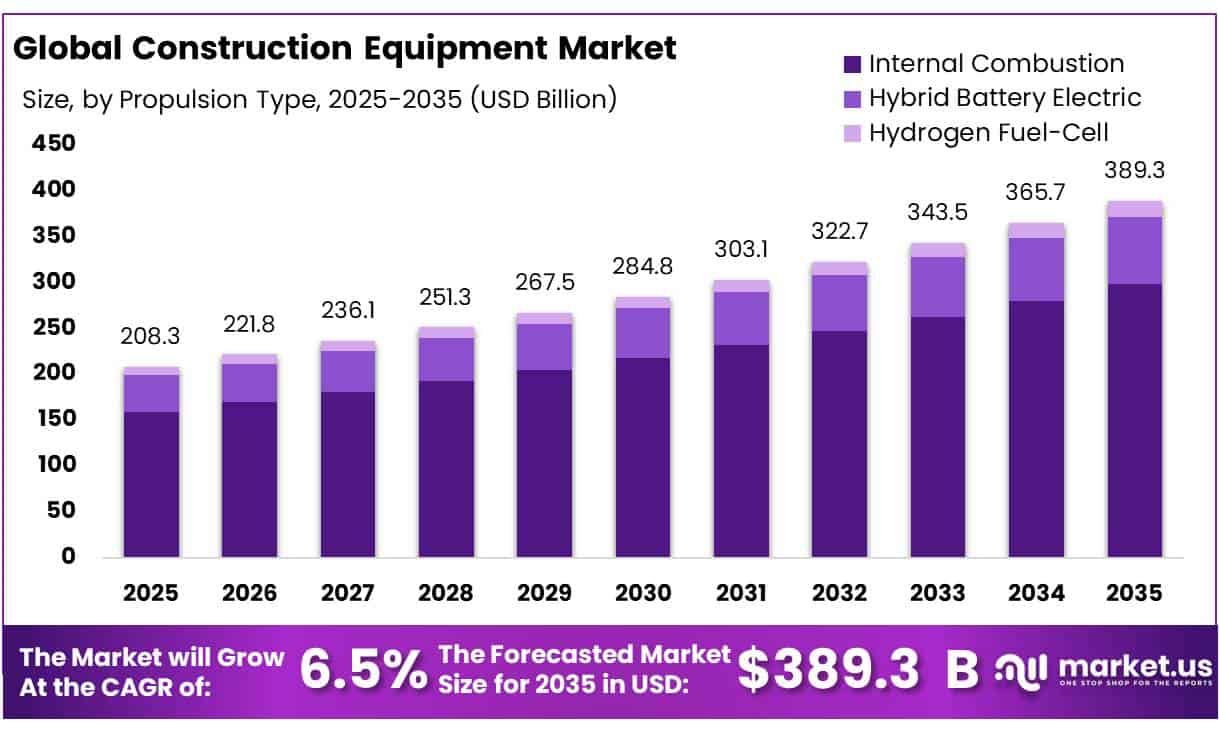
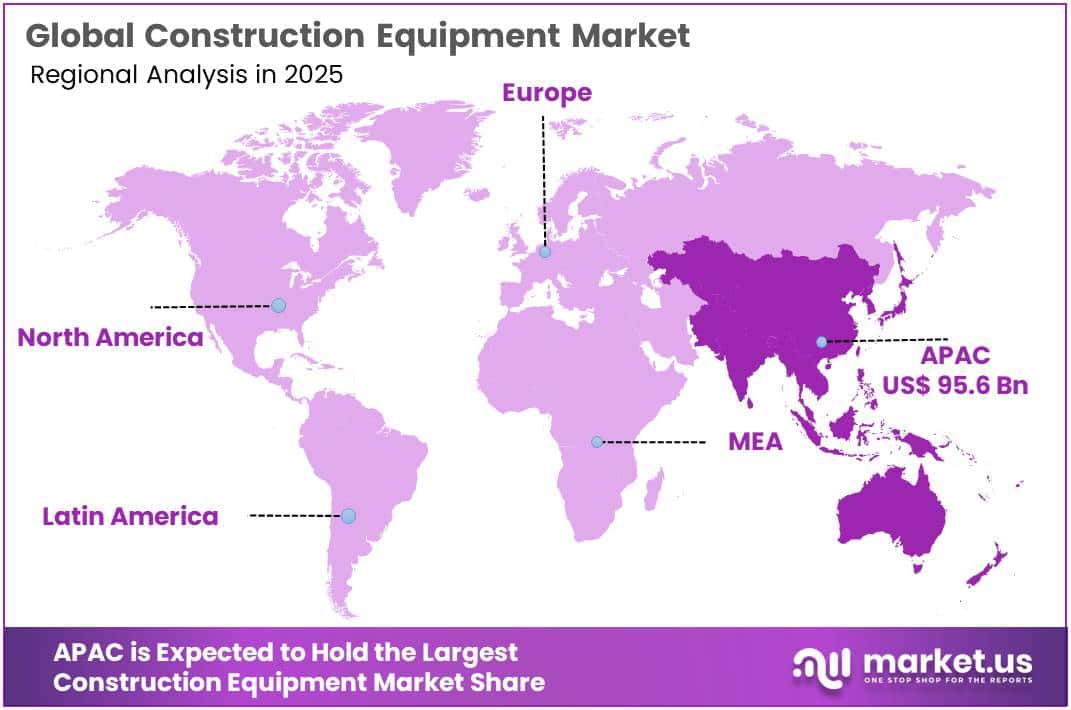
The Global Construction Equipment Market size is expected to be worth around USD 389.3 Billion by 2035, from USD 208.3 Billion in 2025, growing at a CAGR of 6.5% during the forecast period from 2026 to 2035. In 2025, Asia-Pacific held a dominant market position, capturing more than a 46.00% share, holding USD 95.6 Billion revenue.
The construction equipment industry plays an important role in infrastructure development, commercial construction, residential building, mining, transportation, and industrial projects. Construction equipment includes excavators, loaders, bulldozers, cranes, motor graders, road rollers, concrete machinery, and material-handling equipment. These machines support activities such as excavation, earthmoving, lifting, material transportation, demolition, and road development.
- The United States provides an important example of this demand. According to the U.S. Census Bureau, total construction spending reached an annualized rate of USD 2,186.1 billion in September 2026, covering residential, non-residential, and public construction activities. Public construction accounted for USD 546.8 billion, while non-residential construction reached USD 790.6 billion. These activities support demand for excavators, cranes, loaders, concrete equipment, and road-building machinery.
Government infrastructure initiatives are another major factor supporting industry demand. In the United States, the Infrastructure Investment and Jobs Act provides USD 550 billion in new federal infrastructure investment for fiscal years 2022–2026, covering roads, bridges, public transportation, water infrastructure, and broadband development.
The programme creates opportunities for equipment manufacturers and rental companies supplying machinery for large-scale construction projects. Similarly, the European Union’s Connecting Europe Facility allocated EUR 25.8 billion for transport infrastructure development during 2021–2027, supporting railway networks, roads, cross-border connections, and infrastructure modernization.
- According to its 2025 annual report, Caterpillar Inc. generated USD 67.589 billion in total sales and revenues in 2025, compared with USD 64.809 billion in 2024, representing approximately 4% growth. Its Construction Industries segment generated USD 25.060 billion in sales in 2025, although this was approximately 2% lower than the previous year. The company’s performance highlights the importance of construction machinery, dealer networks, replacement equipment, and aftermarket services in the global industrial landscape.
Future growth opportunities are expected to emerge from electric construction equipment, smart construction sites, equipment rental services, infrastructure rehabilitation, and digital fleet management. For example, Volvo Construction Equipment started serial production of its A30 Electric and A40 Electric articulated haulers in April 2026, representing an important development in large battery-electric construction machinery. These machines create opportunities in quarrying, mining, and construction applications where lower-emission operations are becoming increasingly important.
Key Takeaways
- Construction Equipment Market size is expected to be worth around USD 389.3 Billion by 2035, from USD 208.3 Billion in 2025, growing at a CAGR of 6.5%.
- Excavator held a dominant market position, capturing more than a 53.90% share.
- Internal Combustion held a dominant market position, capturing more than a 76.67% share.
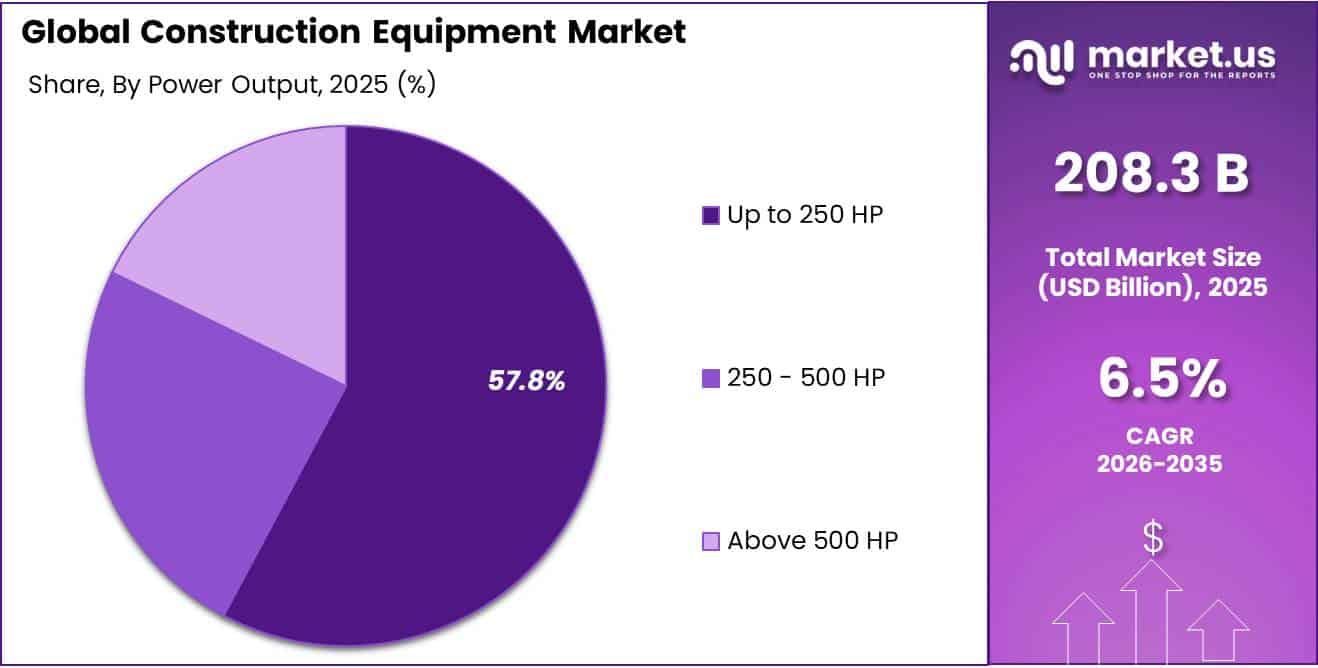
- Up to 250 HP held a dominant market position, capturing more than a 57.89% share.
- Infrastructure held a dominant market position, capturing more than a 73.00% share.
- Asia-Pacific dominated the global Construction Equipment Market in 2025, accounting for 46.00% of the market, valued at USD 95.6 billion.
By Equipment Type Analysis
Excavator – Dominates the market due to its wide use in excavation, earthmoving, demolition, and infrastructure development.
In 2025, “Excavator” held a dominant market position, capturing more than a 53.90% share. Excavators remain essential construction machines because they are used across road development, commercial construction, mining, residential projects, and land preparation. Their ability to perform digging, trenching, lifting, and material-handling activities makes them suitable for both large infrastructure projects and smaller construction sites.
Loader equipment plays an important role in construction activities by supporting material movement, loading, stockpiling, and land preparation. Wheel loaders and backhoe loaders are widely used at construction sites, mining locations, road projects, and industrial facilities because they can handle materials such as sand, gravel, soil, and construction debris.
In 2025 and 2026, demand for loaders was supported by infrastructure development and ongoing construction projects. According to the U.S. Census Bureau, total construction spending reached USD 2,169.657 billion in 2025, while public construction spending accounted for USD 517.317 billion.
By Propulsion type Analysis
Internal Combustion – Dominates the market due to its established technology, high power output, and suitability for heavy-duty construction operations.
In 2025, “Internal Combustion” held a dominant market position, capturing more than a 76.67% share. Internal combustion-powered construction equipment continues to maintain strong demand because of its ability to deliver high power, operate for extended working hours, and perform demanding activities across construction, mining, road development, and infrastructure projects. Excavators, loaders, bulldozers, cranes, and other heavy machinery commonly rely on diesel-powered engines to handle challenging site conditions and heavy workloads.
Hybrid Battery Electric construction equipment is gaining importance as construction companies look for cleaner and more energy-efficient machinery. These machines combine battery power with conventional power systems or use electric propulsion to support construction activities with lower fuel consumption and reduced emissions. In 2025 and 2026, manufacturers continued to develop electric excavators, loaders, compact construction machinery, and battery-powered material-handling equipment.
According to the California Air Resources Board (CARB), its May 2025 advanced clean equipment listing included 334 electric construction and mining equipment models. The wider listing covered 1,006 hybrid and zero-emission equipment models across different industrial categories. This indicates increasing technology availability for cleaner off-road machinery. Growing environmental requirements, demand for quieter equipment, and improvements in battery performance are expected to create further opportunities for this segment.
By Power Output Analysis
Up to 250 HP – Dominates the market due to its versatility, lower operating costs, and suitability for everyday construction activities.
In 2025, “Up to 250 HP” held a dominant market position, capturing more than a 57.89% share. Construction equipment in this power range is widely used in residential construction, road development, landscaping, material handling, and small to medium-sized infrastructure projects. Excavators, wheel loaders, backhoe loaders, compactors, and other machinery within this category offer a practical balance between engine performance, fuel efficiency, and operating expenses.
The 250–500 HP segment serves construction projects that require greater power, lifting capacity, and continuous machine performance. Equipment within this category is commonly used for large-scale earthmoving, mining, road construction, quarrying, and major infrastructure development. Heavy-duty excavators, wheel loaders, bulldozers, and specialized construction machinery benefit from higher horsepower engines because they can handle demanding workloads and challenging operating conditions.
According to the U.S. Census Bureau, total non-residential construction spending reached USD 1,247.926 billion in 2025, while public construction spending accounted for USD 517.317 billion. These investments support demand for high-powered machinery used in large construction and infrastructure projects. Manufacturers are also improving engine performance, hydraulic systems, fuel efficiency, and operator comfort to strengthen equipment productivity.
By Application Analysis
Infrastructure – Dominates the market due to large-scale investment in roads, bridges, transportation networks, and public development projects.
In 2025, “Infrastructure” held a dominant market position, capturing more than a 73.00% share. Infrastructure development remains a major application area for construction equipment because large projects require continuous earthmoving, excavation, material handling, road construction, and heavy lifting operations. Excavators, bulldozers, loaders, motor graders, cranes, and road rollers are widely used in highway construction, railway development, bridges, airports, and utility projects.
Residential and Commercial Construction represents an important application segment, supported by housing development, office buildings, retail spaces, warehouses, hotels, and industrial facilities. Construction equipment such as excavators, loaders, cranes, concrete pumps, and compact machinery is widely used for foundation preparation, material movement, structural development, and site clearance. In 2025, demand was supported by residential renovation, commercial property development, and new building projects.
According to the U.S. Census Bureau, residential construction spending reached USD 921.731 billion, while commercial construction spending amounted to USD 122.071 billion in 2025. Growing demand for modern buildings, warehouse facilities, and urban property development is expected to support the use of construction machinery in this segment.
Government statistics supporting the dominant Infrastructure segment: According to the U.S. Census Bureau, total public construction spending reached USD 517.317 billion in 2025. Within this amount, highway and street construction accounted for USD 142.096 billion, while public transportation construction represented USD 49.198 billion. These investments demonstrate the importance of infrastructure development in supporting demand for excavators, loaders, bulldozers, cranes, and road construction equipment.
Key Market Segments
By Equipment Type
- Excavator
- Loader
- Mobile Cranes
- Motor Graders
- Bulldozers
- Road Rollers
- Dump Trucks
- Others
By Propulsion type
- Internal Combustion
- Hybrid Battery Electric
- Hydrogen Fuel-Cell
By Power Output
- Up to 250 HP
- 250 – 500 HP
- Above 500 HP
By Application
- Infrastructure
- Residential and Commercial Construction
- Mining and Quarrying
- Oil and Gas/Pipelines
- Industrial and Manufacturing
- Others
Driver Analysis
Funded Infrastructure Execution
Funded transport and civil-infrastructure programs create equipment demand when allocations become awarded contracts, mobilized worksites and sustained machine-hours, supporting excavators, loaders, graders, compactors, paving equipment and concrete machinery. India’s FY2026–27 Union Budget proposes approximately INR 12.2 lakh crore of public capital expenditure, compared with INR 11.2 lakh crore in the preceding budget estimate; proposed infrastructure initiatives include seven high-speed rail corridors, a dedicated freight corridor and 20 additional national waterways.
In an illustrative road program, ten simultaneously active work fronts each requiring three excavators, two loaders and four compaction units generate demand for access to 90 machines. If existing contractor and rental fleets supply 70% of that requirement, the residual new-equipment requirement is 27 units; at an assumed weighted realized price of USD 140,000, attributable machinery revenue is USD 3.78 million. The calculation cannot be scaled directly from the national budget because project schedules, utilization and equipment mixes vary.
Commercially, sustained execution improves dealer visibility and supports maintenance-backed fleet packages and financing tied to contractor cash flows, but delayed land access or payments can defer purchases despite unchanged allocations. The +1.1 pp contribution assumes 22% revenue exposure grows 5.0 percentage points faster through additional infrastructure-related procurement, excluding unexecuted budgets, purchases already covered by existing fleets and unrelated government capital expenditure.
Drivers Impact Analysis
| Driver | (~) % Impact on CAGR Forecast | Geographic Relevance | Impact Timeline |
|---|---|---|---|
| Funded infrastructure execution | +1.1 pp | India | Short term (≤ 2 years) |
| Data-center site development | +0.8 pp | US | Short term (≤ 2 years) |
| Power-network construction | +0.7 pp | US | Medium term (2–4 years) |
| Rental fleet investment | +0.7 pp | US, Canada | Short term (≤ 2 years) |
| Labor-saving equipment adoption | +0.5 pp | US | Medium term (2–4 years) |
Restraint Analysis
Building-Sector Demand Weakness
Weak residential and conventional building activity reduces excavation, lifting, concrete-placement and material-handling requirements, limiting new-machine orders even while infrastructure and data-center projects expand. US Census estimates show September 2026 total construction spending at a USD 2.186 trillion seasonally adjusted annual rate, down 2.7% year on year; private residential spending fell 8.9%, while total manufacturing construction declined 17.0%. These are nominal expenditure changes, not equipment-demand elasticities or direct measures of machine-hours.
In Europe, CECE identifies residential building as the principal area of weakness despite a 4.6% recovery in equipment sales during 2025; it describes broadly stable construction output, with civil engineering offsetting building weakness, rather than a synchronized sector contraction. CECE is an industry association, not a commercial market-research company.
In an illustrative contractor fleet of 200 machines, a reduction in productive utilization from 70% to 60% frees capacity equivalent to 20 fully utilized machines. If the contractor had planned ten incremental purchases, those units may become unnecessary; at USD 150,000 each, gross order exposure is USD 1.5 million, not the value of all underused equipment. Suppliers face weaker replacement urgency and greater pressure to finance inventory, but those costs are not separate revenue deductions. The −0.65 pp contribution assumes 25% revenue exposure grows 2.6 percentage points more slowly through building-related order weakness, excluding financing failures and demand already supported by separately modeled infrastructure, data-center and power projects.
Restraint Impact Analysis
| Restraint | (~) % Impact on CAGR Forecast | Geographic Relevance | Impact Timeline |
|---|---|---|---|
| Building-sector demand weakness | −0.65 pp | US, Germany, France | Short term (≤ 2 years) |
| Unaffordable equipment financing | −0.50 pp | US, Canada, India, Brazil | Short term (≤ 2 years) |
| Used-equipment purchase substitution | −0.35 pp | US, Canada | Medium term (2–4 years) |
| Uneconomic ownership utilization | −0.30 pp | US, Germany, France | Medium term (2–4 years) |
| Missing emissions approvals | −0.20 pp | EU | Short term (≤ 2 years) |
Opportunity Analysis
Indoor Electric Work Packages
OEMs and dealers could develop application-specific electric-machine packages for indoor renovation, basement excavation and selective demolition where exhaust, access or noise constraints make conventional machinery difficult to deploy. Volvo CE’s updated ECR25 Electric, introduced in April 2025, increased battery capacity from 20 to 40 kWh and claims up to eight hours of runtime in typical applications; the manufacturer specifically identifies confined spaces, basement groundworks and indoor demolition as applications.
The opportunity is converting work that otherwise remains manual, uses out-of-scope equipment or is not undertaken—not merely replacing diesel excavators already included in the baseline. In an illustrative target pool of 1,000 specialist contractors, 10% adoption of a USD 90,000 configured machine produces USD 9 million of gross orders. If 60% replaces an otherwise planned USD 65,000 conventional purchase, net additional machinery revenue is USD 5.1 million: USD 3.6 million from 40 new adopters plus USD 1.5 million of mix uplift across 60 replacements.
This assumes the configurations are commercially comparable; charging equipment and operating services are excluded. Suppliers need doorway and floor-loading compatibility, suitable guarding, verified duty cycles and a workable charging plan. The +0.40 pp coefficient assumes 8% revenue exposure grows 5.0 percentage points faster through newly accessible indoor applications and justified configuration premiums, excluding ordinary electric replacement and deconstruction projects allocated separately.
Opportunity Impact Analysis
| Opportunity | (~) % Potential CAGR Upside | Geographic Relevance | Execution Window |
|---|---|---|---|
| Indoor electric work packages | +0.40 pp | US, Germany, UK, France | Short term (≤ 2 years) |
| Hazardous-site remote machinery | +0.30 pp | US, Germany, Japan | Medium term (2–4 years) |
| Compact fiber-installation platforms | +0.30 pp | US, UK, Germany, India | Medium term (2–4 years) |
| Circular deconstruction fleets | +0.25 pp | Germany, France, Netherlands | Medium term (2–4 years) |
| Financed first-machine adoption | +0.25 pp | India, Indonesia, Brazil | Medium term (2–4 years) |
Challenges Analysis
Trade-Sensitive Supply Chain Reconfiguration
Internationally distributed component sourcing exposes manufacturers to changing landed costs and repeated decisions about supplier qualification, assembly location and regional product allocation, even when machinery continues to ship. Caterpillar’s fourth-quarter 2025 results illustrate this distinction: Construction Industries sales increased 15% to USD 6.926 billion, but segment profit fell 12% to USD 1.030 billion, with USD 420 million of unfavorable manufacturing costs; the company attributed higher manufacturing costs primarily to tariffs.
In an illustrative machine with USD 120,000 of manufacturing cost, assume USD 30,000 of imported content experiences a 15% landed-cost increase, adding USD 4,500 per unit. Across 5,000 machines, gross exposure reaches USD 22.5 million; recovering 60% through pricing or supplier adjustments leaves USD 9 million before mitigation costs. Separately, adding 15 days of component coverage against USD 150 million of annual affected purchases ties up approximately USD 6.2 million of working capital.
Neither amount is itself lost constant-price market revenue. OEMs need qualified sourcing alternatives, traceable origin data and staged localization that preserves quality and delivery performance. The −0.35 pp contribution assumes 17.5% revenue exposure grows 2.0 percentage points more slowly through residual sourcing transitions and unrecovered delivery deferrals, excluding nominal price increases, explicit import prohibitions and financing-related order rejection.
Challenges Impact Analysis
| Challenge | (~) % CAGR Friction Drag | Geographic Relevance | Mitigation Horizon |
|---|---|---|---|
| Trade-sensitive supply chain reconfiguration | −0.35 pp | US, China, Germany, Japan | Medium term (2–4 years) |
| Technician and operator readiness | −0.30 pp | US, Canada, Germany, Japan | Long term (≥ 4 years) |
| Dealer inventory and allocation | −0.25 pp | US, Canada, EU | Medium term (2–4 years) |
| Electric fleet duty-cycle integration | −0.20 pp | Germany, UK, France, US | Medium term (2–4 years) |
| Mixed-fleet digital interoperability | −0.20 pp | US, Germany, UK, Japan | Long term (≥ 4 years) |
Geopolitical Impact Analysis
Geopolitical Impact of Recent Wars on the Construction Equipment Market
The conflicts have disrupted energy supplies, shipping routes, and industrial supply chains, increasing the cost of diesel, steel, spare parts, and equipment transportation. These challenges are putting pressure on equipment manufacturers, distributors, and construction contractors through higher production and operating expenses. According to the U.S. Energy Information Administration, Brent crude oil averaged USD 124 per barrel in October 2026, reflecting continued energy market pressure.
The Russia-Ukraine war is also creating long-term reconstruction opportunities. According to the World Bank’s February 2026 assessment, Ukraine’s reconstruction and recovery requirements reached nearly USD 588 billion over the next decade, including more than USD 96 billion for transport infrastructure.
This creates potential demand for road-building machinery, excavators, loaders, and heavy construction equipment. Overall, geopolitical instability creates short-term cost and supply challenges, while reconstruction programmes offer opportunities for manufacturers supplying reliable, fuel-efficient, and heavy-duty machinery.
Regional Insights
Asia-Pacific | 46.00% share | USD 95.6 billion
Asia-Pacific dominated the global Construction Equipment Market in 2025, accounting for 46.00% of the market, valued at USD 95.6 billion. The region’s strong position is supported by large infrastructure projects, urban development, transportation expansion, mining activities, and industrial construction. China, Japan, South Korea, and Australia contribute to regional equipment demand through road development, railway construction, commercial projects, and industrial investment.
According to China’s National Bureau of Statistics, 3,109 kilometres of new railways were put into operation in 2025, including 2,862 kilometres of high-speed railways. Additionally, 8,699 kilometres of new and rebuilt highways were completed. These developments support demand for excavators, loaders, bulldozers, cranes, and road construction machinery.
Infrastructure development represents a major growth opportunity for construction equipment manufacturers across Asia-Pacific. Increasing investment in highways, railways, ports, airports, power networks, and urban infrastructure is creating demand for heavy machinery. Australia provides a strong example of this investment trend.
According to Infrastructure Australia’s 2025 Infrastructure Market Capacity Report, the major public infrastructure pipeline reached AUD 242 billion for 2024–25 to 2028–29, representing a 14% increase compared with the previous year’s outlook. Transport infrastructure accounted for AUD 129 billion, representing 53% of the pipeline. These projects are expected to support demand for excavators, cranes, loaders, graders, and road construction machinery.
Key Regions and Countries Insights
- North America
- US
- Canada
- Europe
- Germany
- France
- The UK
- Spain
- Italy
- Rest of Europe
- Asia Pacific
- China
- Japan
- South Korea
- India
- Australia
- Rest of APAC
- Latin America
- Brazil
- Mexico
- Rest of Latin America
- Middle East & Africa
- GCC
- South Africa
- Rest of MEA
Key Players Analysis
Caterpillar Inc. maintained a strong position in the global construction equipment industry through its extensive machinery portfolio, dealer network, and technology investments. In 2025, the company reported total sales and revenues of USD 67.589 billion, representing 4% growth over 2024. Its Construction Industries segment generated USD 25.060 billion, while Resource Industries contributed USD 12.474 billion. The company continues to focus on advanced machinery, digital solutions, equipment rental, and improved operational efficiency.
Komatsu Ltd. is a major manufacturer of excavators, bulldozers, wheel loaders, mining machinery, and other construction equipment. In the financial year ended March 2025, the company recorded consolidated net sales of JPY 4,104.4 billion, increasing 6.2% compared with the previous financial year. Its Construction, Mining and Utility Equipment business generated JPY 3,798.2 billion, representing 5.1% growth. Komatsu continues to strengthen its position through smart construction solutions, autonomous mining equipment, and digital fleet management technologies.
Deere & Company, operating under the John Deere brand, maintains a significant presence in construction and forestry machinery through excavators, loaders, motor graders, and compact construction equipment. In fiscal year 2025, the company reported total equipment operations net sales of USD 38.917 billion. Its Construction and Forestry segment generated USD 11.382 billion, compared with USD 12.956 billion in 2024. The company continues to emphasize smart industrial technology, automation, precision equipment, and digital services to improve customer productivity and equipment performance.
Top Key Players Outlook
- Caterpillar Inc.
- Komatsu Ltd.
- Deere & Company
- Hitachi Construction Machinery Co., Ltd.
- Volvo Construction Equipment
- CNH Industrial (CASE, New Holland)
- Liebherr-International AG
- Bobcat Company
- Kobelco Construction Machinery Co., Ltd.
- SANY Group
- Xuzhou Construction Machinery Group Co., Ltd.
- Zoomlion Heavy Industry Science & Technology Co., Ltd.
- Other Key Players
Recent Developments
- In April 2026, Hitachi Construction Machinery Co., Ltd reported consolidated revenue of JPY 1,405.5 billion, adjusted operating income of JPY 133.0 billion, and approximately 25,288 employees.
- December 2025, Bobcat highlighted its product expansion, including new large wheel loaders, excavators, compact excavator models, and the MT120 mini track loader. It also contributed USD 150,000 to the National Recreation and Park Association and USD 200,000 to support engineering scholarships at the University of North Carolina at Charlotte.
Report Scope
| Report Features | Description |
|---|---|
| Market Value (2025) | USD 208.3 Bn |
| Forecast Revenue (2035) | USD 389.3 Bn |
| CAGR (2026-2035) | 6.5% |
| Base Year for Estimation | 2025 |
| Historic Period | 2020-2024 |
| Forecast Period | 2026-2035 |
| Report Coverage | Revenue Forecast, Market Dynamics, Competitive Landscape, Recent Developments |
| Segments Covered | By Equipment Type (Excavator, Loader, Mobile Cranes, Motor Graders, Bulldozers, Road Rollers, Dump Trucks, Others), By Propulsion type (Internal Combustion, Hybrid Battery Electric, Hydrogen Fuel-Cell), By Power Output (Up to 250 HP, 250 – 500 HP, Above 500 HP), By Application (Infrastructure, Residential and Commercial Construction, Mining and Quarrying, Oil and Gas/Pipelines, Industrial and Manufacturing, Others) |
| Regional Analysis | North America – US, Canada; Europe – Germany, France, The UK, Spain, Italy, Rest of Europe; Asia Pacific – China, Japan, South Korea, India, Australia, Singapore, Rest of APAC; Latin America – Brazil, Mexico, Rest of Latin America; Middle East & Africa – GCC, South Africa, Rest of MEA |
| Competitive Landscape | Caterpillar Inc., Komatsu Ltd., Deere & Company, Hitachi Construction Machinery Co., Ltd., Volvo Construction Equipment, CNH Industrial (CASE, New Holland), Liebherr-International AG, Bobcat Company, Kobelco Construction Machinery Co., Ltd., SANY Group, Xuzhou Construction Machinery Group Co., Ltd., Zoomlion Heavy Industry Science & Technology Co., Ltd., Other Key Players |
| Customization Scope | Customization for segments, region/country-level will be provided. Moreover, additional customization can be done based on the requirements. |
| Purchase Options | We have three licenses to opt for: Single User License, Multi-User License (Up to 5 Users), Corporate Use License (Unlimited User and Printable PDF) |