


Report Overview
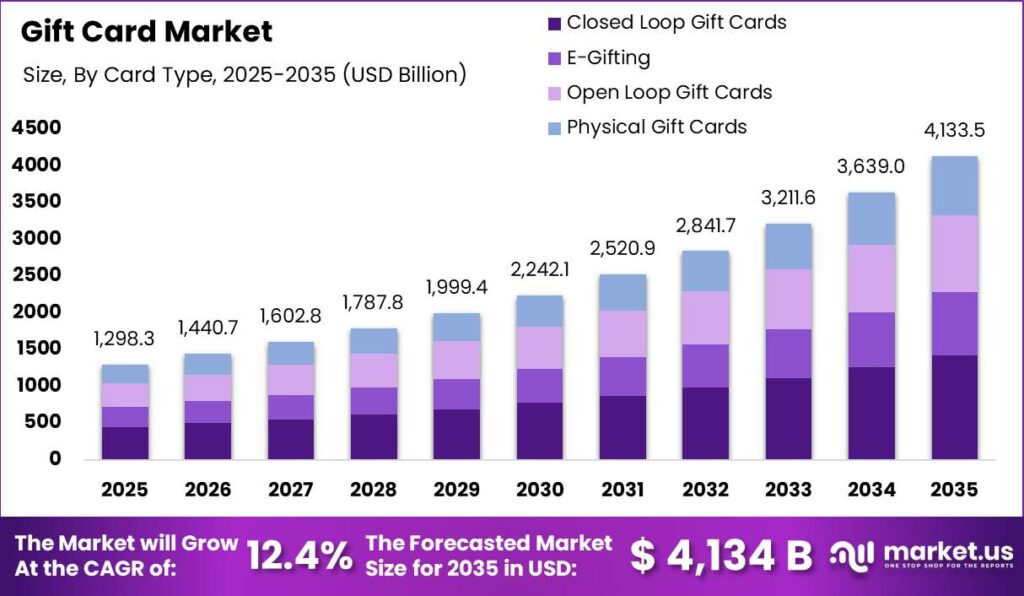
Global Gift Card Market size is expected to be worth around USD 4,134 Billion by 2035 from USD 1,298 Billion in 2025, growing at a CAGR of 12.4% during the forecast period 2026 to 2035. This trajectory reflects a structural shift in consumer and enterprise payment behavior at a global scale. Investors entering this market before the midpoint of the forecast window hold a meaningful first-mover advantage.
The gift card market encompasses prepaid stored-value instruments issued by retailers, financial networks, and third-party platforms for consumer gifting, corporate incentives, and loyalty applications. Products span physical plastic cards, digital e-gift codes, and hybrid omnichannel formats redeemable in-store or online. The market operates across closed-loop systems tied to single merchants and open-loop networks running on payment rails such as Visa and Mastercard. This dual-track structure supports distinct buyer profiles ranging from individual gift-givers to enterprise procurement teams.
Key Takeaways
- The global Gift Card Market is valued at USD 1,298 Billion in 2025 and is forecast to reach USD 4,134 Billion by 2035.
- The market grows at a CAGR of 12.4% from 2026 to 2035.
- By Merchant, Restaurants hold a 15.4% share, representing the leading named sub-segment in that category.
- By Card Type, Closed Loop Gift Cards dominate with a 34.5% share.
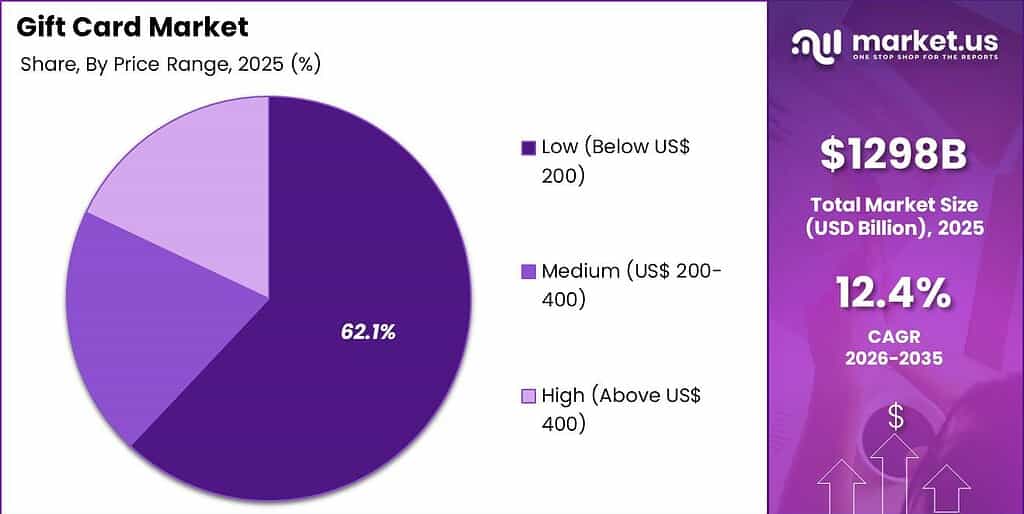
- By Price Range, Low (Below US$ 200) leads with a 62.1% share.
- By Sales Channel, Offline dominates with a 57.4% share.
- By End-user, Individuals lead with a 63.4% share.
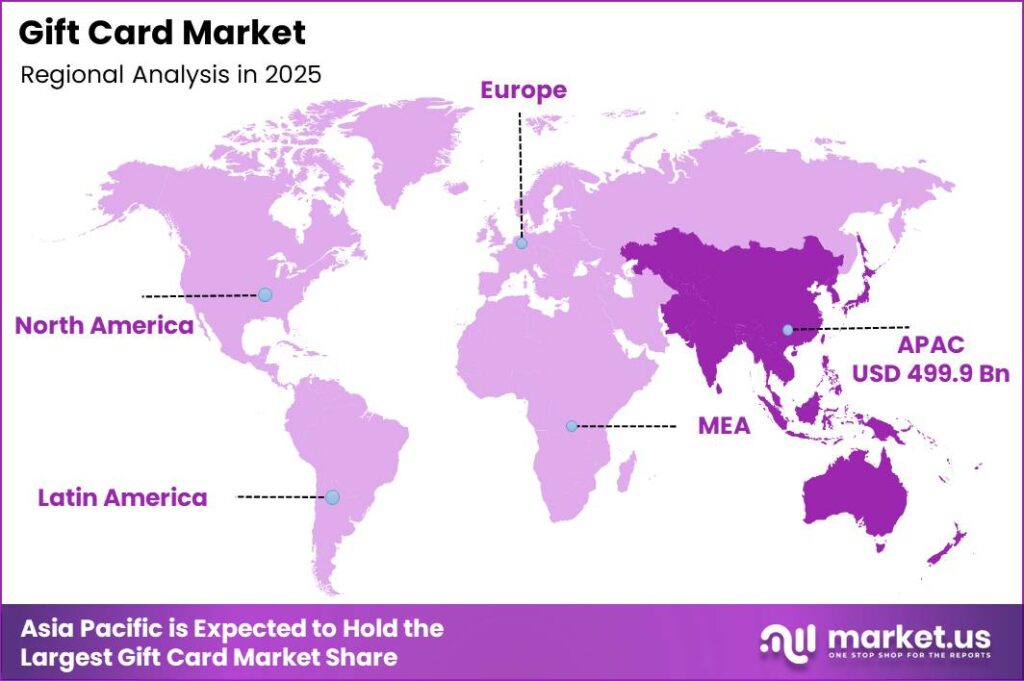
- Asia-Pacific is the dominant region with a 38.5% market share, valued at USD 499.90 Billion.
Regulatory pressure is reshaping physical card distribution. At least 10 U.S. states enacted gift card fraud statutes in 2025 alone, requiring tamper-evident packaging and mandatory employee training. These mandates increase per-unit compliance costs and compress margins for physical card issuers. Sellers who shift investment toward digital issuance infrastructure will absorb these pressures more efficiently than those dependent on open-rack retail display models.
Enterprise adoption is accelerating the commercial end of the market. Corporate reward and incentive programs are replacing cash-based disbursements with digital gift card delivery, widening the addressable market beyond consumer retail. This shift pulls procurement volumes into recurring, high-frequency distribution cycles rather than seasonal spikes. Platforms that embed API-based gifting directly into HR and loyalty software stand to capture the most durable share of this enterprise demand.
As per our research, Giftify reported $154.7 million in gross billings for full-year 2025, representing 27.1% year-over-year growth, with continued expansion of its gift card marketplace noted in March 2026. This growth rate outpaces the broader market CAGR, signaling that specialized marketplace operators are taking share from traditional physical card distribution. Investors tracking platform-model operators will find this segment the clearest indicator of where structural value is consolidating.
Merchant Analysis
Restaurants dominate with 15.4% due to high repeat gifting and occasion spend.
In 2025, Restaurants held a dominant market position in the By Merchant segment of the Gift Card Market, with a 15.4% share. Restaurant gift cards benefit from broad consumer familiarity and strong occasion-driven purchase behavior across birthdays, holidays, and corporate gifting. The National Restaurant Association reports the U.S. restaurant industry generated over $1 trillion in sales in 2024, establishing the scale of the underlying commerce base that gift card programs tap into. This scale creates structural demand that platforms targeting the food-service channel cannot afford to ignore.
Department Stores represent a high-value sub-segment within merchant-type gifting, attracting buyers who prioritize recipient flexibility over brand specificity. National Retail Federation data shows that department store gift cards rank consistently among the most requested gift formats during the November to January retail season. A U.S. retailer SEC filing for fiscal 2025 recorded 149,075 gift card activations and 163,026 redemptions including breakage recognition, reflecting the high velocity of card turnover in this channel. Operators serving this sub-segment must invest in real-time activation and redemption infrastructure to manage that throughput.
Grocery Stores and Supermarkets/Hypermarkets function as distribution hubs rather than destination merchants, making them structurally different from brand-specific issuers. These retailers carry third-party cards alongside their own programs, generating revenue from rack placement fees and commissions. The same 2025 SEC filing reported an ending gift card liability of USD 212.859 million, down from USD 226.810 million a year earlier, indicating active redemption cycles that reduce float duration. Coffee Shops, Book Stores, Discount Stores, Salons and Spas, and Entertainment venues collectively hold the remaining merchant share, each targeting narrower gifting occasions.
Card Type Analysis
Closed Loop Gift Cards dominate with 34.5% due to retailer margin control and loyalty lock-in.
In 2025, Closed Loop Gift Cards held a dominant market position in the By Card Type segment of the Gift Card Market, with a 34.5% share. Closed-loop instruments restrict spending to a single merchant or brand family, giving issuers full control over float, redemption timing, and customer re-engagement data. A May 2025 Tillo and Tenzing investment partnership targeted accelerated expansion of global rewards and digital gift card networks, reinforcing that closed-loop digital formats attract institutional capital. Retailers with established loyalty infrastructure are best positioned to convert this investment interest into closed-loop program scale.
E-Gifting is the fastest-shifting format within the card-type segment, driven by instant digital delivery and zero physical fulfillment cost. The International Telecommunication Union reported that global internet user penetration reached 67% in 2023, providing the connectivity base that e-gifting infrastructure depends on to reach scale. As smartphone and mobile wallet adoption expands in emerging markets, e-gifting programs gain addressable reach without proportional cost increases. Platforms investing now in mobile-first issuance pipelines will be first to capture volume in markets where physical card logistics remain underdeveloped.
Open Loop Gift Cards run on payment network rails such as Visa and Mastercard, enabling redemption at any accepting merchant location. This format serves consumers who prioritize flexibility over brand loyalty, making it structurally stronger in corporate incentive and employee reward use cases where recipient preferences vary widely. Physical Gift Cards retain relevance in in-store gifting occasions and markets where digital payment infrastructure remains limited, providing a fallback channel that physical retailers continue to rely on for seasonal volume. Open-loop and physical formats together serve the share of the market where closed-loop and e-gifting solutions have not yet achieved full penetration.
Price Range Analysis
Low (Below US$ 200) dominates with 62.1% due to broad consumer affordability and impulse purchase behavior.
In 2025, Low (Below US$ 200) held a dominant market position in the By Price Range segment of the Gift Card Market, with a 62.1% share. Sub-USD 200 cards align with the median gifting budget across most consumer demographics, making them the default format for personal occasions and small corporate rewards. World Bank household consumption data shows that discretionary expenditure on gifting and entertainment in emerging markets remains concentrated below the USD 200 threshold, keeping the low price tier structurally dominant as new geographies enter the market. Issuers who optimize for small-denomination digital delivery will capture the largest share of first-time buyers in these regions.
Medium price range cards (US$ 200 to US$ 400) serve a smaller but commercially significant buyer group concentrated in corporate procurement and high-value personal gifting. This tier attracts buyers who want to convey a premium message while retaining the recipient’s purchase freedom. IMF data on household income distribution in high-income OECD economies supports that this spending band correlates with upper-middle-income consumer segments in North America and Western Europe. B2B platforms targeting employee recognition programs find medium-tier denominations attractive because they exceed typical low-value token rewards while remaining below procurement approval thresholds.
High price range cards (Above US$ 400) represent the smallest share of the price range segment by volume but carry disproportionate revenue per transaction. These instruments appear most frequently in executive recognition programs, luxury retail gifting, and high-net-worth consumer occasions. OECD wealth distribution data confirms that the buyer pool for above-USD 400 gift instruments is concentrated among the top income quintile in advanced economies. Platforms serving this tier compete on exclusivity, security, and brand prestige rather than price, creating a defensible niche that mass-market issuers rarely contest directly.
Sales Channel Analysis
Offline dominates with 57.4% due to in-store impulse purchase and rack display reach.
In 2025, Offline held a dominant market position in the By Sales Channel segment of the Gift Card Market, with a 57.4% share. Physical retail rack placement at checkout and gift card display fixtures drives the majority of spontaneous gift card purchases, particularly during holiday and seasonal peak periods. The National Retail Federation reports that in-store shopping remains the primary purchase channel for gift-related categories during peak gifting seasons in the United States. Retailers who maintain strong in-store card rack programs and comply with emerging tamper-evident packaging requirements will protect this offline share through the near term.
Online sales channels hold a structurally growing position within the gift card market, supported by e-commerce penetration, mobile app purchasing, and direct-to-inbox digital delivery. UNCTAD e-commerce data shows global B2C e-commerce sales exceeded USD 3.3 trillion in 2023, establishing the transactional infrastructure that online gift card distribution rides. Platforms that embed gift card purchase options directly into checkout flows or loyalty apps reduce friction to near zero and capture purchase intent at the moment of highest buyer motivation. Operators scaling online channel capabilities now will absorb share from physical formats as digital consumer habits normalize across additional market segments.
End-user Analysis
Individuals dominate with 63.4% due to personal gifting frequency and occasion-driven purchasing.
In 2025, Individuals held a dominant market position in the By End-user segment of the Gift Card Market, with a 63.4% share. Individual consumers purchase gift cards primarily for personal gifting occasions including birthdays, holidays, and celebrations, generating a high-frequency, recurring demand cycle. ITU data shows global mobile phone subscriptions exceeded 8.5 billion in 2023, reflecting the device penetration that now enables individuals to purchase and send digital gift cards without visiting a physical store. Platforms with seamless mobile-native purchase flows convert this connectivity into direct sales volume.
Business buyers represent the fastest-growing end-user segment within the gift card market, driven by corporate incentive, employee recognition, and customer loyalty program adoption. Small and Medium Enterprises use gift cards as a flexible, low-administration reward tool that avoids the complexity of managed benefit programs. Large Enterprises deploy gift cards at scale through API-integrated platforms that connect directly to HR, payroll, and procurement systems. OECD data on enterprise digital payment adoption shows that B2B prepaid instrument use is accelerating across North America and Western Europe, which means platforms that prioritize API infrastructure and volume pricing will capture the highest-value share of this business buyer segment.
Key Market Segments
By Merchant
- Book Store
- Coffee Shops
- Department Stores
- Discount Stores
- Entertainment
- Grocery Stores
- Restaurants
- Salons/Spa
- Supermarkets/Hypermarkets
- Others
By Card Type
- Closed Loop Gift Cards
- E-Gifting
- Open Loop Gift Cards
- Physical Gift Cards
By Price Range
- High (Above US$ 400)
- Medium (US$ 200-400)
- Low (Below US$ 200)
By Sales Channel
- Online
- Offline
By End-user
- Business
- Small and Medium Enterprises
- Large Enterprises
- Individuals
Regional Analysis
Asia-Pacific Dominates the Gift Card Market with a Market Share of 38.5%, Valued at USD 499.90 Billion
Asia-Pacific commands 38.5% of the global gift card market, valued at USD 499.9 Billion. This position reflects the region’s high mobile payment penetration, large digitally active consumer populations in China, Japan, South Korea, and India, and the rapid expansion of super-app ecosystems that embed gift card functionality within broader commerce platforms. Retailers and platform operators entering Asia-Pacific markets gain immediate access to the world’s largest addressable pool of digital-native consumers, making this region the highest-priority expansion target for any issuer scaling globally.
In April 2025, Recharge acquired Giftcloud Limited from Groupon to expand into the B2B digital rewards and corporate gift card market, a move that signals growing institutional appetite for cross-border digital gifting infrastructure in high-growth regions. This type of acquisitive expansion reflects the competitive urgency that platform operators feel to secure distribution reach before market consolidation matures. Emerging Asia-Pacific markets including India and Southeast Asia represent the fastest-growing sub-region within this geography, driven by expanding internet access, rising smartphone adoption, and government-backed digital payment initiatives that reduce friction for new gift card users.
North America and Europe collectively represent the next largest regional blocks, anchored by established retail infrastructure, high per-capita gift card spend, and mature compliance frameworks. These regions generate the highest average transaction values and the deepest corporate incentive program penetration. Latin America and the Middle East and Africa represent earlier-stage markets where digital infrastructure investment is beginning to unlock gift card adoption among previously underserved consumer segments. Operators with scalable digital issuance platforms and multi-currency support are best positioned to capture volume in these regions as penetration deepens.
Key Regions and Countries
North America
- US
- Canada
Europe
- Germany
- France
- The UK
- Spain
- Italy
- Rest of Europe
Asia Pacific
- China
- Japan
- South Korea
- India
- Australia
- Rest of APAC
Latin America
- Brazil
- Mexico
- Rest of Latin America
Middle East and Africa
- GCC
- South Africa
- Rest of MEA
Market Dynamics
Market Opportunity Analysis - Underexploited segments and emerging geographies signal durable entry points for focused operators
The Low price range tier holds a 62.1% share of the gift card market, yet its dominance masks a significant sub-opportunity: small-denomination digital card issuance in emerging Asia-Pacific markets where smartphone penetration is rising faster than formal banking access. Issuers focused on mobile-first, sub-USD 200 digital instruments in India and Southeast Asia face minimal direct competition from incumbent physical card distributors. This combination of high volume potential and low competitive density makes the low-value digital tier in emerging Asia-Pacific one of the clearest entry points available.
The Business end-user segment holds a minority share against Individuals’ 63.4%, yet corporate incentive programs generate structurally higher transaction values, recurring purchase cycles, and predictable volume. Small and Medium Enterprises represent the least-served tier within the business buyer group because API-integrated platforms have historically targeted large enterprise procurement budgets. Operators who build lightweight B2B onboarding tools and volume pricing structures specifically for SME buyers will access a high-frequency demand pool that larger platforms have left commercially underdeveloped.
The Online sales channel currently holds the minority position against Offline’s 57.4% dominance, yet the structural direction of consumer purchasing behavior favors digital channel growth across every geography. Offline dominance reflects historical inertia in rack-based retail display rather than consumer preference for physical formats. Consequently, operators who accelerate digital channel investment now will benefit from the channel share shift before offline incumbents complete their own digital transitions. This timing asymmetry creates a durable window for platform-native entrants to build distribution advantages that physical-first competitors will find difficult to replicate quickly.
E-Gifting within the Card Type segment remains structurally underpenetrated relative to its unit-cost advantages over physical and closed-loop formats. Open-loop cards retain a large share of the corporate gifting market because their flexibility appeals to enterprise procurement buyers who cannot predict recipient preferences. However, this same buyer group increasingly prefers digital delivery for speed and auditability. Platforms that combine open-loop flexibility with e-gift delivery infrastructure can serve enterprise buyers currently split across multiple vendors, consolidating wallet share in a segment where no single operator has yet established clear dominance.
Technology and Innovation Landscape - Digital issuance, authentication, and tokenization are redefining competitive positioning across the gift card market
QR code-based digital gift cards are replacing physical plastic formats in mobile commerce environments, reducing fulfillment latency to near zero and eliminating physical supply chain costs entirely. This format shift is not cosmetic. It fundamentally changes the unit economics of gift card issuance by removing per-card manufacturing, packaging, and distribution expense. Operators who build QR-native issuance pipelines gain a margin advantage over physical card producers that compounds with each incremental unit of digital volume they add to their platforms.
Stronger authentication requirements for digital wallets are improving prepaid payment security across the gift card category. Regulatory pressure from consumer protection agencies in North America and Europe is accelerating the adoption of multi-factor verification at the point of digital card purchase and redemption. According to Market.us data, mobile web experiences in the gift card category improved by 9% year over year in 2025, reflecting measurable operational gains from authentication and UX investment. Platforms that treat security infrastructure as a product differentiator rather than a compliance cost will convert this improvement into lower fraud rates and higher consumer trust scores.
Tokenization and secure digital credential storage are restructuring how prepaid payment instruments are managed across wallets and platforms. Tokenized gift card credentials eliminate the risk of static card number exposure that drives the majority of balance-draining fraud. Financial Stability Board sandbox frameworks are beginning to accommodate tokenized prepaid instruments alongside broader digital asset classifications, creating a regulatory path for wider adoption. Issuers who invest in tokenization infrastructure now position themselves ahead of the compliance curve, reducing future remediation costs while simultaneously improving the security profile they present to enterprise procurement buyers.
Retailers are expanding omnichannel digital gift card redemption across both online and in-store channels, a direct response to consumer expectations for format flexibility. This omnichannel capability requires back-end integration between point-of-sale systems, digital wallet platforms, and loyalty program databases, which creates a significant technology investment barrier for smaller operators. However, operators who complete this integration eliminate the channel friction that causes redemption abandonment and breakage. This signals that omnichannel redemption capability will shift from a competitive differentiator to a minimum table-stakes requirement within the medium-term forecast window.
Drivers
Digital issuance is the market’s most powerful structural force. Physical cards carry manufacturing, packaging, and distribution costs that disappear entirely in an e-gift workflow, expanding incremental margin per redemption without changing retail selling prices. Digital formats crossed 58% of combined U.S. gift and incentive card volume by 2025, and digital purchasing expanded at close to 2.5 times the pace of physical cards across mature European markets in the same year. This cost removal converts format substitution into real CAGR uplift, contributing a leading +3.4% to the baseline.
Mobile wallet embedding and B2B corporate demand operate as compounding secondary forces. Mobile wallet and NFC redemption integration adds +2.1% to the CAGR, concentrated in Asia-Pacific and North America where mobile payment infrastructure is deepest. Corporate incentive and rewards demand contributes a further +1.8%, particularly in North America and Western Europe where enterprises are replacing cash-based disbursements with digital gift card delivery. Retailer float monetization, marketplace aggregator scale, and API-embedded commerce integration add an additional combined +3.1%, reinforcing that this market’s growth engine is structural rather than cyclical.
| Driver | (~) % Impact on CAGR Forecast | Geographic Relevance | Impact Timeline |
|---|---|---|---|
| Digital and eGift format migration | +3.4% | Global, led by North America and Western Europe | Short term (2 years or less) |
| Mobile wallet and NFC redemption embedding | +2.1% | Asia Pacific, North America | Short term (2 years or less) |
| B2B corporate incentive and rewards demand | +1.8% | North America, Western Europe | Medium term (2 to 4 years) |
| Retailer working-capital float monetization | +1.2% | Global | Medium term (2 to 4 years) |
| Marketplace and aggregator distribution scale | +1.0% | Global, emerging market acceleration | Short term (2 years or less) |
| API and embedded-commerce integration | +0.9% | North America, Asia Pacific | Medium term (2 to 4 years) |
Restraints
State-level anti-fraud legislation is the dominant restraint compressing physical card margins today. Legislative tracking from the National Conference of State Legislatures documents at least 10 states enacting gift card fraud statutes in 2025, modeled on Ohio’s 2024 framework. These laws impose tamper-evident packaging, checkout warning signage, and mandatory employee training. Merchants unable to absorb these per-unit compliance costs face pressure to reduce open-rack card inventory, directly suppressing in-store sell-through volumes.
Escheatment liability, elevated interest rates on issuer float, and chargeback exposure layer additional drag onto physical and digital operators alike. Maryland set open-loop compliance deadlines for June 1, 2025 and closed-loop for October 1, 2025, alongside parallel New Jersey requirements, creating hard cost events that forced packaging supply chain re-engineering. Consumer Financial Protection Bureau complaint data on gift card scams reinforces that non-compliance carries enforcement and reputational risk beyond direct cost. Together, these restraints subtract a combined -6.6% from maximum achievable CAGR, making compliance investment a prerequisite for sustained market participation rather than an optional upgrade.
| Restraint | (~) % Impact on CAGR Forecast | Geographic Relevance | Impact Timeline |
|---|---|---|---|
| State fraud statutes and compliance mandates | -2.3% | United States, multi-state | Short term (2 years or less) |
| Unredeemed balance escheatment liability | -1.4% | United States, select European jurisdictions | Medium term (2 to 4 years) |
| Elevated interest rates on issuer float | -1.1% | Global | Short term (2 years or less) |
| Chargeback and scam-driven merchant liability | -1.0% | North America, Western Europe | Short term (2 years or less) |
| Consumer trust erosion from fraud publicity | -0.8% | Global | Medium term (2 to 4 years) |
Challenges
Fragmented cross-border redemption standards are the most severe structural friction in the gift card market. Divergent national payments rails, inconsistent escheatment rules, and uneven consumer protection regimes prevent cards issued in one jurisdiction from redeeming cleanly in another. Bank for International Settlements monitoring highlights persistently high per-transaction friction costs in cross-border retail flows. This interoperability gap suppresses the addressable ceiling in international markets even where consumer demand clearly exists, imposing a -1.6% drag on maximum growth potential.
Real-time fraud detection deficits, payments engineering talent shortages, and legacy POS integration complexity compound the cross-border challenge for operators scaling globally. Issuers must invest in multi-currency ledger infrastructure and ISO 20022-aligned messaging to resolve the settlement fragmentation problem, a multi-year engineering commitment. World Bank Findex data shows uneven digital-payment penetration leaves large emerging-market consumer cohorts unable to redeem international card issuances. These combined friction points subtract an additional -3.5% from achievable CAGR, distinguishing them from compliance restraints by their long mitigation horizon rather than near-term resolvability.
| Challenge | (~) % CAGR Friction Drag | Geographic Relevance | Mitigation Horizon |
|---|---|---|---|
| Fragmented cross-border interoperability | -1.6% | Global, emerging markets acute | Long term (4 years or more) |
| Real-time fraud detection tech deficit | -1.3% | Global | Medium term (2 to 4 years) |
| Payments engineering talent shortage | -0.9% | North America, Western Europe | Medium term (2 to 4 years) |
| Legacy POS integration complexity | -0.7% | Global, mature retail markets | Medium term (2 to 4 years) |
| Currency and settlement volatility drag | -0.6% | Emerging markets, Latin America | Long term (4 years or more) |
Opportunities
Programmable blockchain-based gift instruments represent the highest-upside white space in the market today. Current digital cards are static, single-redemption records. A tokenized gift asset carries embedded logic for conditional spend, resale, and multi-brand redemption across multiple merchants. Bank for International Settlements payments research associates distributed-ledger settlement with meaningful per-transaction cost compression, while Financial Stability Board sandbox frameworks are beginning to accommodate smart-contract expiration and escheatment enforcement. Capturing even early adopters in this space adds an estimated +2.6% above the baseline CAGR.
Emerging-market unbanked cohort capture, fragmented reseller M&A, and loyalty-gaming ecosystem convergence together add up to +4.6% in potential CAGR upside for operators who act within the medium-term window. South Asia, Sub-Saharan Africa, and Southeast Asia hold the largest concentrations of consumers who currently lack access to traditional banking but carry active mobile connections capable of supporting prepaid digital instruments. IMF digital-money analysis confirms that tokenized retail payment rails are maturing in these regions. Platforms that deploy lightweight mobile-first issuance products in these markets before incumbent networks consolidate will secure the most defensible long-run growth positions.
| Opportunity | (~) % Potential CAGR Upside | Geographic Relevance | Execution Window |
|---|---|---|---|
| Programmable blockchain-based gift assets | +2.6% | Global, digital-native cohorts | Long term (4 years or more) |
| Emerging-market unbanked cohort capture | +2.0% | South Asia, Sub-Saharan Africa, Southeast Asia | Medium term (2 to 4 years) |
| Fragmented reseller M&A roll-up | +1.5% | North America, Europe | Medium term (2 to 4 years) |
| Subscription and recurring-load monetization | +1.3% | North America, Asia Pacific | Medium term (2 to 4 years) |
| Loyalty and gaming ecosystem convergence | +1.1% | Global, Asia Pacific led | Medium term (2 to 4 years) |
Key Company Insights
Amazon.com, Inc. operates one of the world’s largest closed-loop gift card ecosystems, embedded directly within its Prime membership and checkout infrastructure. This integration means Amazon captures gift card purchases and redemptions without relying on third-party distribution networks, giving it a structural cost and data advantage over standalone issuers. However, this closed-loop concentration creates dependency risk if regulatory changes target dominant e-commerce gift card bundling practices in key markets.
Blackhawk Network holds a uniquely powerful position as both a program manager and a distribution infrastructure provider across retail verticals. Its 2025 benchmark evaluated 100 U.S. merchants across 17 retail verticals using 126 separate evaluation criteria to assess digital gift card purchasing and recipient experiences. In May 2025, Giftify completed the acquisition of Takeout7, expanding its technology platform with AI-powered restaurant marketing capabilities alongside its CardCash gift card business, signaling that AI integration is becoming a competitive differentiator in platform-model operators. Blackhawk’s multi-vertical reach positions it to serve both enterprise and consumer buyers from a single distribution layer.
Key Players
- Amazon.com, Inc.
- Walmart Inc.
- Visa Inc.
- The Home Depot, Inc.
- Target Corporation
- Starbucks Corporation
- Pine Labs Pvt.
- PayPal Holdings, Inc.
- Mastercard Incorporated
- Gyft
- Blackhawk Network
- Best Buy Company, Inc.
- American Express Company
Recent Developments
- June 2025: Blackhawk Network launched the Tap to Pay Visa Gift Card, introducing a contactless physical gift card with enhanced security features, tamper-evident packaging, and mobile wallet integration.
- July 2025: Blackhawk Network expanded its strategic partnership with Recharge Group to provide millions of consumers worldwide with broader access to digital gift cards through Recharge.com and Startselect.com.
- February 2025: Raise secured a USD 63 million funding round led by Haun Ventures to accelerate its blockchain-powered gift card and loyalty platform, bringing its total funding to over USD 220 million.
- April 2025: TDS Gift Cards entered a strategic agreement with Card Compliant to provide integrated gift card issuance and program management using the CIMI Card platform.
Geopolitical Impact Analysis
Trade policy uncertainty is reshaping the cost structure of physical gift card manufacturing and cross-border digital payment infrastructure. According to WTO data, global goods trade growth slowed to 2.7% in 2024 amid ongoing tariff disputes between major trading blocs, directly raising input costs for the plastic substrates, chip components, and secure packaging materials that physical card producers source internationally. As a result, physical card unit costs are rising at a rate that accelerates the economic case for digital format migration, compressing the competitive window for manufacturers still dependent on global physical supply chains.
Geopolitical fragmentation is also complicating cross-border digital gift card settlement. IMF data shows that currency volatility in emerging markets increased materially during 2024 and 2025, with several Latin American and South Asian currencies experiencing exchange rate movements exceeding 15% against the U.S. dollar in single fiscal years. This volatility inflates settlement risk for open-loop operators managing multi-currency card programs across jurisdictions with unstable monetary policy environments. Platforms without multi-currency hedging infrastructure and ISO 20022-aligned settlement rails face direct margin erosion on every cross-border transaction processed during periods of elevated exchange rate instability.
Report Scope
| Report Features | Description |
|---|---|
| Market Value (2025) | USD 1,298 Billion |
| Forecast Revenue (2035) | USD 4,134 Billion |
| CAGR (2026-2035) | 12.4% |
| Base Year for Estimation | 2025 |
| Historic Period | 2020-2024 |
| Forecast Period | 2026-2035 |
| Report Coverage | Revenue Forecast, Market Dynamics, Market Opportunity Analysis, Technology and Innovation Landscape, Competitive Landscape, Recent Developments |
| Segments Covered | By Merchant (Book Store, Coffee Shops, Department Stores, Discount Stores, Entertainment, Grocery Stores, Restaurants, Salons/Spa, Supermarkets/Hypermarkets, Others), By Card Type (Closed Loop Gift Cards, E-Gifting, Open Loop Gift Cards, Physical Gift Cards), By Price Range (High Above US$ 400, Medium US$ 200-400, Low Below US$ 200), By Sales Channel (Online, Offline), By End-user (Business: Small and Medium Enterprises, Large Enterprises; Individuals) |
| Regional Analysis | North America (US and Canada), Europe (Germany, France, The UK, Spain, Italy, and Rest of Europe), Asia Pacific (China, Japan, South Korea, India, Australia, and Rest of APAC), Latin America (Brazil, Mexico, and Rest of Latin America), Middle East and Africa (GCC, South Africa, and Rest of MEA) |
| Competitive Landscape | Amazon.com Inc., Walmart Inc., Visa Inc., The Home Depot Inc., Target Corporation, Starbucks Corporation, Pine Labs Pvt., PayPal Holdings Inc., Mastercard Incorporated, Gyft, Blackhawk Network, Best Buy Company Inc., American Express Company |
| Customization Scope | Customization for segments, region / country-level will be provided. Additional customization can be done based on requirements. |
| Purchase Options | We have three licenses to opt for: Single User License | Multi-User License (Up to 5 Users) | Corporate Use License (Unlimited User and Printable PDF) |





































