


Report Overview
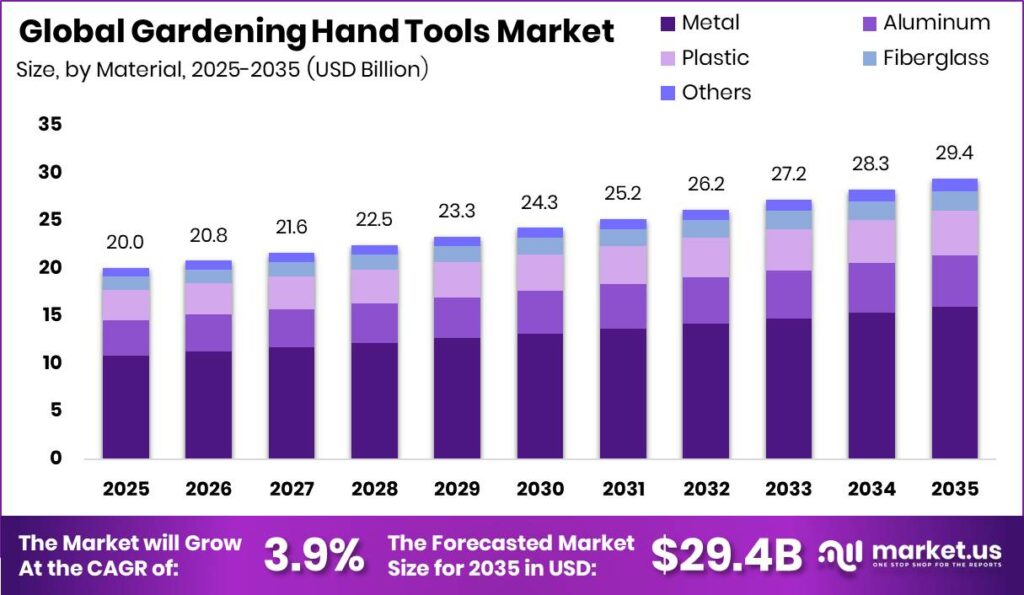
Global Gardening Hand Tools Market size is expected to be worth around USD 29.40 Billion by 2035 from USD 20.00 Billion in 2025, growing at a CAGR of 3.9% during the forecast period 2026 to 2035. This growth rate reflects a mature category with a stable replacement cycle. Steady demand gives manufacturers predictable volume planning rather than boom-and-bust risk.
The gardening hand tools market covers manual implements used for digging, pruning, striking, watering, and weeding tasks. Buyers split into residential hobbyists and commercial landscaping operators. This structure creates two distinct demand engines. Residential buyers chase affordability and ergonomics, while commercial buyers prioritize durability and repeat-use lifespan. Vendors must therefore build separate product tiers to serve both without diluting brand value.
Key Takeaways
- Global market reaches USD 29.40 Billion by 2035, up from USD 20.00 Billion in 2025 at a 3.9% CAGR.
- Pruning Tools lead the product segment with a 32.6% share.
- Metal dominates the material segment with a 54.3% share.
- Residential end users hold a 65.7% share, also the fastest-growing.
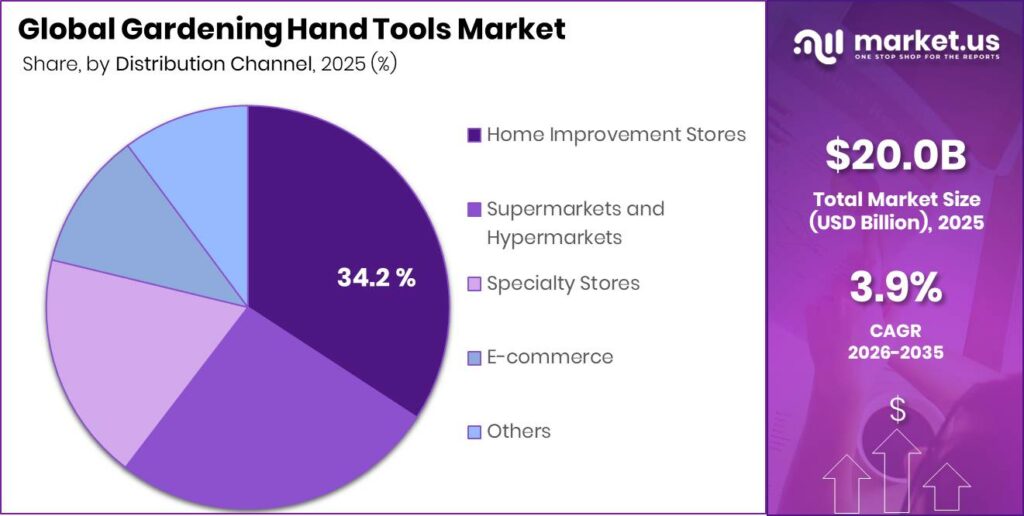
- Home Improvement Stores lead distribution with a 34.2% share.
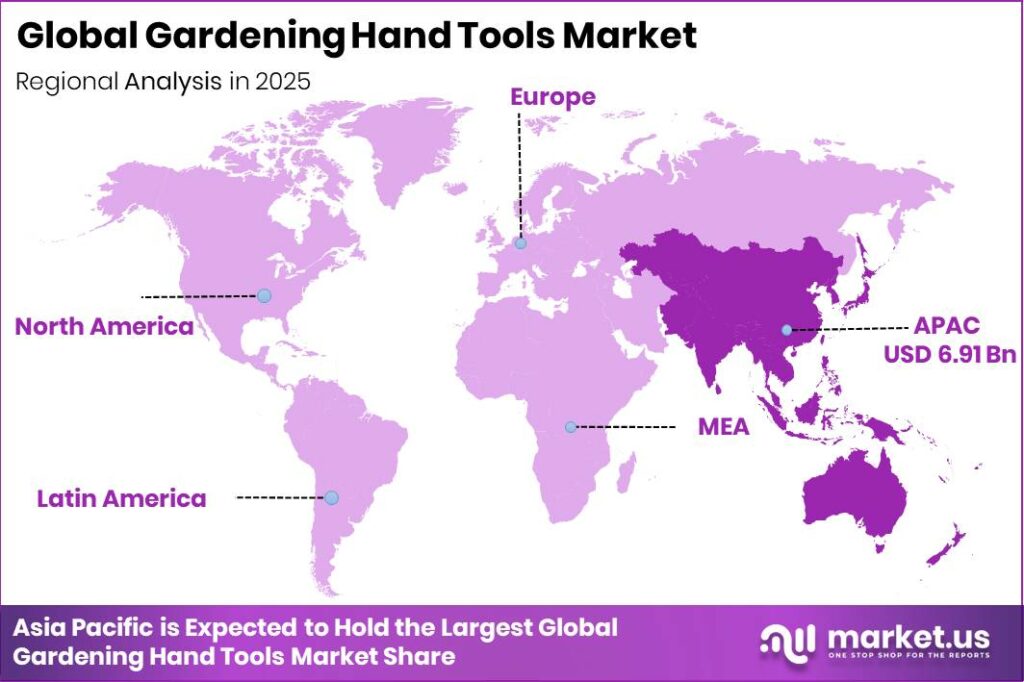
- Asia-Pacific dominates with a 34.5% share, valued at USD 6.91 Billion.
Government bodies now treat manual tool manufacturing as a strategic export sector. As reported by NITI Aayog, India plans to develop 3 to 4 dedicated hand-tool manufacturing clusters spanning 4,000 acres by 2035. This policy expands low-cost production capacity for gardening hand tools. Manufacturers sourcing from these clusters can lower landed costs and defend margins against imported commodity tools.
Health data is reshaping product design priorities across the category. Data from the ISAE greenhouse study shows 91.6% of manual-tool workers reported musculoskeletal disorder symptoms. This finding exposes a clear ergonomic gap in traditional tools. Brands that engineer strain-reducing handles can convert a health problem into a premium selling point.
Repetitive-strain evidence strengthens the case for ergonomic redesign further. The same study found lower-back symptoms in 94.4% of female and 94.2% of male workers. This near-universal strain signals a large unmet comfort need. Therefore, manufacturers who lead with tested ergonomic claims can capture health-conscious buyers before rivals react.
Product Analysis
Pruning Tools dominate with 32.6% due to frequent seasonal cutting and trimming needs.
In 2025, Pruning Tools held a dominant market position in the By Product segment of Gardening Hand Tools Market, with a 32.6% share. As reported by UN Comtrade, global trade in hand tools under heading HS 8201 spans over 200 reporting countries. This wide trade base confirms deep global demand for cutting implements. Vendors with broad export reach can spread seasonal demand risk across hemispheres and smooth annual revenue.
Digging tools serve the foundational tasks of soil preparation and planting. Figures from UNCTAD show global goods trade reached about US$ 33 Trillion in 2024, with tool categories moving through standardized customs channels. This scale supports reliable component sourcing for spades and forks. Manufacturers can therefore secure steady steel inputs and hold consistent shelf pricing for these staple tools.
Striking tools rank as the fastest-growing product line, driven by landscaping and hard-ground work. Data from UN Comtrade shows India shipped hand tools worth USD 600 Million in 2025. This export volume confirms rising manufacturing capacity for heavy-duty implements. Buyers gain more sourcing options, which pressures incumbents to compete on both durability and price.
Watering, weeding, and other tools together fill the remaining share of the product mix. The same trade data indicates India’s hand tools hold 1.8% of global market share. This modest slice shows room for volume expansion in accessory categories. Consequently, suppliers who bundle watering and weeding tools with core kits can lift average order value across mass retail.
Material Analysis
Metal dominates with 54.3% due to strength and long service lifespan.
In 2025, Metal held a dominant market position in the By Material segment of Gardening Hand Tools Market, with a 54.3% share. According to NITI Aayog, India’s power-tool exports reached USD 425 Million in 2025, reflecting strong metal-forming capacity. This industrial base supports steady steel tool output. Manufacturers with local metalworking access can protect delivery timelines and resist supply shocks.
Aluminum tools attract buyers who want strength with reduced carrying weight. Data from UNIDO shows aluminum ranks among the most traded industrial metals worldwide by volume. This availability keeps input costs predictable for lightweight tool lines. Vendors can therefore offer mid-weight tools to aging gardeners without steep price increases.
Plastic components lower cost and appeal to entry-level residential buyers. Figures from UN Comtrade show plastic products move through global trade under widely tracked HS codes. This scale enables cheap, high-volume handle and body production. As a result, brands can defend budget price points against imported starter kits.
Fiberglass ranks as the fastest-growing material, prized for its light weight and rust resistance. The same trade classification tracks composite materials across major exporting economies. This traceability supports reliable fiberglass sourcing at scale. Manufacturers who shift premium handles to fiberglass can command higher margins while older materials fill economy tiers collectively.
End-User Analysis
Residential dominates with 65.7% due to widespread home gardening participation.
In 2025, Residential held a dominant market position in the By End-User segment of Gardening Hand Tools Market, with a 65.7% share. As reported by STIHL, the company maintains more than 1,600 authorized dealers across India for garden tools. This dense network puts tools within easy reach of home users. Brands with wide dealer coverage convert casual interest into repeat retail purchases faster.
Commercial buyers include landscapers, nurseries, and municipal grounds teams. Figures from the World Bank show services and construction activity expanding across major economies. This activity drives demand for durable professional-grade tools. Consequently, suppliers who certify tool lifespan and offer bulk warranties can lock in high-volume commercial contracts.
Distribution Channel Analysis
Home Improvement Stores dominate with 34.2% due to broad in-store tool selection.
In 2025, Home Improvement Stores held a dominant market position in the By Distribution Channel segment of Gardening Hand Tools Market, with a 34.2% share. According to STIHL, its retail footprint exceeds 1,600 dealer outlets in a single major market. This physical scale drives impulse and replacement purchases. Retailers with wide floor space capture buyers who prefer to handle tools before buying.
Supermarkets and hypermarkets place gardening tools alongside everyday goods. Data from the World Bank shows organized retail continues expanding across emerging economies. This growth widens seasonal shelf placement for basic tools. Vendors can therefore ride grocery footfall to move high-volume, low-cost trowels and pruners.
Specialty stores serve committed gardeners seeking expert advice and premium brands. Figures from UN Comtrade confirm steady cross-border flows of branded hand tools worldwide. This supply supports curated premium assortments. As a result, specialty retailers can defend margins by stocking ergonomic and professional lines that big-box channels overlook.
E-commerce ranks as the fastest-growing channel, aided by direct-to-consumer shipping. The same trade data shows tool categories move efficiently through parcel logistics globally. This reach lets small brands sell without shelf-space costs. Other channels hold the remaining share collectively, giving digital-first sellers room to expand fast.
Key Market Segments
By Product
- Digging Tools
- Pruning Tools
- Striking Tools
- Watering Tools
- Weeding Tools
- Others
By Material
- Metal
- Aluminum
- Plastic
- Fiberglass
- Others
By End-User
- Residential
- Commercial
By Distribution Channel
- Supermarkets and Hypermarkets
- Home Improvement Stores
- Specialty Stores
- E-commerce
- Others
Regional Analysis
Asia-Pacific Dominates the Gardening Hand Tools Market with a Market Share of 34.5%, Valued at USD 6.91 Billion
Asia-Pacific leads the gardening hand tools market with a 34.5% share, valued at USD 6.91 Billion in 2025. As per our research, low-cost manufacturing clusters and rising home gardening drive this dominance. This scale advantage lets regional producers export tools cheaply worldwide. Global brands sourcing from Asia-Pacific can lower unit costs and defend shelf pricing against premium rivals.
North America ranks as a fast-growing region, powered by strong DIY and home-improvement spending. As per our research, dense home-improvement retail networks push high replacement volumes. This retail depth accelerates repeat purchases of pruners and trowels. Therefore, brands that secure big-box shelf space capture the bulk of seasonal North American demand.
Europe holds a strong position, supported by premium and ergonomic tool demand. In November 2025, FELCO launched FELCO KIDS, a range of child-friendly gardening tools to encourage young European users. This move widens the buyer base beyond adults. As a result, manufacturers who target family gardening can build early brand loyalty across generations.
Key Regions and Countries
North America
- US
- Canada
Europe
- Germany
- France
- The UK
- Spain
- Italy
- Rest of Europe
Asia Pacific
- China
- Japan
- South Korea
- India
- Australia
- Rest of APAC
Latin America
- Brazil
- Mexico
- Rest of Latin America
Middle East and Africa
- GCC
- South Africa
- Rest of MEA
Market Dynamics
Market Opportunity Analysis - Underexploited segments and fast-rising channels open clear entry points for new players
The Commercial end-user segment stays underexploited next to the 65.7% residential share. Landscapers and nurseries need durable, high-cycle tools that few brands specialize in today. This gap leaves professional buyers underserved by consumer-focused ranges. Therefore, entrants who build certified commercial lines can win contract volume with limited direct competition.
Fiberglass sits below the 54.3% metal share yet ranks as the fastest-growing material. Its light weight and rust resistance suit both seniors and premium buyers. This means demand is climbing faster than current supply. Consequently, manufacturers who scale fiberglass tool lines early can claim share before commodity producers pivot.
E-commerce holds less than the 34.2% held by Home Improvement Stores yet grows fastest among channels. Direct-to-consumer shipping lets small brands skip shelf-space costs entirely. This lowers the barrier for new entrants without retail relationships. As a result, digital-first sellers can test niche tools and scale winners quickly.
Striking tools trail the 32.6% pruning share while growing fastest in the product mix. Rising landscaping and hard-ground work push demand for these heavy-duty implements. This signals unmet volume in a category few brands prioritize. Instead of crowding pruning, new players can target striking tools for cleaner competitive space.
Technology and Innovation Landscape - Battery power and product customization reshape the manual tool edge
Battery-powered pruning shears now reduce operator fatigue during long tasks. As per our research, cordless pruning shears keep users’ hands less prone to discomfort across extended operating periods. This shift blurs the line between manual and powered tools. Therefore, brands that add battery options to hand-tool ranges can capture buyers seeking comfort without heavy machinery.
Product customization is emerging as a premium differentiator in pruning tools. In October 2025, FELCO introduced fully customizable FELCO 6 and FELCO 8 shears with personalized handle size, blade settings, and finishes. This tailoring improves fit and reduces strain for individual users. As a result, manufacturers can defend premium pricing through bespoke ergonomics that commodity tools cannot match.
Ergonomic engineering is becoming a core innovation focus across the category. As per our research, angled and cushioned handles reduce strain during prolonged manual tool use. This design shift addresses the high injury rates seen among frequent users. Consequently, brands investing in tested ergonomic features can convert health concerns into measurable sales advantages.
Drivers
Household gardening participation is expanding the active tool-user base across mature markets. As per our research, around 55% of U.S. households garden, equal to roughly 71.5 million households and about 185.9 million individuals in 2025. In the U.K., about 80% of adults have garden access and an estimated 27 million people garden as a hobby. This broad base lifts annual unit demand for trowels, pruners, rakes, and hoes.
Even small shifts in buying behavior create meaningful volume gains for suppliers. As per our research, a 5% to 7% rise in tool purchases or replacements per household lifts throughput for manufacturers and retailers. This uplift contributes around 1.6% to the baseline 3.9% CAGR. Therefore, brands that broaden household reach can grow steadily within a mature category.
| Driver | (~) % Impact on CAGR Forecast | Geographic Relevance | Impact Timeline |
|---|---|---|---|
| Rising home gardening participation | +1.6% | North America, Europe | Short term (≤ 2 years) |
| Urban gardening and small-space landscaping | +0.9% | North America, Europe, Asia Pacific | Medium term (2–4 years) |
| DIY outdoor improvement projects | +0.7% | North America, Europe | Short term (≤ 2 years) |
| Health and wellness-driven gardening adoption | +0.5% | Global | Medium term (2–4 years) |
| Seasonal promotional activity by big-box retailers | +0.3% | North America, Europe | Short term (≤ 2 years) |
Restraints
Low-cost mass production is eroding pricing power for established brands. As per our research, basic tools such as trowels and hand forks now sell under roughly 5 dollars at mass-market retailers, with starter kits priced between 10 and 15 dollars. These prices undercut ergonomic or sustainably sourced tools by two to three times. This gap blocks premium brands from raising prices to cover steel and wood cost swings.
Margin pressure limits value growth even when unit volumes hold steady. As per our research, some premium hand tool lines saw margin erosion of 2% to 4% over recent seasons while absorbing higher material costs. This drag subtracts an estimated 1.3% from the baseline 3.9% CAGR. Therefore, brands must justify premiums with clear performance and durability proof.
| Restraint | (~) % Impact on CAGR Forecast | Geographic Relevance | Impact Timeline |
|---|---|---|---|
| Competition from low-cost mass-produced tools | -1.3% | Global | Short term (≤ 2 years) |
| Weather volatility reducing gardening activity | -0.9% | North America, Europe | Short term (≤ 2 years) |
| Substitution by powered gardening equipment | -0.7% | North America, Europe | Medium term (2–4 years) |
| Retail shelf-space pressure from higher-margin categories | -0.5% | North America, Europe | Medium term (2–4 years) |
Challenges
Seasonal demand concentration makes accurate forecasting hard for retailers. As per our research, many retailers record over 60% of annual tool volume in a 3 to 4 month window, while winter months hold under roughly 15% of sales. Weather and local trend swings cause sell-through to deviate 10% to 20% from pre-season plans. This variability raises the risk of both overstock and stock-outs.
Forecast errors tie up capital and squeeze margins on both sides. As per our research, over-forecasting triggers markdowns and carryover that depress gross margins by an estimated 2% to 3%. This friction caps the market’s growth potential by roughly 0.8% against the baseline 3.9% CAGR. Therefore, investment in data-driven planning becomes a competitive necessity, not an option.
| Challenge | (~) % CAGR Friction Drag | Geographic Relevance | Mitigation Horizon |
|---|---|---|---|
| Inventory seasonality and demand forecasting complexity | -0.8% | North America, Europe | Medium term (2–4 years) |
| Aging population ergonomic needs misalignment | -0.6% | Europe, North America | Medium term (2–4 years) |
| Fragmented distribution between specialty and DIY retailers | -0.5% | Global | Medium term (2–4 years) |
| Limited brand differentiation in commodity tools | -0.4% | Global | Long term (≥ 4 years) |
Opportunities
Aging populations create untapped demand for ergonomic, lightweight tools. As per our research, the share of adults over roughly 60 years keeps rising in Europe and North America, yet most mass-market tools still target average-strength users. Adoption of specialized ergonomic tools remains limited to a fraction of the user base. This gap leaves millions of older gardeners underserved.
Purpose-built senior lines can command strong price premiums. As per our research, cutting tool weight by 20% to 40% and reducing perceived exertion by 15% to 25% lets brands charge 30% to 50% more than commodity tools. This underpenetrated segment supports an incremental upside of around 0.9% on top of the baseline 3.9% CAGR. Therefore, early movers can lock in loyalty before rivals respond.
| Opportunity | (~) % Potential CAGR Upside | Geographic Relevance | Execution Window |
|---|---|---|---|
| Ergonomic and lightweight tool lines for seniors | +0.9% | Europe, North America | Medium term (2–4 years) |
| Eco-friendly materials and sustainable branding | +0.7% | Global | Long term (≥ 4 years) |
| Online direct-to-consumer gardening tool bundles | +0.6% | North America, Europe | Short term (≤ 2 years) |
| Co-branded tool sets with home-improvement influencers | +0.4% | Global | Medium term (2–4 years) |
Key Company Insights
Fiskars Group holds a structural advantage through its recognized ergonomic hand-tool brand and wide retail presence across mature Western markets. This brand strength lets it defend premium price points where commodity rivals compete only on cost. However, low-cost imports pressure its mid-tier lines. As per our research, hand-tool exports of USD 600 Million from India show rising cheap supply that could erode Fiskars share in value segments unless it deepens ergonomic differentiation.
The Great States Corporation competes on affordable, durable manual tools aimed at cost-sensitive residential buyers. This positioning shields it from premium-price competition but caps its margin ceiling. As reported by STIHL, more than 1,600 dealers now serve garden-tool buyers in India alone, signaling how distribution depth wins share. The Great States must widen retail reach to match, or risk losing volume to brands with denser channel networks.
Key Players
- Fiskars Group
- The Great States Corporation
- The AMES Companies
- Stanley Black & Decker, Inc.
- Solid Tools
- Sneeboer
- SNA Europe
- Seymour Midwest
- Robert Bosch
- Lasher Tools
- Husqvarna AB
- Garden Tool Company
- CobraHead LLC
- Bully Tools, Inc.
- Ampco Safety Tools
Recent Developments
- November 2025: FELCO introduced FELCO ATELIER, a new customer experience that lets users assemble their own pruning shears, strengthening product personalization and premium brand engagement.
- October 2025: FELCO introduced fully customizable FELCO 6 and FELCO 8 pruning shears, letting customers personalize handle size, blade settings, finishes, and engravings for improved ergonomics and user comfort.
Geopolitical Impact Analysis
Trade tensions are reshaping sourcing costs for hand tools built from imported steel and components. According to the Office of the U.S. Trade Representative, Section 301 tariffs on Chinese steel and aluminum products rose to 25% from earlier bands of 0% or 7.5% starting September 27, 2024. These metal inputs sit at the core of digging and striking tools. This means U.S. importers face higher landed costs, pushing brands to diversify sourcing toward India and Southeast Asia.
Global shipping and trade flows add further pressure on tool distribution economics. As reported by UNCTAD, combined global trade in goods and services reached about US$ 33 Trillion in 2024, straining freight capacity across major lanes. On November 26, 2025, USTR extended certain China tariff exclusions through November 10, 2026, giving importers temporary relief. Therefore, tool manufacturers must plan inventory around shifting tariff windows to protect margins and delivery timelines.
Report Scope
| Report Features | Description |
|---|---|
| Market Value (2025) | USD 20.00 Billion |
| Forecast Revenue (2035) | USD 29.40 Billion |
| CAGR (2026-2035) | 3.9% |
| Base Year for Estimation | 2025 |
| Historic Period | 2020-2024 |
| Forecast Period | 2026-2035 |
| Report Coverage | Revenue Forecast, Market Dynamics, Market Opportunity Analysis, Technology and Innovation Landscape, Competitive Landscape, Recent Developments |
| Segments Covered | By Product (Digging Tools, Pruning Tools, Striking Tools, Watering Tools, Weeding Tools, Others), By Material (Metal, Aluminum, Plastic, Fiberglass, Others), By End-User (Residential, Commercial), By Distribution Channel (Supermarkets and Hypermarkets, Home Improvement Stores, Specialty Stores, E-commerce, Others) |
| Regional Analysis | North America (US and Canada), Europe (Germany, France, The UK, Spain, Italy, and Rest of Europe), Asia Pacific (China, Japan, South Korea, India, Australia, and Rest of APAC), Latin America (Brazil, Mexico, and Rest of Latin America), Middle East and Africa (GCC, South Africa, and Rest of MEA) |
| Competitive Landscape | Fiskars Group, The Great States Corporation, The AMES Companies, Stanley Black & Decker, Inc., Solid Tools, Sneeboer, SNA Europe, Seymour Midwest, Robert Bosch, Lasher Tools, Husqvarna AB, Garden Tool Company, CobraHead LLC, Bully Tools, Inc., Ampco Safety Tools |
| Customization Scope | Customization for segments, region / country-level will be provided. Additional customization can be done based on requirements. |
| Purchase Options | We have three licenses to opt for: Single User License | Multi-User License (Up to 5 Users) | Corporate Use License (Unlimited User and Printable PDF) |





































