


Report Overview
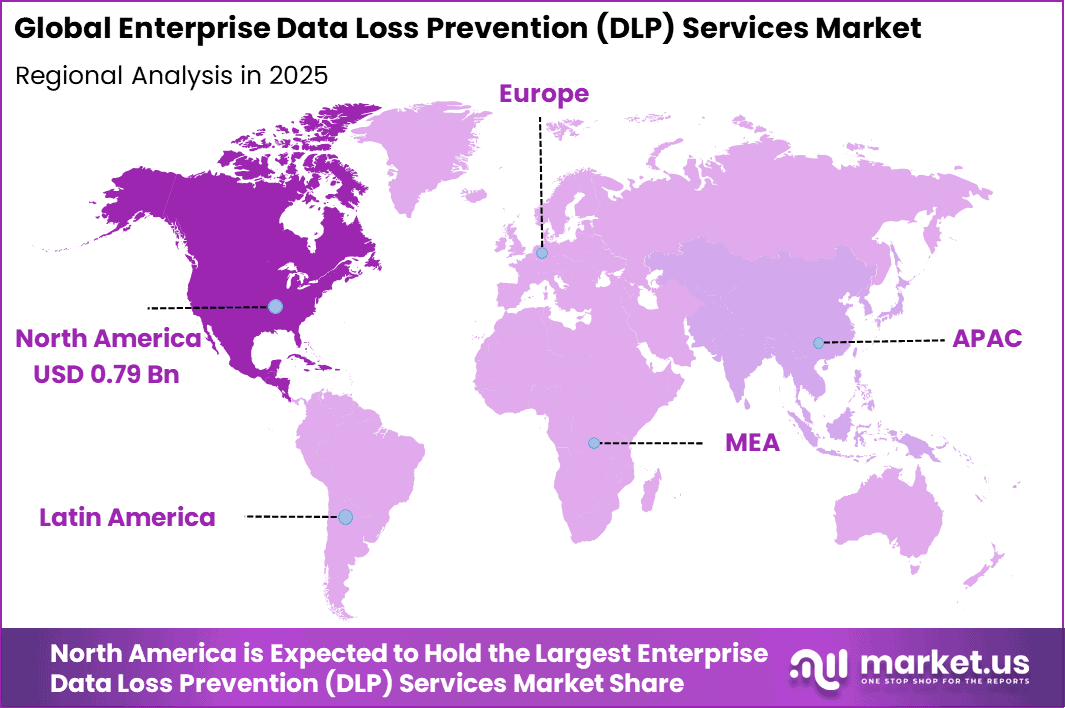
The Global Enterprise Data Loss Prevention (DLP) Services Market generated USD 4.1 billion in 2025 and is predicted to register growth from USD 4.9 billion in 2026 to about USD 23.9 billion by 2035, recording a CAGR of 19.2% throughout the forecast span. In 2025, North America held a dominant market position, capturing more than a 36.4% share, holding USD 1.35 billion in revenue.
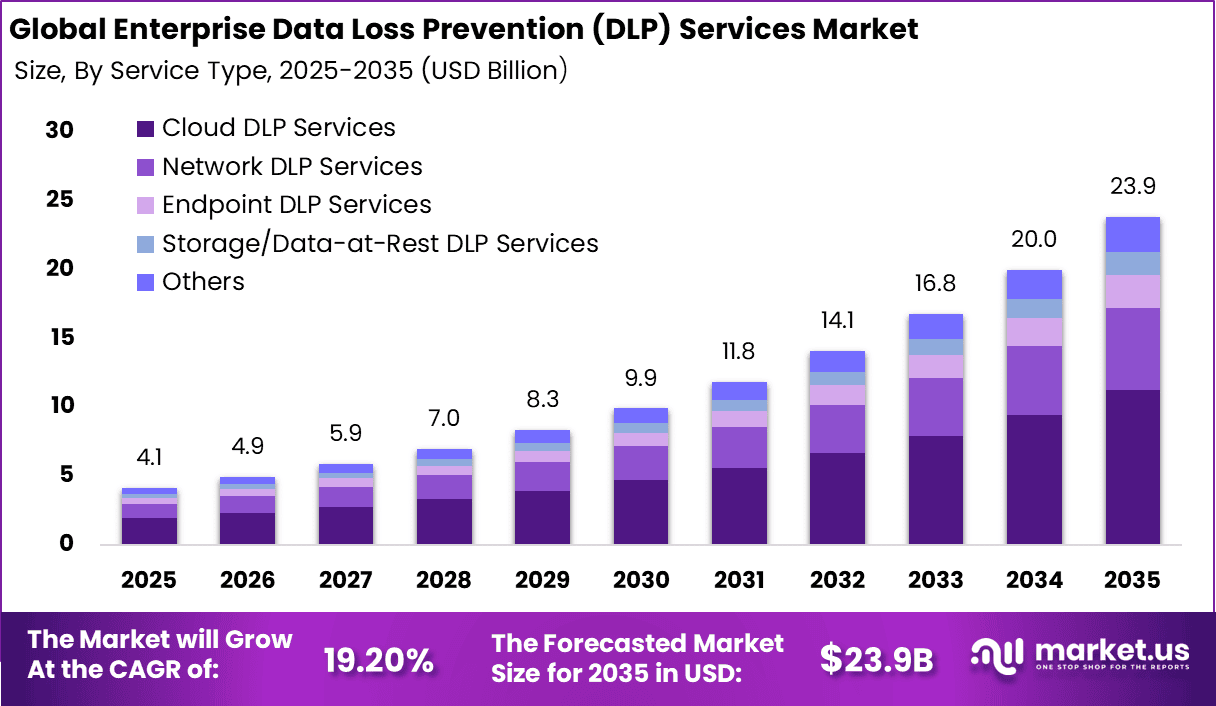
Enterprise Data Loss Prevention (DLP) services market refers to solutions that help organisations protect sensitive information from being lost, leaked, or accessed by unauthorised users. DLP services monitor data in motion, at rest, and in use across networks, endpoints, and cloud environments to prevent accidental or malicious exposure.
The main driving factors for the DLP services market are the rising volume of sensitive data and increasing risk of cyber threats. Organisations are generating and storing more business-critical data than ever before, and this data moves across devices, applications, and cloud platforms. Traditional security measures are not always sufficient to prevent data misuse, making specialised DLP services essential.
Demand is supported by hybrid IT environments where data moves between on-premise systems and cloud services. As data becomes more central to business operations and compliance pressures increase, investment in DLP services is expected to remain strong, enabling organisations to protect information and support secure digital transformation.
Top Market Takeaways
- By service type, cloud DLP services captured 47.3% of the enterprise data loss prevention services market, offering scalable protection for data stored and shared online.
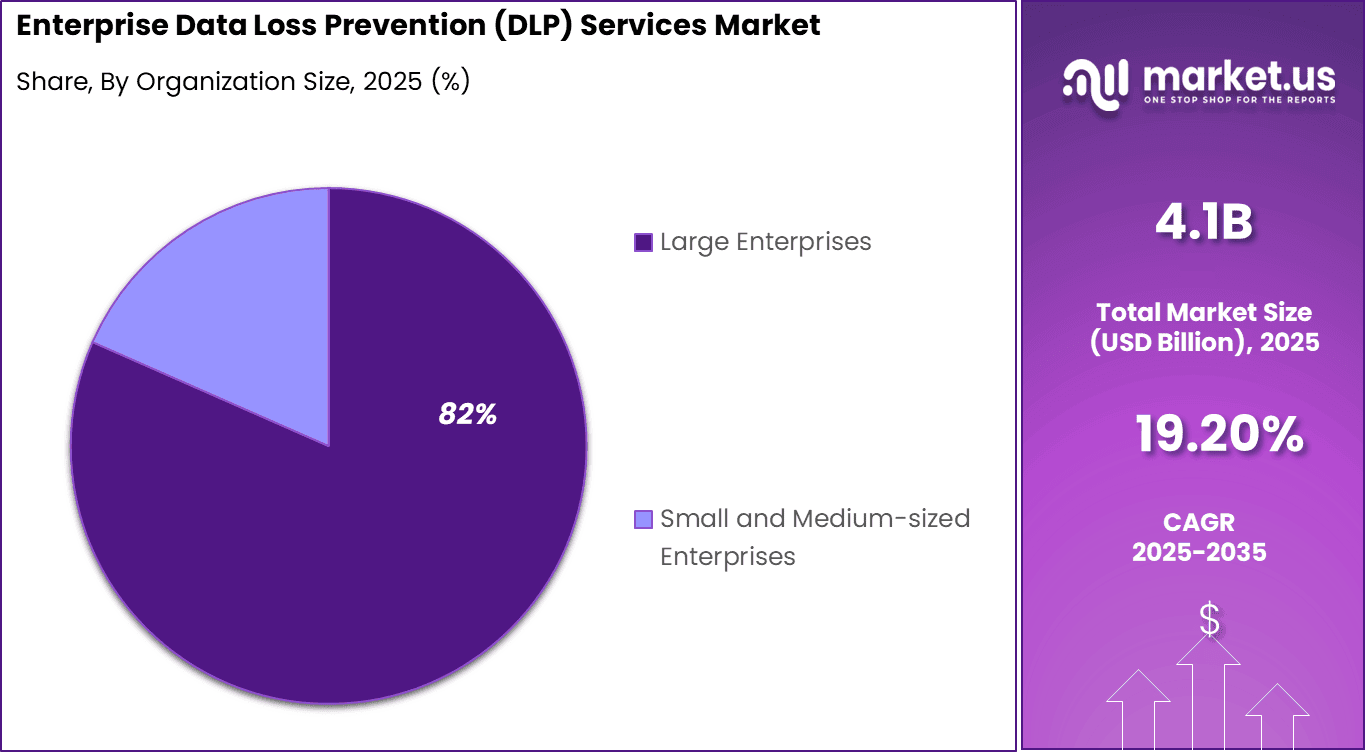
- By organization size, large enterprises dominated with an 81.6% share, implementing comprehensive DLP to safeguard sensitive information across global operations.
- By end-user industry, banking, financial services, and insurance led at 34.8%, prioritizing DLP to meet strict regulatory requirements and prevent financial fraud.
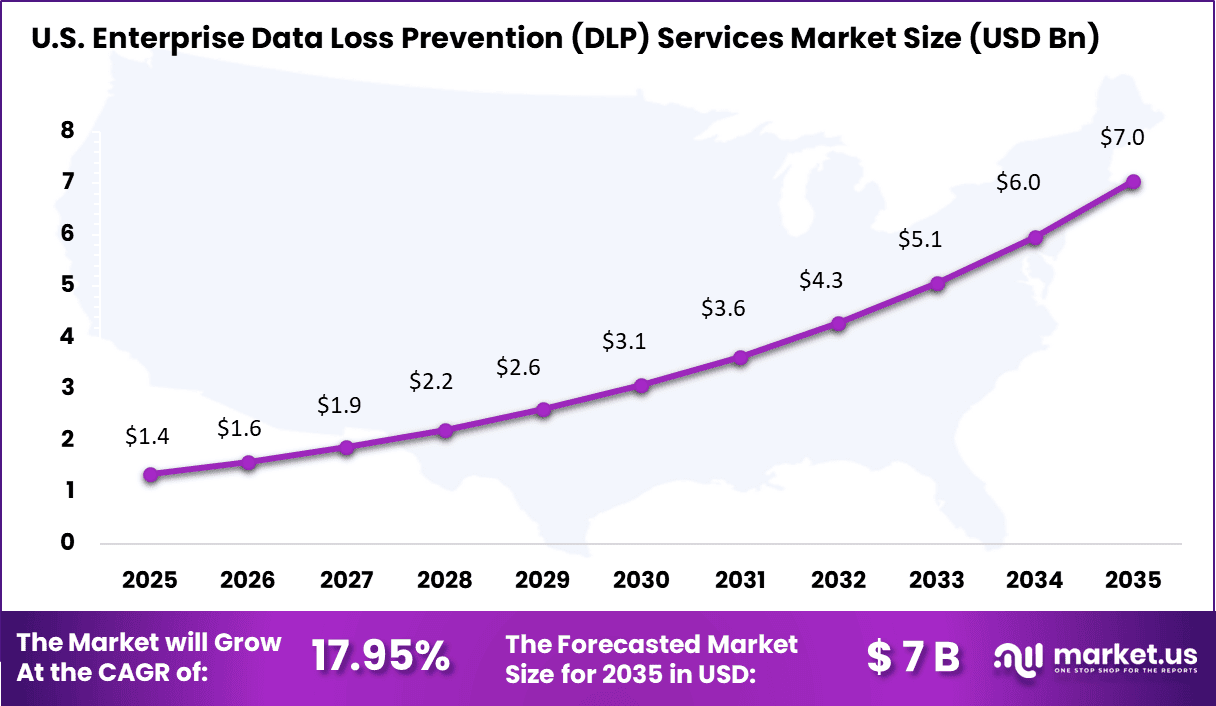
- North America held 36.4% of the global market, with the U.S. valued at USD 1.35 billion and growing at a CAGR of 17.95%.
Service Type Analysis
Cloud DLP services account for 47.3% of the Enterprise Data Loss Prevention Services market, showing strong demand for cloud-native security controls. These services monitor, detect, and prevent sensitive data from being exposed across cloud applications, storage, and collaboration platforms.
From an operational standpoint, cloud DLP services are easier to deploy and manage compared to on-premises models. They support rapid updates to policies and threat detection rules as data risks evolve. The strong share of this segment reflects enterprise focus on securing cloud-based data workflows while maintaining flexibility and scalability.
Organization Size Analysis
Large enterprises represent 82% of the market, indicating that data loss prevention is a critical priority for organizations with complex data environments. These enterprises manage vast volumes of sensitive data across departments, regions, and digital platforms. DLP services help them enforce data protection policies consistently and reduce the risk of internal and external data breaches.
Large enterprises also face strict regulatory and compliance requirements. DLP services support audit readiness and regulatory reporting by tracking data access and movement. The strong dominance of this segment highlights the importance of structured and enterprise-grade data protection strategies in large-scale organizations.
End-User Industry Analysis
The BFSI sector accounts for 34.8% of end-user demand, making it the leading industry for DLP services adoption. Financial institutions handle highly sensitive customer data, transaction records, and confidential financial information. Data loss incidents in this sector can lead to significant financial and reputational damage.
DLP services help BFSI organizations prevent unauthorized data sharing and insider threats. They also support compliance with data protection and financial regulations. The strong presence of BFSI reflects the industry’s focus on safeguarding critical data assets and maintaining customer trust.
Key Market Segments
By Service Type
- Network DLP Services
- Endpoint DLP Services
- Storage/Data-at-Rest DLP Services
- Cloud DLP Services
- Others
By Organization Size
- Large Enterprises
- Small and Medium-sized Enterprises
By End-User Industry
- Banking, Financial Services, and Insurance
- Healthcare
- Government & Defense
- IT & Telecommunications
- Retail & E-commerce
- Others
Regional Analysis
North America accounted for a 36.4% share, supported by strong emphasis on data security, regulatory compliance, and risk management across enterprises. Organizations in sectors such as banking, healthcare, government, and technology have widely adopted data loss prevention services to protect sensitive information from unauthorized access and accidental leakage.
Demand has been driven by increasing cloud adoption, remote work expansion, and rising incidents of data breaches. Enterprises in the region have prioritized DLP services to maintain data visibility and enforce consistent security policies.
The U.S. market reached USD 1.35 Bn and is projected to grow at a 17.95% CAGR, reflecting strong demand from large enterprises and regulated industries. Adoption has been driven by the need to protect intellectual property, customer data, and confidential business information across distributed IT environments. DLP services have helped U.S. organizations reduce insider risk, improve compliance, and strengthen incident response capabilities.
Key Regions and Countries
- North America
- US
- Canada
- Europe
- Germany
- France
- The UK
- Spain
- Italy
- Russia
- Netherlands
- Rest of Europe
- Asia Pacific
- China
- Japan
- South Korea
- India
- Australia
- Singapore
- Thailand
- Vietnam
- Rest of APAC
- Latin America
- Brazil
- Mexico
- Rest of Latin America
- Middle East & Africa
- South Africa
- Saudi Arabia
- UAE
- Rest of MEA
Key Reasons for Adoption
- Data security risks are increasing due to remote work and cloud-based operations
- Sensitive business information needs stronger protection against internal misuse
- Regulatory and compliance requirements demand strict control over data movement
- Insider threats are becoming harder to detect with traditional security tools
- Enterprises require visibility into how data is accessed, shared, and stored
Benefits
- Confidential data is protected across endpoints, networks, and cloud platforms
- Compliance efforts are strengthened through consistent policy enforcement
- Risk exposure is reduced by preventing unauthorized data transfers
- Security teams gain better insight into data usage patterns
- Business reputation is protected by lowering the risk of data breaches
Usage
- Used by enterprises to monitor and control data shared through email and messaging
- Applied in cloud environments to prevent sensitive data leakage
- Deployed across employee devices to secure files and documents
- Utilized in regulated industries to meet data protection standards
- Integrated with existing security systems for centralized data governance
Emerging Trends
| Key Trend | Description |
|---|---|
| AI-powered behavioral analysis | Machine learning detects anomalous data access patterns in real time. |
| Cloud-native DLP solutions | Seamless protection for hybrid and multi-cloud environments. |
| Endpoint and CASB Integration | Unified coverage across devices, SaaS apps, and networks. |
| Zero-trust data security | Continuous verification for sensitive information flows. |
| Automation and orchestration | Self-remediating policies reduce response times. |
Growth Factors
| Key Factors | Description |
|---|---|
| Escalating cyber threats | Ransomware and insider risks demand advanced prevention. |
| Remote work proliferation | Distributed endpoints expand data exposure surfaces. |
| Stringent compliance mandates | Regulations like GDPR enforce data protection measures. |
| Cloud migration acceleration | SaaS adoption requires integrated DLP controls. |
| Enterprise digital transformation | Growing data volumes necessitate scalable solutions. |
Opportunities & Challenges
The Enterprise Data Loss Prevention Services market shows strong opportunities as organizations handle larger volumes of sensitive data across cloud, mobile, and remote work environments. DLP services help prevent unauthorized data access, sharing, and leaks.
Growing regulatory pressure around data protection and privacy is increasing demand for managed and outsourced DLP solutions. Companies prefer services that provide continuous monitoring and expert support without building large internal security teams.
More opportunities are emerging from cloud adoption and digital collaboration. DLP services support email, file sharing, endpoints, and cloud applications through unified policy management. Integration with identity management and security analytics improves visibility and control. As data breaches become more costly, organizations are investing in DLP services to reduce risk and maintain customer trust.
The market faces threats related to complexity and cost. DLP policies can be difficult to configure and maintain, leading to false alerts and user frustration. High service costs may limit adoption among small and mid-sized businesses. Limited understanding of DLP value can also delay purchasing decisions.
Another threat comes from evolving data environments. New collaboration tools and data formats require continuous policy updates. User behavior such as shadow IT can bypass DLP controls. Concerns about monitoring employee activity may also raise privacy and compliance issues in some regions.
Competitive Analysis
The competitive landscape of the enterprise data loss prevention services market is led by established cybersecurity vendors offering broad information protection and threat prevention portfolios. Symantec under Broadcom, McAfee, Forcepoint, and Zscaler hold strong positions due to their advanced data classification, policy enforcement, and integration with endpoint, network, and cloud security platforms.
Specialized DLP and insider risk providers such as Digital Guardian, Code42 Software, GTB Technologies, Fidelis Cybersecurity, Trustwave Holdings, and HelpSystems increase competition by focusing on deep content inspection, user behavior analytics, and incident response support. Competition increasingly depends on accuracy of detection, ease of policy management, cloud readiness, and regulatory compliance.
Top Key Players in the Market
- Symantec Corporation (Broadcom Inc.)
- McAfee Corp.
- Forcepoint LLC
- Trend Micro Incorporated
- Digital Guardian, Inc.
- Code42 Software, Inc.
- GTB Technologies, Inc.
- Zscaler, Inc.
- Check Point Software Technologies Ltd.
- Cisco Systems, Inc.
- RSA Security LLC
- Fidelis Cybersecurity, Inc.
- Trustwave Holdings, Inc.
- HelpSystems, LLC
- Palo Alto Networks, Inc.
- Others
Future Outlook
Growth in the Enterprise Data Loss Prevention Services market is expected to remain strong as organizations focus on protecting sensitive information. DLP services are being used to monitor, detect, and prevent unauthorized data sharing across email, cloud, and endpoint environments.
Rising regulatory pressure and increasing remote work are supporting wider adoption. Over time, better integration with cloud security, user behavior analytics, and automation is likely to improve accuracy and reduce false alerts.
Recent Developments
- In December 2025, Forcepoint LLC updated its DLP solution with unified policy management, AI-driven data classification, and integration with data security posture management (DSPM), increasing visibility and threat detection across cloud, endpoint, and network channels.
- In September 2025, Symantec Corporation (Broadcom Inc.) released Symantec Data Loss Prevention 25.1, expanding DLP coverage, improving integration with AI model file classification, enhancing browser monitoring support, and strengthening encryption and authentication options in enterprise deployments.
Report Scope
| Report Features | Description |
|---|---|
| Market Value (2025) | USD 4.1 Billion |
| Forecast Revenue (2035) | USD 23.9 Billion |
| CAGR(2025-2035) | 19.2% |
| Base Year for Estimation | 2025 |
| Historic Period | 2020-2024 |
| Forecast Period | 2025-2035 |
| Report Coverage | Revenue forecast, AI impact on Market trends, Share Insights, Company ranking, competitive landscape, Recent Developments, Market Dynamics and Emerging Trends |
| Segments Covered | By Service Type (Network DLP Services, Endpoint DLP Services, Others), By Organization Size (Large Enterprises, Small and Medium-sized Enterprises), By End-User Industry (Banking, Financial Services, and Insurance, Healthcare, Others) |
| Regional Analysis | North America – US, Canada; Europe – Germany, France, The UK, Spain, Italy, Russia, Netherlands, Rest of Europe; Asia Pacific – China, Japan, South Korea, India, New Zealand, Singapore, Thailand, Vietnam, Rest of Latin America; Latin America – Brazil, Mexico, Rest of Latin America; Middle East & Africa – South Africa, Saudi Arabia, UAE, Rest of MEA |
| Competitive Landscape | Symantec Corporation (Broadcom Inc.), McAfee Corp., Forcepoint LLC, Trend Micro Incorporated, Digital Guardian, Inc., Code42 Software, Inc., GTB Technologies, Inc., Zscaler, Inc., Check Point Software Technologies Ltd., Cisco Systems, Inc., RSA Security LLC, Fidelis Cybersecurity, Inc., Trustwave Holdings, Inc., HelpSystems, LLC, Palo Alto Networks, Inc., Others |
| Customization Scope | Customization for segments, region/country-level will be provided. Moreover, additional customization can be done based on the requirements. |
| Purchase Options | We have three licenses to opt for: Single User License, Multi-User License (Up to 5 Users), Corporate Use License (Unlimited Users and Printable PDF) |





























