Report Overview
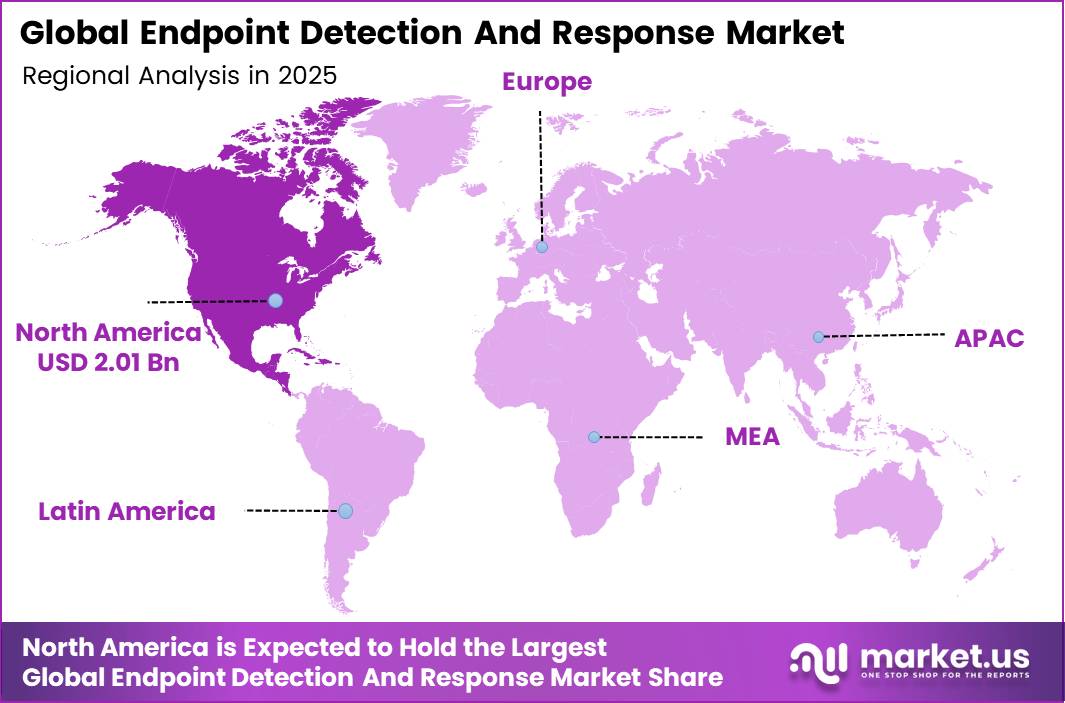
In 2025, the Global Endpoint Detection and Response Market was valued at USD 5.1 billion. The market is projected to grow at a CAGR of 23.6% during 2026–2035, reaching approximately USD 42.1 billion by 2035. North America dominated the global market in 2025, accounting for more than 39.5% of the total market share and generating approximately USD 2.01 billion in revenue.
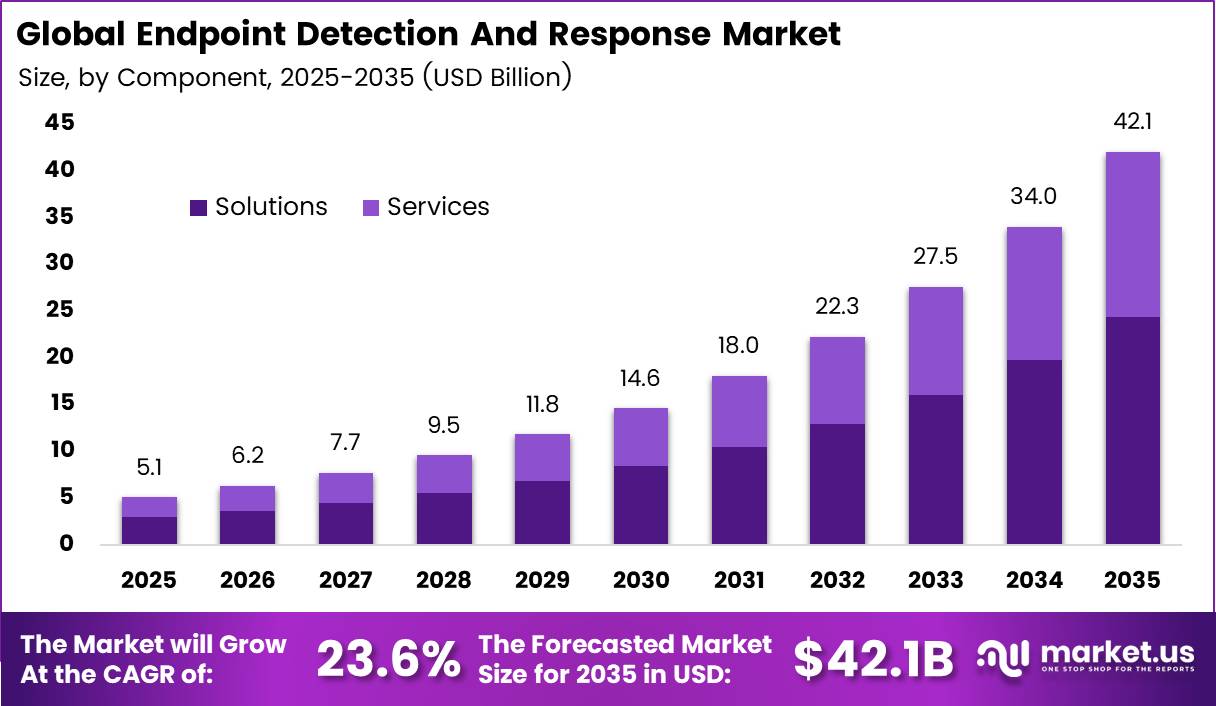
Rising cybercrime losses drive this growth. The FBI Internet Crime Complaint Center logged 859,532 complaints in 2024. Reported losses hit a record USD 16.6 billion, up 33% from 2023. Ransomware remained the most common threat to critical infrastructure, and those complaints rose 9% in one year.
The North America region has the largest base of digital businesses and the highest cyber loss exposure. The FBI found that the average reported loss per complaint reached USD 19,372 in 2024. Crypto-related fraud alone caused USD 9.3 billion in losses across 149,686 complaints. These losses are pushing US firms and agencies to spend more on endpoint defense.
Key Takeaways
- The Endpoint Detection and Response Market was worth USD 5.1 billion in 2025 and will reach USD 42.1 billion by 2035. at a CAGR of 23.6% from 2026 to 2035.
- By Component, Solutions led with a 58.6% share, while Managed Services is the fastest-growing sub-segment.
- By Deployment Mode, Cloud-Based led with a 58.3% share, while On-Premises keeps steady demand in regulated sectors.
- By Organization Size, Large Enterprises led with a 67.3% share, while SMEs are the fastest-growing sub-segment.
- By Endpoint Device, Network Devices and Servers led with a 52.3% share, while Mobile Devices are the fastest-growing sub-segment.
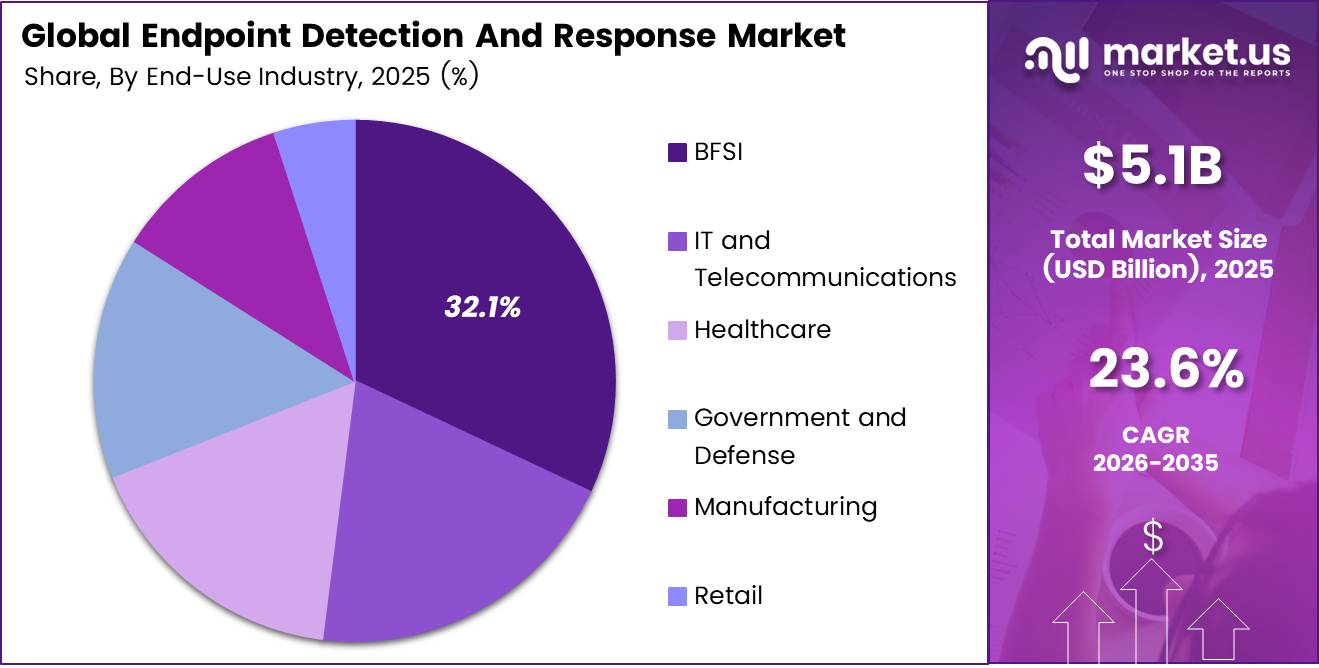
- By End-Use Industry, BFSI led with a 32.1% share, while Healthcare is the fastest-growing sub-segment.
- North America dominated with a 39.5% share and USD 2.01 billion in revenue.
By Component
Solutions dominate with 58.6% due to subscription-based platform licensing across endpoints.
Solutions lead because every EDR program starts with the core software. That software monitors devices, detects threats, and automatically blocks attacks. Companies buy these platforms on yearly subscriptions and add more modules over time. CrowdStrike’s SEC filing shows annual recurring revenue of $4.24 billion, up 23% year over year.
The same filing reports subscription revenue of $3.76 billion in fiscal 2025, a 31% rise. This steady recurring income shows that buyers treat EDR software as a must-have budget item, not a one-time purchase. Services, led by Managed Services, form the fastest-growing component. Many firms cannot hire enough skilled threat hunters to watch alerts around the clock.
By Deployment Mode
Cloud-Based dominates with 58.3% due to central visibility across remote endpoints.
Cloud-based EDR leads because one central console can protect laptops, servers, and offices in many places at once. Updates and new threat rules reach every device right away, with no local hardware to manage. The US government shows this scale: CISA has helped deploy more than 920,000 EDR agents across 51 federal agencies.
Cloud-based deployment is also the fastest-growing mode, while on-premises keeps steady demand in secret or tightly regulated settings. Hybrid work, cheaper startup costs, and faster rollout all favor the cloud. Booz Allen deployed EDR at 5 large agencies covering almost 480,000 endpoints, which shows how fast big programs can expand when teams manage them centrally.
By Organization Size
Large Enterprises dominate with 67.3% due to vast endpoint fleets and budgets.
Large enterprises lead because they run thousands of devices across many sites and countries. They also face strict audit rules and have dedicated security teams with large budgets. These firms are prime targets for criminals. The FBI’s IC3 received 859,532 complaints in 2024, with reported losses of $16.6 billion.
Those losses rose 33% from 2023. Rising damage pushes boards at big companies to fund full EDR coverage, round-the-clock monitoring, and fast incident response as part of their core risk plans. Small and Medium-Sized Enterprises (SMEs) are the fastest-growing group.
Attackers now target smaller firms because their defenses are often weaker. Cloud EDR plans with simple pricing and managed support make strong protection affordable without a full in-house team. IC3 reported 256,256 complaints with an actual loss in 2024, at an average of $19,372 per complaint.
By Endpoint Device
Network Devices and Servers dominate with 52.3% due to high-value data on core systems.
Network devices and servers lead because they hold a company’s most important data and run its key applications. One breached server can expose millions of records or stop operations. Attackers also keep changing their tools. IC3 recognized 67 new ransomware variants in 2024, and most of them aim at servers and shared network systems.
The FBI also logged 263,455 cyber threat complaints in 2024, linked to $1.571 billion in losses. This threat volume keeps server protection at the top of security budgets. Mobile Devices are the fastest-growing endpoint group. Staff now use phones and tablets to reach email, cloud apps, and payment tools, which opens new paths for attackers.
By End-Use Industry
Banking, Financial Services, and Insurance (BFSI) dominates with 32.1% due to strict regulation and fraud exposure.
BFSI leads because banks and insurers hold money and sensitive customer data, which makes them constant targets. Regulators require strong monitoring, fast breach reporting, and proof of control. IC3’s critical infrastructure data shows the financial services sector reported 190 ransomware attacks and 175 data breaches in 2024.
Ransomware remained the most widespread threat to critical sectors overall, with complaints rising 9% to 3,156. BFSI firms respond with large, mature EDR programs tied to their fraud and compliance teams. Healthcare is the fastest-growing industry. Hospitals run many connected devices and older systems that are hard to patch.
Attacks can delay patient care, so the stakes are very high. Healthcare and public health reported 238 ransomware attacks and 206 data breaches in 2024, more than financial services. This growing pressure pushes hospitals and clinics to adopt EDR quickly, often through managed services that suit their small IT teams.
Key Market Segments
By Component
- Solutions
- Services
- Professional Services
- Managed Services
By Deployment Mode
- Cloud-Based
- On-Premises
By Organization Size
- Small and Medium-Sized Enterprises (SMEs)
- Large Enterprises
By Endpoint Device
- Network Devices and Servers
- Mobile Devices
- Point-of-Sale (POS) Devices
- Others
By End-Use Industry
- Banking, Financial Services, and Insurance (BFSI)
- IT and Telecommunications
- Healthcare
- Government and Defense
- Manufacturing
- Retail
- Others
Geopolitical Impact Analysis
EDR is software, but it runs on hardware, cloud data centers, and global networks. Trade tensions raise the cost of all three. The US raised Section 301 tariffs on Chinese semiconductors to 50% in 2025. This lifts the cost of the servers and chips that vendors use for cloud threat analytics.
The WTO cut its 2025 forecast for global merchandise trade and warned of a possible 0.2% drop due to tariff measures. Higher tariffs on servers and network gear push up data center build costs. EDR vendors pass part of this cost to buyers through higher subscription prices.
Shipping disruptions add delays for hardware-based security appliances. Red Sea attacks forced container ships around the Cape of Good Hope. UNCTAD reported that this route adds about 10 to 14 days to Asia-Europe voyages. Suez Canal transits fell by more than 50% at the peak of the disruption. These delays slow the rollout of on-premises EDR servers and sensors in Europe and the Middle East.
State-sponsored cyber activity linked to regional conflicts also lifts demand. Governments now ban some foreign security software over data concerns. The US banned Kaspersky sales in 2024. This shifts market share toward Western and allied vendors. Energy prices matter too. The IEA projects that data center electricity use will reach about 945 TWh by 2030, which raises hosting costs for cloud EDR platforms.
Regional Analysis
North America dominates the Endpoint Detection and Response Market, holding a 39.5% share and generating USD 2.01 billion in revenue. The US drives most of this demand. Federal rules push agencies and contractors to adopt EDR tools. Executive Order 14028 required federal civilian agencies to deploy EDR across their networks.
The Canadian Centre for Cyber Security reports that ransomware remains the top cyber threat to Canadian firms. Local vendors also give the region an edge. CrowdStrike posted fiscal 2026 revenue of USD 4.81 billion, up 22%. Its ending ARR reached USD 5.25 billion.
Asia Pacific is the fastest-growing region in the Endpoint Detection and Response Market. Fast digital growth in India, China, and Southeast Asia adds millions of new endpoints each year. India’s CERT-In requires firms to report cyber incidents within 6 hours, which pushes demand for real-time detection.
Europe holds a strong position in the market. The NIS2 Directive widened cyber rules to cover about 18 critical sectors. It also allows fines of up to EUR 10 million or 2% of global turnover. DORA applies to EU financial firms from January 2025. Germany, France, and the UK lead regional spending.
Latin America shows rising demand as ransomware hits public agencies and banks. Brazil’s LGPD data law allows fines of up to 2% of revenue, capped at BRL 50 million per violation. Mexico faces growing attacks on retail and financial services. Banks in both countries lead EDR spending. Managed services help firms with small security teams.
Key Regions and Countries
North America
- US
- Canada
Europe
- Germany
- France
- The UK
- Spain
- Italy
- Rest of Europe
Asia Pacific
- China
- Japan
- South Korea
- India
- Australia
- Rest of APAC
Latin America
- Brazil
- Mexico
- Rest of Latin America
Middle East and Africa
- GCC
- South Africa
- Rest of MEA
Market Dynamics
Drivers
| Driver | (~) % Impact on CAGR Forecast | Geographic Relevance | Impact Timeline |
|---|---|---|---|
| Ransomware and Identity-Led Intrusion Escalation | +3.1% | Global | Short term (2 years or less) |
| Mandatory Incident Disclosure and Cyber Regulation | +2.4% | North America, Europe | Short term (2 years or less) |
| Cloud-Native SaaS Platform Consolidation | +2.0% | North America, Europe, Asia Pacific | Medium term (2 to 4 years) |
| Hybrid Work Endpoint Proliferation | +1.4% | Global | Short term (2 years or less) |
| Cyber Insurance Underwriting Requirements | +1.2% | North America, Europe | Short term (2 years or less) |
| AI-Assisted Detection and Autonomous Triage | +1.1% | North America, Asia Pacific | Medium term (2 to 4 years) |
Ransomware and Identity-Led Intrusion Escalation
The rise in hands-on-keyboard intrusions has made EDR a must-have control instead of an optional extra. Per FBI IC3 annual reporting, ransomware complaints against critical infrastructure stayed above 1,500 a year in 2024, and CrowdStrike threat reporting put average eCrime breakout time at about 48 minutes, with the fastest cases under 1 minute. Both figures show why signature-based antivirus cannot keep up.
The change in business model is clear in vendor disclosures. CrowdStrike SEC filings show ending ARR above $4 billion during fiscal 2025, with more than 40% of subscription customers buying 6 or more modules. This points to a shift from per-seat EDR licensing toward platform subscriptions that raise net revenue retention above 110%.
Per IBM breach-cost studies, the global average breach cost was about $4.88 million in 2024. Against that loss, an EDR seat priced at $50 to $185 a year is easy for CISOs to justify, which lowers customer acquisition cost in mid-market sales cycles.
Restraints
| Restraint | (~) % Impact on CAGR Forecast | Geographic Relevance | Impact Timeline |
|---|---|---|---|
| SMB Budget Constraints and High Total Cost | -1.8% | Global, Emerging Markets | Short term (2 years or less) |
| Kernel-Level Agent Outage Risk Aversion | -1.2% | Global | Short term (2 years or less) |
| Data Sovereignty and Telemetry Localization Rules | -0.9% | Europe, China, Middle East, India | Medium term (2 to 4 years) |
| Vendor Exclusion and Procurement Bans | -0.7% | North America, China, Russia | Short term (2 years or less) |
| Elevated Cost of Capital for IT Spending | -0.6% | Global | Short term (2 years or less) |
| Legacy OT and Unsupported Endpoint Incompatibility | -0.5% | Global | Medium term (2 to 4 years) |
SMB Budget Constraints and High Total Cost
The underlying problem is a mismatch between what EDR costs and what small firms earn. According to OECD SME statistics, small and medium-sized enterprises make up about 99% of businesses and roughly 60% of employment in member economies. Yet U.S. Small Business Administration survey data shows that many small firms spend less than $500 a year on cybersecurity.
The bottleneck goes beyond licence fees. Per ISC2 workforce studies, an EDR deployment needs analyst coverage around the clock. When fully loaded managed-service fees are added, cost per protected endpoint can rise 2 to 3 times above the base licence, and many deals under 100 seats stall or fall back to basic antivirus.
Vendor earnings calls in 2025 described longer sales cycles and heavier discounting in the SMB segment. That pressure squeezes gross margins by about 2 to 4 percentage points on low-end tiers and pushes back channel expansion investment.
Challenges
| Challenge | (~) % CAGR Friction Drag | Geographic Relevance | Mitigation Horizon |
|---|---|---|---|
| Cybersecurity Analyst Talent Shortage | -1.5% | Global | Long term (4 years or more) |
| Alert Fatigue and False Positives | -0.9% | Global | Medium term (2 to 4 years) |
| EDR Evasion and Bring-Your-Own-Vulnerable-Driver Attacks | -0.7% | Global | Medium term (2 to 4 years) |
| Multi-Tool Integration Complexity | -0.6% | North America, Europe | Medium term (2 to 4 years) |
| Intense Price Competition and Bundling | -0.5% | Global | Short term (2 years or less) |
Cybersecurity Analyst Talent Shortage
EDR only creates value if someone acts on its alerts, which ties the market to a workforce that is short of people. Per ISC2 workforce studies, the global cybersecurity workforce gap was about 4.8 million professionals in 2024, and around 67% of organizations reported staffing shortfalls.
The friction shows up in queues and wages. U.S. Bureau of Labor Statistics data projects information security analyst employment growth of about 33% over the decade, and median pay is above $120,000. At those rates, a five-seat 24×7 SOC costs well over $600,000 a year in salaries alone.
To adapt, vendors are building managed detection and response services, as Microsoft and SentinelOne filings show, and putting AI copilots into analyst workflows. Over the long term, this moves revenue mix toward services that carry 10 to 20 point lower gross margins than pure software.
Opportunities
| Opportunity | (~) % Potential CAGR Upside | Geographic Relevance | Execution Window |
|---|---|---|---|
| Extension to IoT, OT and Medical Devices | +1.9% | North America, Europe, Asia Pacific | Long term (4 years or more) |
| MSP-Delivered EDR for Underserved SMBs | +1.6% | Global, Emerging Markets | Medium term (2 to 4 years) |
| Sovereign In-Region EDR Offerings | +1.0% | Europe, Middle East, India | Medium term (2 to 4 years) |
| Outcome-Based Breach Warranty Monetization | +0.8% | North America, Europe | Medium term (2 to 4 years) |
| Tuck-In M&A for Exposure Management Roll-Ups | +0.7% | North America, Israel | Short term (2 years or less) |
Extension to IoT, OT and Medical Devices
Today’s EDR revenue comes almost entirely from Windows, macOS, Linux, and mobile devices, so connected industrial and clinical assets are still mostly unprotected. Per GSMA Intelligence tracking, connected IoT devices are expected to grow well beyond 25 billion units, and FDA medical device cybersecurity requirements under the PATCH Act provisions now apply to new premarket submissions.
Capturing this market depends on new delivery models. CISA advisory data shows that operational technology vulnerability disclosures run into the thousands every year. That supports lightweight or agentless sensors priced per asset at about 30% to 50% below a full endpoint seat, while reusing the cloud analytics backend vendors already have.
Because detection models and data infrastructure are already paid for, the incremental cost to serve each device may fall by 40% or more, per company investor decks. That could lift blended gross margins by 2 to 3 points and open a sizable untapped share of the addressable market in manufacturing, utilities, and healthcare.
Key Players Analysis
Tier 1 leaders include CrowdStrike, Microsoft, and Palo Alto Networks. CrowdStrike grew subscription revenue to USD 4.56 billion in fiscal 2026, up 21%. It added a record USD 1.01 billion in net new ARR. In Q2 fiscal 2027, its quarterly revenue hit USD 1.47 billion, and ARR reached USD 5.84 billion. Microsoft bundles Defender for Endpoint into its E5 licenses. Its security business tops USD 20 billion in yearly revenue.
Palo Alto Networks expanded through deals. It closed its CyberArk deal in February 2026. CyberArk shareholders received USD 45.00 in cash plus 2.2005 Palo Alto shares for each CyberArk share, a deal worth about USD 25 billion. Its Cortex XDR platform competes directly in EDR.
Tier 2 challengers include SentinelOne, Fortinet, Trend Micro, Sophos, and Cisco. SentinelOne posted fiscal 2025 revenue of about USD 821.5 million. Fortinet reported 2024 revenue of about USD 5.96 billion and keeps adding endpoint features to its Security Fabric. Cisco paid about USD 28 billion for Splunk in 2024 to link its endpoint telemetry with SIEM analytics.
Niche players such as Trellix, Bitdefender, Check Point, Cybereason, ESET, Elastic, and WithSecure focus on regional and mid-market buyers. ESET and WithSecure gain from EU data rules. Elastic pairs open search with endpoint security for cost-conscious buyers.
Top Key Players in the Market
- CrowdStrike Holdings, Inc.
- Microsoft Corporation
- SentinelOne, Inc.
- Palo Alto Networks, Inc.
- Trend Micro Incorporated
- Sophos Ltd.
- Cisco Systems, Inc.
- Fortinet, Inc.
- Trellix
- Bitdefender
- Check Point Software Technologies Ltd.
- Cybereason, Inc.
- ESET, spol. s r.o.
- Elastic N.V.
- WithSecure Corporation
Recent Developments
- In February 2026, Palo Alto Networks completed its acquisition of CyberArk. CyberArk shareholders received USD 45.00 in cash and 2.2005 Palo Alto shares per CyberArk share, adding identity security to its platform.
- In September 2025, CrowdStrike agreed to buy AI security firm Pangea for about USD 260 million to extend AI detection and response.
- In August 2025, SentinelOne agreed to buy Prompt Security for about USD 250 million to secure generative AI use on endpoints.
Report Scope
| Report Features | Description |
|---|---|
| Market Value (2025) | USD 5.1 Billion |
| Forecast Revenue (2035) | USD 42.1 Billion |
| CAGR (2026-2035) | 23.6% |
| Base Year for Estimation | 2025 |
| Historic Period | 2020-2024 |
| Forecast Period | 2026-2035 |
| Report Coverage | Revenue Forecast, Market Dynamics, Competitive Landscape, Recent Developments |
| Segments Covered | By Component (Solutions, Services, Professional Services, Managed Services); By Deployment Mode (Cloud-Based, On-Premises); By Organization Size (Small and Medium-Sized Enterprises (SMEs), Large Enterprises); By Endpoint Device (Network Devices and Servers, Mobile Devices, Point-of-Sale (POS) Devices, Others); By End-Use Industry (Banking, Financial Services, and Insurance (BFSI), IT and Telecommunications, Healthcare, Government and Defense, Manufacturing, Retail, Others) |
| Regional Analysis | North America – US, Canada; Europe – Germany, France, The UK, Spain, Italy, Rest of Europe; Asia Pacific – China, Japan, South Korea, India, Australia, Singapore, Rest of APAC; Latin America – Brazil, Mexico, Rest of Latin America; Middle East & Africa – GCC, South Africa, Rest of MEA |
| Competitive Landscape | CrowdStrike Holdings, Inc., Microsoft Corporation, SentinelOne, Inc., Palo Alto Networks, Inc., Trend Micro Incorporated, Sophos Ltd., Cisco Systems, Inc., Fortinet, Inc., Trellix, Bitdefender, Check Point Software Technologies Ltd., Cybereason, Inc., ESET, spol. s r.o., Elastic N.V., WithSecure Corporation |
| Customization Scope | Customization for segments and region/country-level will be provided. Moreover, additional customization can be done based on the requirements. |
| Purchase Options | We have three licenses to opt for: Single User License, Multi-User License (Up to 5 Users), Corporate Use License (Unlimited Users and Printable PDF) |