Report Overview
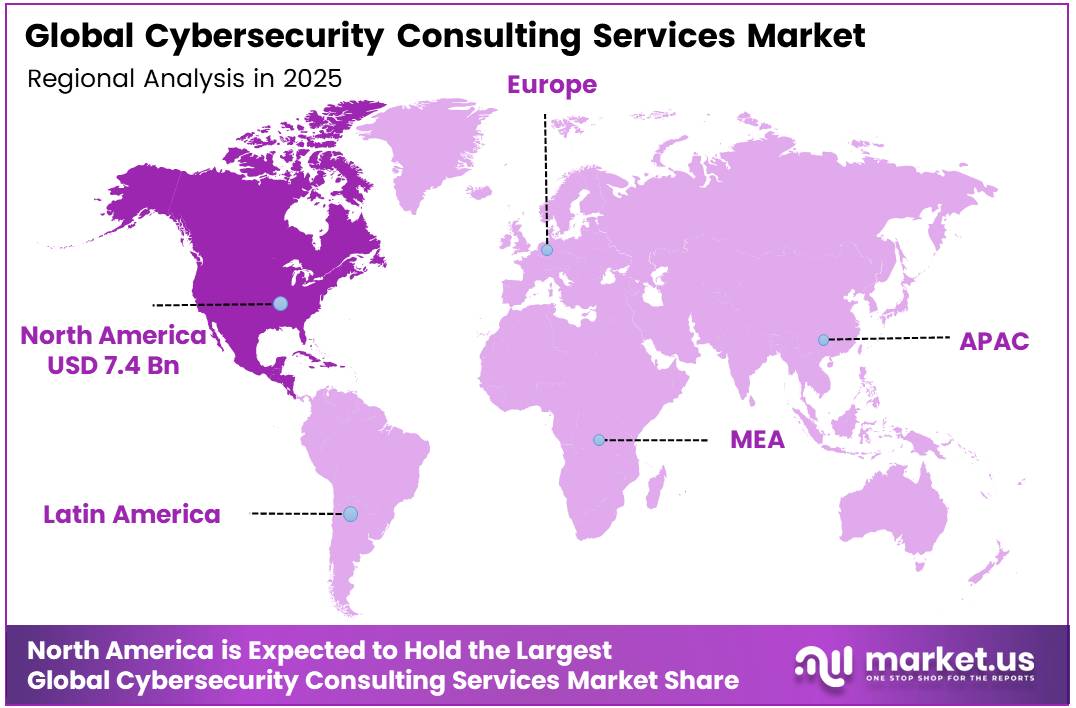
In 2025, the Global Cybersecurity Consulting Services Market was valued at USD 19.4 billion. The market is projected to grow at a CAGR of 16.4% during 2026–2035, reaching approximately USD 88.4 billion by 2035. North America dominated the global market in 2025, accounting for more than 38.0% of the total market share and generating approximately USD 7.4 billion in revenue.
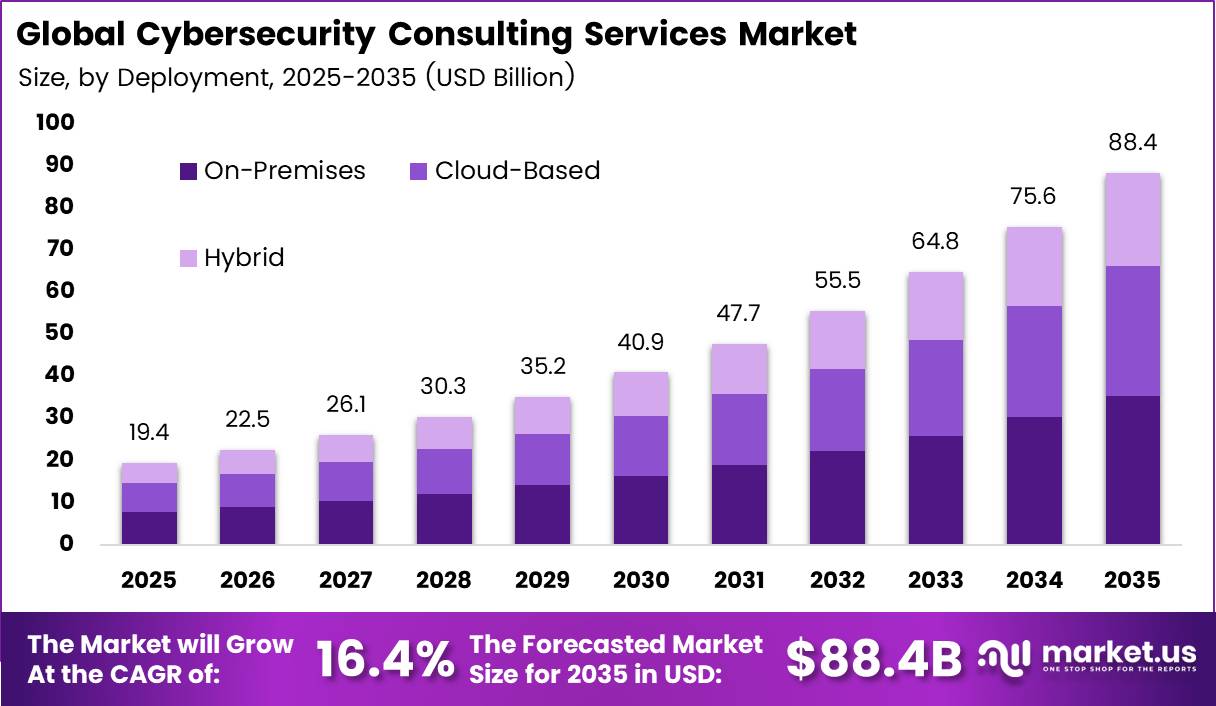
Demand is rising because organizations need expert help to manage complex cyber risks, meet regulations, and protect digital systems. The World Bank reports that cyber incidents rise by 21% worldwide each year and by 37% annually in upper-middle-income countries. This pressure pushes banks, hospitals, governments, and technology firms to invest in risk assessment, compliance, incident response, and security architecture services.
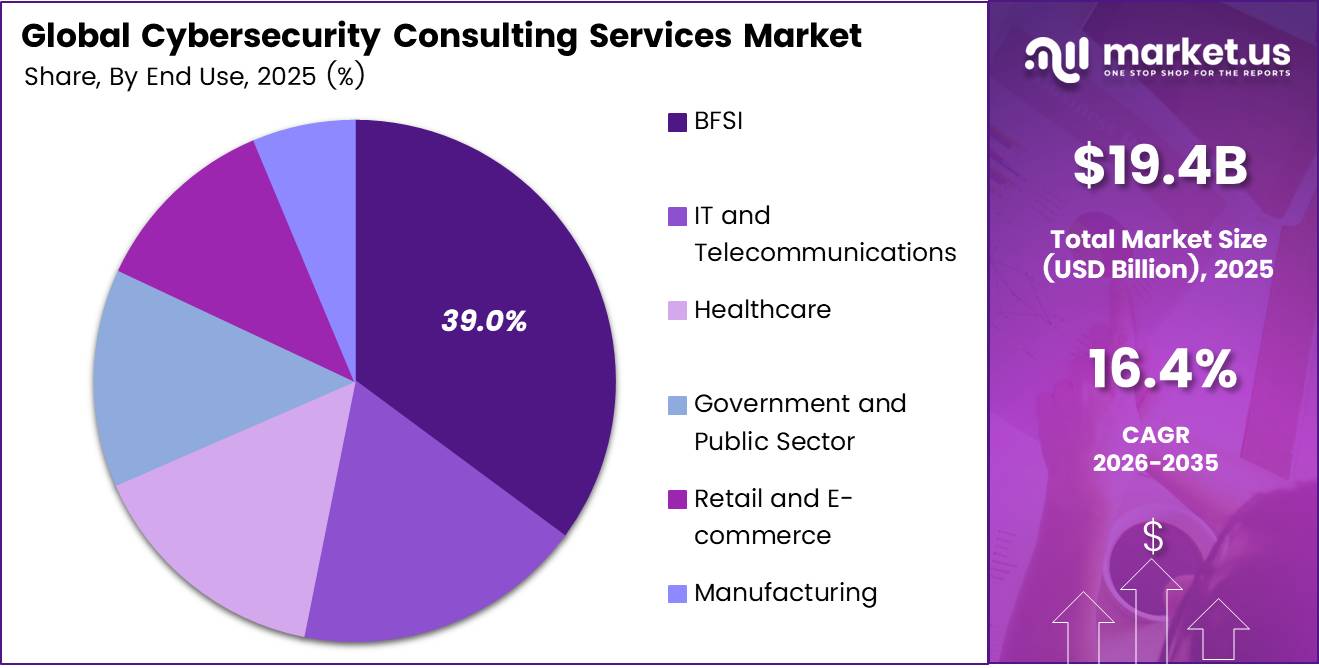
BFSI alone accounts for 39.0% of market demand because financial institutions handle sensitive customer data and face strict regulatory checks. Large enterprises contribute 69.0% of revenue because they manage wider networks, more cloud workloads, and higher compliance requirements.
The North America region benefits from strong digital infrastructure, high enterprise technology spending, and strict data-protection expectations. The United States and Canada host major cloud, software, financial-services, and healthcare organizations that need continuous security consulting.
Key Takeaways
- The Cybersecurity Consulting Services Market is projected to grow from USD 19.4 billion in 2025 to USD 88.4 billion by 2035. at a 16.4% CAGR from 2026 to 2035.
- Risk assessment and management leads the service type segment with an 18.0% share.
- Network security leads the security type segment with a 19.0% share.
- On-premises deployment leads the deployment mode segment with a 45.0% share.
- Large enterprises lead the organization size segment with a 69.0% share.
- BFSI leads the end-use industry segment with a 39.0% share.
- North America dominates the market with a 38.0% share and USD 7.4 billion in revenue in 2025.
By Service Type
Risk Assessment and Management dominates with 18.0% due to rising breach-cost accountability pressure.
Organizations choose risk assessment first because it shows where they need to invest in protection. IBM reports that the global average cost of a data breach reached USD 4.44 million, while U.S. breaches averaged USD 10.22 million. These costs push boards to fund structured risk reviews before buying tools.
Incident response and forensics are growing quickly because attacks now demand fast evidence collection and recovery. Verizon found ransomware in 44% of reviewed breaches, a 37% rise from the prior year. Firms therefore keep response specialists ready to limit downtime and legal exposure.
Compliance consulting also gains demand as regulators tighten rules. ENISA analyzed 4,875 incidents between July 2024 and June 2025, showing that documented controls and audit-ready processes are now basic business needs.
By Security Type
Network Security dominates with 19.0% due to expanding remote access attack surfaces.
Network security remains the largest area because every user, device, and cloud service connects through networks. Companies invest in firewalls, segmentation, and secure access to stop attackers from moving across systems. The FBI received 859,532 internet-crime complaints in 2024, with reported losses of USD 16.6 billion, reinforcing the need for strong perimeter and internal network controls.
Cloud security is the fastest-growing type as workloads move outside company data centers. IBM found that breaches involving multiple environments cost USD 5.05 million on average, compared with USD 4.01 million for on-premises breaches. This gap encourages firms to improve cloud configuration, identity controls, and workload protection.
Public-sector rules also speed cloud-security adoption. CISA’s Binding Operational Directive 25-01 requires U.S. civilian agencies to identify cloud tenants and apply secure configuration baselines, creating a clear model for private enterprises.
By Deployment Mode
On-Premises dominates with 45.0% due to data control and regulatory requirements.
Many banks, governments, and manufacturers still prefer on-premises consulting because they want direct control over sensitive data and critical systems. IBM reports that breaches confined to on-premises environments averaged USD 4.01 million, lower than the USD 5.05 million average for breaches across multiple environments.
Cloud-based deployment is growing fastest because it scales quickly and supports distributed teams. Organizations use cloud tools for continuous monitoring, vulnerability scanning, and remote incident support. ENISA reviewed nearly 4,900 curated incidents in its latest threat landscape, reflecting the wider range of environments that modern security teams must monitor.
Hybrid deployment is also rising because firms want to keep core records in-house while using cloud analytics and threat intelligence. The FBI recorded 256,256 complaints with actual financial loss in 2024, showing why organizations need flexible security coverage across both environments.
By Organization Size
Large Enterprises dominate with 69.0% due to complex systems and compliance obligations.
Large enterprises lead spending because they operate many offices, applications, suppliers, and regulatory duties. The World Bank reports that large firms with more than 100 employees increased investment in digital solutions from 20% to 60% between 2020 and 2022. More digital systems create more security consulting needs.
SMEs are the fastest-growing customer group because attackers increasingly target smaller firms with weaker defenses. Verizon reports that 43% of cyberattacks target small businesses, while 88% of breaches involving SMBs included a ransomware component. These firms now seek affordable assessments, staff training, and managed advisory support.
By End-Use Industry
BFSI dominates with 39.0% due to high-value transactions and strict regulation.
Banking, financial services, and insurance firms lead demand because they handle money, customer identities, and sensitive transaction data. The FBI recorded 21,442 business email compromise cases in 2024, with about USD 2.79 billion in reported losses. Financial institutions therefore invest heavily in fraud prevention, identity controls, and incident-response planning.
IT and telecommunications is a fast-growing end-use segment because it supplies the networks and platforms other industries depend on. Service providers must protect large customer bases and critical infrastructure. FBI data shows 4,878 complaints from critical-infrastructure organizations in 2024, underlining the sector’s exposure.
Healthcare, retail, and manufacturing also expand consulting demand as digital payments, connected devices, and patient data increase risk. IBM notes that attackers used AI in 16% of breaches, including AI-generated phishing in 37% of those cases, making industry-specific security training and controls more important.
Key Market Segments
By Service Type
- Risk Assessment and Management
- Security Strategy and Advisory
- Compliance and Regulatory Consulting
- Incident Response and Forensics
- Vulnerability Assessment and Penetration Testing
- Security Architecture and Design
- Managed Security Consulting
- Others
By Security Type
- Network Security
- Endpoint Security
- Cloud Security
- Application Security
- Identity and Access Management (IAM)
- Data Security
- Operational Technology (OT) Security
- Others
By Deployment Mode
- On-Premises
- Cloud-Based
- Hybrid
By Organization Size
- Small and Medium-Sized Enterprises (SMEs)
- Large Enterprises
By End-Use Industry
- Banking, Financial Services, and Insurance (BFSI)
- IT and Telecommunications
- Healthcare
- Government and Public Sector
- Retail and E-commerce
- Manufacturing
- Energy and Utilities
- Aerospace and Defense
- Others
Geopolitical Impact Analysis
Geopolitical tensions affect cybersecurity consulting through supply chains, cloud infrastructure, and cross-border data flows. UNCTAD reports that global tariffs rose in 2025, with manufacturing most affected, while tariff actions recorded through February 2026 affect about 11% of global trade. Higher duties raise the cost of servers, networking equipment, security appliances, and data-center hardware.
Trade disruption also affects the delivery of security services. UNCTAD reports that disruption around the Strait of Hormuz raised energy prices and increased transportation, logistics, and production costs across supply chains. Global trade inflation reached 3.6% quarter-on-quarter in the first quarter of 2026, with a further estimated increase of around 5.1% in the second quarter.
Policy uncertainty changes client priorities. UNCTAD states that nearly two-thirds of global trade occurs within value chains being reshaped by geopolitical tensions, industrial policy, and new technologies. Companies respond by diversifying suppliers, strengthening OT security, and improving resilience planning.
Regional conflicts and export controls can delay equipment and restrict access to certain technologies. WTO data show that the share of world merchandise trade conducted on non-discriminatory MFN terms fell from 80% at the start of 2025 to 72% by the end of July 2026.
Regional Analysis
North America dominates the Cybersecurity Consulting Services Market, holding a 38.0% share and generating USD 7.4 billion in revenue. The United States leads because it has a large base of banks, insurers, healthcare providers, technology companies, and government agencies with complex security needs.
The region also benefits from a deep talent pool and strong adoption of cloud platforms. Microsoft reported FY2025 Intelligent Cloud revenue of USD 106.3 billion, showing the scale of cloud environments that require security governance. Palo Alto Networks generated USD 9.2 billion in fiscal 2025 revenue, supporting a mature vendor and consulting ecosystem.
Asia Pacific is the fastest-growing region. China, Japan, South Korea, India, and Australia invest heavily in digital public services, manufacturing, telecom networks, and financial technology. India and Australia see strong demand for compliance and managed security consulting as enterprises expand cloud use. Japan and South Korea focus on OT security for automotive, electronics, and industrial operations.
Europe holds a strong position due to strict data-protection rules and high adoption of security governance services. Germany leads in industrial and automotive cybersecurity, while the United Kingdom drives financial-services and managed security demand.
Key Regions and Countries
North America
- US
- Canada
Europe
- Germany
- France
- The UK
- Spain
- Italy
- Rest of Europe
Asia Pacific
- China
- Japan
- South Korea
- India
- Australia
- Rest of APAC
Latin America
- Brazil
- Mexico
- Rest of Latin America
Middle East and Africa
- GCC
- South Africa
- Rest of MEA
Market Dynamics
Driver
| Driver | (~) % Impact on CAGR Forecast | Geographic Relevance | Impact Timeline |
|---|---|---|---|
| Regulatory Compliance Demand | +3.1% | Global; EU, North America, Asia-Pacific | Short term (2 years or less) |
| Ransomware and Incident Response | +2.4% | Global | Short term (2 years or less) |
| Cloud and AI Security Advisory | +2.0% | North America, Europe, Asia-Pacific | Short term (2 years or less) |
| Zero-Trust Architecture Adoption | +1.5% | Global | Medium term (2 to 4 years) |
| Supply-Chain Security Assurance | +1.2% | Global; manufacturing and software sectors | Medium term (2 to 4 years) |
| SME Security Outsourcing | +0.9% | Emerging markets; India, Southeast Asia, Latin America | Medium term (2 to 4 years) |
Regulatory Compliance Demand
Regulatory enforcement is the largest active driver because it converts cybersecurity consulting from discretionary risk management into a recurring compliance requirement. The EU Cyber Resilience Act’s vulnerability- and incident-reporting obligations took effect, while its conformity-assessment, technical-documentation, and CE-marking requirements create a staged pipeline of gap assessments.
The commercial effect is a plausible +3.1% incremental contribution to the stated 16.4% baseline CAGR, concentrated in EU-facing manufacturers, software vendors, and their global supply chains, with parallel demand from entities subject to NIS 2 governance and incident-reporting duties.
Restraint
| Restraint | (~) % Impact on CAGR Forecast | Geographic Relevance | Impact Timeline |
|---|---|---|---|
| Client Budget Constraints | -2.2% | Global; SME-heavy markets | Short term (2 years or less) |
| High Consulting Fee Barriers | -1.6% | Global | Short term (2 years or less) |
| Security Talent Scarcity | -1.4% | Global | Medium term (2 to 4 years) |
| Procurement Cycle Delays | -1.0% | Government, BFSI, healthcare | Short term (2 years or less) |
| Fragmented Compliance Regimes | -0.8% | Global | Medium term (2 to 4 years) |
Client Budget Constraints
Client budget pressure is the principal immediate restraint because it delays or reduces discretionary advisory spend even where security risk is rising. In ISC2’s 2025 workforce study, 36% of respondents reported cybersecurity budget cuts, and 24% reported layoffs, while 33% said their organizations lacked resources to staff security teams adequately and 29% could not afford the required skills.
The net effect is an estimated -2.2% deduction from the baseline CAGR, with the sharpest impact on small and mid-sized enterprises and cost-sensitive public-sector buyers; providers can offset part of the drag through tiered retainers, outcome-linked pricing, and automation-assisted delivery.
Challenges
| Challenge | (~) % CAGR Friction Drag | Geographic Relevance | Mitigation Horizon |
|---|---|---|---|
| Specialist Talent Mismatch | -1.8% | Global | Medium term (2 to 4 years) |
| AI Skill Transition | -1.3% | Global | Medium term (2 to 4 years) |
| Tool Sprawl Integration | -1.1% | North America, Europe, Asia-Pacific | Medium term (2 to 4 years) |
| Cross-Border Data Friction | -0.9% | EU, UK, North America, Asia-Pacific | Long term (4 years or more) |
| Threat Intelligence Fragmentation | -0.7% | Global | Medium term (2 to 4 years) |
Specialist Talent Mismatch
The sector’s structural vulnerability is not simply an absolute shortage of personnel but a mismatch between available generalist capability and the specialized skills required for cloud, AI, OT, and product-security engagements.
ISC2’s 2025 study found that 88% of cybersecurity professionals had experienced at least one significant security consequence linked to skills shortages, 95% reported at least one skill need, and critical skill shortages rose 15% year over year.
This constrains the market’s maximum growth potential by limiting billable capacity, increasing senior-consultant compensation, and forcing firms to turn away complex engagements or rely on junior delivery teams with lower quality assurance.
Opportunity
| Opportunity | (~) % Potential CAGR Upside | Geographic Relevance | Execution Window |
|---|---|---|---|
| Product Security Compliance Services | +2.6% | EU, North America, Asia-Pacific | Medium term (2 to 4 years) |
| AI Governance Assurance | +1.9% | Global | Medium term (2 to 4 years) |
| Managed Compliance Platforms | +1.5% | Global | Short term (2 years or less) |
| OT and Critical Infrastructure | +1.3% | Global | Long term (4 years or more) |
| SME Security Bundles | +1.1% | Emerging markets | Medium term (2 to 4 years) |
| Boutique Advisory Roll-Ups | +0.8% | North America, Europe | Short term (2 years or less) |
Product Security Compliance Services
Product-security compliance is an untapped opportunity rather than a fully active driver because the EU Cyber Resilience Act’s core manufacturer obligations do not apply until 11 December 2027, leaving a substantial white space for pre-compliance remediation, SBOM management, vulnerability-handling process design, technical-file preparation, and conformity-support services.
A firm that automates documentation and control mapping could reduce cost per compliance workstream by roughly 20% to 30%, while shifting a meaningful share of revenue from one-time assessments to multi-year retainers, supporting an estimated +2.6% upside above the baseline CAGR if captured across EU-market manufacturers and their international suppliers.
Key Players Analysis
Tier 1 leaders combine broad security portfolios, global delivery capacity, and large enterprise customer bases. Microsoft leads through its cloud and security ecosystem. In FY2025, Microsoft recorded total revenue of USD 281.7 billion, Intelligent Cloud revenue of USD 106.3 billion, and R&D spending of USD 32.5 billion.
Palo Alto Networks, CrowdStrike, Fortinet, Check Point, Trend Micro, Broadcom, and Zscaler form a strong group of platform-led challengers and leaders. Palo Alto Networks earned USD 9.2 billion in fiscal 2025 revenue and spent USD 1.98 billion on R&D.
It also agreed to acquire CyberArk for an equity value of approximately USD 25 billion, expanding its identity security capabilities. CrowdStrike generated USD 3.95 billion in fiscal 2025 revenue and invested USD 1.08 billion in R&D, supporting endpoint, cloud, identity, and AI-security growth.
Tier 2 challengers focus on specialized capabilities. Qualys leads in vulnerability management and compliance scanning. SentinelOne focuses on AI-driven endpoint protection. Sophos serves mid-market and channel-led security needs. Trellix combines endpoint, network, and data security capabilities. IBM brings consulting scale, threat intelligence, and managed security services.
Palo Alto Networks’ USD 25 billion CyberArk agreement targets identity security, while CrowdStrike acquired Onum for USD 290 million and Pangea for USD 260 million to strengthen telemetry and AI security. These moves increase demand for consultants who can integrate platforms, redesign security architecture, and manage complex environments.
Top Key Players in the Market
- Microsoft Corporation
- Palo Alto Networks, Inc.
- Cisco Systems, Inc.
- Fortinet, Inc.
- CrowdStrike Holdings, Inc.
- Broadcom Inc. (Symantec)
- Check Point Software Technologies Ltd.
- Trend Micro Incorporated
- Gen Digital Inc.
- IBM Corporation
- Sophos Limited
- Trellix
- SentinelOne, Inc.
- Zscaler, Inc.
- Qualys, Inc.
Recent Developments
- In August 2025, CrowdStrike announced an agreement to acquire Onum, a real-time telemetry pipeline management company, for USD 290 million to strengthen Falcon Next-Gen SIEM data ingestion.
- In September 2025, CrowdStrike announced an agreement to acquire Pangea, an AI security company, for USD 260 million to expand protection across enterprise AI systems.
- In 2026, Microsoft expanded its security and cloud portfolio through continued investment in Intelligent Cloud, which reached USD 137.8 billion in FY2026 revenue, supporting greater demand for cloud security consulting and implementation services.
Report Scope
| Report Features | Description |
|---|---|
| Market Value (2025) | USD 19.4 billion |
| Forecast Revenue (2035) | USD 88.4 billion |
| CAGR (2026-2035) | 16.4% |
| Base Year for Estimation | 2025 |
| Historic Period | 2020-2024 |
| Forecast Period | 2026-2035 |
| Report Coverage | Revenue Forecast, Market Dynamics, Competitive Landscape, Recent Developments |
| Segments Covered | By Service Type (Risk Assessment and Management, Security Strategy and Advisory, Compliance and Regulatory Consulting, Incident Response and Forensics, Vulnerability Assessment and Penetration Testing, Security Architecture and Design, Managed Security Consulting, Others); By Security Type (Network Security, Endpoint Security, Cloud Security, Application Security, Identity and Access Management (IAM), Data Security, Operational Technology (OT) Security, Others); By Deployment Mode (On-Premises, Cloud-Based, Hybrid); By Organization Size (Small and Medium-Sized Enterprises (SMEs), Large Enterprises); By End-Use Industry (Banking, Financial Services, and Insurance (BFSI), IT and Telecommunications, Healthcare, Government and Public Sector, Retail and E-commerce, Manufacturing, Energy and Utilities, Aerospace and Defense, Others) |
| Regional Analysis | North America – US, Canada; Europe – Germany, France, The UK, Spain, Italy, Rest of Europe; Asia Pacific – China, Japan, South Korea, India, Australia, Singapore, Rest of APAC; Latin America – Brazil, Mexico, Rest of Latin America; Middle East & Africa – GCC, South Africa, Rest of MEA |
| Competitive Landscape | Microsoft Corporation, Palo Alto Networks, Inc., Cisco Systems, Inc., Fortinet, Inc., CrowdStrike Holdings, Inc., Broadcom Inc. (Symantec), Check Point Software Technologies Ltd., Trend Micro Incorporated, Gen Digital Inc., IBM Corporation, Sophos Limited, Trellix, SentinelOne, Inc., Zscaler, Inc., Qualys, Inc. |
| Customization Scope | Customization for segments and region/country-level will be provided. Moreover, additional customization can be done based on the requirements. |
| Purchase Options | We have three licenses to opt for: Single User License, Multi-User License (Up to 5 Users), Corporate Use License (Unlimited Users and Printable PDF) |