Report Overview
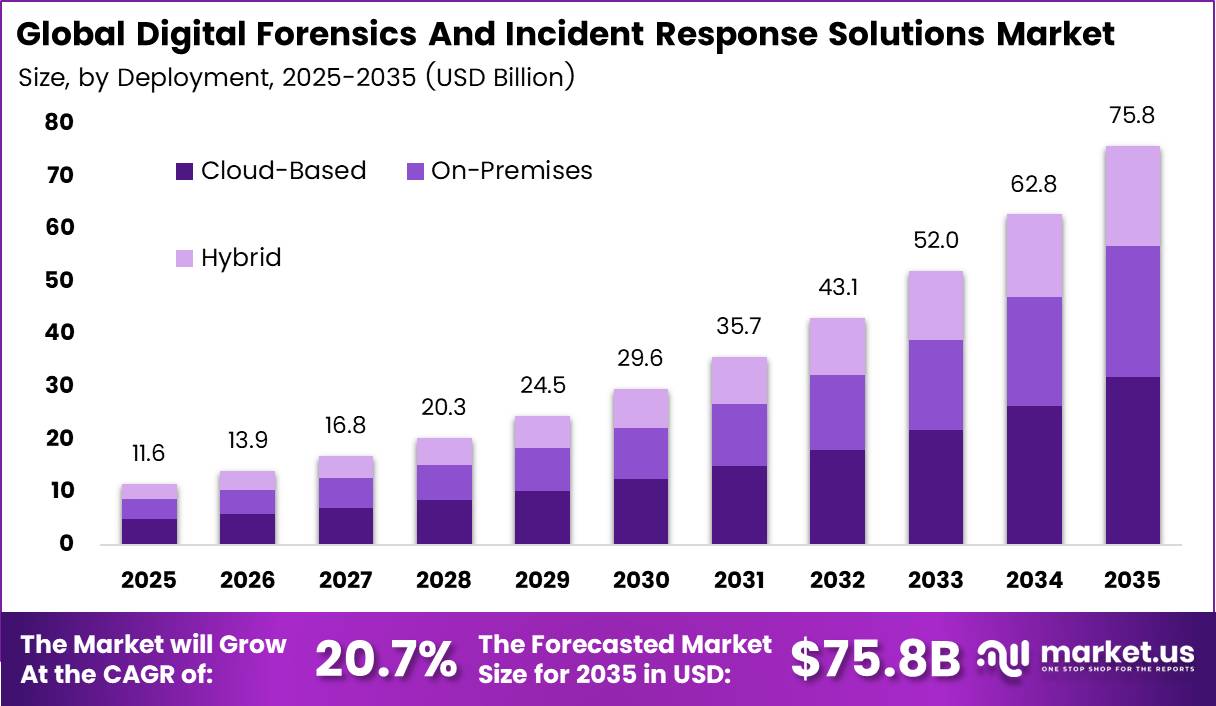
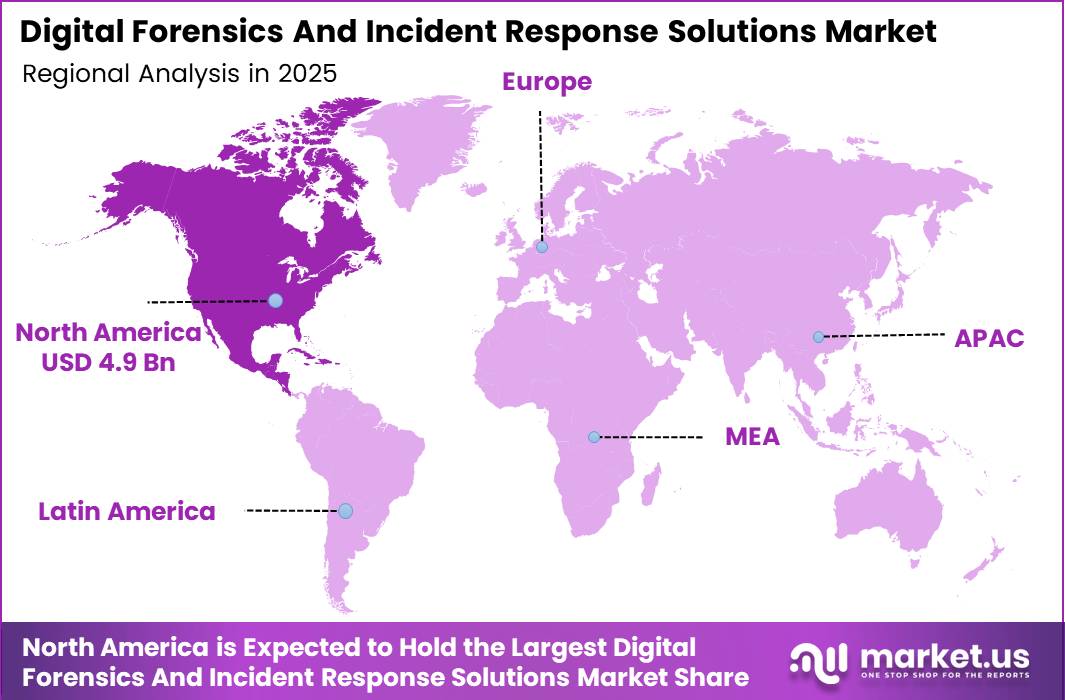
In 2025, the Global Digital Forensics And Incident Response Solutions Market was valued at USD 11.6 billion. The market is projected to grow at a CAGR of 20.7% during 2026–2035, reaching approximately USD 75.8 billion by 2035. North America dominated the global market in 2025, accounting for more than 42.0% of the total market share and generating approximately USD 4.9 billion in revenue.
IBM reported that the global average cost of a data breach reached USD 4.44 million in 2025, while the average cost in the United States rose 9%. These losses push banks, hospitals, retailers, and government agencies to invest in tools that can preserve evidence, investigate attacks, and restore operations quickly.
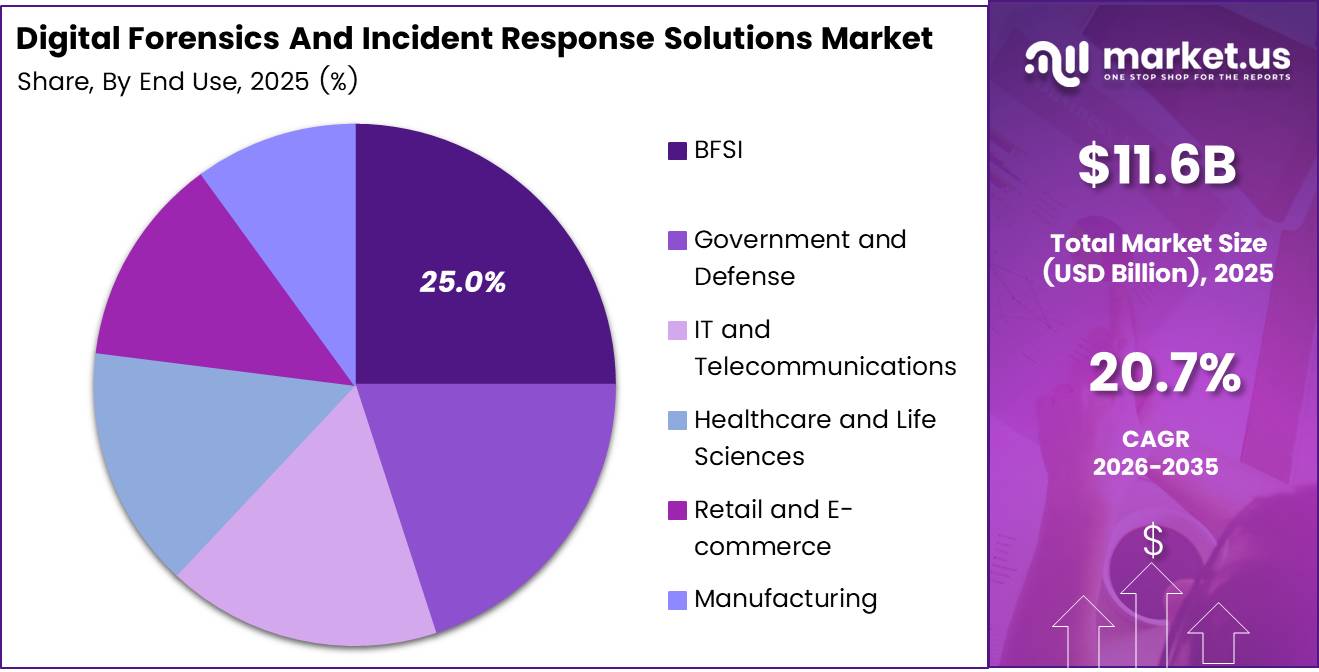
The World Bank reported that internet penetration reached 68% of the global population, adding 400 million new users. More connected users, cloud workloads, mobile devices, and AI systems create more endpoints to monitor and more data to examine after an incident. BFSI alone accounts for 25.0% of market demand because financial firms must investigate fraud, comply with audit rules, and protect customer data.
The North America region benefits from a large base of regulated enterprises, advanced cloud adoption, and strong cybersecurity budgets. The United States records the highest average breach cost globally at USD 10.22 million, which encourages firms to buy forensic software, managed response services, and incident readiness programs.
Key Takeaways
- The Digital Forensics And Incident Response Solutions market was valued at USD 11.6 billion in 2025 and is projected to reach USD 75.8 billion by 2035. at a 20.7% CAGR from 2026 to 2035.
- Software and platforms lead the component segment with a 55.0% share; services are the other key sub-segment.
- Cloud-based deployment leads the deployment mode segment with a 42.0% share; on-premises and hybrid deployments are the other sub-segments.
- Large enterprises lead the organization size segment with a 72.0% share; SMEs are the other sub-segment.
- BFSI leads the end-use industry segment with a 25.0% share.
- North America dominates the market with a 42.0% share and revenue of USD 4.9 billion.
By Component
Software and platforms dominate with 55.0% due to automated investigation and evidence management.
Software and platforms lead because they give security teams one place to collect evidence, study attacks, and create reports. These tools use automation to sort alerts, track attacker activity, and preserve digital proof.
IBM studied 600 breached organizations across 17 industries and found that teams using AI and automation extensively reduced breach costs by USD 1.9 million and shortened the breach lifecycle by 80 days. This clear value encourages buyers to choose software first.
Services are the fastest-growing sub-segment because many organizations lack trained forensic staff. External experts help with incident response, malware analysis, legal support, and recovery after ransomware attacks. Verizon found that ransomware appeared in 44% of reviewed breaches, up from 32% in the prior year.
By Deployment Mode
Cloud-based deployment dominates with 42.0% due to rapid scalability and remote access.
Cloud-based deployment leads because it lets security teams start quickly without buying servers or maintaining data centers. Teams can access case data from different locations, add storage when needed, and share evidence with outside experts. This model suits companies with remote workers, multiple offices, and fast-changing security needs
IBM reported that breaches involving multiple environments cost an average of USD 5.05 million, compared with USD 4.01 million for breaches contained on-premises. This cost gap pushes organizations to adopt hybrid models that improve visibility across both environments.
By Organization Size
Large Enterprises dominate with 72.0% due to complex systems and strict compliance needs.
Large enterprises lead because they operate many networks, applications, cloud services, and third-party connections. A single incident can affect thousands of employees and customers, so these firms invest heavily in forensic tools, response teams, and retention policies. They also face audits, contracts, and regulatory rules that require clear proof of what happened during a breach.
SMEs are the fastest-growing group because cyberattacks now reach smaller firms more often. ENISA analyzed 4,875 incidents between July 2024 and June 2025, while reporting that 24% of organizations suffered a ransomware attack in 2025, up from 18.6% in 2024. Smaller companies often have limited internal security staff, so they turn to affordable cloud tools and managed response services.
By End-Use Industry
BFSI dominates with 25.0% due to high-value data and regulation.
Banking, financial services, and insurance lead because these firms handle money, payment data, credit records, and confidential customer information. Attackers target them for direct financial gain, while regulators require strong controls, audit trails, and fast reporting.
Healthcare and life sciences are growing quickly because hospitals, clinics, and research organizations face rising ransomware and data-theft risks. IBM found that 13% of organizations reported breaches involving AI models or applications, and the average U.S. breach cost reached USD 10.22 million. Healthcare providers cannot risk long system outages because patient care depends on connected records and medical devices.
Key Market Segments
By Component
- Software and Platforms
- Services
By Deployment Mode
- Cloud-based
- On-premises
- Hybrid
By Organization Size
- Small and Medium-sized Enterprises (SMEs)
- Large Enterprises
By End-Use Industry
- Banking, Financial Services, and Insurance (BFSI)
- Government and Defense
- IT and Telecommunications
- Healthcare and Life Sciences
- Retail and E-commerce
- Manufacturing
- Energy and Utilities
- Other
Geopolitical Impact Analysis
Trade tensions affect the supply of servers, storage hardware, security appliances, and cloud infrastructure used in digital forensics platforms. The WTO reported that world merchandise trade volume grew 4.6% in 2025, above its October forecast of 2.4%, as demand for AI-related goods offset higher tariffs and trade policy uncertainty.
Shipping disruption also affects delivery of forensic workstations, mobile extraction kits, write blockers, and evidence storage devices. The World Shipping Council reported that Red Sea diversions added up to 17 days to transit times, while the World Bank found cargo travel times increased by up to 45% on affected routes.
Commodity and energy price movements influence data center and cloud costs. DFIR platforms require secure storage, high-performance computing, and continuous logging. When electricity, semiconductor, or logistics costs rise, vendors face higher operating expenses and may adjust subscription prices.
Geopolitical risk also increases demand for DFIR itself. State-linked cyber activity, sanctions compliance investigations, and cross-border data disputes require evidence that can withstand legal review. Governments and defense agencies increase spending on forensic readiness, while multinational firms use DFIR tools to investigate incidents across jurisdictions.
Regional Analysis
North America dominates the Digital Forensics And Incident Response Solutions market, holding a 42.0% share and generating USD 4.9 billion in revenue. The United States and Canada lead because they combine high cybersecurity spending, strict regulatory oversight, and a mature base of cloud and enterprise software buyers.
The U.S. organizations face an average data breach cost of USD 10.22 million, the highest recorded regional figure in IBM’s 2025 study. This cost pressure drives investment in forensic imaging, endpoint detection, log analysis, and incident response retainers.
Asia Pacific is the fastest-growing region. China, Japan, South Korea, India, and Australia are expanding digital payments, smart manufacturing, and public digital services. This growth increases the volume of digital evidence and the need for rapid breach response. India and Australia are investing in cybersecurity capability, while Japan and South Korea strengthen defenses for critical infrastructure. manufacturers.
Europe holds a strong position due to data protection rules, cyber resilience laws, and a large base of regulated enterprises. Germany, France, the UK, Spain, and Italy invest in forensic capability across banking, manufacturing, healthcare, and public administration. The UK is a major hub for incident response services, while Germany and France focus on industrial and government security.
Key Regions and Countries
North America
- US
- Canada
Europe
- Germany
- France
- The UK
- Spain
- Italy
- Rest of Europe
Asia Pacific
- China
- Japan
- South Korea
- India
- Australia
- Rest of APAC
Latin America
- Brazil
- Mexico
- Rest of Latin America
Middle East and Africa
- GCC
- South Africa
- Rest of MEA
Market Dynamics
Driver
| Driver | (~) % Impact on CAGR Forecast | Geographic Relevance | Impact Timeline |
|---|---|---|---|
| Rising ransomware and cybercrime losses | +3.2% | Global; highest in North America and Europe | Short term (2 years or less) |
| Mandatory breach and incident reporting | +2.4% | EU, UK, North America, APAC | Short term (2 years or less) |
| Cloud, SaaS and hybrid-work attack surface | +2.0% | Global | Short term (2 years or less) |
| AI-assisted investigation and triage | +1.6% | North America, Europe, developed APAC | Medium term (2 to 4 years) |
| IoT, OT and connected-device evidence growth | +1.2% | Global; manufacturing and critical infrastructure | Medium term (2 to 4 years) |
| Cyber-insurance forensic-readiness requirements | +1.0% | North America, Europe | Short term (2 years or less) |
Rising ransomware and cybercrime losses are the highest-impact driver.
The root cause is the industrialization of extortion, fraud, and credential-theft campaigns, which converts security incidents into recurring demand for evidence preservation, malware reverse engineering, timeline reconstruction, legal hold support, and post-incident hardening.
Per the FBI’s Internet Crime Complaint Center, reported cybercrime losses reached nearly $20.9 billion in 2025, up 26% from $16.6 billion in 2024, while complaints exceeded 1 million for the first time; this creates a direct, near-term pull-through for retainer-based incident response and per-engagement forensic services.
Commercially, providers are shifting from episodic breach-response billing toward 24/7 managed detection-and-response plus DFIR retainers, improving revenue visibility and reducing customer-acquisition costs because insured and regulated buyers increasingly pre-contract response capacity.
The result is an estimated +3.2% incremental contribution to the stated 20.7% baseline CAGR, with the strongest effect in North America and Europe, where board-level cyber risk ownership and insurer evidence requirements are most mature.
Restraint
| Restraint | (~) % Impact on CAGR Forecast | Geographic Relevance | Impact Timeline |
|---|---|---|---|
| Acute certified-forensics talent scarcity | -2.3% | Global; acute in North America, Europe, India | Short term (2 years or less) |
| High cost of licensed forensic tooling | -1.5% | Global; strongest for SMEs and public sector | Short term (2 years or less) |
| Data sovereignty and cross-border evidence limits | -1.2% | EU, Middle East, APAC | Medium term (2 to 4 years) |
| Encryption and privacy constraints on evidence access | -1.0% | Global | Short term (2 years or less) |
| Fragmented public-sector procurement cycles | -0.8% | North America, Europe, India | Medium term (2 to 4 years) |
Acute certified-forensics talent scarcity is the principal restraint.
The bottleneck originates in a narrow pool of professionals who combine endpoint, cloud, malware, legal-chain-of-custody, and courtroom-testimony skills; demand has risen faster than accredited training pipelines can supply qualified investigators.
Operationally, this limits concurrent caseloads, extends response lead times, and raises labor cost per engagement; where senior examiner availability is constrained, service margins can compress by 10% to 20% as firms rely on overtime, subcontractors, or travel-heavy response teams.
The commercial effect is delayed contract starts, rationed retainers, and slower expansion into mid-market accounts, producing an estimated -2.3% deduction from the baseline CAGR rather than a halt to underlying demand.
Challenge
| Challenge | (~) % CAGR Friction Drag | Geographic Relevance | Mitigation Horizon |
|---|---|---|---|
| Cloud evidence fragmentation | -1.8% | Global | Medium term (2 to 4 years) |
| AI-enabled adversary evasion | -1.4% | Global | Medium term (2 to 4 years) |
| Forensic tool interoperability gaps | -1.1% | Global | Medium term (2 to 4 years) |
| Cross-border legal workflow complexity | -0.9% | EU, APAC, Middle East | Long term (4 years or more) |
| Encryption and privacy-by-design friction | -0.8% | Global | Long term (4 years or more) |
Cloud evidence fragmentation is the largest ongoing challenge.
The structural vulnerability arises because identity, endpoint, email, SaaS, container, serverless, and backup evidence now reside across multiple providers with different logging defaults, retention periods, and export interfaces.
A single investigation may require correlating data from 5 to 15 distinct sources, while inadequate log retention can erase decisive artifacts before responders are engaged; enterprises commonly need 12 to 24 months of immutable, searchable telemetry to support reliable root-cause analysis.
Vendors must therefore invest in API-based collection, standardized evidence schemas, automated timeline correlation and cloud-native storage; without that shift, gross margins on complex investigations may fall by 5% to 15% because each additional data source adds labor without proportionate price realization. The friction is estimated at -1.8% against the market’s maximum growth potential and is distinct from the talent constraint already reflected under Restraints.
Opportunity
| Opportunity | (~) % Potential CAGR Upside | Geographic Relevance | Execution Window |
|---|---|---|---|
| Forensic-readiness-as-a-service | +2.1% | Global; strongest in regulated sectors | Short term (2 years or less) |
| EU product-security compliance forensics | +1.7% | EU and EU-facing supply chains | Short term (2 years or less) |
| AI-enabled automated triage platforms | +1.5% | North America, Europe, developed APAC | Medium term (2 to 4 years) |
| OT and IoT investigation suites | +1.3% | Global; industrial and critical infrastructure | Medium term (2 to 4 years) |
| Sovereign-cloud forensic platforms | +1.0% | EU, India, Middle East, ASEAN | Medium term (2 to 4 years) |
| DFIR M&A and capability roll-ups | +0.9% | North America, Europe | Short term (2 years or less) |
Forensic-readiness-as-a-service is the largest untapped opportunity.
Unlike the active ransomware-response demand already captured in the baseline, most mid-market and regulated organizations still buy DFIR reactively after an incident, leaving substantial white space in pre-agreed evidence capture, log-retention design, legal-hold automation, tabletop exercises, and insurer-aligned response playbooks.
A subscription model can convert unpredictable emergency engagements into recurring annual contracts, improve revenue quality and reduce emergency-response discounting; vendors that automate collection and triage can potentially lower cost per investigated endpoint or mailbox by 20% to 40% while expanding gross margin by 5% to 12%.
Capturing this white space could add an estimated +2.1% upside to the 20.7% baseline CAGR, particularly across financial services, healthcare, manufacturing, and public-sector buyers.
Key Players Analysis
Tier 1 includes Microsoft, Google Cloud, IBM, Cisco, Palo Alto Networks, and CrowdStrike. These companies combine global cloud platforms, security portfolios, and large enterprise customer bases. Microsoft generated revenue of USD 281.7 billion in fiscal 2025 and spent USD 32.5 billion on research and development, equal to 12% of revenue. Its security, compliance, and cloud businesses support forensic investigation at enterprise scale.
Tier 2 includes strong challengers with specialized forensic, investigation, or managed detection capabilities. IBM brings consulting, managed security services, and enterprise software, while Cisco adds network visibility and secure infrastructure. Kroll, OpenText, Magnet Forensics, Exterro, Cellebrite, Rapid7, Sophos, Secureworks, SentinelOne, and Group-IB serve niches such as mobile forensics, eDiscovery, legal hold, threat intelligence, and managed response.
Consolidation is reshaping competition. IBM completed its acquisition of HashiCorp in a transaction valued at USD 6.4 billion in February 2025, strengthening its hybrid cloud and security automation capabilities. Google announced an agreement to acquire Wiz for USD 32 billion in March 2025, targeting cloud security and posture management. Palo Alto Networks acquired Protect AI for approximately USD 700 million in 2025, expanding AI security and model risk capabilities.
Competition now centers on speed, automation, and legal defensibility. Vendors with strong telemetry, AI analysis, and global service teams can reduce investigation time and support large incident response programs. Specialist firms compete by offering validated forensic tools, mobile device support, chain-of-custody controls, and expert testimony.
Top Key Players in the Market
- Google Cloud
- CrowdStrike
- Palo Alto Networks
- Microsoft
- IBM
- Cisco
- Kroll
- OpenText
- Magnet Forensics
- Exterro
- Cellebrite
- Rapid7
- Sophos, Including Secureworks
- SentinelOne
- Group-IB
Recent Developments
- In February 2025, IBM completed its acquisition of HashiCorp in a transaction valued at USD 6.4 billion, strengthening hybrid cloud security, automation, and infrastructure management capabilities.
- In March 2025, Google announced an agreement to acquire Wiz for USD 32 billion, expanding Google Cloud’s cloud security, workload protection, and risk visibility portfolio.
- In April 2025, Palo Alto Networks acquired Protect AI in a transaction valued at approximately USD 700 million, adding AI security, model scanning, and AI runtime protection capabilities.
- In July 2025, CrowdStrike acquired Onum in a transaction valued at approximately USD 290 million, strengthening real-time telemetry processing and security data pipeline capabilities.
Report Scope
| Report Features | Description |
|---|---|
| Market Value (2025) | USD 11.6 Billion |
| Forecast Revenue (2035) | USD 75.8 Billion |
| CAGR (2026-2035) | 20.7% |
| Base Year for Estimation | 2025 |
| Historic Period | 2020-2024 |
| Forecast Period | 2026-2035 |
| Report Coverage | Revenue Forecast, Market Dynamics, Competitive Landscape, Recent Developments |
| Segments Covered | By Component (Software and Platforms, Services); By Deployment Mode (Cloud-based, On-premises, Hybrid); By Organization Size (Small and Medium-sized Enterprises (SMEs), Large Enterprises); By End-Use Industry (Banking, Financial Services, and Insurance (BFSI), Government and Defense, IT and Telecommunications, Healthcare and Life Sciences, Retail and E-commerce, Manufacturing, Energy and Utilities, Other) |
| Regional Analysis | North America – US, Canada; Europe – Germany, France, The UK, Spain, Italy, Rest of Europe; Asia Pacific – China, Japan, South Korea, India, Australia, Singapore, Rest of APAC; Latin America – Brazil, Mexico, Rest of Latin America; Middle East & Africa – GCC, South Africa, Rest of MEA |
| Competitive Landscape | Google Cloud, CrowdStrike, Palo Alto Networks, Microsoft, IBM, Cisco, Kroll, OpenText, Magnet Forensics, Exterro, Cellebrite, Rapid7, Sophos, including Secureworks, SentinelOne, Group-IB |
| Customization Scope | Customization for segments and region/country-level will be provided. Moreover, additional customization can be done based on the requirements. |
| Purchase Options | We have three licenses to opt for: Single User License, Multi-User License (Up to 5 Users), Corporate Use License (Unlimited Users and Printable PDF) |