


Global Egg-free Mayonnaise Market Size, Share, And Industry Analysis Report By Nature (Conventional, Organic), By Distribution Channel (Hypermarket and Supermarket, Food and Drink Specialty Stores, Convenience Store, Discount Store, Online Retail, Others), By End User (Household, HoReCa, Food Processors), By Region and Companies - Industry Segment Outlook, Market Assessment, Competition Scenario, Trends, and Forecast 2025-2034
- Published date: December 2025
- Report ID: 172135
- Number of Pages: 299
- Format:
-
keyboard_arrow_up
Quick Navigation
Report Overview
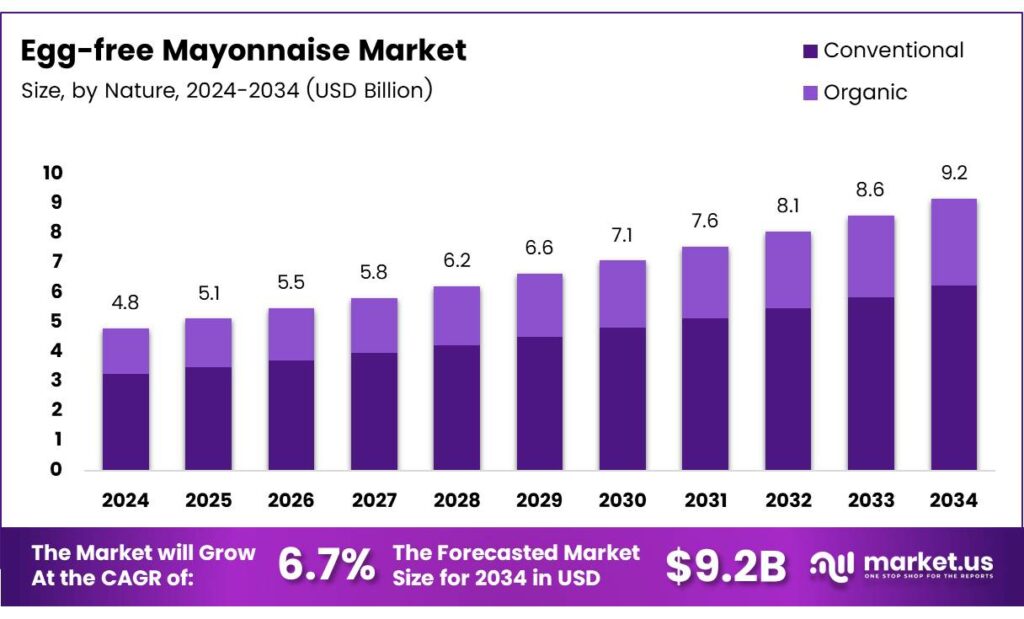
The Global Egg-free Mayonnaise Market size is expected to be worth around USD 9.2 billion by 2034, from USD 4.8 billion in 2024, growing at a CAGR of 6.7% during the forecast period from 2025 to 2034.
Egg-free mayonnaise is a plant-based alternative to traditional mayonnaise, formulated without eggs, appealing to health-conscious and allergy-aware consumers. It combines vegetable oils, vinegar, and salt in an oil-in-water emulsion, offering a creamy texture similar to conventional mayonnaise. The market is expanding as plant-based diets gain momentum globally.
Growing consumer awareness about egg allergies is driving demand for egg-free mayonnaise products. Hen’s eggs are the primary cause of food allergy in 0.5–2.5% of children under five, pushing manufacturers to provide safer, allergen-free options. This trend is supported by educational campaigns and health advisories promoting alternatives for sensitive populations.
- Egg-free mayonnaise is a calorie-dense condiment rich in healthy fats and low in protein, making it ideal for energy-focused diets. A standard serving provides approximately 1,719 kcal, 174 g of fat, 39 g of carbohydrates, and 8 g of protein, offering a functional option for consumers seeking balanced nutrition without eggs.
The product’s high fat content, constituting 60–80% of its formulation, ensures a stable emulsion and smooth texture. This characteristic opens opportunities for innovation, including reduced-fat or nutrient-fortified variants, allowing manufacturers to cater to diverse dietary preferences while maintaining taste and visual appeal.
Beyond macronutrients, egg-free mayonnaise contains essential micronutrients such as Vitamin A (2,884 IU), Vitamin C (101 mg), calcium (242 mg), iron (5 mg), and potassium (685 mg), while remaining low in cholesterol (12 mg per serving). Its versatility and nutritional profile make it a sustainable, functional choice for both households and the foodservice industry.
Key Takeaways
- The Global Egg-free Mayonnaise Market was valued at USD 4.8 billion in 2024 and is projected to reach USD 9.2 billion by 2034, at a CAGR of 6.7% during the forecast period from 2025 to 2034.
- Conventional egg-free mayonnaise dominates the By Nature segment with a 65.9% market share due to its affordability and wide accessibility.
- Hypermarkets and Supermarkets lead the By Distribution Channel segment with a 38.2% share, driven by product variety and convenience.
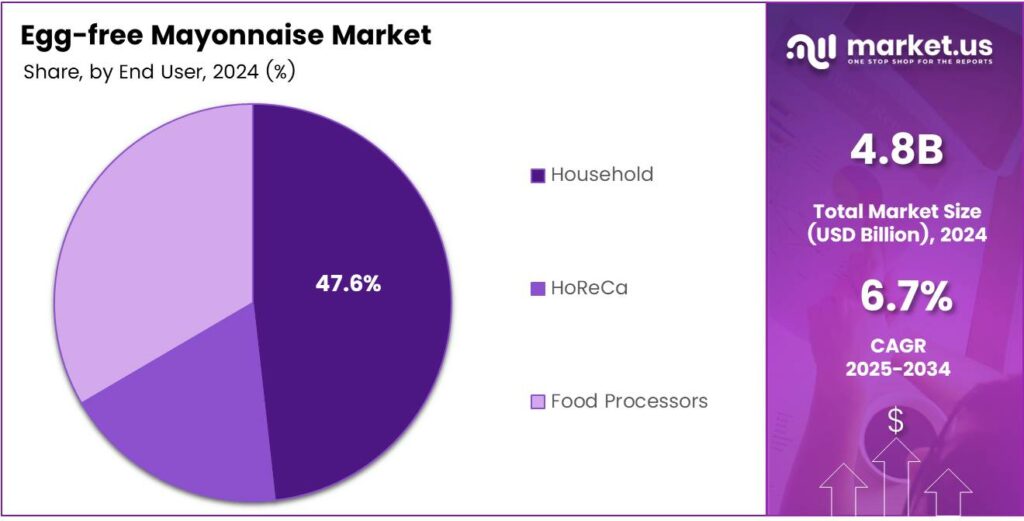
- Household users hold the largest share in the By End User segment at 47.6%, fueled by rising home cooking and vegan trends.
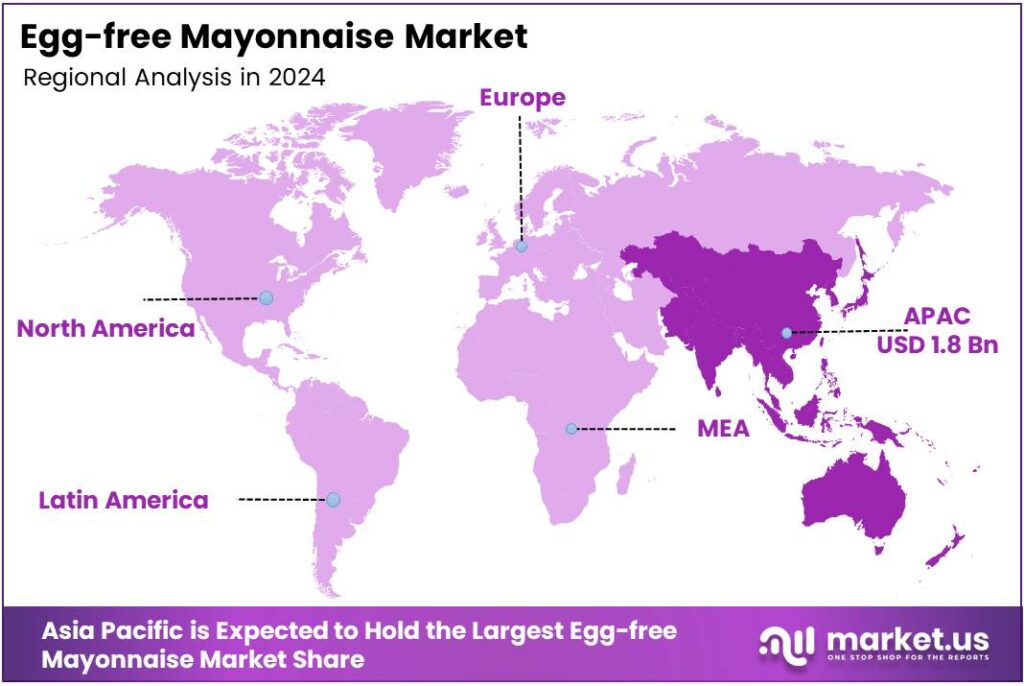
- Asia Pacific dominates the regional market with a 37.8% share, valued at USD 1.8 billion in 2024.
By Nature Analysis
Conventional dominates with 65.9% due to its affordability and broad consumer accessibility.
Conventional egg-free mayonnaise leads the market, capturing a significant 65.9% share. Moreover, its production scalability allows for lower costs, appealing to budget-conscious buyers. Additionally, widespread availability in mainstream stores boosts its adoption. Furthermore, consistent quality standards ensure reliability for everyday use, driving sustained demand.
Organic egg-free mayonnaise, while smaller in share, gains traction among health-focused consumers. Besides, its use of natural ingredients attracts eco-conscious shoppers. However, higher pricing limits broader penetration. Nevertheless, growing awareness of sustainability propels gradual expansion in this niche.
By Distribution Channel Analysis
Hypermarket and Supermarket dominate with 38.2% due to extensive product variety and one-stop shopping convenience.
Hypermarkets and supermarkets command a 38.2% market share in egg-free mayonnaise distribution. Furthermore, their large-scale operations enable competitive pricing and promotions. Additionally, high foot traffic enhances visibility for new variants. Moreover, integrated supply chains ensure fresh stock availability year-round.
Food and drink specialty stores cater to niche preferences in egg-free mayonnaise. Besides, they offer premium and artisanal options, drawing gourmet enthusiasts. However, limited locations restrict overall reach. Nevertheless, personalized service fosters loyal customer bases.
Convenience stores provide quick access to egg-free mayonnaise for on-the-go consumers. Additionally, their extended hours support impulse purchases. Moreover, compact packaging suits small-scale buying. Furthermore, strategic urban placements boost everyday sales.
By End User Analysis
Household dominates with 47.6% due to rising home cooking trends and vegan lifestyle adoption.
Household users dominate egg-free mayonnaise consumption with a 47.6% share. Moreover, increasing plant-based diets fuels demand in daily meals. Additionally, versatile recipes like salads and sandwiches boost usage. Furthermore, family-sized packaging supports cost-effective home storage.
HoReCa sectors, such as hotels and restaurants, utilize egg-free mayonnaise for menu innovations. Besides, allergen-free options meet diverse customer needs. However, bulk procurement challenges smaller outlets. Nevertheless, quality focus drives professional applications.
Food processors incorporate egg-free mayonnaise in ready-to-eat products. Furthermore, its stability enhances manufacturing efficiency. Additionally, clean-label demands align with ingredient trends. Moreover, scalable production supports industrial volumes.
Key Market Segments
By Nature
- Conventional
- Organic
By Distribution Channel
- Hypermarket and Supermarket
- Food and Drink Specialty Stores
- Convenience Store
- Discount Store
- Online Retail
- Others
By End User
- Household
- HoReCa
- Food Processors
Emerging Trends
Plant-Based and Vegan Trends Boost Popularity of Egg-Free Mayonnaise
Consumers are increasingly embracing plant-based lifestyles, which has made egg-free mayonnaise a preferred choice. The trend is particularly strong among millennials and Gen Z, who value sustainability and ethical consumption. Social media influence and influencer marketing have also played a key role.
- A significant portion of people with food allergies will specifically seek out products labeled as vegan or free of common allergens like egg and dairy. In fact, up to 86% of people with egg or milk allergies say they would buy products that are clearly labeled as vegan because these foods help them avoid ingredients that could trigger reactions.
Restaurants and cafes are incorporating egg-free mayonnaise into their menus, responding to growing vegan and health-conscious clientele. This creates visibility and encourages trials among a broader audience. Innovation in flavors and formulations further attracts consumers.
Drivers
Rising Health Awareness Among Consumers Drives Market Growth
Consumers are increasingly shifting toward healthier diets, which has boosted the demand for egg-free mayonnaise. People are looking for products that are lower in cholesterol but still provide the creamy texture of traditional mayonnaise. This trend has encouraged manufacturers to innovate and expand their product offerings.
- The World Health Organization (WHO) has been very vocal about this, stating that high intake of trans fats increases the risk of dying from heart disease by a staggering 23%. This has pushed people to look for condiments that skip the animal cholesterol entirely.
The rise of veganism and plant-based diets has also contributed significantly. Many households prefer egg-free alternatives to support ethical and environmental choices. This shift has created a broader customer base, increasing market penetration across regions. Egg-free mayonnaise is versatile and easy to use in sandwiches, salads, and snacks, appealing to consumers seeking quick, healthy options.
Restraints
High Production Costs and Shelf-life Limitations Restrain Market Growth
Egg-free mayonnaise production involves specialized ingredients like plant-based proteins and stabilizers, which can be costlier than traditional components. These higher production costs often translate to elevated retail prices, limiting adoption among price-sensitive consumers.
- The Food and Agriculture Organization (FAO) of the United Nations, the global benchmark for food commodity prices, has been on a wild ride. While the overall food price index was about 2.1% lower, the cost of the specialized vegetable oils and high-quality plant proteins needed for egg-free emulsions remains stubborn.
Egg-free formulations may require preservatives to maintain freshness, which can reduce appeal to health-conscious buyers. Managing storage and transportation conditions also adds complexity. Some consumers are still hesitant due to taste differences compared to traditional mayonnaise. Convincing users to switch requires consistent quality and flavor, which can be difficult to maintain at scale.
Growth Factors
Expansion of Online Retail Channels Offers Significant Opportunities
Online retail growth has opened new avenues for egg-free mayonnaise brands. E-commerce platforms allow direct consumer engagement, making it easier to showcase product benefits and drive purchases. Subscription services and bundled offers present opportunities to increase recurring sales.
Customers seeking convenient access to healthy products can now order regularly, ensuring steady demand. Regional expansion is more feasible through digital channels. Smaller brands can reach urban and semi-urban consumers without heavy investments in physical stores, improving market coverage.
Collaborations with food delivery and meal-kit services also provide growth potential. As home cooking and quick meals gain popularity, egg-free mayonnaise can become a staple ingredient in prepared meal options. Brands offering unique taste profiles while maintaining health benefits gain a competitive edge in the market.
Regional Analysis
Asia Pacific Dominates the Egg-free Mayonnaise Market with a Market Share of 37.8%, Valued at USD 1.8 billion
In 2024, Asia Pacific emerged as the leading region in the egg-free mayonnaise market, accounting for a significant 37.8% share, valued at USD 1.8 billion. The growth is driven by rising vegan and plant-based food consumption, increasing health awareness, and a strong retail network. Countries like China, India, and Japan are witnessing increased adoption of egg-free alternatives, supporting market expansion.
North America holds a strong position in the egg-free mayonnaise market due to growing consumer preference for clean-label and allergen-free products. Rising health consciousness, vegan trends, and widespread availability in supermarkets and online retail channels contribute to steady growth. The market is expected to benefit from innovative product launches and increasing dietary awareness.
Europe shows robust demand for egg-free mayonnaise, fueled by rising veganism, lactose intolerance awareness, and preference for sustainable products. Western European countries lead in consumption, supported by organized retail and foodservice channels. The region continues to focus on product innovation and healthier alternatives to traditional mayonnaise.
The U.S. market shows strong growth in egg-free mayonnaise, fueled by increasing vegan and vegetarian populations. Rising concerns over cholesterol and allergens are driving demand. Supermarkets, specialty stores, and e-commerce channels play a key role in making these products accessible to health-conscious consumers.
Key Regions and Countries
North America
- US
- Canada
Europe
- Germany
- France
- The UK
- Spain
- Italy
- Rest of Europe
Asia Pacific
- China
- Japan
- South Korea
- India
- Australia
- Rest of APAC
Latin America
- Brazil
- Mexico
- Rest of Latin America
Middle East & Africa
- GCC
- South Africa
- Rest of MEA
Key Players Analysis
In the competitive landscape of the global Egg‑free Mayonnaise market in 2024, a handful of established and innovative players are driving growth through product development, distribution strategies, and consumer engagement.
Crosse and Blackwell continues to leverage its long heritage in condiments to strengthen its presence in the egg‑free mayonnaise segment. The company’s focus on balancing traditional flavors with modern dietary trends has helped it appeal to both legacy customers and new health‑conscious consumers. Its strategic marketing and retail partnerships are enhancing visibility, particularly in markets where plant‑based alternatives are gaining traction, allowing it to sustain steady year‑on‑year growth.
Kensington and Sons LLC distinguishes itself through artisanal and premium positioning within the egg‑free mayonnaise category. Emphasizing quality ingredients and small‑batch production, the brand taps into a niche but rapidly expanding consumer base seeking gourmet and clean-label options. Kensington’s commitment to sustainability, including eco‑friendly packaging, reinforces its brand ethos and resonates well with environmentally aware buyers, driving differentiation in a crowded market.
Nestlé S.A. utilizes its vast global infrastructure to accelerate the penetration of egg‑free mayonnaise across diverse regions. By integrating plant‑based formulations into its extensive product portfolio, Nestlé benefits from unparalleled distribution networks and marketing resources. The company’s R&D investments focus on optimizing taste and texture to mimic traditional mayonnaise, which helps to attract flexitarians and those reducing egg consumption without compromising sensory expectations.
Zydus Wellness Limited combines health‑oriented branding with innovative product offerings to capitalize on the wellness trend influencing consumer food choices. Known for emphasizing nutritional benefits, Zydus positions its egg‑free mayonnaise as a heart‑healthy and cholesterol‑free alternative. Through targeted campaigns and collaborations with health influencers, the company is building strong brand loyalty among fitness‑focused and diet‑aware segments, reinforcing its competitive stance in the market.
Top Key Players in the Market
- Crosse and Blackwell
- Kensington and Sons LLC
- Nestlé S.A.
- Zydus Wellness Limited
- Del Monte Foods Inc.
- Spectrum Organic Products LLC
- Unilever Group
- Eat Just Inc.
- Veeba Food Services Private Limited
- Follow Your Heart Inc.
Recent Developments
- In 2024, Crosse & Blackwell offers a range of mayonnaise products, including their classic tangy variety, a bold Kasi flavor, a smooth, mild, and creamy option, and a lighter Trim version. However, there is no explicit information indicating that any of these are egg-free or vegan, and traditional mayonnaise recipes typically include eggs.
- In 2024, Kensington and Sons LLC operates under the Sir Kensington’s brand, which produces a variety of mayonnaise products. They offer a dedicated vegan mayonnaise (often called Fabanaise), made with aquafaba (chickpea water) as an egg substitute, along with options like avocado oil-based mayonnaise that emphasize clean, non-GMO ingredients.
Report Scope
Report Features Description Market Value (2024) USD 4.8 Billion Forecast Revenue (2034) USD 9.2 Billion CAGR (2025-2034) 6.7% Base Year for Estimation 2024 Historic Period 2020-2023 Forecast Period 2025-2034 Report Coverage Revenue Forecast, Market Dynamics, Competitive Landscape, Recent Developments Segments Covered By Nature (Conventional, Organic), By Distribution Channel (Hypermarket and Supermarket, Food and Drink Specialty Stores, Convenience Store, Discount Store, Online Retail, Others), By End User (Household, HoReCa, Food Processors) Regional Analysis North America (US and Canada), Europe (Germany, France, The UK, Spain, Italy, and Rest of Europe), Asia Pacific (China, Japan, South Korea, India, Australia, and Rest of APAC), Latin America (Brazil, Mexico, and Rest of Latin America), Middle East & Africa (GCC, South Africa, and Rest of MEA) Competitive Landscape Crosse and Blackwell, Kensington and Sons LLC, Nestlé S.A., Zydus Wellness Limited, Del Monte Foods Inc., Spectrum Organic Products LLC, Unilever Group, Eat Just Inc., Veeba Food Services Private Limited, Follow Your Heart Inc. Customization Scope Customisation for segments, region/country-level will be provided. Moreover, additional customisation can be done based on the requirements. Purchase Options We have three licenses to opt for: Single User License, Multi-User License (Up to 5 Users), Corporate Use License (Unlimited Users and Printable PDF)  Egg-free Mayonnaise MarketPublished date: December 2025add_shopping_cartBuy Now get_appDownload Sample
 -
-
- Crosse and Blackwell
- Kensington and Sons LLC
- Nestlé S.A.
- Zydus Wellness Limited
- Del Monte Foods Inc.
- Spectrum Organic Products LLC
- Unilever Group
- Eat Just Inc.
- Veeba Food Services Private Limited
- Follow Your Heart Inc.
Our Clients

- 172135
- December 2025






