


Report Overview
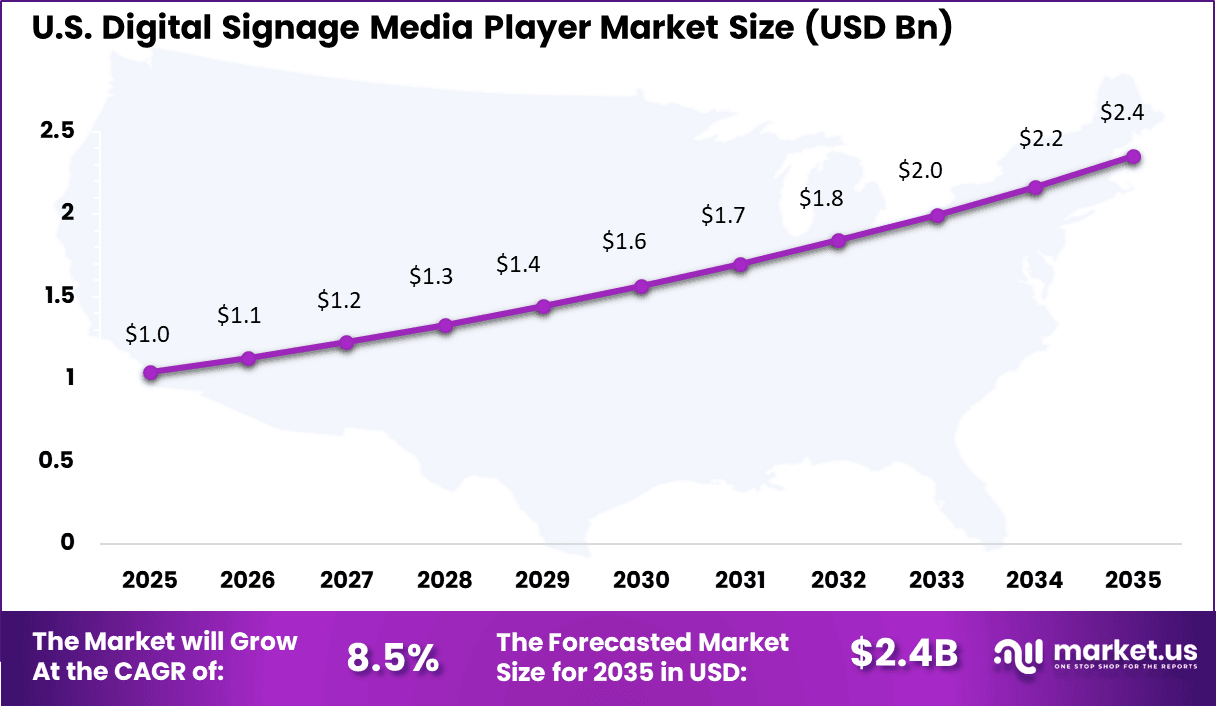
The Global Digital Signage Media Player Market generated USD 3.6 billion in 2025 and is predicted to register growth from USD 4.0 billion in 2026 to about USD 11.3 billion by 2035, recording a CAGR of 12.2% throughout the forecast span. In 2025, North America held a dominant market position, capturing more than a 33.6% share, with USD 1.19 billion in revenue.
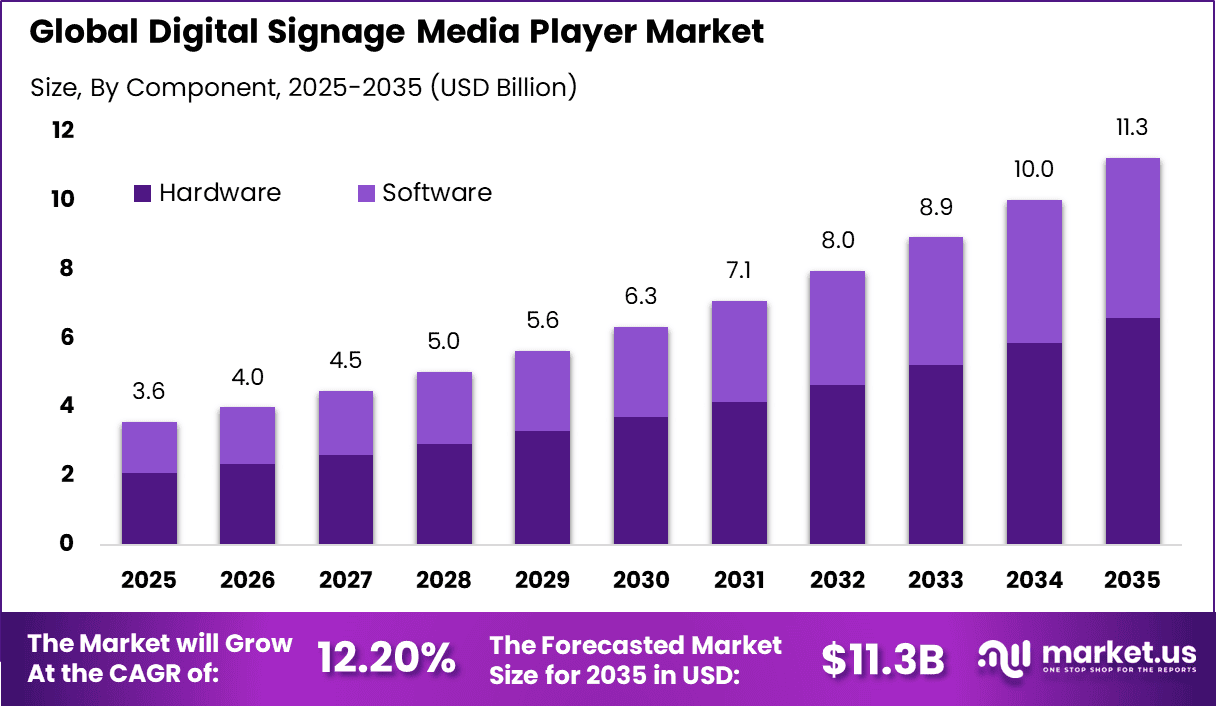
The digital signage media player market refers to devices that deliver and control content on digital displays used in public and commercial spaces. Media players connect to screens such as LED, LCD, and video walls to show images, video, and interactive content for advertising, information, wayfinding, and branding.
The main driving factors for the digital signage media player market are the rising use of digital displays in public and commercial environments and the need for flexible content control. Businesses seek effective ways to capture attention, share messages, and promote products or services with visual content that can be updated centrally and quickly.
Educational institutions and corporate facilities add digital signage to communicate news, events, and wayfinding information to visitors and staff. Small and medium-sized enterprises adopt affordable media players to improve in-store communication with minimal technical support. As digital signage becomes an integral part of communication strategies across sectors, investment in media players is expected to remain strong, driven by demand for dynamic, easy-to-manage visual content systems.
Top Market Takeaways
- By component, hardware dominated the digital signage media player market with a 58.5% share, providing robust players for reliable 24/7 content playback.
- By product, enterprise-level players captured 46.7%, designed for large-scale deployments with advanced features like 4K support and remote management.
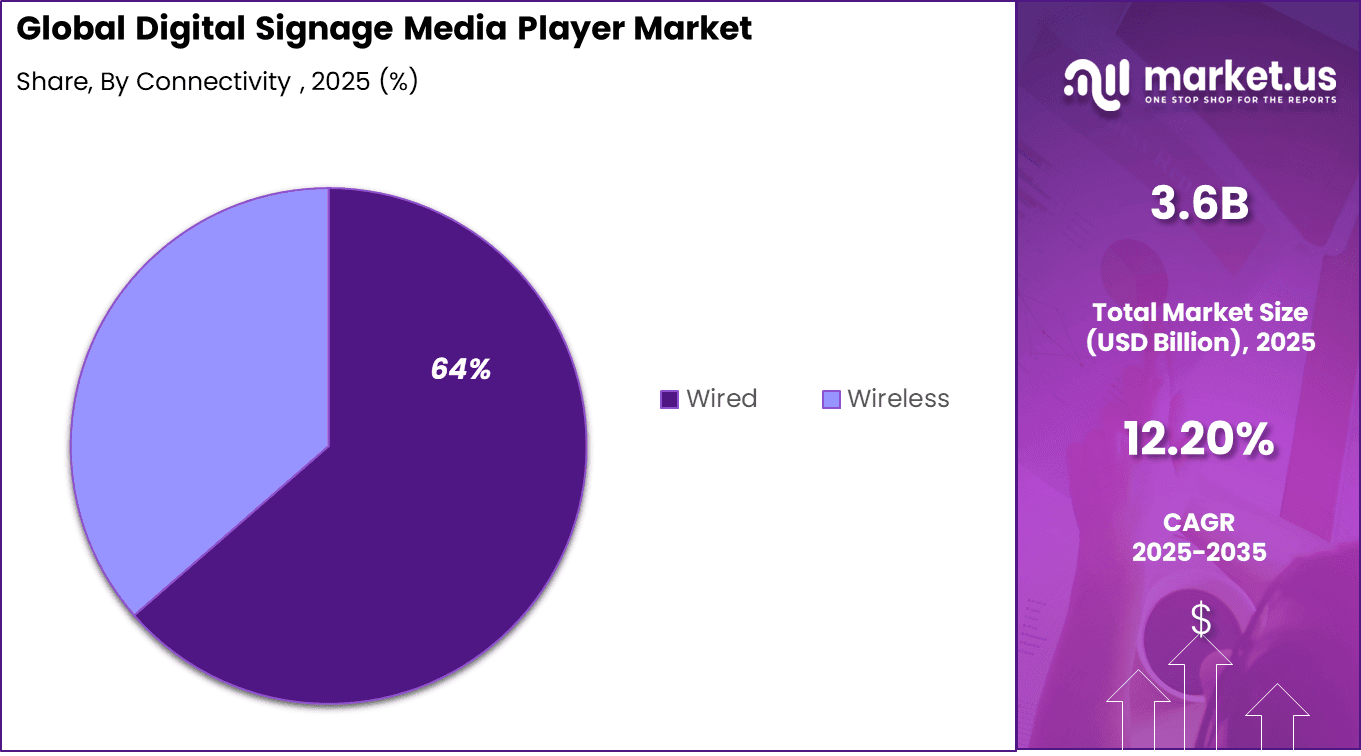
- By connectivity, wired connections led at 63.6%, ensuring stable, high-bandwidth delivery for mission-critical displays.
- By application, retail held 35.3%, using media players for dynamic promotions, pricing updates, and customer engagement screens.
- North America accounted for 33.6% of the global market, with the U.S. valued at USD 1.04 billion and growing at a CAGR of 8.5%.
Key Market Insights
Adoption Statistics
- About 60% of businesses that do not use digital signage today plan to invest in it within the next two years.
- More than 67% of existing users plan to increase their spending on digital signage systems.
- Around 73% of educational institutions view digital signage as important for future communication and information sharing.
Player Type and Deployment Trends
- External vs integrated players: About 89% of digital signage screens use external media players instead of built-in system-on-chip solutions.
- Connectivity: Wireless setups account for 67.25% of installations, as Wi Fi 6 and 5G help lower cabling needs and installation costs.
- Operating systems: More than 72% of new signage networks use Android-based or ARM-powered players, mainly because they cost less and are easier to update remotely.
- Performance levels: Advanced media players generated 46.3% of revenue in 2025, driven by demand for high-resolution displays and interactive features.
Industry Adoption and Performance
- Retail: Retail is the largest user segment, where digital signage players help increase store visits by 24% and boost sales by up to 33%.
- Healthcare: About 70% of hospitals use media players for digital communication, which helps reduce perceived patient wait times by 35%.
- Corporate: In offices, media players used for internal communication can raise employee productivity by around 25%.
Key Media Player Technologies and Trends
- Wireless usage: Wireless media players make up 67.25% of installations, supported by wider use of 5G and Wi Fi 6, and continue to see steady growth.
- Performance features: Media players released in 2025 and 2026 focus on 4K HDR playback, small fanless designs for nonstop use, and built-in AI tools for monitoring and analysis.
- Security needs: There is strong demand for devices with TPM 2.0 chips and secure boot features to protect systems and data.
- Application areas: Transportation is the fastest growing sector, followed by increasing adoption in corporate offices, retail spaces, and healthcare facilities.
Component Analysis
Hardware accounts for 58.5% of the Digital Signage Media Player market, indicating that physical devices remain the foundation of digital signage networks. Media player hardware includes processors, storage units, graphics modules, and cooling systems that support continuous content playback. Enterprises invest in reliable hardware to ensure stable performance across long operating hours, especially in public and commercial environments.
Strong hardware performance is critical for handling high-resolution video, animations, and interactive content. From an operational standpoint, hardware-based media players provide consistent uptime and predictable performance. They are designed to operate in demanding conditions such as retail stores, transportation hubs, and corporate buildings.
Product Analysis
Enterprise-level products account for 46.7% of the market, showing strong adoption among large organizations with multi-location signage networks. These media players are built to support centralized management, advanced security, and integration with enterprise IT systems. Enterprises use these products to deliver consistent messaging across regions while maintaining control over content updates and system performance.
Enterprise-level media players also support scalability and customization. They can manage multiple displays and content formats from a single platform. The strong presence of this segment reflects demand for robust and manageable solutions that align with large-scale digital communication strategies.
Connectivity Analysis
Wired connectivity dominates the market with 64%, highlighting preference for stable and secure network connections. Wired connections provide consistent bandwidth and lower risk of signal interruption, which is critical for real-time content delivery. Many organizations choose wired networks to ensure uninterrupted playback and reliable system updates.
From a deployment perspective, wired connectivity supports better security and lower latency. It is commonly used in fixed installations such as retail stores and corporate offices. The strong share of this segment reflects continued reliance on dependable network infrastructure for digital signage operations.
Application Analysis
Retail accounts for 35.3% of application demand, making it the largest use case for digital signage media players. Retailers use digital signage to display promotions, pricing, and product information in real time. Media players enable dynamic content updates that help attract customers and influence purchase decisions.
Retail environments also benefit from targeted messaging and visual engagement. Digital signage improves brand visibility and customer experience. The strong presence of this segment reflects growing use of digital displays to modernize in-store communication and drive sales performance.
Key Market Segments
By Component
- Hardware
- Software
By Product
- Entry-Level
- Advanced-Level
- Enterprise-Level
By Connectivity
- Wired
- Wireless
By Application
- Retail
- Hospitality
- Corporate
- Transportation
- Education
- Government
- Others
Regional Analysis
North America accounted for a 33.6% share, supported by widespread adoption of digital signage across retail, corporate, transportation, healthcare, and hospitality environments. Digital signage media players have been widely used to manage and deliver dynamic content such as advertisements, information displays, and real-time updates.
Demand has been driven by the need for improved customer engagement, centralized content control, and cost-effective communication across multiple locations. The region’s advanced display infrastructure and high digital advertising spend have reinforced steady market adoption.
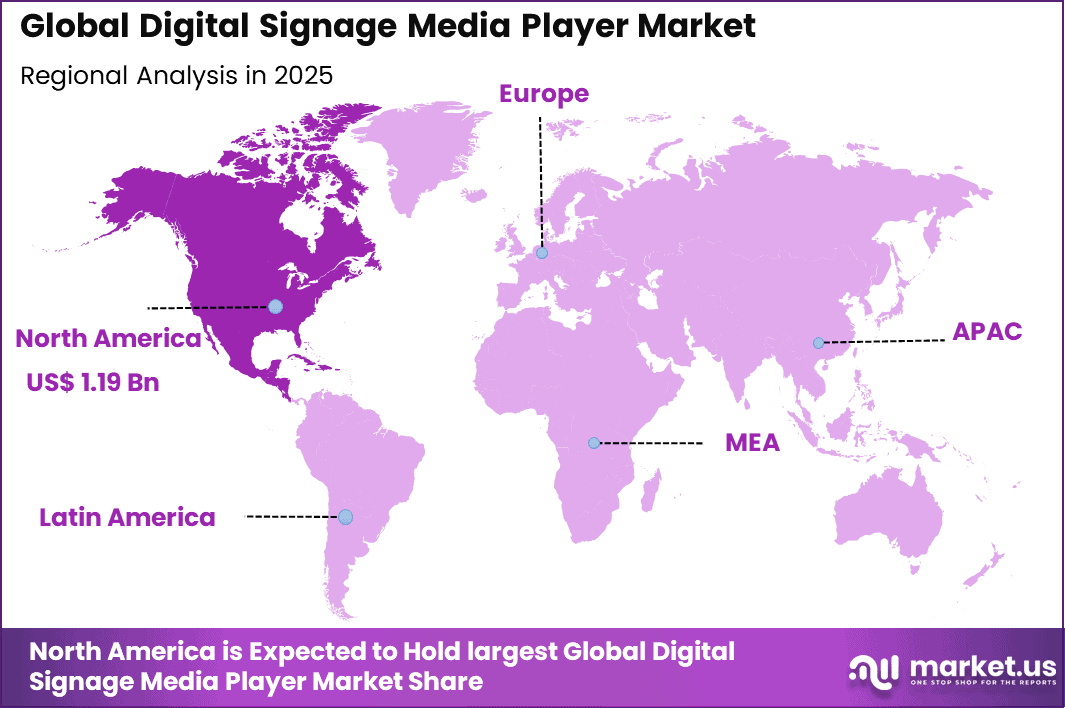
The U.S. market reached USD 1.04 Bn and is projected to grow at an 8.5% CAGR, reflecting stable demand from commercial and public sector deployments. Adoption has been particularly strong in retail and transportation, where timely and targeted messaging improves customer experience. Digital signage media players have helped U.S. organizations manage large networks of screens efficiently while maintaining consistent content quality.
Key Regions and Countries
- North America
- US
- Canada
- Europe
- Germany
- France
- The UK
- Spain
- Italy
- Russia
- Netherlands
- Rest of Europe
- Asia Pacific
- China
- Japan
- South Korea
- India
- Australia
- Singapore
- Thailand
- Vietnam
- Rest of APAC
- Latin America
- Brazil
- Mexico
- Rest of Latin America
- Middle East & Africa
- South Africa
- Saudi Arabia
- UAE
- Rest of MEA
Market Dynamics
Driver Analysis - Growing Use of Digital Displays in Public and Retail Spaces
The demand for digital signage media players is driven by the shift from static signs to digital screens across retail stores, airports, offices, and public venues. Businesses use digital displays to show promotions, directions, and real-time updates, which improves communication and customer engagement. Media players make this possible by enabling smooth content playback and remote updates. As display networks expand, organisations increasingly rely on reliable media players to manage visuals efficiently across multiple locations.
Restraint Analysis - High Setup Cost and Technical Dependency
One key restraint is the initial cost of deploying digital signage systems, including media players, screens, and network setup. Smaller organisations often delay adoption due to budget limitations and unclear return on investment. Another limitation is technical dependency. Media players must integrate with content management software and internal IT systems. Without skilled support, maintaining performance and stability becomes challenging for many users.
Opportunity Analysis - Cloud Control and Smart Infrastructure Adoption
The growing use of cloud-based content management creates a strong opportunity for media player vendors. Cloud control allows central scheduling, remote updates, and easier scaling of signage networks with less manual effort. Smart city projects, transport hubs, and commercial developments also increase demand for digital signage. Media players that support real-time updates and remote monitoring are well positioned to benefit from these investments.
Challenge Analysis - Keeping Content Relevant and Engaging
A major challenge is ensuring that digital signage content remains useful and engaging. Screens that display repetitive or unclear messages often fail to capture attention, reducing their impact. To address this, organisations must invest in content planning and performance tracking. Without a clear content strategy, even advanced media players may not deliver expected value.
Emerging Trends
| Key Trend | Description |
|---|---|
| AI-driven content targeting | Media players use analytics and AI to adapt playlists in real time based on audience, time, and context. |
| Cloud-managed networks | Centralized, cloud-based platforms control large fleets of players with remote updates and monitoring. |
| 4K/8K and high-refresh output | Support for ultra-high resolution and smooth playback for immersive visual experiences. |
| Interactive and touch-enabled signage | Players increasingly power kiosks, touch screens, and sensor-based interactions. |
| IoT and data integration | Players pull data from external systems such as POS, inventory, and traffic to trigger contextual content. |
Growth Factors
| Key Factors | Description |
|---|---|
| Demand for dynamic advertising | Brands shift from static posters to digital displays for higher engagement and monetization. |
| Retail and hospitality digitization | Stores, hotels, and restaurants deploy signage for menus, promotions, and wayfinding. |
| Cost decline of displays and hardware | Falling panel and player prices make deployments viable for SMEs. |
| Smart city and transport projects | Airports, metros, and bus terminals adopt digital signage for real-time information. |
| Need for centralized content control | Multi-site enterprises seek consistent messaging with lower operational overhead. |
Competitive Analysis
The competitive landscape of the digital signage media player market is shaped by a mix of specialized signage hardware vendors, IT infrastructure providers, and display technology companies. BrightSign, Advantech, AOPEN, IAdea, ONELAN under Uniguest, Stratacache, and Broadsign hold strong positions due to their focus on reliable media playback, remote device management, and compatibility with large-scale signage networks.
Global technology and display manufacturers such as Cisco Systems, Dell Technologies, Hewlett Packard Enterprise, LG Electronics, Samsung Electronics, NEC through Sharp NEC Display Solutions, Barco, Christie Digital, and 3M intensify competition by bundling media players with displays, networking, and enterprise IT solutions.
Top Key Players in the Market
- Advantech Co., Ltd.
- AOPEN, Inc.
- BrightSign, LLC
- IAdea Corporation
- ONELAN Limited (Uniguest)
- Cisco Systems, Inc.
- Dell Technologies Inc.
- Hewlett-Packard Enterprise Company
- Barco NV
- Christie Digital Systems USA, Inc.
- 3M Company
- LG Electronics Inc.
- Samsung Electronics Co., Ltd.
- NEC Corporation (Sharp NEC Display Solutions Ltd.)
- Stratacache, Inc.
- Broadsign International, LLC
- Disguise Technologies Limited
- Dataton AB
- AV Stumpfl GmbH
- Green-Hippo Ltd. (tvONE)
- 7thSense Design Ltd.
- Others
Future Outlooks
Growth in the Digital Signage Media Player market is expected to continue as businesses use digital displays for communication, advertising, and information sharing. Media players are being adopted across retail, hospitality, transportation, healthcare, and corporate environments to deliver dynamic content.
Rising demand for high-resolution displays, real-time updates, and remote content management is supporting steady adoption. Over time, improved hardware performance, cloud-based control, and integration with analytics are likely to expand use cases.
Recent Developments
- In November 2025, BrightSign rolled out its Series 5 lineup (XT5, XD5, HD5, LS5, AU5) of digital signage media players, supporting resolutions from Full HD up to 8K HDR and PoE+‑enabled, rugged designs for retail and venue deployments.
- In December 2025, IAdea’s XMP‑8550 4K commercial‑grade Android media player was featured as a rugged, 24/7 signage device for kiosks in retail and transport, supporting UHD 4K playback and remote management.
Report Scope
| Report Features | Description |
|---|---|
| Market Value (2025) | USD 3.6 Billion |
| Forecast Revenue (2035) | USD 11.3 Billion |
| CAGR(2025-2035) | 12.2% |
| Base Year for Estimation | 2024 |
| Historic Period | 2020-2024 |
| Forecast Period | 2025-2035 |
| Report Coverage | Revenue forecast, AI impact on Market trends, Share Insights, Company ranking, competitive landscape, Recent Developments, Market Dynamics and Emerging Trends |
| Segments Covered | By Component (Hardware, Software), By Product (Entry‑Level, Advanced‑Level, Enterprise‑Level), By Connectivity (Wired, Wireless), By Application (Retail, Hospitality, Corporate, Transportation, Education, Government, Others) |
| Regional Analysis | North America – US, Canada; Europe – Germany, France, The UK, Spain, Italy, Russia, Netherlands, Rest of Europe; Asia Pacific – China, Japan, South Korea, India, New Zealand, Singapore, Thailand, Vietnam, Rest of Latin America; Latin America – Brazil, Mexico, Rest of Latin America; Middle East & Africa – South Africa, Saudi Arabia, UAE, Rest of MEA |
| Competitive Landscape | Advantech Co., Ltd., AOPEN, Inc., BrightSign, LLC, IAdea Corporation, ONELAN Limited (Uniguest), Cisco Systems, Inc., Dell Technologies Inc., Hewlett-Packard Enterprise Company, Barco NV, Christie Digital Systems USA, Inc., 3M Company, LG Electronics Inc., Samsung Electronics Co., Ltd., NEC Corporation (Sharp NEC Display Solutions Ltd.), Stratacache, Inc., Broadsign International, LLC, Disguise Technologies Limited, Dataton AB, AV Stumpfl GmbH, Green-Hippo Ltd. (tvONE), 7thSense Design Ltd., Others |
| Customization Scope | Customization for segments, region/country-level will be provided. Moreover, additional customization can be done based on the requirements. |
| Purchase Options | We have three licenses to opt for: Single User License, Multi-User License (Up to 5 Users), Corporate Use License (Unlimited Users and Printable PDF) |





























