Report Overview
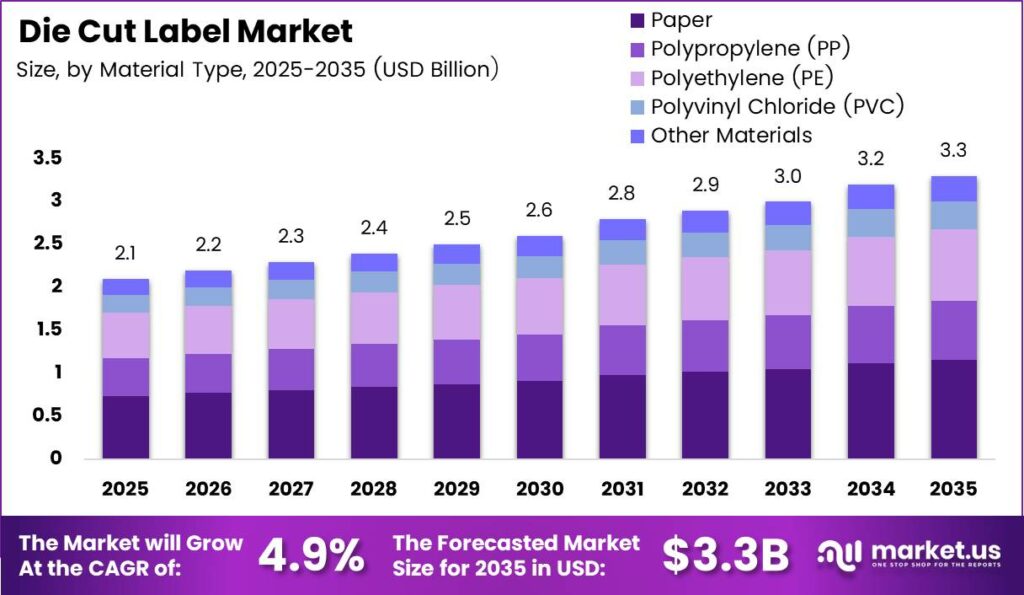
Global Die Cut Label Market size is expected to be worth around USD 3.3 Billion by 2035 from USD 2.1 Billion in 2025, growing at a CAGR of 4.9% during the forecast period 2026 to 2035.
The die cut label market encompasses pressure-sensitive, wet-glue, and specialty label products shaped through rotary or flatbed die cutting processes. These labels serve identification, branding, compliance, and logistics functions across food and beverage, pharmaceuticals, personal care, automotive, and consumer electronics industries. The market spans material substrates including paper and film stocks, multiple adhesive chemistries, and printing technologies from flexographic to digital inkjet.
Key Takeaways
- The Global Die Cut Label Market is valued at USD 2.1 Billion in 2025 and is expected to reach USD 3.3 Billion by 2035, growing at a CAGR of 4.9%.
- Paper leads the By Material Type segment with a 35.0% market share in 2025.
- Permanent Adhesive holds a dominant 48.0% share in the By Adhesive Type segment in 2025.
- Flexographic Printing accounts for 36.0% of the By Printing Technology segment in 2025.
- Food and Beverage leads the By End-Use Industry segment with a 31.0% share in 2025.
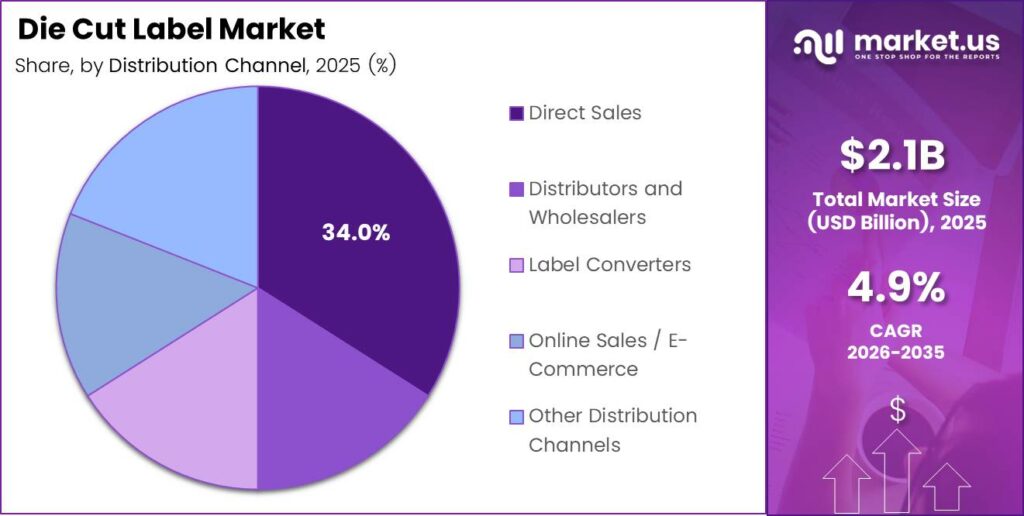
- Direct Sales holds the largest share of 34.0% in the By Distribution Channel segment in 2025.
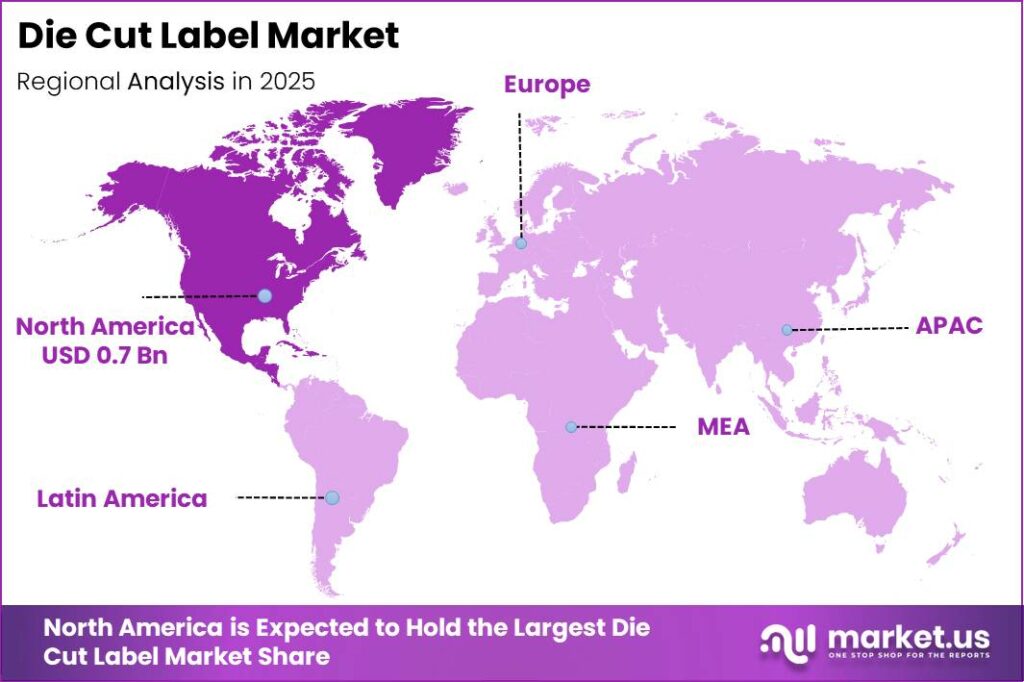
- North America dominates the global die cut label market with a 35.0% share, valued at USD 0.7 Billion in 2025.
As per our research, the EU generated 81.5 million tonnes of packaging waste in 2024, equivalent to 181.0 kilograms per inhabitant. This packaging volume indicates sustained demand for labeling solutions that meet both functional and regulatory requirements, creating consistent order flow for converters serving European brand owners. In October 2025, Avery Dennison completed its acquisition of Meridian Adhesives Group’s U.S. flooring-adhesives business for USD 390 million, reflecting how leading players are broadening their adhesive material platforms beyond traditional label substrates.
According to the Flexible Packaging Association, the U.S. flexible packaging industry generated USD 42.6 Billion in annual sales in 2024, up 2.9% from USD 41.4 Billion in 2023. This output level reflects the scale of packaging substrate activity that supports downstream label demand. Data from the U.S. Environmental Protection Agency shows the U.S. recycling rate for paper and paperboard packaging reached 80.9% in 2018, underlining long-standing policy pressure that continues to steer label buyers toward recyclable constructions and sustainable substrate choices.
Material Type Analysis
Paper dominates with 35.0% due to cost, recyclability, and converter familiarity.
In 2025, Paper held a dominant market position in the By Material Type segment of the Die Cut Label Market, with a 35.0% share. Paper substrates offer wide compatibility with flexographic, digital, and offset printing, enabling high-volume decorative and compliance label production across food, beverage, and retail applications. As reported by the U.S. Environmental Protection Agency, the U.S. recycling rate for paper and paperboard packaging stood at 80.9% in 2018. Brand owners selecting paper labels gain a recyclability credential that supports packaging sustainability claims and aligns procurement with retailer and regulatory expectations.
Polypropylene (PP) film labels deliver moisture resistance, clarity, and dimensional stability that paper cannot match in refrigerated, wet-fill, and premium personal care applications. UPM Raflatac introduced C-PCR polypropylene label materials during 2021 containing 30% chemically recycled post-consumer plastic, demonstrating that recycled-content PP constructions are commercially viable at scale. This development signals that converters can offer brand owners both performance and sustainability credentials in the same label construction, reducing the trade-off that previously slowed PP adoption in environmentally sensitive procurement programs.
Polyethylene (PE) film labels serve squeezable containers, flexible pouches, and conformable packaging where low modulus and tear resistance outweigh the stiffness advantages of PP. A UPM Raflatac case study documented in November 2020 described the replacement of 85-micron polyethylene label material with thinner Raflex Pro film for Unilever, reducing plastic per label. Thinner PE constructions lower material cost per roll and reduce liner weight in disposal, making substrate down-gauging a viable tool for converters responding to brand-owner plastic reduction targets without switching substrate chemistry.
Polyvinyl Chloride (PVC) labels retain a specialized role in shrink sleeve, battery, and cable identification applications where conformability over irregular shapes or chemical resistance is the primary specification driver. Other Materials, including polyester, polylactic acid, and specialty composites, serve niche technical and high-durability identification requirements. These sub-segments collectively address application-specific performance needs that neither paper nor standard film substrates can meet, sustaining demand for specialty substrate inventories at converters serving industrial, pharmaceutical, and durable-goods customers.
Adhesive Type Analysis
Permanent Adhesive dominates with 48.0% due to irreversible bond performance across substrates.
In 2025, Permanent Adhesive held a dominant market position in the By Adhesive Type segment of the Die Cut Label Market, with a 48.0% share. Permanent acrylic adhesives bond irreversibly to a wide range of substrates including glass, HDPE, PET, and coated board, making them the default specification for primary food, beverage, and pharmaceutical labels where label loss in distribution is a compliance or safety risk. HERMA’s specification for its HERMAtherm G BPA-free thermal label product lists a permanent acrylic adhesive with a service-temperature range of -30°C to +60°C and a minimum application temperature of -5°C, illustrating the breadth of operating conditions permanent adhesive constructions routinely satisfy.
Removable Adhesive labels enable clean peel-off without substrate damage, serving promotional overlabeling, retail price-change programs, and secondary identification in logistics. The adhesive chemistry must balance initial tack for secure in-use retention with controlled release force that avoids substrate tearing on removal. Buyers specifying removable constructions accept a higher material cost per label relative to permanent grades, meaning converters can capture modest margin premiums in this sub-segment by qualifying adhesives against specific surface energy and temperature profiles required by retail and logistics customers.
Repositionable Adhesive labels offer repeated removal and reapplication cycles before bonding becomes semi-permanent over time. Avery’s repositionable address-label product 55160 contains 30 labels per sheet and 3,000 labels per package, illustrating the high unit volumes that office and light commercial repositionable formats generate through stationery channels. Freezer-Grade Adhesive and Other Specialty Adhesives serve low-temperature storage, tamper-evidence, and high-surface-energy industrial applications. These sub-segments represent specification-driven demand where adhesive qualification cycles, not price competition, determine supplier selection.
Printing Technology Analysis
Flexographic Printing dominates with 36.0% due to high-speed multi-color roll-to-roll efficiency.
In 2025, Flexographic Printing held a dominant market position in the By Printing Technology segment of the Die Cut Label Market, with a 36.0% share. Flexographic presses run continuous roll-to-roll substrates at high line speeds with UV or water-based inks across paper and film stocks, making them the cost-effective choice for long-run food, beverage, and industrial label volumes. BOBST specifies a maximum printing speed of 200 metres per minute for its MASTER M5 flexographic press depending on the process and print job. This throughput capacity means a single press run can serve large-format retail label contracts, limiting per-unit production cost and supporting competitive pricing against offset alternatives.
Digital Printing presses eliminate plate costs and enable economical short runs, versioning, and variable-data printing that flexographic equipment cannot match economically below a threshold job length. HEIDELBERG specifies that the Gallus One digital inkjet label press prints at 1,200 x 1,200 dpi at 70 metres per minute, with 340 mm and 430 mm printing-width options. This resolution at press speed makes digital viable for premium personal care, craft beverage, and pharmaceutical serialization labels where image fidelity and lot-level variability justify the per-meter ink cost premium over flexographic production. In April 2026, Avery Dennison announced a USD 75 million minority investment in Wiliot and an expanded partnership covering preferred inlay design, manufacturing, and joint go-to-market efforts, signaling that digital label platforms are converging with embedded sensor and data capabilities.
Offset Printing delivers superior color accuracy and halftone reproduction on coated paper substrates, retaining share in wine, spirits, and premium food labels where photographic print quality is a brand specification. Gravure Printing serves ultra-long-run decorative film labels in household and personal care markets where the cylinder cost is amortized over tens of millions of impressions. Screen Printing and Thermal Transfer Printing address specialty and industrial identification requirements respectively, with screen offering opaque inks on non-porous surfaces and thermal transfer producing durable variable-data marks on polyester and polyimide constructions for asset tracking and compliance labeling.
End-Use Industry Analysis
Food and Beverage dominates with 31.0% due to mandatory product identification at mass scale.
In 2025, Food and Beverage held a dominant market position in the By End-Use Industry segment of the Die Cut Label Market, with a 31.0% share. Every packaged food and beverage unit requires at least one label carrying ingredient, nutritional, allergen, and traceability information under national food safety regulations. According to the USDA Economic Research Service, U.S. consumers spent USD 2.58 Trillion on food in 2024, up 4.0% from USD 2.48 Trillion in 2023. This spending volume translates directly into label demand at retail shelf level, where SKU proliferation from private label and premium product launches sustains order frequency for converters supplying food manufacturers.
Pharmaceuticals and Healthcare labels carry regulatory and patient-safety requirements that mandate precise adhesion, chemical resistance, and often serialization or tamper-evidence features. The U.S. Food and Drug Administration’s Center for Drug Evaluation and Research approved 46 novel drugs in 2025. Each approved drug requires primary, secondary, and often patient-instruction labels produced to strict specifications, creating a pipeline of new label programs that feed recurring volume as approved drugs move through commercial launch and eventual generic competition cycles.
Personal Care and Cosmetics labels combine aesthetic print quality with substrate performance across glass, HDPE, and flexible tube constructions. According to Cosmetics Europe, European cosmetics and personal care retail sales were valued at €110 Billion in 2025. This market scale supports large-format label orders across premium skin care, hair care, and color cosmetics ranges, where short product cycles and seasonal launches drive high versioning frequency that favors converters equipped for digital short runs alongside conventional flexographic production.
Household and Homecare Products, Automotive, and Consumer Electronics together account for the remaining end-use volume. Household labels must resist cleaning chemicals and moisture exposure, automotive labels require high-temperature and solvent-resistant adhesive constructions, and consumer electronics labels serve asset tracking and regulatory compliance functions. Other End-Use Industries, including agriculture, logistics, and industrial manufacturing, generate specification-driven demand for durable and specialty constructions that sustain converter margin in lower-volume but higher-value label programs.
Distribution Channel Analysis
Direct Sales dominates with 34.0% due to converter control over specification and account retention.
In 2025, Direct Sales held a dominant market position in the By Distribution Channel segment of the Die Cut Label Market, with a 34.0% share. Direct sales relationships allow converters to manage technical specifications, adhesive qualification, and color standards directly with brand procurement teams, reducing intermediary margin loss and protecting account relationships from competitive displacement. As reported by the U.S. Census Bureau, U.S. retail e-commerce sales were estimated at USD 1,233.7 Billion in 2025, increasing 5.4% from 2024. Converters with direct accounts in e-commerce fulfillment benefit from this volume growth through recurring parcel and logistics label orders that do not require campaign-level re-selling.
Distributors and Wholesalers provide converters with geographic reach and inventory buffer capacity that direct sales forces cannot efficiently replicate across fragmented small and mid-size buyer segments. U.S. merchant-wholesaler sales, excluding manufacturers’ sales branches and offices, were initially estimated at USD 680.0 Billion for January 2025, illustrating the scale of wholesale infrastructure through which commodity label volumes move to regional industrial and retail customers. This channel suits standardized stock label formats where price and availability dominate the buying decision rather than technical customization.
Label Converters operating as distribution intermediaries reprint or convert base materials purchased from material suppliers, serving brand owners who require finished labels but do not operate converting equipment. Online Sales and E-Commerce channels serve microbrands, short-run promotional buyers, and startup consumer goods companies that require low minimum-order quantities and self-service ordering. As per our research, U.S. e-commerce retail sales reached USD 316.1 Billion in the fourth quarter of 2025 alone. Other Distribution Channels including agent networks and buying groups serve geographically dispersed industrial accounts and emerging-market buyers where converter direct coverage is uneconomical.
Key Market Segments
By Material Type
- Paper
- Polypropylene (PP)
- Polyethylene (PE)
- Polyvinyl Chloride (PVC)
- Other Materials
By Adhesive Type
- Permanent Adhesive
- Removable Adhesive
- Repositionable Adhesive
- Freezer-Grade Adhesive
- Other Specialty Adhesives
By Printing Technology
- Flexographic Printing
- Digital Printing
- Offset Printing
- Gravure Printing
- Screen Printing
- Thermal Transfer Printing
By End-Use Industry
- Food and Beverage
- Pharmaceuticals and Healthcare
- Personal Care and Cosmetics
- Household and Homecare Products
- Automotive
- Consumer Electronics
- Other End-Use Industries
By Distribution Channel
- Direct Sales
- Distributors and Wholesalers
- Label Converters
- Online Sales / E-Commerce
- Other Distribution Channels
Regional Analysis
North America Dominates the Die Cut Label Market with a Market Share of 35.0%, Valued at USD 0.7 Billion
North America holds the largest regional share of the die cut label market, driven by concentrated food manufacturing, pharmaceutical production, and retail packaged goods industries that generate high-volume, specification-driven label demand. The U.S. market benefits from a mature converter base, established direct-sales channel structures, and consistent enforcement of FDA and USDA labeling regulations that sustain baseline label volumes across primary product categories. This regulatory certainty reduces demand volatility and supports multi-year converter supply contracts with major consumer goods manufacturers.
Asia Pacific represents the fastest-growing regional market, supported by expanding packaged food retail, pharmaceutical manufacturing investment, and personal care consumption across China, India, and Southeast Asian economies. India’s domestic passenger-vehicle sales reached approximately 4.3 Million units in FY2024 to 2025, growing 2% from FY2023 to 2024 according to the Society of Indian Automobile Manufacturers. This automotive volume supports demand for durable adhesive labels used in component identification, VIN marking, and under-hood compliance applications, adding industrial label volume alongside the consumer goods categories driving primary regional growth. In June 2024, CCL Industries completed its acquisition of the remaining 50% equity interest in Pacman-CCL for approximately C$143 Million, expanding its label-production footprint across the United Arab Emirates, Oman, Egypt, Saudi Arabia, and Pakistan.
Latin America and Africa represent smaller but structurally developing label markets. The World Bank’s October 2026 economic update projected Latin America and the Caribbean’s GDP to expand by 2.2% in 2026, indicating consumer spending capacity that supports packaged goods growth and associated label demand. According to UNIDO’s International Yearbook of Industrial Statistics 2024, Africa accounted for 2.0% of global manufacturing value added in 2023. This limited manufacturing base constrains near-term label market scale, but long-term urbanization and fast-moving consumer goods investment create entry opportunities for converters establishing early regional production or distribution presence.
Key Regions and Countries
North America
- US
- Canada
Europe
- Germany
- France
- The UK
- Spain
- Italy
- Rest of Europe
Asia Pacific
- China
- Japan
- South Korea
- India
- Australia
- Rest of APAC
Latin America
- Brazil
- Mexico
- Rest of Latin America
Middle East and Africa
- GCC
- South Africa
- Rest of MEA
Market Dynamics
Market Opportunity Analysis - Underserved geographies and emerging application categories offer structured entry points for converters and investors
The Middle East and Africa region represents the most structurally underserved geographic opportunity in the die cut label market. Africa accounted for only 2.0% of global manufacturing value added in 2023 according to UNIDO, yet urbanization and fast-moving consumer goods investment are advancing across Nigeria, Kenya, and South Africa. Converters establishing early distribution or light converting presence in these markets gain first-mover account relationships before multinational label groups deploy capital, capturing brand loyalty at the point of market formation rather than competing retroactively against entrenched suppliers.
The cryogenic biobanking and pharmaceutical serialization sub-segments within the Pharmaceuticals and Healthcare end-use industry remain underserved relative to their regulatory complexity and switching cost profile. The FDA’s approval of 46 novel drugs in 2025 creates a pipeline of new serialization and primary label programs with long product lifecycles. However, converters without qualified cryogenic adhesive constructions and validated serialization workflows cannot bid on these programs. This capability barrier limits competition, meaning qualified suppliers set pricing from a position of technical scarcity rather than commodity competition.
Online Sales and E-Commerce distribution remains structurally underutilized by mid-size converters that have historically relied on direct sales and distributor channels. This channel serves microbrand and startup consumer goods buyers who require low minimum-order quantities and self-service ordering interfaces. Converters that build digital storefronts and automated quoting tools gain access to a buyer segment that the conventional direct-sales model cannot serve economically, diversifying revenue away from concentrated major-account relationships that carry single-customer revenue risk.
The Latin American market presents a medium-term entry window for converters willing to absorb near-term economic volatility. The World Bank projected the region’s GDP growth at 2.2% in 2026, signaling positive but moderate consumer market expansion. Packaged food and personal care growth in Brazil and Mexico will require label supply that currently depends heavily on imports or regional converters with limited technical capability. Early investment in local converting capacity positions entrants ahead of the volume inflection point where domestic demand justifies larger-scale plants.
Technology and Innovation Landscape - Press speed advances, digital integration, and sustainable substrate innovation redefine converter competitive positioning
High-speed flexographic press technology sets the throughput benchmark for long-run label production. BOBST specifies a maximum printing speed of 200 metres per minute for its MASTER M5 flexographic press depending on the process and print job. At this speed, converters can satisfy large retail and food manufacturer label contracts within compressed delivery windows, reducing per-unit production cost and enabling competitive pricing on commodity volume programs. Converters that invest in current-generation flexographic equipment gain a structural cost advantage over operators running older platforms at lower line speeds.
Hybrid press technology integrates digital inkjet printing heads into conventional flexographic or offset converting lines, enabling versioning and variable-data capability without sacrificing the throughput economics of analog production. HEIDELBERG and Gallus launched the Gallus Five hybrid label press in September 2025, specifying 1,200 x 1,200 dpi resolution and production speeds up to 100 metres per minute with 340 mm and 430 mm width options. This architecture allows a single press to serve both high-volume commodity runs and short-run premium versioning programs, removing the need to operate separate analog and digital lines for converters with mixed order profiles.
HEIDELBERG’s Speedmaster XL 106 delivers speeds up to 21,000 sheets per hour in wet-glue and in-mould label production. While these applications are distinct from pressure-sensitive die-cut labels, the sheet-fed platform demonstrates the throughput ceiling achievable with current offset technology in adjacent label formats. The EU recycled 42.4% of its generated plastic packaging waste in 2024, up from 41.6% in 2023 according to Eurostat. This recycling rate improvement creates technical pressure on substrate and adhesive suppliers to develop constructions that maintain performance through closed-loop recycling streams without contaminating sorted waste fractions.
Active label technology integrates wireless communication directly into the label construction, extending its function from passive identification to real-time condition monitoring. Avery Dennison announced its AD Visi active Bluetooth Low Energy label range in September 2026, specifying thickness below 1 mm, an operating-temperature range of -30°C to +60°C, and reading distances up to 100 metres. This specification range covers cold-chain pharmaceutical, food, and industrial asset tracking applications. Converters qualified to produce and integrate active label constructions command significant margin premiums over commodity pressure-sensitive formats and create recurring data-service revenue streams alongside the physical label supply.
Drivers
Online retail creates sustained demand for individually identified parcels, generating repeat purchases of die-cut shipping, routing, and returns labels. According to the U.S. Census Bureau, U.S. retail e-commerce sales were estimated at USD 1,233.7 Billion in 2025, increasing 5.4% from 2024, while total retail grew 3.5%. This differential growth rate signals that e-commerce is outpacing physical retail, and converters with standardized thermal label formats and replenishment contracts benefit directly from this structural channel shift.
Packaged food identification requirements and personal care premiumization compound the e-commerce growth signal. Urbanizing consumer markets require precise ingredient, allergen, and nutritional labeling on every SKU, sustaining high-frequency label orders from food manufacturers. Premium personal care brands across Asia Pacific, Europe, and North America invest in high-quality die-cut labels to reinforce shelf differentiation and brand value perception. Digital short-run production adoption reduces minimum viable job sizes, allowing converters to serve both high-volume commodity runs and low-volume premium versioning efficiently within the same facility.
| Driver | (~) % Impact on CAGR Forecast | Geographic Relevance | Impact Timeline |
|---|---|---|---|
| E-commerce parcel-label consumption | +0.40% | Global; North America and Asia-Pacific led | Short term (≤ 2 years) |
| Packaged-food identification requirements | +0.25% | Global; urbanizing consumer markets | Short term (≤ 2 years) |
| Personal-care premiumization | +0.20% | Asia-Pacific, Europe, North America | Medium term (2–4 years) |
| Digital short-run production adoption | +0.15% | Europe, North America, developed Asia | Short term (≤ 2 years) |
| Industrial asset-identification demand | +0.10% | Global manufacturing hubs | Medium term (2–4 years) |
Restraints
Continuous linerless label formats remove the release liner and allow labels to be cut to length at the point of dispensing, directly displacing conventional pre-die-cut orders in variable-information applications. Avery Dennison’s manufacturer guidance describes approximately one-third lower material use and up to 50% more labels per comparable roll for linerless constructions. This format substitution reduces replenishment volume on affected die-cut lines and pressures converters to shift their value proposition toward complex shapes and application-specific constructions that linerless equipment cannot replicate.
Direct-to-container printing displaces adhesive labels on glass and rigid plastic in European and North American beverage markets, while credit-constrained converter expansion slows capacity investment among independent European operators. Custom-tooling minimum-order barriers restrict small brand buyers from accessing bespoke die shapes, pushing them toward stock label formats or digital alternatives that bypass conventional converter workflows. Buyer insolvencies and credit holds create receivables risk for converters reliant on concentrated customer relationships in financially vulnerable retail or hospitality sectors.
| Restraint | (~) % Impact on CAGR Forecast | Geographic Relevance | Impact Timeline |
|---|---|---|---|
| Continuous linerless format substitution | -0.30% | North America, Europe, developed Asia | Short term (≤ 2 years) |
| Direct-to-container printing displacement | -0.20% | Europe, North America, East Asia | Medium term (2–4 years) |
| Credit-constrained converter expansion | -0.15% | Europe; leveraged independent converters | Short term (≤ 2 years) |
| Custom-tooling minimum-order barriers | -0.10% | Global; microbrands and small buyers | Short term (≤ 2 years) |
| Buyer insolvencies and credit holds | -0.05% | Global; financially vulnerable customers | Short term (≤ 2 years) |
Challenges
Thin-stock die cutting demands consistent liner caliper, precisely matched tooling, and stable web tension throughout production. Insufficient blade penetration leaves incomplete cuts, while excessive penetration damages the liner and raises web-break frequency. For an illustrative operating case, increasing scrap from 4% to 6% raises material consumption per saleable label by approximately 2.1%, while reducing effective line speed from 100% to 95% raises time-dependent conversion cost per unit by approximately 5.3%. These friction points delay capacity qualification and constrain saleable throughput, directly compressing converter margins on thin-film programs.
Specialist press-operator succession gaps in Europe, North America, and Japan reduce the available skill pool for setting and maintaining high-speed converting lines, slowing throughput ramp on new equipment investments. Adhesive qualification cycle complexity extends product launch timelines for converters entering demanding end-use environments such as cryogenic storage or high-temperature industrial applications. Multisite color consistency management and imported specialty-input lead-time variability create additional operational friction for converters serving global brand supply networks that require identical label output across multiple geographies.
| Challenge | (~) % CAGR Friction Drag | Geographic Relevance | Mitigation Horizon |
|---|---|---|---|
| Thin-stock converting yield instability | -0.25% | Global; high-speed converting operations | Medium term (2–4 years) |
| Specialist press-operator succession gaps | -0.15% | Europe, North America, Japan | Medium term (2–4 years) |
| Adhesive qualification cycle complexity | -0.10% | Global; demanding end-use environments | Medium term (2–4 years) |
| Multisite color consistency management | -0.08% | Global brand supply networks | Short term (≤ 2 years) |
| Imported specialty-input lead-time variability | -0.07% | Import-dependent converting markets | Short term (≤ 2 years) |
Opportunities
Digital product passports create a prospective route for converters to move from supplying printed identifiers to providing durable die-cut data carriers with encoding, verification, and managed record-linking services. The European Commission’s April 2025 working plan prioritizes product categories including textiles, furniture, tyres, and mattresses, with implementation guidance specifying transition periods of at least 18 months following product-specific measures. An illustrative premium offering at a selling-price index of 120 against a conventional-label index of 100 would lift gross margin from 25% to 30%, conditional on sufficient volume and controlled support costs.
Reusable-packaging wash-off label systems, cryogenic biobanking label expansion, and authenticated collectible security labels each open adjacent revenue streams beyond conventional pressure-sensitive formats. The European Union recycled 42.4% of its generated plastic packaging waste in 2024, up from 41.6% in 2023 according to Eurostat. This recycling rate improvement reflects organized European reuse infrastructure that creates demand for wash-off adhesive label constructions compatible with return-and-refill bottle programs. Converters that qualify wash-off systems ahead of regulatory mandates position themselves as preferred suppliers when brand owners formalize reusable-packaging commitments.
| Opportunity | (~) % Potential CAGR Upside | Geographic Relevance | Execution Window |
|---|---|---|---|
| Product-passport label and data services | +0.30% | European Union and exporting suppliers | Medium term (2–4 years) |
| Reusable-packaging wash-off label systems | +0.20% | Europe; organized reuse networks | Long term (≥ 4 years) |
| Cryogenic biobanking label expansion | +0.15% | North America, Europe, Asia-Pacific hubs | Medium term (2–4 years) |
| Authenticated collectible security labels | +0.10% | Global; premium collectibles channels | Medium term (2–4 years) |
| Acquisition-led cross-border account capture | +0.05% | Fragmented regional converting markets | Medium term (2–4 years) |
Key Company Insights
Avery Dennison Corporation invested approximately USD 200 Million in capital expenditures company-wide during 2025, signaling continued commitment to materials and technology platform development. This investment scale allows Avery Dennison to advance substrate innovation, expand pressure-sensitive material capacity, and support digital label technology partnerships. However, its broad portfolio breadth across label materials, RFID, and industrial tapes creates operational complexity that focused specialty converters can exploit by competing on faster qualification cycles and tighter application-specific service levels.
CCL Industries Inc. reported consolidated sales of C$7,663.8 Million in 2025, increasing 5.8% from C$7,245.0 Million in 2024, with its Avery segment generating C$1,062.2 Million in sales. In March 2026, CCL Industries announced a binding option agreement to acquire Sleever International, which operated 11 manufacturing sites and employed 910 people, extending its reach into the adjacent shrink-sleeve segment. CCL’s capital-expenditure budget of C$470 Million for 2026 reflects an aggressive expansion posture that will add converting capacity across greenfield projects and technology upgrades, widening its scale advantage over regional independent converters.
Key Players
- Avery Dennison Corporation
- CCL Industries Inc.
- Multi-Color Corporation (MCC)
- UPM Raflatac
- LINTEC Corporation
- Fuji Seal International, Inc.
- HERMA GmbH
- Fedrigoni S.p.A.
- Resource Label Group LLC
- Fort Dearborn Company
- Consolidated Label Co.
- Grand Rapids Label
- Blue Label Packaging Company
- Sticker Mule
- StickerGiant
Recent Developments
- September 15, 2026: Avery Dennison announced its AD Visi active Bluetooth Low Energy label range, specifying thickness below 1 mm, an operating-temperature range of -30°C to +60°C, and reading distances up to 100 metres, with initial products scheduled for ordering availability in late 2026.
- January 27, 2026: Multi-Color Corporation announced a restructuring support agreement providing for USD 889 Million in new common and preferred equity investment and targeting a reduction in net debt from approximately USD 5.9 Billion to USD 2.0 Billion.
- October 24, 2025: CCL Industries announced its acquisition of IDESCO Holding Corporation and IDSecurityonline.com, LLC for approximately C$19.0 Million on a debt-free, all-cash basis, adding secure badging and identification solutions to its Avery segment portfolio.
- September 16, 2025: HEIDELBERG and Gallus launched the Gallus Five hybrid label press, specifying 1,200 x 1,200 dpi resolution, production speeds up to 100 metres per minute, and 340 mm and 430 mm width options.
- September 16, 2025: HEIDELBERG and Gallus launched the Gallus Alpha digital-only label press, specifying a 340 mm printing width and 1,200 x 1,200 dpi printing at 65 metres per minute.
- February 5, 2025: UPM Raflatac announced its acquisition of Metamark at an enterprise value of £146 Million, approximately €175 Million, adding self-adhesive graphics materials manufacturing and distribution capabilities to its product platform.
Geopolitical Impact Analysis
Maritime route disruptions directly affect specialty label substrate supply chains that depend on imported film stocks, adhesive chemicals, and release liner materials transported through the Red Sea corridor. According to UNCTAD’s Review of Maritime Transport 2024, tonnage transiting the Suez Canal fell 70% by mid-2024, while ship capacity crossing the Gulf of Aden fell 76% over the same period. These rerouting volumes shift cargo to the Cape of Good Hope route, adding transit time and freight cost to imported PP film and release liner shipments sourced from Asian producers for European converters.
Extended transit routes inflate logistics costs that converters cannot fully absorb in fixed-price label contracts. As reported by UNCTAD’s Review of Maritime Transport 2025, global seaborne trade measured in ton-miles increased 5.9% in 2024, while volumes grew only 2.2%, confirming that longer routes are generating disproportionate freight cost per tonne. This gap between volume growth and ton-mile growth signals structural cost inflation for import-dependent converting markets. Converters reliant on Asian specialty inputs must either renegotiate raw material contracts to include freight indexation or accelerate qualification of regional substrate alternatives to reduce route-length exposure.
Report Scope
| Report Features | Description |
|---|---|
| Market Value (2025) | USD 2.1 Billion |
| Forecast Revenue (2035) | USD 3.3 Billion |
| CAGR (2026-2035) | 4.9% |
| Base Year for Estimation | 2025 |
| Historic Period | 2020-2024 |
| Forecast Period | 2026-2035 |
| Report Coverage | Revenue Forecast, Market Dynamics, Market Opportunity Analysis, Technology and Innovation Landscape, Competitive Landscape, Recent Developments |
| Segments Covered | By Material Type (Paper, Polypropylene (PP), Polyethylene (PE), Polyvinyl Chloride (PVC), Other Materials), By Adhesive Type (Permanent Adhesive, Removable Adhesive, Repositionable Adhesive, Freezer-Grade Adhesive, Other Specialty Adhesives), By Printing Technology (Flexographic Printing, Digital Printing, Offset Printing, Gravure Printing, Screen Printing, Thermal Transfer Printing), By End-Use Industry (Food and Beverage, Pharmaceuticals and Healthcare, Personal Care and Cosmetics, Household and Homecare Products, Automotive, Consumer Electronics, Other End-Use Industries), By Distribution Channel (Direct Sales, Distributors and Wholesalers, Label Converters, Online Sales / E-Commerce, Other Distribution Channels) |
| Regional Analysis | North America (US and Canada), Europe (Germany, France, The UK, Spain, Italy, and Rest of Europe), Asia Pacific (China, Japan, South Korea, India, Australia, and Rest of APAC), Latin America (Brazil, Mexico, and Rest of Latin America), Middle East and Africa (GCC, South Africa, and Rest of MEA) |
| Competitive Landscape | Avery Dennison Corporation, CCL Industries Inc., Multi-Color Corporation (MCC), UPM Raflatac, LINTEC Corporation, Fuji Seal International, Inc., HERMA GmbH, Fedrigoni S.p.A., Resource Label Group LLC, Fort Dearborn Company, Consolidated Label Co., Grand Rapids Label, Blue Label Packaging Company, Sticker Mule, StickerGiant |
| Customization Scope | Customization for segments, region / country-level will be provided. Additional customization can be done based on requirements. |
| Purchase Options | We have three licenses to opt for: Single User License | Multi-User License (Up to 5 Users) | Corporate Use License (Unlimited User and Printable PDF) |