Market Overview
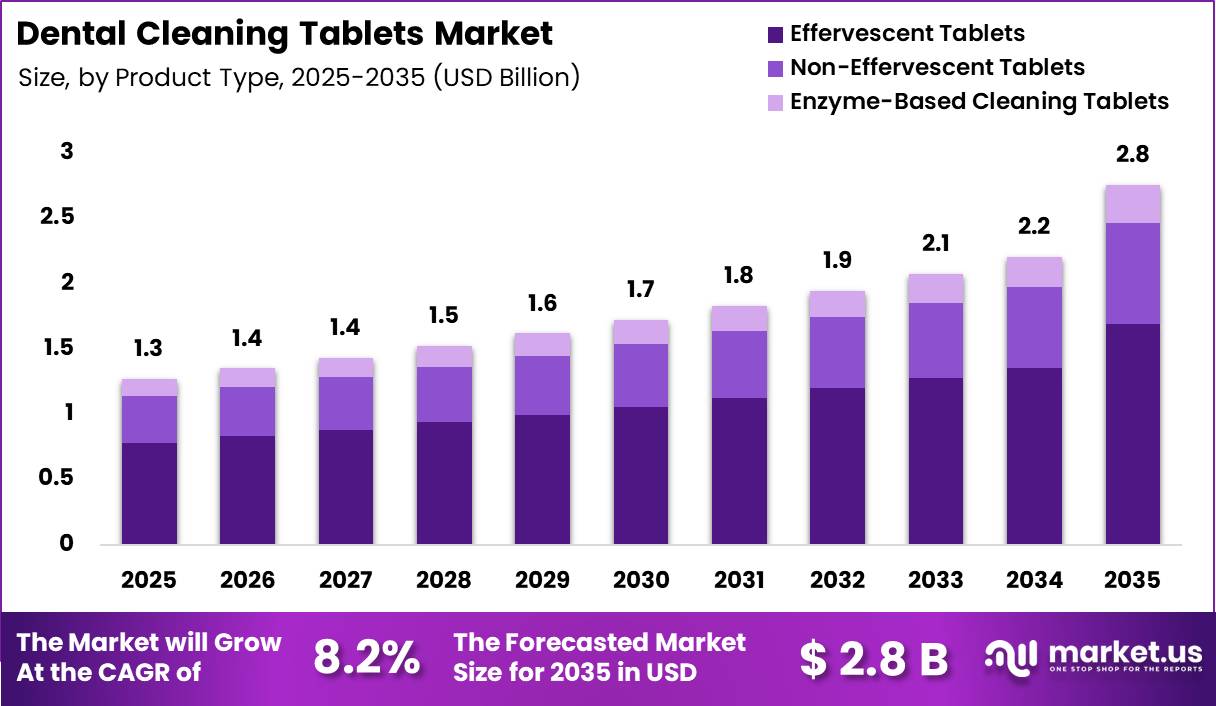
Global Dental Cleaning Tablets Market size is expected to be worth around US$ 2.8 Billion by 2035 from US$ 1.3 Billion in 2025, growing at a CAGR of 8.2% during the forecast period from 2026 to 2035. In 2025, North America led the market, achieving over 37.00% share with a revenue of US$ 0.47 Billion.
Dental cleaning tablets are compact, chewable or dissolvable tablets designed to support oral hygiene by helping users remove dental plaque and enhance everyday tooth cleaning routines.
Dental plaque is a sticky biofilm of bacteria that begins forming on tooth surfaces within minutes after eating and, if not removed, can harden into tartar and contribute to cavities and gum disease.
Regular removal of plaque through effective brushing and cleaning between teeth is a cornerstone of oral health maintenance, as recommended by government oral health agencies like the U.S. National Institute of Dental and Craniofacial Research and the CDC.
A common type of dental tablet used at home is plaque disclosing tablets, which contain a color-staining dye that adheres to plaque and shows users where their brushing may have missed bacterial buildup. Users chew one tablet for about 30 seconds, rinse with water, and then inspect teeth for coloured areas that indicate plaque presence — guiding a more thorough brushing afterward.
Other tablets, often marketed as dentifrice or “toothpaste tablets,” contain abrasive cleaning agents and fluoride similar to traditional toothpaste. Some research shows tablets with 1100 ppm fluoride can be as effective in aiding enamel remineralization and caries prevention as conventional toothpaste.
Government oral health guidance consistently emphasizes brushing at least twice daily and cleaning between teeth to prevent decay and gum disease.
For more official guidance on preventive oral care, see the U.S. National Institute of Dental and Craniofacial Research (oral hygiene section) and the CDC’s oral health pages, which outline best practices and the role of plaque control in maintaining overall dental health.
Key Takeaways
- Market Size: Dental Cleaning Tablets Market size is expected to be worth around US$ 2.8 Billion by 2035 from US$ 1.3 Billion in 2025
- Market Share: The market is growing at a CAGR of 8.2% during the forecast period from 2026 to 2035.
- Product Type Analysis: In 2025, effervescent tablets dominate with a 61.50% market share, driven by their rapid dissolution.
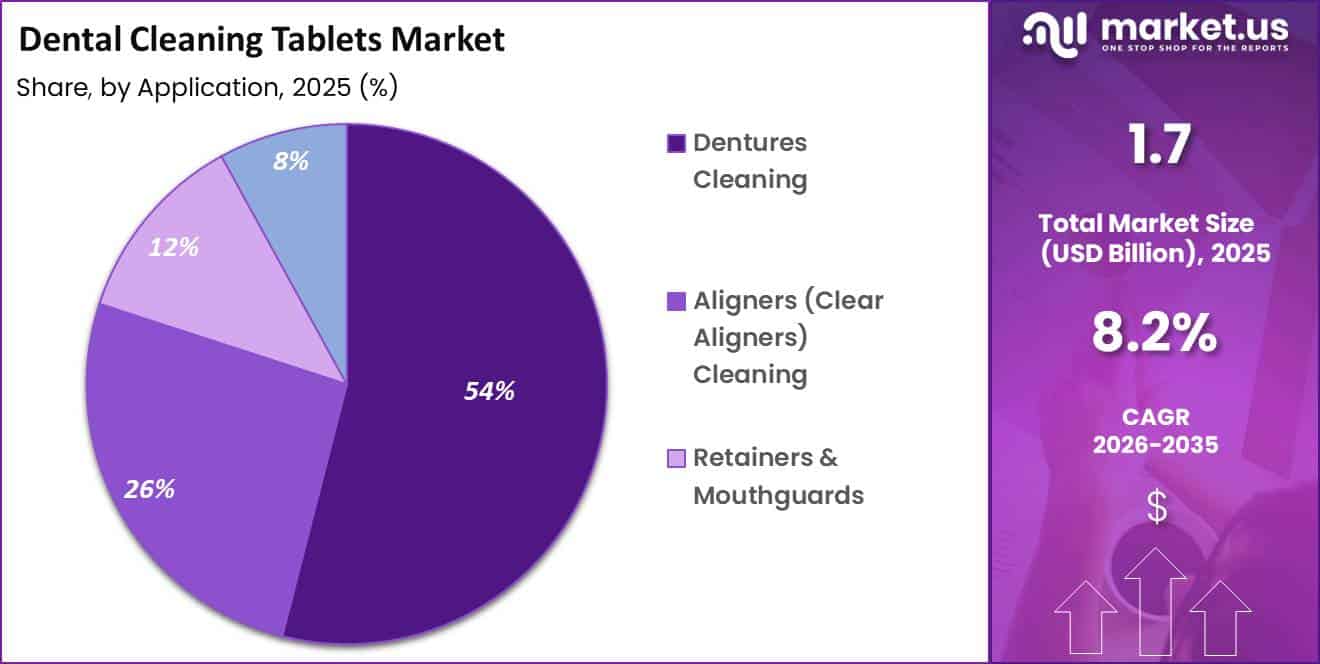
- Application Analysis: The Denture cleaning leads the market with a 54.00% share in 2025.
- End User Analysis: The End-user segmentation reveals that the geriatric population dominates the Dental Cleaning Tablets Market with a 48.00% share in 2025
- Distribution Channel Analysis: The Distribution channel segmentation shows that retail pharmacies dominate with a 42.00% market share in 2025.
- Form Analysis: Dental Cleaning Tablets Market highlights a clear preference for single-use tablets, which dominate with a 67.00% market share.
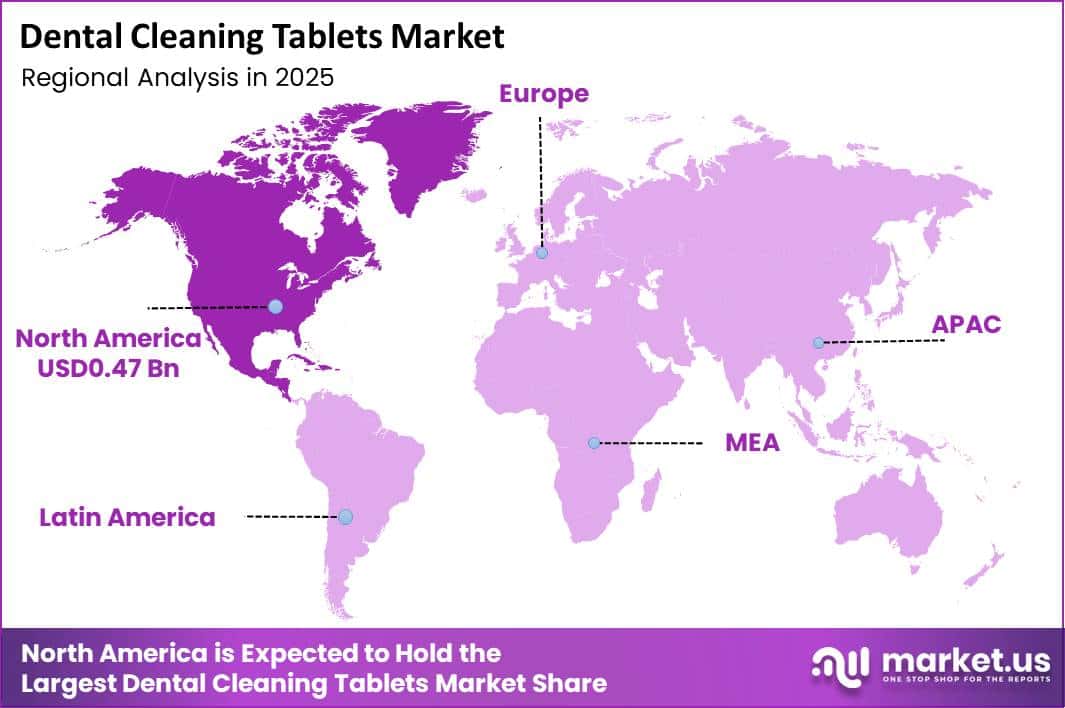
- Regional Analysis: In 2025, North America led the market, achieving over 37.00% share with a revenue of US$ 0.47 Billion.
Product Type Analysis
The Dental Cleaning Tablets Market by product type is primarily segmented into Effervescent Tablets, Non-Effervescent Tablets, and Enzyme-Based Cleaning Tablets. In 2025, effervescent tablets dominate with a 61.50% market share, driven by their rapid dissolution, visible bubbling action, and strong consumer perception of superior cleaning efficacy.
These tablets are widely preferred for daily denture and aligner hygiene, as effervescence helps loosen plaque, stains, and odor-causing bacteria within minutes, improving user compliance among elderly and working populations alike.
Non-effervescent tablets account for 28.00% of the market, supported by cost-sensitive consumers and institutional buyers such as long-term care facilities.
These products typically rely on soaking mechanisms without fizzing, offering adequate antimicrobial cleaning at a lower price point, particularly in emerging markets. Meanwhile, enzyme-based cleaning tablets hold a 10.50% share, reflecting growing interest in gentler, bio-active formulations.
Enzymatic products target protein-based debris and biofilms while minimizing abrasive or chemical stress on dental appliances. Although currently niche, enzyme-based tablets are gaining traction among users with premium dentures, clear aligners, and sensitivity concerns.
Overall, product type dynamics indicate sustained dominance of effervescent formats alongside gradual diversification toward enzyme-driven and non-effervescent solutions.
Application Analysis
Application-based segmentation of the Dental Cleaning Tablets Market highlights diverse use cases across removable oral care devices. Denture cleaning leads the market with a 54.00% share in 2025, reflecting the large global denture-wearing population and the need for daily hygiene to prevent plaque buildup, halitosis, and oral infections.
Dentures typically require routine soaking, making tablets a convenient and standardized cleaning solution across homecare and institutional settings.
Clear aligner cleaning represents 26.00% of market demand, supported by rising orthodontic treatments among adolescents and adults. Clear aligners require frequent cleaning to maintain transparency and prevent bacterial accumulation, driving adoption of specialized tablets that are non-abrasive and fast-acting.
Retainers and mouthguards account for 12.00%, benefiting from increasing sports participation and post-orthodontic care, where hygiene compliance is critical to appliance longevity.
The remaining 8.00% share comes from dental appliances such as braces accessories, including removable components and orthodontic tools. While smaller in volume, this segment is expanding with growing awareness of oral hygiene during orthodontic treatment.
Overall, application trends reflect a shift from traditional denture care toward orthodontic and preventive dental appliance maintenance.
End User Analysis
End-user segmentation reveals that the geriatric population dominates the Dental Cleaning Tablets Market with a 48.00% share in 2025. This leadership is closely linked to higher denture usage, age-related tooth loss, and increased susceptibility to oral infections among older adults.
Regular cleaning of dentures is essential to prevent stomatitis and microbial colonization, making tablets a routine hygiene product in elderly households, assisted-living facilities, and nursing homes.
Adults represent a substantial secondary user group, driven by growing adoption of clear aligners, retainers, and mouthguards. This demographic values convenience, portability, and fast cleaning cycles, supporting demand for effervescent and enzyme-based formulations.
Pediatric and adolescent users form a smaller but steadily growing segment, primarily associated with orthodontic retainers and sports mouthguards, where caregiver awareness plays a key role in product uptake.
Healthcare institutions and long-term care facilities also contribute to end-user demand, particularly in aging societies. These settings favor standardized tablet-based cleaning due to ease of use and infection-control benefits.
Overall, while geriatric users remain the core market foundation, expanding orthodontic adoption among younger populations is gradually reshaping long-term demand patterns.
Distribution Channel Analysis
Distribution channel segmentation shows that retail pharmacies dominate with a 42.00% market share in 2025, reflecting strong consumer trust, accessibility, and pharmacist recommendations.
Pharmacies serve as a primary purchase point for denture wearers and elderly consumers, who often bundle dental cleaning tablets with other oral care or prescription products. The presence of branded and private-label options further strengthens pharmacy-led sales.
Supermarkets and mass merchandisers form an important secondary channel, benefiting from impulse purchases and competitive pricing, particularly for effervescent tablets.
Online pharmacies and e-commerce platforms are the fastest-growing channel, driven by subscription models, bulk purchasing, and increasing digital adoption among middle-aged and younger users, especially aligner wearers.
Dental clinics and hospitals represent a smaller but strategic channel, often influencing first-time product adoption through professional recommendations. Institutional sales to nursing homes and care facilities also contribute to steady volume demand.
Overall, while retail pharmacies remain the cornerstone of distribution, omnichannel expansion—especially online—continues to reshape purchasing behavior and improve product accessibility across demographics.
Form Analysis
Form-based segmentation of the Dental Cleaning Tablets Market highlights a clear preference for single-use tablets, which dominate with a 67.00% market share in 2025. The strong position of single-use formats is driven by convenience, hygiene assurance, and accurate dosing.
Each tablet is pre-measured for one cleaning cycle, eliminating the risk of under- or over-use while ensuring consistent antimicrobial performance. This is particularly important for denture wearers and aligner users who require daily or frequent cleaning. Single-use tablets are also widely recommended in clinical and long-term care settings, where infection control and standardization are critical.
Multi-use or bulk-dose formats account for the remaining market share and are primarily adopted in cost-sensitive environments such as nursing homes, dental laboratories, and institutional care facilities.
These formats offer lower per-use costs but require careful handling and measurement, which may reduce convenience and hygiene confidence for individual consumers. Despite their economic advantage, multi-use forms face slower adoption among home users due to concerns around contamination and inconsistent cleaning efficacy.
Overall, form segmentation trends indicate that consumer preference strongly favors simplicity, portability, and safety. As awareness of oral hygiene and appliance care grows, single-use tablets are expected to maintain dominance, supported by lifestyle convenience and rising demand for standardized daily cleaning solutions.
Market Segmentations
By Product Type
- Effervescent Tablets
- Non-Effervescent Tablets
- Enzyme-Based Cleaning Tablets
By Application
- Dentures Cleaning
- Aligners (Clear Aligners) Cleaning
- Retainers & Mouthguards
- Dental Appliances (Braces Accessories)
By End User
- Geriatric Population
- Adult Orthodontic Patients
- Dental Clinics & Hospitals
By Distribution Channel
- Retail Pharmacies
- Online Pharmacies
- Supermarkets & Hypermarkets
- Dental Clinics
By Form
- Single-Use Tablets
- Multi-Pack Tablets
Challenge
Aging User Compliance Gaps
Aging user compliance remains a notable challenge for the denture care products market, as effective denture hygiene requires consistent daily routines involving soaking, rinsing, product replenishment, and adherence to usage instructions. While oral diseases affect approximately 3.7 billion people globally and tooth loss remains prevalent among older adults, product ownership does not always translate into optimal usage.
Real-world compliance can fall 20–35% below recommended daily care protocols , particularly among elderly users affected by cognitive decline, limited dexterity, caregiver inconsistency, or low routine adherence. This gap can reduce product replenishment rates, limit clinical effectiveness, and weaken long-term consumer engagement.
As a result, manufacturers increasingly need to invest in simplified instructions, optimized packaging formats, multilingual labeling, and caregiver-focused education programs through pharmacies, dental practices, and senior-care facilities.
Consequently, sustained market growth depends not only on expanding product availability but also on improving user adherence and supporting assisted-care models among aging populations.
| Challenge | (~) % CAGR Friction Drag | Geographic Relevance | Mitigation Horizon |
|---|---|---|---|
| Active Ingredient Cost Volatility | -1.2% | EU manufacturing bases, North America imports, APAC chemical corridors | Medium term (2-4 years) |
| GMP And Tablet Stability Control | -1.0% | North America core, EU regulatory hubs, India contract manufacturing clusters | Medium term (2-4 years) |
| Aging User Compliance Gaps | -0.9% | Western Europe, Japan, South Korea, North America senior care channels | Long term (≥ 4 years) |
| Retail Private-Label Price Compression | -0.8% | North America mass retail, EU pharmacy chains, APAC e-commerce corridors | Medium term (2-4 years) |
| Freight And Packaging Disruptions | -0.7% | APAC export routes, EU import nodes, Middle East transit lanes | Short term (≤ 2 years) |
| Safety Labeling And Liability Exposure | -0.6% | US FDA market, EU consumer safety markets, developed APAC | Medium term (2-4 years) |
Opportunity
Pharmacy-Led Senior Care Bundles
A promising opportunity in the denture care products market lies in developing integrated senior-care bundles that combine denture cleaning tablets with complementary products and caregiver support solutions.
Global demographic trends provide a strong foundation for this opportunity, with 1 in 6 people expected to be aged 60 or older by 2030 and the global 60+ population reaching 1.4 billion .
In addition, complete tooth loss affects nearly 7% of adults aged 20 years and above globally , creating a sizeable and growing user base for denture care products. Rather than marketing cleaning tablets as standalone OTC products, manufacturers can create higher-value solutions that include denture adhesives, storage containers, antimicrobial rinses, and caregiver education materials.
Such bundled offerings have the potential to increase average revenue per user by 40–70% and raise pharmacy basket values by 1.5x–2.0x compared with individual product purchases.
The opportunity is particularly attractive in aging markets where pharmacies and healthcare professionals play an important role in senior care, creating scope for care-pathway integration through pharmacists, elder-care facilities, and post-treatment oral care programs.
| Opportunity | (~) % Potential CAGR Upside | Geographic Relevance | Execution Window |
|---|---|---|---|
| Aligner & retainer care extension | +2.4% | North America, EU, APAC urban | Short term |
| Subscription refill model | +1.8% | North America core, EU, ANZ | Short term |
| Pharmacy-led senior care bundles | +2.1% | Japan, EU, U.S., South Korea | Medium term |
| APAC value-tier localization | +3.0% | India, SEA, China | Medium term |
| Clinical/private-label B2B roll-up | +1.6% | North America, EU | Medium term |
| Antifungal premium-medicated positioning | +2.2% | U.S., EU5, Latin America | Long term |
Driver
Clear Aligner and Retainer Installed-Base Growth
The expanding use of clear aligners, removable retainers, night guards, and other oral appliances is becoming a major growth driver for the dental cleaning tablets market, broadening demand beyond traditional denture users and attracting younger consumer segments with higher premium-product adoption rates.
The scale of this trend is reflected by 676,855 clear aligner shipments reported in Q4 2025 by a leading industry participant, highlighting the growing installed base of removable dental appliances that require regular cleaning and maintenance.
Unlike traditional denture users, aligner and retainer wearers often prioritize aesthetics, hygiene, and odor control, leading to more consistent product usage and digital replenishment behavior.
A typical aligner treatment lasting 6–12 months can generate 180–360 daily cleaning occasions , while retainer use can extend cleaning-product demand well beyond active treatment.
As a result, manufacturers are increasingly positioning cleaning tablets as part of a broader appliance-care ecosystem spanning aligners, retainers, mouth guards, and splints, creating opportunities for product premiumization, targeted formulations, and expanded consumer reach.
| Driver | (~) % Impact on CAGR Forecast | Geographic Relevance | Impact Timeline |
|---|---|---|---|
| Ageing-led denture hygiene demand expansion | +1.6% | North America core, Western Europe core, Japan, South Korea, urban China spill-over | Medium term (2-4 years) |
| Clear aligner and retainer installed-base growth | +1.4% | North America core, EU, Australia, urban APAC corridors, GCC private dental hubs | Short term (≤ 2 years) |
| Preventive oral-care awareness and daily-use routines | +1.1% | North America, EU, India metros, Southeast Asia, Latin America urban centers | Short term (≤ 2 years) |
| Premium multi-benefit tablet innovation and trade-up | +0.9% | North America core, EU, Japan, premium APAC cities | Medium term (2-4 years) |
| Pharmacy plus e-commerce access widening | +0.8% | U.S., Canada, UK, Germany, India, Southeast Asia | Short term (≤ 2 years) |
| Safety labeling and appliance-specific formulation upgrades | +0.5% | U.S. core, EU regulated markets, Australia, Japan | Medium term (2-4 years) |
Restraint
Regulatory classification friction
Dental cleaning tablets operate in a regulatory grey zone because their intended use across dentures, retainers, aligners, and other oral appliances can shift them from simple consumer FMCG classification into accessory or borderline medical-device scrutiny, increasing compliance complexity across jurisdictions.
In the U.S., products that support or maintain a parent device may be treated as accessories, while in Europe evolving MDR interpretations continue to emphasize intended-use clarity, labeling precision, toxicology substantiation, and performance validation.
This creates meaningful commercialization friction, with new appliance-specific SKUs often facing 9–15 months of launch delays , 4–7% incremental compliance and validation costs in early revenue phases, and 150–300 basis points of EBITDA pressure during rollout due to documentation, labeling, and manufacturing adjustments.
The result is slower innovation cycles, limited SKU harmonization across regions, and delayed cross-border expansion, making regulatory uncertainty a persistent constraint on category scalability and speed of product development.
| Restraint | (~) % Impact on CAGR Forecast | Geographic Relevance | Impact Timeline |
|---|---|---|---|
| Regulatory classification friction | -1.4% | North America core, EU | Medium term (2-4 years) |
| Raw material cost volatility | -1.2% | North America, EU, APAC import corridors | Short term (≤ 2 years) |
| Freight and lead-time instability | -0.9% | EU, UK, MENA-linked APAC routes | Short term (≤ 2 years) |
| Efficacy skepticism in retainers | -1.1% | North America core, EU urban, developed APAC | Medium term (2-4 years) |
| Private-label price compression | -0.8% | North America, Western Europe | Short term (≤ 2 years) |
| Appliance-material compatibility risk | -0.7% | North America, EU, Japan, South Korea | Long term (≥ 4 years) |
Regional Analysis
In 2025, North America dominated the Dental Cleaning Tablets Market, accounting for over 37.00% of global share and generating approximately US$ 0.47 billion in revenue.
This leadership is driven by high awareness of oral hygiene, widespread use of removable dentures and aligners, and strong penetration of preventive dental care products across the United States and Canada. Well-established retail pharmacies, e-commerce channels, and recommendations from dental professionals further support consistent demand in the region.
Europe represents the second-largest regional market, supported by an aging population, high prevalence of edentulism, and strong reimbursement coverage for dental care in countries such as Germany, the UK, and France. European consumers also show growing preference for enzyme-based and eco-friendly dental cleaning tablets, aligning with regional sustainability trends.
The Asia-Pacific market is experiencing the fastest growth, fueled by rising disposable incomes, expanding middle-class populations, and increasing adoption of dentures and orthodontic appliances in China, India, Japan, and South Korea. Improving access to dental care and rapid expansion of online sales platforms are accelerating product uptake.
Meanwhile, Latin America and Middle East & Africa are emerging markets, where growth is supported by improving healthcare infrastructure, urbanization, and increasing awareness of oral hygiene, although overall market penetration remains comparatively lower.
Key Regions and Countries
North America
- The US
- Canada
Europe
- Germany
- France
- The U.K.
- Italy
- Spain
- Russia & CIS
- Rest of Europe
Asia Pacific
- China
- India
- Japan
- South Korea
- ASEAN
- Australia & New Zealand
- Rest of Asia Pacific
Middle East & Africa
- GCC
- South Africa
- Rest of Middle East & Africa
Latin America
- Brazil
- Mexico
- Rest of Latin America
Key Player Analysis
The market is characterized by a selective consolidation, where multinational oral-care leaders coexist with niche appliance-care specialists. Competitive dynamics emphasize brand trust, regulatory credibility, and broad retail penetration.
While differentiation increasingly comes from material-safe chemistries, aligner-compatible cleaners, and daily hygiene solutions. Innovation focus has shifted toward low-abrasion, antimicrobial, and enzyme-driven formulations that support long-term appliance durability.
Major participants include GlaxoSmithKline (Polident / Poligrip), Procter & Gamble (Oral-B), Reckitt Benckiser (Denture Care Brands), Colgate-Palmolive, Haleon, Dentek Oral Care, Corega (GSK brand), Retainer Brite, Steradent (Church & Dwight), Fittydent International, M3 Naturals, SmileDirectClub (oral care accessories), Invisalign (Align Technology ecosystem), Prestige Consumer Healthcare, and Dr. Fresh LLC.
From a competitive strategy perspective, leaders prioritize R&D to validate antimicrobial efficacy and compatibility with acrylics, metals, and thermoplastics. Partnerships with dental clinics, orthodontic networks, and e-commerce platforms extend reach.
Product innovation targets appliance-specific use cases, while workflow integration aligns cleaners with adhesives, aligners, and daily oral routines. This shift toward ecosystem-based competition strengthens brand loyalty and recurring consumption.
Top Key Players
- GlaxoSmithKline (Polident / Poligrip)
- Procter & Gamble (Oral-B)
- Reckitt Benckiser (Denture Care Brands)
- Colgate-Palmolive
- Haleon
- Dentek Oral Care
- Corega (GSK brand)
- Retainer Brite
- Steradent (Church & Dwight)
- Fittydent International
- M3 Naturals
- SmileDirectClub (oral care accessories)
- Invisalign (Align Technology ecosystem)
- Prestige Consumer Healthcare Dr. Fresh LLC
Recent Developments
- Jun 2025 – Colgate‑Palmolive announced plans to introduce new global home and personal care brands (beyond core oral care) into India as part of strategy to expand premium portfolio and rural growth, indicating broader brand rollouts in adjacent categories
- Jun 2026: Completed acquisition of the Breathe Right brand and related product portfolio from Foundation Consumer Healthcare for $1.045 billion, diversifying into a broader consumer health product base
Report Scope
| Report Features | Description |
|---|---|
| Market Value (2025) | US$ 1.3 Billion |
| Forecast Revenue (2035) | US$ 2.8 Billion |
| CAGR (2026-2035) | 8.2% |
| Base Year for Estimation | 2025 |
| Historic Period | 2020-2024 |
| Forecast Period | 2026-2035 |
| Report Coverage | Revenue Forecast, Market Dynamics, Competitive Landscape, Recent Developments |
| Segments Covered | Product Type(Effervescent Tablets, Non-Effervescent Tablets, Enzyme-Based Cleaning Tablets)By Application (Dentures Cleaning, Aligners (Clear Aligners Cleaning), Retainers & Mouthguards, Dental Appliances (Braces Accessories))By End User(Geriatric Population, Adult Orthodontic Patients, Dental Clinics & Hospitals) By Distribution Channel(Retail Pharmacies, Online Pharmacies,Supermarkets & Hypermarkets,Dental Clinics) By Form (Single-Use Tablets,Multi-Pack Tablets) |
| Regional Analysis | North America – The US, Canada; Europe – Germany, France, U.K., Italy, Spain, Russia & CIS, Rest of Europe; Asia Pacific – China, India, Japan, South Korea, ASEAN, Australia & New Zealand, Rest of Asia Pacific; Middle East & Africa – GCC, South Africa, Rest of Middle East & Africa; Latin America – Brazil, Mexico, Rest of Latin America |
| Competitive Landscape | GlaxoSmithKline (Polident / Poligrip), Procter & Gamble (Oral-B), Reckitt Benckiser (Denture Care Brands),Colgate-Palmolive,Haleon,Dentek Oral Care,Corega (GSK brand),Retainer Brite,Steradent (Church & Dwight), Fittydent International, M3 Naturals, SmileDirectClub (oral care accessories), Invisalign (Align Technology ecosystem),Prestige Consumer Healthcare, Dr. Fresh LLC |
| Customization Scope | Customization for segments, region/country-level will be provided. Moreover, additional customization can be done based on the requirements. |
| Purchase Options | We have three licenses to opt for: Single User License, Multi-User License (Up to 5 Users), Corporate Use License (Unlimited User and Printable PDF) |