


Report Overview
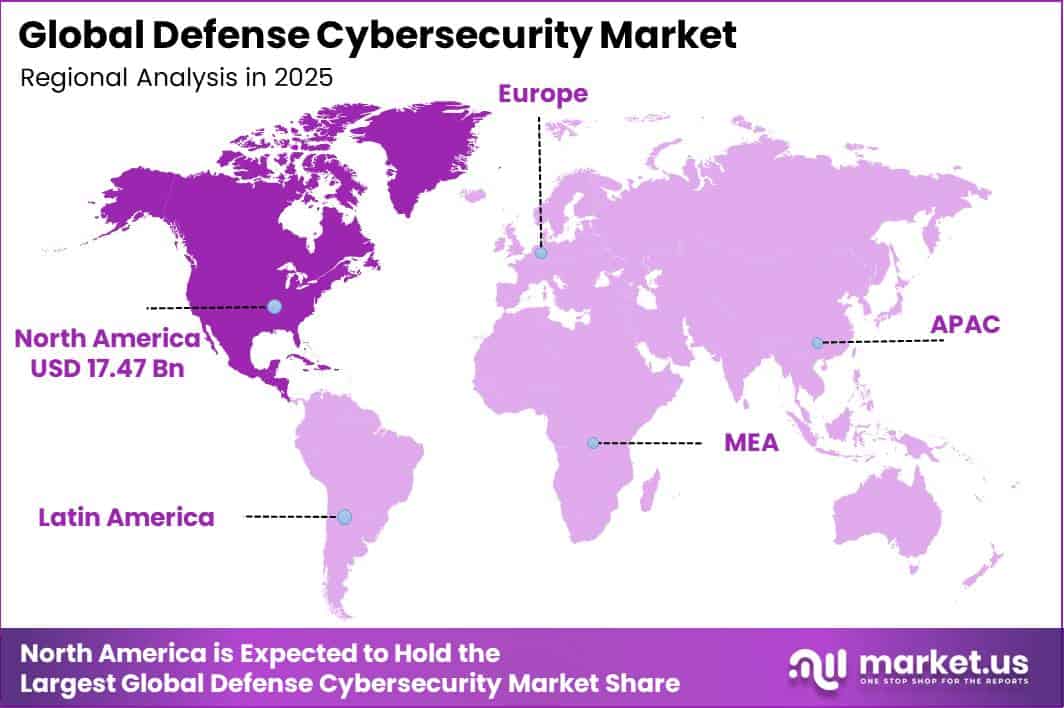
In 2025, the Global Defense Cybersecurity Market was valued at USD 49.5 billion. The market is projected to grow at a CAGR of 11.2% during 2026–2035, reaching approximately USD 143.1 billion by 2035. North America dominated the global market in 2025, accounting for more than 35.3% of the total market share and generating approximately USD 17.47 billion in revenue.
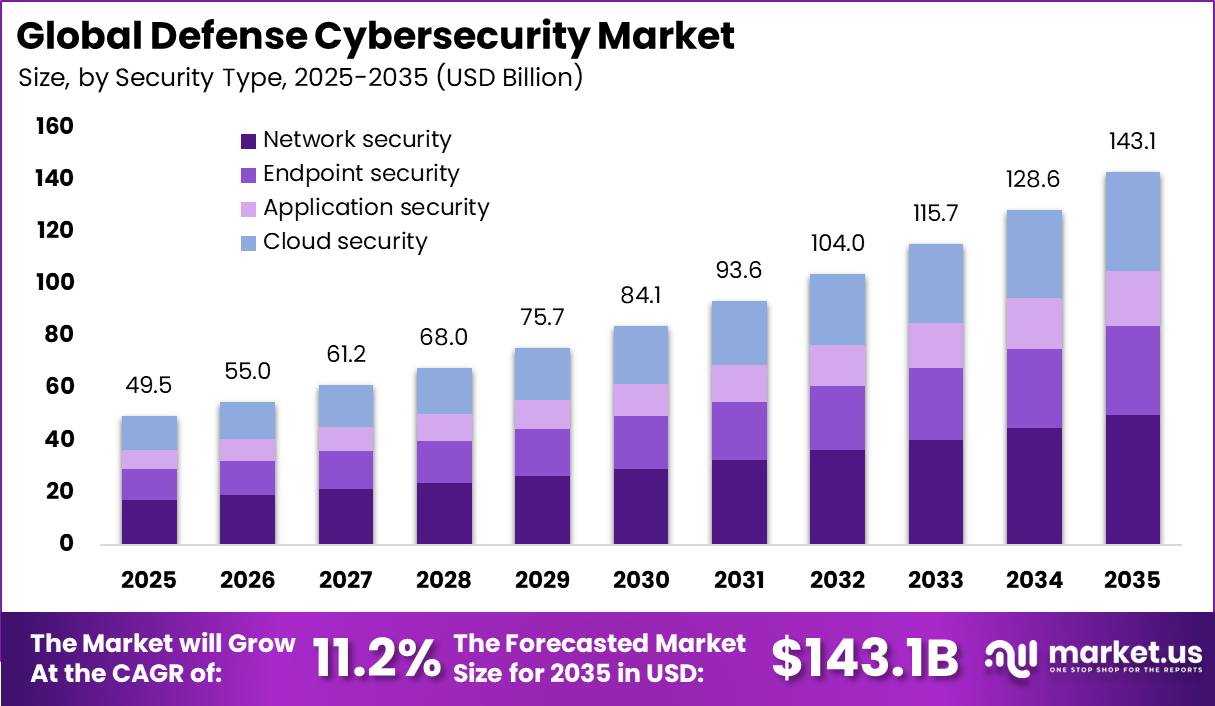
Market growth is supported by rising global defence spending and the increasing need to protect military networks, weapons systems, satellites, command platforms, and sensitive intelligence from cyber threats. According to SIPRI, global military expenditure reached USD 2.71 trillion in 2024, increasing 9.4% in real terms year over year, the fastest rise since at least 1988.
This represented the tenth consecutive annual increase, while total spending was 37% higher than in 2015. Growing defence budgets are supporting stronger investment in secure communications, threat detection, encryption, identity management, cloud security, zero-trust systems, and cyber incident response.
The U.S. Department of Defense requested USD 849.8 billion for FY 2025, including USD 14.5 billion for cyberspace activities. This allocation is nearly 29% of the stated global defence cybersecurity market value for 2025. U.S. Cyber Command also requested USD 1.7 billion for FY 2025, an increase of USD 54.4 million from the previous-year estimate, supporting continued demand for cybersecurity software, hardware, services, testing, and system upgrades.
Key Takeaway
- Defense Cybersecurity Market is valued at USD 49.5 billion in 2025, projected to reach USD 143.1 billion by 2035 at a CAGR of 11.2%.
- Network security was dominated by security type, holding a 34.8% share.
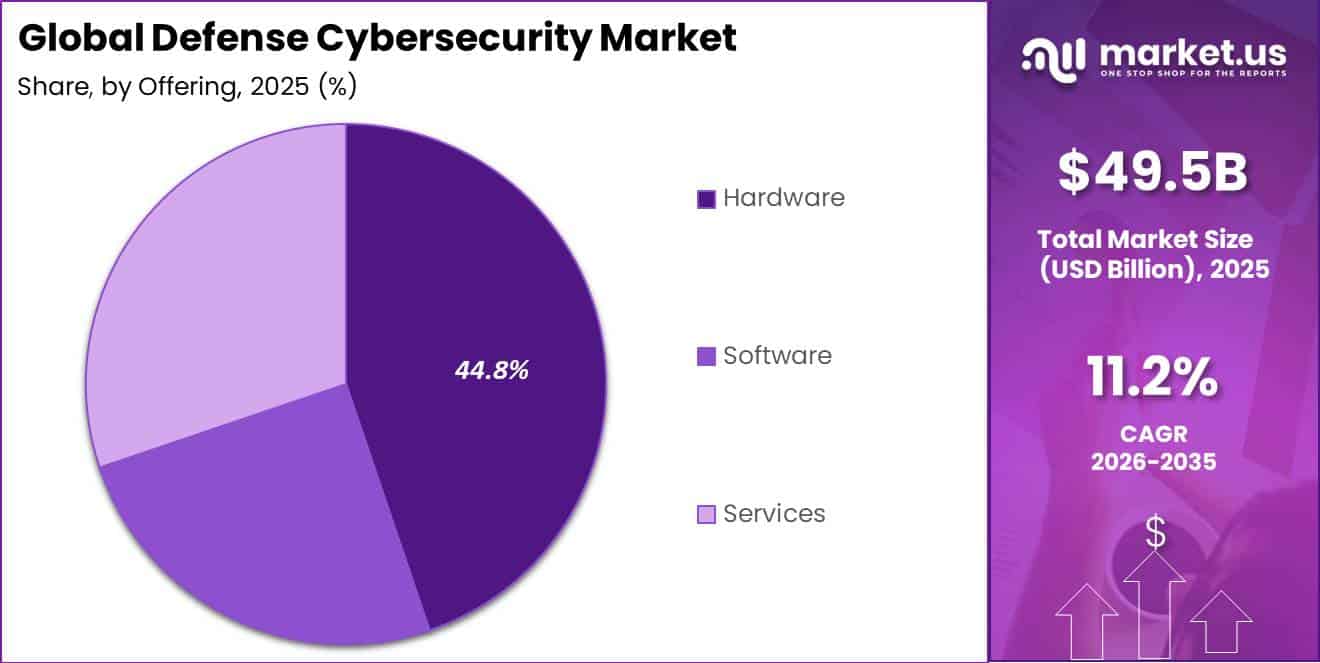
- Hardware led the offering with a 44.8% share.
- Critical infrastructure protection was led by application with a 30.2% share.
- The Army segment was led by end use with a 48.6% share.
- North America led the market in 2025 with a 35.3% share, worth approximately USD 17.4 billion.
Market Statistics and Data Insights
- Global military expenditure reached USD 2.718 trillion in 2024, increasing 9.4% in real terms from 2023. Spending was 37% higher than in 2015, while the global military burden increased to 2.5% of GDP. These figures show a significantly larger funding base for cybersecurity, communications, intelligence, space, and digitally connected military systems.
- The U.S. Department of Defense plans to invest nearly USD 2.4 trillion in 106 of its costliest weapon programs. Modern weapon systems are increasingly software-driven, creating requirements for secure software, embedded encryption, protected communications, identity controls, and continuous vulnerability management.
- NATO Allies agreed in 2025 to invest 5% of GDP annually in defence and security-related areas by 2035. At least 3.5% is intended for core defence requirements, while up to 1.5% can support areas including network defence, critical-infrastructure protection, resilience, innovation, and the defence industrial base.
- DoD’s cyberspace operations structure includes almost 440 operational organizations, approximately 61,000 military and civilian personnel, and more than 9,500 contractors. Another roughly 70 organizations and 3,400 personnel provide supporting roles, illustrating the scale of institutional demand for cyber tools, training, automation, and operational support.
- The Department of Defense planned to spend USD 10.9 billion on 24 major IT business programs during FY2023-FY2025. GAO found that 2 of the 24 programs lacked a strategy for reducing cybersecurity threats, while 4 had not developed plans for meeting the department’s 2027 zero-trust requirement.
- The cybersecurity talent market remains tight. NIST-supported CyberSeek recorded 514,359 U.S. cybersecurity job listings over 12 months in 2025, nearly 57,000 more positions than the previous period, representing a 12% increase.
- The European Commission selected 57 new European Defence Fund projects under its 2025 calls, representing EUR 1.07 billion of investment. Cyber defence, AI, drones, counter-drone systems, sensors, and digital technologies are among the funded areas.
- The 57 EDF projects involve 634 entities across 26 EU Member States and Norway. SMEs account for more than 38% of participants and receive more than 21% of the funding. The program attracted a record 410 proposals, 37% more than the prior round.
- The UK National Cyber Security Centre handled 429 cyber incidents during 2024-25. Of these, 204, or 48%, were considered nationally significant, up from 89 the previous year. Highly significant incidents increased to 18 from 12, while three major vulnerabilities alone were linked to 29 NCSC-managed incidents.
- NATO’s Integrated Cyber Defence Centre is being structured for continuous 24/7 cooperation among civilian, military, Allied, and industry cyber defenders. NATO initially estimated 2025 Phase 1 resources at EUR 10 million from NSIP, EUR 9.5 million from the Military Budget, and EUR 0.5 million from the Civil Budget.
- Australia’s cyber authority responded to 1,253 cybersecurity incidents in FY2024-25, an 11% annual increase. It issued more than 1,700 notifications of possible malicious cyber activity, up 83%, and blocked access to 334 million malicious domains, up 307%. Its cyber-threat-intelligence network expanded 13% to more than 450 partners.
By Security Type
Network Security held a dominant position in the Defense Cybersecurity Market, accounting for a 34.8% share. Its leadership is supported by the need to protect digital connections linking defence personnel, command centres, weapons platforms, sensors, suppliers, and allied forces.
The U.S. Department of Defense information environment includes approximately 15,000 classified and unclassified networks, 10,000 operational systems, 65,000 servers, and 7 million computers and electronic devices.
The same information environment supports around 1.3 million active-duty personnel and operates across more than 6,000 locations in over 146 countries. Federal agencies reported 32,211 information-security incidents in FY 2023, showing the continued cyber risks faced by government systems.
By Offering
Hardware held a dominant position in the Defense Cybersecurity Market, accounting for a 44.8% share. Its leadership is supported by the need for physical security systems across classified and mission-critical military networks. Defence organizations use rugged firewalls, encrypted radios, secure gateways, hardware security modules, trusted chips, network appliances, and phishing-resistant identity devices across ships, aircraft, vehicles, command centres, and remote bases.
The U.S. Department of Defense also uses Common Access Cards as its preferred authenticator, supporting continued demand for hardware-based identity and access security. Hardware demand is further strengthened by large defence equipment programs. The U.S. Government Accountability Office reported that the Department of Defense plans to invest more than USD 2 trillion in its major weapon systems portfolio.
New and upgraded military platforms require embedded encryption, secure processors, protected data links, and hardened network interfaces. In FY 2025, the U.S. Defense Contract Management Agency allocated USD 42.54 million to cyber activities, compared with USD 30.28 million in FY 2024.
By Application
Critical Infrastructure Protection held a dominant position in the Defense Cybersecurity Market, accounting for a 30.2% share. Its leadership is supported by the need to protect power, telecommunications, transport, fuel, water, healthcare, manufacturing, and government systems that support military operations.
The U.S. Federal Bureau of Investigation’s Internet Crime Complaint Center recorded 4,878 cyber-threat complaints from critical-infrastructure organisations in 2024, resulting in reported losses of USD 1.571 billion. Ransomware remained the most common threat, while related complaints from these organisations increased by 9% from 2023.
By End Use
The Army segment held a dominant position in the Defense Cybersecurity Market, accounting for a 48.6% share. Its leadership is driven by the large number of connected systems used by land forces, including tactical command posts, combat vehicles, drones, ground sensors, radios, battlefield management platforms, logistics systems, and mobile devices.
The U.S. Army’s FY 2025 budget request totals USD 185.9 billion and supports a total force of 943,100 personnel, including 442,300 active-duty soldiers, 325,000 Army National Guard personnel, and 175,800 Army Reserve personnel. This large user base creates a significant cybersecurity requirement across field and command environments.
The budget also allocates USD 755 million to accelerate Zero Trust cybersecurity, USD 704 million for Handheld, Manpack and Small Form Fit radios, USD 299 million for tactical network transport, and USD 300 million for central cyber and IT services. An additional USD 280.3 million supports mission-network refresh and replacement of end-of-life commercial technology, strengthening demand for defence cybersecurity solutions.
Key Market Segments
By Security Type
- Network security
- Firewall and security appliance
- Intrusion Detection System (IDS)
- Intrusion Prevention System (IPS)
- Secure network infrastructure
- Endpoint security
- Antivirus/antimalware solution
- Encryption tool
- Biometric device
- Application security
- Encryption device
- Secure development tool
- Application security testing
- Cloud security
- Secure cloud server and storage device
- Cloud encryption software
- Cloud Access Security Broker (CASB)
By Offering
- Hardware
- Software
- Services
By Application
- Critical infrastructure protection
- Data protection and encryption
- Incident response and forensics
- Identity and access management
- Secure communications system
By End Use
- Army
- Navy
- Air force
Geopolitical Impact Analysis
Geopolitical tensions are increasing the cost and supply risk of defence cybersecurity hardware, including secure routers, encrypted radios, firewalls, hardware security modules, servers, trusted chips, and optical-network equipment. These products depend on globally sourced semiconductors, printed circuit boards, copper, aluminium, power units, and specialist electronic components.
U.S. trade measures increased tariffs on Chinese-origin semiconductors to 50% from 1 January 2025, while tariffs of 50% also apply to steel, aluminium, and copper products under Section 232 measures. Higher tariffs increase the cost of imported chips, metal enclosures, connectors, and subassemblies used in defence cybersecurity equipment.
The impact is greater for classified systems because components must meet strict security, reliability, and origin requirements before deployment, making rapid supplier substitution more difficult. Regional conflicts are also disrupting logistics and delivery schedules. UNCTAD reported that rerouting Asia–Europe cargo around the Cape of Good Hope adds about 12 sailing days, or roughly a 30% increase in transit time, while reducing effective global container capacity by around 9%.
By June 2024, Suez Canal ship transits were down 70% from late-2023 levels, while Shanghai-to-Europe shipping rates had increased 256% from early December 2023. The World Bank projected its energy-price index to decline 17% in 2025, with Brent crude averaging USD 64 per barrel. However, longer routes continue to increase fuel, insurance, freight costs, lead times, and the need for dual sourcing and buffer inventories.
Regional Analysis
North America dominated the global Defense Cybersecurity Market in 2025, accounting for 35.3% of revenue, or approximately USD 17.47 billion. The region benefits from a large base of military networks, connected weapons systems, defence cloud platforms, intelligence databases, satellites, and defence suppliers that require continuous cybersecurity protection.
The U.S. Department of Defense’s FY 2025 budget request included USD 14.5 billion for cyberspace activities, covering cyber operations, network protection, system modernisation, zero-trust adoption, workforce development, and research.
Canada also supports regional growth. Budget 2024 allocated CAD 917.4 million over five years to strengthen intelligence and cyber operations, while the Communications Security Establishment’s 2024–25 Main Estimates reached CAD 1.04 billion, increasing by CAD 75.8 million from the previous year.
Asia Pacific is expected to be the fastest-growing regional market as governments increase defence digitisation, border security, naval modernisation, satellite programs, and protection against cyber espionage. Growing deployment of connected aircraft, naval vessels, drones, sensors, tactical communication systems, and battlefield networks is expanding the cyber attack surface.
Key Regions and Countries
North America
- US
- Canada
Europe
- Germany
- France
- The UK
- Spain
- Italy
- Rest of Europe
Asia Pacific
- China
- Japan
- South Korea
- India
- Australia
- Rest of APAC
Latin America
- Brazil
- Mexico
- Rest of Latin America
Middle East & Africa
- GCC
- South Africa
- Rest of MEA
Market Dynamics
Drivers
| Driver | (~) % CAGR | Geographic Relevance | Impact Timeline |
|---|---|---|---|
| Zero Trust Architecture Mandates | +2.8% | North America, Europe | Short term (2 years or less) |
| Rising State-Sponsored Intrusion Volume | +2.1% | Global | Short term (2 years or less) |
| Cloud/SaaS Migration of Defense IT | +1.9% | North America, Asia-Pacific | Medium term (2 to 4 years) |
| NATO Cyber Defence Pledge Funding | +1.6% | Europe | Medium term (2 to 4 years) |
| Sustained Prime-Contractor Cyber M&A | +1.3% | North America | Short term (2 years or less) |
| AI-Enabled Threat Detection Adoption | +1.1% | Global | Medium term (2 to 4 years) |
Zero Trust Architecture Mandates
Mandatory zero-trust requirements are creating strong demand in the Defense Cybersecurity Market. The U.S. Department of War’s zero-trust strategy, introduced in 2022, established implementation milestones across 2024 and 2025, requiring defence contractors to strengthen identity management, network segmentation, and continuous monitoring.
Related ICAM spending also increased across cyber budgets between fiscal 2024 and fiscal 2026, while more than 80% of covered systems were required to demonstrate initial zero-trust milestones by the end of fiscal 2024.
This compliance-driven shift benefits vendors that meet demanding government security standards. Providers with FedRAMP High and Impact Level 5 capabilities can compete more effectively for sensitive defence contracts. Acquisition-cycle tracking indicates that qualified vendors can reduce sales-cycle timelines by around 15%–20%.
Restraints
| Restraint | (~) % CAGR | Geographic Relevance | Impact Timeline |
|---|---|---|---|
| Classified Budget Continuing-Resolution Freezes | -1.7% | North America | Short term (2 years or less) |
| Export-Control Licensing Barriers | -1.2% | Global | Short term (2 years or less) |
| Security Clearance Backlog Bottleneck | -0.9% | North America, Europe | Short term (2 years or less) |
| Sovereign Data Residency Restrictions | -0.8% | Europe, Asia-Pacific | Medium term (2 to 4 years) |
| High Capital Cost of Accreditation | -0.6% | Global | Short term (2 years or less) |
Classified Budget Continuing-Resolution Freezes
Legislative funding delays remain a key challenge for the Defense Cybersecurity Market. Repeated continuing resolutions across fiscal 2024 through fiscal 2026 have limited new-start cyber programs by holding spending near prior-year levels and restricting new procurement activity.
New classified cyber task orders awarded during these periods were estimated to fall by around 18%–22%, while program funding delays of roughly 60–90 days were also reported. These delays create direct financial pressure for mid-tier defence integrators, especially those using cost-plus and time-and-materials contracts.
Challenges
| Challenge | (~) % CAGR | Geographic Relevance | Mitigation Horizon |
|---|---|---|---|
| Cleared Cyber Talent Shortage | -1.4% | North America, Europe | Medium term (2 to 4 years) |
| Legacy System Interoperability Debt | -1.0% | Global | Long term (4 years or more) |
| Fragmented Multinational Standards Alignment | -0.7% | Europe, Asia-Pacific | Long term (4 years or more) |
| Adversarial AI Escalation Cycle | -0.6% | Global | Medium term (2 to 4 years) |
| Sub-Tier Supplier Cyber Hygiene Gaps | -0.5% | North America | Medium term (2 to 4 years) |
Cleared Cyber Talent Shortage
The shortage of skilled and security-cleared cybersecurity professionals remains a major challenge for the Defense Cybersecurity Market. Workforce studies show a large gap between available talent and mission-critical demand.
Security-clearance processing can also take around 60–100 days for Secret-level cases and considerably longer for Top Secret/SCI positions, delaying hiring for sensitive defence cyber roles. Several defence IT contractors have reported cyber-role vacancy rates of roughly 8%–12%, limiting their ability to fully staff funded contracts.
Companies are responding through AI-assisted security tools, expanded cyber-training partnerships, and stronger employee-retention programs. However, higher competition for cleared professionals has increased labour costs by around 4%–6% annually, creating margin pressure and limiting how quickly contractors can expand even when government cybersecurity spending remains strong.
Opportunities
| Opportunity | (~) % CAGR | Geographic Relevance | Execution Window |
|---|---|---|---|
| Autonomous Weapons-Platform Cyber Hardening | +1.8% | North America, Europe | Medium term (2 to 4 years) |
| Allied Cyber Interoperability Roll-Ups | +1.4% | Europe, Asia-Pacific | Long term (4 years or more) |
| Space-Domain Cyber Resilience Services | +1.1% | Global | Long term (4 years or more) |
| Cyber-as-a-Managed-Service Monetization | +0.9% | North America | Medium term (2 to 4 years) |
| Defense-Grade OT/ICS Retrofit Contracts | +0.7% | North America, Europe | Medium term (2 to 4 years) |
Autonomous Weapons-Platform Cyber Hardening
Embedded cybersecurity for unmanned and autonomous weapons remains an untapped opportunity rather than a major current market driver. Many counter-autonomy and onboard-security programs are still funded through research, development, test, and evaluation instead of full-rate production.
The long-term margin opportunity is attractive. Embedded firmware-security retrofits can generate gross margins of around 35%–45% once they move into sustainment contracts, compared with roughly 15%–20% for cost-plus development work.
Companies that qualify hardened autonomy software under emerging NATO cyber-resilience standards and rapid-fielding programs could therefore convert defence R&D spending into higher-margin, recurring cybersecurity revenue as autonomous platforms move toward wider deployment.
Key Players Analysis
Tier-1 leaders hold a strong position in the Defense Cybersecurity Market due to their large defence contracts and broad system-integration capabilities. Lockheed Martin generated USD 75.0 billion in total sales in 2025, with 72% coming from U.S. Government contracts and 63% from the Department of War.
Its Aeronautics segment generated USD 30.3 billion, while Missiles and Fire Control contributed USD 14.5 billion. Northrop Grumman reported USD 41.95 billion in 2025 sales, up 2% year-over-year, with Mission Systems contributing more than USD 1.1 billion of the increase. CACI International recorded USD 8.63 billion in fiscal 2025 revenue, rising 12.6% YoY and 7.2% organically.
Department of Defense customers represented approximately 75%, or USD 6.3 billion, of revenue. Thales generated EUR 22.14 billion in total 2025 sales, while its Cyber & Digital segment contributed EUR 3.85 billion. The Cyber sub-segment generated EUR 1.46 billion, down 7.1%, with an adjusted EBIT margin of 13.7%.
Tier-2 challengers are expanding faster through cybersecurity software and subscription models. CrowdStrike reported USD 3.95 billion in fiscal 2025 revenue, up 29% YoY, with ARR reaching USD 4.24 billion, up 23%, and net new ARR of USD 806.7 million. Palo Alto Networks generated USD 9.2 billion in fiscal 2025 revenue, up 15%, increasing to USD 11.48 billion in fiscal 2026, up 24%, while subscription and support revenue reached USD 9.2 billion. Tier-1 primes are estimated to control 55–60% of integrated defence-cyber contract value.
Top Key Players in the Market
- Airbus
- BAE Systems
- Boeing
- CACI International
- Carlyle Group
- Cisco
- CrowdStrike
- General Dynamics
- Hanwha Systems
- IBM
- Israel Aerospace Industries
- L3Harris Technologies
- Leonardo
- Lockheed Martin
- ManTech International
- Northrop Grumman
- Palo Alto
- Rafael Advanced Defense Systems
- Raytheon Technologies
- Rheinmetall
- Saab
- SAIC
- Salient CRGT
- Thales
Recent Developments
- In 2025, SAIC announced on October 6, 2025, an agreement to acquire SilverEdge Government Solutions from Godspeed Capital for USD 205 million in cash. Its latest filing records a purchase price of USD 202 million, net of USD 6 million of acquired cash.
- In 2026, Palo Alto Networks completed its acquisition of CyberArk, following the transaction announced in 2025. The approximately USD 25 billion combination established identity security as a core pillar of Palo Alto Networks’ platform strategy. Former CyberArk shareholders were entitled to receive 2.2005 Palo Alto Networks shares and USD 45.0 in cash for each CyberArk ordinary share.
Report Scope
| Report Features | Description |
|---|---|
| Market Value (2025) | USD 49.5 Billion |
| Forecast Revenue (2035) | USD 143.1 Billion |
| CAGR (2026-2035) | 11.2% |
| Base Year for Estimation | 2025 |
| Historic Period | 2020-2024 |
| Forecast Period | 2026-2035 |
| Report Coverage | Revenue Forecast, Market Dynamics, Competitive Landscape, Recent Developments |
| Segments Covered | By Security Type (Network security, Endpoint security, Application security, Cloud security); By Offering (Hardware, Software, Services); By Application (Critical infrastructure protection, Data protection and encryption, Incident response and forensics, Identity and access management, Secure communications system); By End Use (Army, Navy, Air Force) |
| Regional Analysis | North America – US, Canada; Europe – Germany, France, The UK, Spain, Italy, Rest of Europe; Asia Pacific – China, Japan, South Korea, India, Australia, Singapore, Rest of APAC; Latin America – Brazil, Mexico, Rest of Latin America; Middle East & Africa – GCC, South Africa, Rest of MEA |
| Competitive Landscape | Airbus, BAE Systems, Boeing, CACI International, Carlyle Group, Cisco, CrowdStrike, General Dynamics, Hanwha Systems, IBM, Israel Aerospace Industries, L3Harris Technologies, Leonardo, Lockheed Martin, ManTech International, Northrop Grumman, Palo Alto, Rafael Advanced Defense Systems, Raytheon Technologies, Rheinmetall, Saab, SAIC, Salient CRGT, Thales |
| Customization Scope | Customization for segments, region/country-level will be provided. Moreover, additional customization can be done based on the requirements. |
| Purchase Options | We have three licenses to opt for: Single User License, Multi-User License (Up to 5 Users), Corporate Use License (Unlimited Users and Printable PDF) |





























