


Global Cosmetic Chemicals Market Size, Share, And Business Benefits By Product Type (Surfactants, Colorants, Preservatives, Emulsifiers, Polymer Ingredients, Others), By Source (Synthetic, Natural, Organic), By Application (Skin Care, Hair Care, Oral Care, Makeup, Fragrances, Others), By Region and Companies - Industry Segment Outlook, Market Assessment, Competition Scenario, Trends, and Forecast 2025-2034
- Published date: May 2025
- Report ID: 122529
- Number of Pages: 383
- Format:
-
keyboard_arrow_up
Quick Navigation
Report Overview
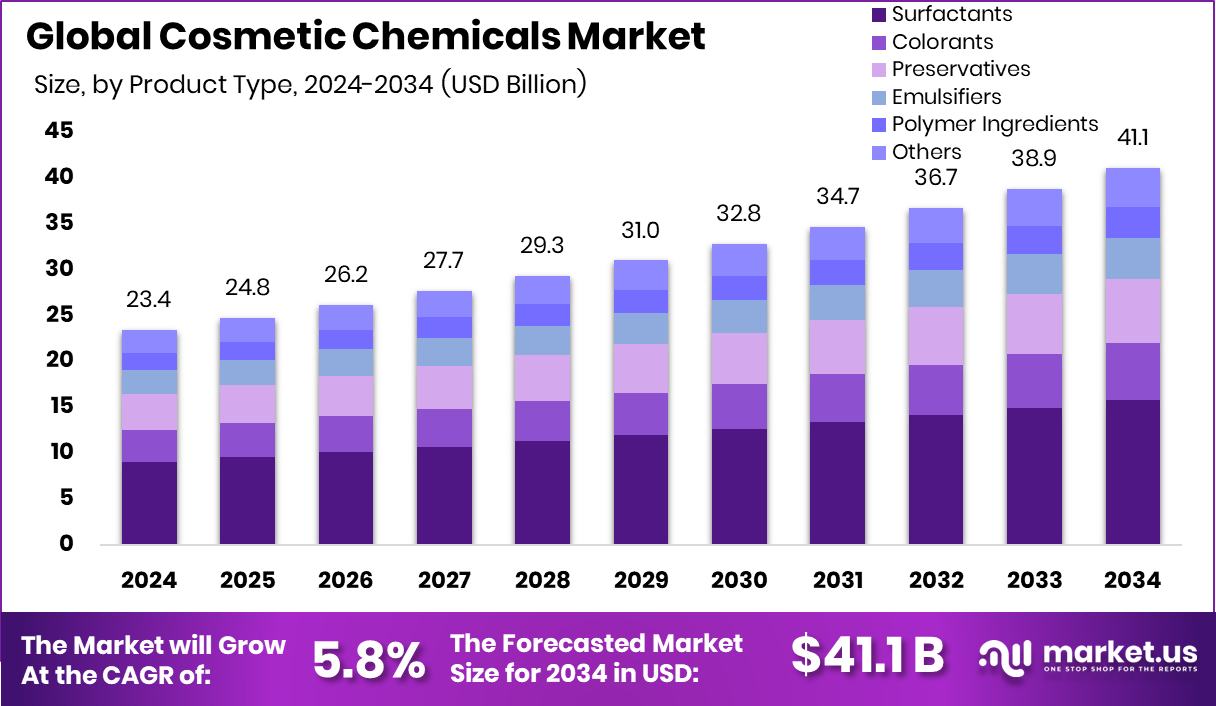
The Global Cosmetic Chemicals Market is expected to be worth around USD 41.1 billion by 2034, up from USD 23.4 billion in 2024, and grow at a CAGR of 5.8% from 2025 to 2034. Rising demand for skincare products boosted North America’s cosmetic chemicals market by 45.8%.
Cosmetic chemicals refer to a broad range of chemical ingredients used in the formulation of personal care and beauty products such as creams, lotions, shampoos, lipsticks, perfumes, and deodorants. These chemicals include surfactants, emollients, preservatives, colorants, and active agents that improve texture, shelf life, fragrance, or skincare effects.
The cosmetic chemicals market includes all raw materials used in cosmetics manufacturing. This market supports a massive global beauty and personal care industry, driven by rising grooming awareness and demand for specialized skincare. It caters to a wide spectrum of consumers, from mass-market products to luxury formulations, covering everything from anti-aging solutions to organic makeup.
One of the key growth drivers is the increasing awareness around skincare and personal hygiene, especially among younger populations. Social media exposure and rising disposable incomes are prompting consumers to experiment with new beauty products, leading to a constant need for novel and effective ingredients. According to an industry report, RAS Luxury Skincare has raised $5 million in funding from Unilever Ventures and other investors.
Demand for cosmetic chemicals is also rising due to urbanization, changing lifestyles, and a growing preference for multifunctional beauty products that combine skincare and cosmetic benefits. There’s a visible shift toward products offering anti-pollution, UV protection, hydration, and skin repair, boosting the need for specialized chemical inputs.
Key Takeaways
- The Global Cosmetic Chemicals Market is expected to be worth around USD 41.1 billion by 2034, up from USD 23.4 billion in 2024, and grow at a CAGR of 5.8% from 2025 to 2034.
- Surfactants lead the Cosmetic Chemicals Market by product type, holding a strong 38.5% market share.
- Synthetic ingredients dominate the Cosmetic Chemicals Market by source, contributing 67.6% of total usage globally.
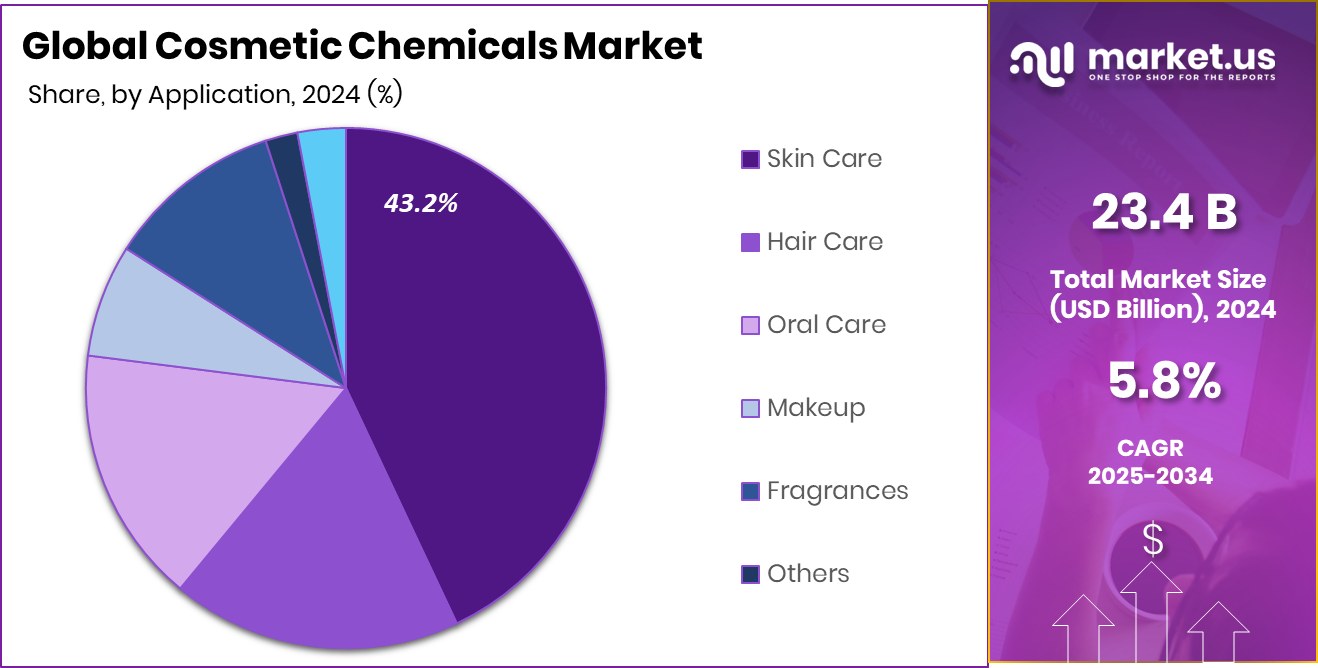
- Skin care applications drive demand in the Cosmetic Chemicals Market, accounting for 43.2% market share.
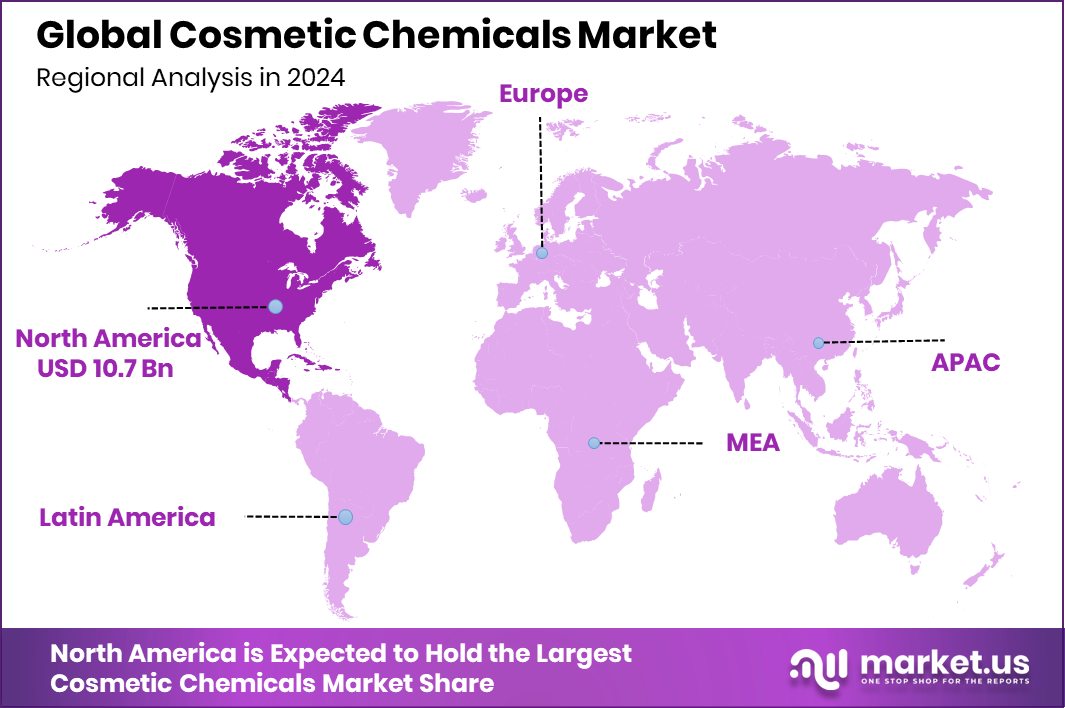
- The North American market reached a value of USD 10.7 billion in 2024.
By Product Type Analysis
Surfactants hold a 38.5% share in the Cosmetic Chemicals Market by product type.
In 2024, Surfactants held a dominant market position in the By Product Type segment of the Cosmetic Chemicals Market, with a 38.5% share. Surfactants are key ingredients in cleansing and foaming products, widely used in shampoos, facial cleansers, body washes, and soaps. Their ability to emulsify oil and water, remove dirt, and create lather makes them essential in both skincare and haircare formulations.
Following surfactants, emollients also contributed a notable share, driven by increasing demand for moisturizers and anti-aging creams that focus on skin hydration and softness. Preservatives maintained consistent demand, as product shelf-life and microbial safety remain key formulation requirements. Colorants, though smaller in volume, are crucial in decorative cosmetics such as lipsticks and foundations, adding aesthetic appeal.
The market’s segmentation reflects evolving consumer needs, where functionality, skin compatibility, and stability of formulations are influencing ingredient selection. Surfactants’ dominance in 2024 underscores their foundational role in product performance, while the rise in other segments signals growing demand for sensory and therapeutic benefits in cosmetic formulations.
By Source Analysis
Synthetic ingredients dominate the Cosmetic Chemicals Market, accounting for 67.6% overall share.
In 2024, Synthetic held a dominant market position in the By Source segment of the Cosmetic Chemicals Market, with a 67.6% share. Synthetic cosmetic chemicals are widely favored for their consistency, stability, and cost-effectiveness, making them a preferred choice for mass production. These ingredients offer predictable performance in formulations, ensuring reliable results in products like shampoos, conditioners, lotions, and makeup items.
Natural cosmetic chemicals, while gaining attention due to rising consumer interest in clean and green beauty, still accounted for a smaller portion of the market. Although there is growing traction in plant-based and bio-derived ingredients, challenges such as limited availability, shorter shelf-life, and higher costs have constrained their market share compared to synthetic alternatives.
The 67.6% share of synthetics in 2024 reflects ongoing demand for high-performance, scalable ingredients across global cosmetics manufacturing. While sustainability and natural sourcing are emerging trends, synthetic chemicals continue to dominate due to their formulation versatility, safety profiles, and ease of standardization.
By Application Analysis
Skin care leads the Cosmetic Chemicals Market application, capturing a strong 43.2% share.
In 2024, Skin Care held a dominant market position in the By Application segment of the Cosmetic Chemicals Market, with a 43.2% share. The high share is driven by increasing consumer focus on maintaining healthy, youthful skin, along with growing demand for daily skincare routines. Products such as moisturizers, anti-aging creams, sunscreens, and serums continue to rely heavily on specialized cosmetic chemicals, including emollients, surfactants, active agents, and preservatives.
Additionally, the influence of social media, beauty influencers, and skincare-centric marketing campaigns has encouraged more frequent usage of skincare products across both genders and all age groups. This trend has amplified the demand for ingredient innovation and performance-enhancing cosmetic chemicals tailored for skin health.
Hair Care, Color Cosmetics, Fragrances, and other applications accounted for the remaining market share. While these categories are also essential, their pace of growth is relatively moderate compared to the booming skincare demand.
Key Market Segments
By Product Type
- Surfactants
- Colorants
- Preservatives
- Emulsifiers
- Polymer Ingredients
- Others
By Source
- Synthetic
- Natural
- Organic
By Application
- Skin Care
- Hair Care
- Oral Care
- Makeup
- Fragrances
- Others
Driving Factors
Rising Skincare Awareness Among Urban Consumers Globally
One of the major driving forces behind the cosmetic chemicals market is the growing awareness of skincare among urban consumers. With increasing concerns about pollution, sun damage, and aging, people are now more focused on using effective skincare products. This shift in mindset is leading to higher demand for creams, serums, cleansers, and sunscreens that contain quality cosmetic chemicals.
Social media, online beauty influencers, and dermatologists are also playing a big role in educating people about skin health and product ingredients. As more consumers look for targeted benefits like hydration, anti-aging, or acne control, the use of specialized chemicals in product formulations is increasing.
Restraining Factors
Health Concerns Over Chemical-Based Cosmetic Ingredients
A key factor limiting the growth of the cosmetic chemicals market is increasing concern over the safety of chemical-based ingredients. Many consumers are now questioning the long-term effects of synthetic compounds used in beauty and personal care products. Ingredients like parabens, sulfates, and certain preservatives are often linked to skin irritation, allergies, or potential health risks.
This rising awareness is pushing users to shift toward natural or organic alternatives. As a result, manufacturers face challenges in balancing performance with clean-label expectations. Regulatory scrutiny is also increasing, with several governments tightening rules around ingredient transparency and labeling.
Growth Opportunity
Demand Rising For Natural And Green Ingredients
A major growth opportunity in the cosmetic chemicals market lies in the increasing demand for natural and eco-friendly ingredients. Consumers are becoming more conscious about what goes into their skincare and beauty products. They prefer plant-based, organic, and biodegradable ingredients that are safe for both skin and the environment.
Formulators are now exploring botanical extracts, fruit enzymes, essential oils, and natural preservatives to meet this demand. The clean beauty movement is especially strong in Europe and North America, and it’s gaining momentum in Asia too. Brands that focus on transparency and sustainability have a clear edge in this evolving market landscape.
Latest Trends
AI-Powered Personalization Transforming Cosmetic Ingredients
A significant trend in the cosmetic chemicals market is the integration of artificial intelligence (AI) to create personalized beauty products. AI technologies are enabling brands to analyze individual skin types, preferences, and concerns, leading to the development of customized formulations.
This approach not only enhances user satisfaction but also streamlines product development processes. By leveraging AI, companies can predict how different ingredients interact with various skin types, ensuring safety and efficacy.
This personalized approach is particularly appealing to consumers seeking products tailored to their unique needs, fostering brand loyalty and driving market growth. As AI continues to evolve, its role in personalizing cosmetic products is expected to become even more prominent, shaping the future of the industry.
Regional Analysis
In 2024, North America held a 45.8% share of the cosmetic chemicals market.
In 2024, North America emerged as the dominant region in the global Cosmetic Chemicals Market, accounting for 45.8% of the total market share, valued at USD 10.7 billion. The region’s leadership is supported by high consumer spending on personal care products, a well-established cosmetics industry, and growing demand for advanced skincare and anti-aging solutions.
Europe followed with a significant share, driven by widespread awareness of ingredient safety, strong regulations, and a mature beauty market. Asia Pacific registered steady growth as consumer interest in beauty and grooming continues to rise, particularly among younger demographics in countries like India, China, and South Korea. The Middle East & Africa region showed emerging potential due to increasing urbanization and rising demand for premium cosmetic products.
Meanwhile, Latin America is gradually expanding as international brands enter the market and local beauty trends influence cosmetic formulations. Despite regional differences in product preferences and regulatory environments, the global market is witnessing unified growth trends such as ingredient transparency and demand for high-performance formulations.
Key Regions and Countries
- North America
- US
- Canada
- Europe
- Germany
- France
- The UK
- Spain
- Italy
- Rest of Europe
- Asia Pacific
- China
- Japan
- South Korea
- India
- Australia
- Rest of APAC
- Latin America
- Brazil
- Mexico
- Rest of Latin America
- Middle East & Africa
- GCC
- South Africa
- Rest of MEA
Key Players Analysis
In 2024, Ashland Inc. maintained its strategic position in the global cosmetic chemicals market by focusing on innovative, sustainable, and science-driven ingredient solutions. The company strengthened its portfolio with bio-based and multifunctional ingredients catering to skin and hair care applications. Ashland’s emphasis on naturally derived polymers and plant-based actives aligned well with the growing clean beauty movement.
Eastman Chemical Company leveraged its strength in specialty chemicals to support personal care product manufacturers with performance-enhancing additives and functional ingredients. Its expertise in ester technology and advanced skin conditioning agents positioned it as a valuable partner for formulation developers. In 2024, Eastman emphasized product safety, low environmental impact, and ingredient transparency—factors that resonate strongly with today’s consumers and regulatory bodies.
Lonza Group focused on high-purity preservatives, multifunctional active ingredients, and microbial control solutions within the cosmetic chemicals sector. Their offerings supported long shelf-life, stability, and safety of formulations, making them especially relevant for global cosmetic brands. In 2024, Lonza’s presence in both mature and emerging markets, coupled with its commitment to formulation support and regulatory compliance, reinforced its importance in the cosmetic chemicals value chain.
Top Key Players in the Market
- Dow
- Givaudan
- Ashland Inc.
- Eastman Chemical Company
- Lonza Group
- BASF SE
- Lanxess
- P&G Chemicals
- Solvay S.A.
- Evonik Industries AG
- Bayer AG
- Croda International plc
- Stephan Company
- Symrise
- Cargill
Recent Developments
- In March 2025, Givaudan Active Beauty introduced Evernityl™, a marine-derived active ingredient sourced from Brittany’s ocean. Evernityl™ targets Porphyr’ageing™, a newly discovered mechanism of skin aging, by inhibiting porphyrin production and enhancing skin elasticity and firmness.
- In February 2025, Ashland introduced Collapeptyl™, a groundbreaking hyalopeptide hybrid designed through molecular modeling. This innovative ingredient mimics and enhances 20 types of collagen, delivering immediate skin benefits such as improved elasticity, hydration, and a glass-like glow.
Report Scope
Report Features Description Market Value (2024) USD 23.4 Billion Forecast Revenue (2034) USD 41.1 Billion CAGR (2025-2034) 5.8% Base Year for Estimation 2024 Historic Period 2020-2023 Forecast Period 2025-2034 Report Coverage Revenue Forecast, Market Dynamics, Competitive Landscape, Recent Developments Segments Covered By Product Type (Surfactants, Colorants, Preservatives, Emulsifiers, Polymer Ingredients, Others), By Source (Synthetic, Natural, Organic), By Application (Skin Care, Hair Care, Oral Care, Makeup, Fragrances, Others) Regional Analysis North America – US, Canada; Europe – Germany, France, The UK, Spain, Italy, Rest of Europe; Asia Pacific – China, Japan, South Korea, India, Australia, Singapore, Rest of APAC; Latin America – Brazil, Mexico, Rest of Latin America; Middle East & Africa – GCC, South Africa, Rest of MEA Competitive Landscape Dow, Givaudan, Ashland Inc., Eastman Chemical Company, Lonza Group, BASF SE, Lanxess, P&G Chemicals, Solvay S.A., Evonik Industries AG, Bayer AG, Croda International plc, Stephan Company, Symrise, Cargill Customization Scope Customization for segments, region/country-level will be provided. Moreover, additional customization can be done based on the requirements. Purchase Options We have three licenses to opt for: Single User License, Multi-User License (Up to 5 Users), Corporate Use License (Unlimited User and Printable PDF) 
-
-
- Dow
- Givaudan
- Ashland Inc.
- Eastman Chemical Company
- Lonza Group
- BASF SE
- Lanxess
- P&G Chemicals
- Solvay S.A.
- Evonik Industries AG
- Bayer AG
- Croda International plc
- Stephan Company
- Symrise
- Cargill
Our Clients

- 122529
- May 2025






