Report Overview
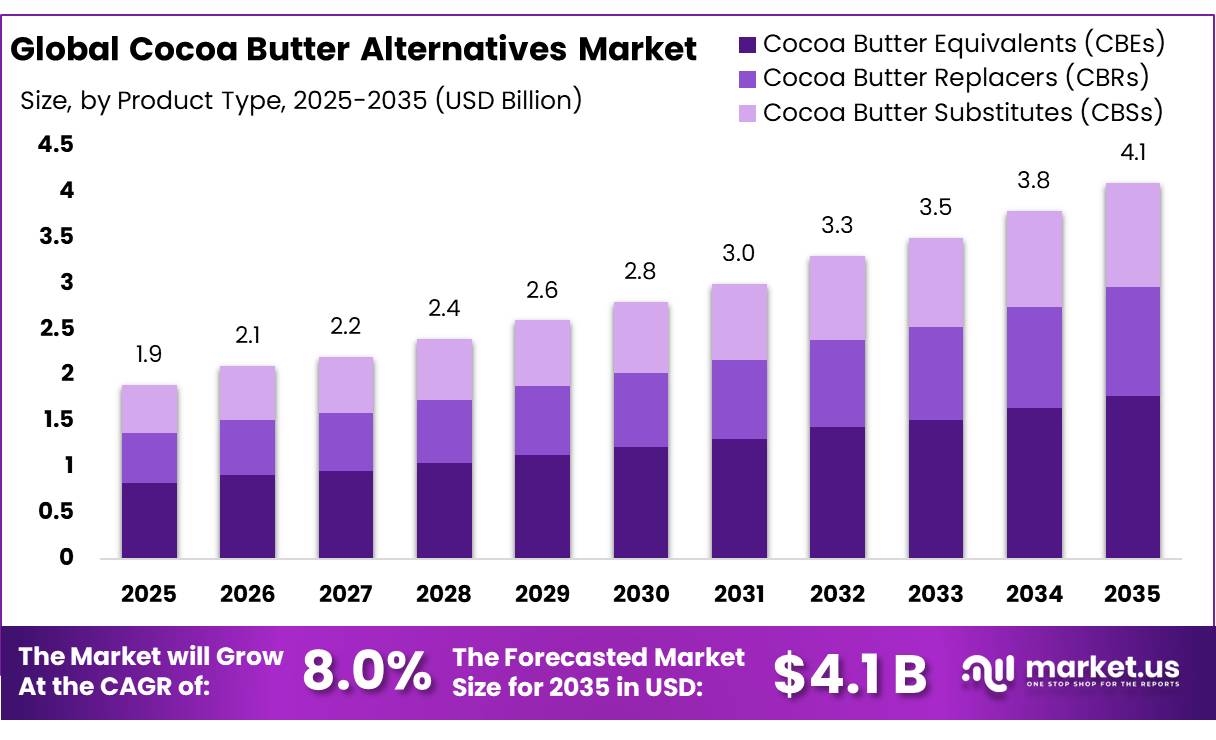
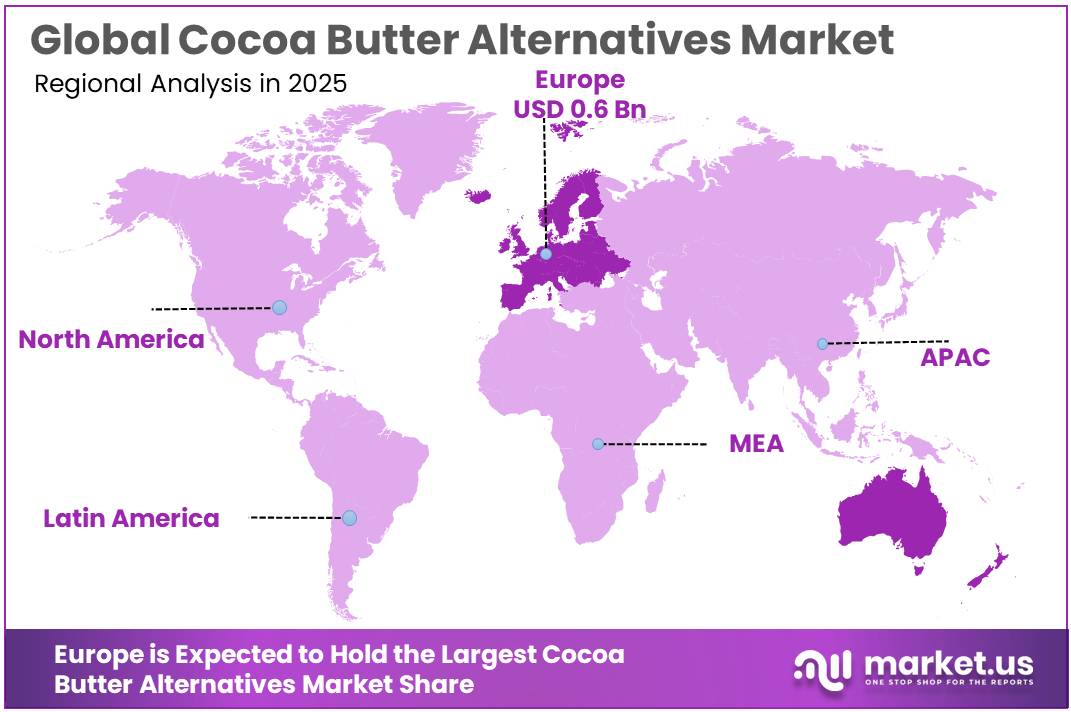
The Global Cocoa Butter Alternatives Market size is expected to be worth around USD 4.1 Billion by 2035, from USD 1.9 Billion in 2025, growing at a CAGR of 8.0% during the forecast period from 2026 to 2035. In 2025, Europe held a dominant market position, capturing more than a 36.78% share, holding USD 0.6 Billion revenue.
Cocoa butter alternatives are specialty fats developed to replace or partially substitute natural cocoa butter in chocolate, confectionery, bakery, fillings, coatings, and other food products. These alternatives are generally classified into three major categories: Cocoa Butter Equivalents (CBEs), Cocoa Butter Replacers (CBRs), and Cocoa Butter Substitutes (CBSs).
- According to the International Cocoa Organization (ICCO), global cocoa production reached approximately 4.733 million tonnes in 2024/25, representing an 8.5% year-on-year increase, while global cocoa grindings declined by 3.3% to 4.649 million tonnes. The organization estimated a global supply surplus of 37,000 tonnes and ending stocks of 1.309 million tonnes. Although supply conditions improved, price volatility and uncertainty continue to encourage food manufacturers to explore alternative fat formulations.
One of the major driving factors is the growing need for cost-effective ingredients across the chocolate and confectionery industry. Cocoa butter alternatives allow manufacturers to control production expenses, improve formulation flexibility, and maintain consistent product quality. Leading specialty fats producer AAK reported in its 2025 Annual Report that higher cocoa prices encouraged chocolate manufacturers to reformulate products and increase demand for cocoa butter equivalents. Its ILLEXAO™ super compound range can replace up to 100% of cocoa butter in selected formulations while maintaining the desired sensory characteristics.
- Regulatory requirements also influence industrial development. The European Union’s Chocolate Directive 2000/36/EC permits the addition of up to 5% vegetable fats other than cocoa butter in chocolate, provided the fats meet specified compositional and processing requirements. The permitted sources include palm, shea, illipe, sal, kokum, and mango kernel fats. Manufacturers must also follow applicable product-labelling requirements.
Technological advancements in fat fractionation, refining, and enzymatic processing are creating additional opportunities for specialty ingredient manufacturers. These technologies support the development of customized fat compositions with improved melting profiles, snap, hardness, and resistance to fat bloom. Increasing demand for compound chocolate, bakery coatings, wafer fillings, ice cream coatings, pralines, and chocolate spreads is further supporting industrial adoption.
Key Takeaways
- Cocoa Butter Alternatives Market size is expected to be worth around USD 4.1 Billion by 2035, from USD 1.9 Billion in 2025, growing at a CAGR of 8.0%.
- Cocoa Butter Equivalents (CBEs) held a dominant market position, capturing more than a 43.45% share.
- Food and Beverages held a dominant market position, capturing more than a 66.00% share.
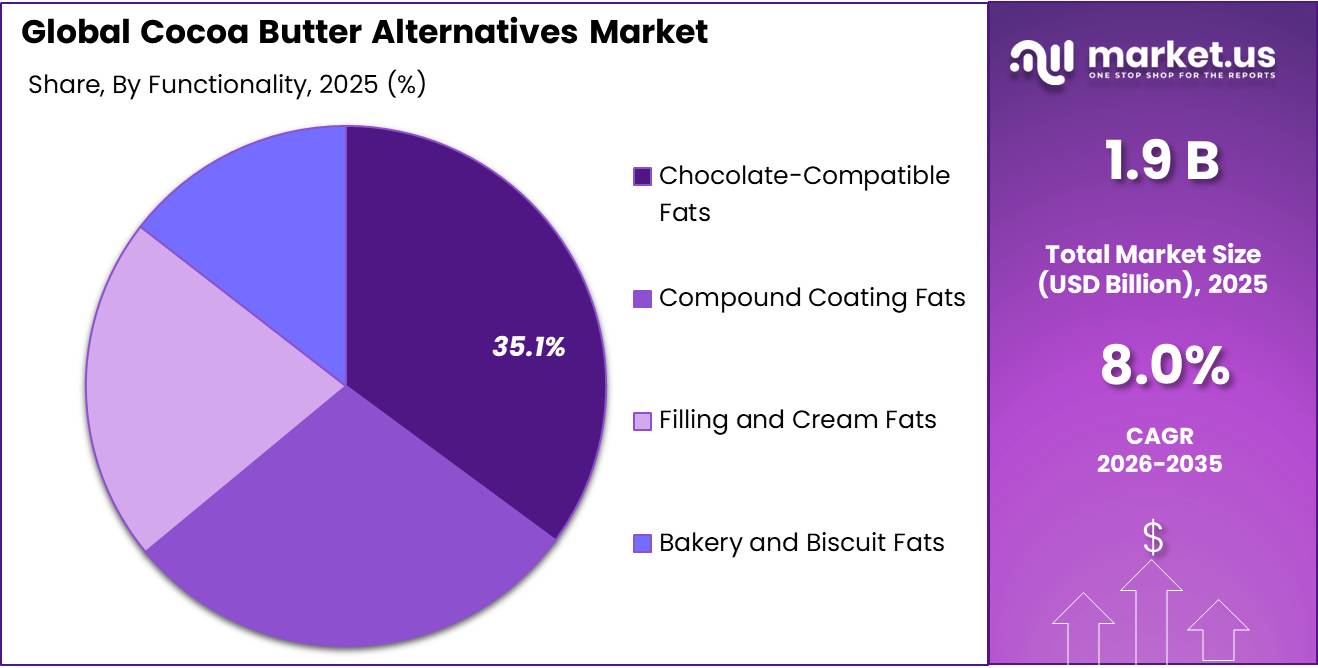
- Chocolate-Compatible Fats held a dominant market position, capturing more than a 35.12% share.
- Europe dominated the Cocoa Butter Alternatives Market, accounting for 36.78% of the market, valued at USD 0.6 billion.
By Product Type Analysis
Cocoa Butter Equivalents (CBEs) – Dominance Driven by Chocolate Quality and Formulation Flexibility
In 2025, “Cocoa Butter Equivalents (CBEs)” held a dominant market position, capturing more than a 43.45% share. This dominance is supported by their ability to deliver properties similar to natural cocoa butter, including smooth texture, desirable melting behaviour, gloss, and firmness. CBEs are widely used in chocolate and premium confectionery because they can be blended with cocoa butter while maintaining important product characteristics.
In 2025, demand was supported by chocolate manufacturers seeking consistent fat quality, improved processing performance, and greater flexibility in product formulation. The European Union’s Chocolate Directive 2000/36/EC recognises specific vegetable fats, including shea, palm, illipe, sal, kokum, and mango kernel fats, for use in chocolate under defined conditions.
Cocoa Butter Replacers (CBRs) are gaining attention because they offer food manufacturers a cost-effective alternative to natural cocoa butter, particularly in compound chocolate, confectionery coatings, bakery products, and fillings. These fats are generally developed from vegetable oils and are valued for their affordability, processing convenience, and good product stability.
In 2026, the United States Bureau of Labor Statistics reported 40,389 employees in chocolate and confectionery manufacturing in March 2026, reflecting the scale of the industrial sector supporting demand for specialty fats and alternative chocolate ingredients. This included 30,798 employees in confectionery manufacturing from purchased chocolate. These figures indicate a substantial downstream manufacturing base for ingredients such as CBRs, although they do not represent CBR-specific consumption.
By Application Analysis
Food and Beverages – Dominance Supported by Broad Use in Chocolate and Processed Food Production
In 2025, “Food and Beverages” held a dominant market position, capturing more than a 66.00% share. This dominance is mainly driven by the extensive use of cocoa butter alternatives in chocolate, confectionery, bakery products, biscuits, spreads, fillings, and other processed food applications.
In 2025, demand was further supported by changing cocoa supply conditions and the need for reliable ingredient sourcing. According to the International Cocoa Organization, global cocoa production was estimated at 4.733 million tonnes in the 2024/25 season, while global cocoa grindings reached 4.649 million tonnes.
Confectionery is a major application segment for cocoa butter alternatives because manufacturers use specialty fats in chocolate coatings, candy bars, pralines, wafers, toffees, and filled confectionery products. These ingredients help maintain smooth texture, attractive appearance, suitable hardness, and consistent melting properties. In 2026, demand from confectionery manufacturers was supported by the need to manage cocoa butter costs and maintain stable production.
According to the U.S. Bureau of Labor Statistics, chocolate and confectionery manufacturing employed 40,389 workers in March 2026, including 30,798 workers in confectionery manufacturing from purchased chocolate and 9,591 workers in chocolate and confectionery manufacturing from cacao beans. This employment data highlights the scale of the downstream industry supporting demand for specialty fats.
By Functionality Analysis
Chocolate-Compatible Fats – Dominance Driven by Similarity to Natural Cocoa Butter
In 2025, “Chocolate-Compatible Fats” held a dominant market position, capturing more than a 35.12% share. This dominance is supported by their ability to blend effectively with natural cocoa butter while maintaining the texture, gloss, firmness, and melting properties expected in chocolate products. These fats are widely preferred by chocolate manufacturers because they support consistent product quality and provide flexibility in formulation.
Their use is particularly important in premium chocolate, pralines, chocolate bars, and filled confectionery products, where fat compatibility directly affects the final product’s performance. In 2025, manufacturers continued to focus on improving fat composition and processing quality to address raw material cost pressures and changing cocoa supply conditions. The European Union’s Directive 2000/36/EC provides a regulatory framework for permitted vegetable fats in chocolate, supporting the development of compatible fat formulations.
Compound Coating Fats are increasingly used in confectionery, bakery products, biscuits, wafers, ice cream coatings, and snack applications because they provide an alternative to traditional cocoa butter-based coatings. These fats help manufacturers achieve suitable hardness, smooth coating performance, and product stability while managing ingredient costs.
In 2026, demand was supported by the expanding use of compound coatings in industrial food production and the need for efficient processing. According to the U.S. Department of Agriculture, the United States produced approximately 8.1 billion pounds of chocolate and cocoa products in 2024, demonstrating the scale of the downstream industry for chocolate-based ingredients and coatings.
Key Market Segments
By Product Type
- Cocoa Butter Equivalents (CBEs)
- Cocoa Butter Replacers (CBRs)
- Cocoa Butter Substitutes (CBSs)
By Application
- Food and Beverages
- Confectionery
- Bakery Products
- Dairy and Frozen Desserts
- Functional Foods and Beverages
- Cosmetics and Personal Care
- Pharmaceuticals
- Other Applications
By Functionality
- Chocolate-Compatible Fats
- Compound Coating Fats
- Filling and Cream Fats
- Bakery and Biscuit Fats
Driver Analysis
Cocoa-Cost Reformulation
Cocoa-price volatility is already encouraging manufacturers to qualify alternative fat systems to protect affordable retail price points, making reformulation a current demand driver rather than a speculative future opportunity. AAK’s 2025 annual report explicitly links cocoa volatility to increased CBE adoption, while also reporting a 6.0% decline in Chocolate & Confectionery Fats volumes, a 2.0% operating-profit increase and operating profit of SEK 4.19/kg, up 8.0%; those segment figures illustrate that higher-value formulation activity can coexist with weak overall confectionery demand and should not be interpreted as CBE volume growth.
The supply backdrop also requires balance: ICCO’s August 2026 bulletin estimated a 37,000-tonne surplus for 2024/25 and a 3.3% decline in grindings, so a forecast premised on permanently worsening cocoa shortages would be inappropriate. Bean-balance figures are not direct cocoa-butter price quotations.
In an illustrative formulation using 50 kg of eligible CBE per tonne, assumed cocoa-butter and CBE costs of USD 8.0/kg and USD 4.0/kg generate USD 200.0/tonne of gross ingredient savings; after an assumed USD 40.0/tonne for qualification, processing adjustments and quality assurance, net savings are USD 160.0/tonne, or USD 1.6 million across 10,000 tonnes annually. For EU-defined chocolate, permitted vegetable fats cannot exceed the statutory 5.0% calculation basis, reduce required cocoa constituents or bypass supplementary labelling requirements.
Suppliers therefore capture value through legally compliant, sensory-validated cost reduction rather than selling the cheapest bulk oil. The +1.2 pp estimate assumes 30.0% revenue exposure grows 4.0 percentage points faster through cost-led reformulation, with sensitivity to narrowing ingredient-price spreads.
Drivers Impact Analysis
| Driver | (~) % Impact on CAGR Forecast | Geographic Relevance | Impact Timeline |
|---|---|---|---|
| Cocoa-cost reformulation | +1.2 pp | EU, UK, North America, India | Short term (≤ 2 years) |
| Non-temper processing adoption | +0.8 pp | India, Southeast Asia, Latin America | Short term (≤ 2 years) |
| Higher cocoa-butter compatibility | +0.6 pp | EU, UK, North America, East Asia | Medium term (2–4 years) |
| Shelf-stability formulation demand | +0.5 pp | India, Southeast Asia, Middle East, Africa | Medium term (2–4 years) |
| Non-hydrogenated fat conversion | +0.4 pp | EU, UK, North America, Asian export hubs | Short term (≤ 2 years) |
Restraint Analysis
Chocolate Identity Restrictions
Chocolate standards impose a direct ceiling on the alternative-fat volume that can enter products retaining protected chocolate descriptions, making legal addressability smaller than total confectionery-fat consumption. EU Directive 2000/36/EC limits eligible vegetable-fat additions to 5.0% of the finished product after deducting specified other edible matter, without reducing minimum cocoa-butter or total cocoa-solids requirements; its Annex II also requires qualifying fats to be non-lauric, compatible with cocoa butter and produced through permitted refining or fractionation processes rather than enzymatic triglyceride modification.
In the US, standardized sweet chocolate lists cacao fat among permitted ingredients, while a separate standard permits other vegetable fats under the name “sweet chocolate and vegetable fat coating”; therefore, compound sales remain possible, but unrestricted substitution within standardized chocolate is not.
In a simplified 1,000-tonne EU chocolate formulation with no deductible inclusions, the 5.0% limit permits at most 50 tonnes of eligible added vegetable fat, not replacement of the entire fat phase. If an unconstrained commercial plan assumed 100 tonnes, 50 tonnes of prospective demand would be outside that formulation’s legal allowance, while cocoa-constituent minima could constrain replacement further. Suppliers consequently need product-specific regulatory screening before converting finished-chocolate volumes into addressable ingredient demand.
Restraint Impact Analysis
| Restraint | (~) % Impact on CAGR Forecast | Geographic Relevance | Impact Timeline |
|---|---|---|---|
| Chocolate identity restrictions | −0.6 pp | EU, US; export suppliers | Long term (≥ 4 years) |
| Narrowing substitution savings | −0.4 pp | EU, UK, North America, India | Short term (≤ 2 years) |
| Weak confectionery throughput | −0.3 pp | Europe, North America; export suppliers | Short term (≤ 2 years) |
| Formulation compatibility ceilings | −0.3 pp | EU, UK, East Asia, North America | Medium term (2–4 years) |
| Premium product exclusions | −0.2 pp | EU, UK, Japan, North America | Long term (≥ 4 years) |
Opportunity Analysis
Nutrition-Snack Coating Platforms
Dedicated alternative-fat systems for protein bars, fibre-rich snacks and other nutritionally positioned confectionery offer an adjacent application opportunity where suppliers can develop coatings around unfamiliar ingredient interactions rather than simply substitute fat in established chocolate recipes. AAK’s October 2026 participation in the Asia-Pacific Healthy Snacks Challenge includes expertise in coatings, fillings, plant-based fat systems and mouthfeel, establishing an active innovation channel but not proving that the resulting products already generate material cocoa butter alternatives revenue.
The untapped component is conversion of currently uncoated products or applications using out-of-scope fat systems into qualified cocoa butter alternative coatings, not continued growth of existing compound-coated snacks. In an illustrative target portfolio of 40 manufacturers producing 2,000 tonnes of eligible snacks each annually, a 15.0% coating rate and 30.0% alternative-fat content within the coating create 3,600 tonnes of technical ingredient potential. Converting 25.0% of that portfolio yields 900 tonnes of obtainable volume, equivalent to USD 2.7 million annually at an assumed USD 3,000.0/tonne, before deducting any incumbent alternative-fat purchases.
Suppliers would need application trials addressing oil migration, texture, sweetness systems and nutritional claims, with performance verified in the complete bar rather than the isolated coating. The +0.35 pp estimate assumes 7.0% revenue exposure grows 5.0 percentage points faster through genuinely additional applications, excluding generic bakery coatings and compatibility-led conversions already included in baseline drivers.
Opportunity Impact Analysis
| Opportunity | (~) % Potential CAGR Upside | Geographic Relevance | Execution Window |
|---|---|---|---|
| Nutrition-snack coating platforms | +0.35 pp | North America, EU, India, Southeast Asia | Short term (≤ 2 years) |
| Regional small-batch formulation hubs | +0.30 pp | India, Indonesia, Vietnam, Brazil | Short term (≤ 2 years) |
| Alternative-kernel fraction development | +0.25 pp | India, West Africa; EU buyers | Medium term (2–4 years) |
| Segregated specialty-fat contracts | +0.25 pp | EU, UK, North America; West African sourcing | Medium term (2–4 years) |
| Fermentation-derived confectionery fats | +0.15 pp | US, EU, Singapore | Long term (≥ 4 years) |
Challenges Analysis
Kernel Quality and Yield
Agricultural variation and inconsistent post-harvest handling create recurring differences in moisture, deterioration and recoverable fat quality, requiring processors to adjust purchasing specifications, blending and refining rather than simply procure kernels by weight. AAK’s shea supply-chain documentation identifies boiling, drying, de-shelling, hygiene and dry storage as quality-critical stages; its sourcing disclosures also describe insufficient drying as a cause of lower-quality kernels. These documents establish enduring operating mechanisms, not a quantified deterioration event in 2026 or an industry-wide yield benchmark.
In an illustrative 10,000-tonne kernel program, an assumed 45.0% extractable-fat yield followed by 95.0% refining recovery produces 4,275 tonnes of refined fat before specialty fractionation. If extractable yield falls to 43.0% and refining recovery to 93.0%, output declines to 3,999 tonnes, a 276-tonne or 6.5% reduction. A fixed USD 8.0 million kernel procurement bill consequently rises from approximately USD 1,871.3 to USD 2,000.5 per tonne of refined output, before utilities, logistics, fractionation and coproduct credits.
This is a feedstock-cost sensitivity, not a full CBE production-cost estimate. Suppliers need intake testing linked to origin, moisture-controlled storage, supplier feedback and yield-based procurement decisions; higher-quality material should be evaluated against recoverable value rather than purchase price alone. The −0.30 pp coefficient assumes 15.0% revenue exposure grows 2.0 percentage points more slowly through yield variability and quality-related reprocessing, excluding outright supply prohibitions and commercial feedstock shortages.
Challenges Impact Analysis
| Challenge | (~) % CAGR Friction Drag | Geographic Relevance | Mitigation Horizon |
|---|---|---|---|
| Kernel quality and yield | −0.30 pp | West Africa, India; EU processors | Medium term (2–4 years) |
| Crystallization and cooling control | −0.30 pp | EU, India, Southeast Asia, Brazil | Medium term (2–4 years) |
| Migration and bloom management | −0.25 pp | EU, North America, India, Middle East | Long term (≥ 4 years) |
| Refining contaminant process control | −0.25 pp | Malaysia, Indonesia, EU; export processors | Medium term (2–4 years) |
| Multi-tier traceability data reconciliation | −0.20 pp | West Africa, Southeast Asia; EU buyers | Medium term (2–4 years) |
Geopolitical Impact Analysis
Geopolitical Impact of Ongoing Wars on the Cocoa Butter Alternatives Market
Ongoing geopolitical conflicts, particularly the Russia-Ukraine war and instability in the Middle East, are creating indirect pressure on the Cocoa Butter Alternatives Market through higher energy costs, shipping disruptions, and uncertainty in international trade. These conditions affect the transportation of vegetable oils, specialty fats, and food-processing ingredients. Higher freight and insurance costs can increase procurement expenses for manufacturers, particularly those dependent on imported palm, shea, and other specialty fats.
The impact is also visible through energy markets. According to the U.S. Energy Information Administration, approximately 20.9 million barrels of oil per day passed through the Strait of Hormuz during the first half of 2025, representing around 20% of global petroleum liquids consumption. Any disruption can increase fuel and transportation costs for food ingredient manufacturers. The World Food Programme reported that shipping costs for its operations were 20% higher amid trade route disruptions in 2026.
Consequently, cocoa butter alternative producers may face higher operating expenses, delayed raw material deliveries, and pressure on profit margins. However, these conditions also create opportunities for regional sourcing, diversified vegetable fat procurement, and improved inventory management. Companies with flexible supply networks are better positioned to maintain production and serve confectionery manufacturers during geopolitical uncertainty.
Regional Insights
Europe – Dominating Region
In 2025, Europe dominated the Cocoa Butter Alternatives Market, accounting for 36.78% of the market, valued at USD 0.6 billion. The region’s leading position is supported by its established chocolate manufacturing industry, strong confectionery consumption, and presence of major food ingredient producers. Countries such as Germany, Switzerland, Belgium, France, and the Netherlands have well-developed chocolate processing industries, creating consistent demand for cocoa butter equivalents, replacers, and compound coating fats.
European manufacturers increasingly focus on alternative vegetable fats to manage cocoa procurement costs, maintain product quality, and improve production flexibility. The European Union’s regulatory framework also supports the use of specific vegetable fats in chocolate, subject to compositional and labelling requirements.
The Americas represent an important growth opportunity for cocoa butter alternatives, supported by established chocolate manufacturing, confectionery consumption, and increasing demand for cost-efficient specialty fats. The United States, Brazil, and other regional markets provide opportunities for suppliers of cocoa butter equivalents, cocoa butter replacers, and compound coating fats.
According to the International Cocoa Organization, the Americas were the only major cocoa-processing region expected to record growth in 2024/25, with grindings projected to increase by 1.2% to 903,000 tonnes. This performance reflects comparatively stronger processing activity despite elevated cocoa prices and input costs. The region’s demand is also supported by manufacturers seeking alternative fats for chocolate coatings, bakery products, and confectionery fillings.
Key Regions and Countries Insights
- North America
- US
- Canada
- Europe
- Germany
- France
- The UK
- Spain
- Italy
- Rest of Europe
- Asia Pacific
- China
- Japan
- South Korea
- India
- Australia
- Rest of APAC
- Latin America
- Brazil
- Mexico
- Rest of Latin America
- Middle East & Africa
- GCC
- South Africa
- Rest of MEA
Key Players Analysis
AAK AB maintains a strong position in the cocoa butter alternatives industry through its Chocolate & Confectionery Fats business, which supplies cocoa butter equivalents, filling fats, and specialty fats. In 2025, the company operated 19 production facilities, supported by 16 Customer Innovation Centers and approximately 4,000 employees. Its ILLEXAO™ product range offers formulations capable of replacing up to 100% of cocoa butter in selected applications. In May 2026, AAK introduced ILLEXAO™ EN 10 to improve enrobing performance and processing efficiency.
Cargill strengthens its position through specialty fats designed for chocolate, confectionery, bakery, and dairy applications. The company operates across 70 countries, employs more than 150,000 people, and has cocoa and chocolate operations across 35 locations on five continents. In March 2026, Cargill expanded its Port Klang facility in Malaysia through a multi-million-dollar investment in a new specialty fats production line. The facility produces cocoa butter equivalents and low-trans cocoa butter replacers.
Bunge Global SA participates in the cocoa butter alternatives industry through Bunge Loders Croklaan, which develops specialty vegetable fats for chocolate and confectionery applications. Its portfolio includes palm-based fats, shea butter, and other specialty oils used in cocoa butter equivalents, replacers, and substitutes. In 2025, Bunge maintained an 80% ownership interest in its Loders joint venture with IOI Corporation. Its global refining and processing network across North America, Europe, Asia-Pacific, and Africa supports specialty fat production and supply.
Top Key Players Outlook
- AAK AB
- Cargill, Incorporated
- Bunge Global SA
- Fuji Oil Holdings Inc.
- Barry Callebaut AG
- Wilmar International Limited
- Olam International Limited
- Musim Mas Group
- Manorama Industries Limited
- Mewah International Inc.
- The Nisshin OilliO Group, Ltd.
- Archer Daniels Midland Company
- 3F Industries Ltd.
- Kuala Lumpur Kepong Berhad
- Intercontinental Specialty Fats Sdn. Bhd.
- Other Key Players
Recent Developments
- In February 2026, Fuji Oil Holdings Inc introduced Ano-The M (Anoza M), a chocolate-flavoured ingredient developed without cocoa-derived raw materials, using plant-based ingredients such as peas and carob. On the investment side, Fuji Oil reported ¥13.6 billion in capital expenditure for its Industrial Chocolate Business in FY2025.
- June 2026, Barry Callebaut AG announced a EUR 250 million multi-year investment plan for its Wieze factory in Belgium. It also introduced its Focus for Growth strategy, targeting 2–4% mid-term volume growth and CHF 300–400 million in free cash flow.
Report Scope
| Report Features | Description |
|---|---|
| Market Value (2025) | USD 1.9 Bn |
| Forecast Revenue (2035) | USD 4.1 Bn |
| CAGR (2026-2035) | 8.0% |
| Base Year for Estimation | 2025 |
| Historic Period | 2020-2024 |
| Forecast Period | 2026-2035 |
| Report Coverage | Revenue Forecast, Market Dynamics, Competitive Landscape, Recent Developments |
| Segments Covered | By Product Type (Cocoa Butter Equivalents (CBEs), Cocoa Butter Replacers (CBRs), Cocoa Butter Substitutes (CBSs)), By Application(Food and Beverages, Confectionery, Bakery Products, Dairy and Frozen Desserts, Functional Foods and Beverages, Cosmetics and Personal Care, Pharmaceuticals, Other Applications), By Functionality (Chocolate-Compatible Fats, Compound Coating Fats, Filling and Cream Fats, Bakery and Biscuit Fats) |
| Regional Analysis | North America – US, Canada; Europe – Germany, France, The UK, Spain, Italy, Rest of Europe; Asia Pacific – China, Japan, South Korea, India, Australia, Singapore, Rest of APAC; Latin America – Brazil, Mexico, Rest of Latin America; Middle East & Africa – GCC, South Africa, Rest of MEA |
| Competitive Landscape | AAK AB, Cargill, Incorporated, Bunge Global SA, Fuji Oil Holdings Inc., Barry Callebaut AG, Wilmar International Limited, Olam International Limited, Musim Mas Group, Manorama Industries Limited, Mewah International Inc., The Nisshin OilliO Group, Ltd., Archer Daniels Midland Company, 3F Industries Ltd., Kuala Lumpur Kepong Berhad, Intercontinental Specialty Fats Sdn. Bhd., Other Key Players |
| Customization Scope | Customization for segments, region/country-level will be provided. Moreover, additional customization can be done based on the requirements. |
| Purchase Options | We have three licenses to opt for: Single User License, Multi-User License (Up to 5 Users), Corporate Use License (Unlimited User and Printable PDF) |