


Report Overview
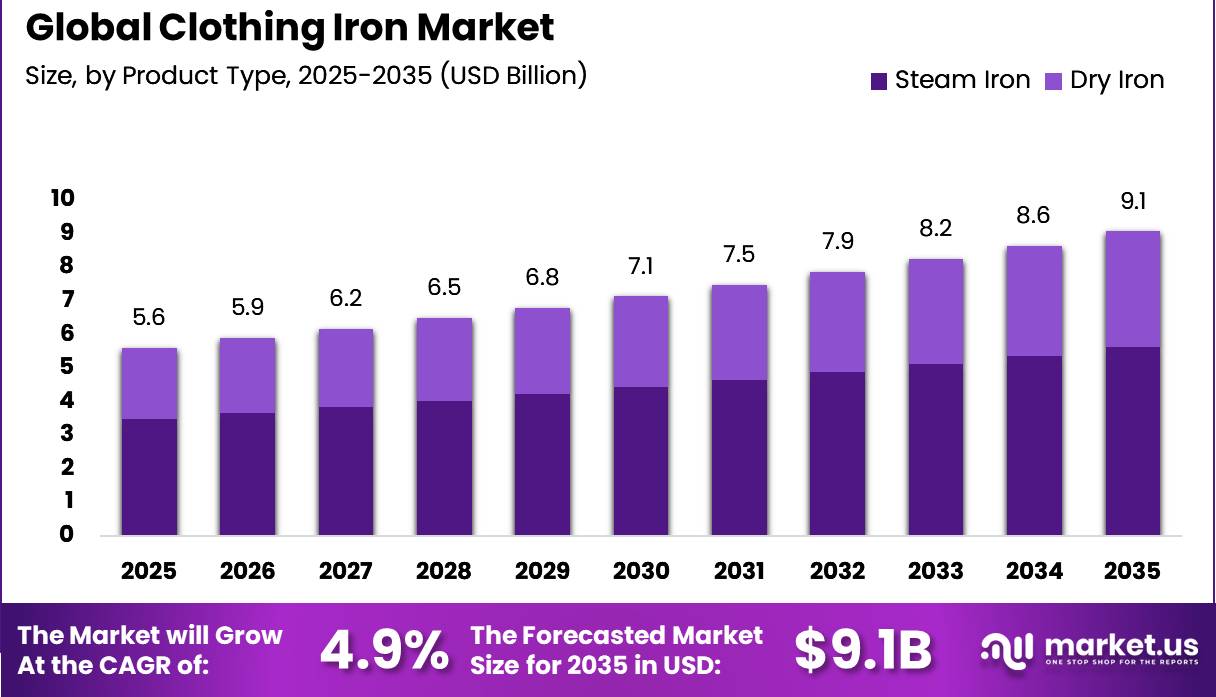
Global Clothing Iron Market size is expected to be worth around USD 9.1 Billion by 2035 from USD 5.6 Billion in 2025, growing at a CAGR of 4.9% during the forecast period 2026 to 2035. This growth reflects steady replacement demand and rising appliance ownership across emerging economies.
This reflects a market built around functional fabric care appliances used across households and light commercial settings. Clothing irons span steam and dry variants, automatic and non-automatic functions, and offline and online distribution channels. Manufacturers compete on soleplate material, wattage, and safety features to capture replacement and first-time buyers.
Key Takeaways
- The global clothing iron market size is estimated at USD 5.6 Billion in 2025 and is projected to reach USD 9.1 Billion by 2035.
- The market is expected to grow at a CAGR of 4.9% between 2026 and 2035.
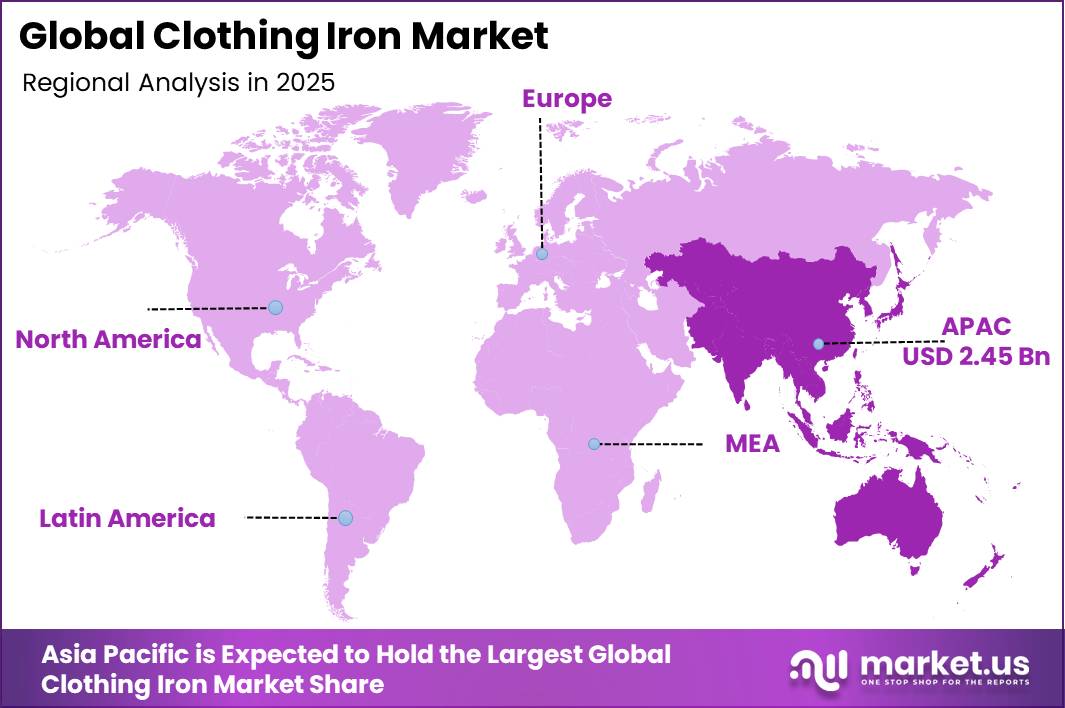
- Asia Pacific dominates the market with a share of 43.67%, valued at USD 2.45 Billion.
- Steam iron leads the product type segment with a share of 62.11%, while dry iron is the fastest growing product type.
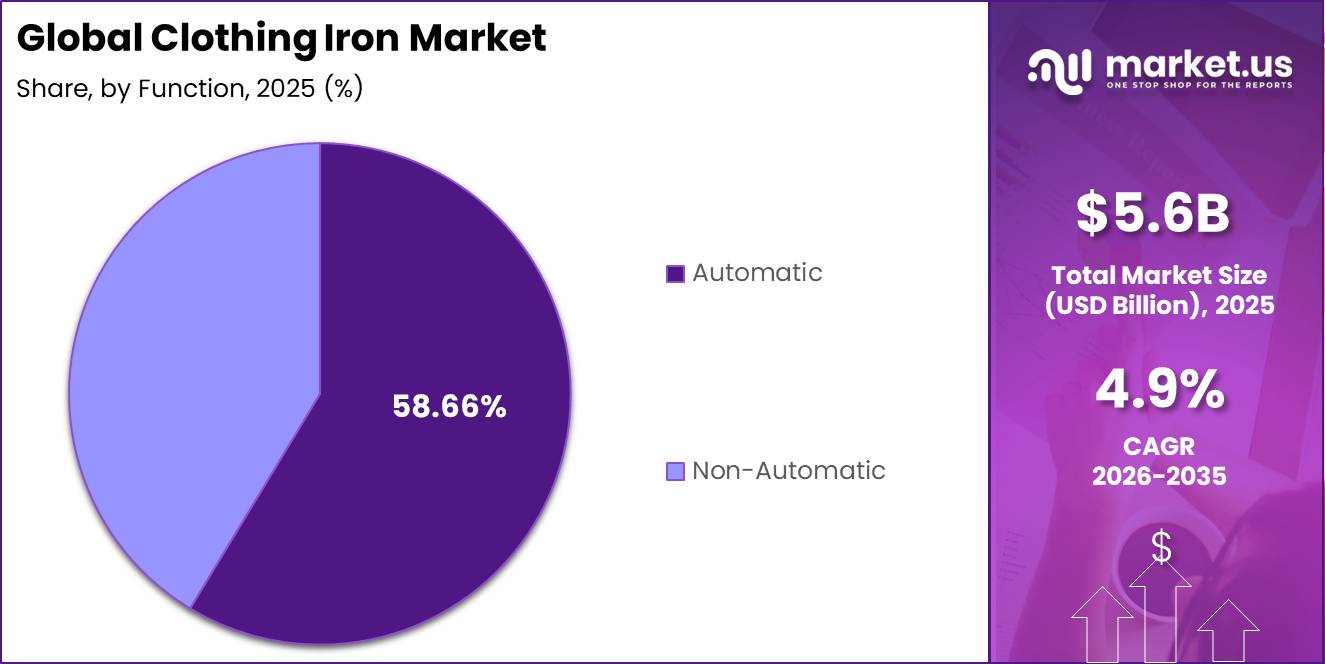
- Automatic irons dominate the function segment with a share of 58.66%.
- Offline distribution leads with a share of 81.23%, while online distribution is the fastest growing channel.
Consequently, government energy efficiency regulation is becoming a defining structural factor for clothing iron design and labeling. Regulatory bodies across Europe require manufacturers to display standardized energy performance information on household appliances. This regulatory push shapes soleplate technology, wattage disclosure, and marketing claims across the industry.
According to the European Commission, 93% of EU consumers recognize the energy label and 79% consider it before purchasing new electric appliances. This awareness pressures manufacturers to prioritize certified energy ratings in product development. Brands without visible efficiency credentials risk losing shelf preference in regulated European markets.
Data from the European Commission shows Ecodesign and Energy Label rules are estimated to generate around 131 million tonnes of oil equivalent in energy savings by 2030. This target reinforces long-term demand for efficient soleplate and auto shut-off technology. Manufacturers investing early in efficiency compliance gain a durable regulatory advantage.
Product Type Analysis
Steam Iron dominates with 62.11% due to faster heat-up and superior wrinkle removal.
In 2025, Steam Iron held a dominant market position in the By Product Type segment of Clothing Iron Market, with a 62.11% share. This segment benefits from faster heat-up times and stronger wrinkle removal performance compared to dry alternatives. Consequently, brands are prioritizing steam-based soleplate innovation to defend this leadership position.
Dry Iron functions as the fastest growing product type within the clothing iron market. Its lower price point and simple heat retention appeal to cost sensitive buyers in developing regions. As a result, entry level distribution channels are stocking dry iron variants to capture first-time appliance buyers.
In April 2025, Groupe SEB introduced AeroSteam Plus, expanding its premium garment steamer portfolio within the steam segment. This reflects rising consumer garment volume, as research from Electrolux Group shows consumers buy roughly 400% more clothing than they did two decades ago. This creates sustained demand for faster, higher capacity steam appliances.
Function Analysis
Automatic dominates with 58.66% due to convenience and reduced manual effort.
In 2025, Automatic held a dominant market position in the By Function segment of Clothing Iron Market, with a 58.66% share. This segment benefits from auto shut-off, anti-drip, and anti-calc systems that reduce manual monitoring. Consequently, replacement purchases favor automatic models over legacy non-automatic irons.
Non-Automatic irons continue to serve budget conscious households across price sensitive markets. Research from Electrolux Group indicates roughly 70% of consumers inherit garment care habits from their parents, sustaining familiarity with manual iron use. Instead of switching quickly, these households often delay upgrades until failure occurs.
Distribution Channel Analysis
Offline dominates with 81.23% due to in-store trial and immediate purchase convenience.
In 2025, Offline held a dominant market position in the By Distribution Channel segment of Clothing Iron Market, with a 81.23% share. Supermarkets, hypermarkets, and specialty stores collectively drive this channel through physical product trial. Consequently, manufacturers maintain strong retail partnerships to protect shelf visibility and brand trust.
Online distribution operates as the fastest growing channel within the clothing iron market. Digital marketplaces offer wider product comparison and doorstep delivery convenience for time constrained buyers. This creates pressure on offline retailers to strengthen loyalty programs and match online pricing transparency.
Key Market Segments
By Product Type
- Steam Iron
- Dry Iron
By Function
- Automatic
- Non-Automatic
By Distribution Channel
- Offline
- Supermarkets/Hypermarkets
- Specialty Stores
- Online
Regional Analysis
Asia Pacific Dominates the Clothing Iron Market with a Market Share of 43.67%, Valued at USD 2.45 Billion
Asia Pacific leads the clothing iron market through dense population centers, expanding middle class households, and growing electrification across South Asia and Southeast Asia. Local manufacturing hubs in China and India keep production costs competitive for both steam and dry iron categories. This regional manufacturing base supports faster distribution and lower retail pricing across the region.
Key Regions and Countries
North America
- US
- Canada
Europe
- Germany
- France
- The UK
- Spain
- Italy
- Rest of Europe
Asia Pacific
- China
- Japan
- South Korea
- India
- Australia
- Rest of APAC
Latin America
- Brazil
- Mexico
- Rest of Latin America
Middle East and Africa
- GCC
- South Africa
- Rest of MEA
Market Dynamics
Market Opportunity Analysis - Underexploited product, function, and regional segments offer entry points for new players
Dry Iron remains underexploited relative to steam variants despite its role as the fastest growing product type. This gap creates room for manufacturers targeting affordability focused buyers in developing regions. Therefore, companies prioritizing low-cost dry iron manufacturing can capture volume before steam alternatives fully penetrate these markets.
Online distribution remains a smaller channel than offline retail despite being the fastest growing distribution format. This gap signals room for direct to consumer expansion among brands lacking strong marketplace presence. As a result, early movers building online fulfillment capability can secure share before saturation.
Non-Automatic irons remain underserved by premium feature innovation compared to the automatic segment. This creates an opening for manufacturers to introduce safety upgrades without pushing pricing into the automatic tier. Instead of ceding this segment, new entrants can capture budget conscious buyers overlooked by premium focused brands.
Regions outside Asia Pacific collectively hold the majority of remaining global share beyond its 43.67% position. This distribution signals substantial room for regional manufacturing and distribution investment outside the current leading region. Consequently, new entrants can target underrepresented regional supply chains before established players expand further.
Technology and Innovation Landscape - Soleplate materials, automation, and connectivity redefine competitive positioning
Ceramic, titanium, and multi-layer soleplate technologies are expanding premium garment care appliance options. These materials improve heat distribution and reduce fabric sticking compared to standard aluminum soleplates. This creates a clear upgrade path for manufacturers targeting replacement buyers seeking better performance.
Auto shut-off, anti-drip, and anti-calc systems are increasing replacement purchases of legacy iron models. These safety and maintenance features reduce user risk and extend appliance lifespan. Consequently, brands integrating these systems can justify premium pricing over older non-automatic designs.
Cordless charging-base irons are shifting product design toward greater mobility and user convenience. This format removes cord restriction during use, appealing to buyers seeking flexible ironing setups. This reflects a broader industry move toward ergonomic, mobility focused appliance design.
Smart connected clothing irons with fabric recognition and app-based maintenance diagnostics represent an emerging innovation category. This technology allows automatic adjustment of heat and steam settings based on fabric type. Therefore, manufacturers entering this segment early can establish differentiation before competitors replicate the feature set.
Drivers
Household electrification in underserved markets continues to drive first-time appliance purchases, with the clothing iron often bought soon after lighting and mobile charging access. The World Bank reports 666 million people lacked electricity in 2023, with 581 million in Sub-Saharan Africa. This unconnected population represents a future appliance eligible household base for low-cost dry and entry steam irons.
This driver is estimated to add 1.6 percentage points to CAGR growth because first-time adoption carries a stronger unit effect than replacement cycles. Therefore, brands offering low-cost, cash-affordable iron models stand to capture disproportionate volume in South Asia and African urbanizing corridors as grid access expands.
| Driver | (~) % Impact on CAGR Forecast | Geographic Relevance | Impact Timeline |
|---|---|---|---|
| Steam/premium feature shift in household irons | +1.4% | North America core, EU, urban APAC | Short term (≤ 2 years) |
| E-commerce assortment and D2C replacement pull | +1.1% | India, Southeast Asia, North America, Gulf | Short term (≤ 2 years) |
| Electrification-led first appliance adoption | +1.6% | South Asia, Sub-Saharan Africa, frontier APAC | Medium term (2-4 years) |
| China subsidy ecosystem supporting small appliance upgrades | +1.2% | China core, APAC spill-over supply chain | Short term (≤ 2 years) |
| Textile consumption intensity sustaining garment-care frequency | +0.9% | EU, North America, India, Latin urban markets | Medium term (2-4 years) |
| Energy efficiency and repairability reshaping replacement mix | +0.8% | EU core, UK, developed APAC | Medium term (2-4 years) |
Restraints
The European Union’s repairability direction is emerging as a structural cost headwind for clothing iron manufacturers. Directive 2024/1799 requires wider repair access, spare parts availability, and service transparency, with national implementation due no later than 31 July 2026. This pushes brands toward modular design and stronger aftersales infrastructure.
This compliance burden can add 2% to 4% to lifecycle product support cost and raise working capital needs. As a result, this restraint creates a realistic 0.7 percentage point CAGR deduction across EU core and UK adjacent channels over the next two to four years, favoring larger incumbents with existing repair infrastructure.
| Restraint | (~) % Impact on CAGR Forecast | Geographic Relevance | Impact Timeline |
|---|---|---|---|
| Metal input inflation | -1.1% | North America core, EU, China export base | Short term (≤ 2 years) |
| Freight volatility | -0.9% | EU import hubs, North America, APAC corridors | Short term (≤ 2 years) |
| Power-cost sensitivity | -0.8% | EU, UK, urban APAC | Medium term (2-4 years) |
| Repair-compliance burden | -0.7% | EU core, UK-aligned channels | Medium term (2-4 years) |
| Laundry outsourcing shift | -0.6% | North America core, Western Europe, GCC metros | Long term (≥ 4 years) |
| Low-cost import pressure | -0.8% | Global mass market, LATAM, MEA, South Asia | Medium term (2-4 years) |
Challenges
E-commerce growth is intensifying price transparency and promotional competition across the clothing iron market. Online platforms display many comparable irons within narrow price ranges, while shoppers use price tracking tools to target discounts of 10% to 15%. This drives monthly price swings of roughly 5% to 8% across listed retail prices.
Online fulfillment also adds distribution costs of roughly 3% to 6% above traditional wholesale channels through warehousing, delivery, and returns. Instead of accepting margin loss, manufacturers are tightening pricing policies and expanding direct to consumer sales to protect data visibility and margin control.
| Challenge | (~) % CAGR Friction Drag | Geographic Relevance | Mitigation Horizon |
|---|---|---|---|
| Volatile freight & routing | -0.8% | APAC–EU/US trade lanes | Medium term (2-4 years) |
| Input cost & energy volatility | -0.7% | Europe, LatAm, energy-importing APAC | Medium term (2-4 years) |
| Slow premiumization & feature fatigue | -0.6% | North America, Western Europe | Long term (≥ 4 years) |
| Talent & tooling constraints | -0.5% | China, India, ASEAN manufacturing hubs | Medium term (2-4 years) |
| Policy, safety & eco-design tightening | -0.5% | EU regulatory hubs, spillover to global OEMs | Long term (≥ 4 years) |
| Channel shift & price transparency pressure | -0.4% | Global e-commerce corridors | Short term (≤ 2 years) |
Opportunities
Rising income and urbanization create structural upside for clothing iron adoption once basic electrification thresholds are met. Appliance ownership research shows adoption rises quickly after affordability improves, then shifts toward replacement cycles and premium upgrades as markets saturate. This signals a shift from first-time purchases to premiumization over time.
The International Energy Agency notes minimum energy performance standards can cut residential electricity consumption by roughly 25% to 33% over time. This signals future iron design will lean further into regulatory efficiency requirements, rewarding manufacturers that invest early in compliant, energy efficient soleplate and heating technology.
| Opportunity | (~) % Potential CAGR Upside | Geographic Relevance | Execution Window |
|---|---|---|---|
| Inclusive-income premium uptake | +1.4% | Emerging Asia, Sub-Saharan Africa, LATAM | Medium term (2-4 years) |
| Urban time-saving garment tech | +1.3% | Global urban cores, especially Asia | Short term (≤ 2 years) |
| Efficiency-led product migration | +1.1% | OECD, China, large emerging economies | Medium term (2-4 years) |
| Gender-aware care solutions | +0.9% | South Asia, MENA, Africa, Latin America | Long term (≥ 4 years) |
| Trade-optimized local assembly | +1.0% | Import-dependent, tariff-sensitive markets | Medium term (2-4 years) |
| Circular refurb & secondary trade | +0.8% | EU, UK, selected OECD, large cities worldwide | Long term (≥ 4 years) |
Key Company Insights
Bajaj Electricals Ltd. holds a strong position in the Indian clothing iron market through established retail distribution and brand recognition across offline channels. The company benefits from wide presence in supermarkets, hypermarkets, and specialty stores across South Asia. However, its growth depends on expanding steam and automatic iron offerings to match shifting consumer preference toward premium features.
BCL Electronic competes primarily on affordability, serving price sensitive buyers seeking dry and non-automatic iron models. This positioning helps the company capture first-time appliance buyers in developing regions. Instead of competing on premium features, BCL Electronic focuses on cost efficient manufacturing, which limits its exposure to steam and automatic segment growth trends.
Key Players
- Bajaj Electricals Ltd.
- BCL Electronic
- Crompton Greaves
- Eveready Industries India Ltd.
- Groupe SEB India
- Hamilton Beach
- Havells India Ltd.
- Impex Technologies Inc.
- Koninklijke Philips N.V.
- Orient Electric
- Osian
- Panasonic
- Sears Brands, LLC
- Other Key Players
Recent Developments
- June 2025 – Tefal launched the Origin Home Standing Garment Steamer, featuring 2,000 W power output and steam delivery of up to 42 g/min for home garment care applications.
Report Scope
| Report Features | Description |
|---|---|
| Market Value (2025) | USD 5.6 Billion |
| Forecast Revenue (2035) | USD 9.1 Billion |
| CAGR (2026-2035) | 4.9% |
| Base Year for Estimation | 2025 |
| Historic Period | 2020-2024 |
| Forecast Period | 2026-2035 |
| Report Coverage | Revenue Forecast, Market Dynamics, Market Opportunity Analysis, Technology and Innovation Landscape, Competitive Landscape, Recent Developments |
| Segments Covered | Product Type (Steam Iron, Dry Iron), Function (Automatic, Non-Automatic), Distribution Channel (Offline: Supermarkets/Hypermarkets, Specialty Stores; Online) |
| Regional Analysis | North America (US and Canada), Europe (Germany, France, The UK, Spain, Italy, and Rest of Europe), Asia Pacific (China, Japan, South Korea, India, Australia, and Rest of APAC), Latin America (Brazil, Mexico, and Rest of Latin America), Middle East and Africa (GCC, South Africa, and Rest of MEA) |
| Competitive Landscape | Bajaj Electricals Ltd., BCL Electronic, Crompton Greaves, Eveready Industries India Ltd., Groupe SEB India, Hamilton Beach, Havells India Ltd., Impex Technologies Inc., Koninklijke Philips N.V., Orient Electric, Osian, Panasonic, Sears Brands, LLC, Other Key Players |
| Customization Scope | Customization for segments, region/country-level will be provided. Additional customization can be done based on requirements. |
| Purchase Options | We have three licenses to opt for: Single User License, Multi-User License (Up to 5 Users), Corporate Use License (Unlimited User and Printable PDF) |





































