


Report Overview
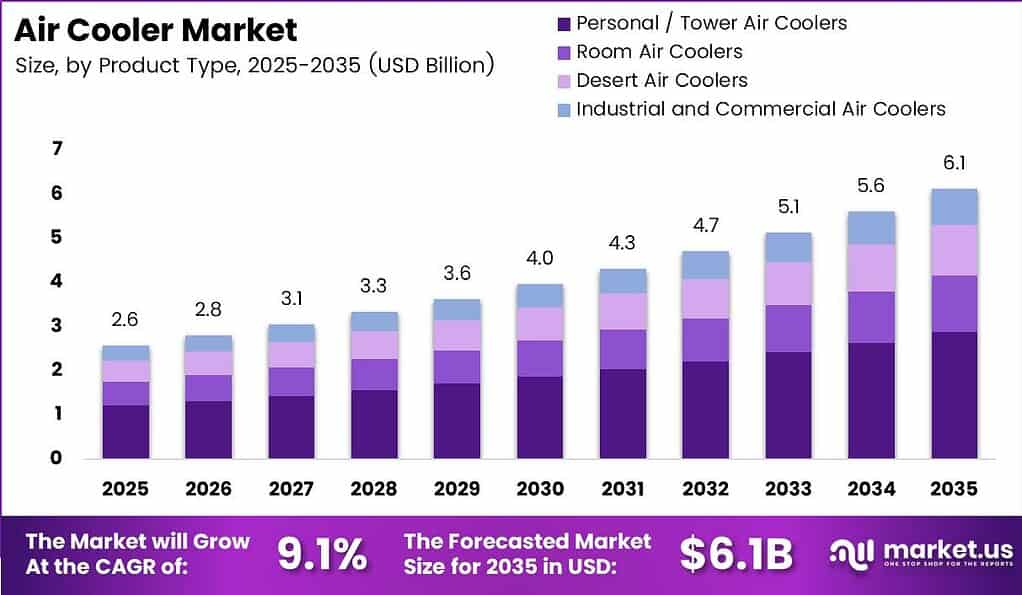
Global Air Cooler Market size is expected to be worth around USD 6.15 Billion by 2035 from USD 2.57 Billion in 2025, growing at a CAGR of 9.1% during the forecast period 2026 to 2035. This trajectory reflects a market doubling in size within a decade. Vendors with cost-efficient manufacturing and wide distribution will capture the largest share of this expansion.
The air cooler market covers appliances that use evaporative cooling to lower ambient air temperature without vapor-compression refrigerants. Products range from compact personal and tower coolers to large-scale industrial and desert-type units. The market serves residential, commercial, industrial, and institutional end users across geographies with hot and arid climates.
Key Takeaways
- Market size in 2025: USD 2.57 Billion
- Market forecast for 2035: USD 6.15 Billion
- CAGR (2026–2035): 9.1%
- Dominant product type segment: Personal / Tower Air Coolers with 47.00% share
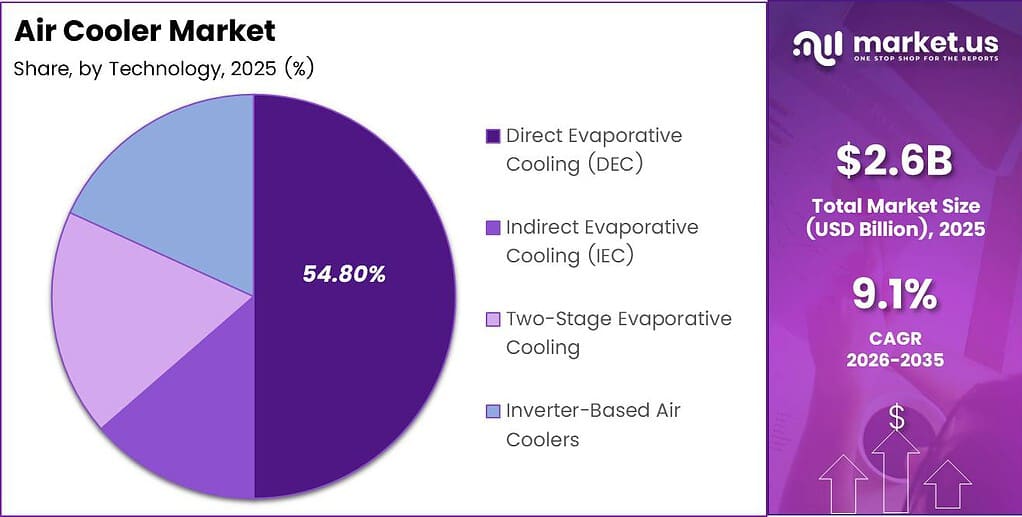
- Dominant technology segment: Direct Evaporative Cooling (DEC) with 54.80% share
- Dominant end user segment: Residential with 62.40% share
- Dominant distribution channel: Offline Retail with 58.40% share
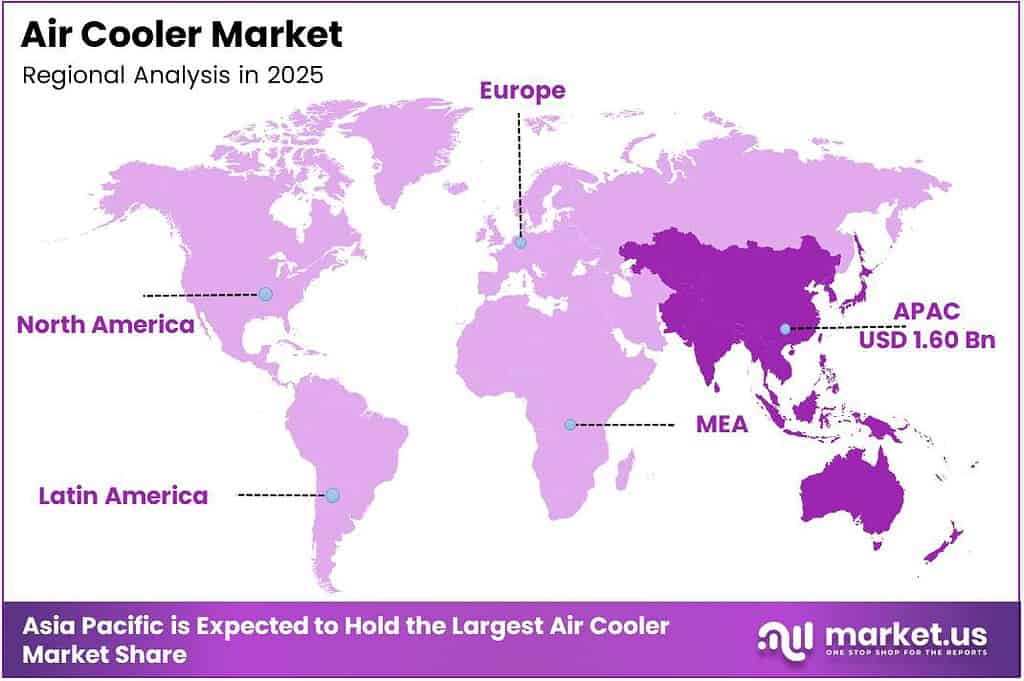
- Dominant region: Asia Pacific with 62.20% share, valued at USD 1.60 Billion
Government mandates and energy efficiency standards are reshaping the competitive landscape. India’s Bureau of Energy Efficiency (BEE) star labeling program for air coolers creates a compliance floor that favors organized manufacturers over informal players. This policy shift pushes category premiumization and accelerates exit of low-quality units from organized retail channels.
As reported by doi, wet-bulb effectiveness of advanced evaporative cooling systems ranges between 76% and 81% in indirect evaporative configurations. This efficiency range defines the performance ceiling for indirect systems under real operating conditions. Manufacturers who exceed this benchmark through engineering improvements hold a clear premium pricing justification against standard models.
Data from shows evaporative cooling can reduce dry-bulb air temperature by approximately 10°C to 15°C in low-humidity environments. This cooling delta makes evaporative systems a viable substitute for entry-level air conditioners in arid zones. In 2025, Symphony Limited expanded its smart air cooler portfolio with IoT-enabled residential systems and increased export penetration across Middle East and North America, reflecting how manufacturers are capitalizing on this performance advantage in high-potential export corridors.
Product Type Analysis
Personal / Tower Air Coolers dominate with 47.00% due to portability and low sub-₹10,000 price points.
In 2025, Personal / Tower Air Coolers held a dominant market position in the By Product Type segment of the Air Cooler Market, with a 47.00% share. These units serve urban rental households and first-time buyers who need portable, low-footprint cooling without permanent installation. This segment’s dominance signals that affordability and flexibility outrank raw cooling power in the mass market purchasing decision.
Room Air Coolers held a 24.60% share, serving mid-size residential rooms where fixed placement is acceptable. Buyers in this sub-segment prioritize airflow volume over portability. This positions room coolers as the natural upgrade path from personal units, creating a clear product ladder for manufacturers to drive trade-up revenue within existing customer bases.
Desert Air Coolers captured 18.20% share, deployed primarily in large open spaces, semi-outdoor areas, and homes in extremely arid geographies. Their high water tank capacity and powerful blower motors make them suitable for Rajasthan, Gujarat, and similar high-heat zones. This sub-segment favors brands with deep Tier 2 and Tier 3 distribution presence where desert conditions dominate seasonal demand.
Industrial and Commercial Air Coolers held the remaining 10.20% share. This sub-segment covers warehouses, factories, and logistics facilities requiring large-volume air movement. Though smallest in current share, it represents the highest revenue-per-unit opportunity. Vendors who develop purpose-built commercial configurations stand to gain disproportionate margin from this segment as industrial cooling adoption expands.
Technology Analysis
Direct Evaporative Cooling (DEC) dominates with 54.80% due to low cost and mechanical simplicity.
In 2025, Direct Evaporative Cooling (DEC) held a dominant market position in the By Technology segment of the Air Cooler Market, with a 54.80% share. According to our research, engineered evaporative media systems achieve saturation efficiency levels of approximately 80% to 90% in high-performance pads. This efficiency range makes DEC the default technology choice for mass-market manufacturers focused on cost-to-performance ratios.
Indirect Evaporative Cooling (IEC) held a 22.40% share. Figures from our research show that indirect evaporative cooling systems demonstrate wet-bulb effectiveness between 74% and 126% depending on flow design and operating conditions. This performance range justifies the higher unit cost of IEC systems and positions them for premium residential and commercial applications where humidity sensitivity limits DEC effectiveness.
Two-Stage Evaporative Cooling held a 13.60% share. As per our research, multi-stage evaporative cooling systems can reach near-saturation cooling efficiency of approximately 95% in controlled environments. This performance ceiling makes two-stage configurations attractive for commercial buyers who need reliable cooling across variable ambient conditions, particularly in semi-arid climates with moderate humidity swings.
Inverter-Based Air Coolers held the remaining 9.20% share. These units integrate variable-speed motor control to reduce energy draw during low-load periods. The BLDC motor shift already visible in the market’s trending factors aligns directly with this sub-segment’s growth logic. Vendors investing in inverter integration now will be better positioned as energy efficiency standards tighten across India and the GCC.
End User Analysis
Residential dominates with 62.40% due to first-time buyer volume and rental housing growth.
In 2025, Residential held a dominant market position in the By End User segment of the Air Cooler Market, with a 62.40% share. Rapid expansion of low-income urban housing in Tier 2 and Tier 3 cities sustains this dominance by continuously adding first-time cooling appliance buyers. Manufacturers who serve this base with sub-₹10,000 units and strong after-sales networks hold a durable volume advantage.
Commercial, Industrial, and Institutional end users collectively account for the remaining share. Commercial buyers include retail outlets, restaurants, and office spaces seeking low-energy cooling for employee and customer comfort. Industrial buyers prioritize airflow volume in manufacturing and logistics environments. Institutional users span schools, hospitals, and government facilities where budget constraints make air coolers a preferred alternative to centralized air conditioning systems.
Distribution Channel Analysis
Offline Retail dominates with 58.40% due to tactile buying behavior and rural channel depth.
In 2025, Offline Retail held a dominant market position in the By Distribution Channel segment of the Air Cooler Market, with a 58.40% share. Physical retail allows buyers to assess product size, airflow strength, and noise levels before purchase, which is critical for a high-involvement seasonal appliance. Brands with strong general trade and modern retail presence convert this channel dependency into a durable first-mover advantage in underpenetrated districts.
Online Retail and E-Commerce along with Direct Sales and B2B channels account for the remaining distribution share. E-commerce penetration is reshaping seasonal demand spikes, with D2C brands using platform algorithms to capture pre-summer search intent. Direct Sales and B2B channels serve industrial and institutional buyers who procure in bulk, often bypassing retail entirely. These channels collectively represent the fastest-growing distribution shift in the market.
Key Market Segments
By Product Type
- Personal / Tower Air Coolers
- Room Air Coolers
- Desert Air Coolers
- Industrial and Commercial Air Coolers
By Technology
- Direct Evaporative Cooling (DEC)
- Indirect Evaporative Cooling (IEC)
- Two-Stage Evaporative Cooling
- Inverter-Based Air Coolers
By End User
- Residential
- Commercial
- Industrial
- Institutional
By Distribution Channel
- Offline Retail
- Online Retail / E-Commerce
- Direct Sales and B2B
Market Dynamics
Market Opportunity Analysis - Underpenetrated segments and export-ready geographies reward early movers with category definition advantages
Industrial and Commercial Air Coolers hold only 10.20% of current product type share despite representing the highest revenue-per-unit opportunity in the market. Warehouses, factories, and logistics facilities require large-volume evaporative cooling systems but face limited purpose-built product availability from organized manufacturers. Brands that develop dedicated commercial configurations for this buyer profile can command pricing power unavailable in the crowded residential segment.
Inverter-Based Air Coolers account for just 9.20% of the technology segment. This share is disproportionately low relative to rising energy efficiency expectations in India and GCC markets. The BLDC motor shift documented in market trends confirms that consumer awareness of energy cost savings is already present. This creates a defined entry window for brands willing to invest in inverter integration before the segment becomes contested at scale.
The Middle East and Africa region remains structurally underserved relative to its climate compatibility with evaporative cooling. Off-grid and weak-grid conditions across sub-Saharan Africa align directly with the solar-hybrid cooler opportunity, which carries a 1.8 percentage point CAGR upside potential. Export-focused Indian and Chinese manufacturers with established arid-climate product lines are best positioned to define category standards in these markets before European or North American players organize a competitive response.
Latin America holds early-stage market conditions where organized retail and e-commerce presence remain sparse. Brazil and Mexico anchor volume potential, but the absence of dominant branded players means category penetration curves are still in their formative phase. By contrast, brands that establish distribution infrastructure now will benefit from first-mover loyalty before the market structure solidifies around two or three dominant competitors.
Technology and Innovation Landscape - Engineering advances in evaporative systems redefine performance benchmarks and open premium application tiers
Dew-point evaporative cooling represents the most significant performance breakthrough in the category. According to our research, dew-point evaporative cooling systems can achieve wet-bulb effectiveness above 100%, reaching approximately 114% under controlled laboratory conditions. This exceeds the thermodynamic ceiling of conventional direct systems and positions dew-point configurations for premium commercial and data center applications where reliability and performance consistency justify higher capital costs.
Hybrid evaporative cooling systems demonstrate exergy efficiency improvements of up to approximately 80% compared to conventional vapor-compression systems, as reported by our research. This efficiency advantage makes hybrid configurations commercially viable for industrial buyers who face both energy cost pressure and regulatory scrutiny on refrigerant use. Vendors who commercialize hybrid systems ahead of efficiency standard tightening secure a first-mover position in the highest-margin application tier of this market.
Indirect-direct hybrid evaporative systems can achieve wet-bulb effectiveness up to 126% under optimized geometries, as shown by our research. This performance level enables these systems to deliver reliable cooling in semi-humid environments where standard direct evaporative systems fail. The practical implication is a geographic market expansion beyond arid zones into coastal and transitional climate regions that were previously inaccessible to evaporative cooling product lines.
BLDC motor adoption represents the most commercially immediate technology shift at the product level. Variable-speed BLDC motors reduce operational noise and power draw simultaneously, addressing two of the most common consumer objections against air coolers relative to split air conditioners. Manufacturers who standardize BLDC integration across mid-tier SKUs create a product quality signal that supports premiumization without requiring full smart-system investment from the buyer.
Drivers
Extreme heat events are the clearest near-term volume catalyst for this market. WMO confirmed 2025 as one of the three warmest years on record, with global average surface temperature approximately 1.44°C above the 1850 to 1900 baseline. NOAA reported January to June 2025 as the second-warmest first half-year in its record. Air coolers are a highly weather-elastic appliance category, and early heat onset pulls purchases forward while mid-season heat spikes trigger emergency refill orders.
India represents the market’s most commercially critical battlefield, where IMD-linked data shows above-normal temperatures expected from April to June 2025. States including Uttar Pradesh, Jharkhand, Chhattisgarh, and Odisha face 10 to 11 heatwave days, with Delhi reaching 40.2°C in early April 2025. This extends the stocking window for desert and room-cooler SKUs and reduces markdown risk when heat arrives ahead of schedule. Manufacturers with flexible procurement of motors, pumps, pads, and plastic bodies convert this timing advantage into annual revenue outperformance.
According to our research, direct evaporative cooling systems typically achieve 50% to 90% cooling efficiency depending on airflow and pad design. This wide efficiency band reflects meaningful engineering differentiation opportunities for manufacturers who invest in pad quality and airflow optimization. As per our research, evaporative cooling systems eliminate refrigerants entirely, reducing environmental impact compared to vapor-compression AC systems. This refrigerant-free design aligns with global phase-down commitments under the Kigali Amendment, creating a regulatory positioning advantage for air cooler brands over traditional AC manufacturers.
| Driver | (~) % Impact on CAGR Forecast | Geographic Relevance | Impact Timeline |
|---|---|---|---|
| Extreme heat and longer summer seasons lift replacement and first-time purchases | +1.4% | India core, Middle East, North Africa, Southern Europe spill-over | Short term (≤ 2 years) |
| India BEE star labeling enables premiumization and organized-brand conversion | +1.1% | India core, South Asia adjacency | Medium term (2-4 years) |
| Air coolers retain price-power advantage versus room AC ownership | +1.0% | APAC mass market, Africa, Latin America, tier-2/3 urban corridors | Short term (≤ 2 years) |
| E-commerce and modern retail improve seasonal throughput and SKU mix | +0.8% | India core, GCC, Southeast Asia, selected Europe online channels | Short term (≤ 2 years) |
| Commercial and industrial evaporative cooling expands for low-energy ventilation | +0.9% | Europe, India, GCC, Australia, North America dry-climate pockets | Medium term (2-4 years) |
| Smart, inverter-adjacent and solar-compatible designs widen use cases | +0.6% | India, GCC, Africa, off-grid and weak-grid markets | Long term (≥ 4 years) |
Restraints
Evaporative cooling faces a hard thermodynamic ceiling in humid geographies. Based on our research data, evaporative cooling performance becomes highly limited when relative humidity exceeds approximately 50%, due to the reduced vapor pressure gradient between wet pad surface and ambient air. This constraint eliminates the category’s core value proposition in coastal South Asia, Southeast Asia, southern China, and Gulf coastal belts, where urban density is rising fastest.
Our research indicates that in humid climates, evaporation rate approaches saturation conditions, causing minimal temperature drop and ineffective cooling performance. This physical limitation forces manufacturers to either avoid these markets or invest in hybrid configurations that raise bill-of-materials costs without fully resolving latent-load constraints. Retailers in high-humidity markets face elevated return rates and inventory markdown pressure during pre-monsoon and monsoon-overlap periods, compressing seasonal margins for both brands and channel partners.
Metal and component cost inflation applies an estimated 1.2 percentage point drag on CAGR in India and APAC supply hubs. High electricity tariff sensitivity, which drives buyers toward air coolers over air conditioners, simultaneously constrains price realization for manufacturers trying to offset input cost increases. This dual pressure on margin forces hard tradeoffs between maintaining accessible price points and sustaining product quality in the mass-market tier.
| Restraint | (~) % Impact on CAGR Forecast | Geographic Relevance | Impact Timeline |
|---|---|---|---|
| Humidity-led performance ceiling | -1.4% | South Asia coast, SEA, Gulf coast, South China | Long term (≥ 4 years) |
| Metal and component cost inflation | -1.2% | India core, APAC supply hubs, MENA import markets | Short term (≤ 2 years) |
| Water stress and usage scrutiny | -0.9% | India urban belts, MENA, water-stressed APAC corridors | Medium term (2-4 years) |
| Efficiency and compliance burden | -0.8% | India, North America, EU-adjacent import markets | Medium term (2-4 years) |
| Seasonal demand volatility | -0.7% | India core, Pakistan, Middle East, Africa | Short term (≤ 2 years) |
| Retail price sensitivity and AC trade-up | -1.0% | Urban India, China, North America entry tier | Long term (≥ 4 years) |
Challenges
The air cooler industry operates with structural R&D constraints that slow its ability to respond to rising efficiency expectations. R&D spending across many firms sits below 1% to 1.5% of sales, compared with 3% to 5% in advanced air conditioning and heat pump categories. Engineering teams commonly number fewer than 20 to 30 specialists per full product portfolio, restricting depth in fluid dynamics, materials science, and embedded systems development.
Product cycles run approximately 3 to 4 years in this category versus 2 to 3 years in more innovation-intensive HVAC segments, while efficiency gains per cycle average only 2% to 3%. According to our research, cooling performance increases with inlet dry-bulb temperature but decreases with rising humidity levels due to reduced evaporation potential. This thermodynamic constraint, combined with slow R&D cycles, creates a structural 0.6 percentage point drag on long-term CAGR as more efficient alternatives compete for the same buyer base.
| Challenge | (~) % CAGR Friction Drag | Geographic Relevance | Mitigation Horizon |
|---|---|---|---|
| Seasonal demand volatility | -1.0% | India, MENA, SE Asia, LATAM urban | Medium term (2-4 years) |
| Component and motor supply fragility | -0.8% | APAC manufacturing hubs, EU importers | Medium term (2-4 years) |
| Water and power infrastructure stress | -0.9% | South Asia, Middle East, Sub-Saharan Africa | Long term (≥ 4 years) |
| Informal and grey distribution complexity | -0.7% | India tier-2/3, African corridors, rural LATAM | Long term (≥ 4 years) |
| Innovation and talent bottlenecks | -0.6% | Global R&D centers, OEM clusters in APAC | Medium term (2-4 years) |
| Climate policy and standards uncertainty | -0.5% | EU regulatory hubs, urban APAC, GCC | Long term (≥ 4 years) |
Opportunities
Smart premiumization represents the most structurally viable revenue expansion path within the existing buyer base. IoT controls, predictive maintenance alerts, humidity-adaptive fan curves, and app-linked energy monitoring allow manufacturers to price 20% to 35% above conventional models without requiring volume expansion. In India and comparable urbanizing markets, aspirational households are willing to pay this premium when smart features deliver measurable convenience improvements over standard units.
As per our research, evaporative cooling systems integrated with hybrid HVAC systems stabilize performance across variable humidity conditions. This integration path opens the data-center and industrial adiabatic adjacency opportunity, estimated to generate a 2.4 percentage point CAGR upside. North America, the EU, GCC, and India are the primary geographies where this adjacency can be commercialized within a medium-term window of two to four years.
If smart-enabled units reach approximately 10% to 12% of shipments in urban clusters by 2030, the category can achieve about 1.2 percentage points of long-term CAGR uplift. This growth is supported by 400 to 600 basis points of higher margins driven by electronics integration and recurring revenue from filters, pads, and connected service ecosystems. Brands that build this recurring revenue layer now create switching costs that purely hardware-focused competitors cannot replicate.
| Opportunity | (~) % Potential CAGR Upside | Geographic Relevance | Execution Window |
|---|---|---|---|
| Solar-hybrid coolers | +1.8% | India, MENA, SSA, rural APAC | Short term (≤ 2 years) |
| Rental and cooling-as-a-service | +1.4% | India urban, GCC, Africa cities | Short term (≤ 2 years) |
| B2B light-commercial retrofit | +2.1% | India, MENA, Mexico, US Southwest | Medium term (2-4 years) |
| Smart premiumization stack | +1.2% | India metros, GCC, Southeast Asia | Medium term (2-4 years) |
| Data-center/industrial adiabatic adjacency | +2.4% | North America, EU, GCC, India | Medium term (2-4 years) |
| Export-led Africa frontier play | +1.9% | East Africa, West Africa, SSA frontier | Long term (≥ 4 years) |
Regional Analysis
Asia Pacific Dominates the Air Cooler Market with a Market Share of 62.20%, Valued at USD 1.60 Billion
Asia Pacific commands 62.20% of the global air cooler market, valued at USD 1.60 Billion in 2025. India anchors this dominance through a combination of extreme heat events, a large unserved rural population, and a rapidly expanding Tier 2 and Tier 3 urban housing base. Manufacturers operating across this region hold structural scale advantages that are difficult for new entrants to replicate quickly.
North America represents a specialized market where air coolers compete primarily in arid southwestern states like Arizona, Nevada, and New Mexico. High penetration of central air conditioning in eastern and northern markets limits the total addressable base. This means growth in North America depends on commercial and industrial evaporative cooling adoption rather than residential volume expansion.
Europe shows selective demand concentrated in Mediterranean countries and southern regions where summer temperatures regularly exceed 35°C. EU energy efficiency regulations indirectly favor air coolers over power-intensive air conditioners in low-humidity zones. This creates a regulatory tailwind for European market entry by brands with documented energy performance certifications.
Latin America presents early-stage market conditions, with Brazil and Mexico as the primary volume markets. Affordability drives purchasing decisions, and informal distribution channels dominate in rural areas. Brands that establish organized retail and e-commerce presence early in these markets capture category definition advantages before competition intensifies.
Middle East and Africa offers the clearest structural alignment with air cooler technology, given the preponderance of arid and semi-arid climates across GCC states and sub-Saharan Africa. Off-grid and weak-grid regions create demand for solar-compatible and low-power cooling solutions. Export-focused manufacturers from India and China are best positioned to serve this geography at competitive price points.
Key Regions and Countries
North America
- US
- Canada
Europe
- Germany
- France
- The UK
- Spain
- Italy
- Rest of Europe
Asia Pacific
- China
- Japan
- South Korea
- India
- Australia
- Rest of APAC
Latin America
- Brazil
- Mexico
- Rest of Latin America
Middle East and Africa
- GCC
- South Africa
- Rest of MEA
Key Company Insights
Symphony Limited holds the strongest export positioning among Indian air cooler manufacturers, with active penetration across Middle East and North America markets. In 2025, the company expanded its smart air cooler portfolio with IoT-enabled residential systems. This dual focus on domestic volume and export premiumization gives Symphony a revenue diversification structure that most domestic-only competitors cannot match.
Honeywell International Inc. competes in the air cooler segment through its portable evaporative cooling and air management product line. In 2025, Honeywell expanded this line targeting residential and light commercial segments with improved energy efficiency and integrated air filtration. This positions Honeywell to capture health-conscious and premium buyers, a segment underserved by Indian volume brands focused on price competition.
Key Players
- Symphony Limited
- Havells India Ltd.
- Voltas Limited (Tata Group)
- Bajaj Electricals Ltd.
- Honeywell International Inc.
- Kenstar (Videocon Group)
- Orient Electric Ltd.
- Crompton Greaves Consumer Electricals Ltd.
- Midea Group
- Blue Star Limited
- Usha International Ltd.
- Whirlpool Corporation
- Hindware Home Innovation Ltd.
- V-Guard Industries Ltd.
- Cello Air Coolers
Recent Developments
- April 2025 – EcoCooling completed a strategic acquisition of a regional evaporative cooling manufacturer to strengthen its low-water industrial and data center cooling portfolio.
- 2025 – LG Electronics enhanced its HVAC and air cooling solutions portfolio by integrating advanced air management and hybrid cooling technologies for smart home applications.
- 2026 – Seeley International expanded its evaporative cooling manufacturing capacity to support rising global demand for energy-efficient cooling systems in commercial and industrial sectors.
Report Scope
| Report Features | Description |
|---|---|
| Market Value (2025) | USD 2.57 Billion |
| Forecast Revenue (2035) | USD 6.15 Billion |
| CAGR (2026-2035) | 9.1% |
| Base Year for Estimation | 2025 |
| Historic Period | 2020-2024 |
| Forecast Period | 2026-2035 |
| Report Coverage | Revenue Forecast, Market Dynamics, Market Opportunity Analysis, Technology and Innovation Landscape, Competitive Landscape, Recent Developments |
| Segments Covered | By Product Type (Personal / Tower Air Coolers, Room Air Coolers, Desert Air Coolers, Industrial and Commercial Air Coolers), By Technology (Direct Evaporative Cooling, Indirect Evaporative Cooling, Two-Stage Evaporative Cooling, Inverter-Based Air Coolers), By End User (Residential, Commercial, Industrial, Institutional), By Distribution Channel (Offline Retail, Online Retail / E-Commerce, Direct Sales and B2B) |
| Regional Analysis | North America (US and Canada), Europe (Germany, France, The UK, Spain, Italy, and Rest of Europe), Asia Pacific (China, Japan, South Korea, India, Australia, and Rest of APAC), Latin America (Brazil, Mexico, and Rest of Latin America), Middle East and Africa (GCC, South Africa, and Rest of MEA) |
| Competitive Landscape | Symphony Limited, Havells India Ltd., Voltas Limited (Tata Group), Bajaj Electricals Ltd., Honeywell International Inc., Kenstar (Videocon Group), Orient Electric Ltd., Crompton Greaves Consumer Electricals Ltd., Midea Group, Blue Star Limited, Usha International Ltd., Whirlpool Corporation, Hindware Home Innovation Ltd., V-Guard Industries Ltd., Cello Air Coolers |
| Customization Scope | Customization for segments, region/country-level will be provided. Additional customization can be done based on requirements. |
| Purchase Options | We have three licenses to opt for: Single User License, Multi-User License (Up to 5 Users), Corporate Use License (Unlimited User and Printable PDF) |





































