Report Overview
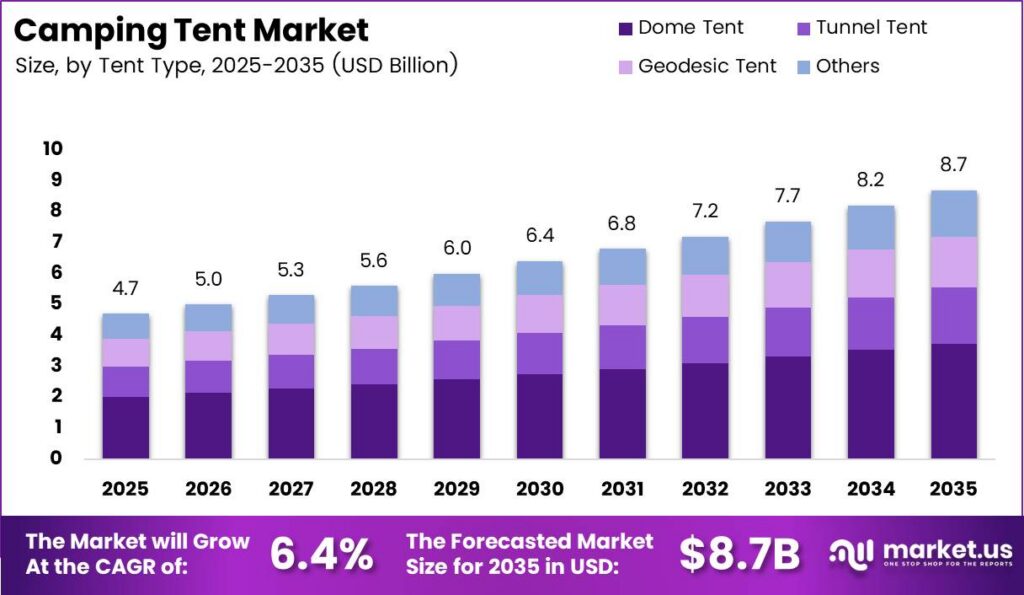
Global Camping Tent Market size is expected to be worth around USD 8.7 Billion by 2035 from USD 4.7 Billion in 2025, growing at a CAGR of 6.4% during the forecast period 2026 to 2035. A camping tent is a portable shelter built from tensioned synthetic or cotton fabrics supported by aluminum, fiberglass, or inflatable air poles. This product protects recreational campers, alpine trekkers, and field personnel from precipitation, wind, ultraviolet radiation, and insects during overnight outdoor stays.
Key Takeaways
- The global Camping Tent Market was valued at USD 4.7 Billion in 2025.
- Market revenue will reach a projected value of USD 8.7 Billion by 2035.
- Global sales will expand at a compound annual growth rate of 6.4% during the forecast period from 2026 to 2035.
- In the Tent Type segment, Dome Tent held the largest share of 42.67% in 2025 and represents the fastest growing category.
- By Capacity, the One Person segment accounted for a leading 46.23% market share in 2025, while the Three or More Persons segment is the fastest growing category.
- Under End Use, Recreational Activities captured the dominant share of 61.23% in 2025 and registers the fastest growth trajectory.
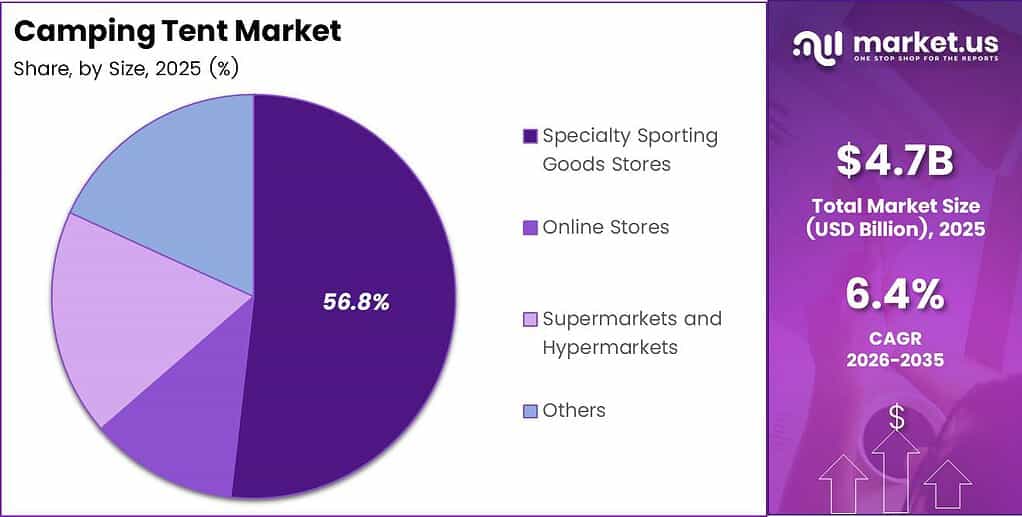
- Across Sales Channels, Specialty Sporting Goods Stores led the market with a 56.89% share in 2025, whereas Online Stores represent the fastest growing distribution channel.
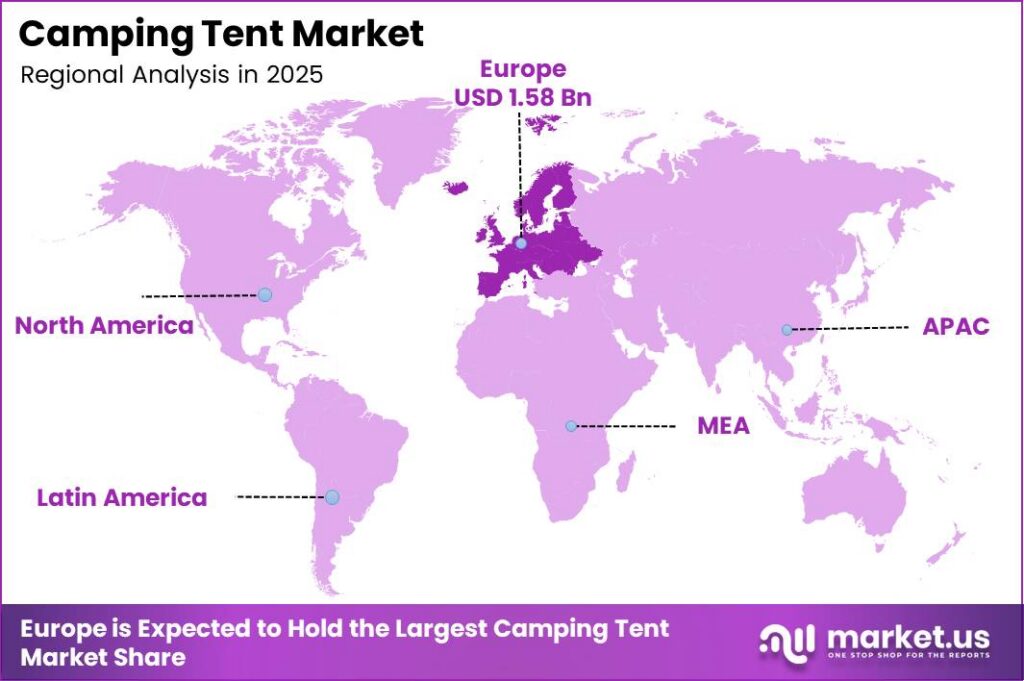
- Europe dominated the global landscape in 2025 with a 33.71% market share valued at USD 1.58 Billion, while Asia-Pacific is the fastest growing region during the 2026 to 2035 forecast period.
Global manufacturing remains heavily concentrated in Asian textile hubs that supply recreational, military, and event buyers worldwide. According to UN Comtrade and World Bank WITS, global exports of synthetic fiber tents under HS Code 630622 from China reached USD 1,902,842.65 thousand across 386,798,000 kg in 2024. Consequently, brand owners rely on high-volume Asian cut-and-sew factories to maintain competitive retail price ladders. This concentration requires importers to hedge tariff exposures and diversify contract assembly across secondary sewing hubs.
National tourism ministries and public land agencies actively fund park infrastructure and cross-border leisure corridors to expand outdoor recreation. As reported by UNWTO, global international tourist arrivals grew by 4% in 2025 to reach 1.52 billion overnight visitors, adding nearly 60 million arrivals over 2024. Therefore, rising international and nature-based travel expands the addressable customer pool for entry-level and family shelter kits. Retailers must align seasonal inventory deliveries with peak national park reservation windows to capture first-time buyers.
Strict chemical regulations in North America and Europe now force shelter designers to eliminate fluoropolymers from waterproof coatings. In March 2025, NEMO Equipment launched the industry’s first bluesign PRODUCT certified backpacking shelter, the 2025 Dagger OSMO, featuring a 2-person minimum weight of 3 lbs 5 oz and an MSRP of USD 499.95. This product uses 100% recycled solution-dyed fabric without harmful chemicals and adds 22% more vestibule storage. Consequently, suppliers with verified chemical compliance secure premium shelf space at specialty retailers.
Europe holds the largest regional position in the global market, capturing a 33.71% share valued at USD 1.58 Billion in 2025. Data from OECD shows that domestic tourism accounted for an average of 78.3% of total tourism expenditure across member countries in 2024. High domestic travel retention and dense commercial holiday park networks across France, Germany, and the United Kingdom sustain steady replacement cycles for multi-room shelters. As a result, manufacturers prioritizing high-headroom family models capture superior European distributor margins.
Material science advancements also allow manufacturers to reduce shelter pack weights while improving tear resistance for backcountry users. In January 2025, Big Agnes introduced its proprietary solution-dyed HyperBead fabric across 5 flagship ultralight product lines. This material is 6% lighter, delivers 25% higher waterproofing at a 1,500 mm rating, and provides 50% greater strength without intentionally added PFAS. Therefore, proprietary textile engineering enables premium brands to defend USD 500-plus retail price points against low-cost private-label imports.
Tent Type Analysis
Dome Tent dominates with 42.67% share in 2025 due to freestanding stability and simple pitching.
In 2025, Dome Tent held a 42.67% share in the Tent Type segment of the Camping Tent Market. UN Comtrade and World Bank WITS found that United States imports of synthetic fiber tents under HS Code 630622 totaled USD 420,956.97 thousand across 97,798,900 kg in 2024. Crossed flexible pole geometry creates self-supporting structural tension, allowing casual buyers to pitch shelters on hard ground without guyline anchoring. Consequently, high-volume importers prioritize two-pole dome architectures to maximize inventory turn across North American mass retail channels.
Tunnel Tent designs serve family campers and long-distance trekkers who prioritize internal livable volume and standing height over freestanding footprints. Based on Eurostat data, nights spent at European Union camping grounds, recreational vehicle parks, and trailer parks increased by 5.8% year-over-year in 2025. Parallel arched poles or inflatable air beams maximize vertical wall geometry, converting floor area into usable multi-room living quarters for extended holiday stays. In December 2025, AMG Group brand Vango launched the 6-person Sherwood Air 600XL inflatable tunnel shelter and the 225 cm height Quadris Air Low Awning to capture European campsite upgrades.
Geodesic Tent architectures target alpine mountaineers, polar expeditions, and four-season base camps operating in severe wind and snow-load environments. UN Comtrade and World Bank WITS indicate that European Union external imports of synthetic fiber tents under HS Code 630622 reached USD 493,947.09 thousand across 79,458,800 kg in 2024. Intersecting multiple pole arcs divides fabric panels into small triangles that distribute aerodynamic stress and prevent structural collapse under heavy snow accumulation. In February 2024, Hilleberg introduced the 4-person Saivo 4 weighing 6.8 kg at EUR 2,844.00 alongside the 3-person Rogen 3 weighing 2.5 kg, demonstrating ultra-high margin potential in technical shelters.
Capacity Analysis
One Person dominates with 46.23% share in 2025 due to solo backpacking weight optimization.
In 2025, One Person held a 46.23% share in the Capacity segment of the Camping Tent Market. Figures from UN Comtrade and World Bank WITS show that Canada imported USD 67,215.74 thousand of synthetic fiber tents under HS Code 630622 weighing 6,079,500 kg in 2024. Solo thru-hikers, bikepackers, and tactical personnel require single-occupant shelters with narrow tapered floors and sub-kilogram aluminum frames to minimize caloric expenditure on steep trails. Therefore, equipment brands must engineer compact solo shelters with high-tenacity 10D to 20D nylon fabrics to capture high-frequency backcountry buyers.
Three or More Persons represents the fastest growing capacity tier as multi-generational households and festival groups seek shared outdoor accommodations. According to Eurostat, summer months between June and August accounted for 67.0% or 277 million nights of all European Union campsite stays in 2025, peaking at 118 million nights in August. Peak summer holiday travel requires wide floor plans, blackout bedroom dividers, and high-clearance hubs that prevent heat buildup inside shared sleeping cabins. In June 2025, Newell Brands subsidiary Coleman launched the 3-person Swagger 3 and 4-person Forest Lodge 4 FastPitch shelters with 2-minute steel frame pitching and 3,000 mm waterproofing to convert family buyers.
Two Persons models function as the core versatile workhorse for couples and solo campers who store packs inside the sleeping canopy. As reported by UN Comtrade and World Bank WITS, Spain imported USD 53,050.08 thousand of synthetic fiber tents under HS Code 630622 across 6,860,220 kg in 2024. Dual-door symmetrical floor layouts with twin vestibules balance weight distribution between two hikers while preventing condensation buildup in warm Mediterranean and mountain climates. This means product managers must standardize dual-entry geometries in two-person SKUs to maintain baseline volume across specialty and rental fleets.
End Use Analysis
Recreational Activities dominates with 61.23% share in 2025 due to rising leisure camping participation.
In 2025, Recreational Activities held a 61.23% share in the End Use segment of the Camping Tent Market. Data from Eurostat shows that total tourist accommodation nights across the European Union reached 3.14 billion in 2025, rising 4.1% with 123 million additional nights as campsites captured a 13.8% share. Consumer preference for affordable nature holidays directly increases wear-and-tear replacement cycles for weekend car-camping and trekking shelters. Consequently, consumer brands that bundle footprints, gear lofts, and integrated LED lighting capture higher average order values from recreational shoppers.
Military and Civil applications require heavy-duty expeditionary shelters capable of withstanding extreme temperatures, chemical exposure, and rapid tactical deployment. The US Department of Defense found that the U.S. Army Contracting Command awarded a USD 432,605,000 contract to HDT Expeditionary Systems Inc. for Army Standard Family-Rigid Wall Shelters running through March 2034. Defense forces and disaster agencies require flame-retardant infrared-compliant textiles and rigid aluminum frames to house mobile command posts and field hospitals. In September 2024, Exxel Outdoors invested over USD 2 million to relocate its national distribution center to Tupelo, Mississippi, adding 40 jobs to support its recreational and U.S. military shelter lines.
Commercial glamping operators, humanitarian relief agencies, and expedition outfitters represent specialized institutional buyers outside standard recreational and military procurement. Based on UN Comtrade and World Bank WITS data, global exports of tents made of other textiles under HS Code 630629 were led in 2024 by China at USD 145,309.16 thousand across 38,505,800 kg and Pakistan at USD 97,461.14 thousand across 26,780,500 kg. Breathable heavy cotton canvas and polycotton blends regulate interior humidity and resist ultraviolet degradation during multi-month semi-permanent installations. Therefore, textile mills in China and Pakistan hold a structural cost advantage in supplying bulk canvas relief and safari shelters.
Sales Channel Analysis
Specialty Sporting Goods Stores dominates with 56.89% share in 2025 due to expert in-store fitting advice.
In 2025, Specialty Sporting Goods Stores held a 56.89% share in the Sales Channel segment of the Camping Tent Market. US Census Bureau indicates that U.S. retail sales at Sporting Goods, Hobby, Book, and Music Stores reached USD 8,681 million in September 2026, up 9.57% from USD 7,923 million in September 2025. Technical buyers inspect pitched floor models, test zipper durability, and verify packed pole lengths in physical showrooms before committing to high-margin shelter purchases. This means premium manufacturers must fund in-store display allowances and staff training programs to protect specialty retail sell-through.
Online Stores represent the fastest growing distribution channel as direct-to-consumer brand portals and digital marketplaces expand assortment reach. Figures from US Census Bureau show that U.S. quarterly retail e-commerce sales reached USD 340,244 million in Q2 2026, increasing 12.2% year-over-year and accounting for 17.1% of total retail sales. Digital comparison tools, video pitching tutorials, and verified weight specifications allow buyers to evaluate technical shelter geometries without visiting brick-and-mortar stores. Consequently, tent brands that optimize parcel packaging dimensions below carrier oversize thresholds capture higher direct-to-consumer net margins.
Supermarkets and Hypermarkets drive high-volume seasonal sales of entry-level dome and family cabin shelters during spring and summer promotional windows. According to US Census Bureau, U.S. retail sales for General Merchandise Stores including Warehouse Clubs and Supercenters under NAICS 4523 reached USD 79,854 million in August 2026, up from USD 76,970 million in August 2025. Mass merchandisers bundle sleeping bags, mats, and fiberglass-pole shelters into palletized promotional displays that trigger impulse purchases among budget-conscious families. In December 2025, Oase Outdoors launched its 2026 collections across Outwell, Easy Camp, and Robens in 45-plus markets, introducing 2 new Outwell lines and PFAS-free assortments for multi-channel retail.
Key Market Segments
By Tent Type
- Dome Tent
- Tunnel Tent
- Geodesic Tent
- Others
By Capacity
- One Person
- Three or More Persons
- Two Persons
By End Use
- Recreational Activities
- Military and Civil
- Others
By Sales Channel
- Specialty Sporting Goods Stores
- Online Stores
- Supermarkets and Hypermarkets
- Others
Regional Analysis
Europe Dominates the Camping Tent Market with a Market Share of 33.71% in 2025, Valued at USD 1.58 Billion
Europe leads the global Camping Tent Market with a 33.71% revenue share valued at USD 1.58 Billion in 2025. As reported by Eurostat, overnight stays at European Union camping grounds, recreational vehicle parks, and trailer parks reached 413 million in 2025, marking a 28.5% expansion compared with 2015. Dense coastal and alpine holiday park infrastructure across France, Germany, Italy, and Spain encourages multi-week outdoor vacations that require durable family shelters. Therefore, European distributors command premium pricing on inflatable polycotton tunnel tents and modular drive-away vehicle awnings.
Asia-Pacific registers the fastest regional growth rate during the 2026 to 2035 forecast period as urban middle-class consumers adopt weekend glamping and alpine trekking. Data from UNWTO shows that international tourist arrivals in Asia and the Pacific grew by 6% in 2025 to reach 331 million visitors, led by a 13% year-over-year expansion in North-East Asia. Expanding highway access to national parks in China, Japan, South Korea, and India stimulates domestic equipment purchases alongside regional outbound adventure travel. Consequently, global brands are localizing high-ventilation shelter designs to capture humid subtropical Asian markets.
Key Regions and Countries
North America
- US
- Canada
Europe
- Germany
- France
- The UK
- Spain
- Italy
- Rest of Europe
Asia Pacific
- China
- Japan
- South Korea
- India
- Australia
- Rest of APAC
Latin America
- Brazil
- Mexico
- Rest of Latin America
Middle East and Africa
- GCC
- South Africa
- Rest of MEA
Market Dynamics
Consumer shifts toward digital gear discovery, PFAS-free waterproof textiles, and accessible family pitching systems reshape competitive positioning across the global shelter industry. Eurostat found that 16.6% of European Union internet users purchased sports goods excluding sport clothing online in 2024, peaking at 22.48% among buyers aged 25 to 34. Younger outdoor participants research hydrostatic head ratings and pack weights online before purchasing, forcing manufacturers to balance tariff costs against rapid product innovation.
Drivers
Expanding outdoor participation across North America and Europe directly enlarges the entry-level customer funnel for recreational shelters. According to the Outdoor Industry Association, U.S. outdoor participation grew 3% to 181.1 million Americans in 2024, while frequent participants rose 5.7%. Furthermore, 66% of households with children participate in outdoor activities, and 91% of campers engage in additional outdoor pursuits. This broader prospect pool drives starter dome tent purchases and subsequent multi-person capacity upgrades, adding an estimated +0.55% to the baseline 6.4% CAGR. Consequently, brands that build accessible family product ladders and cross-category merchandising capture higher repeat household lifetime value.
| Driver | (~) % Impact on CAGR Forecast | Geographic Relevance | Impact Timeline |
|---|---|---|---|
| Broadening outdoor participation | +0.55% | North America; wider-market spillovers | Short term (≤ 2 years) |
| Simplified pitching and family usability | +0.25% | Europe; North America; Asia-Pacific | Short term (≤ 2 years) |
| Ultralight performance premiumization | +0.20% | North America; Europe; Japan | Medium term (2–4 years) |
| Omnichannel product availability | +0.15% | Global; digitally served urban markets | Short term (≤ 2 years) |
| Established campsite tourism demand | +0.10% | Europe; cross-border leisure corridors | Medium term (2–4 years) |
Restraints
Trade tariffs on imported synthetic textiles and aluminum poles directly compress distributor margins and trigger seasonal purchase-order cancellations. Based on an Outdoor Industry Association survey released on April 3, 2025, 84% of responding member businesses expected exposure to new import tariffs. When customs value equals 35% of net selling price, an additional 10 percentage points of duty imposes a cost burden equal to 3.5% of sales, reducing gross margin by 3.5 percentage points if absorbed. This order suppression restrains the baseline forecast by an estimated -0.35%, forcing brands to reallocate production across duty-exempt origins before committing seasonal inventory.
| Restraint | (~) % Impact on CAGR Forecast | Geographic Relevance | Impact Timeline |
|---|---|---|---|
| Import-duty-driven order suppression | -0.35% | United States; exposed export suppliers | Short term (≤ 2 years) |
| PFAS-related noncompliant assortment withdrawal | -0.20% | California; affected textile assortments | Short term (≤ 2 years) |
| Discretionary household spending constraints | -0.15% | North America; mature consumer markets | Short term (≤ 2 years) |
| Finite designated camping capacity | -0.10% | Capacity-constrained destination markets | Medium term (2–4 years) |
| Wildfire-related destination closures | -0.05% | Fire-exposed North American destinations | Short term (≤ 2 years) |
Challenges
Intercontinental maritime routing disruptions lengthen replenishment lead times between Asian cut-and-sew factories and Western retail distribution centers. UN Trade and Development indicates that Suez Canal traffic averaged 33 daily transits by mid-October 2024, falling 55% below the prior year as Cape of Good Hope rerouting rose 89% and lifted container-ship demand by 12%. Extending inventory cover from 60 to 75 days raises working-capital funding needs by 25%, while a 50% freight hike on freight representing 4% of sales erodes 2 percentage points of margin, creating a -0.20% CAGR drag that requires split shipment scheduling.
| Challenge | (~) % CAGR Friction Drag | Geographic Relevance | Mitigation Horizon |
|---|---|---|---|
| Maritime routing and replenishment | -0.20% | Asia–Europe; intercontinental sourcing lanes | Short term (≤ 2 years) |
| Fabric aging and maintenance | -0.12% | Global; high-UV and humid environments | Medium term (2–4 years) |
| Seasonal inventory forecasting complexity | -0.08% | Seasonally concentrated camping markets | Short term (≤ 2 years) |
| Model-specific spare-parts coordination | -0.06% | Global; multigeneration product portfolios | Medium term (2–4 years) |
| Performance verification across suppliers | -0.04% | Global; outsourced manufacturing networks | Medium term (2–4 years) |
Opportunities
Standardized manufacturer-backed rental fleet contracts with commercial campsite operators and tourism gateways offer a structured B2B revenue stream. Operational benchmarks from a major sporting-goods group demonstrate 3 million annual repairs across 1,730 workshops alongside 1.35 million second-hand product sales in 2024. When net contribution per paid rental equals 12% of fleet acquisition cost, operators recover capital after 9 paid turns, while refurbishment costs of 8% to 12% require 1 extra turn to unlock 3 to 5 percentage points of operating margin. Combined opportunities provide +0.85% upside, lifting the potential CAGR ceiling to 7.25%.
| Opportunity | (~) % Potential CAGR Upside | Geographic Relevance | Execution Window |
|---|---|---|---|
| Manufacturer-backed rental fleet contracts | +0.30% | Europe; North America; tourism gateways | Medium term (2–4 years) |
| Adaptive-access tent platforms | +0.20% | Europe; North America; accessible destinations | Medium term (2–4 years) |
| Purpose-built hot-climate shelters | +0.15% | South Asia; Southeast Asia; Middle East | Medium term (2–4 years) |
| Vehicle-manufacturer accessory bundles | +0.10% | North America; Europe; Australia | Medium term (2–4 years) |
| Expandable modular shelter ecosystems | +0.10% | Global; family and group camping | Long term (≥ 4 years) |
Key Company Insights
VF Corporation
VF Corporation operates as a premier global outdoor apparel, footwear, and technical equipment manufacturer through its flagship brand The North Face across the Americas, Europe, and Asia-Pacific. Figures from VF Corporation Form 10-K show that Outdoor segment revenues increased 8.1% to USD 5,741.8 million in FY2026 from USD 5,311.1 million in FY2025, while segment profit rose 18.7% to USD 841.2 million. High brand equity in alpine expedition domes allows the company to command strong wholesale margins across global specialty outdoor chains.
The company continues to expand its addressable consumer base by engineering accessible shelter architectures for underserved outdoor demographics. According to VF Corporation, The North Face launched the inclusive Universal Collection in April 2026, highlighted by the Universal Wawona 3 Tent priced at an MSRP of USD 435. Co-created with adaptive athletes, the shelter utilizes 3 equal-length poles, high-visibility sleeves, oversized zipper loops, and a low-threshold wheelchair entryway, positioning VF Corporation to win institutional park accessibility contracts.
Newell Brands
Newell Brands commands a leading mass-market position in family camping shelters, instant cabin structures, and outdoor recreation accessories across North America, Europe, Latin America, and Asia-Pacific through its Coleman brand. As reported by Newell Brands Form 10-K, the Outdoor and Recreation segment generated net sales of USD 741 million in FY2025 across USD 374 million in North America and USD 367 million internationally, compared to USD 794 million in FY2024 out of USD 7,204 million consolidated net sales.
To reverse post-pandemic inventory normalization in mass retail channels, Newell Brands is deploying celebrity co-branding to attract younger lifestyle and music festival campers. Data from Newell Brands and PR Newswire shows that Coleman entered its first multi-year music partnership with artist Kane Brown in July 2026 to launch a 4-item limited-edition Coleman x Kane Brown collection on Coleman.com. Direct-to-consumer lifestyle collaborations allow Coleman to bypass big-box discounting and capture higher gross margins on seasonal outdoor drops.
Johnson Outdoors Inc.
Johnson Outdoors Inc. designs and markets technical outdoor recreation equipment across 80 countries, operating across Fishing, Diving, Watercraft Recreation, and Camping segments from its headquarters in Racine, Wisconsin. Johnson Outdoors Inc. Form 10-K found that Camping and Watercraft Recreation segment net sales totaled USD 58,071 thousand or USD 58.07 million in FY2025 out of total company net sales of USD 592,415 thousand.
Management actively restructures its camping portfolio to eliminate low-margin shelter lines and reallocate capital toward high-margin backcountry cooking and camp systems. Based on Johnson Outdoors Inc. data from December 2025, the company completed the strategic exit of its Eureka! tent brand in FY2025. While this exit shifted reported segment revenue by 13% to USD 58.07 million, underlying continuing segment revenue grew 2% year-over-year, proving that portfolio pruning improves capital efficiency in competitive equipment categories.
Key Players
- AMG-Group
- Hilleberg the Tentmaker
- Newell Brands
- Johnson Outdoors Inc.
- Oase Outdoors
- Big Agnes, Inc.
- Exxel Outdoors, LLC
- NEMO Equipment, Inc
- Simex Outdoor International GmbH
- Skandika
- Snugpak
- VF Corporation
- Other Key Players
Recent Developments
2026
- November 2026: Dometic Group product launch debuted the 3 model Out Series rooftop tent lineup led by the 4 person dual room Out Post family shelter starting at EUR 1,799 or USD 2,025 ahead of European distribution according to New Atlas and Dometic.
- October 2026: Exxel Outdoors, LLC brand Kelty partnership entered a Canadian distribution agreement with Vancouver based Timebomb Trading Inc. to distribute 100% of Kelty tent and outdoor gear assortments ahead of its 75th anniversary in 2027 according to SGB Media.
- June 2026: NEMO Equipment, Inc. product launch unveiled its 25th anniversary 2027 collection featuring the Wildcat OSMO and updated Hornet OSMO tents with 100% of OSMO backpacking shelters using solution dyed 100% recycled bluesign APPROVED fabrics according to Outdoor Industry Association.
- June 2026: Decathlon brand Simond product launch released the Simond Sprint 2P single wall Dyneema composite tarp tent with dual vestibules for alpine trekking at a retail price of EUR 690 including tax according to Decathlon Media.
- April 2026: Dometic Group product launch introduced the Front Runner Feather Lite II foldable rooftop tent in Hanover weighing 49 kg with a 32 cm closed profile, 6 cm foam mattress, 2,000 mm water column rating, and EUR 1,199.00 price according to Dometic Group.
- March 2026: Big Agnes, Inc. product launch introduced the ultralight VST tent series for its 25th anniversary featuring recycled 20D HyperBead fabric with 4,000 mm PFAS free waterproofing, trail weights starting at 19 oz, and prices from USD 549.95 to USD 849.95 according to Outdoor Industry Association.
- January 2026: NEMO Equipment, Inc. product launch released its Spring 2026 Dragonfly OSMO tent series in 1P, 2P, and 3P capacities featuring 34% more headroom, 100% recycled PFAS free fabric with 20% higher strength, a 2P minimum weight of 2 lbs 14 oz, and USD 499.95 starting MSRP according to Outdoor Industry Association.
- January 2026: Cascade Designs brand MSR product launch rolled out the Hubba Hubba HD tent series in 1P, 2P, and 3P models with a 3,000 mm rainfly, 6,000 mm bathtub floor, 1P trail weight of 2 lbs 10 oz or 1.20 kg, and prices from USD 519.95 to USD 699.95 according to REI and Cascade Designs.
Geopolitical Impact Analysis
Global trade policy shifts and tariff frontloading directly alter cross-border procurement costs for synthetic ripstop nylon, polyester rainflies, and anodized aluminum tent poles. WTO indicates that world merchandise trade volume expanded by 4.6% in 2025 and will grow by 3.9% in 2026 and 4.1% in 2027. Furthermore, Figures from WTO show that world merchandise trade value rose 7% to reach USD 26.26 trillion in 2025, while current US dollar merchandise trade value climbed 15% year-on-year in the first half of 2026. Because camping shelter brands source woven synthetic fabrics, polyurethane coatings, and shock-corded pole assemblies across multi-country Asian supply chains, rising trade values and tariff adjustments inflate landed customs duties. Consequently, North American and European outdoor distributors must frontload spring inventory orders and establish dual-country cut-and-sew contracts to protect wholesale gross margins.
Maritime chokepoint disruptions and energy price volatility simultaneously pressure container freight rates and petrochemical feedstock costs for synthetic tent textiles. According to UNCTAD, global seaborne trade grew by 2.2% in volume and 5.9% in ton-miles in 2024 due to Red Sea rerouting around the Cape of Good Hope, driving the Shanghai Containerized Freight Index up 149% to an average of 2,496 points with July spot rates reaching USD 3,600 per container. Meanwhile, As reported by World Bank, economic growth in East Asia and Pacific will average 4.4% annually across 2026 to 2028 while global GDP growth slows to 2.5% in 2026 amid energy price shocks. Higher crude oil and energy prices directly raise polymerization costs for nylon 6,6 canopies and polyethylene groundsheets in Asian mills. Therefore, shelter manufacturers must lock in multi-quarter fabric supply agreements and book maritime container capacity 90 days ahead of peak summer retail deliveries.
Report Scope
| Report Features | Description |
|---|---|
| Market Value (2025) | USD 4.7 Billion |
| Forecast Revenue (2035) | USD 8.7 Billion |
| CAGR (2026-2035) | 6.4% |
| Base Year for Estimation | 2025 |
| Historic Period | 2021-2025 |
| Forecast Period | 2026-2035 |
| Report Coverage | Revenue Forecast, Market Dynamics, Market Opportunity Analysis, Technology and Innovation Landscape, Competitive Landscape, Recent Developments |
| Segments Covered | By Tent Type (Dome Tent, Tunnel Tent, Geodesic Tent, Others), By Capacity (One Person, Three or More Persons, Two Persons), By End Use (Recreational Activities, Military and Civil, Others), By Sales Channel (Specialty Sporting Goods Stores, Online Stores, Supermarkets and Hypermarkets, Others) |
| Regional Analysis | North America (US and Canada), Europe (Germany, France, The UK, Spain, Italy, and Rest of Europe), Asia Pacific (China, Japan, South Korea, India, Australia, and Rest of APAC), Latin America (Brazil, Mexico, and Rest of Latin America), Middle East and Africa (GCC, South Africa, and Rest of MEA) |
| Competitive Landscape | AMG-Group, Hilleberg the Tentmaker, Newell Brands, Johnson Outdoors Inc., Oase Outdoors, Big Agnes, Inc., Exxel Outdoors, LLC, NEMO Equipment, Inc, Simex Outdoor International GmbH, Skandika, Snugpak, VF Corporation, Other Key Players |
| Customization Scope | Customization for segments, region / country-level will be provided. Additional customization can be done based on requirements. |
| Purchase Options | We have three licenses to opt for: Single User License | Multi-User License (Up to 5 Users) | Corporate Use License (Unlimited User and Printable PDF) |