


Report Overview
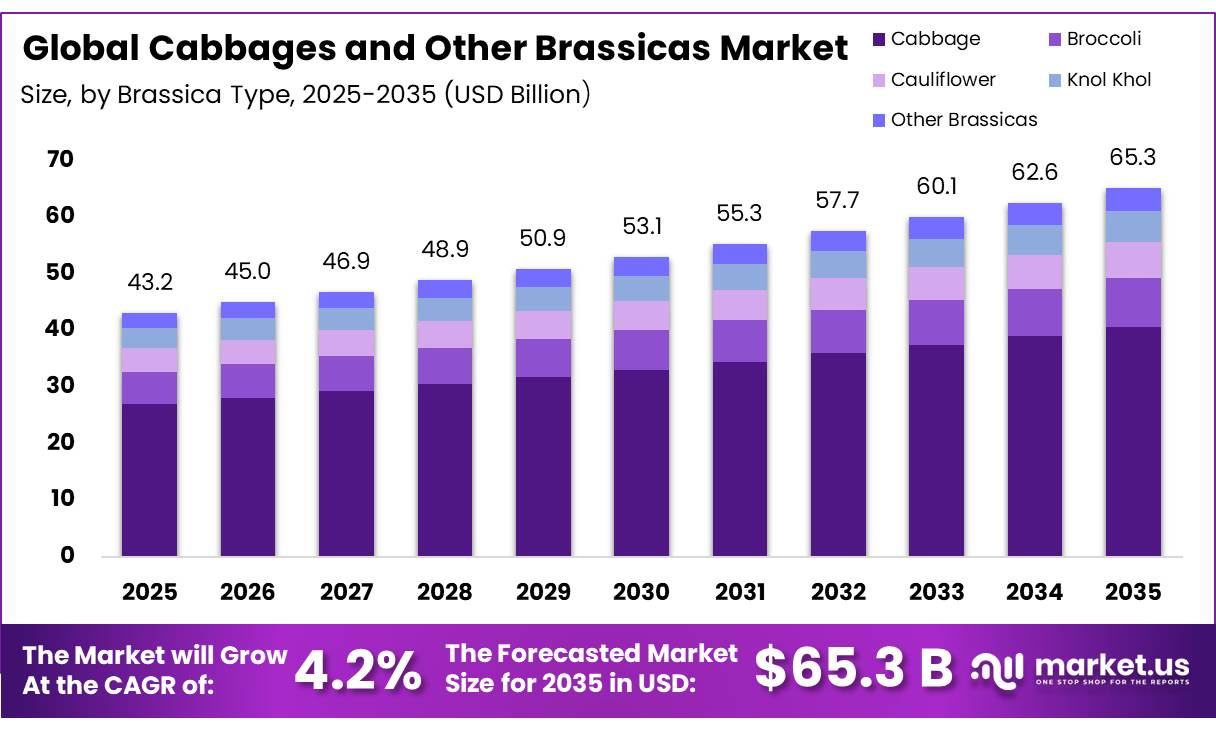
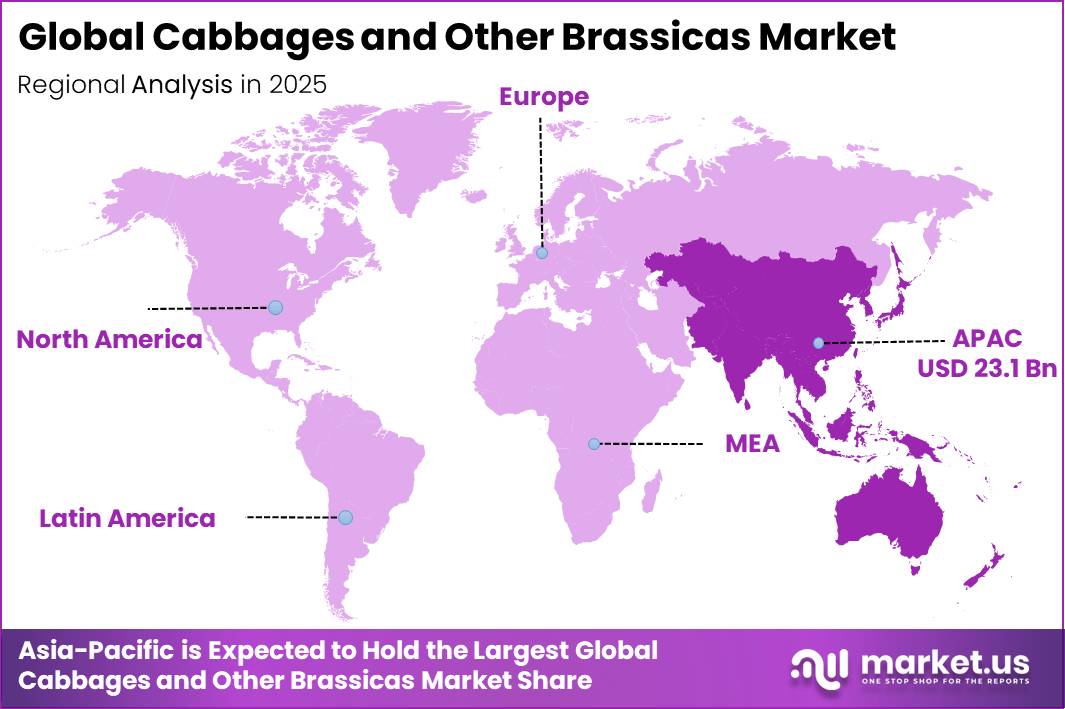
In 2025, the Global Cabbages and Other Brassicas Market was valued at USD 43.2 billion, and between 2026 and 2035, this market is estimated to register a CAGR of 4.2%, reaching about USD 65.3 billion by 2035. In 2025, Asia-Pacific led the market, achieving over 53.5% share with a revenue of USD 23.1 Billion.
Cabbages and other brassicas form an important part of the global fresh-vegetable industry, covering cabbage, broccoli, cauliflower, knol khol, kale, Brussels sprouts and related crops supplied to retail, foodservice and processing channels. Their commercial position is supported by year-round consumption, relatively broad climatic adaptability and use in fresh, frozen, fermented and prepared foods.
According to FAOSTAT, 2025 update, agricultural production data are reported for more than 245 countries and territories, highlighting the broad global production base and widespread cultivation of this crop group across diverse climatic and agricultural regions.
- Eurostat reported in August 2025 that the European Union harvested 62.2 million tonnes of fresh vegetables in 2024, up 6% from 58.8 million tonnes in 2023. In 2024, Spain produced 14.8 million tonnes, Italy 13.9 million tonnes, and France 5.8 million tonnes, with these three countries together accounting for approximately 55% of the European Union’s fresh vegetable production for the respective crop category.
- According to the UK Department for Environment, Food & Rural Affairs (Defra), Horticulture Statistics 2025, the area planted with brassicas increased by 7.0% to 22,000 hectares, while production declined by 3.6% to 341,000 tonnes and the total value of production fell by 9.2% to £350 million.
Key Takeaways
- The Global Cabbages and Other Brassicas Market was valued at USD 43.2 billion in 2025.
- The market is projected to grow at a CAGR of 4.2% and is estimated to reach USD 65.3 billion by 2035.
- On the basis of Brassica Type, Cabbage dominated the market, constituting 62.3% of the total market share.
- Based on the Farming Practice, Open-field dominated the market, with a substantial market share of around 76.8%.
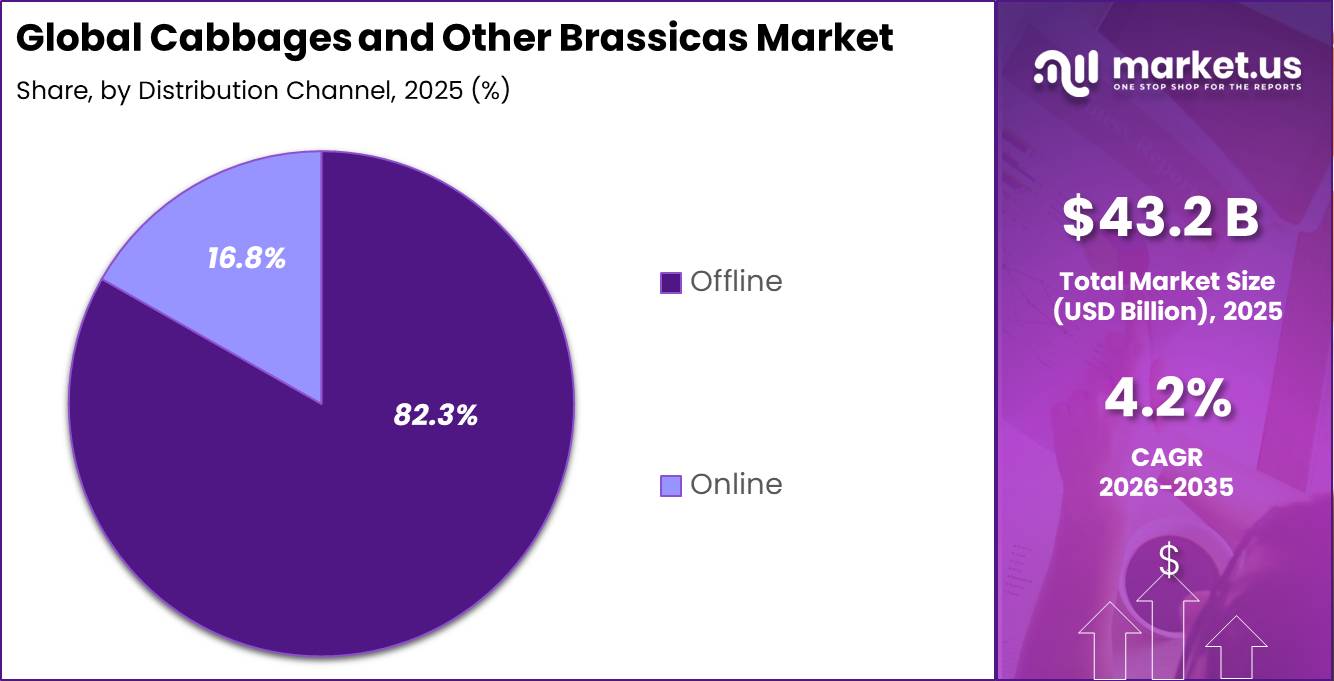
- Based on the Distribution Channel, Offline led the market, comprising 83.2% of the total market.
- In 2025, Asia-Pacific was the most dominant region in the market, accounting for 53.5% of the total global consumption.
Dry establishment conditions, heat and limited irrigation reduced yields and pressured grower returns. Demand is being driven by consumers seeking affordable vegetables, greater dietary variety and convenient products such as shredded cabbage, salad mixes, frozen broccoli and fermented foods. Brassicas also fit retail strategies focused on plant-forward meals and reduced food costs because they can be sold across multiple formats and price points.
- According to the Food and Agriculture Organization of the United Nations (FAO), 2025 update, fruits and vegetables recorded the highest food-loss rate among major commodity groups, increasing from 23.2% in 2015 to 25.4% in 2023.
Investment in rapid cooling, controlled-atmosphere storage, better crates, grading and shorter supply chains can therefore protect saleable volumes. Future growth opportunities are expected in climate-resilient varieties, precision irrigation, protected cultivation, biological crop protection, mechanised harvesting and value-added processing. Producers can expand through ready-to-cook packs, fermented cabbage, frozen florets, vegetable powders and by-product utilisation. In September 2025, USDA awarded $72.9 million across 56 states and territories for 586 specialty-crop projects, including fruit and vegetable competitiveness.
- According to the UK Department for Environment, Food & Rural Affairs (Defra), 2025, the UK Government launched the ADOPT (Accelerating Development of Practices and Technologies) competition, backed by £12.5 million to support on-farm trials and the adoption of innovative agricultural technologies and practices aimed at improving productivity, reducing environmental impacts, and strengthening the resilience of the farming sector, including projects involving precision breeding where applicable.
Longer term, competitiveness will depend on balancing volume with environmental performance. Growers that combine resistant seed, water monitoring, integrated pest management, renewable-powered cold storage and direct buyer contracts should be better placed to manage weather volatility, labour shortages, quality specifications and price pressure while supplying products throughout the year.
Brassica Type Analysis
Cabbage dominates with a 62.3% share due to broad household and food-processing demand.
In 2025, cabbage held a dominant market position, capturing more than a 62.3% share of the Cabbages and Other Brassicas Market by brassica type. Its leadership was supported by regular household consumption, affordable pricing, longer storage life, and wide use in salads, soups, fermented foods, ready meals, and foodservice dishes. Cabbage is also easier to transport and store than several delicate brassica vegetables, helping retailers maintain stable year-round supplies.
- According to the USDA National Agricultural Statistics Service, U.S. cabbage production totaled 22.0 million cwt in 2025, rising from the previous year. The harvested area reached 49,600 acres, while 17.4 million cwt of cabbage was supplied to the fresh market.
In 2025, broccoli was the fastest-growing segment in the Cabbages and Other Brassicas market by brassica type. Its growth was supported by increasing consumer preference for fresh, frozen, convenient, and nutrient-rich vegetables. Broccoli is widely used in salads, soups, pasta dishes, frozen meal packs, stir-fry products, and restaurant menus, giving it strong demand across both retail and foodservice channels. Rising interest in balanced diets and plant-based meals is expected to further strengthen broccoli consumption, particularly among urban households and health-focused consumers.
Farming Practice Analysis
Open-field farming dominates with a 76.8% share due to its suitability for large-scale brassica production.
In 2025, Open-field held a dominant market position, capturing more than a 76.8% share. Open-field farming remained widely used in the Cabbages and Other Brassicas Market because it allows growers to cultivate cabbage, cauliflower, broccoli, and kale across large agricultural areas with limited infrastructure investment. Standard machinery, natural sunlight, crop rotation, and easier field expansion make this practice suitable for bulk commercial production.
- According to the UK Department for Environment, Food and Rural Affairs, the total brassica cultivation area increased by 7.0% to 22 thousand hectares in 2025. These figures highlight the continuing importance of large-scale outdoor cultivation in maintaining commercial brassica supplies.
Protected Cultivation is the fastest-growing segment in the Cabbages and Other Brassicas Market. Growers are increasingly adopting greenhouses, net houses, tunnels, and covered production systems to protect brassica crops from extreme weather, insects, and irregular rainfall. These systems support more stable growing conditions and help farmers improve crop uniformity, appearance, and harvest scheduling. Protected cultivation is particularly useful for premium broccoli, cauliflower, kale, and specialty cabbage varieties that require closer control over temperature, moisture, and pest exposure.
- In 2025, according to the UK Department for Environment, Food and Rural Affairs, the area used for protected vegetable production increased by 4.7% to 866 hectares. Protected farms produced 258 thousand tonnes of vegetables and generated a production value of £431 million during the year.
Distribution Channel Analysis
Offline distribution dominates with an 83.2% share, supported by consumers’ preference for inspecting fresh produce before purchase.
In 2025, Offline held a dominant market position, capturing more than an 83.2% share of the Cabbages and Other Brassicas Market. Supermarkets, grocery stores, wholesale produce markets, farmers’ markets, and local vegetable shops remained the main purchasing points because cabbages, broccoli, cauliflower, and other brassicas are highly perishable. Buyers generally prefer to check freshness, firmness, colour, size, and visible damage before completing a purchase.
- According to USDA data released in June 2026 also showed that U.S. food-at-home expenditure reached USD 1.10 trillion in 2025, highlighting the large volume of groceries purchased for household consumption.
Online is the fastest-growing segment in the Cabbages and Other Brassicas Market. Its expansion is being supported by wider smartphone use, quicker grocery delivery, improved digital payment systems, and the growing availability of fresh vegetables through supermarket applications and online grocery platforms. Retailers are strengthening temperature-controlled fulfilment, better packaging, delivery-slot planning, and real-time inventory systems to reduce quality loss during transportation.
Key Market Segments
By Brassica Type
- Cabbage
- Broccoli
- Cauliflower
- Knol Khol
- Other Brassicas
By Farming Practice
- Open-field
- Protected Cultivation
By Distribution Channel
- Offline
- Online
Driver Analysis
Yield recovery and acreage normalization in cabbage-brassica belts
The first growth driver is simple volume restoration after two uneven crop years in several monitored markets. In the United States, 2024 cabbage utilized production recovered to 20,632.9 thousand cwt from 19,921.8 thousand cwt in 2023, a gain of about 3.6%, while value climbed to $642.3 million from $568.6 million, or roughly 13.0%; 2024 cabbage area harvested also moved up to 50,800 acres from 49,500 acres.
Cauliflower utilized production rose to 8,525.0 thousand cwt in 2024 from 8,089.9 thousand cwt in 2023, while broccoli value rebounded to about $1.09 billion from $1.00 billion despite lower output than 2022, showing that modest supply normalization can still produce meaningful revenue uplift when prices stay supportive.
At the global level, FAOSTAT continues to provide production coverage for more than 245 countries and territories, which matters because the brassica market is structurally broad-based rather than dependent on a single exporter, reducing single-country failure risk in the 2026 baseline. Strategically, this driver improves fixed-cost absorption for packers, cold-chain operators, and processors because even a low-single-digit increase in shipped tonnage spreads labor, cooling, and logistics overhead over more saleable units, supporting margin expansion without requiring aggressive end-market pricing.
Drivers Impact Analysis
| Driver | (~) % Impact on CAGR Forecast | Geographic Relevance | Impact Timeline |
|---|---|---|---|
| Yield recovery and acreage normalization in cabbage-brassica belts | +1.4% | North America core, EU, China, India | Short term (≤ 2 years) |
| Retail affordability and value-tier demand for staple brassicas | +1.1% | North America core, EU, urban APAC | Short term (≤ 2 years) |
| Processing and foodservice pull for slaw, frozen broccoli, and cauliflower | +0.9% | U.S., EU, Japan, South Korea | Medium term (2-4 years) |
| Input-efficiency farming and irrigation productivity upgrades | +1.3% | Water-stressed U.S. West, Southern EU, India, North China | Medium term (2-4 years) |
| Compliance-led shift to safer crop protection and residue management | +0.8% | EU core, UK spill-over, premium export corridors in APAC and Africa | Medium term (2-4 years) |
| Supply resilience through regional diversification and season extension | +1.0% | North America, EU, APAC corridors, Latin America spill-over | Long term (≥ 4 years) |
Restraint Analysis
Input cost inflation & subsidy distortion
Input cost inflation and subsidy distortion are constraining brassica profitability by widening the spread between administered support policies and the actual cost stack for horticultural crops, especially fertilizers, water, and energy, thereby shaving roughly 1.9 percentage points off the baseline CAGR for cabbages and related brassicas over the 2026 forecast horizon.
Government data show that while foodgrain MSPs in India have risen sharply paddy MSP increased from about ₹1,310 per quintal in 2013–14 to roughly ₹2,369 per quintal in 2025–26 this strong policy support directs acreage and working capital preferentially toward cereals and pulses, whose MSP procurement jumped over 7,000% for pulses between 2009–2014 and 2020–2025, crowding out investment bandwidth for non‑MSP horticultural crops such as cabbages.
In parallel, global fertilizer prices and energy tariffs have seen episodes of double‑digit year‑on‑year increases in 2022–2024, and even when governments absorb 20–40% of fertilizer costs through subsidies, farmers still face net input inflation of 8–12%, which for intensive brassica cultivation can add US$20–30 per tonne to variable cost, compressing farm‑level gross margins by 3–5 percentage points unless retail prices are adjusted upward.
Distortions in water and electricity pricing further encourage overuse in some regions and under‑investment in efficient irrigation infrastructure, with many smallholders operating on credit cycles of 6–9 months at effective interest rates above 12%, raising the financial carrying cost of inputs. Strategically, this environment delays on‑farm CapEx in protected cultivation, drip irrigation, and precision nutrient management, extending payback periods from 4–5 years to 6–8 years, and triggers cautious crop planning by commercial farms, which cap brassica acreage growth at low single digits and prioritize more remunerative crops, thereby dampening the growth trajectory of the overall brassicas market despite robust end‑user demand.
Restraint Impact Analysis
| Restraint | (~) % Impact on CAGR Forecast | Geographic Relevance | Impact Timeline |
|---|---|---|---|
| Climate volatility & extreme events | -2.3% | EU, APAC, North America | Long term (≥ 4 years) |
| Input cost inflation & subsidy distortion | -1.9% | Asia (India, China), EU | Medium term (2-4 years) |
| Fragmented cold-chain & logistics gaps | -1.7% | APAC corridors, Africa, LATAM | Medium term (2-4 years) |
| Regulatory uncertainty on crop protection & GM | -1.5% | EU, India, select Asia | Long term (≥ 4 years) |
| Food safety, residue & traceability compliance | -1.4% | EU, North America core | Short term (≤ 2 years) |
| Labor shortages & rural demographic shifts | -1.2% | EU, North America, East Asia | Medium term (2-4 years) |
Opportunity Analysis
Controlled-environment brassicas
This is an opportunity rather than a current driver because open-field cabbage and brassica supply still defines today’s baseline, yet the next leg of upside lies in selectively shifting premium SKUs, nursery stages, and high-loss geographies into controlled-environment systems that monetize supply reliability rather than simple volume. USDA data show U.S. fresh vegetable output fell 4.5% in 2024 while fresh imports rose 9.4% by value and total fresh vegetable import volume reached 20.3 billion pounds, underscoring the commercial value of domestic supply substitution in categories exposed to heat, water, and logistics volatility; at the same time, California’s State Water Project allocation remained only 40% in 2025, which supports the economics of greenhouse, net-house, and hydroponic transplants for brassicas in water-stressed corridors.
A realistic upside case is not full crop migration but 3% to 5% of premium brassica volume moving into protected cultivation and plug-transplant systems, which can cut field failure and cosmetic rejection by an estimated 15% to 25%, reduce seasonal price volatility by 8% to 12%, and support realized price premiums of 10% to 18% for cleaner, more consistent heads and florets in import-displaced urban markets; that operating model can translate into roughly +1.4 percentage points of CAGR upside above baseline through higher gross margins, tighter retailer service levels, and reduced spoilage in markets currently dependent on long-haul imports.
Opportunity Impact Analysis
| Opportunity | (~) % Potential CAGR Upside | Geographic Relevance | Execution Window |
|---|---|---|---|
| Controlled-environment brassicas | +1.4% | North America core, Gulf states, North Asia | Short term (≤ 2 years) |
| Organic conversion premium capture | +1.1% | EU, UK, North America | Medium term (2-4 years) |
| Value-added fermented formats | +1.7% | EU, North America, Japan, Korea | Short term (≤ 2 years) |
| Frozen and convenience brassicas | +1.3% | North America, EU, urban APAC | Medium term (2-4 years) |
| Seed genetics and climate-resilient IP | +0.9% | India, China, EU, U.S. | Long term (≥ 4 years) |
| By-product valorization and bio-inputs | +0.8% | EU, U.S., Brazil, APAC export hubs | Medium term (2-4 years) |
Challenges Analysis
Cold‑chain and logistics gaps
Cold-chain and logistics gaps generate a persistent drag on the cabbages and brassicas value chain because these highly perishable vegetables can lose 15–30 percent of volume between harvest and retail in systems lacking adequate pre-cooling, refrigerated transport, and pack-house infrastructure, with national horticulture assessments explicitly noting that the farm-to-market chain still relies heavily on ambient transport and fragmented intermediaries despite aggregate horticulture output surpassing 360 million tonnes.
At the market level, these frictions manifest as higher volatility in wholesale arrivals, a wider spread between farm-gate and terminal-market prices, and a consistent 2–3 percentage point gap between physical production growth and marketed volume growth, which together contribute an estimated 0.7 percentage point drag on potential CAGR, especially in APAC logistics corridors and sub-Saharan African urbanizing belts.
Strategic mitigation requires scaling integrated cold-chain networks pre-cooling units, pack-houses, and reefer fleets within key vegetable clusters, compressing average transit times to under 24 hours for major markets, and deploying digital logistics coordination platforms so that route optimization, backhaul utilization, and inventory management can cut post-harvest losses by 5–10 percentage points over a 3–5 year horizon, supported by public investment plans that are already increasing agricultural infrastructure budgets to over 1.3 trillion rupees in some national contexts.
Challenges Impact Analysis
| Challenge | (~) % CAGR Friction Drag | Geographic Relevance | Mitigation Horizon |
|---|---|---|---|
| Climate-linked yield volatility | -0.8% | Europe, East Asia, South Asia | Long term (≥ 4 years) |
| Cold-chain and logistics gaps | -0.7% | APAC logistics corridors, Sub-Saharan Africa | Medium term (2-4 years) |
| Input cost and price noise | -0.6% | Global producer belts | Medium term (2-4 years) |
| Labour and skills constraints | -0.5% | EU, North America, East Asia | Long term (≥ 4 years) |
| Phytosanitary and trade frictions | -0.4% | Export-driven hubs | Medium term (2-4 years) |
| Data and risk-management gaps | -0.3% | Emerging markets | Short term (≤ 2 years) |
Geopolitical Impact Analysis
Geopolitical Tensions and Trade Disruptions Reshaping the Cabbages and Other Brassicas Market
The ongoing geopolitical conflicts, particularly the Russia–Ukraine war and rising instability across parts of the Middle East, continue to influence the global Cabbages and Other Brassicas market in 2026. Although these vegetables are produced in many countries, the conflict has increased transportation costs, disrupted regional trade routes, and created uncertainty in the supply of agricultural inputs such as fertilizers, fuel, and packaging materials. Higher logistics expenses have raised production and distribution costs for growers and exporters, especially in Europe.
Several European producers have also faced labor shortages and higher energy prices, affecting greenhouse cultivation, cold storage, and post-harvest handling. At the same time, shipping delays through key maritime routes have extended delivery times for fresh vegetables, making exporters focus more on nearby markets to reduce risks. These challenges have contributed to price fluctuations in international wholesale markets.
Despite these pressures, the market has remained relatively stable because cabbage and other brassicas are widely cultivated across Asia-Pacific, North America, and Latin America. Strong domestic production in major agricultural countries has helped reduce the impact of regional supply disruptions. Looking ahead, growers are expected to strengthen local sourcing, diversify export destinations, and invest in more resilient supply chains to improve market stability during continued geopolitical uncertainty.
Regional Analysis
Asia-Pacific Dominates the Cabbages and Other Brassicas Market
Asia-Pacific accounted for the largest share of the global Cabbages and Other Brassicas market, representing 53.5% of total revenue, valued at approximately USD 23.1 billion in 2025. The region’s leadership is supported by its extensive cultivation area, favorable climatic conditions, and high consumption of cabbage, cauliflower, broccoli, Chinese cabbage, and other brassica vegetables. China remains the world’s largest producer, with FAOSTAT 2025 reporting annual cabbage and brassica production exceeding 35 million metric tons, while India contributes more than 10 million metric tons annually, making it one of the leading producers globally.
- According to Eurostat, the European Union harvested more than 2 million metric tons of cauliflower and broccoli in recent years, while cabbage remains one of the region’s most widely cultivated vegetables across Poland, Germany, Spain, Romania, and the Netherlands. Growing awareness of the health benefits associated with cruciferous vegetables, including high vitamin C, fiber, and antioxidant content, continues to support demand.
Key Regions and Countries Covered
- North America
- The US
- Canada
- Europe
- Germany
- France
- The UK
- Spain
- Italy
- Russia & CIS
- Rest of Europe
- APAC
- China
- Japan
- South Korea
- India
- ASEAN
- Rest of APAC
- Latin America
- Brazil
- Mexico
- Rest of Latin America
- Middle East & Africa
- GCC
- South Africa
- Rest of MEA
Key Players Analysis
Earthbound Farm LLC holds a recognized position in the organic brassicas category through products such as broccoli, cauliflower, kale and Brussels sprouts. The company began in 1984 on a 2.5-acre farm and pioneered retail-ready organic salads. Its earlier company records reported more than 100 organic produce varieties cultivated across nearly 40,000 acres by over 150 farmers.
Grimmway Enterprises Inc. strengthens its position in the cabbages and other brassicas market through its Cal-Organic Farms portfolio. Established in 1969, the company grows more than 65 crops, markets over 135 products and operates 19 facilities. Its products are shipped to more than 20 countries, while 100% of its crops are grown in the United States. Grimmway also manages over 50,000 acres of certified organic land, supporting production of broccoli, cauliflower, kale and other vegetables at commercial scale.
Pero Family Farms Food Company LLC participates in the brassicas market through fresh and convenience-oriented vegetables, including broccoli florets and vegetable blends. Founded in 1908, the business has reached its 5th generation of family farming and manages more than 25,000 acres of farmland.
Green Giant Fresh LLC maintains strong visibility in fresh brassicas through cauliflower, broccoli, cabbage-based blends and meal-ready vegetable products. The Green Giant brand is recognized by more than 90% of consumers, while the fresh portfolio includes over 200 branded products across major vegetable categories.
The Major Players in The Industry
- Dole Food Company Inc.
- Bonduelle Americas Inc.
- Taylor Fresh Foods Inc.
- Fresh Express Incorporated
- Earthbound Farm LLC
- Vegpro International Inc.
- Grimmway Enterprises Inc.
- Church Brothers LLC
- Pero Family Farms Food Company LLC
- Green Giant Fresh LLC
- Other Key Players
Key Development
- In July 2026, Dole plc acquired Greenfood AB’s Fresh Produce division, adding a 26,500-square-metre Helsingborg distribution centre and strengthening its Nordic network. The deal supports faster movement of cabbage, broccoli, cauliflower and other vegetables through 4 technology areas: automation, robotics, inventory control and logistics. Serving customers in more than 85 countries, Dole can improve availability and expand regional sales efficiently.
- In May 2026, Bonduelle Americas entered an investment and development partnership with the Commonwealth of Pennsylvania and the City of Philadelphia to establish a new U.S. Growth Hub. Phase 1 began at 2400 Market Street, a permanent Phase 2 site is planned for 2028, and the project is expected to create more than 100 local jobs.
Report Scope
| Report Features | Description |
|---|---|
| Market Value (2025) | USD 43.2 Bn |
| Forecast Revenue (2035) | USD 65.3 Bn |
| CAGR (2026-2035) | 4.2% |
| Base Year for Estimation | 2025 |
| Historic Period | 2020-2024 |
| Forecast Period | 2026-2035 |
| Report Coverage | Revenue Forecast, Market Dynamics, Competitive Landscape, Recent Developments |
| Segments Covered | By Brassica Type (Cabbage, Broccoli, Cauliflower, Knol Khol, and Other Brassicas), By Farming Practice (Open-field and Protected Cultivation), By Distribution Channel (Offline and Online) |
| Regional Analysis | North America – The US & Canada; Europe – Germany, France, The UK, Spain, Italy, Russia & CIS, Rest of Europe; APAC– China, Japan, South Korea, India, ASEAN & Rest of APAC; Latin America– Brazil, Mexico & Rest of Latin America; Middle East & Africa– GCC, South Africa, & Rest of MEA |
| Competitive Landscape | Dole Food Company Inc., Bonduelle Americas Inc., Taylor Fresh Foods Inc., Fresh Express Incorporated, Earthbound Farm LLC, Vegpro International Inc., Grimmway Enterprises Inc., Church Brothers LLC, Pero Family Farms Food Company LLC, Green Giant Fresh LLC, Other Key Players |
| Customization Scope | Customization for segments, region/country-level will be provided. Moreover, additional customization can be done based on the requirements. |
| Purchase Options | We have three licenses to opt for: Single User License, Multi-User License (Up to 5 Users), Corporate Use License (Unlimited Users and Printable PDF) |





































