


Report Overview
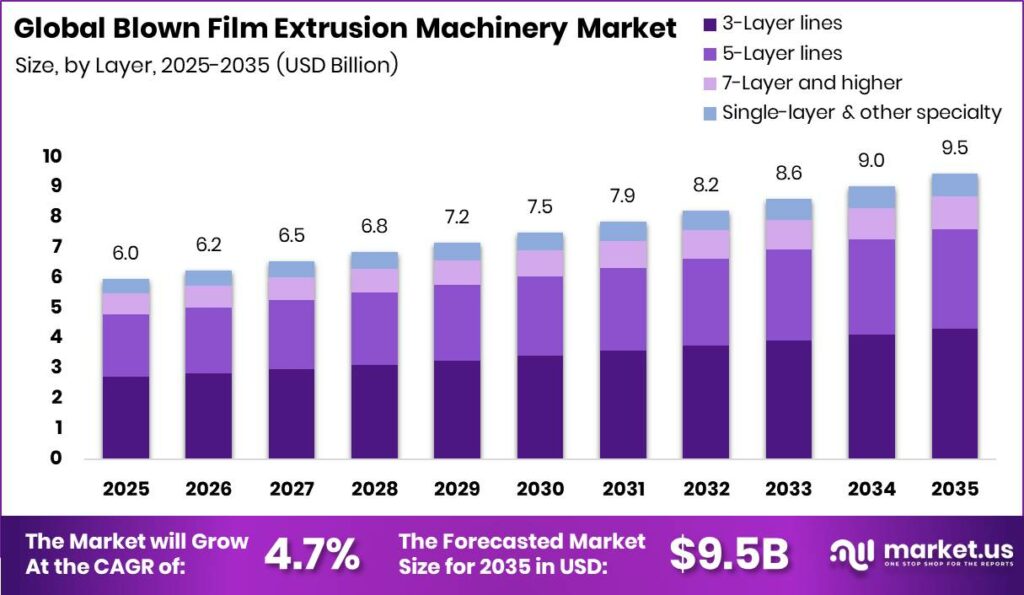
Global Blown Film Extrusion Machinery Market size is expected to be worth around USD 9.5 Billion by 2035 from USD 6.0 Billion in 2025, growing at a CAGR of 4.7% during the forecast period 2026 to 2035. This steady expansion reflects rising film demand across packaging verticals. Machinery buyers gain a clear signal to plan capital cycles around durable, multi-year converting growth.
Blown film extrusion machinery melts polymer resin and inflates it into a continuous tubular film for packaging and industrial use. The market splits by layer count, application, and material type. Manufacturers structure product lines from single-layer commodity systems up to seven-layer barrier co-extrusion lines. This tiered structure lets vendors target both price-sensitive buyers and premium performance segments distinctly.
Key Takeaways
- Global market reaches USD 9.5 Billion by 2035 from USD 6.0 Billion in 2025 at a CAGR of 4.7%.
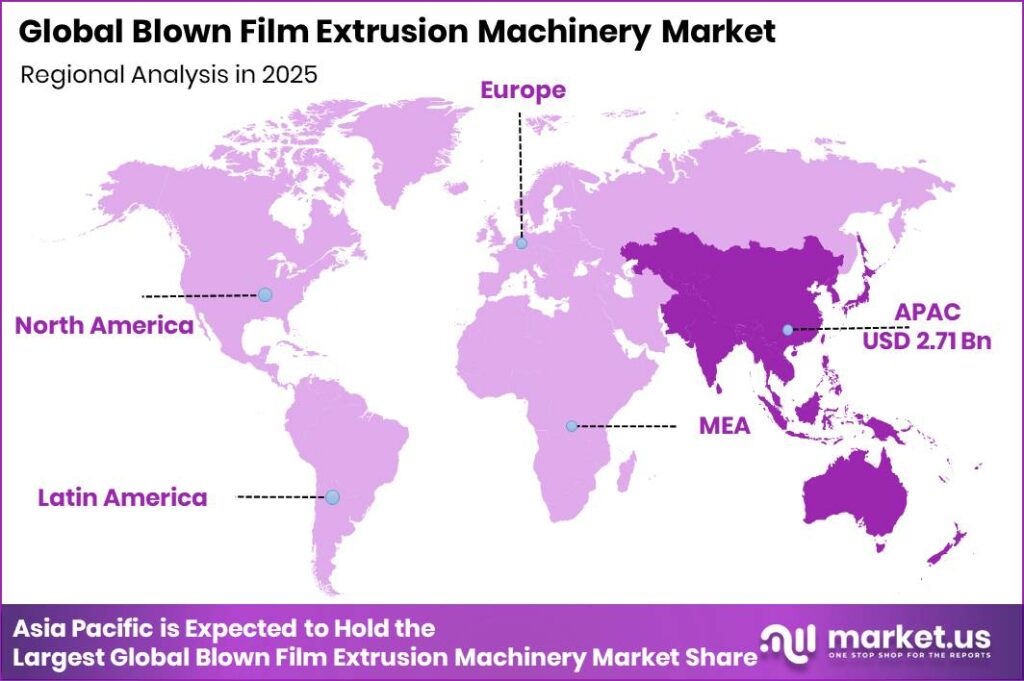
- Asia Pacific leads with a 45.5% share, valued at USD 2.71 Billion.
- 3-Layer lines dominate the layer segment with a 45.6% share.
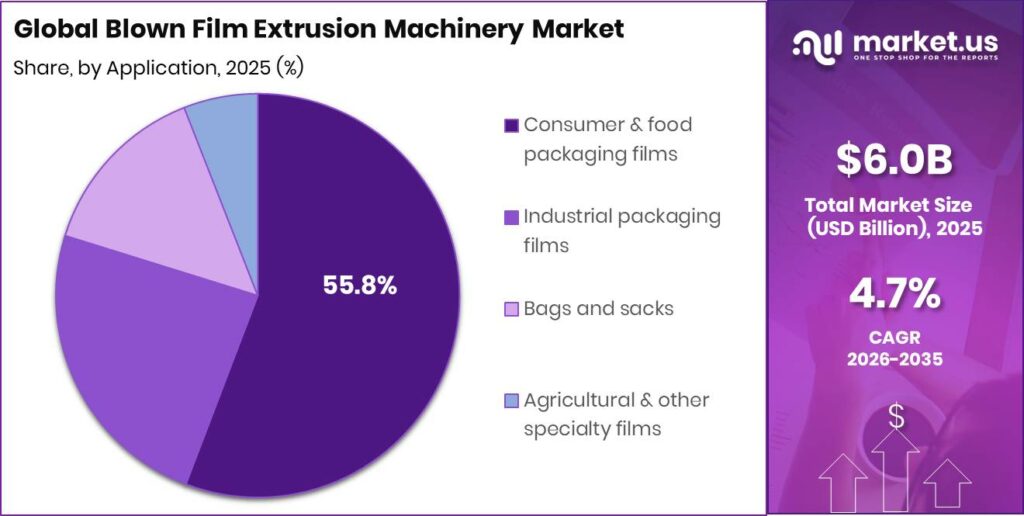
- Consumer and food packaging films lead applications with a 55.8% share.
- Polyethylene resins dominate the material segment with a 55.1% share.
Government trade policy now shapes machinery flows more than at any recent point. Data from the Plastics Industry Association shows U.S. plastics machinery imports rose 6.2% quarter-over-quarter to US$939.4 Million in Q1 2025. This means domestic converters lean on foreign lines for capacity. Local OEMs face pressure to compete on service and financing rather than price alone.
Export dynamics reveal a contrasting strain on domestic producers. As reported by the Plastics Industry Association, U.S. plastics machinery exports fell 18.6% year-over-year to US$325.3 Million in Q1 2025. This signals softening overseas order books for American builders. Vendors must diversify target regions to offset shrinking traditional export demand.
Sustainability commitments increasingly influence buyer selection of machinery partners. Rajoo Engineers reported that roughly 87% of the energy used to manufacture its extrusion machinery now comes from green sources, mainly solar, in 2026. This reflects rising buyer scrutiny of supplier carbon profiles. OEMs with clean manufacturing credentials win preference among sustainability-focused converters.
Layer Analysis
3-Layer lines dominates with 45.6% due to balanced barrier cost efficiency.
In 2025, 3-Layer lines held a dominant market position in the By Layer segment of Blown Film Extrusion Machinery Market, with a 45.6% share. Global packaging film production reached about 125 Million metric tons in 2022, up from 118 Million metric tons in 2021. This volume base sustains steady 3-layer demand. Converters favor these lines for reliable barrier performance at moderate cost, anchoring OEM order books.
5-Layer lines serve converters needing higher barrier and shelf-life performance for food and pharma films. This sub-segment ranks as the fastest growing within the layer category. Polyethylene alone represents nearly 34% of all polymer produced globally, with output near 22.67 Million metric tonnes. This resin abundance supports multi-layer expansion. Vendors that scale 5-layer capacity capture the strongest incremental growth ahead.
7-Layer and higher lines target premium barrier applications requiring specialty resin combinations and precise layer control. Single-layer and other specialty lines cover commodity bags and basic film runs at lower cost. These remaining sub-segments collectively hold the balance of layer demand behind 3-layer and 5-layer leaders. Buyers choosing higher-layer systems accept greater capital outlay for premium film margins.
Application Analysis
Consumer and food packaging films dominates with 55.8% due to daily consumption film volume.
In 2025, Consumer and food packaging films held a dominant market position in the By Application segment of Blown Film Extrusion Machinery Market, with a 55.8% share. Food packaging accounts for roughly 60% of total flexible film volume globally. This concentration secures baseline machinery demand. Converters serving food brands maintain high line utilization, driving consistent reinvestment in blown film capacity.
Industrial packaging films protect heavy goods through stretch hood, pallet wrap, and void-fill formats during transit. E-commerce fulfillment film volumes grew an estimated 9% annually across 2023 to 2025. This surge lifts industrial film line orders. Machinery suppliers targeting logistics converters benefit from durable e-commerce driven demand well beyond consumer packaging.
Bags and sacks cover retail carrier bags, produce bags, and bulk sacks produced on cost-efficient lines. Agricultural and other specialty films include mulch film and greenhouse covers serving farming regions. These two sub-segments together hold the remaining application share behind consumer and industrial films. Producers here compete on throughput and price, limiting premium machinery penetration in these categories.
Material Analysis
Polyethylene dominates with 55.1% due to versatile processing and low cost.
In 2025, Polyethylene held a dominant market position in the By Material segment of Blown Film Extrusion Machinery Market, with a 55.1% share. Polyethylene makes up close to 34% of all polymer produced worldwide. This dominance ties machinery design tightly to PE grades. OEMs optimize screw and die systems for LDPE, LLDPE, and HDPE to match the largest resin demand pool.
Polypropylene serves applications needing higher clarity, stiffness, and heat resistance than polyethylene provides. Global packaging film production climbed to 125 Million metric tons in 2022. This volume growth widens the PP processing base. Converters adding PP capability broaden their product mix and reduce dependence on single-resin demand cycles.
PVC film lines address niche shrink and cling applications with specialized handling needs. Other resins including EVA, bio-based, and blends rank as the fastest growing material group as recyclable and compostable demand rises. These sub-segments hold the remaining material share behind PE and PP. Vendors investing early in bio-resin capable lines position for the strongest future material transition.
Key Market Segments
By Layer
- 3-Layer lines
- 5-Layer lines
- 7-Layer and higher
- Single-layer and other specialty
By Application
- Consumer and food packaging films
- Industrial packaging films
- Bags and sacks
- Agricultural and other specialty films
By Material
- Polyethylene (LDPE/LLDPE/HDPE)
- Polypropylene (PP)
- PVC
- Other resins (EVA, bio-based, blends)
Regional Analysis
Asia Pacific Dominates the Blown Film Extrusion Machinery Market with a Market Share of 45.5%, Valued at USD 2.71 Billion
Asia Pacific leads the market with a 45.5% share worth USD 2.71 Billion. Strong food packaging demand and rapid converter buildout across India and Southeast Asia anchor this position. This means regional OEMs enjoy large, nearby demand pools. In January 2026, Rajoo Engineers launched its PROEX Series high-performance platform, targeting higher automation and energy efficiency for regional converters.
North America stands as a key growth region driven by import-led capacity additions and premium film demand. As per our research, converters here increasingly favor automated multi-layer lines for food and pharma applications. This creates steady replacement demand for advanced systems. Vendors offering strong local service networks capture the most durable share in this region.
Europe advances through sustainability-driven machinery upgrades linked to recyclable film mandates. Latin America and the Middle East and Africa expand via organized retail and cold chain growth. These regions together hold the remaining market share behind Asia Pacific and North America. Suppliers entering these markets early build first-mover advantage as converter capacity scales.
Key Regions and Countries
North America
- US
- Canada
Europe
- Germany
- France
- The UK
- Spain
- Italy
- Rest of Europe
Asia Pacific
- China
- Japan
- South Korea
- India
- Australia
- Rest of APAC
Latin America
- Brazil
- Mexico
- Rest of Latin America
Middle East and Africa
- GCC
- South Africa
- Rest of MEA
Market Dynamics
Market Opportunity Analysis - Recyclable film retrofits and India ASEAN capacity buildout open entry points for new players
The Other resins group, covering EVA and bio-based blends, stands underexploited as the fastest growing material sub-segment. Most installed lines still serve polyethylene at a 55.1% material share. This means recyclable-resin capacity remains thin. New entrants building bio-resin capable lines face limited competition while positioning for regulatory-driven demand.
PCR-content film retrofits open a near-term entry point for converters upgrading existing assets. COLINES demonstrated a line processing films with 35% post-consumer recycled material. This proves recycled-content production is commercially viable today. Investors backing retrofit specialists can capture upgrade demand before broad competition develops in recyclable film machinery.
India and ASEAN greenfield converter buildout remains underserved despite Asia Pacific holding a 45.5% regional share. Consumer and food packaging films lead applications at 55.8%, yet local capacity trails demand. This creates room for new line installations. Early entrants securing regional footholds gain durable advantage as converter capacity expands.
The 5-Layer lines sub-segment, the fastest growing within the layer category, remains underpenetrated relative to 3-layer dominance at 45.6%. By contrast, few emerging-market converters yet run five-layer barrier systems. This gap favors vendors offering financed five-layer packages. New players targeting this transition capture upgrade demand ahead of slower incumbents.
Technology and Innovation Landscape - High-output co-extrusion and energy-efficient controls redefine competitive edges
High-output multi-layer systems now define competitive advantage among leading OEMs. Kung Hsing’s KS-ML-7-55 seven-layer line uses seven 55 mm extruders for a combined 1,050 kg/hour output. This means converters achieve premium barrier film at scale. Buyers gain lower per-unit cost, rewarding OEMs that push throughput ceilings higher.
Energy-efficient design increasingly separates winning platforms from legacy lines. Kung Hsing’s five-layer system consumes as little as 0.37 kWh per kilogram versus an industry average near 0.50 kWh/kg. Colines states its PERFORM-EX infrared heaters cut energy use up to 22% against ceramic heaters. This means lower operating cost. Efficiency-focused OEMs win converters facing rising energy bills.
Advanced air rings and closed-loop control lift both output and film quality. Jinming’s SUPEREX M5B-2500Q-S delivers 30% to 50% higher output through a counter-flow air ring and closed-loop thickness control. Rajoo demonstrated a five-layer line at 700 kg/hour at PlastIndia 2026. This means tighter tolerances and faster runs. Converters adopting these systems reduce waste and raise yield.
Extruder technology shows the strongest recent momentum across the sector. Data from the Plastics Industry Association shows twin-screw extruder shipments rose 48.5% quarter-over-quarter and 115.4% year-over-year in Q2 2025. COLINES demonstrated a nine-layer POLYBLOWN line producing fully recyclable PE-based barrier film. This signals rapid demand for advanced extrusion. OEMs leading here capture the fastest-growing equipment niche.
Drivers
Flexible packaging demand pushes the market forward as food, pharma, and e-commerce shift from rigid formats to film. Global flexible packaging consumption grew an estimated 4.2% to 5.0% annually through 2024, with food films taking roughly 60% to 65% of volume. This means converters need higher output lines. Buyers investing early in co-extrusion capacity secure margin advantages over slower rivals.
Converters running lines above 85% of rated capacity consistently trigger new equipment orders within a 12 to 18 month window. Premium five-to-nine layer lines priced at USD 1.2 Million to 4.5 Million now displace commodity systems once sold at USD 180,000 to 350,000. This means OEM revenue grows faster than unit counts. Sellers focused on barrier lines capture the richest gross margins.
| Driver | (~) % Impact on CAGR Forecast | Geographic Relevance | Impact Timeline |
|---|---|---|---|
| Flexible Packaging Demand Growth Across Food, Pharma & E-Commerce Sectors | +1.55% | Global — led by Asia Pacific, North America, Europe | Short term (≤ 2 years) |
| Multi-Layer Barrier Film Adoption Driven by Extended Shelf-Life & Hygiene Requirements | +1.10% | Global — concentrated in Europe, North America, Japan | Medium term (2–4 years) |
| Rapid Expansion of Organised Retail & Cold Chain Infrastructure in Emerging Markets | +0.85% | India, Southeast Asia, Middle East, Africa | Short term (≤ 2 years) |
| Industry 4.0 Integration Driving Replacement Demand for Automated & Smart Extrusion Lines | +0.65% | Europe, North America, Japan, South Korea | Medium term (2–4 years) |
| Agricultural Mulch Film & Greenhouse Cover Demand Expansion | +0.55% | China, India, Turkey, Spain, Latin America | Short term (≤ 2 years) |
| Post-Pandemic Healthcare & Hygiene Film Demand Sustaining Elevated Output Requirements | +0.38% | Global — led by North America, Europe, Southeast Asia | Short term (≤ 2 years) |
Restraints
Single-use plastic bans suppress demand for thin-gauge film that represents an estimated 18% to 25% of global blown film output. The EU directive required per-capita bag consumption to fall to 40 bags per person by 2025 from 90 bags in 2010. This means converters serving banned categories lose revenue. Machinery buyers delay orders as affected film portfolios shrink.
India’s 2022 ban removed an estimated 3.2 Million to 4.5 Million metric tonnes of annual film volume from the market. Standard monolayer line enquiries from European and Indian converters fell an estimated 20% to 30% across 2023 to 2025. This means entry-level OEM revenue erodes 4% to 7% yearly. Vendors must pivot toward recyclable-film capable platforms to protect order flow.
| Restraint | (~) % Impact on CAGR Forecast | Geographic Relevance | Impact Timeline |
|---|---|---|---|
| Single-Use Plastic Bans & Extended Producer Responsibility Legislation Suppressing Film Demand | -1.20% | European Union, United Kingdom, India, Canada, Australia | Short term (≤ 2 years) |
| High Capital Expenditure & Long Payback Periods Delaying Investment Decisions | -0.80% | South Asia, Southeast Asia, Africa, Latin America | Short term (≤ 2 years) |
| Polyethylene & Polypropylene Resin Price Volatility Compressing Converter Margins | -0.55% | Global — most acute in import-dependent emerging markets | Short term (≤ 2 years) |
| Chinese Low-Cost Machinery Exports Suppressing Global ASPs & Margins | -0.40% | Southeast Asia, Middle East, Africa, Latin America | Short term (≤ 2 years) |
| Skilled Technician Shortage Delaying Installation & Commissioning Timelines | -0.28% | Africa, South Asia, Latin America, Eastern Europe | Medium term (2–4 years) |
Challenges
Mono-material recyclable film clashes with lines built for multi-polymer barrier laminates using EVOH and tie-layer resins. Converting a five-layer barrier line to all-PE cuts output 15% to 25% below rated capacity during initial trials. This means converters lose productivity while qualifying new structures. Machinery buyers face real throughput risk when shifting toward recyclable film production.
Running mono-material structures on conventional lines reduces steady output an estimated 10% to 20%, while all-PE resins add USD 80 to 160 per tonne. Leading OEMs estimate USD 8 Million to 20 Million and 3 to 5 years to re-engineer compatible platforms. This creates a large new revenue stream for OEMs that solve throughput parity first. Early movers unlock recyclable-line replacement demand.
| Challenge | (~) % CAGR Friction Drag | Geographic Relevance | Mitigation Horizon |
|---|---|---|---|
| Mono-Material Recyclable Film Processability | -0.75% | Europe, North America, Japan, Australia | Medium term (2–4 years) |
| Energy Consumption & Carbon Footprint of Extrusion | -0.60% | European Union, North America, Japan | Long term (≥ 4 years) |
| Multi-Layer Die & Feedblock Precision Engineering Gaps | -0.50% | South Asia, Southeast Asia, Eastern Europe, Latin America | Long term (≥ 4 years) |
| Resin Contamination & Quality Consistency in Recycled-Content Lines | -0.40% | Europe, North America | Long term (≥ 4 years) |
| Aftermarket Service & Spare Parts Supply Chain Complexity | -0.32% | Africa, South Asia, Latin America, Middle East | Medium term (2–4 years) |
Opportunities
Biodegradable film machinery remains white space, with fewer than 8% to 12% of installed lines validated for PLA, PBAT, and PHA feedstocks. These materials need barrel temperatures of 160°C to 190°C versus 190°C to 230°C for standard polyolefins. This means most existing lines cannot serve compostable demand. Early movers face little competition as compliance mandates approach.
Specialised biodegradable lines command USD 900,000 to 2.2 Million versus USD 300,000 to 700,000 for standard PE lines. Gross margins reach an estimated 32% to 42% against 18% to 26% on commodity lines. This means early investment yields a 12 to 18 percentage point margin gain. OEMs building capability now capture premium demand within a 2 to 4 year window.
| Opportunity | (~) % Potential CAGR Upside | Geographic Relevance | Execution Window |
|---|---|---|---|
| Biodegradable & Compostable Film Machinery Specialisation | +1.30% | European Union, North America, Japan, Australia | Medium term (2–4 years) |
| Digital-Twin & AI-Driven Process Optimisation Platform Monetisation | +0.90% | Europe, North America, Japan, South Korea | Medium term (2–4 years) |
| Post-Consumer Recycled (PCR) Content Film Line Retrofit & Upgrade | +0.75% | European Union, United Kingdom, North America | Short term (≤ 2 years) |
| India & ASEAN Greenfield Converter Capacity Buildout | +0.65% | India, Vietnam, Indonesia, Bangladesh, Thailand | Short term (≤ 2 years) |
| Machinery-as-a-Service & Output-Based Leasing Models | +0.45% | North America, Europe, GCC | Long term (≥ 4 years) |
Key Company Insights
Windmöller & Hölscher holds a structural advantage through its high-performance multi-layer OPTIMEX platform favored by premium film converters. Total primary plastics machinery shipments reached US$253.8 Million in Q2 2025, rising 0.7% from the prior quarter. This steady demand base rewards its premium positioning. However, reliance on high-cost lines exposes the firm to price competition in emerging markets.
Kabra Extrusiontechnik builds scale advantage through a vast installed base across cost-sensitive regions. The company has installed more than 15,700 extrusion systems worldwide, giving it deep aftermarket reach. This installed base secures recurring spare-parts and service revenue. However, its value positioning may limit share in the premium barrier line segment where margins run highest.
Key Players
- Windmöller & Hölscher
- Reifenhäuser Group
- Hosokawa Alpine AG
- Macchi SpA
- Davis-Standard, LLC
- SML Maschinengesellschaft mbH
- Colines S.p.A.
- Rajoo Engineers Ltd.
- POLYSTAR Machinery Co., Ltd.
- Kung Hsing Plastic Machinery Co., Ltd.
- Windsor Machines Ltd.
- Fong Kee International Machinery Co., Ltd.
- Alpha Marathon Film/Technologies Group Inc.
- Brampton Engineering Inc.
- JINMING Machinery Co., Ltd
- Others
Recent Developments
- January 2026: Summit Films (Innotex Packaging Solutions) expanded its blown film capacity by acquiring a new 5-layer OPTIMEX II blown film extrusion line from Windmöller & Hölscher, strengthening production of high-performance films.
- April 2026: Reifenhäuser commercially introduced its EVO GEN3 blown film extrusion line generation, delivering up to 30% higher output of up to 1,050 kg/h with new automation, AI-ready controls, and digital assistance systems.
Report Scope
| Report Features | Description |
|---|---|
| Market Value (2025) | USD 6.0 Billion |
| Forecast Revenue (2035) | USD 9.5 Billion |
| CAGR (2026-2035) | 4.7% |
| Base Year for Estimation | 2025 |
| Historic Period | 2020-2024 |
| Forecast Period | 2026-2035 |
| Report Coverage | Revenue Forecast, Market Dynamics, Market Opportunity Analysis, Technology and Innovation Landscape, Competitive Landscape, Recent Developments |
| Segments Covered | By Layer (3-Layer lines, 5-Layer lines, 7-Layer and higher, Single-layer and other specialty), By Application (Consumer and food packaging films, Industrial packaging films, Bags and sacks, Agricultural and other specialty films), By Material (Polyethylene, Polypropylene, PVC, Other resins) |
| Regional Analysis | North America (US and Canada), Europe (Germany, France, The UK, Spain, Italy, and Rest of Europe), Asia Pacific (China, Japan, South Korea, India, Australia, and Rest of APAC), Latin America (Brazil, Mexico, and Rest of Latin America), Middle East and Africa (GCC, South Africa, and Rest of MEA) |
| Competitive Landscape | Windmöller & Hölscher, Reifenhäuser Group, Hosokawa Alpine AG, Macchi SpA, Davis-Standard LLC, SML Maschinengesellschaft mbH, Colines S.p.A., Rajoo Engineers Ltd., POLYSTAR Machinery Co. Ltd., Kung Hsing Plastic Machinery Co. Ltd., Windsor Machines Ltd., Fong Kee International Machinery Co. Ltd., Alpha Marathon Film/Technologies Group Inc., Brampton Engineering Inc., JINMING Machinery Co. Ltd, Others |
| Customization Scope | Customization for segments, region / country-level will be provided. Additional customization can be done based on requirements. |
| Purchase Options | We have three licenses to opt for: Single User License | Multi-User License (Up to 5 Users) | Corporate Use License (Unlimited User and Printable PDF) |





































