


Report Overview
Global Blind Spot Detection Adaptive Cruise Control System Market size is expected to be worth around USD 10.4 Billion by 2035 from USD 4.5 Billion in 2025, growing at a CAGR of 8.8% during the forecast period 2026 to 2035.
The blind spot detection and adaptive cruise control system market combines radar, camera, and electronic control hardware with validated software to warn drivers of unseen vehicles and automatically maintain safe following distances. This market spans passenger cars, commercial vehicles, and fleet applications across private and public end users.
Key Takeaways
- Market size in 2025 stood at USD 4.5 Billion and is forecast to reach USD 10.4 Billion by 2035.
- The market grows at a CAGR of 8.8% from 2026 to 2035.
- Hardware dominates the component segment with a 68.78% share and is the fastest-growing sub-segment.
- Passenger cars hold the largest vehicle-type share at 57.34% and are the fastest-growing sub-segment.
- Private use leads the end-user segment with a 62.34% share and is the fastest-growing category.
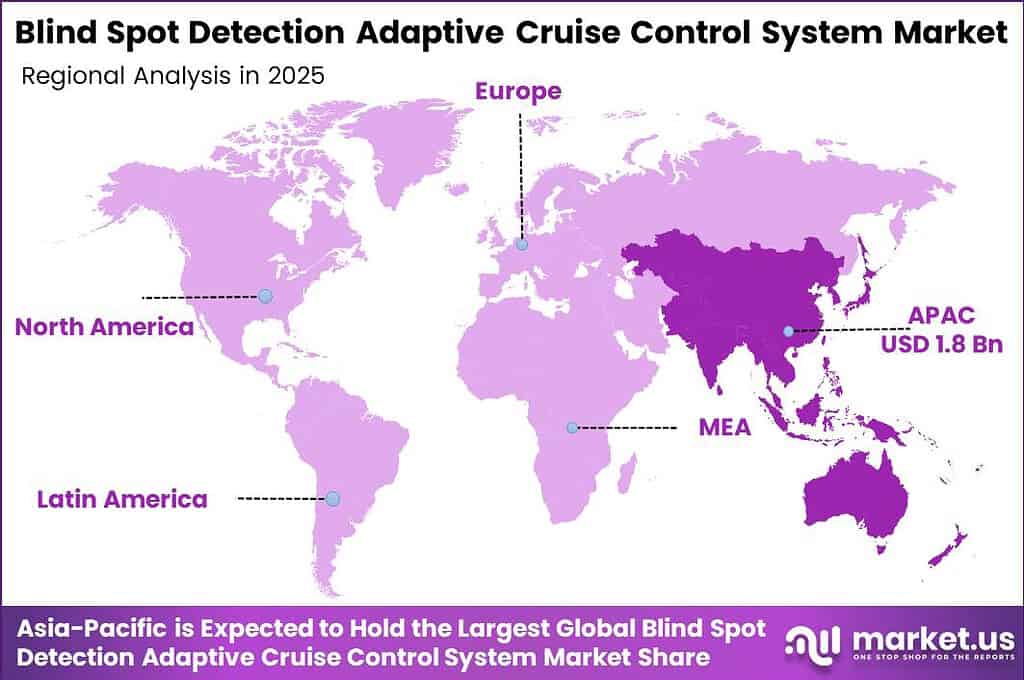
- Asia-Pacific is the dominant region with a 40.23% share, valued at USD 1.8 Billion.
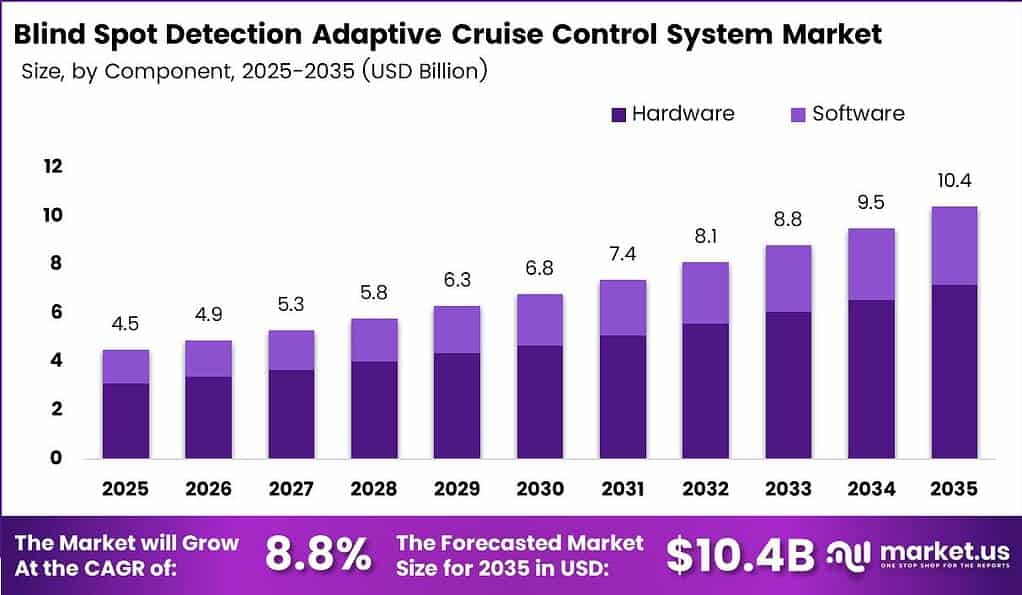
Regulatory frameworks are expanding the mandatory scope of advanced driver assistance. UN Regulation No. 151 covers Blind Spot Information Systems for bicycle detection, while UN Regulation No. 152 governs Advanced Emergency Braking Systems. These UNECE standards establish baseline technology requirements that OEMs must meet, directly expanding addressable volume for compliant sensor and software suppliers.
Road safety data reinforces commercial urgency. According to the World Health Organization, approximately 1.16 million people die annually from road-traffic crashes, while road crashes cause an estimated 20 million to 50 million non-fatal injuries each year. These figures make safety-system adoption a policy and liability priority, not a discretionary feature decision for automakers and fleet operators.
Global vehicle output supports demand scale. According to the International Organization of Motor Vehicle Manufacturers, global motor-vehicle production rose 3.9% to 96.4 million units in 2025, while global sales reached 99.8 million units, a 4.7% increase. Japan alone produced 8.41 million vehicles in 2025, representing a substantial installed-base opportunity for ADAS fitment at source.
Component Analysis
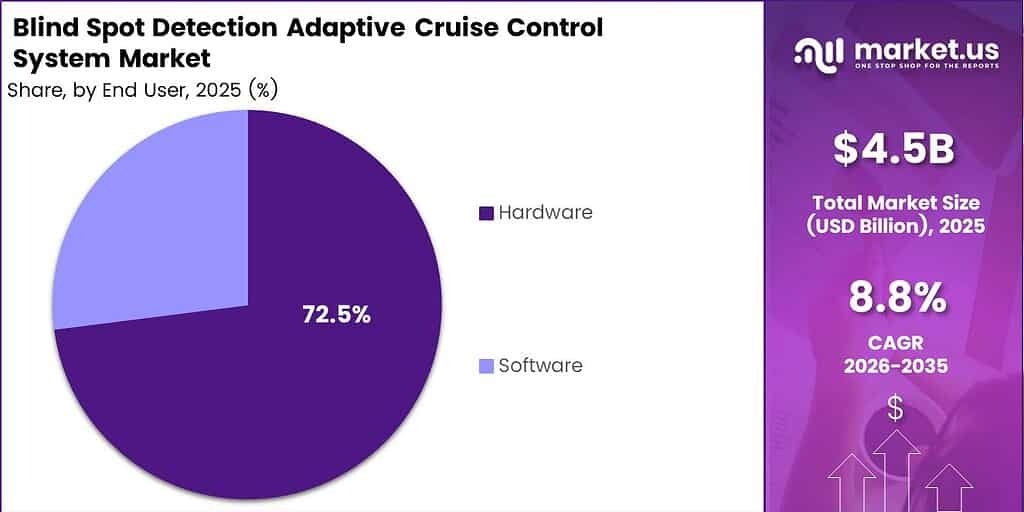
Hardware dominates with 68.78% due to radar and camera fitment as mandatory base content.
In 2025, Hardware held a dominant market position in the By Component segment of the Blind Spot Detection Adaptive Cruise Control System Market, with a 68.78% share. Radar sensors, cameras, electronic control units, and wiring harnesses constitute the physical foundation of every system. No warning, intervention, or cruise function operates without this base layer, making hardware spend non-negotiable across all vehicle and end-user segments.
Software holds the remaining share and represents the fastest route to margin expansion within the component structure. Validated object-classification algorithms, functional-safety compliance packages, and over-the-air update capability carry gross margins that exceed hardware content by a structurally meaningful gap. Suppliers who control both layers command stronger program economics than pure hardware vendors.
Vehicle Analysis
Passenger cars dominate with 57.34% due to volume output and standard-fit regulatory pressure.
In 2025, Passenger cars held a dominant market position in the By Vehicle segment of the Blind Spot Detection Adaptive Cruise Control System Market, with a 57.34% share. International Energy Agency data shows electric cars accounted for 25% of all new cars sold globally in 2025. As EV architectures centralize compute and sensor integration, blind spot and cruise systems migrate from option packages to standard content at a faster rate than in conventional platforms.
Commercial vehicles represent the second vehicle segment and carry a structurally different value proposition. According to the International Organization of Motor Vehicle Manufacturers, India recorded domestic sales of more than 1 million trucks and buses in fiscal 2025–26, while India produced 6.49 million vehicles in the same period. Fleet operators and logistics companies in high-density markets represent concentrated procurement decisions that can drive rapid volume uptake for ADAS suppliers. Aptiv was selected by a leading Indian commercial-vehicle OEM in January 2026 to equip future trucks and buses with its Gen 6 ADAS platform, marking the first ADAS collaboration of its type with an Indian commercial-vehicle manufacturer.
End User Analysis
Private Use dominates with 62.34% due to consumer safety awareness and new-car ADAS standard-fit rates.
In 2025, Private Use held a dominant market position in the By End User segment of the Blind Spot Detection Adaptive Cruise Control System Market, with a 62.34% share. Consumer demand for safety ratings, insurance incentives, and regulatory mandates together push OEMs to include blind spot warning and adaptive cruise as standard items on upper trims and increasingly on base configurations. Magna International marked the first full year of scaled global production of its Driver Monitoring System with a Germany-based OEM in China in October 2025, demonstrating that private-use fitment is already scaling across major programs.
Public fleet end users, including logistics operators, public-transit authorities, and government vehicle programs, hold the remaining share. Procurement is driven by liability management, insurance cost reduction, and regulatory compliance rather than consumer preference. This segment creates a durable, contract-driven revenue stream for suppliers with proven commercial-vehicle system certifications.
Key Market Segments
By Component
- Hardware
- Software
By Vehicle
- Passenger Cars
- Commercial Vehicles
By End User
- Private Use
- Public Fleet
Regional Analysis
Asia-Pacific Dominates the Blind Spot Detection Adaptive Cruise Control System Market with a Market Share of 40.23%, Valued at USD 1.8 Billion
Asia-Pacific leads all regions on the back of Chinese manufacturing scale and EV-led ADAS integration. International Energy Agency data shows China accounted for nearly 75% of global electric-car production in 2025, and almost 22 million electric cars were produced globally in 2025, more than 25% above the prior year. Chinese automakers supplied 60% of global electric-car sales in 2025, concentrating sensor and software content decisions within the region. International Organization of Motor Vehicle Manufacturers data further confirms India recorded domestic sales of more than 4.6 million passenger vehicles in fiscal 2025–26, adding a secondary growth corridor within the region.
Europe is the fastest-growing region, supported by mandatory safety content upgrades and strong EV sales momentum. As reported by the International Energy Agency, European electric-car sales rose more than 30% in 2025 and reached 28% of total regional car sales. European automakers supplied about 15% of global electric-car sales in 2025. This combination of electrification pace and homologation requirements accelerates the shift from optional to standard ADAS fitment across European OEM programs.
North America holds a meaningful share supported by regulatory mandates on automatic emergency braking and new crash-rating criteria for blind spot intervention technologies at the 2026 model year. Data from the International Energy Agency shows North American automakers supplied about 15% of global electric-car sales in 2025. More than 13 million electric cars were sold in China in 2025, reinforcing that North American suppliers competing in China must localize sensor and software stacks to remain competitive in the world’s largest single EV market.
Key Regions and Countries
North America
- US
- Canada
Europe
- Germany
- France
- The UK
- Spain
- Italy
- Rest of Europe
Asia Pacific
- China
- Japan
- South Korea
- India
- Australia
- Rest of APAC
Latin America
- Brazil
- Mexico
- Rest of Latin America
Middle East and Africa
- GCC
- South Africa
- Rest of MEA
Market Dynamics
Market Opportunity Analysis - Underserved segments and emerging corridors offer defensible entry points for focused ADAS suppliers
The public fleet end-user segment holds the remaining share after private use captures 62.34%, yet fleet procurement cycles operate on multi-year contract terms with predictable renewal windows. Suppliers who certify their blind spot and adaptive cruise systems for commercial-vehicle duty cycles and liability-grade documentation unlock a contract-driven revenue base that private-consumer demand cannot replicate.
The software sub-segment holds only the minority share within the By Component split dominated by hardware at 68.78%. This gap signals that most current programs still monetize the physical content rather than the intelligence layer. Suppliers who move first to separate software activation pricing from hardware list prices create a recurring revenue structure that competitors locked into one-time unit sales cannot quickly replicate.
Commercial vehicles represent the second vehicle segment behind passenger cars at 57.34%, yet carry a concentrated procurement structure where a single OEM decision covers tens of thousands of units annually. The India commercial-vehicle corridor, where domestic truck and bus sales exceeded 1 million units in fiscal 2025–26, offers volume at early-stage system pricing before market saturation compresses margins in the passenger car segment.
Asia-Pacific holds 40.23% of global market share, yet the region’s internal structure is uneven. India’s passenger vehicle sales of more than 4.6 million units in fiscal 2025–26 reveal a sub-market where ADAS fitment rates remain well below Chinese and Japanese levels. Suppliers who establish local engineering and calibration infrastructure ahead of regulatory mandates secure first-mover supply relationships before the mandatory fitment window opens.
Technology and Innovation Landscape - Sensor integration, software-defined architectures, and platform consolidation redefine supplier competitiveness
EyeQ chip architecture from Mobileye illustrates how proprietary silicon creates durable competitive barriers in the ADAS supply chain. More than 230 million vehicles had been built with EyeQ technology through 2025, and the EyeQ6 High variant now anchors high-volume Surround ADAS programs. Suppliers without equivalent purpose-built vision processors must license or integrate third-party silicon, reducing their software differentiation and margin control.
Radar-camera sensor fusion on shared hardware platforms is the technology architecture enabling software-defined ADAS upgrades. A shared hardware layer that raises initial fitment costs by 5 to 10% but supports later software activation can deliver software gross margins more than 20 percentage points above incremental hardware content. This architecture shift transfers the primary value creation point from component manufacturing to software engineering and over-the-air deployment infrastructure.
Bosch’s partnership with Qualcomm Technologies expanded to ADAS solutions in April 2026, with Bosch having delivered more than 10 million Snapdragon Cockpit Platform-based vehicle computers globally. This collaboration demonstrates that compute-platform standardization across cockpit and ADAS domains reduces per-function silicon cost and simplifies software integration across vehicle lines. Suppliers who align with dominant compute platforms gain access to a broader OEM customer base without proportional increases in validation expenditure.
ZF’s planned divestiture of its ADAS business to Harman International at €1.5 billion reflects a technology portfolio reallocation trend where Tier 1 suppliers exit hardware-intensive ADAS divisions to focus on higher-margin software and systems integration businesses. This creates acquisition and white-space opportunities for focused ADAS specialists, component-level suppliers, and new entrants who can absorb divested product lines with lower overhead structures and leaner validation pipelines.
Drivers
Safety-rating criteria are converting blind spot detection and adaptive cruise control from premium options into standard-fit requirements. The United States finalized automatic emergency braking requirements covering forward-collision warning from above 10 km/h to below 145 km/h, with pedestrian braking extending to below 73 km/h. The upgraded crash-rating program added blind spot warning and intervention for the 2026 model year.
This regulatory escalation makes integrated radar-camera and control-domain architectures commercially attractive because one sensing stack supports multiple rated safety functions. Suppliers spread validation, software, and homologation costs across larger vehicle programs. However, they must sustain functional-safety evidence and software-update capability to protect margins as OEM cost-down pressure intensifies.
| Driver | (~) % Impact on CAGR Forecast | Geographic Relevance | Impact Timeline |
|---|---|---|---|
| Safety-rating ADAS pull | +2.0% | North America, Europe, China | Short term (≤ 2 years) |
| Premium-feature democratization | +1.5% | China, India, ASEAN, Latin America | Short term (≤ 2 years) |
| SUV and crossover mix | +1.2% | Global | Medium term (2–4 years) |
| Highway congestion demand | +1.0% | North America, Europe, East Asia | Short term (≤ 2 years) |
| Sensor-content per vehicle | +0.9% | China, Europe, Japan, South Korea | Medium term (2–4 years) |
| Fleet safety procurement | +0.6% | North America, Europe, Gulf states | Medium term (2–4 years) |
Restraints
Fitting radar, cameras, electronic control units, wiring, and validated software into price-sensitive platforms adds a mid-single- to low-double-digit percentage burden to entry-trim electronics costs before OEM purchasing leverage. Radar alignment, bumper replacement, and post-repair calibration raise insurance repair bills materially. OEMs in cost-priority markets respond by reserving the package for upper trims or removing intervention functions entirely.
This affordability ceiling translates into program deferrals and narrower trim availability. Suppliers face margin compression as automakers demand annual cost-downs while safety, electromagnetic-compatibility, and environmental validation expenses remain largely fixed. The estimated -1.8% CAGR deduction reflects these compounding pressures across high-volume compact platforms in India, ASEAN, Latin America, and Africa.
| Restraint | (~) % Impact on CAGR Forecast | Geographic Relevance | Impact Timeline |
|---|---|---|---|
| Entry-vehicle affordability ceiling | -1.8% | India, ASEAN, Latin America, Africa | Short term (≤ 2 years) |
| Automotive-grade validation cost | -1.4% | Global | Medium term (2–4 years) |
| Vehicle-program cost-down pressure | -1.1% | Global | Short term (≤ 2 years) |
| Fragmented homologation requirements | -0.9% | Europe, North America, China, India | Medium term (2–4 years) |
| High repair-cost deterrence | -0.7% | North America, Europe, Japan | Short term (≤ 2 years) |
| Used-vehicle retrofit limits | -0.5% | Emerging markets | Long term (≥ 4 years) |
Challenges
Blind spot detection and adaptive cruise control systems must arbitrate among radar, camera, vehicle-motion, and map signals within real-time control cycles. Rain, fog, glare, road spray, radar multipath, cut-ins, and worn lane markings can each degrade sensor confidence independently. A single platform may require validation across thousands of scenario permutations, multiple speed ranges, and regional road environments before production sign-off.
Inadequate tuning generates nuisance alerts and driver disengagement, while conservative tuning reduces perceived system value and increases warranty exposure. The estimated -1.5% growth friction requires long-term investment in scenario libraries, simulation platforms, fleet-data feedback loops, and standardized over-the-air validation processes. This raises recurring research and development costs even as OEMs negotiate lower unit prices each model year.
| Challenge | (~) % CAGR Friction Drag | Geographic Relevance | Mitigation Horizon |
|---|---|---|---|
| Sensor fusion edge cases | -1.5% | Global | Long term (≥ 4 years) |
| Radar-chip sourcing concentration | -1.2% | Global | Medium term (2–4 years) |
| Software verification burden | -1.0% | Global | Long term (≥ 4 years) |
| Real-world false alerts | -0.8% | Global | Medium term (2–4 years) |
| Cybersecurity update exposure | -0.7% | Europe, North America, China, Japan | Medium term (2–4 years) |
| Calibration-service readiness | -0.6% | Emerging markets and rural regions | Medium term (2–4 years) |
Opportunities
Software-defined ADAS upgrades remain undermonetized because most installed sensor hardware is sold as a fixed, vehicle-at-delivery feature set. Suppliers and OEMs that standardize sufficient radar, camera, compute, and connectivity hardware across trims can activate capability later through validated software packages. This converts a one-time component sale into a recurring lifecycle revenue stream.
If a shared hardware architecture raises initial sensor fitment by roughly 5 to 10% and enables paid or bundled feature activation across several ownership years, software gross margins can exceed those of incremental hardware content by more than 20 percentage points. The estimated +1.9% potential CAGR upside depends on cybersecurity compliance, reliable over-the-air deployment, and commercially acceptable activation pricing.
| Opportunity | (~) % Potential CAGR Upside | Geographic Relevance | Execution Window |
|---|---|---|---|
| Software-defined ADAS upgrades | +1.9% | North America, Europe, China, Japan, South Korea | Medium term (2–4 years) |
| Commercial-fleet safety bundles | +1.5% | North America, Europe, China, India | Medium term (2–4 years) |
| Two-wheeler detection expansion | +1.3% | India, ASEAN, Latin America | Medium term (2–4 years) |
| Aftermarket calibration networks | +1.0% | North America, Europe, urban Asia | Short term (≤ 2 years) |
| Shared radar platform modules | +0.9% | Global | Medium term (2–4 years) |
| Usage-based insurance partnerships | +0.7% | North America, Europe, China | Long term (≥ 4 years) |
Key Company Insights
Continental AG reported €19.676 billion in consolidated sales from continuing operations in 2025 with a workforce of 92,653 employees. This scale allows Continental to absorb functional-safety validation and homologation costs across multiple OEM programs simultaneously. Suppliers without equivalent global engineering depth face disproportionately higher per-program development expenses in this market.
DENSO Corp. generated consolidated revenue of ¥7,161.8 billion in fiscal year 2025, with operating profit of ¥519.0 billion, a 36.4% year-on-year increase, and profit attributable to parent owners of ¥419.1 billion. This profitability trajectory gives DENSO significant reinvestment capacity for sensor and software development. Competitors with thinner operating margins will find it structurally difficult to match DENSO’s pace of ADAS content expansion.
Autoliv Inc. reported $10.8 billion in net sales in 2025 alongside record financial performance metrics. This positions Autoliv as the largest passive and active safety supplier by revenue among publicly disclosed peers in this data set. As integrated safety architectures combine airbag, seatbelt, and ADAS functions on shared platforms, Autoliv’s cross-system customer relationships create a structural advantage in program bundling.
Mobileye posted full-year 2025 revenue of $1.894 billion, up 15% year on year, with an eight-year expected automotive revenue pipeline of $24.5 billion, 42% higher than its year-end 2022 update. More than 230 million vehicles had been built with Mobileye EyeQ technology through 2025. In January 2026, Mobileye received a high-volume U.S. OEM Surround ADAS program using EyeQ6 High, with its first two Surround ADAS customers representing 19 million units of expected future volume. In July 2025, Mobileye repurchased $100 million in stock from Intel, signaling balance sheet confidence and strategic independence. International Energy Agency data confirms global electric-car sales exceeded 20 million units in 2025, with more than 13 million sold in China alone, underlining the platform scale on which EyeQ-based systems now operate.
ZF Friedrichshafen AG reported sales of €38.8 billion in 2025 with an adjusted EBIT margin of 4.5% and research and development investment of €3.3 billion. ZF agreed to sell its Advanced Driver Assistance Systems business to Harman International at a company value of €1.5 billion, with closing expected in the second half of 2026 subject to regulatory approvals. This divestiture signals ZF’s strategic reallocation away from ADAS hardware toward higher-margin driveline and chassis systems.
Robert Bosch GmbH launched a new ADAS product family in China in April 2025, with serial production expected from Q4 2025, and its mid-range variant entering serial production with a Chinese manufacturer in mid-2025. Bosch Mobility China generated sales of ¥122.3 billion (approximately €15.1 billion) in 2025, up 4.9% year on year. In April 2026, Bosch and Qualcomm Technologies expanded their strategic collaboration to ADAS solutions, with Bosch having delivered more than 10 million Snapdragon Cockpit Platform-based vehicle computers globally.
Knorr-Bremse AG forecast 2025 revenue of €8.1 billion to €8.4 billion, an operating EBIT margin of 12.5% to 13.5%, and free cash flow of €700 million to €800 million. This profitability profile gives Knorr-Bremse capital to pursue adjacent technology acquisitions. In October 2025, Knorr-Bremse acquired Dutch commercial-vehicle road-services booking platform TRAVIS for a mid-double-digit-million-euro sum, expanding its digital fleet services reach beyond hardware ADAS systems.
Key Players
- Continental AG
- Delphi Technologies PLC
- DENSO Corp
- Autoliv Inc.
- Magna International
- WABCO Vehicle Control Services
- Robert Bosch GmbH
- ZF Friedrichshafen AG
- Bendix Commercial Vehicle Systems LLC (Knorr-Bremse AG)
- Mobileye
- Mando-Hella Electronics Corp.
- Other Key Players
Recent Developments
- 2025 – ZF Friedrichshafen AG agreed to sell its Advanced Driver Assistance Systems business to Harman International at a company value of €1.5 billion; closing was expected in the second half of 2026 subject to regulatory approvals.
- July 2026 – Mobileye and Stellantis announced that selected future Stellantis vehicles would integrate Mobileye’s cloud-enhanced ADAS beginning in 2027; more than 230 million vehicles had been built with EyeQ technology through 2025.
- January 2026 – Mobileye received a high-volume U.S. OEM Surround ADAS program using EyeQ6 High and Mobileye software; its first two Surround ADAS customers represented 19 million units of expected future volume.
- September 2026 – Knorr-Bremse secured an extended supply contract from a leading truck manufacturer for Electronic Levelling Control systems through 2033, covering around 200,000 systems annually.
- October 2025 – Knorr-Bremse acquired Dutch commercial-vehicle road-services booking platform TRAVIS; the purchase price was a mid-double-digit-million-euro sum.
- May 2025 – ZF Aftermarket introduced a Smart Camera to independent passenger-car workshops, with 10 references immediately available and coverage for more than 50 vehicle applications.
Report Scope
| Report Features | Description |
|---|---|
| Market Value (2025) | USD 4.5 Billion |
| Forecast Revenue (2035) | USD 10.4 Billion |
| CAGR (2026-2035) | 8.8% |
| Base Year for Estimation | 2025 |
| Historic Period | 2020-2024 |
| Forecast Period | 2026-2035 |
| Report Coverage | Revenue Forecast, Market Dynamics, Market Opportunity Analysis, Technology and Innovation Landscape, Competitive Landscape, Recent Developments |
| Segments Covered | By Component (Hardware, Software), By Vehicle (Passenger Cars, Commercial Vehicles), By End User (Private Use, Public Fleet) |
| Regional Analysis | North America (US and Canada), Europe (Germany, France, The UK, Spain, Italy, and Rest of Europe), Asia Pacific (China, Japan, South Korea, India, Australia, and Rest of APAC), Latin America (Brazil, Mexico, and Rest of Latin America), Middle East and Africa (GCC, South Africa, and Rest of MEA) |
| Competitive Landscape | Continental AG, Delphi Technologies PLC, DENSO Corp, Autoliv Inc., Magna International, WABCO Vehicle Control Services, Robert Bosch GmbH, ZF Friedrichshafen AG, Bendix Commercial Vehicle Systems LLC (Knorr-Bremse AG), Mobileye, Mando-Hella Electronics Corp. |
| Customization Scope | Customization for segments, region/country-level will be provided. Additional customization can be done based on requirements. |
| Purchase Options | We have three licenses to opt for: Single User License, Multi-User License (Up to 5 Users), Corporate Use License (Unlimited User and Printable PDF) |





































