


Report Overview
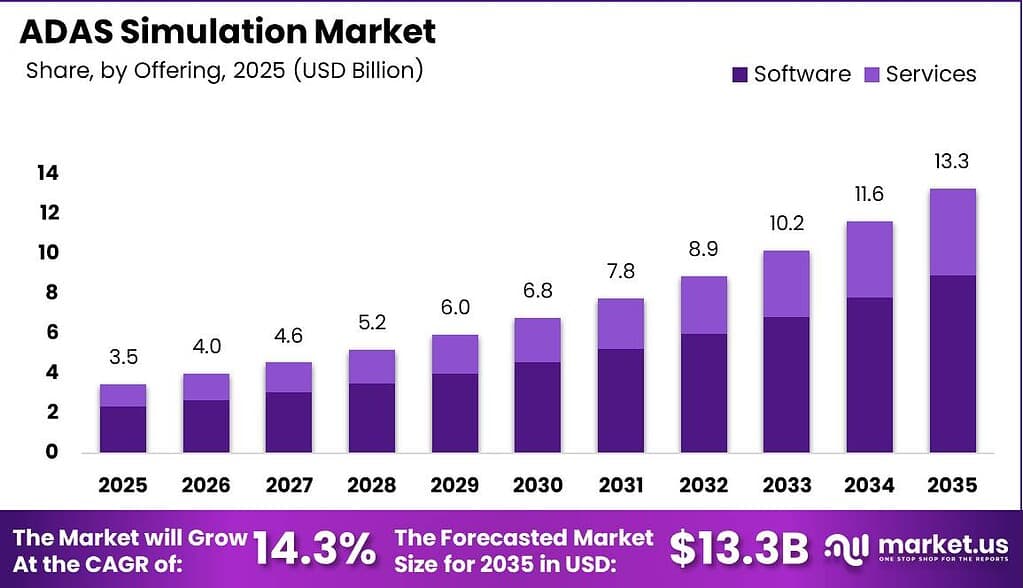
Global ADAS Simulation Market size is expected to be worth around USD 13.30 Billion by 2035 from USD 3.50 Billion in 2025, growing at a CAGR of 14.3% during the forecast period 2026 to 2035. This trajectory reflects steady adoption of virtual testing tools across passenger and commercial vehicle programs. Investors can treat this range as a baseline for judging vendor growth claims and licensing models over the coming decade.
This means the ADAS Simulation Market covers software, hardware, and cloud tools that recreate driving conditions to test advanced driver assistance systems without physical vehicles. The market spans offering type, simulation method, application area, vehicle type, and end user categories. Engineering teams use these tools to validate sensor fusion, control logic, and safety functions before building costly physical prototypes.
Key Takeaways
- ADAS Simulation Market size is estimated at USD 3.50 Billion in 2025 and is projected to reach USD 13.30 Billion by 2035.
- The market is expected to grow at a CAGR of 14.3% between 2026 and 2035.
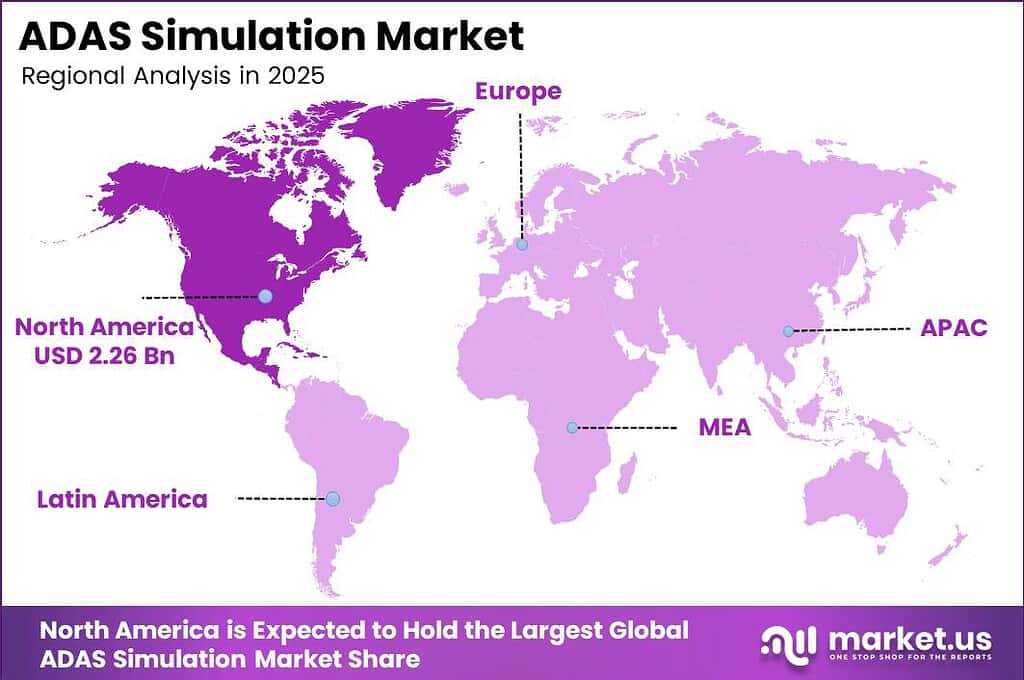
- North America led the market with a share of 36.45%, valued at USD 2.26 Billion in 2025.
- Software held a dominant offering share of 67.34% in 2025.
- Software-in-the-Loop led the simulation method segment with a 38.67% share.
- ADAS Function Validation led the application segment with a 42.34% share.
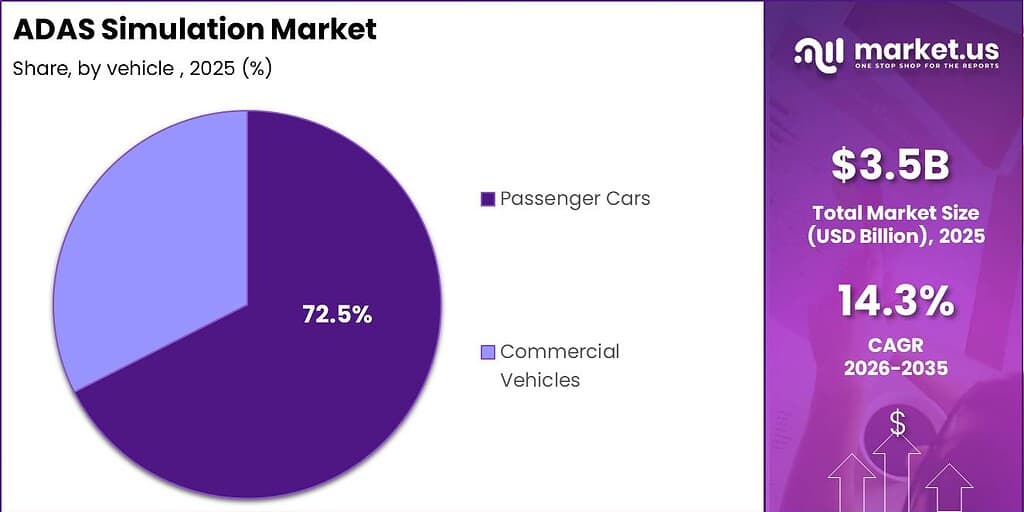
- Passenger Cars accounted for 72.5% of the vehicle type segment.
- Automotive OEMs held 62.34% of the end user segment.
However, regulators across major vehicle markets increasingly accept virtual validation evidence alongside physical road testing for new safety systems. This shift reduces the burden on manufacturers to run every safety scenario on public roads before launch. Companies that build simulation evidence into compliance workflows early can shorten time to market for new ADAS features.
Waymo’s autonomous driving system has logged nearly 200 million fully autonomous miles, while its simulation systems run across billions of virtual miles to test complex scenarios. This gap between physical and virtual mileage shows why simulation scales faster than road testing alone. As robotaxi and passenger programs expand, demand for high volume virtual mile generation grows with them.
NVIDIA DRIVE Constellation lets developers test self-driving systems across billions of virtual miles using photorealistic environments. This means hardware and software teams can validate rare, dangerous scenarios without risking physical vehicles or drivers. Growing end use demand from robotaxi and passenger vehicle programs directly increases orders for high fidelity simulation platforms.
Offering Analysis
Software dominates with 67.34% due to reusable licensing across validation programs.
In 2025, Software held a dominant market position in the By Offering segment of ADAS Simulation Market, with a 67.34% share. OICA data shows global vehicle production reached 96.4 million units in 2025, up 3.9% from 2024. This growing production base pushes automakers toward reusable simulation software licenses instead of one off service contracts. Vendors pricing software as a recurring platform gain steadier revenue than those relying on project work.
Services support automakers that lack in house simulation expertise for new ADAS programs. As reported by UNECE, more than 50 member states have implemented Regulation R157 covering automated lane keeping systems. This regulatory spread increases demand for consulting, scenario libraries, and validation support contracts. Services providers offering regulatory mapping alongside technical validation gain an edge over pure software vendors.
Simulation Analysis
Software-in-the-Loop dominates with 38.67% due to low cost early stage code validation.
In 2025, Software-in-the-Loop held a dominant market position in the By Simulation segment of ADAS Simulation Market, with a 38.67% share. Waymo states its simulation platform has driven more than 15 billion simulated miles to validate software updates and prepare rare edge cases. This scale shows why code level validation happens virtually long before any hardware is involved. Vendors offering high throughput software validation environments capture early stage development budgets.
Hardware-in-the-Loop testing connects physical electronic control units to simulated sensor inputs for real time validation. UNECE R157 test annexes require a minimum of 15 operating hours on public roads, with 5 hours in heavy congested traffic. This regulatory bar pushes suppliers toward hardware accurate rigs that shorten physical test time. Vendors offering integrated HIL platforms, such as LeddarTech’s camera, radar, and LiDAR focused LeddarSim, can charge premium rates for compliance grade work.
Model-in-the-Loop simulation validates control algorithms using mathematical vehicle models before code generation begins. UNIDO reports that computers and electronics manufacturing output rose 2.6% in the first quarter of 2025, alongside 6.4% growth in transport equipment production. This parallel growth in electronics and vehicle hardware output supports earlier, model level validation cycles. Engineering teams adopting model checks reduce late stage redesign costs across ADAS programs.
Driver-in-the-Loop rigs place a human driver inside a simulated cockpit to test behavior around automation handoffs. OICA reports that Asia Pacific vehicle production rose 7.6% in 2025 to around 59.2 million units. Rising regional output raises demand for driver behavior validation across new domestic ADAS programs. Test houses offering driver behavior rigs alongside software validation win broader compliance contracts from OEMs.
Application Analysis
ADAS Function Validation dominates with 42.34% due to mandatory safety compliance testing cycles.
In 2025, ADAS Function Validation held a dominant market position in the By Application segment of ADAS Simulation Market, with a 42.34% share. OICA reports global vehicle sales reached 99.8 million units in 2025, up 4.7% from 2024. Every new model entering this expanding sales base needs documented function validation before launch. This keeps demand for function validation ahead of exploratory testing categories.
Autonomous Driving Testing covers full stack evaluation of perception, planning, and control systems before public road deployment. OICA data shows China produced 34.53 million vehicles in 2025, a rise of 10.4% from the prior year. This expanding domestic fleet raises pressure on developers to validate full stack autonomy through virtual testing at scale. Vendors supplying large scenario libraries capture spending from companies pursuing full autonomy programs.
Sensor Fusion Testing validates how camera, radar, and LiDAR data merge into a single environmental model. Waymo’s Simulation City uses more than 20 million autonomous road miles collected from real driving to generate test scenarios. Feeding real mileage into fusion testing improves confidence in how virtual sensor data matches road behavior. This reduces duplicate engineering effort for Tier suppliers building multi sensor ADAS stacks.
Scenario and Environment Simulation recreates weather, lighting, and road geometry conditions for repeatable virtual testing. OICA reports European vehicle production totalled 17.2 million units in 2025, down 0.8% from the prior year. Slower regional output pushes European suppliers toward virtual environment libraries to control validation costs. This favors vendors offering configurable weather and lighting scenario packages for European type approval.
Vehicle Type Analysis
Passenger Cars dominates with 72.5% due to highest global production volume base.
In 2025, Passenger Cars held a dominant market position in the By Vehicle Type segment of ADAS Simulation Market, with a 72.5% share. OICA data shows global passenger car production reached 71.3 million units in 2025, up 5% from 2024. This large production base gives simulation vendors a wide addressable pool of vehicle platforms to validate. Suppliers with passenger car scenario libraries win repeat business across annual model refreshes.
Commercial Vehicles require simulation of longer braking distances, wider blind spots, and heavier load dynamics than passenger platforms. OICA reports that India’s vehicle production rose to 6.49 million units in 2025. Growing commercial fleet production in emerging markets creates fresh demand for truck and bus specific scenario sets. Vendors adapting existing scenario libraries for heavier vehicle dynamics gain an early position in this segment.
End User Analysis
Automotive OEMs dominates with 62.34% due to direct type approval compliance ownership.
In 2025, Automotive OEMs held a dominant market position in the By End User segment of ADAS Simulation Market, with a 62.34% share. As reported by WTO, world trade conducted on a most favoured nation basis stood at 72% by the end of February 2026. This stable trade framework supports predictable sourcing for OEM validation budgets tied to global platforms. OEMs remain the primary buyer of enterprise simulation licenses as a result.
Technology Providers supply sensors, compute platforms, and software stacks that OEMs integrate into ADAS systems. Data from WTO shows trade in AI enabling goods, including chips and data transmission equipment, rose 21.9% year on year to USD 4.18 trillion in 2025. This surge in compute related trade signals rising technology provider investment in simulation ready hardware. Providers embedding simulation tools into their own hardware stacks gain influence over OEM validation workflows.
Research and Testing Institutes conduct independent validation and academic research supporting new ADAS safety methods. WTO figures show global commercial services trade growth is expected to reach 4.8% in 2026. Growing services trade supports cross border collaboration between institutes and commercial simulation vendors. Institutes partnering with vendors expand access to compute heavy validation infrastructure they could not fund alone.
Key Market Segments
By Offering
- Software
- Services
By Simulation
- Software-in-the-Loop
- Hardware-in-the-Loop
- Model-in-the-Loop
- Driver-in-the-Loop
By Application
- Autonomous Driving Testing
- ADAS Function Validation
- Sensor Fusion Testing
- Scenario and Environment Simulation
By Vehicle Type
- Passenger Cars
- Commercial Vehicles
By End User
- Automotive OEMs
- Technology Providers
- Research and Testing Institutes
Regional Analysis
North America Dominates the ADAS Simulation Market with a Market Share of 36.45%, Valued at USD 2.26 Billion
North America leads the ADAS Simulation Market with a 36.45% share, valued at USD 2.26 Billion in 2025. Dense concentration of automotive OEMs, technology providers, and regulatory testing bodies keeps validation spending centered in this region. Companies with established North American compliance certifications gain faster access to procurement budgets tied to new vehicle safety programs. This regional advantage supports early revenue capture for simulation vendors entering the market.
Key Regions and Countries
North America
- US
- Canada
Europe
- Germany
- France
- The UK
- Spain
- Italy
- Rest of Europe
Asia Pacific
- China
- Japan
- South Korea
- India
- Australia
- Rest of APAC
Latin America
- Brazil
- Mexico
- Rest of Latin America
Middle East and Africa
- GCC
- South Africa
- Rest of MEA
Market Dynamics
Market Opportunity Analysis - Underserved simulation methods and end user groups offer entry points for new vendors
Services remains underexploited within the Offering segment despite being the fastest growing category behind dominant Software licensing. This means new entrants can build consulting and scenario library businesses without competing directly against entrenched software vendors. Consequently, firms that pair light software tools with hands on validation support can win smaller suppliers that larger vendors overlook.
Driver-in-the-Loop and Model-in-the-Loop simulation carry no disclosed share yet remain structurally necessary across every ADAS program. This signals room for specialist vendors to own these methods before larger platform providers expand into them. Instead of competing on scale, focused vendors can compete on depth within a single simulation method.
Research and Testing Institutes hold no disclosed share within the End User segment despite performing independent validation work regulators trust. This creates an entry point for vendors offering discounted or academic focused licensing to build long term regulatory credibility. Therefore, early partnerships with institutes can translate into referrals toward larger OEM contracts later.
Commercial Vehicles remain the fastest growing Vehicle Type despite trailing Passenger Cars in overall share. This reflects an underbuilt library of truck and bus specific scenarios compared to passenger platforms. New entrants building commercial vehicle scenario sets early can secure supplier relationships before larger vendors extend their passenger car libraries into this space.
Technology and Innovation Landscape - Cloud computing and generative AI reshape ADAS validation tools
Cloud based ADAS simulation platforms enable scalable autonomous vehicle testing for global OEMs without heavy on premise compute investment. This means smaller developers can access enterprise grade validation capacity on demand rather than building expensive infrastructure. Vendors offering flexible cloud consumption models capture budget from customers unwilling to commit to fixed hardware.
Generative AI is being integrated for automated scenario creation and edge case testing in autonomous driving systems. This reduces manual scenario authoring time and helps teams surface rare, dangerous situations earlier in development. Companies embedding generative scenario tools into their platforms can shorten validation cycles for customers under regulatory deadline pressure.
Digital twin technology supports continuous vehicle performance monitoring and virtual certification across a vehicle’s operating life. This extends simulation value beyond initial development into ongoing fleet management and software update validation. Vendors linking digital twins to over the air software updates create recurring revenue beyond the initial sale.
Open simulation platforms are gaining adoption as automakers, chipmakers, and software developers collaborate on shared scenario formats. ASAM’s OpenSCENARIO and OpenDRIVE standards support this exchange of scenario and road network data across tool chains. This standardization lowers switching costs for customers and expands the addressable market for interoperable simulation tools.
Drivers
Mandatory automatic emergency braking validation is now the strongest active demand driver, turning simulation into a required safety evidence tool rather than an optional engineering aid. A US federal rule finalized in 2024 requires automatic braking and pedestrian detection on nearly all new passenger vehicles and light trucks under 10,000 pounds by September 2029, creating a multi year testing pipeline across platforms and software releases.
Regulators expect the rule to prevent at least 360 deaths and 24,000 injuries annually, raising the cost of incomplete scenario coverage. Braking requirements run up to 90 mph for lead vehicle collisions and 45 mph for pedestrian scenarios, pushing vendor revenue toward recurring scenario libraries, cloud compute, and traceable compliance reporting instead of one time software licenses.
| Driver | (~) % Impact on CAGR Forecast | Geographic Relevance | Impact Timeline |
|---|---|---|---|
| Mandatory AEB compliance validation | +2.4% | North America | Medium term (2 to 4 years) |
| Software-defined vehicle release cycles | +1.8% | Global OEM hubs | Short term (2 years or less) |
| Virtual homologation acceptance | +1.5% | Europe and UNECE markets | Medium term (2 to 4 years) |
| NCAP safety-score competition | +1.2% | Europe, China, India | Short term (2 years or less) |
| EV platform safety integration | +1.0% | China, Europe, North America | Medium term (2 to 4 years) |
| Fleet ADAS feature penetration | +0.8% | North America and Europe | Medium term (2 to 4 years) |
| Automated lane-keeping approvals | +0.7% | UNECE markets | Medium term (2 to 4 years) |
| Driver-monitoring integration | +0.6% | Europe and China | Short term (2 years or less) |
Restraints
Automotive programme cost rationalization is restraining current simulation sales because manufacturers split limited capital across electrified powertrains, battery supply chains, vehicle software, cybersecurity, and ADAS validation simultaneously. The European Commission’s automotive action plan from March 2025 committed €1.8 Billion to battery manufacturing support over two years and €350 Million to battery research through 2025 to 2027, showing how capital intensive priorities compete with discretionary simulation spending.
The Commission also flagged at least 3 large scale cross border autonomous vehicle test beds starting from 2026, though this public infrastructure does not remove customer level funding pressure for proprietary models and validation workflows. Customers keep mandatory compliance work active while delaying platform wide migrations and long duration engineering engagements, which extends sales cycles and lowers near term services utilization for vendors.
| Restraint | (~) % Impact on CAGR Forecast | Geographic Relevance | Impact Timeline |
|---|---|---|---|
| Automotive programme cost rationalisation | -2.0% | Europe and North America | Short term (2 years or less) |
| Fragmented procurement budgets | -1.4% | Global OEM and supplier base | Short term (2 years or less) |
| High-fidelity compute expense | -1.2% | Global | Medium term (2 to 4 years) |
| Long automotive qualification cycles | -1.0% | Global | Medium term (2 to 4 years) |
| Limited smaller-supplier budgets | -0.8% | Asia-Pacific and Europe | Short term (2 years or less) |
| Toolchain switching costs | -0.7% | Global installed base | Medium term (2 to 4 years) |
| Delayed platform launches | -0.6% | Europe and North America | Short term (2 years or less) |
| Supplier consolidation pressure | -0.5% | Global | Medium term (2 to 4 years) |
Challenges
The scenario coverage validation gap is a structural challenge because a credible safety case must address combinations of traffic density, road geometry, sensor degradation, weather, and driver behavior that multiply as ADAS features grow more complex. ISO 21448:2022 requires manufacturers to identify unknown unsafe scenarios and demonstrate that residual risk stays acceptable, while UNECE Regulation R157 allows simulation tools to verify safety concept elements alongside physical testing.
Virtual evidence still depends on credible sensor models, vehicle dynamics, and correlation against physical track results. NHTSA’s crash reporting framework also collects data on automated driving system and Level 2 ADAS events for safety investigation, raising the evidentiary bar for simulation based claims. This keeps continuous investment in scenario mining and closed loop correlation necessary, slowing the substitution rate away from physical testing.
| Challenge | (~) % CAGR Friction Drag | Geographic Relevance | Mitigation Horizon |
|---|---|---|---|
| Scenario coverage validation gap | -1.9% | Global | Long term (4 years or more) |
| Sensor model correlation | -1.5% | Global | Medium term (2 to 4 years) |
| Safety engineering talent scarcity | -1.2% | North America, Europe, Asia-Pacific | Long term (4 years or more) |
| Multi-region protocol divergence | -1.1% | Global | Long term (4 years or more) |
| Cybersecurity co-validation burden | -0.9% | UNECE markets | Medium term (2 to 4 years) |
| Cloud data governance complexity | -0.7% | Europe and China | Medium term (2 to 4 years) |
| Real-world data labelling | -0.6% | Global | Long term (4 years or more) |
| Hardware-in-loop synchronisation | -0.5% | Global | Medium term (2 to 4 years) |
Opportunities
Usage based simulation platforms represent the largest open opportunity because validation capacity is still mostly sold through fixed annual licenses and project bound contracts rather than metered, cloud based access. A consumption pricing model could lower initial customer commitment by an estimated 30% to 50%, opening access for smaller Tier suppliers and improving vendor gross margins by an estimated 5 to 10 percentage points as compute utilization scales.
The European Union’s Data Act became applicable on 12 September 2025, creating a pathway for retrievable vehicle data to support privacy governed scenario replay and digital twin calibration. This opportunity remains ahead of the baseline because data consent, interoperable interfaces, and subscription billing preferences are still developing, even as the Commission’s 2025 action plan launched a Connected and Autonomous Vehicle Alliance to support shared mobility approaches.
| Opportunity | (~) % Potential CAGR Upside | Geographic Relevance | Execution Window |
|---|---|---|---|
| Usage-based simulation platforms | +2.2% | Global OEM and supplier base | Medium term (2 to 4 years) |
| Vehicle-data ecosystem monetisation | +1.8% | European Union | Medium term (2 to 4 years) |
| Indian ADAS protocol localisation | +1.6% | India | Medium term (2 to 4 years) |
| Commercial fleet digital twins | +1.4% | North America, Europe, Asia-Pacific | Medium term (2 to 4 years) |
| Insurance risk-model validation | +1.1% | North America and Europe | Long term (4 years or more) |
| Edge-to-cloud replay services | +0.9% | Global | Short term (2 years or less) |
| Synthetic vulnerable-road-user data | +0.8% | Global | Medium term (2 to 4 years) |
| Safety-evidence audit platforms | +0.7% | Europe and North America | Medium term (2 to 4 years) |
Key Company Insights
Ansys brings decades of physics based engineering simulation experience to automotive sensor and vehicle dynamics validation. This technical depth gives OEM and Tier supplier customers confidence in high fidelity, safety critical test results. Ansys tools support digital twin development alongside GPU accelerated computing partnerships that speed up complex simulation workloads. Premium physics based licensing can price out smaller developers.
Siemens introduced PAVE360 Automotive in December 2025, a cloud based digital twin platform built to accelerate ADAS and autonomous driving software validation. This system level virtual validation approach positions Siemens as a full stack simulation provider rather than a point tool vendor. Broader platform coverage strengthens long term OEM contracts, though portfolio scale can slow decisions for customers wanting lighter tools.
Key Players
- Ansys
- Siemens
- dSPACE
- Altair
- MathWorks
- NVIDIA
- LeddarTech
- IPG Automotive
- Vector Informatik
- Aimsun
- Synopsys
- Unreal Engine
- FEV Group
- QinetiQ
Recent Developments
- March 2025: Siemens completed the acquisition of Altair Engineering for approximately USD 10 Billion, strengthening simulation, digital twin, and high performance computing capabilities for automotive development.
- March 2025: NVIDIA announced that Ansys, Altair, Siemens, and Synopsys adopted its Blackwell platform to accelerate engineering simulation workloads by up to 50 times for automotive and digital twin applications.
- July 2025: Synopsys completed the acquisition of Ansys, combining electronic design automation with engineering simulation to expand AI driven automotive simulation solutions.
- January 2026: Siemens and NVIDIA expanded their partnership to develop AI accelerated simulation workflows for industrial and automotive engineering applications.
- March 2026: NVIDIA announced collaboration with Siemens and other industrial software leaders to integrate CUDA X, Omniverse, and GPU accelerated tools into automotive simulation workflows.
Geopolitical Impact Analysis
Trade tensions directly shape the compute and sensor costs that ADAS simulation vendors depend on for hardware in the loop rigs. As reported by WTO, global merchandise trade growth is projected to slow to 1.9% in 2026 from 4.6% in 2025 as tariff effects normalize. However, WTO data shows semiconductors and data transmission equipment remain exempt from most new tariffs, protecting compute heavy simulation hardware from direct cost shocks even as broader component trade slows.
Electronics intensive supply chains face separate pressure from investment pullback rather than tariffs alone. UNCTAD projects foreign direct investment in tariff exposed, value chain intensive sectors including electronics and machinery will fall by 25% in 2025. This means sensor and control unit suppliers feeding simulation labs may see slower capacity expansion. Therefore, vendors relying on physical hardware in the loop rigs face longer lead times even as software licensing stays comparatively insulated.
Report Scope
| Report Features | Description |
|---|---|
| Market Value (2025) | USD 3.50 Billion |
| Forecast Revenue (2035) | USD 13.30 Billion |
| CAGR (2026-2035) | 14.3% |
| Base Year for Estimation | 2025 |
| Historic Period | 2020-2024 |
| Forecast Period | 2026-2035 |
| Report Coverage | Revenue Forecast, Market Dynamics, Market Opportunity Analysis, Technology and Innovation Landscape, Competitive Landscape, Recent Developments |
| Segments Covered | By Offering (Software, Services), By Simulation (Software-in-the-Loop, Hardware-in-the-Loop, Model-in-the-Loop, Driver-in-the-Loop), By Application (Autonomous Driving Testing, ADAS Function Validation, Sensor Fusion Testing, Scenario and Environment Simulation), By Vehicle Type (Passenger Cars, Commercial Vehicles), By End User (Automotive OEMs, Technology Providers, Research and Testing Institutes) |
| Regional Analysis | North America (US and Canada), Europe (Germany, France, The UK, Spain, Italy, and Rest of Europe), Asia Pacific (China, Japan, South Korea, India, Australia, and Rest of APAC), Latin America (Brazil, Mexico, and Rest of Latin America), Middle East and Africa (GCC, South Africa, and Rest of MEA) |
| Competitive Landscape | Ansys, Siemens, dSPACE, Altair, MathWorks, NVIDIA, LeddarTech, IPG Automotive, Vector Informatik, Aimsun, Synopsys, Unreal Engine, FEV Group, QinetiQ |
| Customization Scope | Customization for segments, region / country-level will be provided. Additional customization can be done based on requirements. |
| Purchase Options | We have three licenses to opt for: Single User License | Multi-User License (Up to 5 Users) | Corporate Use License (Unlimited User and Printable PDF) |





































