


Report Overview
Global Connected Car Security Market size is expected to be worth around USD 17.3 Billion by 2035 from USD 4.1 Billion in 2025, growing at a CAGR of 15.5% during the forecast period 2026 to 2035. This market protects connected vehicles from cyber threats across software, hardware, and network layers. Strong regulatory pressure and rising vehicle connectivity anchor this expansion.
The Connected Car Security Market covers solutions that secure in-vehicle systems, cloud services, and communication modules against attacks. Therefore, the structure spans five layers: solution type, security type, application, form, and propulsion. Each layer serves a distinct buyer need, from endpoint protection inside the vehicle to network defense across fleets. This layered design lets vendors target OEMs, fleet operators, and tier-one suppliers separately.
Key Takeaways
- Global market size reached USD 4.1 Billion in 2025 and will hit USD 17.3 Billion by 2035 at a CAGR of 15.5%.
- Hardware led the Solution segment with a 72.34% share.
- Network Security held 45.67% of the Security Type segment.
- ADAS and Autonomous Driving Systems captured 42.23% of the Application segment.
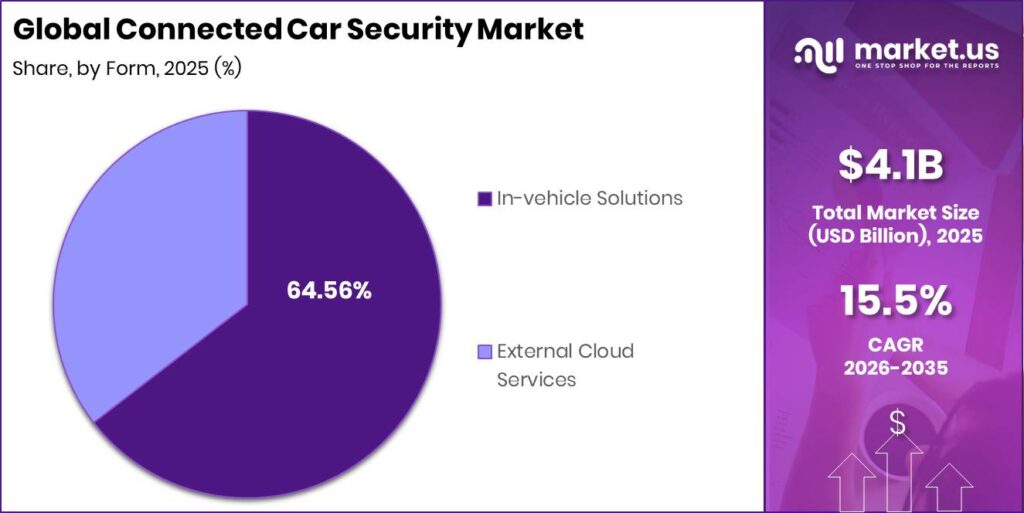
- In-vehicle Solutions dominated the Form segment with 64.56%.
- Internal Combustion Engine vehicles held 66.56% of the Propulsion segment.
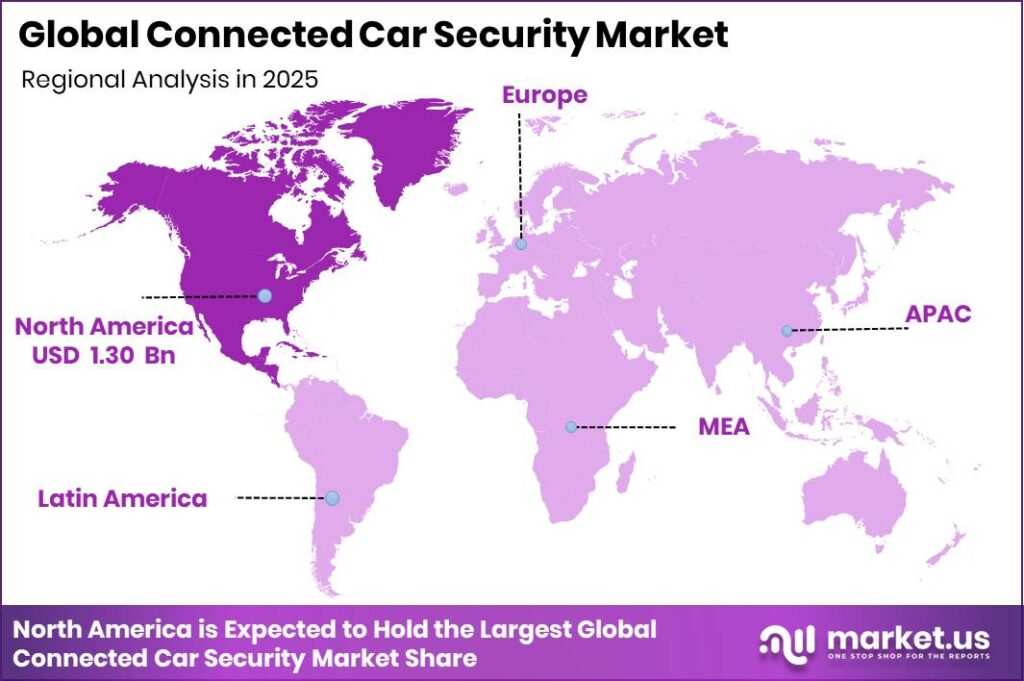
- North America led all regions with a 31.56% share, valued at USD 1.30 Billion.
Government regulation now sets the pace for this market. UNECE rules UN R155 and R156 require cybersecurity and software update management for new vehicles. As a result, OEMs must embed continuous security controls before they can sell vehicles in major markets. This means suppliers gain steady, multi-year demand instead of one-time project fees. 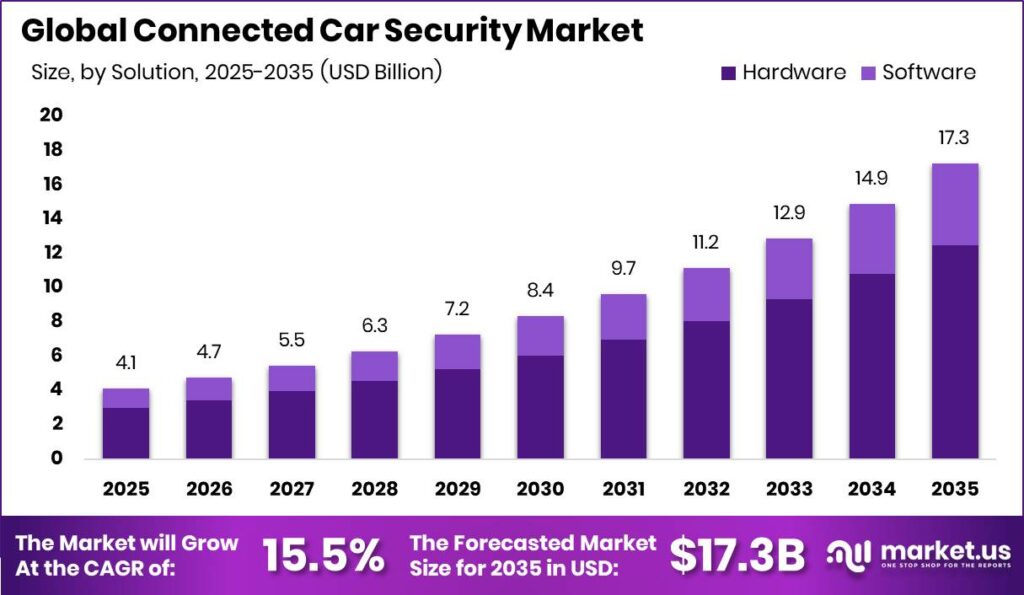
Threat volume reinforces this shift. As reported by Upstream Security, 494 automotive and smart-mobility cybersecurity incidents surfaced publicly in 2025, setting the industry benchmark sample. This rising incident count forces automakers to fund defense across entire fleets. Consequently, vendors offering fleet-wide monitoring gain a clear procurement advantage.
Attack economics deepen the urgency. Based on Upstream Security data, ransom-related attacks made up 44% of all reported automotive incidents in 2025. This concentration raises financial risk for exposed OEMs. Therefore, buyers now prioritize security platforms that reduce ransom exposure, expanding recurring revenue streams for security providers. In January 2025, Upstream Security added AI-driven threat detection to its Vehicle Security Operations Center platform to identify fleet attacks in real time.
Solution Analysis
Hardware dominates with 72.34% due to embedded secure gateway integration.
In 2025, Hardware held a dominant market position in the By Solution segment of Connected Car Security Market, with a 72.34% share. GSMA data shows annual connected-car connection sales reaching 91 million units by 2025, each requiring embedded secure chips. This scale locks demand into silicon-level protection. Vendors that own hardware roots of trust gain a defensible position over software-only rivals.
Software functions as the fastest growing sub-segment by enabling remote patching and updates. GSMA Intelligence projects 5.5 billion global 5G connections by 2030, widening the software attack surface across vehicle fleets. This shift rewards firms that ship secure over-the-air update platforms. Companies delaying software security investment risk losing OEM contracts to faster challengers.
The Solution segment splits cleanly between embedded protection and update-driven defense. UNECE R156 mandates software update management systems for new vehicle type approvals. This regulation forces both hardware and software vendors to align on lifecycle security. As a result, integrated hardware-software suppliers capture the widest share of OEM budgets.
Security Type Analysis
Network Security dominates with 45.67% due to fleet-wide communication threat exposure.
In 2025, Network Security held a dominant market position in the By Security Type segment of Connected Car Security Market, with a 45.67% share. Upstream Security found that telematics and cloud infrastructure caused 67% of reported automotive incidents in 2025. This exposure sits squarely at the network layer. Vendors defending vehicle communication channels therefore capture the largest security budgets.
Application Security serves as the fastest growing sub-segment as software-defined vehicles expand. Upstream Security data shows API-related attacks reached 17% of incidents in 2025, exceeding infotainment as an entry point. This trend pushes OEMs to secure application code and interfaces. Firms that protect vehicle apps gain fast-rising demand ahead of slower incumbents.
Endpoint Security protects individual in-vehicle control units against direct compromise. VicOne identified 1,384 automotive vulnerabilities in 2025, roughly 2.8 times the 2024 volume. This surge raises the value of device-level defense. Other Security Type solutions hold the remaining share collectively, covering niche diagnostic and gateway protection needs.
Application Analysis
ADAS and Autonomous Driving Systems dominate with 42.23% due to safety-critical driver-facing exposure.
In 2025, ADAS and Autonomous Driving Systems held a dominant market position in the By Application segment of Connected Car Security Market, with a 42.23% share. VicOne determined that 33% of automotive cyber risk directly affected driver-facing systems in 2025. This risk concentration makes ADAS protection non-negotiable. Vendors securing autonomous functions therefore command premium pricing.
Telematics Control Units act as the fastest growing sub-segment because they connect vehicles to external networks. VicOne data shows in-vehicle systems accounted for 39.7% of targeted automotive environments in 2025, above the 37.7% for enterprise IT. This gap signals rising attacker focus on vehicle telematics. Suppliers securing TCUs gain expanding contract volume.
Infotainment Systems and Communication Modules carry connectivity risk across cabin and network layers. VicOne reported that 89% of 2025 automotive vulnerabilities were published in the CVE database, exposing known weak points. This visibility helps attackers target unpatched units. Communication Modules and Others hold the remaining share collectively, covering gateway and auxiliary connectivity roles.
Form Analysis
In-vehicle Solutions dominate with 64.56% due to direct embedded onboard protection.
In 2025, In-vehicle Solutions held a dominant market position in the By Form segment of Connected Car Security Market, with a 64.56% share. RunSafe Security found that only 19% of surveyed drivers felt very confident their vehicles were protected. This low confidence pushes OEMs toward visible onboard defenses. Vendors offering embedded protection therefore win buyer trust and share.
External Cloud Services function as the fastest growing sub-segment by scaling threat detection across fleets. In a RunSafe survey of 2,000 connected-car drivers, 76% feared a remote attack could cause an accident. This fear drives demand for cloud-side monitoring. Providers of scalable cloud security gain rapid adoption as fleets grow.
Propulsion Analysis
Internal Combustion Engine dominates with 66.56% due to large installed vehicle base.
In 2025, Internal Combustion Engine held a dominant market position in the By Propulsion segment of Connected Car Security Market, with a 66.56% share. ACEA reported EU passenger cars averaged 12.5 years old in its 2025 fleet assessment. This aging base keeps ICE vehicles central to security demand. Vendors serving legacy platforms retain the widest addressable market.
Electric Vehicles serve as the fastest growing sub-segment as software-defined architectures spread. RunSafe found 83% of drivers wanted manufacturers to disclose software sources in connected vehicles. This demand favors transparent, secure-by-design EV platforms. Suppliers targeting EV security gain fast-rising contract opportunities as fleets electrify.
Key Market Segments
By Solution
- Software
- Hardware
By Security Type
- Endpoint Security
- Application Security
- Network Security
- Other Security Type
By Application
- Telematics Control Units (TCUs)
- Infotainment Systems
- ADAS and Autonomous Driving Systems
- Communication Modules
- Others
By Form
- In-vehicle Solutions
- External Cloud Services
By Propulsion
- Internal Combustion Engine (ICE)
- Electric Vehicle
Regional Analysis
North America Dominates the Connected Car Security Market with a Market Share of 31.56%, Valued at USD 1.30 Billion
North America led the Connected Car Security Market with a 31.56% share, valued at USD 1.30 Billion in 2025. Strong fleet monitoring adoption and early NHTSA cybersecurity guidance drive this lead. This regulatory push forces automakers to fund continuous vehicle defense. As a result, security vendors find the deepest and most stable demand pool in this region.
Asia-Pacific ranks as the fastest growing region as connected-vehicle production scales rapidly. Rising 5G rollout and expanding manufacturing hubs lift regional security spending. This growth creates fresh entry points for vendors outside established Western markets. Therefore, early movers into Asia-Pacific can secure share before local competition matures.
Key Regions and Countries
North America
- US
- Canada
Europe
- Germany
- France
- The UK
- Spain
- Italy
- Rest of Europe
Asia Pacific
- China
- Japan
- South Korea
- India
- Australia
- Rest of APAC
Latin America
- Brazil
- Mexico
- Rest of Latin America
Middle East and Africa
- GCC
- South Africa
- Rest of MEA
Market Dynamics
Market Opportunity Analysis - Underserved propulsion, form, and regional segments open entry points for new players
The Electric Vehicle propulsion sub-segment remains underexploited against the 66.56% ICE share. New entrants can target software-defined EV platforms before incumbents fully pivot. This gap exists because most security spend still flows to legacy ICE architectures. Therefore, vendors building EV-native protection can claim share while the segment is still forming.
External Cloud Services sit below the 64.56% In-vehicle Solutions share, marking clear white space. Cloud-side security scales across fleets without hardware redesign. This structural advantage suits agile software firms over hardware-heavy incumbents. As a result, early cloud specialists can capture fleet contracts ahead of slower onboard-focused rivals.
Asia-Pacific stands out as the fastest growing region against North America’s 31.56% lead. Rising connected-vehicle production creates demand outside saturated Western markets. This shift lets nimble entrants build local relationships early. Instead of competing head-on in North America, new players can anchor share in fast-scaling Asia-Pacific hubs.
Technology and Innovation Landscape - AI-native defense, V2X security, and SBOM automation redefine competitive edges
AI-native cybersecurity now shapes onboard protection. VicOne’s xPhinx detects prompt injection, jailbreak attempts, and data leakage in AI-powered vehicle cockpits. This capability matters as smart cockpits add new attack surfaces. Therefore, manufacturers adopting AI-native defense can protect emerging cabin systems that older tools miss.
Secure V2X communication marks a second innovation front. Qualcomm’s acquisition of Autotalks expanded its secure vehicle-to-everything portfolio for connected and autonomous vehicles. This move strengthens trusted communication between vehicles and infrastructure. As a result, suppliers investing in V2X security gain an edge as autonomous deployment scales.
Software Bill of Materials automation reshapes lifecycle security. C2A Security’s acquisition of Vigilant Ops added SBOM automation and lifecycle management to its EVSec platform. This tooling helps OEMs track every software component for compliance. Consequently, vendors offering automated SBOM support align directly with UNECE and CRA reporting demands.
Drivers
Regulatory enforcement has turned connected-car security from optional engineering spend into a condition of market access. UNECE rules require cybersecurity management, secure-by-design controls, fleet monitoring, incident response, and protected software updating. The Vehicle Certification Agency confirms that UN R155 and R156 govern vehicle cybersecurity and software-update management. In July 2024, these requirements extended to all newly registered vehicles in the European Union and Japan.
Deadlines keep tightening across major economies. In December 2024, the EU Cyber Resilience Act entered into force, setting reporting duties from September 2026 ahead of its principal December 2027 requirements. NHTSA guidance promotes network segmentation, encryption, and firmware protection, while Automotive ISAC’s 2025 guidance stresses vulnerability management. These mandates shift OEM procurement toward multi-year licensing, supporting an estimated +2.4% incremental CAGR contribution and stronger recurring revenue.
| Driver | (~) % Impact on CAGR Forecast | Geographic Relevance | Impact Timeline |
|---|---|---|---|
| Mandatory Vehicle Cybersecurity Compliance | +2.4% | Europe, Japan, South Korea | Short term (2 years or less) |
| Software-Defined Vehicle Expansion | +1.9% | Global | Medium term (2 to 4 years) |
| Fleet Threat-Monitoring Adoption | +1.4% | North America, Europe, East Asia | Short term (2 years or less) |
| Secure OTA Update Proliferation | +1.2% | Global | Short term (2 years or less) |
| Connected-Vehicle Attack Growth | +1.0% | Global | Short term (2 years or less) |
| Cybersecurity-by-Design Procurement | +0.8% | Europe, North America, East Asia | Medium term (2 to 4 years) |
Restraints
The installed vehicle base turns over too slowly for embedded security revenue to scale at the pace new-model connectivity implies. ACEA reported that EU passenger cars averaged 12.5 years old, light commercial vehicles 12.7 years, and trucks 14.1 years in its 2025 fleet assessment. An earlier ACEA dataset placed average EU car age at 12.3 years. This shows the bottleneck is structural, not cyclical.
UNECE’s framework applies through type approval, so it accelerates protection in new production but does not retrofit older vehicles lacking secure gateways. This leaves a large share of the road fleet unsuitable for full-stack endpoint security. Consequently, suppliers face an estimated -1.8% CAGR deduction, smaller serviceable volumes, and longer payback periods, while OEMs defer security spending until platform replacement.
| Restraint | (~) % Impact on CAGR Forecast | Geographic Relevance | Impact Timeline |
|---|---|---|---|
| Legacy Fleet Replacement Inertia | -1.8% | Europe, Latin America, Emerging Asia | Long term (4 years or more) |
| OEM Program Budget Compression | -1.5% | Global | Short term (2 years or less) |
| Privacy-Limited Data Monetization | -1.2% | Europe, California, China | Medium term (2 to 4 years) |
| Fragmented Type-Approval Regimes | -1.0% | Global | Medium term (2 to 4 years) |
| Low-Cost Vehicle Affordability Ceiling | -0.9% | South Asia, Africa, Latin America | Long term (4 years or more) |
| Long Automotive Qualification Cycles | -0.7% | Global | Medium term (2 to 4 years) |
Challenges
Connected vehicles inherit vulnerabilities from a dispersed chain of semiconductor, telematics, operating-system, cloud, and application suppliers. Verizon’s 2025 breach analysis found third-party involvement doubled from 15% to 30%, while vulnerability exploitation rose 34%. This shows ecosystem exposure is expanding faster than supplier-control capacity. Automotive ISAC’s 2025 guidance identifies third-party risk management as one of 5 essential domains.
The talent layer compounds this friction. ISC2 estimated a global cybersecurity workforce of 5.5 million against a 4.8 million shortfall in 2024, leaving nearly 47% of demand unmet. This gap slows software releases and raises containment costs, producing a -1.6% growth drag. Therefore, OEMs must impose software bills of materials and enforce patch windows over a 2-to-4-year horizon.
| Challenge | (~) % CAGR Friction Drag | Geographic Relevance | Mitigation Horizon |
|---|---|---|---|
| Multi-Tier Supplier Exposure | -1.6% | Global Automotive Hubs | Medium term (2 to 4 years) |
| Automotive Cyber Talent Deficit | -1.4% | Global | Long term (4 years or more) |
| Heterogeneous ECU Architectures | -1.2% | Global | Long term (4 years or more) |
| Real-Time Detection Constraints | -1.0% | Global | Medium term (2 to 4 years) |
| Post-Quantum Migration Complexity | -0.8% | North America, Europe, East Asia | Long term (4 years or more) |
| False-Positive Alert Burden | -0.6% | Global | Medium term (2 to 4 years) |
Opportunities
Vehicle security operations remain white space rather than a realized driver, since many OEMs still run fragmented monitoring and incident-response workflows. UNECE requires fleet-level threat detection, Automotive ISAC’s 2025 framework prioritizes vulnerability management, and NHTSA recommends cybersecurity-event logging. The addressable base will widen as GSMA projects 5.5 billion global 5G connections by 2030, with annual connected-car connection sales reaching 91 million by 2025.
Providers that consolidate monitoring, triage, and remote remediation into multi-year subscriptions could add roughly +1.9% CAGR upside. This model raises recurring-revenue gross margins by an estimated 6 to 10 percentage points over labor-heavy testing. As a result, per-vehicle monitoring costs fall by roughly 20% to 30% at fleet scale, favoring vendors with interoperable telemetry and automated remediation.
| Opportunity | (~) % Potential CAGR Upside | Geographic Relevance | Execution Window |
|---|---|---|---|
| Vehicle Security Operations Services | +1.9% | Global | Medium term (2 to 4 years) |
| Aftermarket Cyber Retrofit Kits | +1.5% | Europe, North America, Emerging Markets | Medium term (2 to 4 years) |
| Usage-Based Insurance Security Scoring | +1.2% | North America, Europe, East Asia | Medium term (2 to 4 years) |
| Commercial Fleet Security Bundles | +1.0% | North America, Europe, Asia-Pacific | Short term (2 years or less) |
| V2X Trust-Credential Services | +0.9% | China, Europe, North America | Long term (4 years or more) |
| Cross-Border Threat Intelligence | +0.7% | Global | Medium term (2 to 4 years) |
Key Company Insights
ARM anchors its position through processor architecture that embeds security at the silicon level for connected vehicles. This design reach gives ARM influence over how OEMs build secure gateways and roots of trust. Its licensing model spreads its technology across many chipmakers at once. However, dependence on downstream partners for final integration leaves gaps that pure security specialists can exploit.
AUMOVIO competes by focusing on automotive-specific electronic systems and connected-vehicle components. This specialization lets it align security features tightly with OEM platform needs. Its automotive heritage builds trust with manufacturers seeking proven suppliers. However, a narrower product scope limits its reach into cloud and network-layer defense, opening room for broader platform rivals to win multi-layer contracts.
Key Players
- ARM
- AUMOVIO
- BlackBerry
- Harman International
- Intertek
- Keysight Technologies
- KPIT Technologies
- NXP Semiconductors
- Secunet Security Networks
- Thales
- Other Key Players
Recent Developments
- June 2025: Qualcomm completed the acquisition of Autotalks, expanding its secure V2X communications portfolio for connected and autonomous vehicles.
- March 2025: VicOne launched xPhinx, an AI powered automotive cybersecurity solution that protects AI enabled smart cockpits from prompt injection, data leakage, and emerging cyber threats.
- October 2025: C2A Security acquired Vigilant Ops to enhance its EVSec platform with Software Bill of Materials automation and lifecycle cybersecurity management for software defined vehicles.
- April 2025: Karamba Security introduced an enhanced XGuard Automotive Integrity platform with runtime ECU protection and automated compliance support for UNECE R155 cybersecurity regulations.
Geopolitical Impact Analysis
Trade tensions now reshape connected-car security hardware sourcing. According to the WTO, global trade growth faces pressure as major economies raise duties on technology goods. The United States applied a 25% tariff on imported semiconductors in 2025, raising the cost of secure automotive chips. This increase lifts input prices for hardware roots of trust, which hold the segment’s 72.34% share. Therefore, OEMs face higher bills for embedded security silicon.
Supply chain rerouting adds further strain on component delivery. As reported by UNCTAD, shipping disruptions have pushed some transit times up by roughly 10 days on rerouted lanes. Longer routes delay delivery of telematics and communication modules central to network security. This friction raises inventory costs for suppliers serving global automotive hubs. Consequently, vendors with regional manufacturing gain a distribution edge over import-dependent rivals.
Report Scope
| Report Features | Description |
|---|---|
| Market Value (2025) | USD 4.1 Billion |
| Forecast Revenue (2035) | USD 17.3 Billion |
| CAGR (2026-2035) | 15.5% |
| Base Year for Estimation | 2025 |
| Historic Period | 2020-2024 |
| Forecast Period | 2026-2035 |
| Report Coverage | Revenue Forecast, Market Dynamics, Market Opportunity Analysis, Technology and Innovation Landscape, Competitive Landscape, Recent Developments |
| Segments Covered | By Solution (Software, Hardware), By Security Type (Endpoint Security, Application Security, Network Security, Other Security Type), By Application (Telematics Control Units, Infotainment Systems, ADAS and Autonomous Driving Systems, Communication Modules, Others), By Form (In-vehicle Solutions, External Cloud Services), By Propulsion (Internal Combustion Engine, Electric Vehicle) |
| Regional Analysis | North America (US and Canada), Europe (Germany, France, The UK, Spain, Italy, and Rest of Europe), Asia Pacific (China, Japan, South Korea, India, Australia, and Rest of APAC), Latin America (Brazil, Mexico, and Rest of Latin America), Middle East and Africa (GCC, South Africa, and Rest of MEA) |
| Competitive Landscape | ARM, AUMOVIO, BlackBerry, Harman International, Intertek, Keysight Technologies, KPIT Technologies, NXP Semiconductors, Secunet Security Networks, Thales, Other Key Players |
| Customization Scope | Customization for segments, region / country-level will be provided. Additional customization can be done based on requirements. |
| Purchase Options | We have three licenses to opt for: Single User License | Multi-User License (Up to 5 Users) | Corporate Use License (Unlimited User and Printable PDF) |





































