


Market Overview
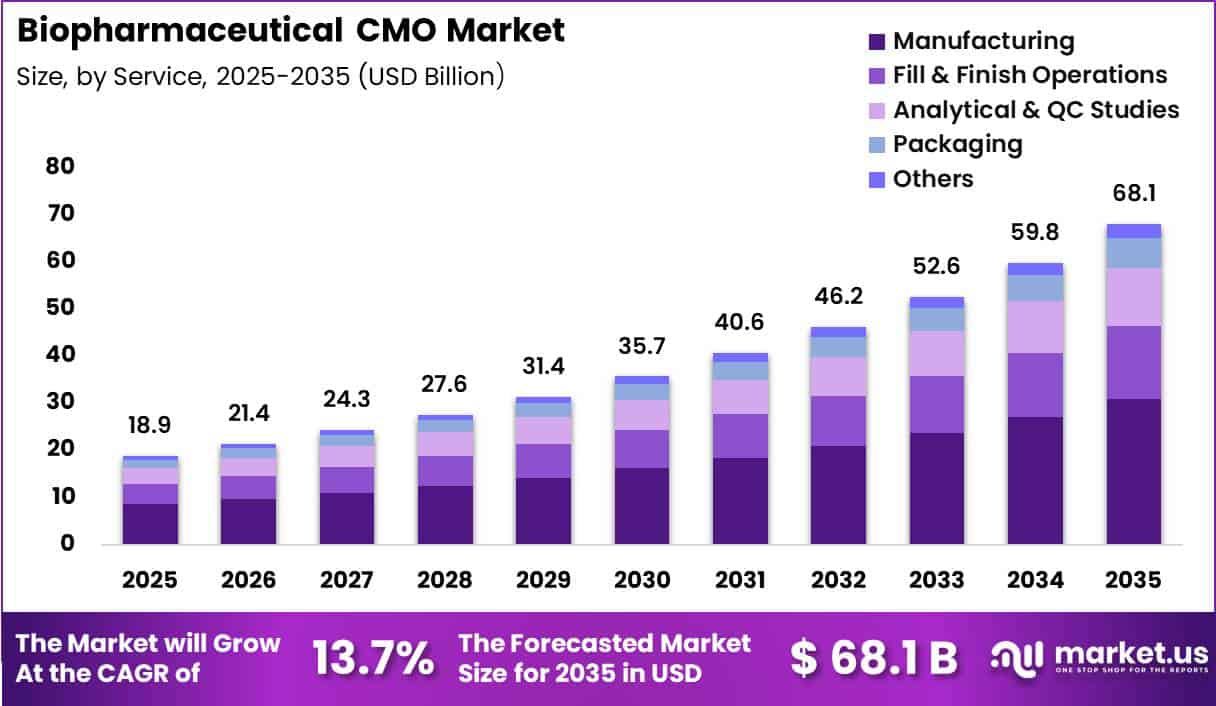
Global Biopharmaceutical CMO Market size is expected to be worth around US$ 68.1 Billion by 2035 from US$ 18.9 Billion in 2025, growing at a CAGR of 13.7% during the forecast period from 2026 to 2035. In 2025, North America led the market, achieving over 39.4% share with a revenue of US$ 7.4 Billion.
The Biopharmaceutical Contract Manufacturing Organization (CMO) Market is becoming increasingly important as pharmaceutical and biotechnology companies seek specialized manufacturing capabilities for biologics and other complex therapies. CMOs can support activities across biologics development and manufacturing, including production processes, quality control, quality assessment, and regulatory requirements.
The growing complexity of biological medicines is creating demand for advanced manufacturing expertise. The U.S. Food and Drug Administration (FDA) stated in January 2026 that its Center for Biologics Evaluation and Research (CBER) had approved close to 50 cell and gene therapies over the previous decade.
The agency also announced greater flexibility in certain chemistry, manufacturing, and controls (CMC) requirements for cell and gene therapies, highlighting the importance of specialized manufacturing approaches for these products.
Supply-chain resilience is another important factor influencing pharmaceutical manufacturing strategies. According to the FDA, in 2025, approximately 53% of branded drug products and 69% of generic drug products were manufactured outside the United States. This has increased attention on domestic production capacity and resilient pharmaceutical supply chains.
Global biomanufacturing capabilities are also expanding. WHO reported that its Global Training Hub for Biomanufacturing had provided introductory courses to more than 1,190 participants from 75 low- and middle-income countries, while a 2026 program was planned for 130 trainees. These initiatives demonstrate the growing global focus on strengthening biologics manufacturing skills and capacity.
Key Takeaways
- Market Size: Global Biopharmaceutical CMO Market size is expected to be worth around US$ 68.1 Billion by 2035 from US$ 18.9 Billion in 2025.
- Market Share: The market is growing at a CAGR of 13.7% during the forecast period from 2026 to 2035.
- Service: The service segment of the Biopharmaceutical CMO Market is led by Manufacturing segments, including Upstream Processing and Downstream Processing, which accounted for 45.3% market share in 2025.
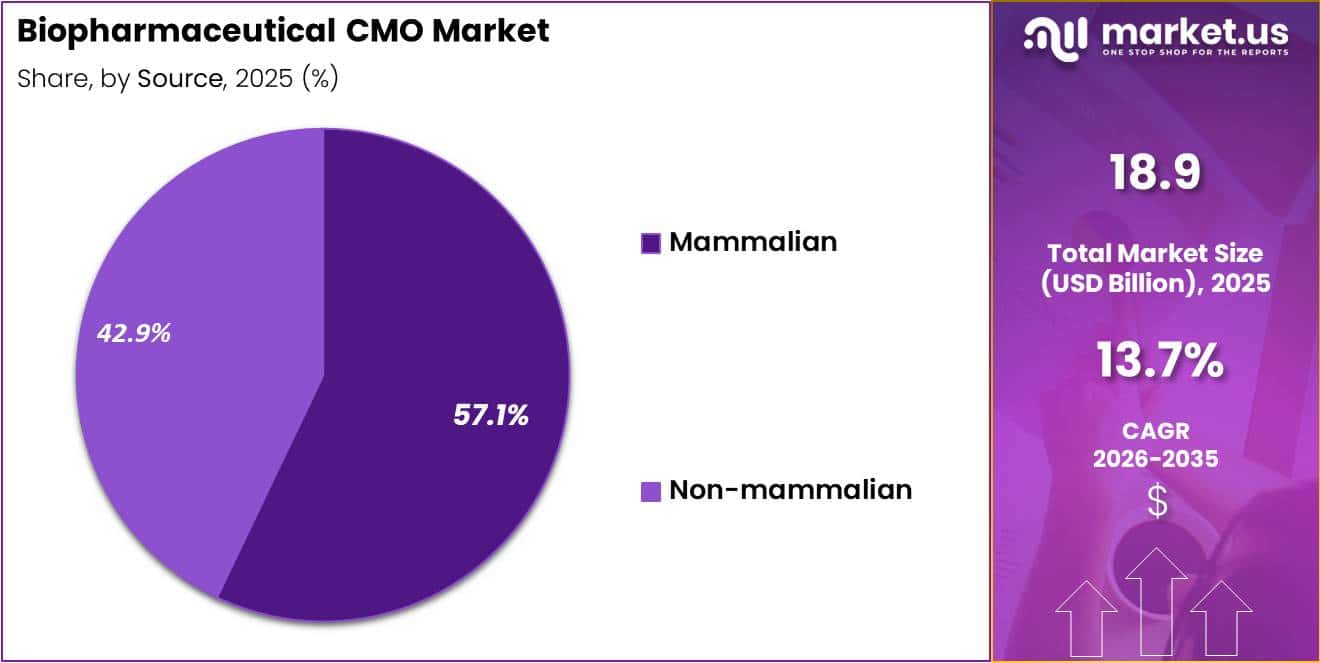
- Source: The source segment of the Biopharmaceutical CMO Market is dominated by Mammalian sources, which accounted for 57.1% market share in 2025.
- Product: The product segment of the Biopharmaceutical CMO Market is led by Biologics, which accounted for 78.2% market share in 2025.
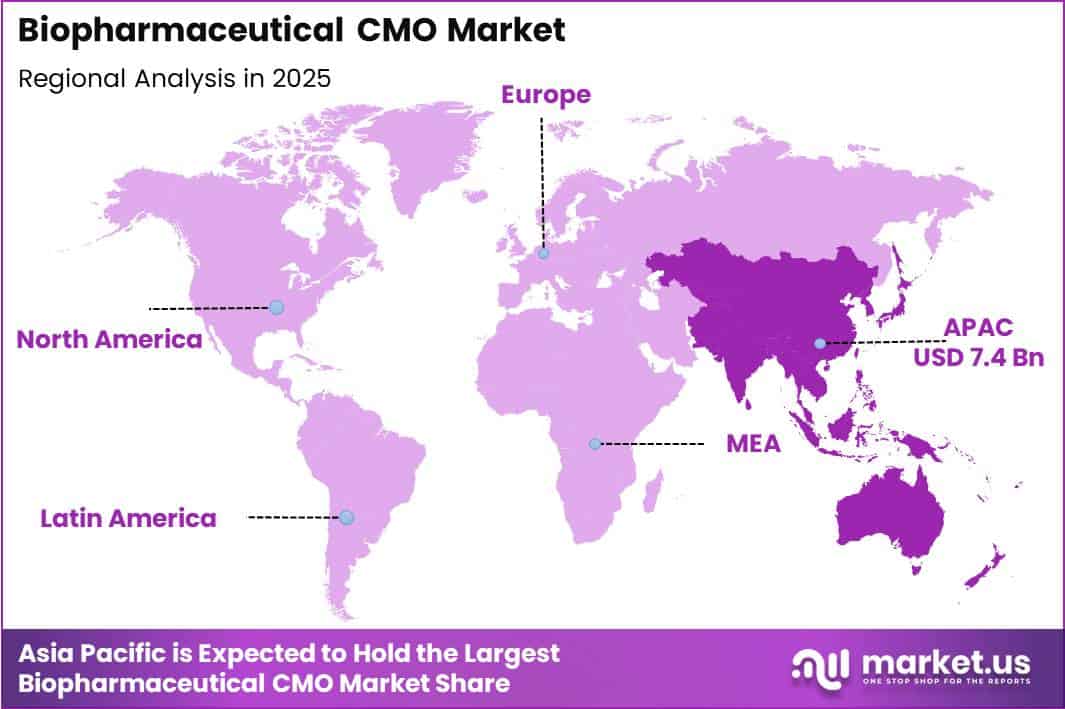
- Regional Analysis: In 2025, North America led the market, achieving over 39.4% share with a revenue of US$ 7.4 Billion.
Service Analysis
Service segment of the Biopharmaceutical CMO Market is led by Manufacturing segments.
The service segment of the Biopharmaceutical CMO Market is led by Manufacturing segments, including Upstream Processing and Downstream Processing, which accounted for 45.3% market share in 2025.
These services represent the core of biopharmaceutical production, covering cell culture, fermentation, purification, and other critical activities required to produce high-quality biologic medicines at commercial scale. Growing outsourcing by pharmaceutical and biotechnology companies is supporting demand for flexible manufacturing capacity and specialized technical expertise.
Fill & Finish Operations represented 22.8% of the market and are expected to be the fastest-growing service segment, driven by increasing demand for sterile filling, vial filling, prefilled syringes, and other final drug-product manufacturing activities.
Analytical & QC Studies held an 18.2% share, reflecting the growing importance of quality testing, process validation, and regulatory compliance throughout biologics development and manufacturing. Packaging contributed 9.2%, supported by demand for specialized packaging solutions for temperature-sensitive biologics.
Others accounted for the remaining 4.5%, including complementary services that support biopharmaceutical production and supply-chain operations.
Source Analysis
Source segment of the Biopharmaceutical CMO Market is dominated by Mammalian sources.
The source segment of the Biopharmaceutical CMO Market is dominated by Mammalian sources, which accounted for 57.1% market share in 2025. Mammalian cell-based production is widely used for complex biologics because these systems can support advanced protein folding and post-translational modifications required for many therapeutic products.
The segment benefits from continued demand for monoclonal antibodies, recombinant proteins, and other sophisticated biologic therapies. As pharmaceutical companies increasingly outsource development and manufacturing activities, CMOs with established mammalian cell culture capabilities are positioned to attract growing demand.
Non-mammalian sources accounted for 42.9% of the market in 2025. This category includes microbial and other expression systems that are particularly useful for producing selected recombinant proteins, enzymes, and therapeutic molecules.
Non-mammalian platforms can offer advantages such as faster production cycles, scalable fermentation, and potentially lower manufacturing costs for suitable products. Overall, both source categories remain important to the outsourcing ecosystem, while mammalian systems maintain leadership because of their strong alignment with the production requirements of complex biologic medicines.
Product Analysis
Product segment of the Biopharmaceutical CMO Market is led by Biologics.
The product segment of the Biopharmaceutical CMO Market is led by Biologics, which accounted for 78.2% market share in 2025. This broad category includes monoclonal antibodies (MAbs), recombinant proteins, vaccines, antisense, RNAi and molecular therapies, and other biologic products.
The strong position of biologics reflects increasing pharmaceutical investment in targeted therapies and advanced treatments, as well as the growing complexity of biologic development and manufacturing. Monoclonal antibodies represent a major component of outsourced biologics production because of their widespread use across oncology, autoimmune diseases, and other therapeutic areas.
Recombinant proteins and vaccines also contribute significantly to outsourcing demand, while newer modalities such as antisense, RNAi, and molecular therapies are creating additional opportunities for specialized CMO capabilities.
The remaining product category, Biosimilars, accounted for 21.8% of the market in 2025, covering additional biopharmaceutical products outside the major biologics groups. Overall, the product landscape demonstrates a strong shift toward complex, high-value biologic therapies, encouraging pharmaceutical companies to collaborate with specialized CMOs for development, manufacturing, quality control, and commercialization support.
Key Market Segments
By Service
- Manufacturing
- Upstream Processing
- Downstream Processing
- Fill & Finish Operations
- Analytical & QC Studies
- Packaging
- Others
By Source
- Mammalian
- Non-mammalian
By Product
- Biologics
- Monoclonal antibodies (MAbs)
- Recombinant Proteins
- Vaccines
- Antisense, RNAi, & Molecular Therapy
- Others
- Biosimilars
Drivers
Biologics Pipeline Complexity Drives Integrated CMO Demand Growth.
Biopharmaceutical sponsors are increasingly outsourcing because biologics programs now require linked development, analytical, GMP scale-up, fill-finish, and regulatory support rather than isolated batch manufacturing, which favors CMOs that can keep process knowledge inside one operating system from cell line or upstream development through commercial supply.
In practice, this changes the business model from fee-for-batch manufacturing toward multi-year platform contracts with bundled process characterization, comparability packages, validation support, and lifecycle management. That expands revenue per molecule and reduces sponsor willingness to dual-source early unless a program reaches very high volume or risk diversification thresholds.
For 2026 forecasting, the incremental effect is strongest in monoclonal antibodies, recombinant proteins, and sterile biologics, where one failed transfer or delayed PPQ campaign can cost quarters of launch timing. Integrated CMO networks capture value through higher utilization of single-use bioreactors, analytical release labs, and high-margin clinical-to-commercial conversion work rather than only bulk drug substance slots.
Regulatory pressure is a direct demand catalyst because FDA frames CGMP as the minimum requirement governing facilities, controls, equipment, strength, identity, and manufacturing reliability, while sterile processing guidance reinforces demanding controls around facility design, environmental monitoring, qualification, and aseptic process simulation.
This raises the fixed-cost threshold for internal manufacturing: sterile biologics operations must sustain ISO-classified environments, HEPA-managed pressure cascades, validated sterilization paths, media fills, trained gowning-qualified staff, and deviation investigation systems, which makes subscale internal sites economically unattractive for small and mid-size biopharma sponsors.
The resulting outsourcing effect is strongest in the next 24 months because FDA also links shortages to manufacturing and quality problems, so sponsors increasingly favor CMOs with inspection-ready quality systems, redundant fill-finish lines, and prequalified contamination-control programs to reduce remediation risk, batch loss, and supply interruption probability.
| Driver | (~) % Impact on CAGR Forecast | Geographic Relevance | Impact Timeline |
|---|---|---|---|
| Biologics pipeline complexity lifting integrated outsourcing demand | 2.4% | North America core, EU, APAC biologics hubs | Medium term (2-4 years) |
| GMP and aseptic compliance tightening raising barriers to in-house manufacture | 1.8% | North America core, EU, Japan, South Korea, Singapore | Short term (≤ 2 years) |
| Biosimilar pricing pressure and Medicare reimbursement reform expanding outsourced supply | 1.5% | U.S. core, EU biosimilar markets, APAC export corridors | Medium term (2-4 years) |
| Regionalized resilience and sovereign biomanufacturing investment re-routing capacity | 1.3% | U.S., EU, India, South Korea, Middle East spill-over | Long term (≥ 4 years) |
| mRNA and next-wave platform transfer creating new development-to-commercial slots | 1.1% | EU, LMIC manufacturing networks, APAC corridors, North America spill-over | Medium term (2-4 years) |
| End-to-end tech transfer models reducing launch risk and accelerating commercialization | 1.0% | North America core, EU, China-plus-one APAC networks | Short term (≤ 2 years) |
Challenges
Complex Biologics Regulation Increases CMO Operational Barriers.
Regulatory complexity around biologics, biosimilars, and cell-based products imposes persistent friction on CMOs, primarily through elongated development timelines and increased compliance overhead rather than outright market freezes, as firms must navigate evolving guidance on manufacturing changes, comparability, and safety testing.
In the US, current good manufacturing practice requirements under 21 CFR parts 210, 211, 212, and 600–680, coupled with pre-approval and surveillance inspections, routinely add 6–12 months to tech transfer and commercialization cycles for complex biologics, with large CMOs frequently managing 30–60 active regulatory interactions per year across BLAs and INDs.
Draft guidance for allogeneic cell-based products in 2024 requires expanded safety testing, including tighter control of cell banks, reagents, and genome-edited cells, which can increase analytical workload by 20–30 assays per product and push per-project compliance spend 8–12% higher, effectively shaving around 1.2% points off otherwise achievable annual growth by forcing capacity to be reserved for validation, documentation, and remediation rather than incremental commercial runs.
Strategically, CMOs are responding by building centralized regulatory operations teams of 40–80 FTEs at top-tier facilities, investing in standardized change-control digital workflows, and developing playbooks for post-approval manufacturing changes so that typical cycle times for moderate-risk changes (CBE30) can be compressed from 9–10 months toward 6–7 months, with the long-term goal of restoring roughly half of the modeled regulatory drag once harmonization and internal analytics platforms mature over a 4–7-year horizon.
| Challenge | (~) % CAGR Friction Drag | Geographic Relevance | Mitigation Horizon |
|---|---|---|---|
| Complex biologics regulation | -1.2% | North America, EU hubs | Long term (≥ 4 years) |
| Advanced therapy capacity bottlenecks | -1.0% | North America core, EU, APAC | Medium term (2-4 years) |
| Skilled bioprocess talent gap | -0.8% | US, EU, Asia biotech clusters | Long term (≥ 4 years) |
| Single-use supply chain volatility | -0.7% | Global biologics corridors | Medium term (2-4 years) |
| Tech transfer and scale-up friction | -0.9% | Global large-molecule sites | Medium term (2-4 years) |
| Quality, inspection, and compliance burden | -0.6% | US, EU, regulated APAC | Long term (≥ 4 years) |
Restraints
Escalating GMP Enforcement Increases Biologics CMO Compliance Challenges.
Across 2024–2026, regulators have intensified inspection cadence and guidance density for biologics and advanced therapies, creating a harsher enforcement landscape in which a single data integrity or sterility breach can shut down a CMO line for 3–9 months and ripple across sponsor supply chains.
FDA and EMA biologics-related agendas list dozens of new or updated guidances, spanning donor eligibility, microbial testing validation, combination products, and cellular and gene therapies, which translate operationally into incremental documentation, electronic batch record upgrades, and frequent SOP re-writes that can absorb 2–4% of annual revenue as compliance OpEx rather than productive capacity, especially in multi-site networks.
With inspection findings increasingly triggering import alerts or consent decrees, conservative internal modeling suggests that 3–5% of global CMO capacity could be intermittently constrained each year due to remediation, with individual sites facing 20–30% throughput reductions during corrective action periods, and remediation programs often carrying budgets of USD 10–30 million per facility over 18–24 months, including requalification runs and third-party audits.
At the sponsor interface, contract negotiations respond by embedding stricter quality KPIs, mandatory redundancy, and step-in rights, but these protections come at the cost of duplicated campaigns across multiple CMOs, 15–25% higher total cost of quality, and longer tech transfer sequences, often expanded from 9–12 months to 15–18 months for complex biologics, eroding time-to-market advantages that outsourcing originally promised.
Strategically, CMOs must divert capital from new capacity toward quality systems, data historians, validated analytics platforms, and enhanced cleaning validation, with 20–30% of planned CapEx for expansion reallocated to compliance and digital infrastructure between 2026 and 2028, slowing global capacity additions and tempering growth momentum.
Altogether, heightened GMP and data integrity enforcement subtracts an estimated 1.9% points from baseline CMO CAGR by throttling effective capacity, inflating fixed cost structures, and raising the hurdle rate for new investments across US, EU, and highly regulated Asian markets.
| Restraint | (~) % Impact on CAGR Forecast | Geographic Relevance | Impact Timeline |
|---|---|---|---|
| IRA-linked pricing compression on biologics outsourcing | -2.2% | US core, EU spillover | Medium term (2–4 years) |
| Escalating GMP and data integrity enforcement risk | -1.9% | US, EU, Japan, select APAC | Short–Medium term (≤ 4 years) |
| Chronic drug shortage and API supply fragility | -1.7% | US, EU, global API corridors | Short term (≤ 2 years) |
| Cell & gene therapy regulatory complexity and tech transfer drag | -1.5% | US, EU, UK, Japan | Medium–Long term (≥ 3 years) |
| Bioreactor, single-use, and skilled labor capacity constraints | -1.4% | North America, EU, East Asia | Short–Medium term (≤ 4 years) |
| Serialization and traceability compliance (DSCSA-like, EU FMD) | -1.1% | US, EU, select LATAM/APAC | Medium term (2–4 years) |
Opportunity
Quality-Led Pricing Models Enhance CMO Revenue Growth Potential.
Quality-led premium pricing and risk-sharing commercial models constitute an upside opportunity because current baseline revenue projections generally assume conventional per-batch or per-volume pricing with limited explicit monetization of high regulatory and quality performance, even though regulatory bodies repeatedly highlight manufacturing quality deficiencies and warning letters as a key bottleneck in biologics supply.
Biopharmaceutical CMOs that can demonstrate superior track records, measured by fewer FDA Form 483 observations, shorter deviation closure times, and robust process validation metrics, can credibly structure contracts where 10–20% of fees are linked to key performance indicators such as batch release cycle time, right-first-time rates, and inspection readiness.
If CMOs capture even a 5–10% pricing premium on programs with complex biologics or high-risk modalities, combined with performance-linked bonuses tied to lower recall risk and smoother regulatory approvals, this can expand per-program margins by 300–500 basis points without materially increasing operating expenses, as much of the required quality infrastructure overlaps with regulatory expectations anyway. Such models are not yet widely embedded in standard contracts, which is why they represent upside rather than a baseline driver.
As innovator firms face rising costs from failed inspections and supply interruptions, they will be more willing to accept value-based manufacturing fees tied to quality outcomes, particularly in North America and the EU5 markets where regulatory scrutiny is highest.
The estimated 1.6% point CAGR uplift assumes that a subset of CMOs (perhaps 25–30% of market revenue by 2030) adopt these models, increasing average revenue per program by 5–8% while improving customer retention due to the perceived reduction in regulatory and operational risk.
| Opportunity | (~) % Potential CAGR Upside | Geographic Relevance | Execution Window |
|---|---|---|---|
| Integrated CGT & mRNA platforms | 2.8% | North America, EU, APAC emerging | Medium term (2-4 years) |
| Mid-scale biologics for regional biopharma | 1.9% | Asia (ex-Japan), LATAM, CEE | Medium term (2-4 years) |
| Quality-led premium pricing & risk-sharing | 1.6% | North America core, EU5 | Short term (≤ 2 years) |
| Digital QMS & continuous analytics services | 1.4% | Global, highly regulated markets | Short term (≤ 2 years) |
| Strategic M&A roll-ups of niche CMOs | 2.2% | North America, Western Europe | Long term (≥ 4 years) |
| Value-based manufacturing for high-cost biologics | 1.7% | US, EU, select GCC | Medium term (2-4 years) |
Regional Analysis
North America dominated the Biopharmaceutical CMO Market.
North America led the Biopharmaceutical CMO Market in 2025, accounting for over 39.4% of the global market and generating approximately US$ 7.4 billion in revenue.
The region’s leadership is supported by its well-established biopharmaceutical manufacturing ecosystem, strong presence of biotechnology companies, advanced research infrastructure, and increasing demand for outsourced manufacturing services. The United States remains a major contributor, supported by a high concentration of biologics developers, CMOs, and specialized manufacturing facilities.
Rising demand for monoclonal antibodies, recombinant proteins, vaccines, and other biologics is encouraging pharmaceutical companies to outsource manufacturing to improve flexibility, scalability, and production timelines.
North America also benefits from advanced capabilities in upstream and downstream processing, fill-and-finish operations, analytical testing, and quality control. Growing investments in biopharmaceutical manufacturing capacity and strategic partnerships between pharmaceutical companies and CMOs are further strengthening the region’s position.
Key Regions and Countries
North America
- The US
- Canada
Europe
- Germany
- France
- The U.K.
- Italy
- Spain
- Russia & CIS
- Rest of Europe
Asia Pacific
- China
- India
- Japan
- South Korea
- ASEAN
- Australia & New Zealand
- Rest of Asia Pacific
Middle East & Africa
- GCC
- South Africa
- Rest of Middle East & Africa
Latin America
- Brazil
- Mexico
- Rest of Latin America
Key Player Analysis
The Biopharmaceutical CMO Market is moderately consolidated, with leading global providers competing alongside specialized and regional organizations. Competitive dynamics are shaped by manufacturing capacity, technical expertise, regulatory compliance, speed-to-market, and the ability to support biologics across the development lifecycle.
Lonza Group AG, Catalent, Inc., Thermo Fisher Scientific Inc., Samsung Biologics Co., Ltd., WuXi Biologics (Cayman) Inc., and Fujifilm Diosynth Biotechnologies maintain strong positions through broad manufacturing capabilities and integrated service portfolios.
Meanwhile, Abzena plc, AGC Biologics, Binex Co., Ltd., BIOTEC Services International Ltd., Boehringer Ingelheim International GmbH, Celonic AG, Evonik Industries AG, KBI Biopharma, Inc., ProBioGen AG, and Recipharm AB strengthen competition through specialized expertise, flexible production, and targeted biologics services.
Competitive strategies increasingly focus on R&D investment, strategic partnerships, process innovation, and workflow integration. Companies are expanding capabilities in cell-line development, process development, analytical testing, clinical manufacturing, commercial-scale production, and fill-finish services.
Partnerships with biotechnology and pharmaceutical companies help accelerate development timelines and improve manufacturing scalability. Product and process innovation, including advanced biologics platforms and optimized production technologies, remains a major priority.
Ecosystem-based competition is also increasing, as CMOs seek to provide end-to-end solutions that integrate development, manufacturing, quality control, and regulatory support, enabling customers to reduce complexity and streamline biologics commercialization.
Top Key Players
- Lonza Group AG
- Abzena plc
- AGC Biologics
- Binex Co., Ltd.
- BIOTEC Services International Ltd.
- Boehringer Ingelheim International GmbH
- Catalent, Inc.
- Celonic AG
- Evonik Industries AG
- Fujifilm Diosynth Biotechnologies
- KBI Biopharma, Inc.
- ProBioGen AG
- Recipharm AB
- Samsung Biologics Co., Ltd.
- Thermo Fisher Scientific Inc.
- WuXi Biologics (Cayman) Inc.
Recent Developments
- In April 2025, Lonza Group AG: Lonza implemented a new operating model built around three CDMO business platforms—Integrated Biologics, Advanced Synthesis, and Specialized Modalities. The restructuring is strategically important because it is designed to integrate technology platforms and customer partnerships more closely, strengthening its end-to-end outsourcing proposition.
- In February 2026, FUJIFILM Biotechnologies: The company unveiled a significantly expanded UK biomanufacturing and process-development presence, backed by approximately £400 million in investment from FUJIFILM Corporation. The expansion includes a large single-use biopharmaceutical CDMO facility, strengthening the UK’s capacity for commercial-scale biologics production and supporting the company’s global manufacturing network.
- In March 2025, Samsung Biologics Co., Ltd.: Samsung Biologics expanded its manufacturing portfolio with the start of operations at a dedicated antibody-drug conjugate (ADC) facility in Songdo. The move strengthens its ability to support newer biologic modalities and broadens its manufacturing offering beyond conventional antibody production.
Report Scope
| Report Features | Description |
|---|---|
| Market Value (2025) | US$ 18.9 Billion |
| Forecast Revenue (2035) | US$ 68.1 Billion |
| CAGR (2026-2035) | 13.7% |
| Base Year for Estimation | 2025 |
| Historic Period | 2020-2024 |
| Forecast Period | 2026-2035 |
| Report Coverage | Revenue Forecast, Market Dynamics, Competitive Landscape, Recent Developments |
| Segments Covered | By Service (Manufacturing (Upstream Processing, Downstream Processing), Fill & Finish Operations, Analytical & QC Studies, Packaging, Others), By Source (Mammalian, Non-mammalian), By Product (Biologics (Monoclonal antibodies (MAbs), Recombinant Proteins, Vaccines, Antisense, RNAi, & Molecular Therapy, Others), Biosimilars) |
| Regional Analysis | North America – The US, Canada; Europe – Germany, France, U.K., Italy, Spain, Russia & CIS, Rest of Europe; Asia Pacific – China, India, Japan, South Korea, ASEAN, Australia & New Zealand, Rest of Asia Pacific; Middle East & Africa – GCC, South Africa, Rest of Middle East & Africa; Latin America – Brazil, Mexico, Rest of Latin America |
| Competitive Landscape | Lonza Group AG, Abzena plc, AGC Biologics, Binex Co., Ltd., BIOTEC Services International Ltd., Boehringer Ingelheim International GmbH, Catalent, Inc., Celonic AG, Evonik Industries AG, Fujifilm Diosynth Biotechnologies, KBI Biopharma, Inc., ProBioGen AG, Recipharm AB, Samsung Biologics Co., Ltd., Thermo Fisher Scientific Inc., WuXi Biologics (Cayman) Inc. |
| Customization Scope | Customization for segments, region/country-level will be provided. Moreover, additional customization can be done based on the requirements. |
| Purchase Options | We have three licenses to opt for: Single User License, Multi-User License (Up to 5 Users), Corporate Use License (Unlimited User and Printable PDF) |





































