


Global Benzenoid Market Size, Share, And Industry Analysis Report By Product Type (Benzaldehyde, Benzoic Acid, Toluene, Xylene, Styrene, Others), By Source (Natural, Synthetic), By Application (Flavor and Fragrance, Food and Beverages, Pharmaceuticals, Polymers and Plastics, Paints and Coatings, Others), By Region and Companies - Industry Segment Outlook, Market Assessment, Competition Scenario, Statistics, Trends and Forecast 2025-2034
- Published date: February 2026
- Report ID: 178903
- Number of Pages: 296
- Format:
-
keyboard_arrow_up
Quick Navigation
Report Overview
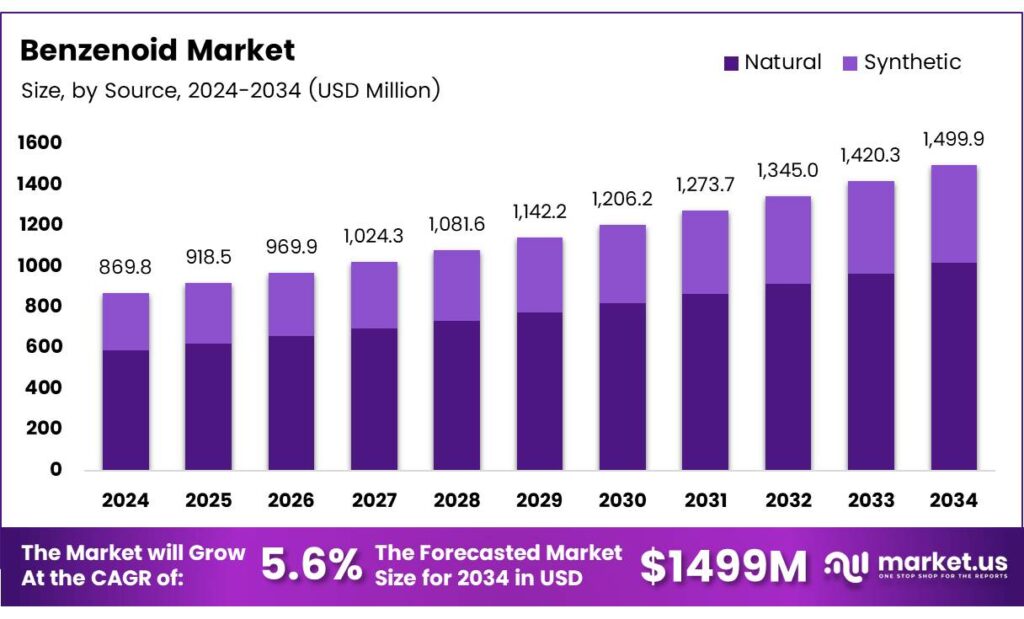
The Global Benzenoid Market size is expected to be worth around USD 1,499.9 million by 2034 from USD 869.8 million in 2024, growing at a CAGR of 5.6% during the forecast period 2025 to 2034.
The benzenoid market covers a wide class of aromatic organic compounds derived from benzene. These molecules serve as critical building blocks across flavors, fragrances, pharmaceuticals, and polymer industries. Moreover, their diverse chemical properties make them highly versatile intermediates in both industrial and consumer-facing applications.
Benzenoids include compounds such as benzaldehyde, benzoic acid, toluene, xylene, and styrene. Manufacturers source these either from natural plant-based materials or through synthetic petrochemical routes. Consequently, the market spans a broad spectrum of production methods, quality grades, and downstream end-use segments.
- The United States exported HS 3302 odoriferous substances and aroma mixtures valued at $14,940,418.06 thousand, positioning it as one of the largest country-level exporters globally. This scale underscores the massive commercial demand for benzenoid-linked aroma ingredients across end-use industries.
- The European Union’s exports of odoriferous substances under HS code 3302 reached $8,812,692.64 thousand, representing 15.5% of total world exports. This confirms the EU as a dominant regional producer and supplier of benzenoid-based aroma and fragrance ingredients.
Consumer demand for premium personal care and cosmetic products continues to fuel benzenoid adoption. Fragrance houses and flavor manufacturers rely heavily on these aromatic compounds to deliver consistent sensory experiences. Additionally, the pharmaceutical sector uses benzenoids as active pharmaceutical ingredient intermediates, further broadening the application scope.
Key Takeaways
- The Global Benzenoid Market was valued at USD 869.8 million in 2024 and is projected to reach USD 1,499.9 million by 2034, at a CAGR of 5.6% during the forecast period 2025 to 2034.
- Benzaldehyde held the dominant market share at 44.9% in 2025.
- The Natural segment led the market with a 59.6% share in 2025.
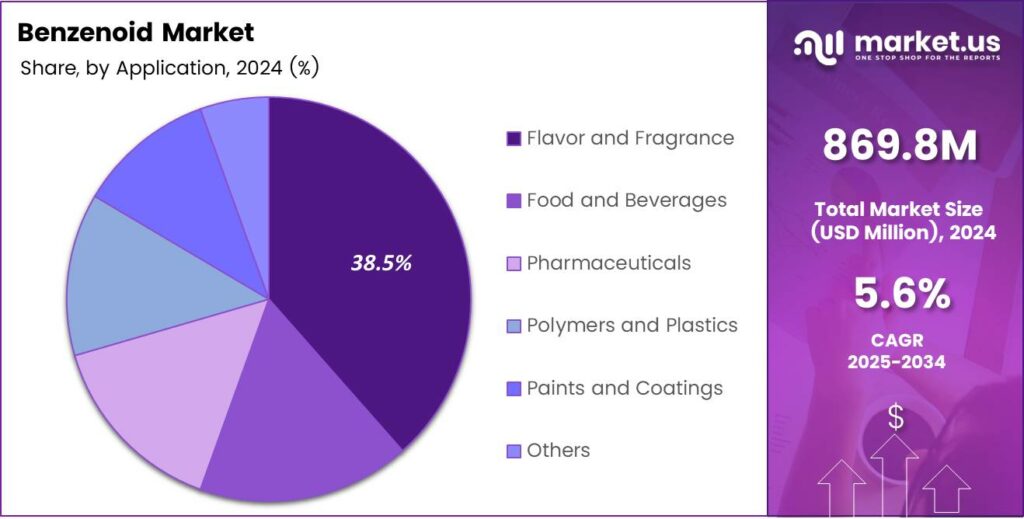
- Flavor and Fragrance was the leading segment, accounting for 38.5% of the market in 2025.
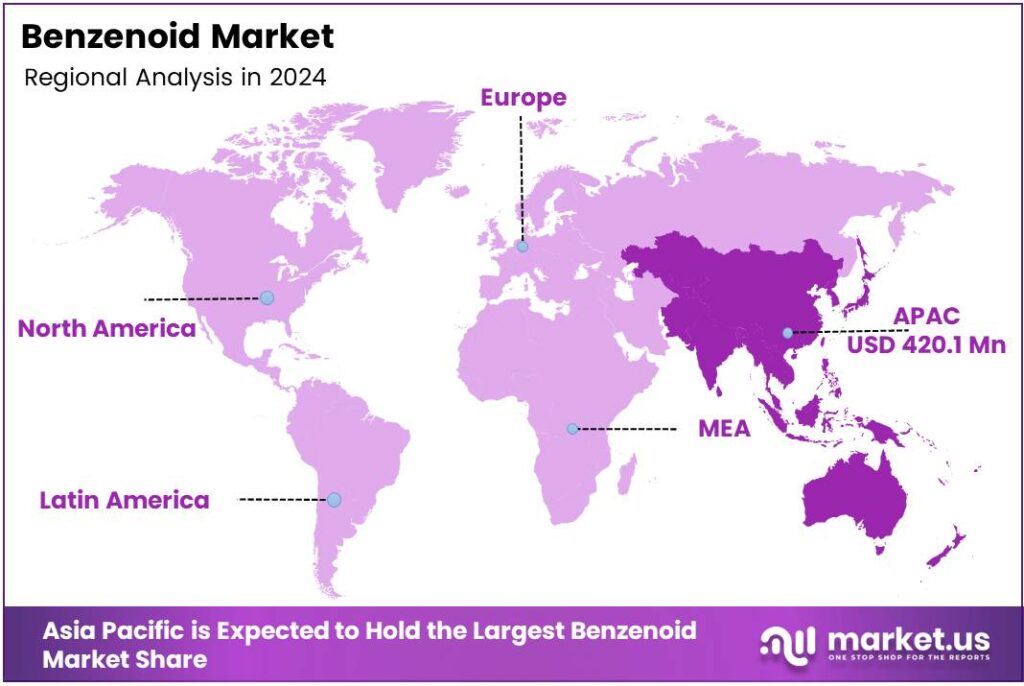
- Asia Pacific dominated the regional landscape with a 48.3% share, valued at USD 420.1 million.
Product Type Analysis
Benzaldehyde dominates with 44.9% due to its widespread use in flavors, fragrances, and pharmaceutical synthesis.
In 2025, Benzaldehyde held a dominant market position in the By Product Type segment of the Benzenoid Market, with a 44.9% share. Its almond-like aroma and chemical reactivity make it a top choice for fragrance houses and pharmaceutical manufacturers. Moreover, its compatibility with both natural and synthetic production routes reinforces its commercial leadership.
Benzoic Acid serves as a key preservative and intermediate in the food, pharmaceutical, and plastics industries. Its antimicrobial properties drive adoption in food and beverage applications. Additionally, it functions as a precursor in the synthesis of several important downstream chemical compounds used across industrial sectors.
Toluene and Xylene are widely used as solvents and petrochemical feedstocks in paints, coatings, and polymer manufacturing. These aromatic hydrocarbons support large-scale industrial operations. Consequently, their demand remains tightly linked to construction activity and the expanding paints and coatings sector in emerging economies.
Styrene plays a central role in plastics, rubber, and resin production. Manufacturers use it extensively to produce polystyrene and styrene-butadiene rubber. Furthermore, the Others sub-segment captures niche benzenoid derivatives that serve specialty chemical, agricultural, and research applications with growing commercial relevance.
Source Analysis
Natural source dominates with 59.6% due to rising clean-label demand and consumer preference for plant-derived ingredients.
In 2025, Natural held a dominant market position in the By Source segment of the Benzenoid Market, with a 59.6% share. Consumer preference for plant-based and sustainable ingredients continues to push formulators toward naturally derived aromatic compounds. Additionally, clean-label trends in food, beverage, and personal care products amplify demand for botanical-sourced benzenoids.
Synthetic benzenoids remain commercially significant due to their cost efficiency, scalability, and chemical consistency. Industrial manufacturers rely on petrochemical-derived compounds to meet high-volume production requirements. However, increasing regulatory scrutiny and environmental concerns are gradually pushing producers to innovate within synthetic processes to reduce ecological impact and compliance risks.
Application Analysis
Flavor and fragrance dominate with 38.5% due to the pervasive use of benzenoids in perfumery, cosmetics, and food flavoring.
In 2025, Flavor and Fragrance held a dominant market position in the By Application segment of the Benzenoid Market, with a 38.5% share. Premium perfumes, personal care products, and food flavoring agents rely extensively on benzenoid compounds for distinct sensory profiles. Moreover, rising consumer spending on luxury and personal wellness products sustains this segment’s market leadership.
The Food and Beverages segment benefits from benzenoids used as taste enhancers, preservatives, and aroma agents. Processed food manufacturers use compounds like benzoic acid and benzaldehyde to achieve consistent flavor quality. Consequently, the global expansion of packaged and convenience food categories directly supports demand in this application area.
The Pharmaceuticals segment uses benzenoids as active ingredient intermediates and excipients in drug formulation. Their chemical reactivity supports the synthesis of a wide range of therapeutic molecules. Additionally, the Polymers and Plastics, Paints and Coatings, and Others segments collectively represent significant industrial demand driven by construction, packaging, and specialty chemical manufacturing sectors.
Key Market Segments
By Product Type
- Benzaldehyde
- Benzoic Acid
- Toluene
- Xylene
- Styrene
- Others
By Source
- Natural
- Synthetic
By Application
- Flavor and Fragrance
- Food and Beverages
- Pharmaceuticals
- Polymers and Plastics
- Paints and Coatings
- Others
Emerging Trends
Personalization, AI Integration, and Functional Wellness Drive Benzenoid Market Evolution
Personalization in fragrances and flavors is reshaping how brands formulate benzenoid-based products. Consumers now demand tailored sensory experiences that align with individual preferences and cultural identities. Therefore, producers are investing in modular aroma platforms and bespoke formulation capabilities to meet this growing demand for customized aromatic solutions.
- Manufacturers are integrating artificial intelligence and automation into benzenoid production lines to achieve batch-to-batch consistency and precision quality control. AI-driven systems reduce human error and optimize raw material usage. India exported HS 3302 aroma substances worth $2,870,487.59 thousand, reflecting the scale at which quality-consistent benzenoid ingredients must be produced and traded globally.
Expanding use of benzenoids in functional foods, nutraceuticals, and wellness beverages is creating new revenue streams. Sensory-enhancing ingredients now play a role in premium health products targeting urban consumers. Moreover, post-pandemic interest in hygiene, home-care aromatics, and antimicrobial sanitizers has further broadened benzenoid applications beyond traditional fragrance and flavor categories.
Drivers
Rising Fragrance Demand, Pharma Growth, and Sustainability Shifts Drive Benzenoid Market Expansion
Consumer demand for premium fragrances, cosmetics, and personal care products is a primary growth driver for the benzenoid market. Rising disposable incomes and growing awareness of personal grooming are fueling purchases of high-end perfumes and scented products. Consequently, fragrance ingredient suppliers are expanding production capacities to meet this accelerating consumer-driven demand globally.
- The processed food and beverage sector requires sophisticated aroma and taste enhancers, creating robust demand for benzenoid compounds. Additionally, the pharmaceutical industry relies on benzenoids as key intermediates in active ingredient synthesis, making them indispensable to drug development pipelines. Latin America recorded 27.3% like-for-like sales growth, reflecting broad-based regional demand acceleration for aroma and benzenoid-linked portfolios.
The accelerating shift toward bio-based and renewable-source benzenoids represents a structural driver reshaping the market. Sustainability mandates from governments and global brands are pushing manufacturers to adopt greener sourcing strategies. Furthermore, LANXESS in September 2025 announced that benzoic acid and benzaldehyde at its Botlek site now use entirely low-emission electricity, signaling industry commitment to reducing the carbon footprint of benzenoid production.
Restraints
Regulatory Pressure on Synthetic Compounds and Feedstock Price Volatility Restrain Market Growth
Stringent regulatory scrutiny on synthetic benzenoids poses a significant challenge for market participants. Regulatory bodies in the EU, US, and Asia are tightening safety standards due to concerns over genotoxicity, carcinogenicity, and environmental toxicity. Consequently, manufacturers face rising compliance costs and lengthy reformulation cycles that slow product launches and compress profit margins.
- Persistent volatility in petroleum feedstock prices creates unpredictable production cost structures for synthetic benzenoid producers. Crude oil price fluctuations directly affect the cost of toluene, xylene, and benzene derivatives. Gujarat Alkalies and Chemicals reported revenues of Rs 38,967 million in FY2024, down 14.5% from FY2023, reflecting the margin pressures that feedstock-linked chemical manufacturers face during commodity price downturns.
The regulatory and cost pressures together create a dual restraint that limits market entry for smaller producers. Smaller manufacturers lack the financial resources to absorb both compliance investment and raw material cost swings. Therefore, market consolidation is increasing as only well-capitalized companies can navigate these structural constraints while maintaining competitive product quality and pricing.
Growth Factors
Biotechnology Advances, Urbanization, and Green Chemistry Partnerships Accelerate Benzenoid Market Growth
Biotechnology breakthroughs are enabling the production of high-purity, customized natural aroma compounds at a commercial scale. Fermentation-based processes now allow manufacturers to produce natural benzenoid variants with greater consistency and traceability. Moreover, these bio-based solutions command premium pricing in luxury fragrance and clean-label food markets, expanding revenue potential for innovative producers.
- Surging urbanization and rising disposable incomes in emerging economies are fueling the consumption of luxury personal care, cosmetic, and packaged food products. These growing middle-class consumer bases represent high-potential demand pools for benzenoid ingredients. EAME regional sales reached €1,881 million while Asia Pacific contributed €979 million, highlighting the geographic breadth of global fragrance and flavor demand growth.
Rising clean-label ingredient trends and strategic green chemistry partnerships are creating durable growth pathways. Brands increasingly require naturally sourced, transparently labeled benzenoid formulations to satisfy environmentally conscious consumers. Additionally, capacity expansions in sustainable pharmaceutical and food-grade chemical manufacturing are enabling producers to capture new contract opportunities across regulated end-use sectors globally.
Regional Analysis
Asia Pacific Dominates the Benzenoid Market with a Market Share of 48.3%, Valued at USD 420.1 Million
Asia Pacific leads the global benzenoid market with a commanding 48.3% share, valued at USD 420.1 million. The region’s dominance stems from its large and growing consumer base, expanding processed food sector, and robust fragrance and personal care industries. China, India, and Japan are key production and consumption hubs driving regional demand for both natural and synthetic benzenoid compounds.
North America represents a mature but innovation-driven benzene market. The United States leads regional demand, particularly in pharmaceutical intermediates, high-end fragrances, and specialty flavor applications. Additionally, strong regulatory frameworks and consumer preference for clean-label and naturally derived ingredients are encouraging domestic producers to invest in bio-based benzenoid alternatives.
Europe holds a significant share of the global benzenoid market, driven by its established fragrance and pharmaceutical industries. Germany, France, and the UK are key consumption centers with deep roots in luxury perfumery and specialty chemicals. Moreover, the EU’s stringent environmental and safety regulations are accelerating the transition toward sustainable and low-emission benzenoid manufacturing processes.
Latin America presents emerging growth opportunities in the benzenoid market. Rising urban populations and growing middle-class spending on personal care and packaged food products are supporting demand expansion. Furthermore, Brazil and Mexico serve as primary markets, with increasing interest from multinational fragrance and flavor companies seeking to strengthen regional supply chains.
Key Regions and Countries
North America
- US
- Canada
Europe
- Germany
- France
- The UK
- Spain
- Italy
- Rest of Europe
Asia Pacific
- China
- Japan
- South Korea
- India
- Australia
- Rest of APAC
Latin America
- Brazil
- Mexico
- Rest of Latin America
Middle East & Africa
- GCC
- South Africa
- Rest of MEA
Key Players Analysis
BASF operates through its Nutrition and Health division to supply high-quality aroma ingredients to the global flavor and fragrance industry. Its portfolio spans citrus, lavender, rose, and mint scent families, along with the Isobionics range of fermentation-derived natural ingredients. This positions BASF as a vertically integrated player capable of serving both synthetic and bio-based benzenoid demand segments.
Givaudan is a global leader in fragrance creation, flavor development, and natural ingredient production. The company is investing in Campus 52 in Grasse, France, a new center of excellence for premium natural fragrance ingredient development under its House of Naturals program. This strategic facility reinforces Givaudan’s commitment to sustainable, responsibly sourced benzenoid-linked aroma compounds for luxury and mainstream markets.
Sigma-Aldrich Co. LLC., operating under the Merck group, is a leading supplier of high-purity benzenoid compounds for laboratory, research, and industrial applications. Its extensive chemical catalog supports pharmaceutical manufacturers, academic institutions, and specialty chemical producers globally. Moreover, its distribution strength and quality certification capabilities make it a preferred sourcing partner across regulated industries requiring traceable aromatic intermediates.
The Good Scents Company serves as a specialized information resource and ingredient platform within the fragrance and flavor industry. It connects formulators with suppliers of benzenoid and aroma compounds, facilitating efficient ingredient discovery and sourcing. Additionally, its deep product database and technical expertise support perfumers and flavorists in identifying both natural and synthetic benzenoid solutions for new product development.
Top Key Players in the Market
- BASF
- Sigma-Aldrich Co. LLC.
- The Good Scents Company
- Givaudan
- Firmenich
- Takasago
- Others
Recent Developments
- In 2025, BASF Aroma Ingredients (part of its Nutrition & Health division) actively develops and supplies high-quality aroma ingredients for the flavor and fragrance industry, including applications in perfumes, personal care, home care, beverages, and confectionery. Its portfolio covers scent families such as Citrus, Lavender, Mint, Muguet, Rose, and Selected Sensations, plus the Isobionics range of natural ingredients produced via fermentation from renewable resources.
- In 2025, Givaudan, a global leader in fragrances and flavors, focuses heavily on fragrance creation, ingredients, and production. Fragrance & Beauty involves numerous aromatic compounds and precursors (many benzenoid-derived or related in perfumery). Investment for ‘Campus 52’ in Grasse, France — a new centre of excellence for its House of Naturals (exploration, development, and production of premium natural fragrance ingredients with advanced extraction and responsible sourcing).
Report Scope
Report Features Description Market Value (2024) USD 869.8 Million Forecast Revenue (2034) USD 1,499.9 Million CAGR (2025-2034) 5.6% Base Year for Estimation 2024 Historic Period 2020-2023 Forecast Period 2025-2034 Report Coverage Revenue Forecast, Market Dynamics, Competitive Landscape, Recent Developments Segments Covered By Product Type (Benzaldehyde, Benzoic Acid, Toluene, Xylene, Styrene, Others), By Source (Natural, Synthetic), By Application (Flavor and Fragrance, Food and Beverages, Pharmaceuticals, Polymers and Plastics, Paints and Coatings, Others) Regional Analysis North America (US and Canada), Europe (Germany, France, The UK, Spain, Italy, and Rest of Europe), Asia Pacific (China, Japan, South Korea, India, Australia, and Rest of APAC), Latin America (Brazil, Mexico, and Rest of Latin America), Middle East & Africa (GCC, South Africa, and Rest of MEA) Competitive Landscape BASF, Sigma-Aldrich Co. LLC., The Good Scents Company, Givaudan, Firmenich, Takasago, Others Customization Scope Customization for segments, region/country-level will be provided. Moreover, additional customization can be done based on the requirements. Purchase Options We have three licenses to opt for: Single User License, Multi-User License (Up to 5 Users), Corporate Use License (Unlimited User and Printable PDF) 
-
-
- BASF
- Sigma-Aldrich Co. LLC.
- The Good Scents Company
- Givaudan
- Firmenich
- Takasago
- Others
Our Clients

- 178903
- February 2026






