


Market Overview
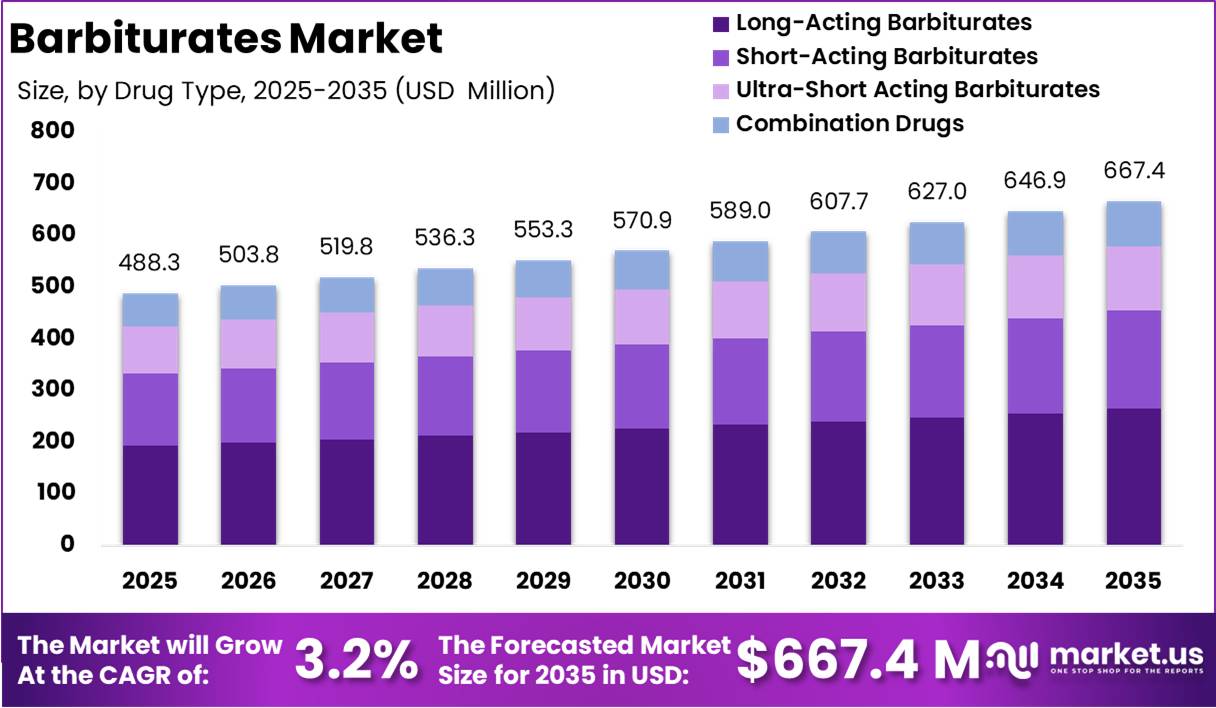
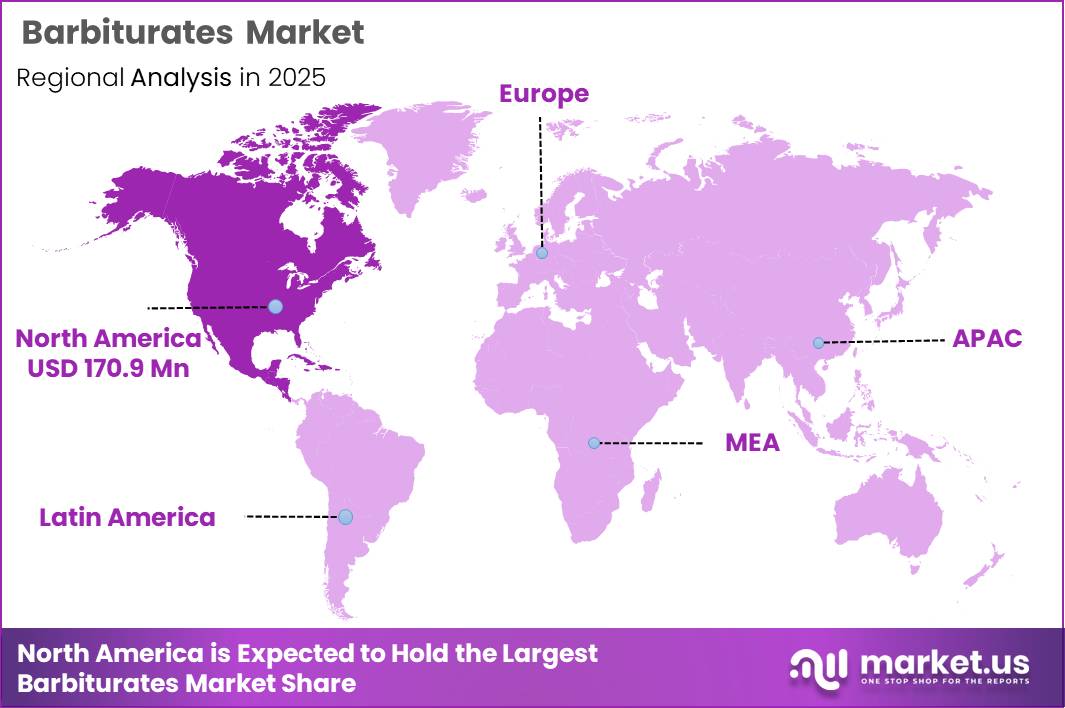
Global Barbiturates Market size is expected to be worth around US$ 667.4 Million by 2035 from US$ 488.3 Million in 2025, growing at a CAGR of 3.2% during the forecast period from 2026 to 2035. In 2025,North America led the market, achieving over 35.0% share with a revenue of US$ 170.9 Million.
Barbiturates are a class of central nervous system (CNS) depressants primarily used for anesthesia induction, seizure management, emergency treatment of status epilepticus, and medically supervised sedation. Although their routine use for anxiety and insomnia has declined because of the availability of safer alternatives, they remain essential medicines in specific hospital and critical care settings.
According to the World Health Organization, phenobarbital continues to be included on the Model List of Essential Medicines due to its effectiveness and affordability in treating epilepsy, particularly in resource-limited healthcare systems. The World Health Organization estimates that approximately 50 million people worldwide are living with epilepsy, making anticonvulsant therapies an important component of neurological care.
In the United States, the Centers for Disease Control and Prevention reports that approximately 3.4 million people live with active epilepsy, including about 470,000 children, highlighting the continuing need for reliable seizure-control medications in selected clinical situations.
Meanwhile, the National Institutes of Health notes that barbiturates continue to play a significant role in neurocritical care, anesthesia, and the management of refractory seizures despite declining outpatient prescriptions. Regulatory oversight by the U.S. Food and Drug Administration ensures that approved barbiturate formulations meet established standards for quality, safety, and efficacy.
Growing surgical volumes, increasing diagnosis of neurological disorders, and expanding access to emergency and intensive care services are supporting the continued clinical relevance of barbiturates. Advances in hospital infrastructure and standardized treatment guidelines are also reinforcing their use in specialized healthcare environments, while ongoing pharmacovigilance programs help ensure appropriate prescribing and monitoring to minimize the risks of dependence, overdose, and adverse events.
Key Takeaways
- Market Size: The global Barbiturates Market was valued at US$ 488.3 Million in 2025.
- Market Share: The global Barbiturates Market is projected to grow at a CAGR of 3.2% and is estimated to reach US$ 667.4 Million by 2035.
- Drug Type Analysis: Long-Acting Barbiturates dominated the market, accounting for 39.6% of the total market share in 2025.
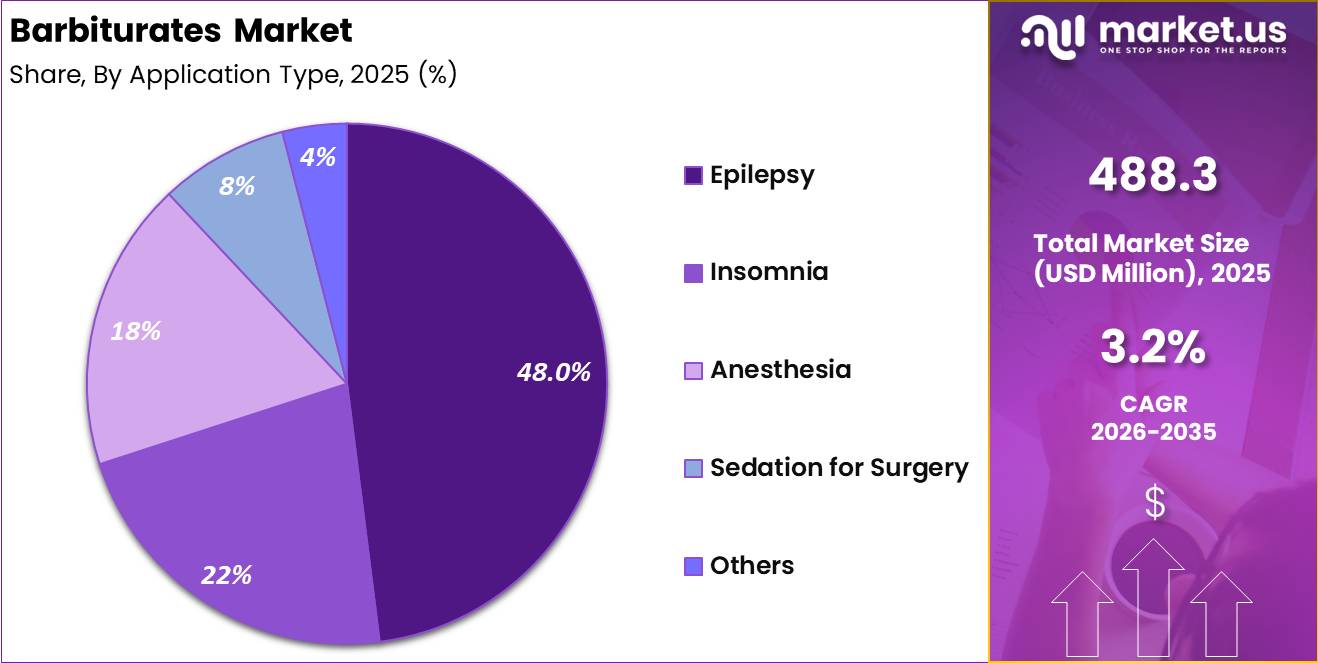
- Application Analysis: Epilepsy dominated the market, constituting 48.00% of the total market share.
- Distribution Channel Analysis: Hospital Pharmacies dominated the market, constituting 62.0% of the total market share.
- Regional Analysis: In 2025,North America led the market, achieving over 35.0% share with a revenue of US$ 170.9 Million.
Drug Type Analysis
The drug type segment of the barbiturates market is led by Long-Acting Barbiturates, which accounted for 39.6% of the market share in 2025. This dominance is attributed to their sustained therapeutic effect, making them suitable for long-term seizure management and specific neurological conditions where prolonged central nervous system suppression is required. Their established clinical use and relatively predictable pharmacokinetic profile continue to support demand across hospital and specialty care settings.
Short-Acting Barbiturates represented 28.5% of the market in 2025. These agents are widely utilized for acute sedation and procedural applications where rapid onset and shorter duration of action are preferred. Ultra-Short Acting Barbiturates held 18.7% share, benefiting from their use in induction of anesthesia and emergency medical interventions requiring immediate CNS depression.
The Combination Drugs segment accounted for 13.2% of the market. Growth in this category is supported by the development of formulations that combine barbiturates with analgesic or adjunctive agents to improve therapeutic outcomes and patient convenience. Overall, the market reflects a balance between traditional long-acting therapies and specialized short-duration products tailored for procedural and critical care use.
Application Analysis
Based on application, Epilepsy remained the largest segment of the barbiturates market, capturing 48.0% of total revenue in 2025. The segment’s dominance reflects the continued use of certain barbiturates as effective anticonvulsant agents, particularly in cases where alternative therapies are inadequate or inaccessible. Their proven efficacy in controlling seizures has maintained demand across both developed and emerging healthcare markets.
Insomnia accounted for 22.0% of the market. Although prescribing patterns have shifted toward newer sleep medications, barbiturates continue to be used in selected clinical situations requiring potent sedative effects. The Anesthesia segment held 18.0% share, supported by the use of specific barbiturate formulations for induction of anesthesia and management of certain neurological emergencies.
Sedation for Surgery represented 8.0% of market revenue. This segment benefits from the need for controlled preoperative sedation and procedural management in hospital settings. The remaining market share was attributed to other specialized neurological and critical care applications. Overall, the application landscape highlights the enduring importance of epilepsy treatment while preserving meaningful demand from anesthesia and sedation-related uses.
Distribution Channel Analysis
The distribution channel landscape of the barbiturates market is dominated by Hospital Pharmacies, which accounted for 35.0% of market revenue in 2025. Their leading position is driven by the fact that many barbiturate formulations are administered in inpatient settings for epilepsy management, anesthesia induction, emergency care, and surgical procedures. Hospitals also maintain strict control over dispensing because of the drugs’ narrow therapeutic index and potential safety concerns.
Retail Pharmacies form another significant channel, supplying prescribed oral formulations for chronic neurological conditions and selected outpatient treatments. Demand through this channel is supported by ongoing patient follow-up and physician-directed therapy. Online Pharmacies are gradually gaining traction as digital healthcare adoption expands, offering convenience for prescription refills and improved access in underserved regions.
Specialty Pharmacies also contribute to market growth by handling controlled substances, complex prescriptions, and patients requiring close therapeutic monitoring. These pharmacies often work closely with neurologists and hospital networks to ensure compliance with regulatory requirements.
Overall, the distribution structure reflects the clinical complexity of barbiturate therapy. Hospital pharmacies remain the primary channel due to the high proportion of acute-care and monitored-use applications, while retail, online, and specialty pharmacies collectively support continuity of care in outpatient settings.
Market Segmentations
By Drug Type
- Long-Acting Barbiturates
- Short-Acting Barbiturates
- Ultra-Short Acting Barbiturates
- Combination Drugs
By Application
- Epilepsy
- Insomnia
- Anesthesia
- Sedation for Surgery
- Others
By Distribution Channel
- Hospital Pharmacies
- Retail Pharmacies
- Online Pharmacies
Drivers
Sustained epilepsy access keeps phenobarbital demand resilient
Phenobarbital remains one of the few barbiturates with durable, high-volume clinical relevance because it is still recognized in epilepsy management guidance and is widely used where affordability and supply continuity outweigh preference for newer agents.
WHO’s epilepsy and mhGAP materials continue to include phenobarbital among standard anti-seizure medicines, and the evidence package cited by WHO notes that phenobarbital remains among the most commonly used ASMs worldwide, especially in lower-resource settings.
That matters commercially because epilepsy treatment is chronic, refill-driven, and procurement-led: once a public system standardizes on a low-cost, older ASM, manufacturers benefit from repeat tenders, stable pack demand, and lower customer-acquisition costs than in specialist-branded neurology markets.
| Driver | (~) % Impact on CAGR Forecast | Geographic Relevance | Impact Timeline |
|---|---|---|---|
| Essential epilepsy access led by phenobarbital procurement | +1.4% | South Asia, Sub-Saharan Africa, parts of ASEAN, Latin America public systems | Medium term (2-4 years) |
| Critical-care and injectable hospital demand stability | +0.9% | North America core, EU, Japan, Gulf hospitals | Short term (≤ 2 years) |
| National essential-medicines alignment and tender expansion | +1.1% | LMIC public procurement corridors, Africa, South Asia, frontier Asia | Medium term (2-4 years) |
| Controlled-substance compliance tightening and abuse safeguards | +0.5% | US, EU, selected APAC regulated markets | Short term (≤ 2 years) |
| Substitution pressure from newer anti-seizure drugs | -1.2% | North America, Western Europe, upper-income APAC | Medium term (2-4 years) |
| Supply concentration, shortages, and API resilience programs | +0.7% | US, EU, India-linked supply base, global hospital channels | Short term (≤ 2 years) |
Challenges
Controlled-substance forecasting gaps distort barbiturate supply reliability
Barbiturates sit inside a uniquely difficult operating model because a meaningful share of the portfolio remains medically necessary yet administratively constrained by controlled-substance estimation, licensing, import authorization, and forecasting systems that are often calibrated imperfectly to volatile hospital and neurology demand.
In practice, even when formal prohibition is absent, small forecasting errors can cascade into 8 to 16 week replenishment slippage, importer under ordering, elevated safety stock of 15% to 25%, and tender fill rate deterioration of roughly 5 to 9 % points, especially in lower capacity public procurement systems where phenobarbital remains clinically relevant for seizure management and essential medicines access.
The resulting drag is not a hard stop on market activity but a persistent efficiency tax that suppresses the market’s realizable growth trajectory by about 1.1% points through slower order conversion, lost institutional confidence, and regional demand deferral, forcing manufacturers and distributors to invest in country level quota intelligence, rolling 12 month requirement forecasting, dual approval trade lanes, and compliance heavy demand sensing rather than pure commercial expansion.
| Challenge | (~) % CAGR Friction Drag | Geographic Relevance | Mitigation Horizon |
|---|---|---|---|
| Controlled-supply planning gaps | -1.1% | North America core; LMIC import markets | Medium term (2-4 years) |
| Injectable shortage volatility | -0.9% | US hospital channels; Australia; EU shortage clusters | Short term (≤ 2 years) |
| API concentration exposure | -1.3% | APAC supply corridors; EU generics base; US import-dependent buyers | Long term (≥ 4 years) |
| Clinical talent attrition | -0.8% | LMIC neurology networks; critical-care centers globally | Long term (≥ 4 years) |
| Safety-monitoring burden escalation | -0.7% | North America hospitals; EU regulatory hubs; tertiary-care APAC | Medium term (2-4 years) |
| Legacy portfolio margin erosion | -1.0% | EU off-patent markets; US multisource generics; LATAM tenders | Medium term (2-4 years) |
Restraints
Regulatory controlled-substance quota friction dampening growth
Barbiturates experience a slower and more constrained supply response than most conventional generic pharmaceuticals because their active ingredients are regulated under narcotics-control frameworks. Manufacturing volumes are governed through annual production quota systems, which limit output based on projected requirements for medical use, scientific research, exports, and reserve inventories.
In January 2026, the U.S. Drug Enforcement Administration (DEA) reaffirmed that controlled substance manufacturers remain subject to aggregate production quotas, with adjustments permitted only through established regulatory processes rather than unrestricted capacity expansion.
These regulatory controls have significant commercial implications. Even when clinical demand remains stable, manufacturers and dosage-form producers must maintain larger compliance inventories, manage extended regulatory timelines for quota modifications, and address the risk that hospital procurement contracts or export demand may exceed available quota allocations.
As a result, tightly supplied barbiturate product categories can experience fill-rate limitations that reduce potential volume growth by an estimated 3–6% points, contributing to an estimated 1.4% point reduction in market CAGR across North America and other quota-regulated export markets.
Additionally, the combination of regulatory compliance costs, facility validation requirements, controlled-substance security measures, and higher working capital needs discourages capacity expansion, reinforcing market concentration among a limited number of licensed manufacturers.
| Restraint | (~) % Impact on CAGR Forecast | Geographic Relevance | Impact Timeline |
|---|---|---|---|
| Controlled-substance quota friction | -1.4% | North America core, export-linked markets | Short term (≤ 2 years) |
| GMP and sterile manufacturing bottlenecks | -1.8% | EU, North America, Japan, ANZ | Short term (≤ 2 years) |
| Low-price generic economics | -1.2% | LATAM, Africa, South Asia, parts of EU | Medium term (2-4 years) |
| API concentration and import dependence | -1.5% | India, EU, ASEAN, MENA, LATAM | Medium term (2-4 years) |
| Therapeutic substitution pressure | -2.1% | North America, EU, Japan, urban China | Long term (≥ 4 years) |
| Compliance and anti-diversion burden | -1.0% | Global regulated markets | Medium term (2-4 years) |
Opportunity
Consolidate veterinary barbiturate channels into platforms
Veterinary barbiturate expansion is an opportunity because pentobarbital and related compounds already have established use in euthanasia and some anesthetic contexts, but the market is still fragmented and often treated as a peripheral channel rather than a scaled specialty platform.
The white space is in rolling up regional veterinary controlled drug distributors, cremation service partners, and animal health compounding capabilities into integrated supply networks that monetize not just the drug vial but the full compliance and procedure ecosystem for clinics, shelters, research facilities, and equine or companion animal centers.
Such integration can increase revenue per account by an estimated 20% to 30% through bundled services, improve reorder frequency due to standing contracts, and produce 300 to 500 basis points of margin expansion from route density, packaging optimization, and reduced third party distribution leakage.
This does not qualify as a current driver because baseline barbiturate sales largely capture existing veterinary consumption only at the product level; the additional upside comes from channel consolidation and service layer monetization that the present market structure has not yet fully exploited.
| Opportunity | (~) % Potential CAGR Upside | Geographic Relevance | Execution Window |
|---|---|---|---|
| LMIC epilepsy access scale-up | +2.4% | Sub-Saharan Africa, South Asia, parts of LATAM | Short term |
| Pediatric formulations | +1.6% | APAC emerging, Africa, EU public systems | Medium term |
| Digital controlled-drug platforms | +1.3% | North America core, EU, Gulf, upper-middle-income APAC | Short term |
| Local API / fill-finish buildout | +1.9% | India, Africa, MENA, LATAM | Medium term |
| Palliative and hospice protocols | +1.1% | EU, North America, urban Asia, select LMIC hubs | Medium term |
| Veterinary consolidation plays | +0.9% | North America core, EU, Australia, Brazil | Short term |
Regional Analysis
In 2025, North America led the market, achieving over 35.0% share with a revenue of US$ 170.92 Million.
North America region’s leadership is supported by a well-established healthcare infrastructure, extensive hospital networks, and continued demand for barbiturate-based therapies in highly specialized clinical settings.
Although the use of barbiturates has declined for routine anxiety and insomnia treatment due to the availability of safer alternatives, they continue to play an essential role in managing refractory epilepsy, anesthesia induction, medically induced coma, and certain emergency neurological conditions. The presence of advanced critical care facilities and specialized neurological centers sustains the demand for barbiturate formulations across the region.
The United States contributes the largest share within North America, driven by high healthcare expenditure, strong pharmaceutical manufacturing capabilities, and established clinical protocols for the use of barbiturates in hospitals and surgical centers. Ongoing research in neurological disorders, increased demand for intensive care services, and the availability of regulated prescription frameworks further support market growth.
Canada also contributes steadily through its universal healthcare system, growing focus on epilepsy management, and increasing investment in hospital-based critical care services. Moreover, strict regulatory oversight for controlled substances ensures responsible prescribing practices while maintaining access for medically necessary applications.
The presence of leading pharmaceutical companies, continuous modernization of healthcare facilities, and rising demand for specialized neurological and anesthetic treatments are expected to support North America’s leading position in the Barbiturates Market throughout the forecast period.
Key Regions and Countries
North America
- The US
- Canada
Europe
- Germany
- France
- The U.K.
- Italy
- Spain
- Russia & CIS
- Rest of Europe
Asia Pacific
- China
- India
- Japan
- South Korea
- ASEAN
- Australia & New Zealand
- Rest of Asia Pacific
Middle East & Africa
- GCC
- South Africa
- Rest of Middle East & Africa
Latin America
- Brazil
- Mexico
- Rest of Latin America
Key Player Analysis
The global barbiturates market is moderately consolidated, with competition led by established pharmaceutical companies, generic drug manufacturers, and regional suppliers. As barbiturates are mature products mainly used for epilepsy treatment, anesthesia, and critical care.
Companies compete primarily through manufacturing efficiency, regulatory compliance, and reliable product availability rather than product innovation. Market participants are focused on maintaining consistent supply, improving production processes, and meeting stringent quality standards for controlled substances.
The competitive landscape consists of three key groups. Global pharmaceutical companies, including Pfizer Inc., Merck & Co., Inc., Novartis AG, Abbott Laboratories, Sanofi S.A., Eli Lilly and Company, and Fresenius Kabi, benefit from extensive manufacturing capabilities, strong regulatory expertise, and established relationships with healthcare providers.
Generic and specialty manufacturers such as Teva Pharmaceutical Industries Ltd., Viatris Inc., Hikma Pharmaceuticals PLC, Sun Pharmaceutical Industries Ltd., Cipla Limited, Zydus Lifesciences Limited, Par Pharmaceutical, Akorn Operating Company LLC, and Ethypharm compete through cost-effective production, geographic expansion, and dependable supply. Sumitomo Pharma Co., Ltd. maintains a competitive position through its expertise in central nervous system therapies.
Competitive advantage is largely determined by manufacturing quality, regulatory approvals, efficient supply chains, and long-term hospital partnerships. Investments in process optimization, formulation improvements, and operational excellence continue to strengthen market positioning and ensure reliable product availability.
Top Key Players
- Pfizer Inc.
- Merck & Co., Inc.
- Teva Pharmaceutical Industries Ltd.
- Mylan N.V. (Viatris Inc.)
- Novartis AG
- Abbott Laboratories
- Hikma Pharmaceuticals PLC
- Fresenius Kabi
- Sanofi S.A.
- Eli Lilly and Company
- Sumitomo Pharma Co., Ltd.
- Sun Pharmaceutical Industries Ltd.
- Cipla Limited
- Zydus Cadila
- Par Pharmaceutical
- Akorn Operating Company LLC
- Ethypharm
Recent Developments
- May 2025: Hikma Pharmaceuticals PLC highlighted continued expansion of its U.S. Injectable business through successful launches of hospital injectable medicines, strengthening its institutional portfolio that includes sterile injectable CNS and anesthesia products relevant to hospital barbiturate supply.
- 2025: Fresenius Kabi continued expanding its injectable medicines portfolio and manufacturing capabilities for hospital pharmaceuticals, reinforcing supply of critical-care and anesthesia products, including legacy injectable medicines used in hospital settings.
- May 2026: Pfizer Inc. updated its global R&D pipeline with continued investment in innovative medicines and vaccines. Although no new barbiturate product was announced, the company remains an established manufacturer of legacy pharmaceutical products through its manufacturing network.
Report Scope
| Report Features | Description |
|---|---|
| Market Value (2025) | US$ 488.3 Million |
| Forecast Revenue (2035) | US$ 667.4 Million |
| CAGR (2026-2035) | 3.2 % |
| Base Year for Estimation | 2025 |
| Historic Period | 2020-2024 |
| Forecast Period | 2026-2035 |
| Report Coverage | Revenue Forecast, Market Dynamics, Competitive Landscape, Recent Developments |
| Segments Covered | By Drug Type (Long-Acting Barbiturates, Short-Acting Barbiturates, Ultra-Short Acting Barbiturates, Combination Drugs) By Application (Epilepsy, Insomnia, Anesthesia, Sedation for Surgery, Others) By Distribution Channel (Hospital Pharmacies, Retail Pharmacies, Online Pharmacies) |
| Regional Analysis | North America – The US, Canada; Europe – Germany, France, U.K., Italy, Spain, Russia & CIS, Rest of Europe; Asia Pacific – China, India, Japan, South Korea, ASEAN, Australia & New Zealand, Rest of Asia Pacific; Middle East & Africa – GCC, South Africa, Rest of Middle East & Africa; Latin America – Brazil, Mexico, Rest of Latin America |
| Competitive Landscape | Pfizer Inc., Merck & Co., Inc., Teva Pharmaceutical Industries Ltd., Mylan N.V. (Viatris Inc.),Novartis AG ,Abbott Laboratories, Hikma Pharmaceuticals PLC, Fresenius Kabi, Sanofi S.A., Eli Lilly and Company, Sumitomo Pharma Co., Ltd. ,Sun Pharmaceutical Industries Ltd., Cipla Limited ,Zydus Cadila, Par Pharmaceutical, Akorn Operating Company LLC, Ethypharm. |
| Customization Scope | Customization for segments, region/country-level will be provided. Moreover, additional customization can be done based on the requirements. |
| Purchase Options | We have three licenses to opt for: Single User License, Multi-User License (Up to 5 Users), Corporate Use License (Unlimited User and Printable PDF) |





































