


Report Overview
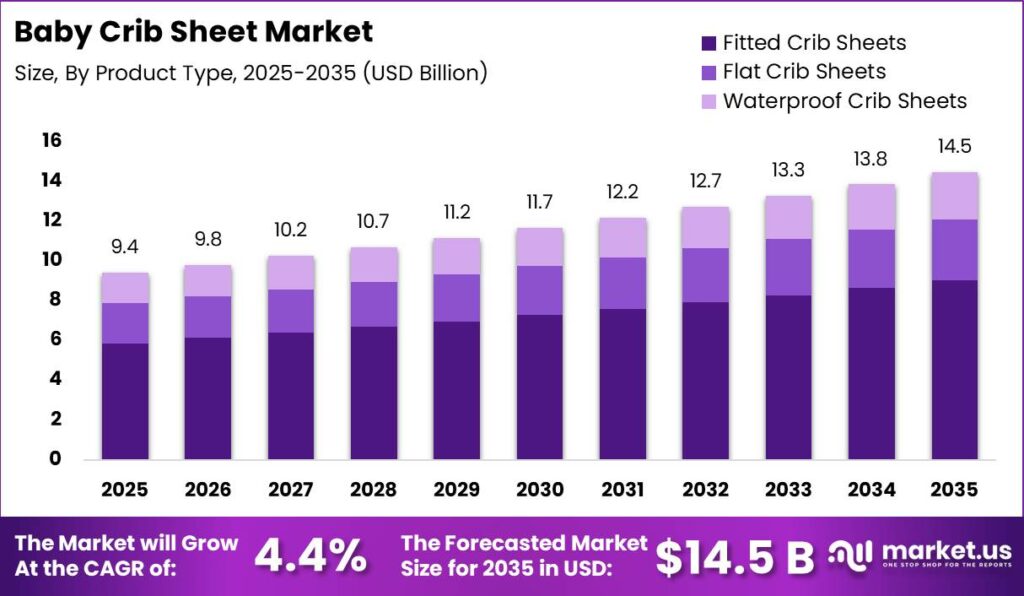
Global Baby Crib Sheet Market size is expected to be worth around USD 14.5 Billion by 2035 from USD 9.4 Billion in 2025, growing at a CAGR of 4.4% during the forecast period 2026 to 2035. This steady climb reflects a non-discretionary product tied directly to infant care. Brands with reliable replenishment channels will capture the most durable share.
The baby crib sheet market covers fitted, flat, and waterproof sheets sized for standard, mini, and portable crib mattresses. Manufacturers sell through offline retail, e-commerce, specialty baby stores, and brand-owned channels. This structure rewards companies that combine material safety certification with wide size compatibility, since parents replace sheets often across the first two years of a child’s life.
Key Takeaways
- Global market size will reach USD 14.5 Billion by 2035, up from USD 9.4 Billion in 2025 at a CAGR of 4.4%.
- Fitted Crib Sheets lead the Product Type segment with a 62.40% share.
- Cotton holds the top Material Type position with a 46.80% share.
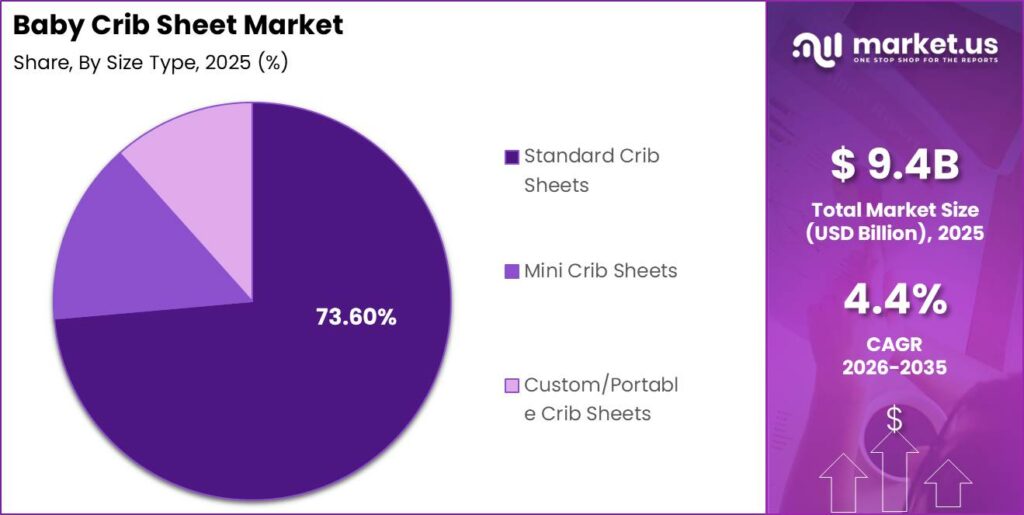
- Standard Crib Sheets dominate the Size Type segment at 73.60%.
- Offline Retail Stores control 57.60% of the Distribution Channel segment.
- Residential Consumers make up 91.40% of the End User segment.
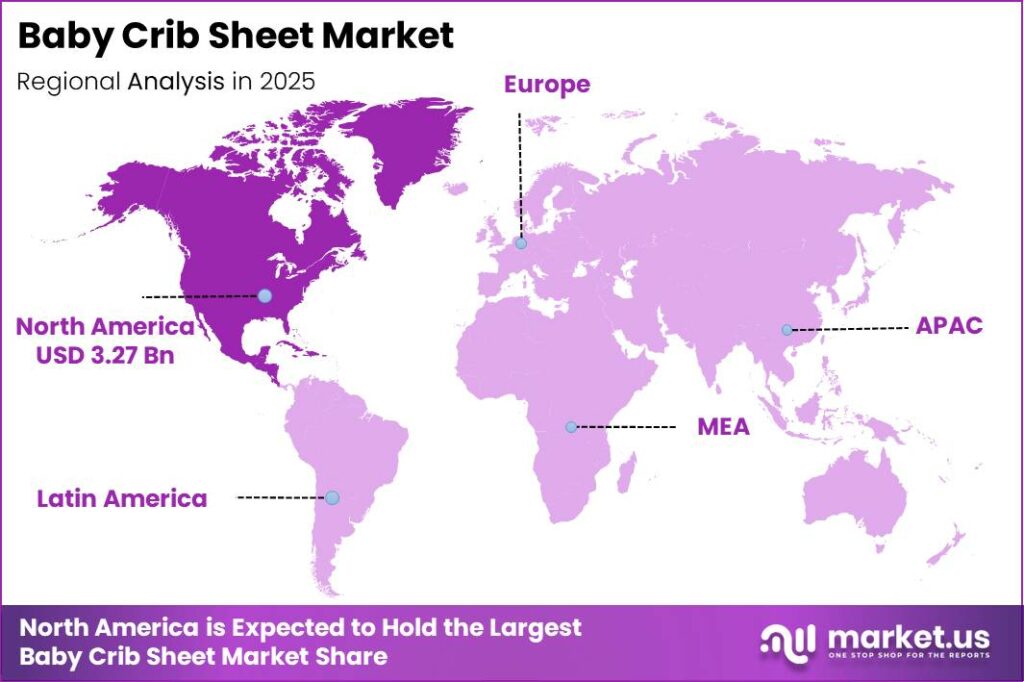
- North America leads all regions with a 34.80% share, valued at USD 3.27 Billion.
Government safe-sleep regulation anchors demand across major markets. The CDC directs that its safe sleep guidance applies to every infant under 12 months, defining a fixed usage window where fitted sheets are required for each sleep cycle. This rule removes substitute bedding from the crib. Therefore, brands that lead with fit and safety messaging convert regulation into predictable, repeat sales.
As per our research, the CDC reports roughly 3,700 sudden unexpected infant deaths in the U.S. each year, which reinforces parental urgency around compliant sleep environments. This fear-to-action link keeps fitted sheets a mandatory purchase. As a result, sellers who certify materials and guarantee snug fit win first-time parents faster than decorative-focused rivals.
Crib mattress safety standards require sheets to hold zero measurable corner lift, a 0 cm gap tolerance in safety testing, to prevent suffocation from loose fabric. This engineering demand raises the bar on elastic and stretch quality. Consequently, manufacturers that invest in anti-slip construction protect both infants and their own margins against low-quality import competition.
Product Type Analysis
Fitted Crib Sheets dominates with 62.40% due to mandatory snug-fit safe-sleep compliance.
In 2025, Fitted Crib Sheets held a dominant market position in the By Product Type segment of Baby Crib Sheet Market, with a 62.40% share. UN Comtrade trade flows under textile category HS 6302 show bed linen moving in billions of units yearly across major importing economies. This scale confirms fitted formats as the default nursery purchase. Brands that standardize fit will lock in shelf and search visibility ahead of niche players.
Flat Crib Sheets serve buyers who want multi-use layering under mattress pads or for daytime bassinet use. This format holds 21.30% of the product segment. World Bank household consumption data links rising infant-care spending to broader textile demand in developing economies. This means flat sheets retain relevance as an economy entry point. Sellers can use them to attract price-sensitive parents before upselling premium fitted sets.
Waterproof Crib Sheets protect mattresses from leaks and support hygiene rotation for daycare settings. This sub-segment accounts for 16.30% of product demand. In April 2025, Hush launched its Hush Little Baby line using 100% bamboo viscose with cooling and hypoallergenic properties, signaling material innovation across protective formats. This creates room for function-led differentiation. Brands blending waterproofing with breathable fabric can command higher margins in institutional and household channels.
Material Type Analysis
Cotton dominates with 46.80% due to breathability and parental safety trust.
In 2025, Cotton held a dominant market position in the By Material Type segment of Baby Crib Sheet Market, with a 46.80% share. FAO cotton production data shows global lint output near 25 million tonnes annually, keeping the fiber widely available and affordable. This supply depth anchors cotton as the default nursery material. Brands relying on cotton gain cost stability and consistent consumer trust.
Organic Cotton attracts premium buyers who prioritize certification and non-toxic claims for infant skin. This sub-segment holds 24.90% of material demand. FAO reports organic cotton represents roughly 1% of total global cotton output, keeping certified supply scarce. This scarcity supports higher pricing power. Brands securing certified supply chains can defend premium margins against commodity competitors.
Polyester Blends offer durability and wrinkle resistance at lower cost for value-focused parents. This format captures 15.40% of the segment. UNIDO manufacturing statistics show synthetic textile output expanding faster than natural fibers in developing regions. This means blends stay competitive in emerging markets. Bamboo Fabric at 8.70% and Others at 4.20% hold the remaining share collectively, serving buyers focused on cooling comfort and specialty niches.
Size Type Analysis
Standard Crib Sheets dominates with 73.60% due to universal mattress dimension compatibility.
In 2025, Standard Crib Sheets held a dominant market position in the By Size Type segment of Baby Crib Sheet Market, with a 73.60% share. National statistical offices in the U.S. define a fixed standard crib mattress dimension of 28 by 52 inches, which manufacturers build to universally. This uniformity simplifies production and inventory. Brands that focus on the standard size gain scale efficiency and lower stocking risk.
Mini Crib Sheets serve urban households and smaller living spaces where compact cribs fit better. This format meets rising demand in dense city markets tracked by World Bank urbanization figures showing over 56% of the global population now living in cities. This shift supports mini format growth. Sellers targeting apartment dwellers can capture an underserved niche with tailored sizing.
Custom and Portable Crib Sheets support travel cribs, play yards, and non-standard mattress shapes. This sub-segment addresses parents who need flexible bedding beyond fixed dimensions. Customs shipment records show steady cross-border trade in portable infant products. This means demand exists for adaptable fits. Brands offering multi-size bundles can serve mobile families and reduce fit-related returns.
Design Type Analysis
Solid Color Sheets dominates with 38.20% due to neutral gender-flexible nursery appeal.
In 2025, Solid Color Sheets held a dominant market position in the By Design Type segment of Baby Crib Sheet Market, with a 38.20% share. ITC Trade Map data shows plain-dyed textiles moving in higher volumes than printed goods across major infant-product importers. This preference reflects the shift toward minimalist nurseries. Brands leading with neutral tones match current parental taste and reduce design overstock.
Printed and Patterned Sheets appeal to parents seeking playful, decorative nursery themes. This format retains steady demand through gifting occasions. Patent database filings show recurring innovation in child-safe textile printing methods. This means print quality keeps improving. Sellers can use limited-edition prints to drive impulse and repeat purchases.
Character and Themed Sheets attract families drawn to licensed and story-based nursery styling. Customized Sheets serve buyers wanting personalized names or bespoke designs for gifting. Together these formats and printed sheets hold the remaining share collectively. This creates niche premium pricing room. Brands offering personalization can capture higher-value gift buyers seeking distinctive nursery products.
Price Range Analysis
Economy dominates with 47.90% due to high-frequency low-cost replacement demand.
In 2025, Economy held a dominant market position in the By Price Range segment of Baby Crib Sheet Market, with a 47.90% share. World Bank income data shows most global births occur in low and middle income households, anchoring demand at accessible price points. This economic reality keeps economy sheets the volume leader. Brands competing here must win on cost efficiency and durability.
Mid-Range sheets balance quality fabric with reasonable pricing for mainstream parents. This tier captures buyers upgrading from economy without paying premium rates. UNIDO output data links rising middle-class manufacturing capacity to broader mid-tier product supply. This means mid-range volume will expand steadily. Sellers can position this tier as the smart-value default for repeat buyers.
Premium sheets serve parents prioritizing organic certification, sustainability, and superior fabric feel. This tier commands the highest margins despite lower volume. Consumer guidance increasingly emphasizes materials and safety over decorative bedding. This supports premium material positioning. Together mid-range and premium hold the remaining share collectively, giving brands clear room to trade buyers upward over time.
Distribution Channel Analysis
Offline Retail Stores dominates with 57.60% due to hands-on fabric inspection preference.
In 2025, Offline Retail Stores held a dominant market position in the By Distribution Channel segment of Baby Crib Sheet Market, with a 57.60% share. National statistical offices report physical retail still handles the majority of baby-goods transactions in most economies. This reflects parents wanting to touch fabric before buying. Brands must maintain strong shelf presence to protect this majority channel.
Online and E-commerce channels grow fastest as parents shift toward convenient home delivery and subscription models. ITU data shows global internet penetration surpassing 67% of the population, widening the digital buyer base. This expansion fuels direct-to-consumer sales. Brands investing in search-led discovery and auto-replenishment can capture rising online demand and reduce reliance on retail margins.
End User Analysis
Residential Consumers dominates with 91.40% due to individual household nursery purchases.
In 2025, Residential Consumers held a dominant market position in the By End User segment of Baby Crib Sheet Market, with a 91.40% share. World Bank data records over 130 million births worldwide each year, and nearly all generate household-level bedding purchases. This volume anchors residential buyers as the core market. Brands must design messaging around parents and gift-givers first.
Daycare Centers and Nurseries buy in bulk for hygiene rotation across many infants. This institutional segment values durability, waterproofing, and cost-per-wash efficiency. UNIDO industrial statistics show expanding childcare infrastructure in urban economies. This means institutional demand will rise steadily. Brands offering multi-pack replacement bundles can win recurring contracts with childcare operators seeking reliable supply.
Sales Channel Analysis
Specialty Baby Stores dominates with 31.70% due to trusted curated infant product assortments.
In 2025, Specialty Baby Stores held a dominant market position in the By Sales Channel segment of Baby Crib Sheet Market, with a 31.70% share. National retail census data shows specialty baby chains concentrate high-intent parent traffic in dedicated formats. This focus builds strong purchase confidence. Brands securing specialty shelf space gain credibility that broad retailers cannot easily match.
Supermarkets and Hypermarkets offer convenience and volume reach for everyday baby purchases. Online Marketplaces provide broad selection and price comparison for digital-first parents. ITC Trade Map data confirms rising cross-border e-commerce in infant textiles. This means marketplace competition intensifies. Brands must balance visibility with margin protection across these aggregator channels.
Brand-Owned Stores let companies control pricing, presentation, and customer data directly. This channel supports premium positioning and loyalty building. Together with Others, these channels hold the remaining share collectively. This creates direct-relationship opportunity. Brands expanding owned retail can capture full margin and richer buyer insight than wholesale allows.
Key Market Segments
By Product Type
- Fitted Crib Sheets
- Flat Crib Sheets
- Waterproof Crib Sheets
By Material Type
- Cotton
- Organic Cotton
- Polyester Blends
- Bamboo Fabric
- Others
By Size Type
- Standard Crib Sheets
- Mini Crib Sheets
- Custom/Portable Crib Sheets
By Design Type
- Solid Color Sheets
- Printed & Patterned Sheets
- Character & Themed Sheets
- Customized Sheets
By Price Range
- Economy
- Mid-Range
- Premium
By Distribution Channel
- Offline Retail Stores
- Online/E-commerce
By End User
- Residential Consumers
- Daycare Centers & Nurseries
By Sales Channel
- Specialty Baby Stores
- Supermarkets & Hypermarkets
- Online Marketplaces
- Brand-Owned Stores
- Others
Regional Analysis
North America Dominates the Baby Crib Sheet Market with a Market Share of 34.80%, Valued at USD 3.27 Billion
North America leads the baby crib sheet market with a 34.80% share worth USD 3.27 Billion. Strict CPSC and AAP safe-sleep rules make fitted sheets the only permitted crib bedding. This regulatory anchor sustains steady replacement demand. In November 2025, Avocado Green Mattress brought its Babyletto crib sheet collection to retail and online channels across select U.S. markets, widening access to organic bundles.
Asia-Pacific ranks as the fastest-growing region as expanding middle-class birth cohorts lift nursery spending. Rising urban incomes across India and Southeast Asia push demand for premium and organic sheets. This growth reflects both volume and value gains. Brands entering organized retail early can build loyalty before competition tightens in these emerging markets.
Europe holds strong demand driven by organic certification preference and established safe-sleep standards. Latin America and Middle East and Africa together represent developing markets where e-commerce unlocks underpenetrated geographies. These regions favor economy formats today. Sellers using digital channels can reach dispersed buyers cost-effectively and grow share ahead of physical retail expansion.
Key Regions and Countries
North America
- US
- Canada
Europe
- Germany
- France
- The UK
- Spain
- Italy
- Rest of Europe
Asia Pacific
- China
- Japan
- South Korea
- India
- Australia
- Rest of APAC
Latin America
- Brazil
- Mexico
- Rest of Latin America
Middle East and Africa
- GCC
- South Africa
- Rest of MEA
Market Dynamics
Market Opportunity Analysis - Underserved size formats, institutional buyers, and Asia-Pacific retail open clear entry points for new players
Mini Crib Sheets remain underexploited despite rising urban housing density that favors compact cribs. Standard sheets hold 73.60% of the size segment, leaving mini formats with thin dedicated supply. This gap reflects manufacturer focus on scale over niche fit. Therefore, entrants building apartment-focused mini-sheet lines can capture city parents that large standard-size brands overlook.
Daycare Centers and Nurseries stay underserved within the End User segment, where Residential Consumers dominate at 91.40%. Institutional buyers need bulk, durable, waterproof sheets for hygiene rotation. This concentration on households leaves recurring institutional demand largely unaddressed. As a result, brands offering contract multi-pack replacement programs can win steady childcare revenue with limited premium competition.
Asia-Pacific offers the strongest regional white space as its birth cohorts and middle class expand faster than North America’s 34.80%-share market. Organized premium retail remains thin across India and Southeast Asia. This creates first-mover room before global brands entrench. Instead of chasing saturated developed markets, new entrants can build early loyalty in these rising economies.
Online and E-commerce channels stay underexploited against Offline Retail’s 57.60% distribution lead. Digital buyers increasingly want subscription and search-led purchasing that physical stores cannot match. This structural imbalance favors direct-to-consumer models. Therefore, brands investing in e-commerce fulfillment can convert the fastest-growing channel into a durable margin advantage.
Technology and Innovation Landscape - Breathable material engineering and fit-focused construction redefine crib sheet competition
Bamboo viscose innovation is reshaping the fabric layer of the market. In April 2025, Hush launched crib sheets built from 100% bamboo viscose with cooling and hypoallergenic properties. This targets parents managing infant heat and sensitive skin. As a result, brands investing in engineered breathable fibers can defend premium pricing against basic woven cotton.
Anti-slip elastic and stretch construction now function as core safety technology, not just comfort features. Safety testing demands zero corner lift, a 0 cm gap tolerance, to prevent suffocation from displaced fabric. This raises the engineering bar on fit. Therefore, manufacturers mastering secure-fit construction protect infants and differentiate against loose, low-cost imports.
Certified organic material technology drives the premium tier’s innovation race. Multiple brands, including Coyuchi and Snuggle Me Organic, launched GOTS-certified organic cotton and muslin sheets in 2025. This reflects rising parental focus on non-toxic textiles. Consequently, brands scaling certified organic supply chains capture the highest-margin, fastest-trust-building corner of the market.
Drivers
Safe-sleep regulation across the U.S., Canada, the EU, and Australia sets the fitted crib sheet as the only permitted bedding item for infants under 12 months. AAP guidelines, adopted by the CPSC, explicitly ban blankets, quilts, and bumpers from the crib. This “bare is best” framework removes substitute products entirely. As a result, the fitted sheet becomes a non-discretionary consumable with near-zero substitution risk.
The commercial effect is direct and repeatable. A typical infant needs 3 to 5 fitted sheets to maintain hygiene rotation across a 12 to 24 month window, and premium organic variants sell at prices 40 to 60% higher. Gifting adds 2 to 3 more sheets per birth. This means brands leading on certification and fit build predictable auto-replenishment revenue.
| Driver | (~) % Impact on CAGR Forecast | Geographic Relevance | Impact Timeline |
|---|---|---|---|
| Safe Sleep Regulatory Mandates Elevating Fitted Crib Sheet as Sole Permitted Bedding Item | +1.6% | United States, Canada, European Union, Australia | Short term (≤ 2 years) |
| Organic & GOTS/OEKO-TEX Certified Fabric Demand Driving Average Selling Price Uplift | +1.0% | North America, Western Europe, Urban India, Japan, Australia | Short term (≤ 2 years) |
| Rising Millennial & Gen Z Premium Nursery Spending | +0.8% | United States, Europe, India, China, Gulf States | Short term (≤ 2 years) |
| Expanding Middle-Class Birth Cohort in Asia-Pacific & Sub-Saharan Africa | +0.5% | India, Southeast Asia, Nigeria, Kenya, Bangladesh | Medium term (2–4 years) |
| E-Commerce & D2C Nursery Bedding Channels Unlocking Underpenetrated Geographies | +0.4% | India, Southeast Asia, Latin America, Middle East | Short term (≤ 2 years) |
Restraints
Declining birth rates cap the market’s volume ceiling in its highest-spending regions. The crib sheet is non-discretionary, and each birth triggers a minimum of 2 to 4 sheets within the first 30 days. However, South Korea’s fertility rate fell to about 0.72 in 2023, Japan’s to 1.2, and the U.S. below 1.7, all under the 2.1 replacement level.
China saw its birth rate fall for the seventh consecutive year through 2024, cutting the annual birth cohort by an estimated 15 to 20% versus prior-decade peaks. This shrinks the direct demand base in premium markets. As a result, manufacturers anchored in North American and European channels face a revenue ceiling that price inflation and gifting frequency only partly offset.
| Restraint | (~) % Impact on CAGR Forecast | Geographic Relevance | Impact Timeline |
|---|---|---|---|
| Declining Birth Rates in High Per-Capita Spending Developed Markets | -1.2% | United States, China, South Korea, Japan, Germany, Italy | Long term (≥ 4 years) |
| Cotton Input Cost Volatility Compressing Manufacturer Margins | -0.7% | Global, acute in India, Bangladesh, Pakistan, China sourcing | Short term (≤ 2 years) |
| Safe Sleep Awareness Gaps Sustaining Demand for Non-Compliant Alternatives | -0.3% | Emerging markets, rural United States, Sub-Saharan Africa | Medium term (2–4 years) |
| Tariff & Trade Policy Disruptions on Textile Imports | -0.3% | United States, European Union | Short term (≤ 2 years) |
| Low Willingness-to-Pay in Price-Sensitive Emerging Market Segments | -0.2% | India (Tier-3/rural), Southeast Asia, Sub-Saharan Africa | Medium term (2–4 years) |
Challenges
Rising organic demand creates a widening certification access gap. Organic cotton’s share across major crib bedding brands grew from about 18% to 27% between 2022 and 2025. However, GOTS certification requires at least 95% certified organic fiber, full supply-chain audits, and annual fees of $1,500 to $8,000 per facility, adding 15 to 20% compliance overhead.
Effective April 2025, OEKO-TEX Standard 100 no longer validates organic cotton claims, forcing brands to migrate to a separate, stricter certification. This disrupts existing product lines. Certified sheets earn gross margins of 50 to 65% versus 30 to 42% for commodity cotton. Therefore, the high entry cost fragments supply and rewards well-capitalized certified producers with defensible margin advantage.
| Challenge | (~) % CAGR Friction Drag | Geographic Relevance | Mitigation Horizon |
|---|---|---|---|
| Organic Certification Cost & Complexity | -0.5% | Global, acute for mid-tier & emerging market manufacturers | Medium term (2–4 years) |
| Counterfeit & Non-Compliant Product Proliferation | -0.4% | India, Southeast Asia, online marketplaces globally | Long term (≥ 4 years) |
| Textile Supply Chain Lead-Time Volatility | -0.4% | Global, concentrated in Asia-to-North America corridors | Short term (≤ 2 years) |
| Retail Channel Margin Compression via Marketplace Aggregators | -0.3% | United States, Europe, India | Medium term (2–4 years) |
| Crib Size Fragmentation Limiting Inventory Efficiency | -0.2% | Global, most complex across US, EU, India, Australia standards | Long term (≥ 4 years) |
Opportunities
Subscription and auto-replenishment models remain structurally untapped. Most crib sheet revenue still comes from one-time gifting and registry purchases, yet a single infant needs 4 to 7 sheets across the 0 to 24 month window with a 3 to 6 month repurchase cadence. This biological replenishment logic sits unmonetized. Brands can reframe the sheet from a gift item into a recurring parental utility service.
The unit economics reward this shift sharply. A subscription household running 4 replenishment cycles at $45 to $75 per cycle generates $180 to $300 in lifetime revenue versus $35 to $65 in conventional retail. Direct-channel margins reach 55 to 70% by bypassing marketplace fees. Therefore, early movers building subscription infrastructure lock in high-retention, high-margin customer relationships.
| Opportunity | (~) % Potential CAGR Upside | Geographic Relevance | Execution Window |
|---|---|---|---|
| Subscription & Auto-Replenishment Model for Repeat-Purchase Crib Sheet Cycles | +1.1% | United States, United Kingdom, Australia, Urban India | Medium term (2–4 years) |
| Smart & Sensor-Embedded Crib Sheet Innovation for Sleep Monitoring | +0.6% | United States, Japan, South Korea, Germany | Long term (≥ 4 years) |
| Bassinet & Play Yard Sheet Adjacency Expansion Beyond Standard Crib Format | +0.5% | North America, Europe, India | Short term (≤ 2 years) |
| Branded Resale & Multi-Pack Gift Bundle Commerce | +0.4% | United States, Europe, Australia, India | Medium term (2–4 years) |
| India & Southeast Asia Organized Retail Penetration for Premium Crib Bedding | +0.3% | India, Indonesia, Vietnam, Malaysia, Philippines | Medium term (2–4 years) |
Key Company Insights
Carter’s, Inc. holds a structural advantage through its dominant U.S. brand recognition and wide retail distribution across department and specialty channels. CDC safe sleep guidance applies to every infant under 12 months, defining the exact window Carter’s targets with fitted, compliant sheets. This scale limits smaller entrants on shelf access. However, heavy retail reliance exposes the brand to marketplace margin pressure.
Delta Children competes on value pricing and broad nursery product bundling, pairing sheets with cribs and furniture for one-stop parents. OEKO-TEX Standard 100 Class I sets non-detectable harmful-substance limits for infant textiles, a threshold Delta uses to signal safety to buyers. This bundling deepens household penetration. However, its value positioning leaves premium organic margins to certified specialist rivals.
Key Players
- Carter’s, Inc.
- Delta Children
- Burt’s Bees Baby
- The Honest Company
- Pottery Barn Kids
- aden + anais
- Trend Lab
- Lambs & Ivy
- American Baby Company
- Little Unicorn
- TL Care Inc.
- NoJo Baby & Kids
- Living Textiles
- Crane Baby
- Kushies Baby
Recent Developments
- September 2025: Snuggle Me Organic expanded its nursery portfolio by launching new crib sheets made from 100% organic cotton and muslin fabric, packaged as a dual-sheet set designed for standard crib mattresses.
- September 2025: Coyuchi launched its Coyuchi Littles baby collection, introducing organic crib sheets as part of a broader nursery textile expansion made entirely from GOTS-certified organic cotton materials.
- November 2025: Avocado Green Mattress and Babyletto expanded their collaboration to include curated organic crib sheets designed for use with certified organic crib mattresses and non-toxic nursery furniture.
Geopolitical Impact Analysis
According to the WTO, global merchandise trade tensions and new tariff rounds have pushed textile import duties higher in key markets, with some U.S. textile categories facing rates above 25%. Cotton crib sheets sourced from Asia absorb much of this cost. As a result, manufacturers face margin pressure and rerouting decisions that raise landed costs on finished nursery bedding.
Based on UNCTAD data, container shipping disruptions and Red Sea rerouting extended average Asia-to-Europe transit times by 10 to 14 days and lifted freight rates by over 150% at peak. Crib sheet supply chains depend on these Asia-to-West corridors. Therefore, brands holding buffer inventory and diversifying sourcing protect delivery reliability during newborn and gifting demand peaks.
Report Scope
| Report Features | Description |
|---|---|
| Market Value (2025) | USD 9.4 Billion |
| Forecast Revenue (2035) | USD 14.5 Billion |
| CAGR (2026-2035) | 4.4% |
| Base Year for Estimation | 2025 |
| Historic Period | 2020-2024 |
| Forecast Period | 2026-2035 |
| Report Coverage | Revenue Forecast, Market Dynamics, Market Opportunity Analysis, Technology and Innovation Landscape, Competitive Landscape, Recent Developments |
| Segments Covered | By Product Type (Fitted Crib Sheets, Flat Crib Sheets, Waterproof Crib Sheets), By Material Type (Cotton, Organic Cotton, Polyester Blends, Bamboo Fabric, Others), By Size Type (Standard Crib Sheets, Mini Crib Sheets, Custom/Portable Crib Sheets), By Design Type (Solid Color Sheets, Printed & Patterned Sheets, Character & Themed Sheets, Customized Sheets), By Price Range (Economy, Mid-Range, Premium), By Distribution Channel (Offline Retail Stores, Online/E-commerce), By End User (Residential Consumers, Daycare Centers & Nurseries), By Sales Channel (Specialty Baby Stores, Supermarkets & Hypermarkets, Online Marketplaces, Brand-Owned Stores, Others) |
| Regional Analysis | North America (US and Canada), Europe (Germany, France, The UK, Spain, Italy, and Rest of Europe), Asia Pacific (China, Japan, South Korea, India, Australia, and Rest of APAC), Latin America (Brazil, Mexico, and Rest of Latin America), Middle East and Africa (GCC, South Africa, and Rest of MEA) |
| Competitive Landscape | Carter’s, Inc., Delta Children, Burt’s Bees Baby, The Honest Company, Pottery Barn Kids, aden + anais, Trend Lab, Lambs & Ivy, American Baby Company, Little Unicorn, TL Care Inc., NoJo Baby & Kids, Living Textiles, Crane Baby, Kushies Baby |
| Customization Scope | Customization for segments, region / country-level will be provided. Additional customization can be done based on requirements. |
| Purchase Options | We have three licenses to opt for: Single User License | Multi-User License (Up to 5 Users) | Corporate Use License (Unlimited User and Printable PDF) |





































