


Report Overview
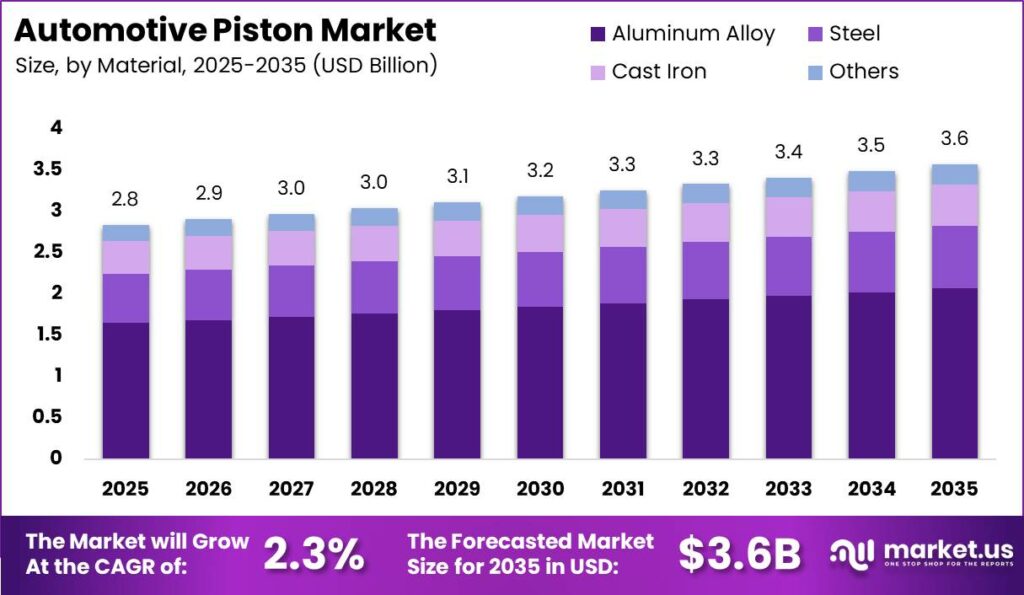
Global Automotive Piston Market size is expected to be worth around USD 3.6 Billion by 2035 from USD 2.8 Billion in 2025, growing at a CAGR of 2.3% during the forecast period 2026 to 2035. This trajectory reflects sustained demand from internal combustion engine production across passenger, commercial, and two-wheeler segments worldwide.
The automotive piston market encompasses precision-engineered components that convert combustion pressure into mechanical motion inside an engine cylinder. The market spans pistons, piston rings, and piston pins across aluminum alloy, steel, and cast iron materials, serving OEM production lines and aftermarket replacement channels across all major vehicle categories globally.
Key Takeaways
- Market size reaches USD 2.8 Billion in 2025 and is forecast to reach USD 3.6 Billion by 2035.
- The market grows at a CAGR of 2.3% during the forecast period 2026 to 2035.
- By Material, Aluminum Alloy dominates with a 58.00% share in 2025.
- By Component Type, Piston holds the leading position with a 62.00% share.
- By Coating Type, Thermal Barrier Coating leads with a 40.30% share.
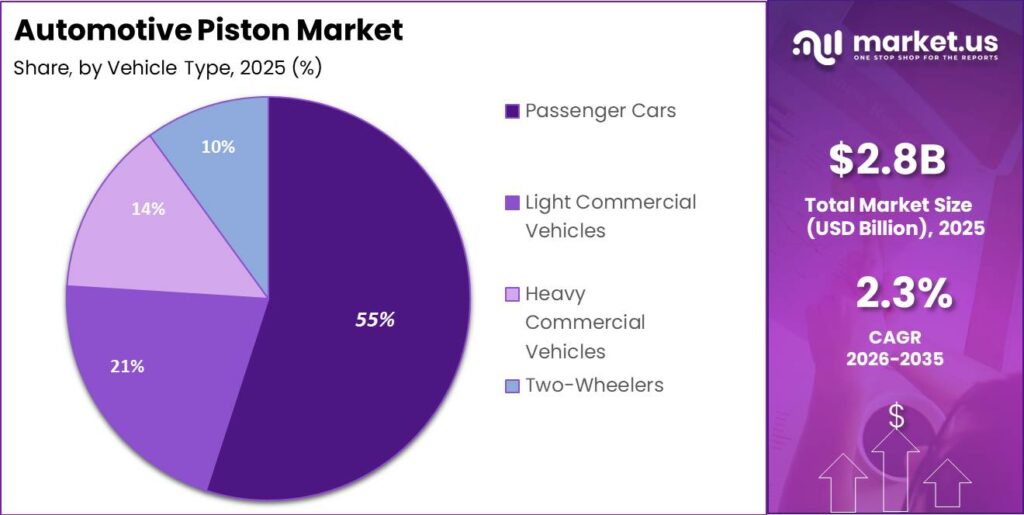
- By Vehicle Type, Passenger Cars account for the largest share at 55.00%.
- By Distribution Channel, OEM leads with a 61.00% share.
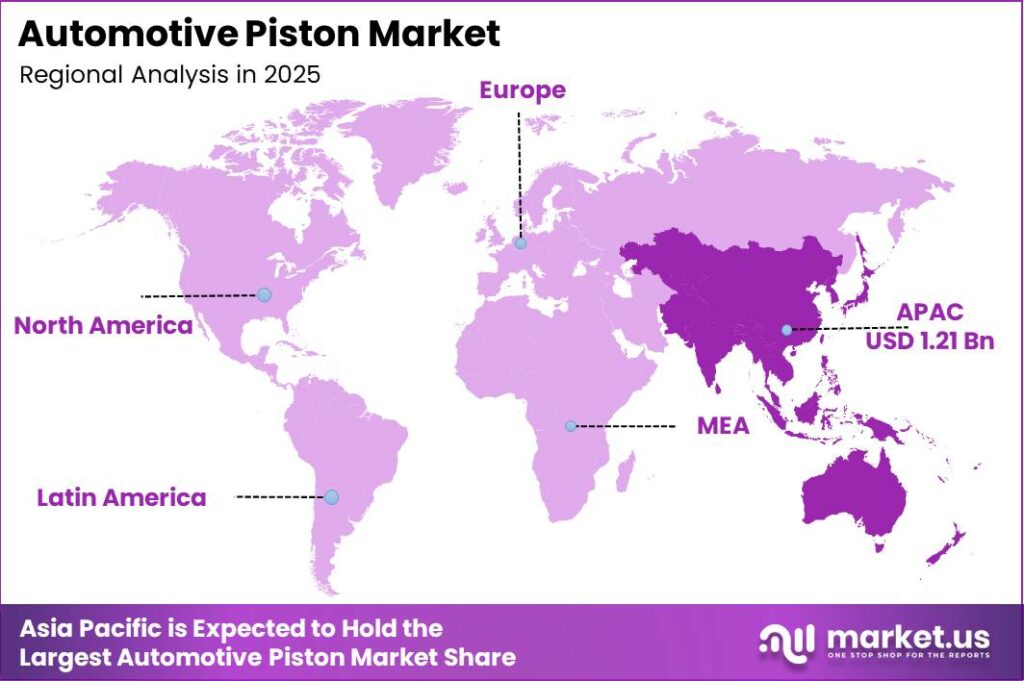
- Asia Pacific dominates the regional landscape with a 42.50% share, valued at USD 1.21 Billion.
Regulatory pressure from Euro 7, China 6b, and US EPA heavy-duty NOx rules is reshaping piston engineering from commodity casting toward co-engineered platform contracts. OEM engineering specifications now mandate tighter oil-consumption ceilings and peak in-cylinder pressures above 200 bar, pushing piston-assembly average selling prices up an estimated 12–18% versus standard aluminum castings. Suppliers able to fund metallurgical R&D at 3–5% of sales will capture margin-accretive platform contracts unavailable to unqualified regional foundries.
Hybrid powertrain proliferation adds structural demand for pistons engineered to Atkinson-cycle thermal cycles, while aging vehicle fleets across North America, Latin America, and MEA sustain aftermarket replacement volumes independent of new vehicle production cycles. In December 2025, Shriram Pistons and Rings Limited signed a definitive agreement to acquire three Grupo Antolin Indian operations for approximately INR 16.70 billion, signaling that leading piston manufacturers are diversifying beyond engine components into adjacen automotive systems to reduce exposure to any single powertrain technology.
Two-wheeler and small-displacement ICE production growth across India, ASEAN, and Africa adds a demand base that operates largely outside the EV transition timeline visible in European and Chinese passenger car segments. This creates a bifurcated market structure where premium co-engineered pistons serve tightening OEM compliance programs while high-volume, cost-competitive parts serve growth markets where ICE penetration remains the primary mobility solution for the foreseeable future.
Material Analysis
Aluminum Alloy dominates with 58.00% due to low weight and high thermal conductivity.
In 2025, Aluminum Alloy held a dominant market position in the By Material segment of the Automotive Piston Market, with a 58.00% share. According to the International Aluminium Institute, global primary aluminum output reached 70.4 million metric tons in 2023, with transportation accounting for roughly 27% of downstream consumption. Aluminum alloy pistons reduce reciprocating mass, directly improving fuel efficiency and throttle response. OEMs prioritize this material across passenger car and light commercial programs where weight reduction carries measurable CO₂ compliance benefit.
Steel pistons serve high-load diesel and turbocharged gasoline direct injection engines where aluminum alloy cannot sustain peak cylinder pressures above 200 bar. The American Iron and Steel Institute reports that automotive-grade steel shipments to powertrain applications have grown alongside turbo-GDI engine adoption in North America and Europe. Steel pistons carry a higher unit cost but command a price premium that expands per-unit margins for qualified suppliers. Their adoption rate is rising as OEMs migrate to smaller-displacement, higher-pressure engine architectures.
Cast Iron pistons address heavy-duty commercial and stationary engine applications where durability requirements exceed the fatigue limits of aluminum alloy at sustained high temperatures. UNIDO manufacturing output data shows heavy-duty diesel engine production remains concentrated in China, India, and the United States, all of which maintain large commercial freight and construction equipment fleets. Cast iron’s higher density limits its share in light-duty applications, but its cost advantage and wear resistance sustain demand in industrial and off-highway markets that replace pistons on fixed maintenance cycles.
Component Type Analysis
Piston dominates with 62.00% due to direct combustion-force conversion role.
In 2025, Piston held a dominant market position in the By Component Type segment of the Automotive Piston Market, with a 62.00% share. Corporate annual reports from major powertrain suppliers confirm that piston assemblies represent the highest unit-cost item within the piston system, with per-unit prices ranging from USD 8 to over USD 80 depending on material and coating specification. Pistons are replaced less frequently than rings but carry higher engineering content, making them the primary revenue driver for tier-one suppliers competing on platform contracts.
Piston Rings seal combustion gases, control oil consumption, and transfer heat from the piston to the cylinder wall. The International Organization for Standardization reports that oil-consumption compliance limits in Euro 7 and US EPA regulations have increased ring-pack engineering complexity significantly. Multi-ring configurations using PVD-coated and nitrided surfaces are now standard on turbocharged applications. Piston ring demand scales directly with engine production volume, making this sub-segment a volume-sensitive component that benefits from both new vehicle production and aftermarket replacement cycles.
Piston Pins connect the piston to the connecting rod and transmit combustion loads into the engine’s rotating assembly. Trade association data from the Automotive Components Manufacturers Association of India shows piston pin production in India exceeded 150 million units annually in recent years, reflecting the country’s large two-wheeler and small commercial engine base. Pin geometry tolerances have tightened alongside higher-pressure engine programs, raising material and machining costs. Suppliers that control pin production alongside piston manufacturing capture integration margin unavailable to component-only suppliers.
Coating Type Analysis
Thermal Barrier Coating dominates with 40.30% due to direct combustion heat isolation benefit.
In 2025, Thermal Barrier Coating held a dominant market position in the By Coating Type segment of the Automotive Piston Market, with a 40.30% share. SAE International technical papers document that ceramic thermal barrier coatings applied to piston crowns reduce heat rejection into the cooling system by 10–20%, improving indicated thermal efficiency and allowing higher compression ratios. OEMs developing low-heat-rejection combustion concepts for hybrid and lean-burn gasoline engines specify thermal barrier coatings as a standard feature on piston crowns in new platform releases.
Dry Film Lubricant Coatings applied to piston skirts reduce cold-start friction and scuffing wear during the first engine seconds before oil film formation. ASTM International coating qualification standards require skirt coatings to sustain adhesion through a defined number of thermal cycles and maintain a low friction coefficient across the temperature operating range. Suppliers that qualify dry film lubricant formulations to OEM test specifications gain program-level preferred-supplier status that limits competitive substitution during a platform’s production life.
Oil Shedding Coatings minimize oil retention on piston surfaces, reducing ring-scraping losses and supporting tighter oil-consumption compliance targets mandated by Euro 7 and equivalent regulations. Patent database filings from major piston manufacturers show accelerated development activity in hydrophobic and oleophobic surface treatments over the past four years, reflecting the regulatory-driven urgency to reduce in-service oil consumption below 0.1 g/kWh ceilings. Suppliers with proprietary oil-shedding formulations hold a qualification advantage that converts into long-term platform content.
Vehicle Type Analysis
Passenger Cars dominate with 55.00% due to largest global ICE production volume.
In 2025, Passenger Cars held a dominant market position in the By Vehicle Type segment of the Automotive Piston Market, with a 55.00% share. OICA global vehicle production statistics show passenger car output exceeded 68 million units in 2023, with ICE and hybrid-ICE powertrains accounting for the substantial majority of that volume. Passenger car pistons are produced at the highest unit volumes in the market, giving tier-one suppliers scale economies that enable investment in advanced coating and material technologies amortized across large program runs.
Light Commercial Vehicles serve last-mile delivery, construction, and utility applications where payload capacity and fuel economy simultaneously drive piston specification. World Bank logistics performance data shows freight transport demand growing fastest in South and Southeast Asia, directly supporting light commercial vehicle production in those regions. LCV pistons often share platform architecture with passenger car designs while carrying additional durability requirements tied to higher annual mileage and load cycles, creating a premium content opportunity for suppliers that serve both segments.
Heavy Commercial Vehicles require pistons engineered for sustained high-load operation across multi-year service intervals, making durability and oil-consumption control the primary procurement criteria. UN Comtrade data shows heavy-duty engine components recorded substantial trade flows between Europe, China, India, and Brazil, reflecting global supply chains for commercial powertrain production. Two-Wheelers represent the fastest-growing volume opportunity in India, ASEAN, and Sub-Saharan Africa, where motorcycle and three-wheeler production serves primary mobility demand with engines in the 100–250 cc displacement range, requiring cost-optimized aluminum alloy pistons at high unit volumes.
Distribution Channel Analysis
OEM dominates with 61.00% due to direct integration into new vehicle production lines.
In 2025, OEM held a dominant market position in the By Distribution Channel segment of the Automotive Piston Market, with a 61.00% share. ITC Trade Map data shows automotive component exports from major producing countries are concentrated in OEM-directed supply chains, with Germany, Japan, China, and India accounting for the largest outbound piston and engine component trade flows. OEM contracts lock in pricing, volume, and technical specifications for the duration of a vehicle platform’s production life, providing revenue predictability that aftermarket supply cannot match.
The Aftermarket channel supplies replacement pistons across a global parc of over 1.4 billion registered vehicles, the majority of which remain ICE-powered. WTO trade statistics confirm that automotive replacement parts represent one of the most consistently growing categories in global goods trade, sustained by vehicle aging in North America, Latin America, MEA, and parts of Asia where fleet turnover is slower than in Europe. Aftermarket pistons require broader SKU coverage across legacy engine families, which raises inventory and logistics costs but supports higher per-unit margins than OEM supply on equivalent specifications.
Key Market Segments
By Material
- Aluminum Alloy
- Steel
- Cast Iron
- Others
By Component Type
- Piston
- Piston Ring
- Piston Pin
By Coating Type
- Thermal Barrier Coating
- Dry Film Lubricant Coating
- Oil Shedding Coating
By Vehicle Type
- Passenger Cars
- Light Commercial Vehicles
- Heavy Commercial Vehicles
- Two-Wheelers
By Distribution Channel
- OEM
- Aftermarket
Regional Analysis
Asia Pacific Dominates the Automotive Piston Market with a Market Share of 42.50%, Valued at USD 1.21 Billion
Asia Pacific commands the largest regional share on the strength of China, India, Japan, and South Korea’s combined engine production base. China remains the world’s largest vehicle market by production volume, while India’s two-wheeler and light commercial vehicle output sustains high-frequency, cost-competitive piston demand. As per our research, the region’s 42.50% share translates to USD 1.21 Billion, reflecting both OEM production concentration and a growing aftermarket base tied to the region’s expanding registered vehicle fleet.
Europe is the fastest-growing region driven by stringent emission compliance programs that require higher-specification piston assemblies per engine unit. Euro 7 mandates force OEM suppliers to upgrade combustion-bowl geometry, ring-pack sealing, and thermal-barrier coatings across new platform releases, lifting average piston content value per vehicle. In January 2026, Shriram Pistons and Rings Limited completed its acquisition of three Grupo Antolin Indian entities at an enterprise value of approximately EUR 159 million, demonstrating how tier-two suppliers are building scale to compete for European-spec piston programs requiring premium material and coating capabilities.
North America sustains demand through a large aftermarket tied to an aging vehicle fleet and ongoing commercial freight fleet renewal cycles. Latin America and the Middle East and Africa maintain structurally positive demand from ICE-dominated vehicle parc growth with limited near-term EV displacement. These regions collectively represent the most durable long-cycle aftermarket opportunity in the global piston market, as fleet turnover rates remain slow and replacement interval demand is predictable across a multi-year horizon.
Key Regions and Countries
North America
- US
- Canada
Europe
- Germany
- France
- The UK
- Spain
- Italy
- Rest of Europe
Asia Pacific
- China
- Japan
- South Korea
- India
- Australia
- Rest of APAC
Latin America
- Brazil
- Mexico
- Rest of Latin America
Middle East and Africa
- GCC
- South Africa
- Rest of MEA
Market Dynamics
Market Opportunity Analysis - Underserved vehicle categories and emerging regions offer high-return entry points for focused piston suppliers.
Two-Wheeler pistons represent the most underpenetrated high-volume opportunity for tier-one suppliers currently focused on passenger car programs. India, ASEAN, and Sub-Saharan Africa sustain motorcycle and three-wheeler production in the 100–250 cc displacement range at unit economics driven by cost sensitivity rather than engineering complexity. Suppliers that build cost-optimized aluminum alloy piston lines scaled for this segment gain access to volume growth that operates independently of the EV transition compressing European and Chinese passenger car addressable markets.
The Aftermarket channel remains structurally underserved in Africa and MEA, where a large ICE fleet operates without access to organized replacement part distribution. As per our research, these regions carry fleet turnover rates well below global averages, sustaining multi-year replacement demand for legacy engine families that OEM-focused suppliers do not actively serve. Distributors or suppliers that establish remanufacturing and inventory operations in Sub-Saharan Africa and the Gulf region enter a channel with minimal organized competition and structurally positive long-cycle demand.
Oil Shedding and Dry Film Lubricant Coating sub-segments hold lower current share than Thermal Barrier Coating but face accelerating regulatory demand from Euro 7 oil-consumption compliance targets. Suppliers that qualify proprietary coating formulations ahead of the 2026 light-duty application dates establish preferred-supplier status on new platform releases before the competition closes. This first-mover advantage converts into long-term platform content that compounds across the full production life of the vehicle program, typically 5–7 years.
Range-extender EV piston programs represent an emerging OEM demand signal that current piston supply chains have not fully organized around. China, North America, and Europe are all developing range-extender architectures that require dedicated, small-displacement, high-efficiency pistons operating in a narrow duty cycle. This application demands different optimization priorities than conventional pistons, creating a specification gap that rewards suppliers who invest in test-bench durability programs and OEM co-development agreements now, before supplier panel freezes lock out later entrants.
Technology and Innovation Landscape - Topology optimization, advanced coatings, and additive manufacturing redefine piston performance and supplier differentiation.
Topology optimization of steel diesel pistons delivers measurable structural and thermal gains that directly lower warranty exposure for OEMs. A 2025 peer-reviewed study published in PMC found that an optimized lightweight steel piston reduced total piston mass by 8.86%, cutting modeled volume from 125,742 mm³ to 114,601 mm³. The same design reduced the window region mass by 41.87% and cut maximum thermal stress by 3.03%, from 414.94 MPa to 402.35 MPa. Suppliers that embed topology optimization into their development toolchain shorten validation cycles and offer OEMs a documented performance advantage over conventional designs.
Cooling gallery redesign amplifies the thermal gains from topology optimization. The study found that offsetting the cooling gallery cross-section outward by 0.4 mm increased gallery volume from 44,162 mm³ to 49,148 mm³ and reduced the head region mass by 11.29%. Maximum piston temperature fell from 446.03°C to 445.07°C, and maximum longitudinal thermal deformation declined by 11.65%, from 0.103 mm to 0.091 mm. These deformation reductions directly lower ring-land fatigue risk, translating into longer service life and reduced warranty claims for OEM customers.
PVD coating technology on piston rings is converting friction reduction from a theoretical benefit into a quantified fuel-economy and emissions credential. Data from fxpvd.com shows that DLC-coated piston rings achieve 20% friction reduction at both 2000 rpm and 3000 rpm, while CrN-coated rings reduced fuel consumption in a mid-size sedan from 7.5 to 7.3 liters per 100 km. PVD films operate at hardness above Hv2000 with a friction coefficient below 0.1. Optimized PVD processes can boost coating hardness by a further 10% and reduce the friction coefficient by roughly 0.05, compounding efficiency gains across the engine’s operating range.
Additive manufacturing unlocks piston geometries impossible with conventional forging. In Porsche’s 911 GT2 RS development program, 3D-printed pistons produced in collaboration with MAHLE and Trumpf weighed 10% less than forged production pistons and delivered up to 30 PS of additional power from the 700 PS biturbo engine through an integrated cooling duct that lowered crown temperature load and permitted higher engine speeds. This performance outcome signals that additive manufacturing will migrate from motorsport prototyping into series-production niche programs where the power and weight targets justify the higher per-unit cost of printed components.
Drivers
Statutory emission frameworks are the primary demand catalyst for premium piston content. The EU’s Euro 7 framework, the US EPA’s heavy-duty NOx rule tightening limits by roughly 80% for model year 2027 engines, and China’s nationwide China 6b enforcement all impose oil-consumption ceilings near 0.05–0.1 g/kWh and peak in-cylinder pressures above 200 bar. These requirements force validation cycles of 18–24 months and lift piston-assembly average selling prices by an estimated 12–18% versus standard aluminum castings.
This regulatory shift converts piston supply from volume-priced commodity casting into co-engineered, IP-bearing platform contracts with tooling recovery clauses and application-engineering fees. Gross-margin expansion of roughly 300–500 basis points is achievable on qualified programs, but only for the 6–8 suppliers able to fund metallurgical R&D at 3–5% of sales. Unqualified regional foundries absorb price-down pressure of 2–3% annually, widening the competitive gap between qualified and unqualified suppliers.
| Driver | (~) % Impact on CAGR Forecast | Geographic Relevance | Impact Timeline |
|---|---|---|---|
| Emission-Standard Combustion Re-Engineering Mandates | +0.7% | EU, China, North America, India | Short term (2 years or less) |
| Turbo-GDI Peak-Pressure Migration to Steel Pistons | +0.6% | Global, OEM programs led by Europe & Japan | Medium term (2 to 4 years) |
| Two-Wheeler & Small-Displacement ICE Output Growth | +0.6% | India, ASEAN, Africa | Short term (2 years or less) |
| Hybrid Atkinson-Cycle Piston Content Uplift | +0.5% | Japan, North America, China | Medium term (2 to 4 years) |
| Aging Vehicle Parc Aftermarket Replacement Demand | +0.5% | North America, Latin America, MEA, CIS | Long term (4 years or more) |
| Commercial Freight Fleet Renewal Cycles | +0.4% | India, ASEAN, Brazil, Mexico | Medium term (2 to 4 years) |
Restraints
Binding fleet-level CO2 legislation is removing piston-bearing ICE units from the addressable base outright across key markets. The European Commission’s passenger-car regulation targets a 100% CO2 reduction by 2035, the UK ZEV mandate requires 28% battery-electric share from 2026, and China Association of Automobile Manufacturers data shows new-energy vehicles exceeding 40% of monthly domestic retail volume. Each of these removes addressable piston-bearing units structurally, not cyclically, compressing the long-term volume ceiling.
European light-duty piston lines engineered for 1.5–2.5 million units annually are running utilization in the 60–75% band against a breakeven near 80%. Each 10-point utilization loss translates to roughly 150–250 basis points of gross-margin erosion. Suppliers are responding by extending existing tooling life 2–3 years instead of re-equipping, deferring upstream casting and coating investment and suppressing order intake across the supply chain for a medium-term horizon.
| Restraint | (~) % Impact on CAGR Forecast | Geographic Relevance | Impact Timeline |
|---|---|---|---|
| Zero-Emission Vehicle Mandates Displacing ICE Registrations | -0.7% | EU, UK, China, California | Short term (2 years or less) |
| Three-Cylinder Downsizing Reducing Pistons Per Engine | -0.5% | Europe, India, China | Short term (2 years or less) |
| Elevated Policy Rates Freezing Powertrain CapEx | -0.3% | Global, acute in emerging markets | Medium term (2 to 4 years) |
| Aluminium-Silicon Alloy Input Cost Pass-Through Failure | -0.2% | Global, acute in Europe | Short term (2 years or less) |
| Urban Diesel Access Bans and Low-Emission Zones | -0.2% | Western Europe, select Asian megacities | Medium term (2 to 4 years) |
Challenges
Demographic pressure is hollowing out the skilled foundry labor pool in Germany, Italy, Japan, and the United States. Eurostat and US Bureau of Labor Statistics data show metal-casting and machining occupations carry a median workforce age above 45, with 20–25% of employees within 10 years of retirement. German apprenticeship and Japanese job-opening data both show more than 1.5 vacancies per qualified applicant for heat-treatment, die-maintenance, and CNC-setter roles, directly constraining production capacity expansion at existing facilities.
The operational cost compounds through yield loss rather than headcount alone. Vacancy fill times of 120–180 days force overtime premiums of 15–25%, and scrap on skirt-profile and pin-bore machining drifts 1–3 points above the sub-2% target, reducing theoretical plant output by 3–6%. Suppliers investing in robotized de-gating and automated gauging cells face a payback threshold near 1.5–3 million units and an initial fixed-cost increase of 2–4% per unit before efficiency recovery, creating a capital barrier that limits this response to larger, better-funded producers.
| Challenge | (~) % CAGR Friction Drag | Geographic Relevance | Mitigation Horizon |
|---|---|---|---|
| Skilled Foundry Labour Deficit | -0.4% | Germany, Italy, Japan, United States | Long term (4 years or more) |
| Concentrated Alloy Feedstock Sourcing | -0.3% | Global, exposure to single-origin supply | Medium term (2 to 4 years) |
| Coating Qualification Cycle Length | -0.3% | Global OEM engineering centres | Medium term (2 to 4 years) |
| Counterfeit Aftermarket Parts Penetration | -0.3% | MEA, South Asia, Latin America | Long term (4 years or more) |
| Energy-Intensive Casting Decarbonisation | -0.3% | EU, UK, Japan, Korea | Long term (4 years or more) |
| Fragmented Legacy Tooling Capacity | -0.2% | Eastern Europe, Turkey, Southeast Asia | Medium term (2 to 4 years) |
Opportunities
Hydrogen ICE and e-fuel piston platforms represent the highest-margin long-term opportunity in the market. Hydrogen combustion at air-fuel ratios above 2 lambda requires redesigned crown geometry, top-land clearance widened by 15–30%, and forged-steel or hybrid-material bodies carrying material costs 8–15% higher than aluminum alternatives. Validated hydrogen pistons command selling prices 35–60% above equivalent aluminum light-duty pistons, implying gross-margin expansion of roughly 600–900 basis points at modest initial volumes for qualified suppliers.
Heavy-duty truck, off-highway, marine auxiliary, and stationary genset applications carry 8–16 year replacement cycles and aftermarket attachment rates well above passenger cars. Suppliers that fund test-bench durability programs now build qualification files that lock out late entrants for 24–36 months once lead OEMs freeze hydrogen engine supplier panels. Africa and MEA remanufacturing distribution also offers an adjacent growth avenue, with large vehicle fleets and limited local manufacturing capacity creating white space for structured remanufacturing and distribution operations.
| Opportunity | (~) % Potential CAGR Upside | Geographic Relevance | Execution Window |
|---|---|---|---|
| Hydrogen ICE and E-Fuel Piston Platforms | +0.6% | Germany, Japan, China, off-highway global | Long term (4 years or more) |
| Range-Extender EV Dedicated Piston Programs | +0.5% | China, North America, Europe | Medium term (2 to 4 years) |
| Roll-Up of Subscale Regional Foundries | +0.4% | Europe, Japan, Turkey, India | Medium term (2 to 4 years) |
| Africa and MEA Remanufacturing Distribution White Space | +0.4% | Sub-Saharan Africa, North Africa, Gulf | Long term (4 years or more) |
| Additive-Manufactured Steel Piston Niches | +0.3% | North America, Europe, Japan | Medium term (2 to 4 years) |
| Condition-Monitoring Data Monetisation Contracts | +0.3% | Global fleet and off-highway operators | Long term (4 years or more) |
Key Company Insights
MAHLE GmbH positions itself at the intersection of combustion optimization and decarbonization. In July 2025, MAHLE launched an ethanol-compatible power cell unit delivering fuel savings of up to 1.5% and CO₂ reductions of up to 70% on E100 operation. Its proprietary Grafal anti-friction skirt coating targets 100,000+ mile service life. This dual focus on emission compliance and long-life performance deepens OEM platform lock-in while building aftermarket retention that commodity suppliers cannot match.
Tenneco Inc. (Federal-Mogul) competes on breadth across both OEM supply and aftermarket distribution, two channels with structurally different margin profiles. Its Federal-Mogul brand carries deep SKU coverage across legacy engine families, sustaining aftermarket volume as ICE fleets age. This breadth is a revenue stabilizer but creates inventory and logistics complexity that narrows net margin versus platform-focused rivals. Tenneco’s ability to serve both channels simultaneously is its primary competitive hedge against volume loss in any single segment or region.
Key Players
- MAHLE GmbH
- Tenneco Inc. (Federal-Mogul)
- Aisin Corporation
- Kolbenschmidt (Rheinmetall Automotive AG)
- Hitachi Astemo, Ltd.
- Shriram Pistons & Rings Limited
- Art Metal Mfg. Co., Ltd.
- Dongsuh Federal-Mogul Co., Ltd.
- Menon Pistons Ltd.
- Amalgamations Group (India Pistons)
- Cosworth Group Holdings Ltd.
- Capricorn Automotive
- Riken Corporation
- Nippon Piston Ring Co., Ltd.
- Zynp Corporation
Recent Developments
- February 2026: Shriram Pistons and Rings Limited disclosed an INR 280 million asset-purchase agreement with Sunbeam Lightweighting Solutions to acquire piston-manufacturing lines, machinery, and related assets, with the first tranche completed during the quarter.
- June 2026: Rheinmetall signed an agreement to sell its Power Systems division, including the Kolbenschmidt automotive-components brand, to AEQUITA for a provisional EUR 350 million, subject to regulatory approval and targeted for completion in the fourth quarter of 2026.
Geopolitical Impact Analysis
US-China trade tensions and escalating tariff structures are adding measurable cost friction to automotive piston supply chains reliant on cross-Pacific component flows. According to WTO tariff data, US Section 301 tariffs on Chinese automotive parts categories reach 25%, directly raising landed costs for aluminum alloy piston assemblies sourced from Chinese tier-two suppliers. This means US OEMs absorb either higher input costs or face re-sourcing timelines of 18–24 months to qualify domestic or near-shore alternatives, adding program risk to model-year launches already constrained by Euro 7 and EPA validation cycles.
Energy price volatility tied to the Russia-Ukraine conflict continues to inflate casting and heat-treatment costs at European piston manufacturing facilities. Data from the IEA shows European industrial natural gas prices remain elevated versus pre-2022 baselines, directly impacting the energy-intensive die-casting and annealing processes that account for an estimated 15–20% of piston manufacturing variable cost. As a result, European suppliers face a structural cost disadvantage versus Asian competitors, compressing margins on OEM contracts where price escalation clauses do not fully capture energy pass-through, accelerating capacity rationalization decisions already triggered by ICE registration declines in the region.
Report Scope
| Report Features | Description |
|---|---|
| Market Value (2025) | USD 2.8 Billion |
| Forecast Revenue (2035) | USD 3.6 Billion |
| CAGR (2026-2035) | 2.3% |
| Base Year for Estimation | 2025 |
| Historic Period | 2020-2024 |
| Forecast Period | 2026-2035 |
| Report Coverage | Revenue Forecast, Market Dynamics, Market Opportunity Analysis, Technology and Innovation Landscape, Competitive Landscape, Recent Developments |
| Segments Covered | By Material (Aluminum Alloy, Steel, Cast Iron, Others), By Component Type (Piston, Piston Ring, Piston Pin), By Coating Type (Thermal Barrier Coating, Dry Film Lubricant Coating, Oil Shedding Coating), By Vehicle Type (Passenger Cars, Light Commercial Vehicles, Heavy Commercial Vehicles, Two-Wheelers), By Distribution Channel (OEM, Aftermarket) |
| Regional Analysis | North America (US and Canada), Europe (Germany, France, The UK, Spain, Italy, and Rest of Europe), Asia Pacific (China, Japan, South Korea, India, Australia, and Rest of APAC), Latin America (Brazil, Mexico, and Rest of Latin America), Middle East and Africa (GCC, South Africa, and Rest of MEA) |
| Competitive Landscape | MAHLE GmbH, Tenneco Inc. (Federal-Mogul), Aisin Corporation, Kolbenschmidt (Rheinmetall Automotive AG), Hitachi Astemo Ltd., Shriram Pistons & Rings Limited, Art Metal Mfg. Co. Ltd., Dongsuh Federal-Mogul Co. Ltd., Menon Pistons Ltd., Amalgamations Group (India Pistons), Cosworth Group Holdings Ltd., Capricorn Automotive, Riken Corporation, Nippon Piston Ring Co. Ltd., Zynp Corporation |
| Customization Scope | Customization for segments, region / country-level will be provided. Additional customization can be done based on requirements. |
| Purchase Options | We have three licenses to opt for: Single User License | Multi-User License (Up to 5 Users) | Corporate Use License (Unlimited User and Printable PDF) |





































