


Report Overview
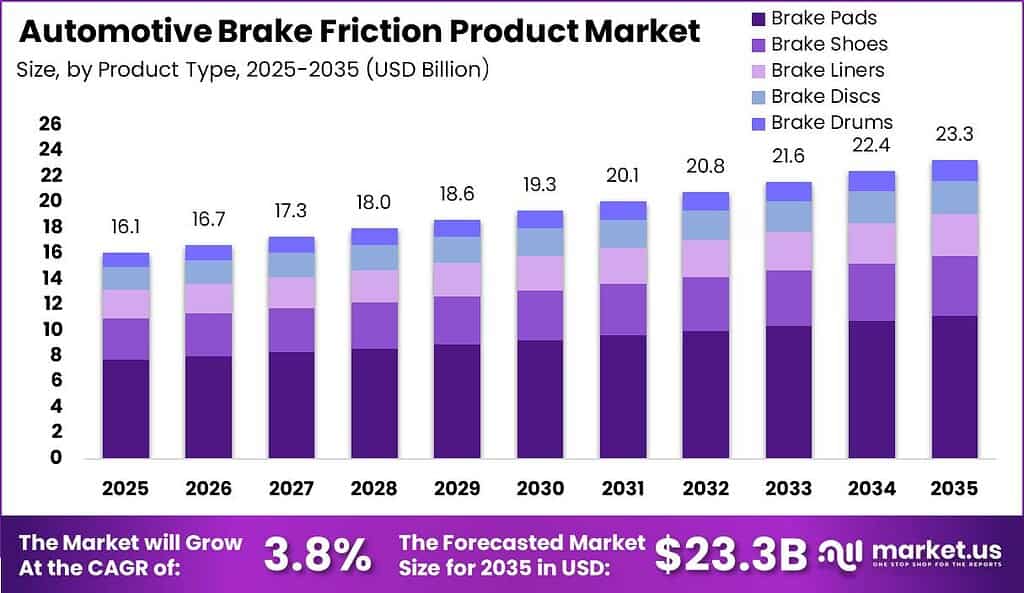
Global Automotive Brake Friction Product Market size is expected to be worth around USD 23.30 Billion by 2035 from USD 16.10 Billion in 2025, growing at a CAGR of 3.8% during the forecast period 2026 to 2035. Suppliers who scale friction capacity now lock multi-year OEM contracts before rivals fill the same slots. This means volume leverage will decide which vendors protect margin through the next replacement cycle.
Therefore, the market covers friction components that convert kinetic energy into heat and stop vehicles under load. Product lines span pads, shoes, liners, discs, and drums across metallic, ceramic, composite, and other materials. Vehicle classes include passenger, light commercial, heavy commercial, and two-wheeler platforms. Sales flow through OEM fitment and aftermarket channels that serve fleets and retail workshops.
Key Takeaways
- The market reaches USD 16.10 Billion in 2025 and USD 23.30 Billion by 2035 at a CAGR of 3.8%.
- Brake Pads lead product type with a 47.90% share.
- Composite friction material holds a 38.00% share.
- Light Commercial Vehicles account for 78.00% of vehicle type demand.
- Aftermarket channels control 75.20% of sales.
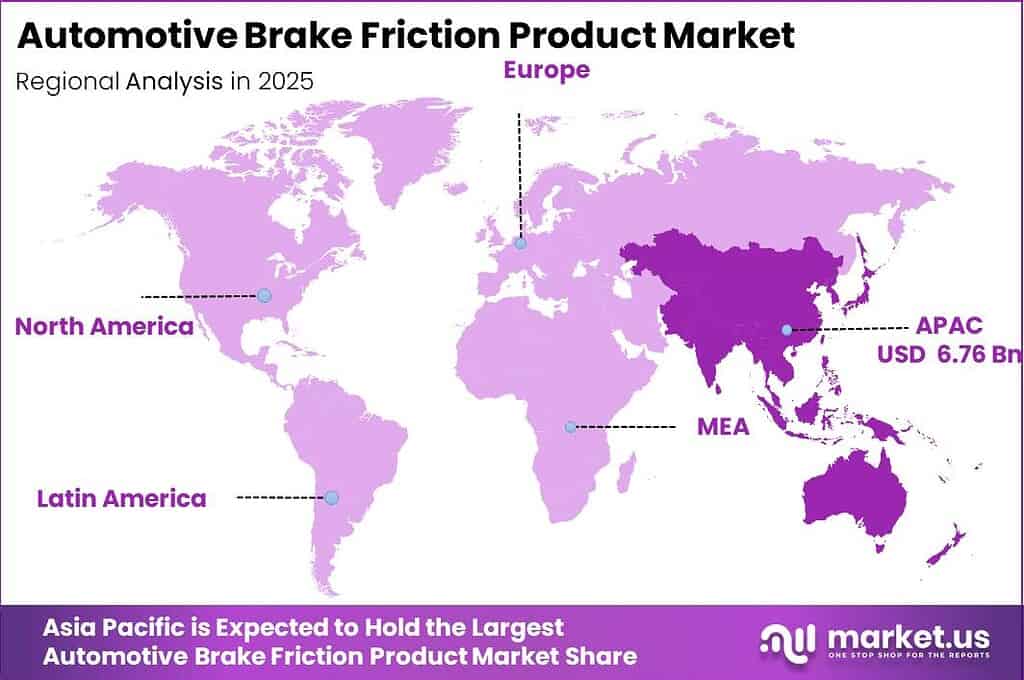
- Asia Pacific leads with a 42.00% share valued at USD 6.76 Billion.
As reported by European Parliament summary documents, Euro 7 sets a brake-particle PM10 limit of 3 mg/km for pure-electric M1 and lighter N1 vehicles from 29 November 2026. Heavier pure-electric N1 Class III vans face a 5 mg/km PM10 cap under the same rules. OEMs that qualify low-dust friction early win type-approval slots before late movers redesign compounds. This creates urgent reformulation spend for suppliers serving European light-duty platforms.
Consequently, Continental AG introduced the ATE New Original line of matched brake discs and copper-free friction pads for electric vehicles and future Euro 7 needs in March 2025. Fleet electrification lowers wear rates yet raises corrosion and intermittent high-torque events that demand new pad chemistry. Vendors who pair copper-free pads with EV-ready discs capture design wins during the 24 to 36 month platform window.
Based on EIT Urban Mobility data, optimized wear-resistant brake discs cost about €100 more per vehicle than grey cast-iron discs that need 2 to 3 replacements over roughly 200,000 to 240,000 km. Non-asbestos organic pads add about €15 per vehicle and need about 6 replacements on conventional vehicles versus 2 to 4 on battery-electric vehicles. Buyers who accept higher first-fit cost cut lifetime dust and service visits, shifting aftermarket mix toward premium low-dust SKUs.
Product Type Analysis
Brake Pads dominates with 47.90% due to disc brake fitment density.
In 2025, Brake Pads held a dominant market position in the By Product Type segment of Automotive Brake Friction Product Market, with a 47.90% share. OICA data show global vehicle production rose to 96.4 million units in 2025 from 92.7 million in 2024. Higher output expands disc-brake pad fitment on passenger and light commercial platforms. Suppliers that secure pad tooling capacity convert production growth into stable OEM call-offs.
Brake Shoes serve drum brake systems still common on rear axles of entry cars and many commercial axles in cost-sensitive markets. National fleet mix keeps shoe demand alive where drum architecture remains cheaper to certify. Workshop stocking patterns favor dual-sourcing of shoes alongside pads. Vendors who maintain shoe SKUs retain share when fleets delay full disc conversion.
Brake Liners support heavy drum applications where bonded or riveted linings handle high thermal loads. Liner replacement cycles track axle utilization in freight and bus fleets. Parts distributors that bundle liners with hardware reduce bay time for fleets. This means liner specialists defend margin where disc conversion stays slow.
Brake Discs and Brake Drums form the rotating partners that complete the friction pair and hold the remaining product share collectively. Disc face quality drives pad life and noise claims in urban stop-go duty. Drum integrity still matters for parking brake and low-cost rear axles. Foundries that tighten metallurgy and coating control win both OEM and premium aftermarket slots.
Friction Material Analysis
Composite dominates with 38.00% due to balanced cost and dust control.
In 2025, Composite held a dominant market position in the By Friction Material segment of Automotive Brake Friction Product Market, with a 38.00% share. California and Washington rules require less than 0.5% copper by weight in friction materials sold from 1 January 2025. Composite blends help suppliers hit N-rated copper-free targets without full ceramic cost. Formulators who lock copper-free composite recipes protect US West Coast distribution rights.
Metallic friction compounds deliver high fade resistance for heavy braking and performance duty cycles. Steel fiber content supports thermal conductivity under repeated stops. Fleet and performance buyers still specify metallic pads where heat capacity outranks dust optics. Producers that offer low-copper metallic grades keep commercial and performance contracts intact.
Ceramic materials target quiet operation and lower rotor wear for premium passenger applications. Ceramic matrices cut noise complaints in urban passenger duty. Dealers upsell ceramic pads on comfort-focused trims. Manufacturers that certify ceramic copper-free lines capture premium aftermarket price ladders.
Others cover specialty organics and hybrid blends that fill niche OEM and regulatory slots and hold the remaining share collectively. Specialty binders address unique corrosion or regen-braking profiles. Niche formulators win small-volume EV and specialty vehicle programs. Early certification of hybrid blends opens white-space SKUs before volume leaders respond.
Vehicle Type Analysis
Light Commercial Vehicles dominates with 78.00% due to high duty cycle wear.
In 2025, Light Commercial Vehicles held a dominant market position in the By Vehicle Type segment of Automotive Brake Friction Product Market, with a 78.00% share. Global vehicle output reached 96.4 million units in 2025, with commercial platforms driving intensive stop-start friction wear. Delivery and service fleets replace pads and shoes more often than private cars. Friction makers who prioritize LCV pad thickness and heat capacity lock fleet contract renewals.
Passenger Vehicles generate large unit volumes through OEM fitment and retail aftermarket replacement. Private car parc size multiplies pad and disc pairs sold each year. Retail chains that stock application-specific passenger SKUs turn inventory faster. Brands that match noise and dust targets for passenger duty protect dealer loyalty.
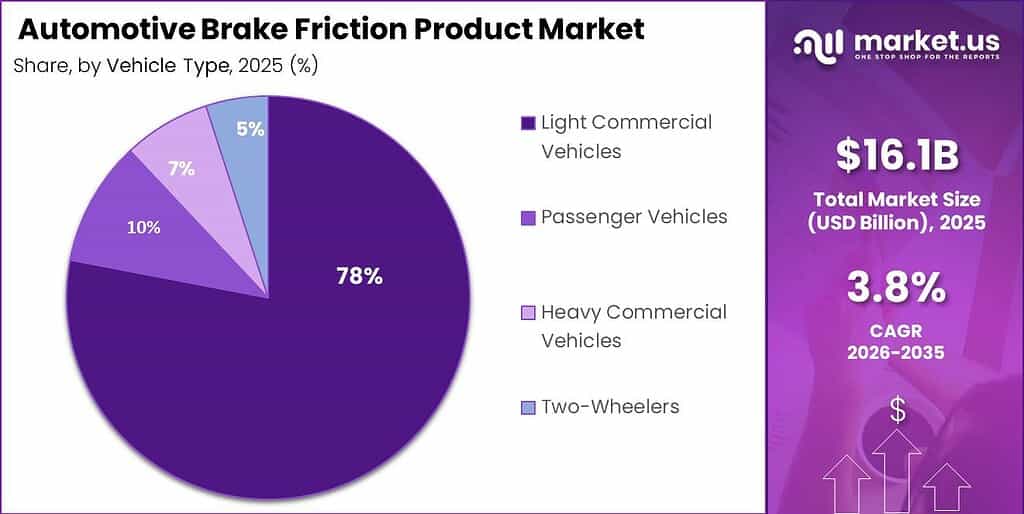
Heavy Commercial Vehicles demand thick linings and drums engineered for axle loads and long grades. Freight utilization ties lining life to ton-kilometers rather than calendar time. Fleet managers who standardize heavy lining specs cut unplanned downtime. Suppliers with heavy-duty validation labs win tender preference on line-haul accounts.
Two-Wheelers add high unit counts in Asia with compact shoe and pad formats and hold remaining vehicle share with heavy platforms above. Dense urban two-wheeler traffic raises braking events per kilometer. Local makers who tool scooter and motorcycle friction parts capture volume in India and ASEAN. Export-ready two-wheeler friction lines open incremental plant utilization.
Sales Channel Analysis
Aftermarket dominates with 75.20% due to replacement cycle frequency.
In 2025, Aftermarket held a dominant market position in the By Sales Channel segment of Automotive Brake Friction Product Market, with a 75.20% share. In February 2026, TMD Friction Holdings GmbH reported that its Textar brand added 153 aftermarket products during 2025, including 54 brake pads and 28 brake discs. Broad catalog depth wins jobber and distributor shelf space. Brands that refresh pad and disc coverage each year defend independent workshop preference.
Original Equipment Manufacturers channel friction parts into factory vehicle builds under multi-year supply contracts. OEM awards hinge on validation, cost-down paths, and global plant coverage. Winning platforms anchors volume for the full model life. Tier-1 suppliers that co-locate near assembly plants protect just-in-time delivery scores.
Independent distributors and retail chains bridge warehouses to workshops with private-label and branded friction lines. Channel power rests on fill rates and application coverage depth. Distributors that cut stock-outs raise installer loyalty. Friction brands that fund training and catalog tools secure preferred-supplier status in this route.
Online parts platforms expand reach for DIY and small garages seeking price transparency on pads and discs. Digital listings reward clear fitment data and return policies. Sellers who publish accurate vehicle applications reduce returns and chargebacks. This signals that data quality is now a commercial weapon in aftermarket e-commerce.
Key Market Segments
By Product Type
- Brake Pads
- Brake Shoes
- Brake Liners
- Brake Discs
- Brake Drums
By Friction Material
- Metallic
- Ceramic
- Composite
- Others
By Vehicle Type
- Passenger Vehicles
- Light Commercial Vehicles
- Heavy Commercial Vehicles
- Two-Wheelers
By Sales Channel
- Original Equipment Manufacturers
- Aftermarket
Regional Analysis
Asia Pacific Dominates the Automotive Brake Friction Product Market with a Market Share of 42.00%, Valued at USD 6.76 Billion
Asia Pacific leads on the back of dense vehicle production and a large in-use parc that feeds both OEM and aftermarket friction demand. India, China, and ASEAN plants pull pad and shoe volumes into local assembly lines. Regional Tier-1 capacity expansions shorten lead times for local OEMs. Investors who fund APAC friction plants capture the largest single regional profit pool.
Europe advances as the fastest structural growth arena for low-dust and copper-free friction under Euro 7 particle limits. Type-approval deadlines force early SKU qualification on passenger and light commercial platforms. Suppliers that certify low-PM compounds ahead of rivals win European OEM shortlists. This signals premium pricing power for compliant European friction portfolios.
North America, Latin America, and Middle East and Africa together add diversified replacement and commercial demand outside the APAC core. US state copper-free rules reshape pad chemistry on West Coast channels. Latin American disc penetration and MEA commercial fleets sustain shoe and drum pull. Global suppliers who balance regional catalogs reduce single-market volume risk.
Key Regions and Countries
North America
- US
- Canada
Europe
- Germany
- France
- The UK
- Spain
- Italy
- Rest of Europe
Asia Pacific
- China
- Japan
- South Korea
- India
- Australia
- Rest of APAC
Latin America
- Brazil
- Mexico
- Rest of Latin America
Middle East and Africa
- GCC
- South Africa
- Rest of MEA
Market Dynamics
Market Opportunity Analysis - Aftermarket depth, LCV duty cycles, and composite chemistry open white space for focused entrants
Aftermarket channels already control the majority of friction sales yet still leave catalog gaps on EV-specific and copper-free applications. Independent workshops need ready SKUs that meet new dust and copper rules without long back orders. New entrants that publish complete fitment data for low-dust pads can win jobber shelf space fast. This creates a distribution-led entry path with lower OEM validation cost than factory fitment.
Light Commercial Vehicles dominate vehicle-type demand through intensive stop-start wear that shortens pad life. Delivery fleets prioritize predictable service intervals over lowest sticker price. Specialists who engineer thicker LCV pads with stable friction curves lock multi-year fleet contracts. Therefore, focused LCV friction brands can outgrow generalists that under-serve commercial duty cycles.
Composite friction material leads material mix and sits at the center of copper-free reformulation programs. Many legacy metallic lines still need redesign to hit N-rated copper limits. Formulators who supply ready composite copper-free grades become preferred dual-source partners for Tier-1s. This signals a materials white space for niche compound houses with proven dyno data.
Asia Pacific holds the largest regional share yet still hosts uneven aftermarket formalization outside top-tier cities. Organized retail and e-commerce friction channels remain thinner in secondary markets. Investors who build branded distribution in India and ASEAN capture replacement volume as parc ages. By contrast, late movers will face higher slotting costs once national chains lock preferred brands.
Technology and Innovation Landscape - Low-dust discs, copper-free pads, and capture systems redefine compliance value
According to Brembo disclosures, the GREENTELL disc-and-pad system can cut brake-dust emissions by about 90% versus a conventional cast-iron disc. The same set can lower environmental impact by up to 85% on life-cycle assessment. OEMs that adopt such systems ease Euro 7 particle compliance on new types. Suppliers with proven low-dust disc coatings gain pricing power on premium EV platforms.
Data from the June 2025 VTT study show low-copper and low-iron pads cut particulate-mass and particle-number emissions by 30% to 90% versus original pads. Regenerative braking often cut PM10 and PN10 emissions by more than 50%. Pad makers who publish WLTP brake-cycle results win engineering trust faster. This means dyno-backed copper-free grades become a sales tool, not only a compliance cost.
Figures from the May 2025 EIT Urban Mobility report show carbon-ceramic composite discs cut PM10 by 81%, PM2.5 by 74%, and particle number by 61% on average versus grey cast iron. Non-asbestos organic pads cut brake-wear PM10 by 62%, PM2.5 by 55%, and particle number by 64% versus low-steel pads. Premium material swaps raise bill-of-materials cost but shrink lifetime dust liability. Investors should track which OEMs standardize ceramic discs on urban EV fleets.
As reported by Ricardo in 2025, hard high-speed braking can raise brake particle-number emissions up to 100 times versus gentle braking. A brake-mounted dust-capture system cut brake-related PM2.5 by more than 40% in the same work. Capture hardware opens an adjacent systems revenue stream beyond pads alone. Chassis suppliers who integrate capture with friction packages differentiate on fleet tender scorecards.
Drivers
Society of Indian Automobile Manufacturers and China Association of Automobile Manufacturers data show sustained passenger and commercial output growth across India and China through 2024 and 2025. Expanding production enlarges the OEM base that needs brake pads and shoes on every axle. Component suppliers report order backlogs of roughly eight to ten weeks. Tier-1 friction makers accelerate capacity CapEx in low-cost hubs, compressing near-term free cash flow by about 150 to 250 basis points while targeting near 85% utilization by 2027.
As a result, buyers gain more local supply options and shorter lead times once new lines ramp. Sellers who hit utilization targets recover margin through volume leverage. Investors should track CapEx timing against backlog duration before committing fresh plant capital.
| Driver | (~) % Impact on CAGR Forecast | Geographic Relevance | Impact Timeline |
|---|---|---|---|
| Rising Asia Pacific Vehicle Production | +1.1% | India, China, ASEAN | Short term (2 years or less) |
| Aftermarket Replacement Cycle Growth | +0.8% | Global | Short term (2 years or less) |
| ADAS and ESC Mandate Adoption | +0.6% | North America, Europe | Medium term (2 to 4 years) |
| Disc Brake Penetration in Entry Vehicles | +0.5% | India, Latin America | Medium term (2 to 4 years) |
| Rising Traffic Congestion Braking Frequency | +0.3% | Global urban centers | Short term (2 years or less) |
| Fleet Electrification-Driven Friction Redesign Demand | +0.4% | China, Europe, North America | Medium term (2 to 4 years) |
Restraints
California Department of Toxic Substances Control rules require brake friction materials sold in California and Washington to contain less than 0.5% copper by weight from 1 January 2025. Hitting the N-rated leaf-mark forces copper substitution with other metallic fibers and raises per-unit input costs by about 8% to 12%. Non-compliant B-rated stock may sell only through 2035, which confuses channels. Suppliers still on legacy mixes face about 150 basis points of margin pressure plus fine risk on leftover inventory.
This means reformulation CapEx and dual-SKU logistics slow near-term cash conversion for friction makers. Buyers pay higher pad prices during the transition window. Investors should favor firms that already hold copper-free certifications across core applications.
| Restraint | (~) % Impact on CAGR Forecast | Geographic Relevance | Impact Timeline |
|---|---|---|---|
| Copper-Free Brake Pad Mandate Compliance | -0.9% | California, Washington (US) | Short term (2 years or less) |
| High Interest Rate Environment on OEM CapEx | -0.6% | North America, Europe | Short term (2 years or less) |
| Raw Material Price Volatility (Steel, Resins) | -0.5% | Global | Short term (2 years or less) |
| Regenerative Braking Substitution in EVs | -0.4% | China, Europe, North America | Medium term (2 to 4 years) |
| Asbestos and Heavy-Metal Import Bans | -0.3% | European Union | Short term (2 years or less) |
Challenges
Euro 7 introduces brake-wear particulate limits rather than tailpipe-only rules, per European Commission text and national PM2.5 inventories. Low-dust formulations need resin binder reengineering that adds about 5% to 7% to unit production cost. Validation cycles stretch development by 6 to 9 months according to European automotive supplier association bulletins. R&D must shift toward ceramic and organic low-dust composites with ongoing third-party test spend.
This creates a paid compliance services lane for test labs and a premium SKU lane for early low-dust suppliers. Sellers who finish validation first quote higher margins on Euro 7-ready pads. Investors can underwrite retooling programs that unlock that premium before the growth ceiling binds late movers.
| Challenge | (~) % CAGR Friction Drag | Geographic Relevance | Mitigation Horizon |
|---|---|---|---|
| Skilled Materials Engineer Shortage | -0.4% | North America, Europe | Medium term (2 to 4 years) |
| Multi-Tier Supplier Fragmentation | -0.3% | Global | Long term (4 years or more) |
| Brake Dust Particulate Emission Scrutiny | -0.35% | European Union, UK | Medium term (2 to 4 years) |
| Uneven EV Brake Wear Standards | -0.25% | Global | Medium term (2 to 4 years) |
| Logistics Lead-Time Volatility | -0.2% | Global | Short term (2 years or less) |
Opportunities
Regenerative braking already cuts friction wear and sits in the restraint set, yet EV-specific low-metallic corrosion-resistant compounds for intermittent high-torque events remain under-monetized. Supplier guidance points to a 15% to 20% average selling price premium over conventional pads and about 200 to 300 basis points of margin once volume scales. Co-development with EV OEMs typically needs a 24 to 36 month pre-production window per SAE International timelines. Early movers who sign platform deals now own the adjacent TAM before baseline forecasts catch up.
As a result, investors should prioritize friction houses with active EV OEM design wins and copper-free corrosion packages. Buyers gain longer pad life and cleaner rotors on regen-heavy duty cycles. Sellers who miss the design window face multi-year exclusion from high-growth EV platforms.
| Opportunity | (~) % Potential CAGR Upside | Geographic Relevance | Execution Window |
|---|---|---|---|
| EV-Specific Friction Formulation White Space | +0.9% | China, Europe, North America | Medium term (2 to 4 years) |
| Low-Dust Ceramic Aftermarket Premiumization | +0.5% | North America, Europe | Medium term (2 to 4 years) |
| Emerging Market Aftermarket Formalization | +0.6% | India, Southeast Asia, Africa | Long term (4 years or more) |
| Smart Brake Wear Sensor Integration | +0.4% | Global | Long term (4 years or more) |
| Tier-2/3 Supplier Consolidation via M&A | +0.3% | Global | Long term (4 years or more) |
Key Company Insights
Robert Bosch GmbH positions friction within a broad chassis and safety systems portfolio that bundles pads with electronic brake controls. System-level packaging raises switching costs for OEMs that want single-source chassis modules. This creates an advantage on global platform awards where electronics and friction must validate together. Risk rises if pure-play friction specialists undercut standalone pad pricing on aftermarket shelves.
Nisshinbo Holdings Inc. anchors friction materials through deep compound science and OEM relationships across Asian vehicle programs. Material expertise supports copper-free and low-dust transitions without full line redesign. This advantage protects Japanese and regional OEM share during regulatory reformulation. Risk appears if European low-PM timelines outpace lab certification speed on export platforms.
Key Players
- Robert Bosch GmbH
- Nisshinbo Holdings Inc.
- Akebono Brake Industry Co., Ltd.
- Brembo S.p.A.
- TMD Friction Holdings GmbH
- AISIN Corporation
- ZF Friedrichshafen AG
- Continental AG
- ADVICS Co., Ltd.
- Sangsin Brake Co., Ltd.
- Miba AG
- Carlisle Brake & Friction
- Bendix Spicer Foundation Brake LLC
- ABS Friction Inc.
- ASK Automotive Limited
Recent Developments
- March 2025: Akebono Brake Industry Co., Ltd. launched the Akebono Premium Comfort Business Edition high-performance disc brake pads for one-box vehicles.
- May 2025: TMD Friction Holdings GmbH launched Virtual Brake Sets for its Textar and Pagid aftermarket braking brands.
- August 2025: TMD Friction Holdings GmbH launched Textar DOT5.1 Ultimate brake fluid with an improved formulation for demanding driving applications.
Geopolitical Impact Analysis
According to UNCTAD trade monitoring, global maritime transit disruptions added average schedule delays of roughly 7 to 12 days on key Asia-Europe lanes during recent Red Sea rerouting peaks. World Bank logistics indicators show container freight rate spikes above 150% year on year on affected corridors in stress windows. Steel and resin inputs for brake discs and pad binders travel these lanes into European and North American plants. Friction manufacturers absorb higher inbound freight or dual-source billets, which lifts unit cost and squeezes fixed-price OEM contracts.
Consequently, data from the WTO goods trade barometer and IMF commodity trackers show industrial metal price swings of more than 10% to 20% within single quarters during tariff and sanction episodes. IEA energy price series record electricity and gas cost jumps above 25% in European industrial hubs during supply shocks. Disc casting and pad curing are energy-intensive steps that pass power inflation into friction ASP. Buyers renegotiate surcharges while suppliers without local melt capacity lose share on landed-cost bids.
Report Scope
| Report Features | Description |
|---|---|
| Market Value (2025) | USD 16.10 Billion |
| Forecast Revenue (2035) | USD 23.30 Billion |
| CAGR (2026-2035) | 3.8% |
| Base Year for Estimation | 2025 |
| Historic Period | 2020-2024 |
| Forecast Period | 2026-2035 |
| Report Coverage | Revenue Forecast, Market Dynamics, Market Opportunity Analysis, Technology and Innovation Landscape, Competitive Landscape, Recent Developments |
| Segments Covered | By Product Type (Brake Pads, Brake Shoes, Brake Liners, Brake Discs, Brake Drums), By Friction Material (Metallic, Ceramic, Composite, Others), By Vehicle Type (Passenger Vehicles, Light Commercial Vehicles, Heavy Commercial Vehicles, Two-Wheelers), By Sales Channel (Original Equipment Manufacturers, Aftermarket) |
| Regional Analysis | North America (US and Canada), Europe (Germany, France, The UK, Spain, Italy, and Rest of Europe), Asia Pacific (China, Japan, South Korea, India, Australia, and Rest of APAC), Latin America (Brazil, Mexico, and Rest of Latin America), Middle East and Africa (GCC, South Africa, and Rest of MEA) |
| Competitive Landscape | Robert Bosch GmbH, Nisshinbo Holdings Inc., Akebono Brake Industry Co., Ltd., Brembo S.p.A., TMD Friction Holdings GmbH, AISIN Corporation, ZF Friedrichshafen AG, Continental AG, ADVICS Co., Ltd., Sangsin Brake Co., Ltd., Miba AG, Carlisle Brake & Friction, Bendix Spicer Foundation Brake LLC, ABS Friction Inc., ASK Automotive Limited |
| Customization Scope | Customization for segments, region / country-level will be provided. Additional customization can be done based on requirements. |
| Purchase Options | We have three licenses to opt for: Single User License | Multi-User License (Up to 5 Users) | Corporate Use License (Unlimited User and Printable PDF) |





































