


Report Overview
Global Automotive Biofuels Market size is expected to be worth around USD 315.26 Billion by 2035 from USD 142.23 Billion in 2025, growing at a CAGR of 8.28% during the forecast period 2026 to 2035. This trajectory reflects one of the most policy-anchored expansion patterns in the energy transition sector, underwritten by binding blending mandates across three of the world’s four largest fuel-consuming economies.
The automotive biofuels market encompasses liquid and gaseous renewable fuels blended with or substituted for conventional petroleum products in road transport applications. It spans bioethanol derived from sugar and starch crops, biodiesel and hydrotreated vegetable oil produced from oilseeds and waste fats, biogas converted for vehicle use, and advanced second-generation fuels processed from agricultural residues and municipal waste. Demand flows through two primary channels: government-mandated blending at the refinery and distribution level, and voluntary fleet decarbonization procurement by commercial operators.
Key Takeaways
- The global Automotive Biofuels Market is valued at USD 142.23 Billion in 2025 and is forecast to reach USD 315.26 Billion by 2035, at a CAGR of 8.28%.
- By Biofuel Type, Bioethanol dominates with a 41.20% share, driven by mature blending mandates across the U.S., India, and Brazil.
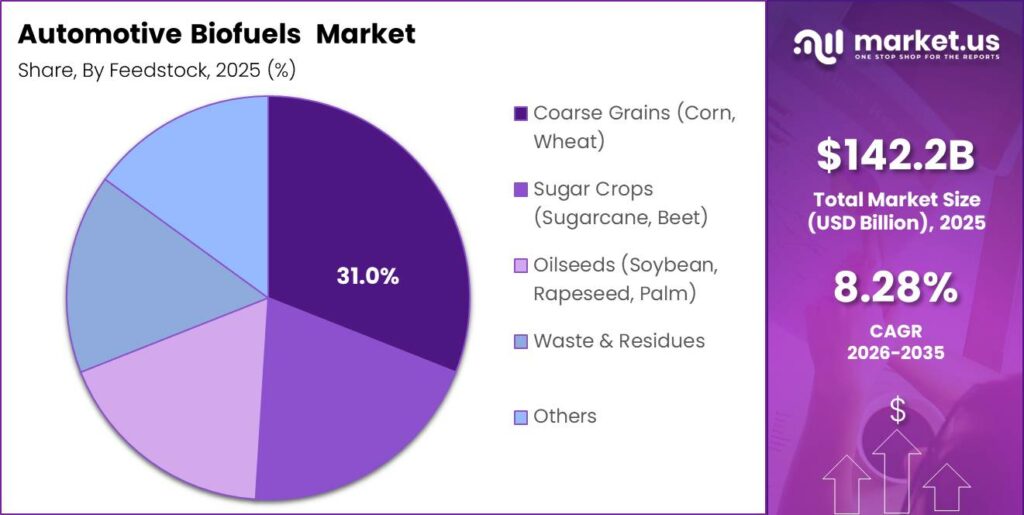
- By Feedstock, Coarse Grains (Corn, Wheat) holds the leading position with a 31.00% share, underpinned by U.S. ethanol production infrastructure.
- By Vehicle Type, Passenger Cars account for 61.20% of demand, reflecting the dominant share of ICE passenger vehicles in the global fleet.
- By Blend Type, Low-Level Blends (E5–E25 / B5–B20) represent 58.00% of volume, as mandated blending programs prioritize compatibility with existing engines.
- By Sales Channel, OEM accounts for 38.00% of the market, reflecting factory-level blending and fleet supply agreements.
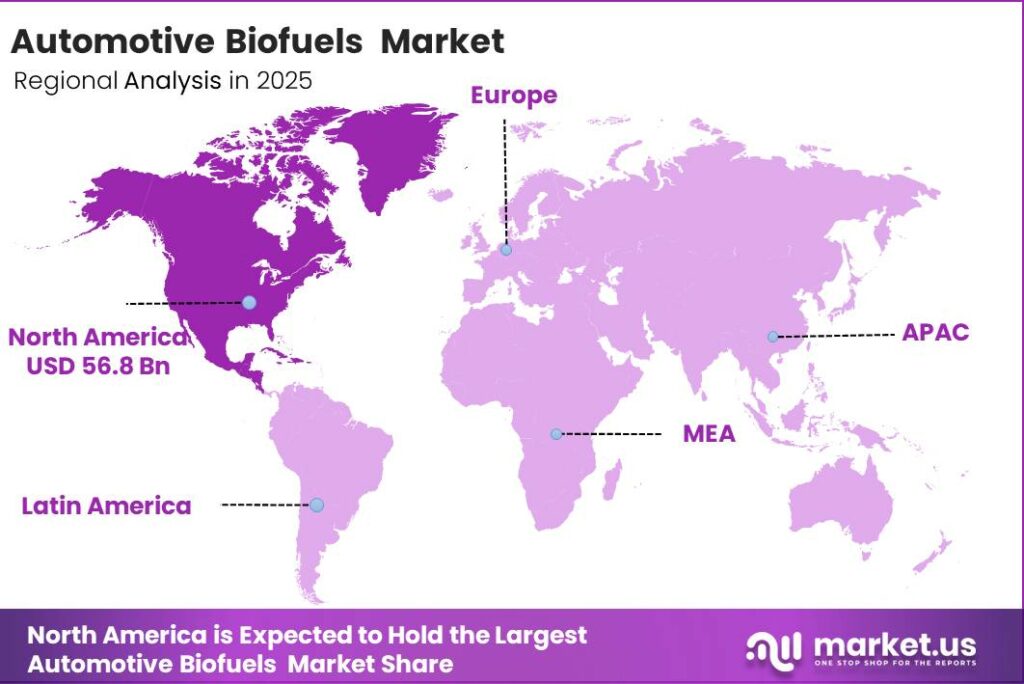
- North America dominates regionally with a 40.10% share, valued at USD 56.8 Billion, anchored by the U.S. Renewable Fuel Standard program.
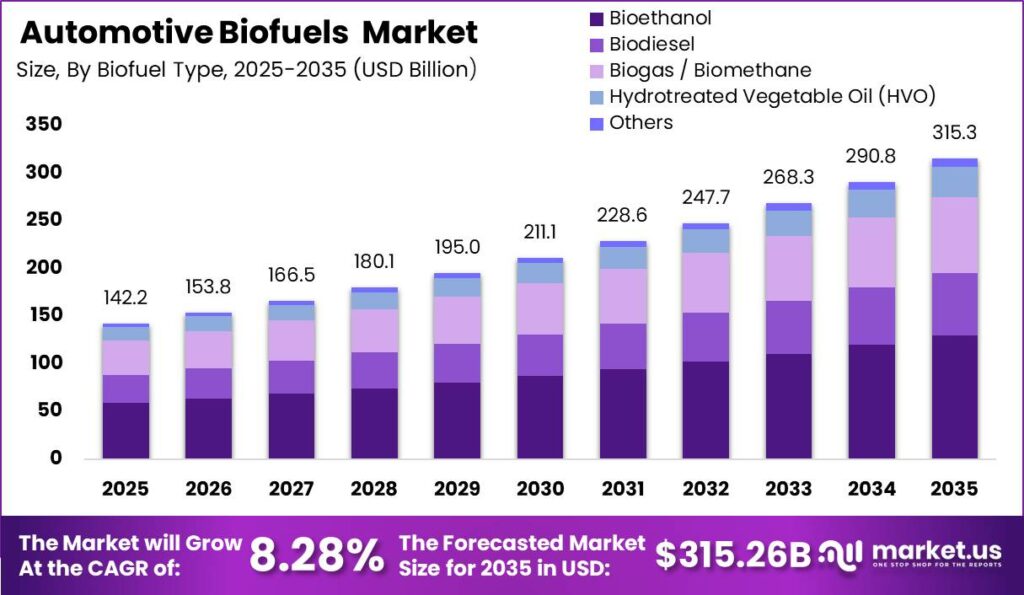
However, regulatory architecture is the dominant demand signal in this market. The U.S. EPA finalized total Renewable Fuel Standard blending volumes at 24.02 billion gallons for 2026 and 24.46 billion gallons for 2027, one of the largest step-ups in the program’s history. According to the U.S. Energy Information Administration, total U.S. biofuel supply is forecast to rise from 1.21 million barrels per day in 2025 to 1.28 million barrels per day in 2026, confirming that mandate escalation is already translating into physical volume expansion.
Consequently, capital is following policy certainty. Chevron and CalBio completed a renewable natural gas central processing facility in Hilmar, California in 2025, adding biomethane supply for transportation applications. This pattern of infrastructure investment anchored to mandate-guaranteed offtake is now repeating across multiple geographies, and it is compressing financing costs for new capacity in a way that sustains the baseline growth rate throughout the forecast period.
Biofuel Type Analysis
Bioethanol dominates with 41.20% due to mandated blending across three continents.
In 2025, Bioethanol held a dominant market position in the By Biofuel Type segment of the Automotive Biofuels Market, with a 41.20% share. As reported by the U.S. Energy Information Administration, fuel ethanol production remained above 1.08 million barrels per day throughout 2026, confirming ethanol’s structural primacy in the U.S. fuel pool. This volume base gives ethanol producers scale advantages that smaller biofuel categories cannot replicate, reinforcing their cost position in mandate-driven procurement markets.
Biodiesel occupies the second-largest position in the biofuel type segment, serving diesel fleet operators across agriculture, logistics, and public transport. Data from the U.S. Energy Information Administration shows biodiesel production rising from 90,000 barrels per day in 2025 to 100,000 barrels per day in 2026, a gain of 11.1%. This expansion reflects the impact of higher biomass-based diesel RVO volumes under the RFS final rule, giving biodiesel producers a clearer forward demand signal to justify capacity maintenance and incremental investment.
Hydrotreated Vegetable Oil represents the fastest-growing sub-segment within Biofuel Type, driven by its drop-in compatibility with existing diesel infrastructure. Neste issued a EUR 700 million green bond in 2025 to finance Rotterdam refinery expansion, a capital commitment that signals producer confidence in long-run HVO demand. Producers targeting the MHCV logistics sector with neat HVO supply can command a meaningful per-liter premium over commodity blended fuel, creating a structurally higher-margin revenue channel than conventional biodiesel.
Biogas and biomethane, along with other advanced biofuel categories, collectively account for the remaining share in the Biofuel Type segment. These sub-segments serve niche commercial vehicle fleets and captive urban transport operations, where pipeline or on-site refueling infrastructure is already present. Their combined contribution to market volume remains modest in 2026, though mandate escalation in India and Southeast Asia is expected to expand their addressable demand base progressively over the forecast period.
Feedstock Analysis
Coarse Grains (Corn, Wheat) dominates with 31.00% due to U.S. ethanol refinery infrastructure concentration.
In 2025, Coarse Grains (Corn, Wheat) held a dominant market position in the By Feedstock segment of the Automotive Biofuels Market, with a 31.00% share. According to the U.S. Department of Agriculture, satisfying domestic fuel ethanol consumption and exports in March 2025 required approximately 465 million bushels of corn, roughly 60 million bushels more than a decade earlier. This sustained corn demand growth locks ethanol refiners into a corn-price dependency that makes feedstock hedging strategy a core competitive differentiator.
Sugar Crops (Sugarcane, Beet) hold the second-largest feedstock share, anchored by Brazil’s dominant sugarcane ethanol complex and India’s expanding sugarcane-to-ethanol diversion under the E20 programme. This feedstock category benefits from dual-use flexibility, as sugar processors can shift output between food and fuel markets based on relative price signals. However, that same flexibility introduces volume uncertainty for ethanol offtakers when food price spikes trigger government-mandated restrictions on sugarcane ethanol conversion, as seen during the 2022 to 2023 supply shocks.
The U.S. Department of Agriculture projects the U.S. biofuel industry will consume a record 15.5 billion pounds of soybean oil during the 2025/26 marketing year, an increase of 26.5% from the prior year. This surge in Oilseeds (Soybean, Rapeseed, Palm) feedstock consumption is directly linked to elevated biomass-based diesel RVO volumes under the RFS final rule. Soybean oil price movements now carry direct pass-through risk to renewable diesel and biodiesel producer margins, making oilseed market monitoring essential for downstream investors.
Waste and Residues feedstocks, including used cooking oil, animal fats, and agricultural residues, represent the fastest-growing feedstock category by policy prioritization, even as their current volume share remains below the three conventional crop categories. Their structural appeal lies in lower ILUC risk and higher carbon-intensity score eligibility under LCFS and RED III schemes. Producers who secure reliable waste feedstock supply chains now gain a durable cost and certification advantage as advanced biofuel sub-targets tighten across EU and U.S. regulatory frameworks through 2030.
Vehicle Type Analysis
Passenger Cars dominates with 61.20% due to largest ICE fleet share globally.
In 2025, Passenger Cars held a dominant market position in the By Vehicle Type segment of the Automotive Biofuels Market, with a 61.20% share. The passenger car fleet represents the primary delivery mechanism for government blending mandates, since retail fuel stations dispensing E10 or B7 blends automatically expose the entire passenger car pool to biofuel consumption regardless of individual driver preference. This captive demand structure insulates the passenger car sub-segment from discretionary purchasing risk, giving it the most stable volume floor of any vehicle category.
Light Commercial Vehicles (LCV) form the second-largest demand segment within the Vehicle Type category, serving last-mile delivery, utility, and small fleet operators. The LCV segment benefits from proximity to the same fuel infrastructure serving passenger cars, lowering the adoption barrier for bioethanol and low-level biodiesel blends. Fleet operators managing cost-per-kilometer metrics in urban delivery applications are increasingly receptive to renewable diesel substitution, particularly where LCFS credit revenues or fleet sustainability mandates reduce the effective premium of higher-blend fuels.
Heavy Commercial Vehicles (HCV) and Two-Wheelers together account for the remaining vehicle type share. The HCV segment is the strategically significant growth vector, as battery-electric technology has not resolved total cost of ownership and range constraints for long-haul applications, keeping HCV operators structurally dependent on liquid fuels. Two-Wheelers remain relevant in India and Southeast Asia, where low-level ethanol blends in two-stroke and four-stroke engines serve urban mobility demand across markets with limited public transit alternatives and a large price-sensitive consumer base.
Blend Type Analysis
Low-Level Blends (E5–E25 / B5–B20) dominates with 58.00% due to universal engine compatibility without modification.
In 2025, Low-Level Blends (E5–E25 / B5–B20) held a dominant market position in the By Blend Type segment of the Automotive Biofuels Market, with a 58.00% share. Nearly 100% of U.S. gasoline contains approximately 10% ethanol, creating a mandatory baseline consumption channel that guarantees low-level blend volumes regardless of oil price cycles or consumer preference. This mandated baseline is the single most reliable volume anchor in the global automotive biofuels market, and it constrains any downward revision risk on total market size through the forecast period.
High-Level Blends (E85, B100) represent the next tier within the Blend Type segment, serving flexible-fuel vehicles and dedicated biofuel fleets. Adoption is concentrated in Brazil, the United States, and Sweden, where FFV penetration and retail E85 infrastructure are most developed. The commercial incentive for suppliers is a per-liter margin premium over low-level blend volumes, but the addressable market is constrained by the limited global FFV fleet share outside these three markets, making infrastructure investment in E85 retail delivery a high-conviction bet only in specific geographies.
Pure Biofuels, including neat HVO100 and B100 applications, represent the smallest Blend Type share but the highest per-liter margin opportunity in the segment. Approved under EN 15940 for use in modern Euro VI diesel engines without modification, HVO100 is gaining traction with European logistics and municipal fleet operators as a drop-in decarbonization tool. This sub-segment’s commercial expansion depends directly on the pace at which HVO production capacity scales and the regulatory cost differentials in EU member state transport fuel tax frameworks narrow the retail price premium.
Sales Channel Analysis
OEM dominates with 38.00% due to factory-level blending mandate compliance integration.
In 2025, OEM held a dominant market position in the By Sales Channel segment of the Automotive Biofuels Market, with a 38.00% share. OEM and refinery-level blending represents the most cost-efficient compliance pathway under volume-based mandates, since blending at the fuel terminal eliminates the logistics cost and certification overhead of downstream distribution-point mixing. This structural efficiency advantage means the OEM channel captures the largest single share of mandate-driven biofuel volumes and retains that position as long as the RFS, RED III, and India E20 frameworks remain intact.
Aftermarket and Retail Fuel Stations account for the remaining sales channel share, serving both consumer-facing ethanol blends at the pump and commercial fleet refueling operations. This channel is where HVO100 and high-level blend growth will materialize, as logistics operators and municipal fleets seek dedicated biofuel supply outside the standard blended fuel pool. Retail fuel station operators who invest in dedicated HVO100 or E85 dispensing infrastructure now position themselves to capture the B2B premium pricing that commercial fleet sustainability commitments are willing to fund over a multi-year contract horizon.
Key Market Segments
By Biofuel Type
- Bioethanol
- Biodiesel
- Biogas / Biomethane
- Hydrotreated Vegetable Oil (HVO)
- Others
By Feedstock
- Coarse Grains (Corn, Wheat)
- Sugar Crops (Sugarcane, Beet)
- Oilseeds (Soybean, Rapeseed, Palm)
- Waste & Residues
- Others
By Vehicle Type
- Passenger Cars
- Light Commercial Vehicles (LCV)
- Heavy Commercial Vehicles (HCV)
- Two-Wheelers
By Blend Type
- Low-Level Blends (E5–E25 / B5–B20)
- High-Level Blends (E85, B100)
- Pure Biofuels
By Sales Channel
- OEM
- Aftermarket / Retail Fuel Stations
Regional Analysis
North America Dominates the Automotive Biofuels Market with a Market Share of 40.10%, Valued at USD 56.8 Billion
North America holds the largest regional share of the automotive biofuels market, anchored by the U.S. Renewable Fuel Standard, the world’s most mature volume-mandate program. As reported by the U.S. Department of Agriculture, the 12-month moving average of U.S. ethanol exports reached a record 167 million gallons in 2025, confirming that domestic production capacity now exceeds domestic blending absorption and is competing globally. This export surplus signals that U.S. ethanol producers are structurally positioned to capture demand from markets without sufficient domestic production capacity, extending North American market influence beyond its regional mandate base.
Asia Pacific represents the fastest-growing regional market, driven by India’s E20 mandate achievement and the escalating blending trajectories across Southeast Asian economies. India’s acceleration to E20 availability nationwide in 2026, approximately five years ahead of its original schedule, signals policy execution capability that is now being extended toward E25 and E30 specifications. This post-E20 escalation trajectory creates a sustained forward demand signal for ethanol producers and cellulosic biofuel investors operating in or supplying the Indian market throughout the forecast period.
Europe is the third major regional market, where RED III compliance obligations are compelling member states to tighten national blending mandates and advance waste-based and HVO feedstock adoption. In January 2026, VARO Energy completed its acquisition of Preem, forming VAROPreem and materially expanding its renewable fuels production and distribution network across Europe. This consolidation move reflects producer recognition that scale in feedstock procurement, refining capacity, and distribution logistics is the primary competitive variable under a tightening European regulatory framework demanding both volume compliance and lifecycle carbon certification.
Key Regions and Countries
North America
- US
- Canada
Europe
- Germany
- France
- The UK
- Spain
- Italy
- Rest of Europe
Asia Pacific
- China
- Japan
- South Korea
- India
- Australia
- Rest of APAC
Latin America
- Brazil
- Mexico
- Rest of Latin America
Middle East and Africa
- GCC
- South Africa
- Rest of MEA
Market Dynamics
Market Opportunity Analysis - Underserved vehicle segments and emerging geographies offer high-conviction entry points for new biofuel investors
The Heavy Commercial Vehicle segment represents the most structurally underexploited demand channel in the automotive biofuels market relative to its addressable volume. Battery-electric technology has not resolved total cost of ownership or range constraints for long-haul Class 7 to 8 trucks, leaving an estimated 60–70% of commercial VKT in heavy transport structurally dependent on liquid fuels. Producers who establish dedicated HVO100 B2B supply agreements with logistics fleet operators now access a channel commanding a 15–25% gross margin premium over the commodity blended fuel pool.
India’s post-E20 escalation pathway is the most precisely timed geographic opportunity in the market. The government has already notified E22, E25, E27, and E30 blend specifications, signaling a demand increment of 2 to 3 billion liters annually above the current E20 requirement. This is a forward-state opportunity: the cellulosic ethanol and agricultural residue processing capacity needed to serve post-E20 volumes without competing with food supply chains does not yet exist at commercial scale in India, creating an uncontested entry window for second-generation producers with the right feedstock and financing structure.
Waste-based and UCO feedstock monetization channels remain underexploited relative to their certified carbon-intensity advantage. Producers supplying UCO-derived biodiesel into EU and California LCFS markets receive credit values that can offset a substantial portion of feedstock and processing costs, making waste-based supply chains more margin-resilient than virgin oilseed equivalents when commodity prices spike. The barrier to entry is supply chain formalization: UCO collection infrastructure in India, Southeast Asia, and China is fragmented, creating a first-mover advantage for aggregators who can build reliable volume at certifiable traceability standards before RED III voluntary scheme compliance requirements tighten further.
Co-processing biofeedstocks in existing petroleum refineries represents an underutilized capital-efficiency pathway for producers in the United States, EU, India, and Brazil. By inserting bio-based feedstocks into existing hydrocracker and fluid catalytic cracking units, conventional refinery operators can produce renewable diesel volumes at a fraction of the CapEx required for dedicated biorefinery construction. This approach lowers the investment threshold for incumbent refinery operators who have been slow to enter renewable fuel production, creating an acquisition and partnership opportunity for biofeedstock suppliers seeking stable, high-volume offtake agreements anchored to existing refinery asset bases.
Technology and Innovation Landscape - Second-generation pathways, waste feedstock processing, and digital carbon platforms are redefining competitive positioning
Hydrotreated Vegetable Oil production technology represents the most commercially mature innovation currently reshaping the automotive biofuels competitive landscape. The HVO process converts a broad range of feedstocks, including waste fats, UCO, and agricultural residues, into a standardized drop-in fuel approved under EN 15940 for modern Euro VI diesel engines without modification. Neste’s EUR 700 million Rotterdam expansion, financed through a green bond in 2025, is the clearest signal that producers with access to proprietary hydrotreatment technology and waste feedstock sourcing networks are investing ahead of demand to lock in scale advantages before the EU’s tightening advanced biofuel sub-targets reshape the supply landscape.
Alcohol-to-Jet technology is advancing as a dual-market production pathway, allowing ethanol producers to convert fermentation output into either automotive bioethanol or sustainable aviation fuel depending on relative mandate incentive values. Gevo’s ATJ project, updated in May 2026, positions it to arbitrage between road transport and aviation demand channels without full retooling of its core fermentation assets. For investors, this feedstock and output flexibility reduces single-market mandate risk and improves the long-run IRR of ethanol plant investments by adding a second premium-priced offtake pathway alongside the road transport blending volume base.
Digital carbon platform development is emerging as a distinct competitive capability in the biofuels value chain, separate from physical production capacity. Gevo’s launch of GevoCarbon.com in June 2026 establishes a customer-facing carbon removal and renewable fuel access layer on top of its physical biofuel production assets. This platform model reflects the commercial reality that lifecycle carbon certification, credit origination, and traceability documentation are increasingly as valuable to large fleet and corporate customers as the physical fuel itself, creating a software-enabled revenue stream that is structurally higher-margin than commodity fuel supply and more defensible against feedstock price volatility.
Biogas-to-Bio-CNG conversion technology is advancing as a lower-capital entry point for commercial vehicle fleet decarbonization in India, Indonesia, Vietnam, and Thailand, where natural gas vehicle infrastructure already exists in urban freight corridors. The Chevron and CalBio renewable natural gas facility completed in Hilmar, California in 2025 demonstrates that industrial-scale biomethane production from agricultural digestate is now commercially executable. This model is directly replicable in India’s dairy and agricultural waste corridors, where the feedstock resource base is large and the captive commercial vehicle fleet demand for compressed biomethane is growing alongside state-level bio-CNG policy incentives.
Drivers
Legally binding blending mandates across the EU, United States, and India function as non-discretionary volume floors that underwrite biofuel demand regardless of oil price cycles or consumer preference. The U.S. EPA’s March 2026 Final Rule set biomass-based diesel obligations at 9.07 billion RINs for 2026, while EPA analysis estimates total biomass-based diesel production will increase by approximately 3.60 billion gallons in 2026 compared to a scenario without the RFS. Mandate-backed offtake compresses project financing hurdle rates from the unsubsidized 18–22% IRR range to 10–14%, directly enabling the capacity expansions that sustain the baseline CAGR.
India’s achievement of nationwide E20 petrol availability in 2026, approximately five years ahead of schedule, and the EU’s RED III transport renewable energy target of 29% by 2030 demonstrate that policy ambition is now matching enforcement capability. HVO capacity scale-up and flexible-fuel vehicle penetration in Brazil and India are reinforcing this mandate architecture with infrastructure and fleet-level demand pull. Investors who align supply agreements with mandate-guaranteed offtake volumes gain a structural financing cost advantage over merchant market peers throughout the forecast period.
| Driver | (~) % Impact on CAGR Forecast | Geographic Relevance | Impact Timeline |
|---|---|---|---|
| Mandatory Blending Regulations — EU RED III, U.S. RFS 2026–2027, India E20 Mandate | +3.2% | EU (all member states), United States, India, Brazil | Short term (≤ 2 years) |
| HVO & Renewable Diesel Capacity Scale-Up as Drop-In Transport Fuel | +2.1% | EU, United States, Southeast Asia (Singapore, Malaysia), Australia | Short term (≤ 2 years) |
| India E20 National Mandate & Ethanol Blending Programme Acceleration | +1.8% | India | Short term (≤ 2 years) |
| Energy Security & Oil Import Substitution Strategy in Fuel-Importing Economies | +1.2% | India, Southeast Asia, GCC, Sub-Saharan Africa, Latin America | Medium term (2–4 years) |
| Fleet Decarbonization Demand from Commercial Road & Heavy Transport Operators | +0.9% | EU, United States, Australia, Japan, India | Medium term (2–4 years) |
| Flexible-Fuel Vehicle (FFV) Penetration Growth in Emerging Markets | +0.6% | Brazil, India, Southeast Asia | Medium term (2–4 years) |
Restraints
Battery electric vehicle adoption is eroding the long-run demand ceiling for automotive liquid fuels in the markets where EV penetration is highest. Global electric passenger car sales exceeded 20 million units in 2025, representing one-quarter of all new car sales globally, and BloombergNEF projects sales above 35.4 million units by 2030. Investment banks are applying terminal demand haircuts of 10–20% on post-2035 road transport biofuel cash flows in EU and China projects, raising financing costs by 150–300 basis points for automotive biofuel capacity relative to aviation and marine equivalents.
U.S. RFS policy uncertainty and elevated feedstock costs compound this structural restraint for near-term producers. Following changes to U.S. tax-credit rules, biodiesel imports fell from 35,000 barrels per day in 2024 to 2,000 barrels per day in the first half of 2025, a reduction of approximately 94%, demonstrating how rapidly regulatory changes can redirect trade flows and strand feedstock sourcing strategies. The EU’s high-ILUC-risk feedstock cap further constrains palm-based biodiesel supply chains, cascading margin pressure to Malaysian and Indonesian exporters who built production capacity against prior EU demand assumptions.
| Restraint | (~) % Impact on CAGR Forecast | Geographic Relevance | Impact Timeline |
|---|---|---|---|
| Accelerating EV Penetration Structurally Eroding Long-Run Road Transport Liquid Fuel Demand | -2.8% | China, Europe, United States, South Korea — primary EV adoption markets | Medium term (2–4 years) |
| U.S. RFS Policy Uncertainty & eRIN Elimination Reducing Blending Incentive Breadth | -1.6% | United States | Short term (≤ 2 years) |
| Elevated Feedstock (Vegetable Oil, Corn, Sugarcane) Price Volatility Compressing Producer Margins | -1.2% | Global, most acute for first-generation biofuel producers | Short term (≤ 2 years) |
| EU RED III High-ILUC-Risk Feedstock Cap & Phase-Out Constraining Palm-Based Biodiesel Supply | -0.9% | EU, cascading to Malaysian & Indonesian palm-oil biofuel exporters | Short term (≤ 2 years) |
| Low Crude Oil Price Environment Widening Biofuel-to-Fossil Cost Gap | -0.7% | Global, most acute for unsubsidized non-mandate markets | Short term (≤ 2 years) |
Challenges
Food-versus-fuel feedstock competition creates recurring political pressure on mandate durability in food-price-sensitive economies. India’s E20 programme requires an estimated 10 billion liters of ethanol annually, with approximately 60–65% historically sourced from food-adjacent commodities including sugarcane juice, molasses, and broken rice. An interministerial calculation estimated that achieving E20 targets from grain and sugar alone would require approximately 7 million hectares of additional crop area, a land demand that strains India’s water-stressed agricultural system and has already triggered temporary government restrictions during food price spikes.
Advanced biofuel scale-up and GHG lifecycle certification compliance impose simultaneous cost barriers on producers trying to transition beyond first-generation feedstocks. EU RED III caps food- and feed-crop-based biofuels at 7% of the transport energy target, but the agricultural residues and waste feedstocks designed to replace them have not yet reached commercially viable production costs at scale. The blend-wall constraint adds further friction: the United States faces E15 infrastructure limitations, India is managing vehicle compatibility above E20, and the EU is assessing B30-plus diesel compatibility across its mixed-age fleet, each requiring capital investment in dispensing equipment and vehicle certification before higher-blend demand can materialize.
| Challenge | (~) % CAGR Friction Drag | Geographic Relevance | Mitigation Horizon |
|---|---|---|---|
| Food-vs-Fuel Feedstock Competition Pressure | -2.2% | Global, most acute in India, Southeast Asia, Sub-Saharan Africa | Long term (≥ 4 years) |
| Advanced Biofuel Scale-Up & Cost Competitiveness Gap | -1.7% | Global, primary barrier in cellulosic ethanol and lignocellulosic pathways | Long term (≥ 4 years) |
| GHG Lifecycle Certification & RED III Traceability Compliance | -1.1% | EU, UK, Norway, countries aligned with RED III voluntary schemes | Medium term (2–4 years) |
| Biofuel Blend-Wall & Vehicle Compatibility Constraints | -0.8% | India (E20+), United States (E15 infrastructure), EU (B30+ diesel compatibility) | Medium term (2–4 years) |
| Agricultural Water Use & Land Availability Limits | -0.5% | India, MENA, Southern Europe, Sub-Saharan Africa | Long term (≥ 4 years) |
Opportunities
The strategic reorientation of automotive biofuel supply toward medium and heavy commercial road transport is the largest near-term revenue expansion opportunity in the market. HVO100 is approved as a drop-in diesel substitute under EN 15940 for modern Euro VI engines, allowing fleet operators to decarbonize existing assets without replacing vehicles costing USD 150,000 to USD 250,000 per long-haul tractor. In leading EU markets, the effective retail premium of HVO100 versus fossil diesel compressed to approximately EUR 0.10 to EUR 0.30 per liter in 2025, reaching the materiality threshold where large commercial fleet operators with sustainability mandates can absorb the cost differential.
India’s post-E20 escalation pathway toward E25 and E30 specifications, combined with the government’s notification of new blend specifications for E22, E25, E27, and E30, signals an additional 2 to 3 billion liters of annual ethanol demand above the current 10 billion liter E20 requirement. Waste-based feedstock monetization, particularly used cooking oil for advanced biodiesel, adds a parallel revenue channel in the EU, China, and the United States, where lower lifecycle carbon intensity unlocks premium LCFS credit values. Co-processing biofeedstocks in existing petroleum refineries offers an accelerated production scale-up route at lower capital intensity than greenfield biorefinery construction.
| Opportunity | (~) % Potential CAGR Upside | Geographic Relevance | Execution Window |
|---|---|---|---|
| Heavy & Commercial Road Transport Biofuel Pivot (HVO100 & B100 Drop-In) | +2.4% | EU, United States, Australia, Japan, India (MHCV segment) | Medium term (2–4 years) |
| India Post-E20 Escalation Pathway (E25–E30) & Cellulosic Ethanol Buildout | +1.8% | India | Medium term (2–4 years) |
| Waste-Based & Used Cooking Oil (UCO) Feedstock Monetization for Advanced Biodiesel | +1.4% | EU, India, China, Southeast Asia, United States | Medium term (2–4 years) |
| Co-Processing Biofeedstock in Existing Petroleum Refineries (Bio-Refinery Integration) | +1.0% | United States, EU, India, Brazil, Southeast Asia | Medium term (2–4 years) |
| Biogas-to-Bio-CNG for Indian & Southeast Asian Commercial Vehicle Fleets | +0.7% | India, Indonesia, Vietnam, Thailand | Long term (≥ 4 years) |
Key Company Insights
Neste Corporation holds the strongest strategic position among HVO producers globally, combining the world’s largest renewable diesel refining capacity with a EUR 700 million green bond-financed Rotterdam expansion program. This capital commitment locks in feedstock processing scale ahead of the tightening RED III advanced biofuel sub-targets. The Rotterdam expansion is expected to increase output specifically in the waste-based feedstock categories that carry the highest carbon-intensity credits, giving Neste a regulatory pricing advantage over conventional biodiesel competitors as LCFS and RED III credit values continue to tighten.
POET LLC operates the largest network of bioethanol refineries in the United States, a structural position that captures the full volume upside of RFS mandate escalation directly through its existing asset base. EcoCeres, a separate producer, announced plans in 2025 to evaluate additional biorefinery locations to expand renewable fuel capacity targeting Europe, Southeast Asia, and the Middle East, signaling that new mid-scale entrants are pursuing geographic diversification to reduce single-jurisdiction mandate risk. POET’s domestic scale advantage means it competes primarily on feedstock efficiency and co-product monetization rather than geographic diversification.
Key Players
- Neste Corporation
- POET LLC
- ADM (Archer-Daniels-Midland)
- Cargill, Incorporated
- Valero Energy Corporation
- Renewable Energy Group (REG)
- Green Plains Inc.
- Bunge Limited
- TotalEnergies SE
- BP p.l.c.
- Shell plc
- Wilmar International Limited
Recent Developments
- June 2026: Gevo announced the expansion of its carbon business and launched the GevoCarbon.com digital platform to accelerate customer access to carbon removal and renewable fuel solutions.
- May 2026: Gevo provided an expansion update on its Alcohol-to-Jet (ATJ) sustainable fuel project while reporting its first-quarter 2026 results, advancing its renewable fuels portfolio.
- January 2026: VARO Energy completed its acquisition of Preem, creating VAROPreem and significantly expanding its renewable fuels production and distribution network across Europe.
Report Scope
| Report Features | Description |
|---|---|
| Market Value (2025) | USD 142.23 Billion |
| Forecast Revenue (2035) | USD 315.26 Billion |
| CAGR (2026-2035) | 8.28% |
| Base Year for Estimation | 2025 |
| Historic Period | 2020-2024 |
| Forecast Period | 2026-2035 |
| Report Coverage | Revenue Forecast, Market Dynamics, Market Opportunity Analysis, Technology and Innovation Landscape, Competitive Landscape, Recent Developments |
| Segments Covered | By Biofuel Type (Bioethanol, Biodiesel, Biogas / Biomethane, Hydrotreated Vegetable Oil (HVO), Others), By Feedstock (Coarse Grains (Corn, Wheat), Sugar Crops (Sugarcane, Beet), Oilseeds (Soybean, Rapeseed, Palm), Waste & Residues, Others), By Vehicle Type (Passenger Cars, Light Commercial Vehicles (LCV), Heavy Commercial Vehicles (HCV), Two-Wheelers), By Blend Type (Low-Level Blends (E5–E25 / B5–B20), High-Level Blends (E85, B100), Pure Biofuels), By Sales Channel (OEM, Aftermarket / Retail Fuel Stations) |
| Regional Analysis | North America (US and Canada), Europe (Germany, France, The UK, Spain, Italy, and Rest of Europe), Asia Pacific (China, Japan, South Korea, India, Australia, and Rest of APAC), Latin America (Brazil, Mexico, and Rest of Latin America), Middle East and Africa (GCC, South Africa, and Rest of MEA) |
| Competitive Landscape | Neste Corporation, POET LLC, ADM (Archer-Daniels-Midland), Cargill, Incorporated, Valero Energy Corporation, Renewable Energy Group (REG), Green Plains Inc., Bunge Limited, TotalEnergies SE, BP p.l.c., Shell plc, Wilmar International Limited |
| Customization Scope | Customization for segments, region / country-level will be provided. Additional customization can be done based on requirements. |
| Purchase Options | We have three licenses to opt for: Single User License | Multi-User License (Up to 5 Users) | Corporate Use License (Unlimited User and Printable PDF) |





































