Report Overview
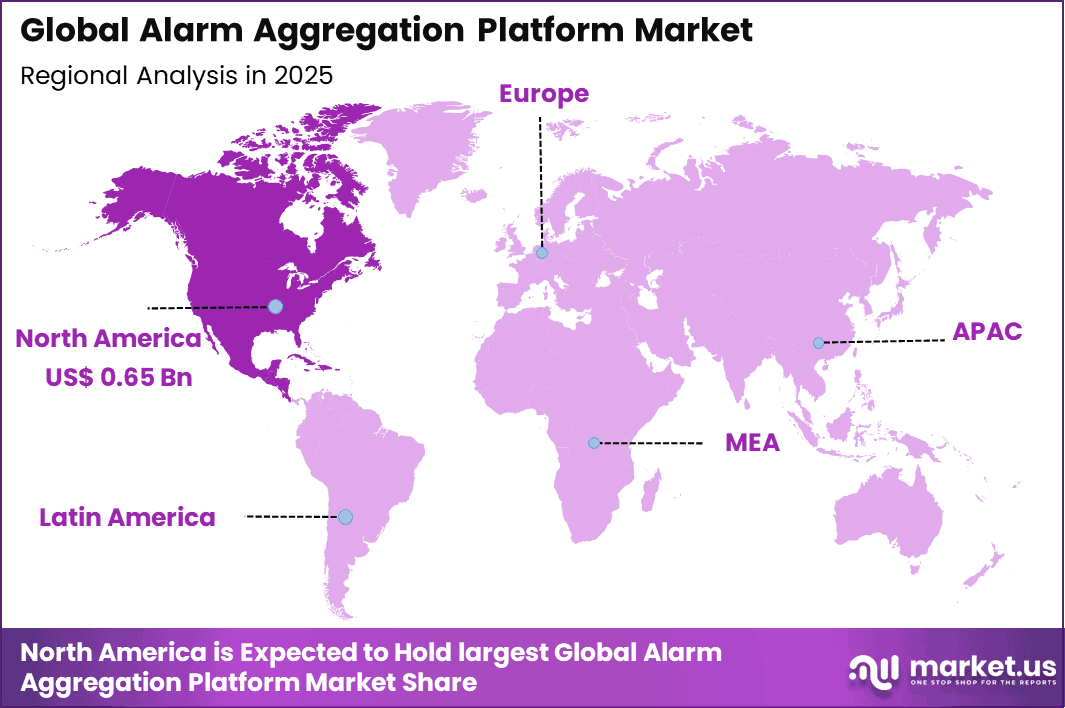
The Global Alarm Aggregation Platform Market generated USD 1.7 billion in 2025 and is projected to grow from USD 1.9 billion in 2026 to about USD 5.5 billion by 2035, recording a CAGR of 12.3% over the forecast period. In 2025, North America held a dominant market position, capturing more than a 38.4% share, with USD 0.65 billion in revenue.
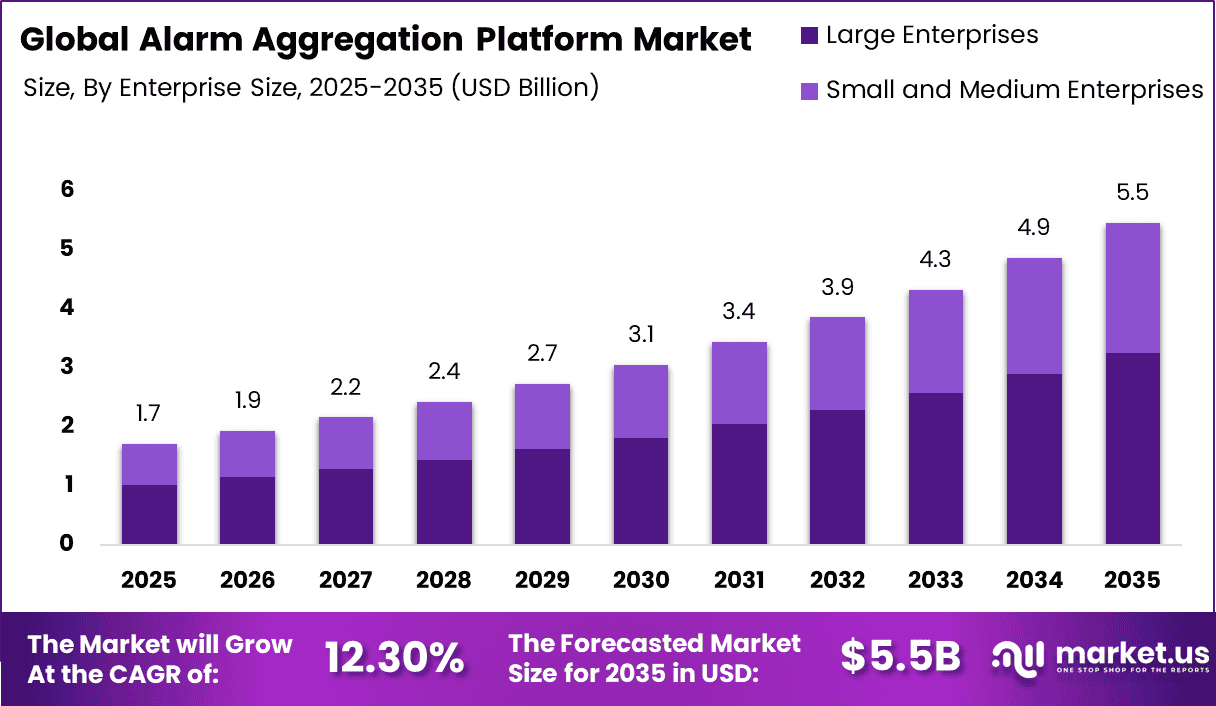
The alarm aggregation platform market focuses on systems that collect, organize, and analyze alerts generated by multiple monitoring tools across industrial, IT, and infrastructure environments. In many organizations, alarms originate from different devices, applications, and network systems, often creating large volumes of alerts that are difficult to manage.
Alarm aggregation platforms consolidate these signals into a centralized interface, enabling operators to quickly identify critical events. The market is shaped by organizations seeking better visibility and faster response to operational disruptions.
The expansion of connected infrastructure across sectors such as manufacturing, energy, telecommunications, and smart facilities supports growth in the alarm aggregation platform market. As monitoring systems produce more data, centralized alarm management becomes essential for maintaining operational stability. Integration with analytics and automation tools further enhances the value of aggregated alerts.
Top Market Takeaways
- By Component, software dominates with a 53.6% share, consolidating multi-source alerts through intelligent deduplication, correlation rules, and priority-based dashboards.
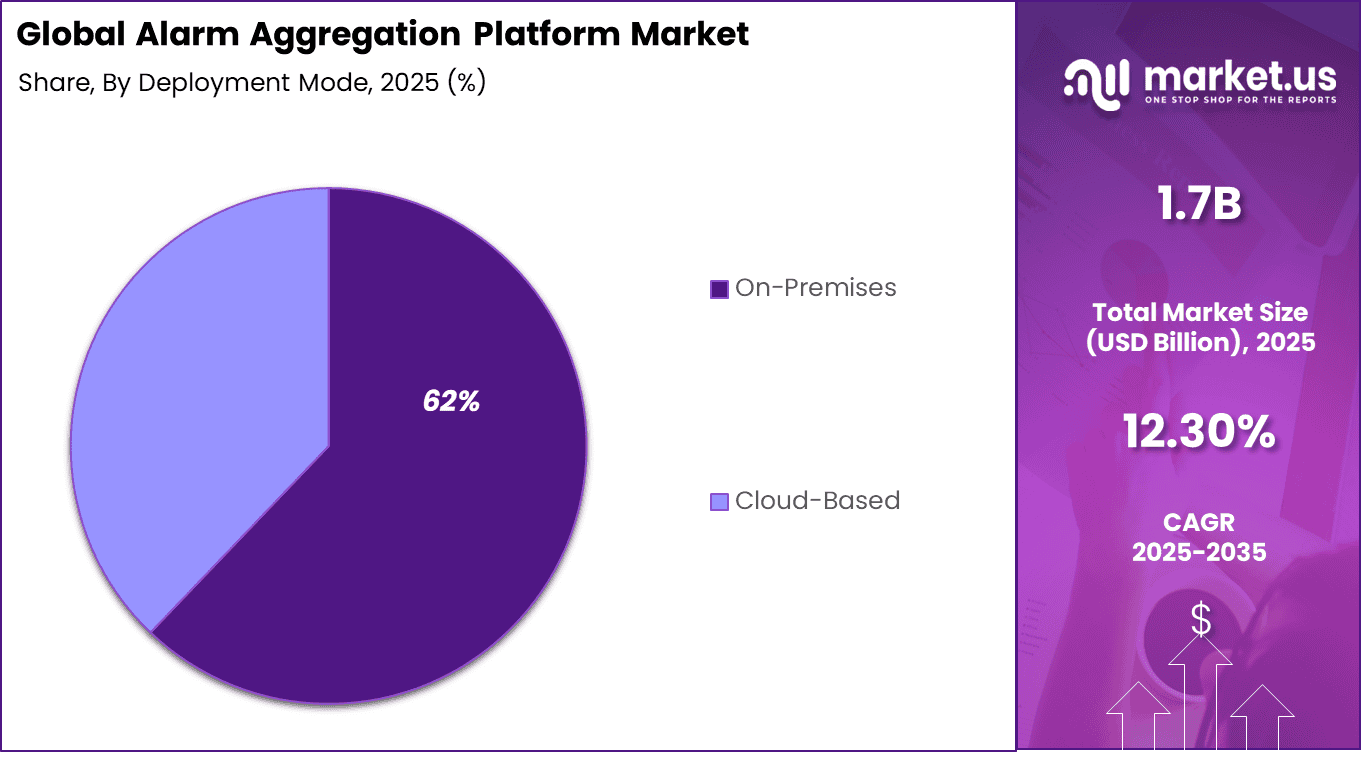
- By Deployment Mode, on-premises captures 62.14%, ensuring real-time processing, air-gapped security, and integration with legacy BMS protocols.
- By Application, building management leads at 56.82%, unifying HVAC, fire, access control, and energy alarms into actionable workflows.
- By Enterprise Size, large enterprises hold 59.46%, orchestrating campus-wide aggregation with SLA-driven response orchestration and audit compliance.
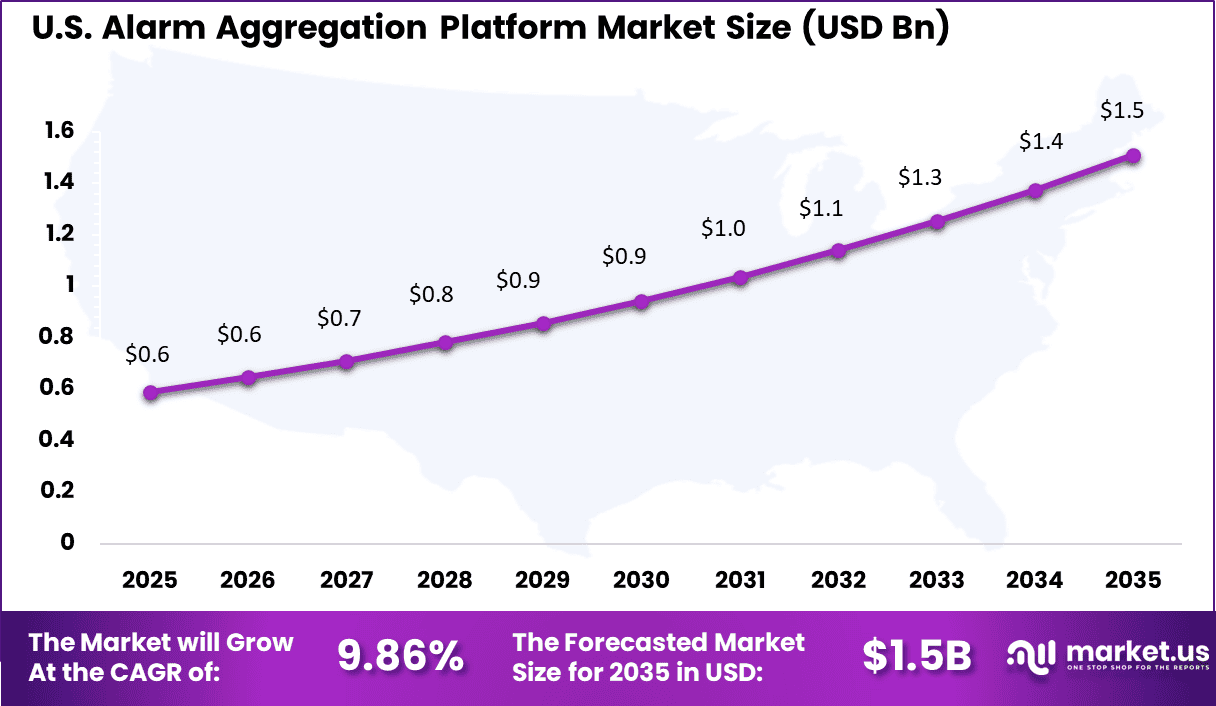
- Regionally, North America accounts for 38.41% global share, with the U.S. market valued at USD 0.59 billion and a CAGR of 9.86%, driven by green building mandates and IoT sensor proliferation.
By Component
Software accounts for 53.6% of adoption in the alarm aggregation platform market, as organizations rely on centralized monitoring systems to consolidate alerts from multiple operational sources. These platforms collect signals from security systems, network devices, sensors, and facility management tools. Consolidating alerts into a single interface improves visibility and response efficiency.
Software-based aggregation tools also provide filtering and prioritization capabilities. This helps operators identify critical incidents quickly while reducing alert fatigue. The ability to manage large volumes of alarms continues to position software as the dominant component.
By Deployment Mode
On-premises deployment holds 62%, reflecting the need for direct control over monitoring infrastructure in critical environments. Facilities such as industrial plants, data centers, and corporate buildings prefer hosting alarm management systems within internal networks. This approach reduces reliance on external connectivity.
Localized deployment also ensures consistent system availability during network disruptions. Organizations managing sensitive infrastructure often prioritize internal control of monitoring systems. This sustains strong preference for on-premises deployment models.
By Application
Building management accounts for 56.82% of application demand, as modern facilities operate multiple integrated systems including fire alarms, access control, HVAC, and surveillance. Alarm aggregation platforms consolidate alerts from these systems into a unified control environment. This improves coordination between facility operators and security teams.
Centralized alarm monitoring also enhances operational safety and response planning. Automated alert prioritization supports faster incident resolution. This continues to anchor building management as the leading application area.
By Enterprise Size
Large enterprises represent 59.46% of adoption due to the scale and complexity of their infrastructure. These organizations operate multiple facilities and require centralized monitoring across locations. Alarm aggregation platforms help standardize incident management processes.
Large firms also prioritize risk management and regulatory compliance. Consolidated alarm systems improve oversight and reporting accuracy. This continues to drive adoption among enterprise-scale organizations.
Key Market Segments
By Component
- Software
- Hardware
- Services
By Deployment Mode
- On-Premises
- Cloud-Based
By Application
- Industrial Automation
- Building Management
- IT & Telecom
- Healthcare
- Energy & Utilities
- Transportation
- Others
By Enterprise Size
- Small and Medium Enterprises
- Large Enterprises
Regional Analysis
North America accounts for 38.41% of the alarm aggregation platform market, supported by advanced monitoring infrastructure across telecommunications, energy, healthcare, and enterprise IT environments. Organizations in the region are increasingly adopting alarm aggregation platforms to consolidate alerts from multiple systems into centralized dashboards. Demand is driven by the need to reduce alarm fatigue, improve incident visibility, and enable faster operational response across complex network and infrastructure environments.
The United States market is valued at USD 0.59 billion and is expanding at a CAGR of 9.86%, reflecting steady investment in integrated monitoring and alert management solutions. Adoption is influenced by increasing complexity of distributed systems, rising network traffic, and the need for automated alert correlation. Growth is further supported by integration of analytics and real-time monitoring capabilities that help operations teams identify critical issues quickly and maintain system reliability.
Key Regions and Countries
- North America
- US
- Canada
- Europe
- Germany
- France
- The UK
- Spain
- Italy
- Russia
- Netherlands
- Rest of Europe
- Asia Pacific
- China
- Japan
- South Korea
- India
- Australia
- Singapore
- Thailand
- Vietnam
- Rest of APAC
- Latin America
- Brazil
- Mexico
- Rest of Latin America
- Middle East & Africa
- South Africa
- Saudi Arabia
- UAE
- Rest of MEA
Drivers Impact Analysis
| Key Drivers | Impact on CAGR Forecast (~%) | Geographic Relevance | Impact Timeline | Strategic Importance |
|---|---|---|---|---|
| Increasing Complexity of IT and Network Infrastructure | +3.1% | North America, Europe | Short to Medium Term | Drives need for centralized alarm visibility |
| Expansion of Industrial Automation and Smart Manufacturing | +2.7% | APAC, North America | Medium to Long Term | Generates high volumes of operational alerts |
| Growing Adoption of Network Monitoring Platforms | +2.3% | Global | Medium Term | Improves real-time infrastructure monitoring |
| Rising Demand for Operational Efficiency in IT Operations | +1.9% | Global | Medium Term | Encourages automated alarm management |
| Integration with Security Operations and Incident Response Systems | +1.6% | North America, Europe | Medium Term | Enhances enterprise risk monitoring |
Restraints Impact Analysis
| Key Restraints | Impact on CAGR Forecast (~%) | Geographic Relevance | Impact Timeline | Market Constraint Level |
|---|---|---|---|---|
| Integration Challenges Across Diverse Monitoring Systems | -2.0% | Global | Medium Term | Limits interoperability across platforms |
| High Implementation and Deployment Costs | -1.7% | Emerging Markets | Short to Medium Term | Slows adoption among smaller organizations |
| Alarm Overload and False Alert Issues | -1.4% | Global | Medium Term | Reduces operational efficiency |
| Lack of Skilled IT Monitoring Professionals | -1.1% | Global | Medium Term | Slows effective platform utilization |
Investor Type Impact Matrix
| Investor Type | Growth Sensitivity | Risk Exposure | Geographic Focus | Investment Outlook |
|---|---|---|---|---|
| Venture Capital | Medium to High | Medium | North America | Focus on IT operations and monitoring startups |
| Private Equity | Medium | Medium | North America, Europe | Attractive enterprise software investment |
| Strategic IT Infrastructure Vendors | High | Low to Medium | Global | Integration with monitoring and observability platforms |
| Institutional Investors | Medium | Medium | Developed Markets | Long-term enterprise IT infrastructure allocation |
| Corporate Technology Investors | Medium | Low to Medium | Global | Expansion of network management ecosystems |
Technology Enablement Analysis
| Technology Enabler | Impact on CAGR Forecast (~%) | Geographic Relevance | Impact Timeline | Adoption Momentum |
|---|---|---|---|---|
| AI-driven Alarm Correlation and Root Cause Analysis | +3.5% | North America, Europe | Medium to Long Term | Reduces alert noise and improves incident resolution |
| Cloud-based Monitoring and Alert Management Platforms | +2.8% | Global | Medium Term | Supports scalable infrastructure monitoring |
| Integration with Observability and AIOps Platforms | +2.3% | Global | Medium to Long Term | Enhances predictive infrastructure management |
| Automated Incident Response and Workflow Systems | +1.9% | North America, APAC | Medium Term | Improves response time to critical events |
| Real-time Data Streaming and Event Processing | +1.5% | Global | Long Term | Enables faster detection and response to system issues |
Key Challenges
- Difficulty in consolidating alerts from multiple monitoring and control systems
- High volume of alarms creating noise and reducing response efficiency
- Integration challenges with legacy industrial and IT monitoring platforms
- Need for accurate filtering to avoid missing critical alerts
- Dependence on skilled operators to interpret aggregated alarm data
Emerging Trends
In the Alarm Aggregation Platform market, a clear trend is the growing use of centralized monitoring environments that collect alerts from multiple operational systems into a single interface. Organizations are increasingly consolidating alarms generated by networks, applications, industrial equipment, and security systems so that teams can understand events without switching between separate tools.
This approach helps reduce confusion caused by scattered alerts and allows operators to view the overall situation more clearly. Another emerging trend is the use of intelligent filtering and correlation techniques that group related alarms together, helping teams focus on meaningful issues rather than reacting to every individual alert.
Growth Factors
A key growth factor in this market is the increasing number of connected systems and monitoring devices within modern operational environments. As infrastructure expands across cloud platforms, networks, and industrial systems, the volume of alerts generated by these systems also increases. Alarm aggregation platforms help organisations organise this information so operators can respond more efficiently and maintain control over system performance.
Another important factor is the growing need for faster incident awareness and response across operational teams. When alerts are scattered across multiple systems, identifying the root cause of an issue can take valuable time. Aggregation platforms provide a unified view that allows teams to identify patterns, understand event relationships, and take timely action. This capability helps organisations maintain service continuity and strengthens confidence in operational monitoring processes.
Competitive Analysis
The Alarm Aggregation Platform market is led by large building automation and security technology providers such as Honeywell International, Siemens, Johnson Controls International, Bosch Security Systems, Carrier Global through UTC Fire and Security, Schneider Electric, ABB, Tyco under Johnson Controls, ADT, and Vanderbilt Industries.
These companies compete on integrated security management systems, reliable alarm monitoring infrastructure, and strong support for large facilities and industrial sites. Their platforms are widely adopted by enterprises, government buildings, and critical infrastructure operators that require centralized alarm visibility and coordinated response.
Specialized security and monitoring providers including Securitas, Optex, Notifier by Honeywell, Mircom Group, Everbridge, and others compete through focused alarm management tools and flexible deployment options.
Competition in this segment is driven by real-time alert consolidation, faster incident response coordination, and compatibility with various surveillance and access control systems. These vendors are often selected by organizations seeking practical alarm monitoring solutions that improve operational awareness and safety management.
Top Key Players in the Market
- Honeywell International Inc.
- Siemens AG
- Johnson Controls International plc
- BigPanda
- Bosch Security Systems
- UTC Fire & Security (Carrier Global Corporation)
- Schneider Electric SE
- ABB Ltd.
- Tyco International (Johnson Controls)
- ADT Inc.
- Securitas AB
- Vanderbilt Industries
- Optex Co., Ltd.
- Notifier by Honeywell
- Mircom Group
- Everbridge, Inc.
- Others
Future Outlook
The future outlook for the Alarm Aggregation Platform Market is positive as organizations increasingly need efficient ways to manage large volumes of alerts from different systems and devices. Alarm aggregation platforms help collect, organize, and prioritize alerts, allowing operators to respond faster and reduce alert overload.
As industries adopt more connected devices, monitoring systems, and automated operations, the need for centralized alarm management is expected to grow. Overall, the market is likely to expand as businesses focus on improving operational visibility, response efficiency, and system reliability.
Recent Developments
- In November 2025, BigPanda raised a $50 million Series C round led by Insight Partners to expand its autonomous operations platform in the global AIOps and event-correlation market. The capital is focused on scaling product development, go-to-market, and international expansion so BigPanda can handle larger, more complex environments with higher volumes of alerts and events.
- In December 2025, Datadog launched Bits AI SRE Agent in general availability as a 24/7 AI on-call assistant that investigates alerts using telemetry and organizational context to surface root causes in minutes. The agent integrates directly with Datadog’s observability stack and collaboration tools.
Report Scope
| Report Features | Description |
|---|---|
| Market Value (2025) | USD 1.7 Billion |
| Forecast Revenue (2035) | USD 5.5 Billion |
| CAGR(2025-2035) | 12.3% |
| Base Year for Estimation | 2024 |
| Historic Period | 2020-2024 |
| Forecast Period | 2025-2035 |
| Report Coverage | Revenue forecast, AI impact on Market trends, Share Insights, Company ranking, competitive landscape, Recent Developments, Market Dynamics and Emerging Trends |
| Segments Covered | By Component (Software, Hardware, Services), By Deployment Mode (On-Premises, Cloud-Based), By Application (Industrial Automation, Building Management, IT & Telecom, Healthcare, Energy & Utilities, Transportation, Others), By Enterprise Size (Small and Medium Enterprises, Large Enterprises) |
| Regional Analysis | North America – US, Canada; Europe – Germany, France, The UK, Spain, Italy, Russia, Netherlands, Rest of Europe; Asia Pacific – China, Japan, South Korea, India, New Zealand, Singapore, Thailand, Vietnam, Rest of Latin America; Latin America – Brazil, Mexico, Rest of Latin America; Middle East & Africa – South Africa, Saudi Arabia, UAE, Rest of MEA |
| Competitive Landscape | Honeywell International Inc., Siemens AG, Johnson Controls International plc, Bosch Security Systems, UTC Fire & Security (Carrier Global Corporation), Schneider Electric SE, ABB Ltd., Tyco International (Johnson Controls), ADT Inc., Securitas AB, Vanderbilt Industries, Optex Co., Ltd., Notifier by Honeywell, Mircom Group, Everbridge, Inc., Others |
| Customization Scope | Customization for segments, region/country-level will be provided. Moreover, additional customization can be done based on the requirements. |
| Purchase Options | We have three licenses to opt for: Single User License, Multi-User License (Up to 5 Users), Corporate Use License (Unlimited Users and Printable PDF) |