


Report Overview
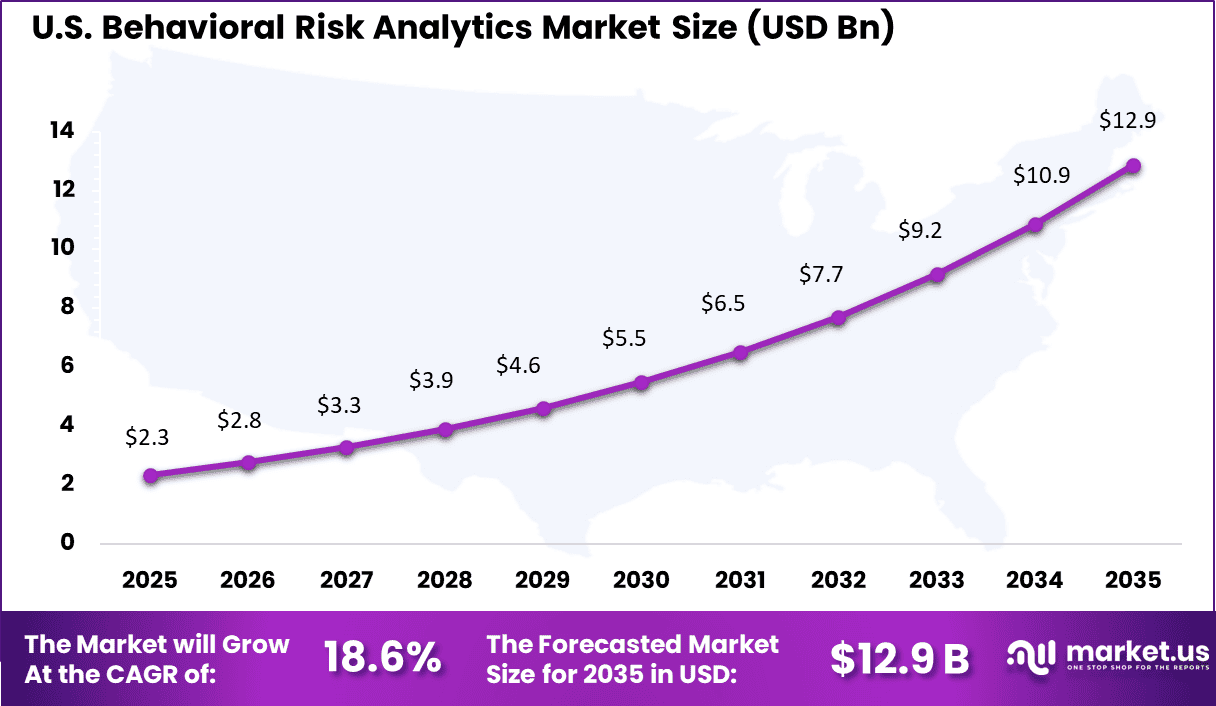
The Global Behavioral Risk Analytics Market generated USD 7.6 billion in 2025 and is projected to grow from USD 9.2 billion in 2026 to about USD 50.9 billion by 2035, recording a CAGR of 21.0% over the forecast period. In 2025, North America held a dominant market position, capturing more than a 36.5% share, with USD 2.76 billion in revenue.
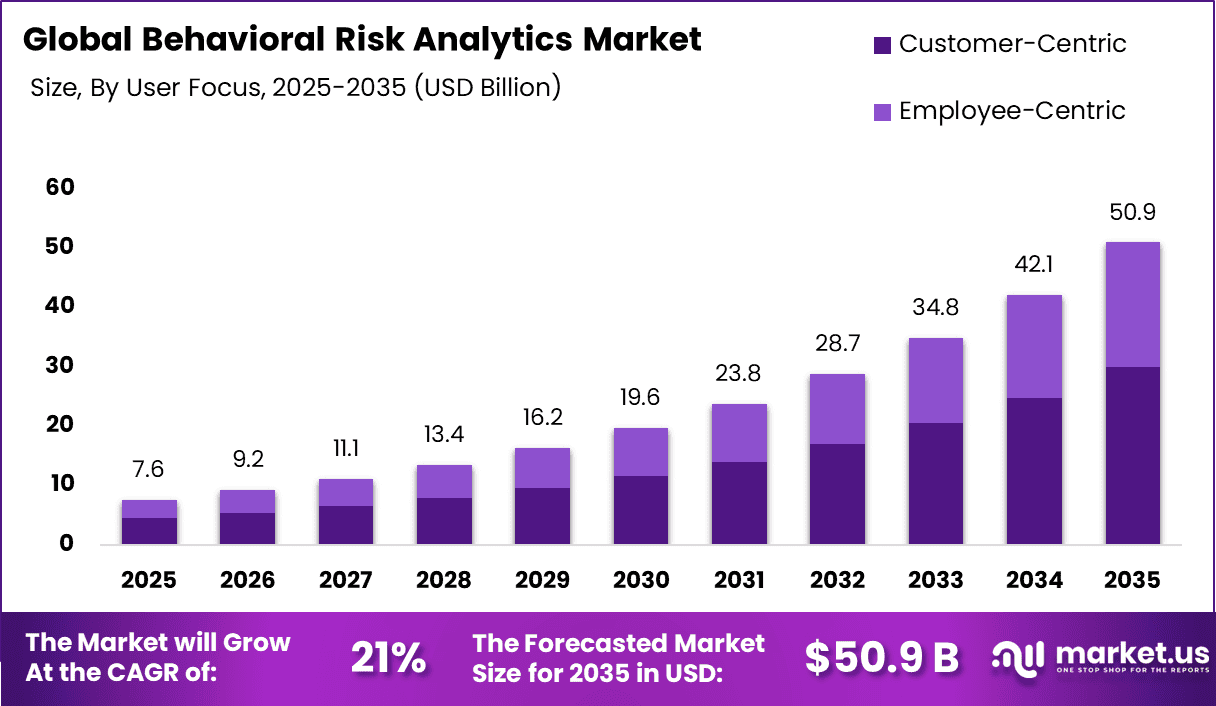
The behavioral risk analytics market focuses on analyzing patterns in human activity to identify potential financial, operational, or security risks. These systems study user behavior across digital platforms, transactions, workplace systems, and customer interactions to detect unusual or high-risk actions. Unlike static rule-based controls, behavioral analytics evaluates deviations from normal patterns over time.
Growth in the behavioral risk analytics market is supported by the expansion of data-driven decision-making and advanced analytical tools. Organizations are integrating behavioral insights into fraud detection, credit assessment, workforce monitoring, and cybersecurity frameworks. Regulatory expectations for stronger internal controls are also influencing adoption.
Top Market Takeaways
- By Component, solutions dominate with a 65.8% share, leveraging UEBA engines, anomaly scoring, and behavioral baselines to flag deviations across user activities.
- By User Focus, customer-centric approaches claim 58.8%, profiling transaction patterns, KYC anomalies, and digital footprints for real-time fraud intervention.
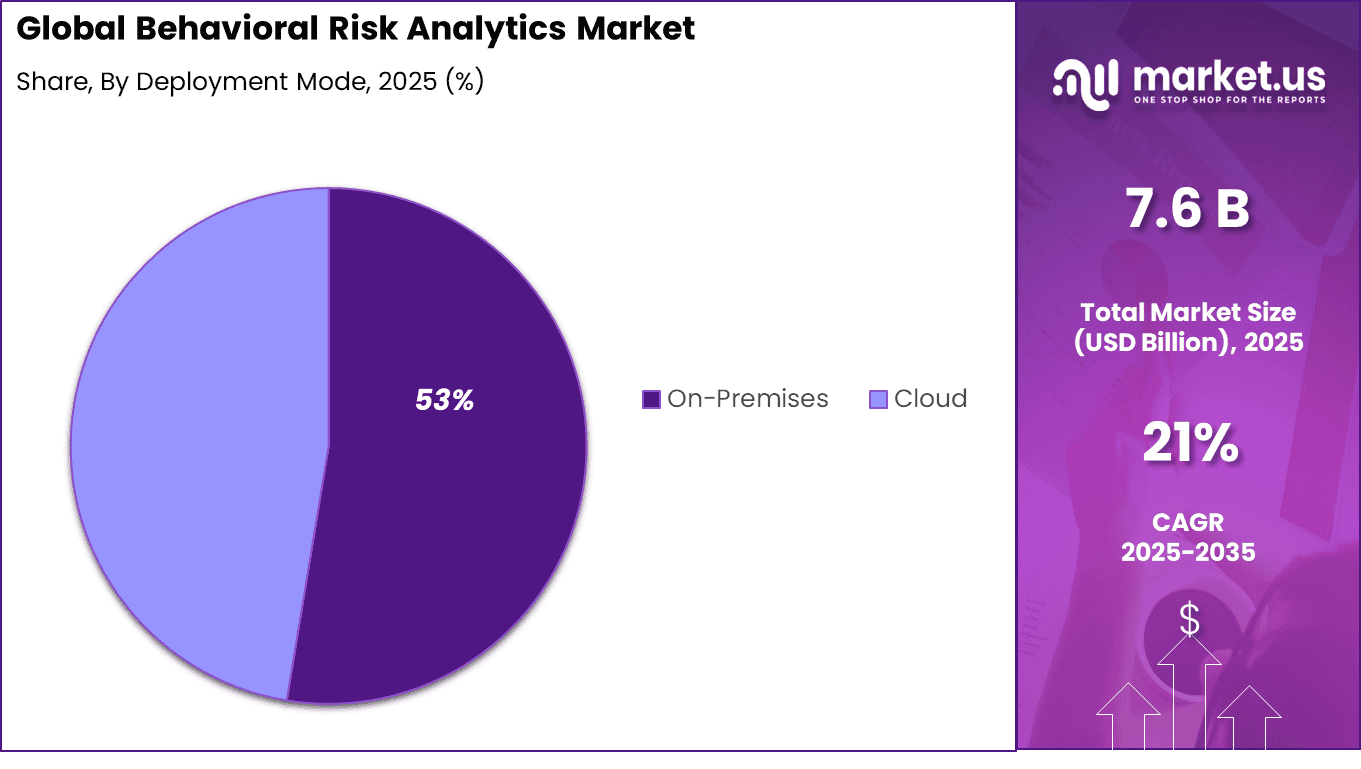
- By Deployment Mode, on-premises captures 52.6%, ensuring data sovereignty, low-latency alerting, and integration with core banking systems.
- By Organization Size, large enterprises hold 74.7%, deploying scalable platforms across global operations with automated risk orchestration.
- By Application, insider threat detection leads at 38.6%, monitoring privileged access, data exfiltration attempts, and lateral movement signatures.
- By Industry Vertical, BFSI commands 40.5%, prioritizing account takeover prevention and compliance-driven behavioral surveillance.
- Regionally, North America accounts for 36.5% global share, with the U.S. market valued at USD 2.34 billion and a CAGR of 18.6%, driven by regulatory pressures and AI-enhanced threat landscapes.
By Component
Solution-based offerings account for 65.8% of adoption in the behavioral risk analytics market, as organizations require integrated platforms to monitor and interpret user behavior patterns. These solutions analyze digital interactions, transaction history, and access activity to identify anomalies. Centralized analytics engines improve early risk detection across enterprise systems.
Advanced behavioral models also combine machine learning with contextual data to enhance accuracy. Automated alerts and dashboards support faster investigation workflows. This functional depth continues to position solutions as the dominant component.
By User Focus
Customer-centric analytics represent 58.8% of focus, reflecting the need to monitor external user behavior in digital channels. Financial institutions and digital platforms analyze transaction trends, login behavior, and device usage to detect unusual activity. This improves fraud prevention and customer protection.
Customer-focused monitoring also enhances personalization and trust. By understanding normal behavioral patterns, organizations reduce false positives. This balance between security and experience sustains strong adoption.
By Deployment Mode
On-premises deployment holds 53%, driven by the sensitivity of behavioral data. Many organizations prefer to maintain control over analytics infrastructure within internal networks. This supports tighter governance and compliance alignment.
Localized deployment also reduces dependency on external connectivity. Enterprises managing regulated data sets often prioritize internal hosting. This sustains the relevance of on-premises implementation.
By Organization Size
Large enterprises represent 74.7% of adoption due to complex digital ecosystems and extensive user bases. These organizations manage high volumes of internal and external interactions daily. Behavioral analytics platforms help maintain oversight at scale. Large firms also face elevated regulatory and reputational risk. Structured analytics improve governance and incident response readiness. This drives sustained uptake among enterprise-scale organizations.
By Application
Insider threat detection accounts for 38.6% of application focus, as unauthorized internal access remains a significant risk. Behavioral analytics tools monitor employee access patterns and privilege usage. Anomalies can indicate potential misuse or data exfiltration. Proactive monitoring reduces financial and reputational damage from internal incidents. Automated detection enhances security team efficiency. This makes insider threat detection a primary use case.
By Industry Vertical
The BFSI sector holds 40.5% of vertical adoption, as financial institutions manage sensitive financial and personal data. Behavioral risk analytics supports fraud detection, compliance, and transaction monitoring. Continuous oversight strengthens risk management frameworks.
Strict regulatory requirements also drive investment in advanced monitoring systems. Enhanced behavioral insights improve audit readiness and governance. This continues to anchor BFSI as a leading vertical in the behavioral risk analytics market.
Key Market Segments
By Component
- Solutions
- Services
- Professional Services
- Managed Services
By User Focus
- Customer-Centric
- Employee-Centric
By Deployment Mode
- On-Premises
- Cloud
By Organization Size
- Large Enterprises
- Small and Medium Enterprises (SMEs)
By Application
- Insider Threat Detection
- Fraud Detection
- Identity and Access Management
- Threat Hunting and Response
- Other
Regional Analysis
North America accounts for 36.5% of the behavioral risk analytics market, supported by advanced cybersecurity adoption and strong regulatory oversight across financial services, healthcare, and enterprise sectors. Organizations in the region are deploying behavioral analytics platforms to monitor user activity, detect insider threats, and identify anomalous behavior patterns in real time.
Demand is driven by rising cyber incidents, increasing digital transactions, and the need to strengthen fraud prevention and access control frameworks.
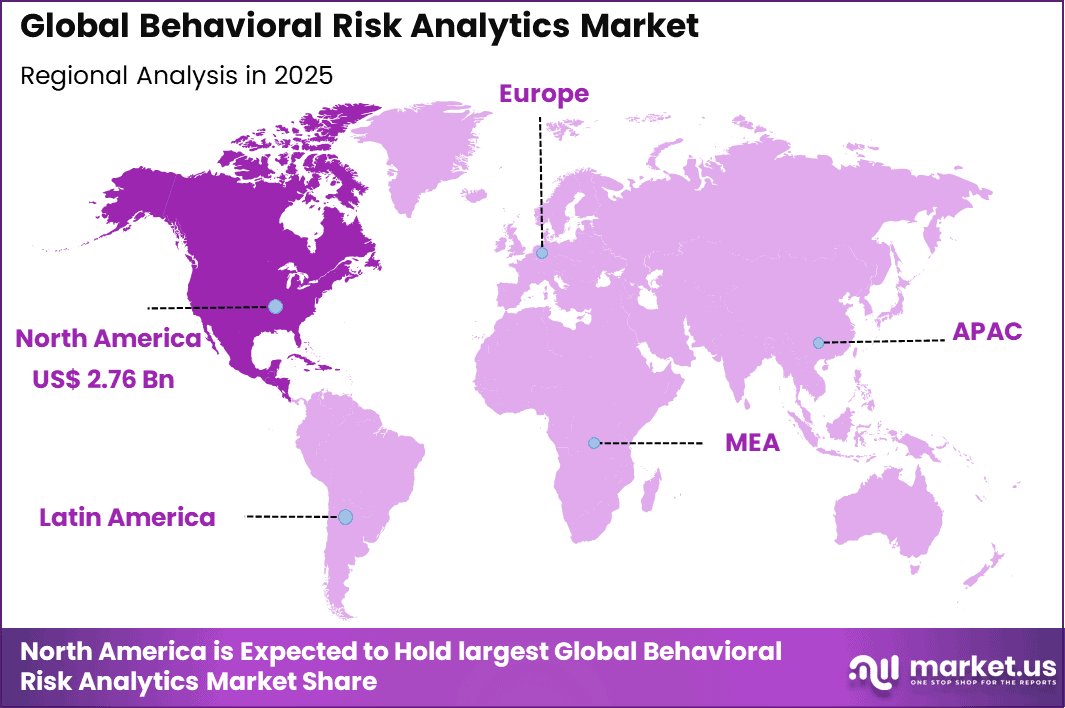
The U.S. market is valued at USD 2.34 Bn and is expanding at a CAGR of 18.6%, reflecting rapid integration of AI-driven risk modeling across enterprise security systems. Adoption is influenced by heightened compliance requirements, remote workforce expansion, and growing exposure to account takeover and identity-based threats.
Growth is further supported by integration of behavioral analytics with security operations centers, enhancing proactive threat detection and improving overall risk governance strategies.
Key Regions and Countries
- North America
- US
- Canada
- Europe
- Germany
- France
- The UK
- Spain
- Italy
- Russia
- Netherlands
- Rest of Europe
- Asia Pacific
- China
- Japan
- South Korea
- India
- Australia
- Singapore
- Thailand
- Vietnam
- Rest of APAC
- Latin America
- Brazil
- Mexico
- Rest of Latin America
- Middle East & Africa
- South Africa
- Saudi Arabia
- UAE
- Rest of MEA
Drivers Impact Analysis
| Key Drivers | Impact on CAGR Forecast (~%) | Geographic Relevance | Impact Timeline | Strategic Importance |
|---|---|---|---|---|
| Rising Insider Threat and Fraud Incidents | +4.3% | North America, Europe | Short to Long Term | Drives demand for real-time behavior monitoring |
| Increasing Regulatory Compliance Requirements | +3.6% | North America, Europe | Medium Term | Mandates structured risk analytics frameworks |
| Growth in Digital Banking and Online Transactions | +3.1% | APAC, North America | Medium to Long Term | Expands transaction monitoring needs |
| Adoption of Remote and Hybrid Work Models | +2.5% | Global | Short to Medium Term | Raises internal behavioral monitoring requirements |
| Integration of Analytics Across Enterprise Systems | +2.0% | Global | Medium Term | Improves cross-platform risk visibility |
Restraints Impact Analysis
| Key Restraints | Impact on CAGR Forecast (~%) | Geographic Relevance | Impact Timeline | Market Constraint Level |
|---|---|---|---|---|
| Data Privacy and Ethical Concerns | -2.4% | Europe, North America | Medium Term | Limits aggressive monitoring practices |
| High Implementation and Integration Costs | -2.1% | Emerging Markets | Short to Medium Term | Budget constraints for SMEs |
| Complexity of Data Aggregation Across Systems | -1.7% | Global | Medium Term | Technical deployment challenges |
| Limited Skilled Analytics Professionals | -1.4% | Global | Medium Term | Slows advanced model optimization |
Investor Type Impact Analysis
| Investor Type | Growth Sensitivity | Risk Exposure | Geographic Focus | Investment Outlook |
|---|---|---|---|---|
| Venture Capital | Very High | High | North America, Israel | Strong focus on AI-driven risk analytics startups |
| Private Equity | High | Medium | North America, Europe | Attractive recurring enterprise software revenue |
| Strategic Financial Institutions | Medium to High | Low to Medium | Global | Integration with compliance platforms |
| Institutional Investors | Medium | Medium | Developed Markets | Long-term fintech and cybersecurity allocation |
| Government and Regulatory Bodies | Medium | Low | North America, Europe | Compliance and financial integrity priority |
Technology Enablement Analysis
| Technology Enabler | Impact on CAGR Forecast (~%) | Geographic Relevance | Impact Timeline | Adoption Momentum |
|---|---|---|---|---|
| AI and Machine Learning Risk Models | +4.5% | North America, Europe | Short to Long Term | Enhances predictive fraud detection |
| Real-time Behavioral Monitoring Platforms | +3.2% | Global | Medium Term | Supports continuous risk assessment |
| Big Data Analytics Infrastructure | +2.7% | APAC, North America | Medium to Long Term | Enables high-volume data processing |
| Natural Language Processing for Communication Analysis | +2.0% | North America | Long Term | Expands monitoring to text-based channels |
| Cloud-native Risk Analytics Platforms | +1.8% | Global | Medium Term | Improves scalability and deployment speed |
Key Challenges
- Difficulty in collecting accurate and complete behavioral data
- Privacy concerns when monitoring user activity and transaction patterns
- Risk of bias in models leading to unfair risk assessment
- Integration challenges with existing risk and compliance systems
- High need for skilled analysts to interpret complex behavioral insights
- Emerging Trends
Emerging Trends
In the Behavioral Risk Analytics market, a noticeable trend is the shift toward linking individual behaviour patterns with organisational risk outcomes in a more continuous way. Rather than relying on periodic reviews or isolated incident reports, analytics systems are being designed to observe actions over time to understand how certain behaviours may contribute to risk exposure.
This helps risk teams see trends such as repeated deviations from process norms or emerging patterns of decision hesitation that could signal deeper issues. Another emerging pattern is the presentation of insights in clear, human-readable formats that help both technical and non-technical stakeholders understand what specific behaviours mean for risk and compliance, improving shared understanding and timely response.
Growth Factors
A key growth driver in this market is the increasing focus on proactive risk management as organisations strive to prevent issues before they surface in financial loss or reputational impact. By analysing behaviour data, companies can strengthen early awareness of patterns that might precede compliance gaps, safety incidents, or operational inefficiencies.
Another important factor is the growing availability of behavioural and process data from digital systems, which provides a richer foundation for analysis. As organisations collect more detailed records of how decisions are made, tasks are executed, and users interact with systems, behavioural risk analytics offers a way to turn this information into actionable insight that supports both risk awareness and organisational resilience.
Competitive Analysis
The Behavioral Risk Analytics market is led by security analytics and SIEM providers such as Splunk, Securonix, Varonis Systems, Exabeam, Rapid7, IBM, NetWitness, Proofpoint, Fortinet, Elastic, Dynatrace, and Devo Technology.
These companies compete on user and entity behavior analytics, real-time threat detection, and integration with existing security operations tools. Their platforms are widely adopted by large enterprises that require continuous monitoring of insider threats, compromised accounts, and abnormal access patterns across hybrid environments.
Specialized and emerging vendors including Gurucul Solutions, Forcepoint, Cynet Security, LogPoint, Panther Labs, Stellar Cyber, Actian Corporation, and others compete through focused analytics engines and faster deployment models.
Competition in this segment is driven by detection accuracy, reduced false alerts, and clear risk scoring aligned with business context. These providers are often selected by organizations seeking advanced behavior-based security monitoring with flexible integration and practical operational support.
Top Key Players in the Market
- Splunk LLC
- Securonix
- Varonis Systems, Inc.
- Exabeam LLC
- Rapid7, Inc.
- Gurucul Solutions, LLC
- Forcepoint LLC
- IBM Corporation
- NetWitness Corporation
- Proofpoint, Inc.
- Fortinet, Inc.
- Cynet Security Ltd.
- LogPoint A/S
- Panther Labs, Inc.
- Securonix, Inc.
- Stellar Cyber, Inc.
- Devo Technology, Inc.
- Elastic N.V.
- Dynatrace LLC
- Actian Corporation
- Others
Future Outlook
The future outlook for the Behavioral Risk Analytics Market is positive as organisations increasingly use data to understand and reduce risk from human behaviour. Demand for behavioural risk analytics solutions is expected to grow because these tools help identify patterns that could lead to fraud, compliance issues, or operational problems.
Adoption of artificial intelligence, machine learning, and real-time insights will improve accuracy and support faster decision-making. Growth can be attributed to rising focus on risk management, regulatory requirements, and the need to protect business operations. Overall, the market is expected to expand as businesses prioritise smarter risk analysis based on behaviour data.
Recent Developments
- In June 2026, Quantifind stated that part of the funding will go to advancing its Graphyte Agentic Middleware, which helps AI agents execute financial‑crime detection and response workflows with governance, explainability, and human oversight essentially behavioral risk analytics focused on entities and transactions.
- In August 2025, IBM released an updated User Entity Behavior Analytics (UEBA) app for IBM QRadar, adding broader visibility into insider‑threat activity by combining user behavior signals with device, server, and asset context.
Report Scope
| Report Features | Description |
|---|---|
| Market Value (2025) | USD 7.6 Billion |
| Forecast Revenue (2035) | USD 50.9 Billion |
| CAGR(2025-2035) | 21.0% |
| Base Year for Estimation | 2024 |
| Historic Period | 2020-2024 |
| Forecast Period | 2025-2035 |
| Report Coverage | Revenue forecast, AI impact on Market trends, Share Insights, Company ranking, competitive landscape, Recent Developments, Market Dynamics and Emerging Trends |
| Segments Covered | By Component (Solutions, Services (Professional Services, Managed Services)), By User Focus (Customer-Centric, Employee-Centric), By Deployment Mode (On-Premises, Cloud), By Organization Size (Large Enterprises, Small and Medium Enterprises (SMEs)), By Application (Insider Threat Detection, Fraud Detection, Identity and Access Management, Threat Hunting and Response, Other) |
| Regional Analysis | North America – US, Canada; Europe – Germany, France, The UK, Spain, Italy, Russia, Netherlands, Rest of Europe; Asia Pacific – China, Japan, South Korea, India, New Zealand, Singapore, Thailand, Vietnam, Rest of Latin America; Latin America – Brazil, Mexico, Rest of Latin America; Middle East & Africa – South Africa, Saudi Arabia, UAE, Rest of MEA |
| Competitive Landscape | Splunk LLC, Securonix, Varonis Systems, Inc., Exabeam LLC, Rapid7, Inc., Gurucul Solutions, LLC, Forcepoint LLC, IBM Corporation, NetWitness Corporation, Proofpoint, Inc., Fortinet, Inc., Cynet Security Ltd., LogPoint A/S, Panther Labs, Inc., Securonix, Inc., Stellar Cyber, Inc., Devo Technology, Inc., Elastic N.V., Dynatrace LLC, Actian Corporation, Others |
| Customization Scope | Customization for segments, region/country-level will be provided. Moreover, additional customization can be done based on the requirements. |
| Purchase Options | We have three licenses to opt for: Single User License, Multi-User License (Up to 5 Users), Corporate Use License (Unlimited Users and Printable PDF) |





























