
One Stop Shop For Reports One Stop Shop For Reports
  • All Reports
  • All Sectors
    • Chemicals & Materials
      • Advanced Materials
      • Bulk Chemicals
      • Coatings | Paints and Additives
      • Composites
      • Renewable | Speciality chemicals
    • Consumer Goods
      • Baby Products
      • Consumer Electronics
      • Consumer Packaging
      • Cosmetics & Personal Care
      • Homecare & Decor
      • Luxury & premium products
    • Energy and Power
      • Energy Efficiency and Conservation
      • Green | Renewable Energy
      • Non Renewable | Conventional Energy
      • Power Equipment and Devices
    • Life Science
      • Biotechnology
      • Diagnostics
      • Healthcare
      • Healthcare IT
      • Medical Devices & Supplies
      • Pharmaceuticals
    • Food and Beverage
      • Agriculture & Agri Products
      • Beverages
      • Food Ingredients
      • Food Services and Hospitality
      • Nutraceutical | Wellness Food
      • Processed & Frozen Foods
    • Automotive and Transportation
      • Automotive components
      • Automotive Logistics
      • Automotive systems and accessories
    • Information and Communications Technology
      • E Commerce and Outsourcing
      • Entertainment & Media
      • High Tech | Enterprise & Consumer IT
      • Information & Network Security
      • Mobility | Telecom & Wireless
      • Software and Services
    • Semiconductor and Electronics
      • Semiconductor Materials and Components
      • Display Technology
      • Electronics System and Components
      • Emerging technologies
      • Security and Surveillance
      • Sensors and Controls
    • Building and Construction
      • Construction Materials
      • HVAC
      • Residential Construction and Improvement
      • Roads & Highways
    • Manufacturing
      • Manufacturing Services
      • Heavy Manufacturing
      • Packaging
      • Engineering | Equipment and Machinery
  • Who Trust Us
  • [email protected]
  • +1 718 874 1545 (International)
  • +91 78878 22626 (Asia)

More Results

One Stop Shop For Reports One Stop Shop For Reports
  • All Reports
  • All Sectors
    • Chemicals & Materials
      • Advanced Materials
      • Bulk Chemicals
      • Coatings | Paints and Additives
      • Composites
      • Renewable | Speciality chemicals
    • Consumer Goods
      • Baby Products
      • Consumer Electronics
      • Consumer Packaging
      • Cosmetics & Personal Care
      • Homecare & Decor
      • Luxury & premium products
    • Energy and Power
      • Energy Efficiency and Conservation
      • Green | Renewable Energy
      • Non Renewable | Conventional Energy
      • Power Equipment and Devices
    • Life Science
      • Biotechnology
      • Diagnostics
      • Healthcare
      • Healthcare IT
      • Medical Devices & Supplies
      • Pharmaceuticals
    • Food and Beverage
      • Agriculture & Agri Products
      • Beverages
      • Food Ingredients
      • Food Services and Hospitality
      • Nutraceutical | Wellness Food
      • Processed & Frozen Foods
    • Automotive and Transportation
      • Automotive components
      • Automotive Logistics
      • Automotive systems and accessories
    • Information and Communications Technology
      • E Commerce and Outsourcing
      • Entertainment & Media
      • High Tech | Enterprise & Consumer IT
      • Information & Network Security
      • Mobility | Telecom & Wireless
      • Software and Services
    • Semiconductor and Electronics
      • Semiconductor Materials and Components
      • Display Technology
      • Electronics System and Components
      • Emerging technologies
      • Security and Surveillance
      • Sensors and Controls
    • Building and Construction
      • Construction Materials
      • HVAC
      • Residential Construction and Improvement
      • Roads & Highways
    • Manufacturing
      • Manufacturing Services
      • Heavy Manufacturing
      • Packaging
      • Engineering | Equipment and Machinery
  • Who Trust Us
Home ➤ Food and Beverage ➤ Agriculture & Agri Products ➤ Floriculture Market
Floriculture Market
Floriculture Market
Published date: July 2026 • Formats:
[email protected] +1 718 874 1545
Request Sample Schedule a Call
Table of Contents
  • Report Overview
  • Key Takeaways
  • By Product Type Analysis
  • By Application Analysis
  • By Flower Type Analysis
  • Distribution Channel Analysis
  • Key Market Segments
  • Drivers
  • Restraints
  • Opportunity
  • Challenge
  • Geopolitical Impact Analysis
  • Regional Analysis
  • Key Players Analysis
  • Key Development
  • Report Scope
  • Home ➤ Food and Beverage ➤ Agriculture & Agri Products ➤ Floriculture Market

Floriculture Market Size, Share And Analysis Report By Product Type (Cut flowers, Bedding plants, Potted plants, Cut foliage, Propagation material, Others), By Application (Conferences and events, Personal use, Gifting, Decoration and displays, Landscaping and gardening, Others), By Flower Type (Rose, Chrysanthemum, Carnation, Gerbera, Lily, Tulip, Orchids, Hydrangea, Freesia, Other), By Distribution Channel (Supermarkets and hypermarkets, Direct sales, Specialty stores and garden centers, Florists and kiosks, Small stores and local retailers, Online retailers and e-commerce, Franchises and other channels), By Region (North America, Europe, Asia Pacific, Latin America, Middle East & Africa) — Industry Segment Outlook, Market Assessment, Competition Scenario, Trends and Forecast 2026–2035

  • Published date: July 2026
  • Report ID: 120309
  • Number of Pages: 310
  • Format:
Fact Checked
Floriculture Market https://market.us/report/floriculture-market/
Cite this Research
  • Overview
  • Table of Contents
  • Segmentation
  • currency-icon
    Revenue, 2025 (US$B)
    73.7 Bn
    growth-icon
    Forecast, 2035 (US$B)
    138.2 Bn
    chart-icon
    CAGR, 2025 - 2035
    6.5%
    globe-icon
    Leading Region
    Asia Pacific

    This report has been updated 2 times. Last updated on July 13, 2026

    • Global Cut Flower Industry (2025): In 2025, the global cut-flower industry was estimated at around USD 40 billion and represented nearly 75% of global floriculture trade, making cut flowers the largest revenue-generating segment within ornamental horticulture.
    • Netherlands Floriculture Exports (2025): According to AIPH, the Netherlands remained the leading global exporter of flowers and plants, with exports reaching approximately EUR 7.2 billion in 2025, representing nearly 2% growth compared with the previous year.
    • Dutch Fresh Cut Flower Trade Position: Trade analysis indicated that the Netherlands exported approximately USD 4.07 billion worth of fresh cut flowers, accounting for around 49.8% of global fresh cut flower exports, supported by advanced greenhouse production and auction-based logistics systems.
    • Kenya Flower Export Growth (2025): In 2025, Kenya’s flower exports were projected at approximately KES 110 billion (around USD 845–851 million), increasing from about USD 835 million in 2024, driven by stronger demand from European and Middle Eastern markets.
    • Kenya Floriculture Economic Contribution (2025): AIPH reported that Kenya’s floriculture sector contributed approximately 1.5% to national GDP in 2025 and supported more than 1 million livelihoods, with women representing over 60% of the workforce.
    • Kenya Horticulture Export Performance (2025): Kenya’s Agriculture and Food Authority recorded total horticultural export earnings of KES 143.78 billion in 2025, with cut flowers contributing approximately 62% of the total value.
    • Kenya Flower Export Reach (2025): Kenyan flowers were exported to approximately 143 global destinations in 2025, while roses accounted for around 69% of the country’s flower exports, highlighting Kenya’s specialization in rose production.
    • U.S. Floriculture and Horticulture Sales (2026): In February 2026, the USDA National Agricultural Statistics Service reported that U.S. horticulture operations generated USD 18.3 billion in sales in 2024, including floriculture, nursery and specialty crops, with 23,060 horticulture operations recorded.
    • Kenya Rose Export Market (2025): In 2025, Kenya’s rose exports generated more than USD 300 million annually, although producers continued addressing challenges related to pest-control standards and stricter European market requirements.
    SEE ALL UPDATES

    Quick Navigation

    • Report Overview
    • Key Takeaways
    • By Product Type Analysis
    • By Application Analysis
    • By Flower Type Analysis
    • Distribution Channel Analysis
    • Key Market Segments
    • Drivers
    • Restraints
    • Opportunity
    • Challenge
    • Geopolitical Impact Analysis
    • Regional Analysis
    • Key Players Analysis
    • Key Development
    • Report Scope

    Report Overview

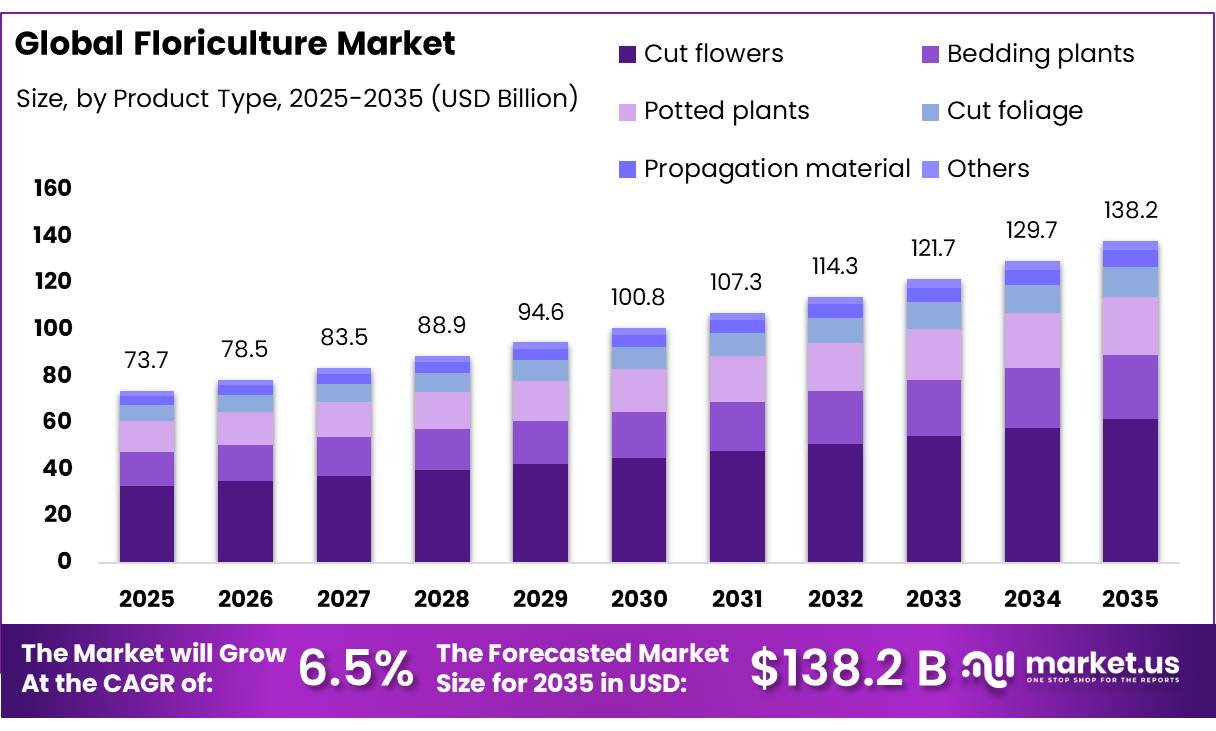
    The Global Floriculture Market size is expected to be worth around US$ 73.7 Billion by 2025, growing at a CAGR of 6.5% during the forecast period from 2026 to 2035, reaching US$ 138.2 Billion by 2035. Asia Pacific held a dominant market position, capturing more than a 35.1% share, holding US$ 25.9 Billion in revenue.

    Floriculture comprises the commercial production and sale of cut flowers, potted plants, bedding plants, foliage, bulbs, and propagation material. The industry links breeders, greenhouse growers, nurseries, auction platforms, wholesalers, florists, garden retailers, and digital sellers. Product quality depends on genetics, controlled cultivation, postharvest handling, refrigeration, packaging, and rapid transport. Its perishable nature makes inventory planning, cold-chain reliability, seasonal scheduling, and consistent grading central to commercial performance at scale across domestic and export markets.

    • In 2025, Royal FloraHolland recorded product turnover of €5.4 billion. Average unit prices increased 3% for flowers and 1% for plants, although volumes declined 2%. Buyer-driven plant transactions completed through its Floriday platform reached 75%, showing how digital ordering and logistics are reshaping wholesale floriculture.
    Key Takeaways

    • The Global Floriculture Market size was USD 73.7 Billion in 2025.
    • The Global Market is estimated to grow to USD 138.2 Billion by 2035.
    • The Compound Annual Growth Rate (CAGR) of the market from 2026 to 2035 will be at 6.5%.
    • Cut Flowers has the largest market share in the product type segment, accounting for 44.8% of total product type sales.
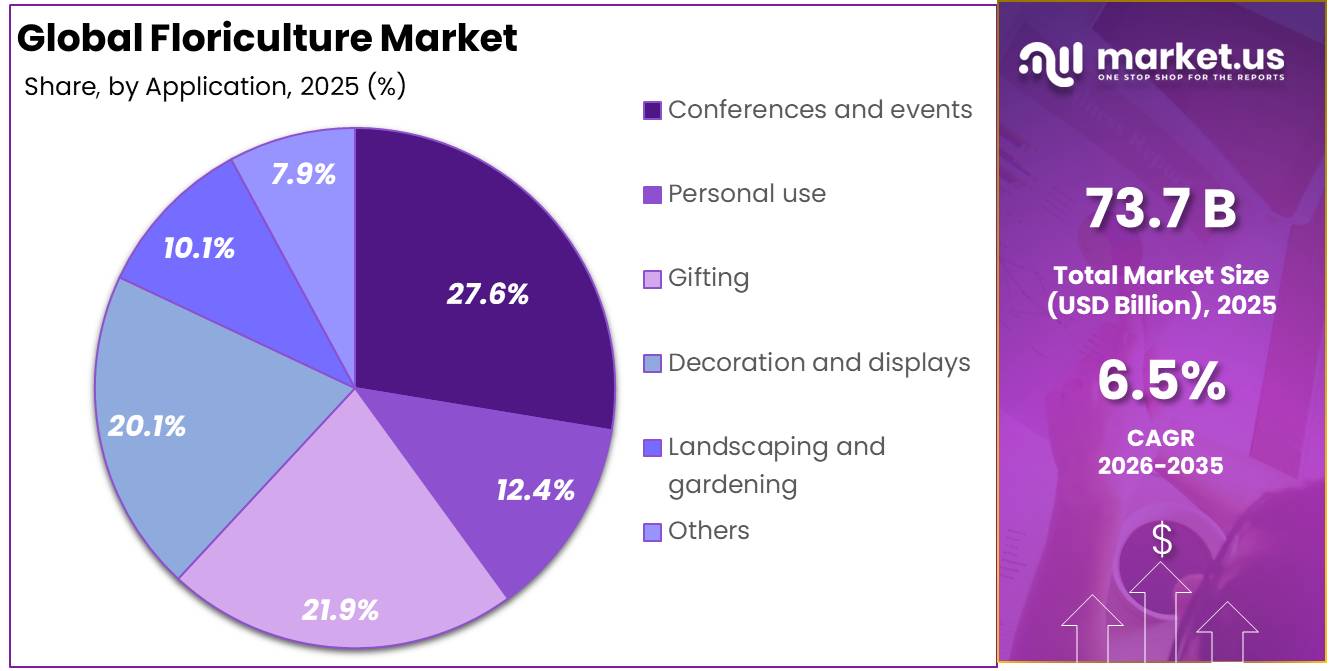
    • Conferences & Events generates the most income within the application segment, accounting for 27.6% of overall application revenue.
    • Roses dominate the floral type segment, accounting for 39.9% of total income.
    • Supermarkets and hypermarkets are the dominant distribution channel, accounting for 27.8% of total revenue.
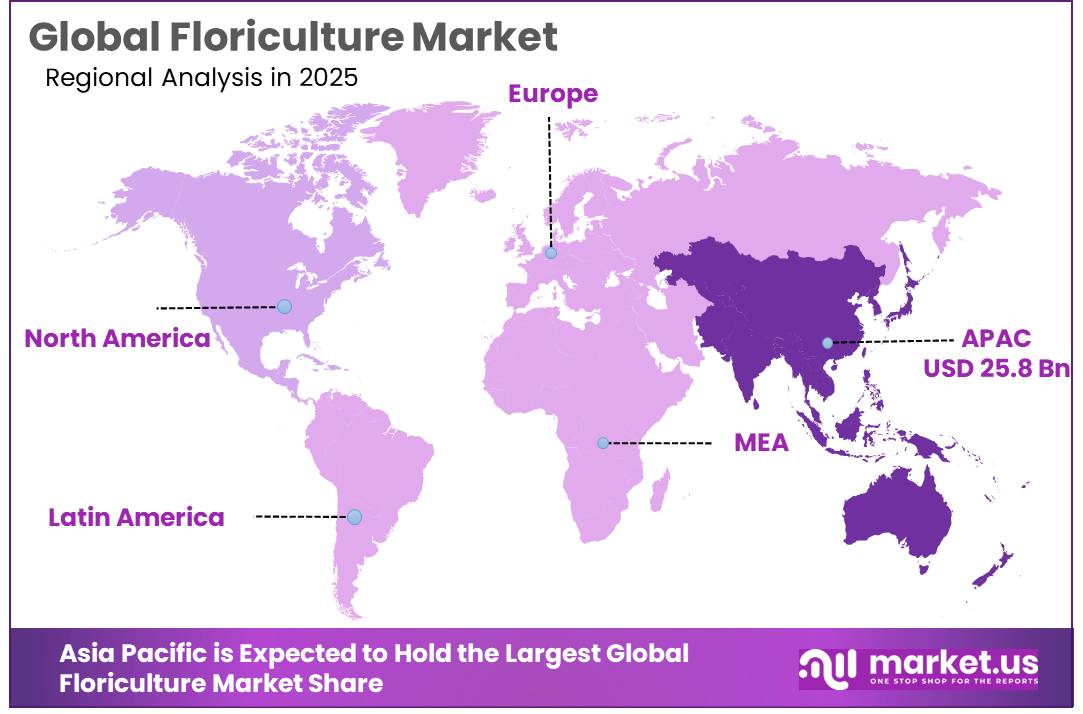
    • Asia Pacific is the dominant regional market, accounting for 35.1% of global sales.

    The figures indicate that pricing, platform efficiency, and dependable fulfillment can protect revenue even when physical product volumes soften, while suppliers face continuing pressure to improve availability and cost control.

    International trade remains an important growth channel for specialist bulbs, planting material, and premium varieties. Eurostat reported that the European Union exported €98.9 million of selected flowering bulbs in 2024, compared with imports of €4.7 million. This surplus highlights opportunities in breeding, protected cultivation, export certification, temperature-controlled distribution, and branded varieties across regions. Further growth can come from online retail, subscription flowers, urban gardening, sustainable packaging, biological crop protection, water-efficient production, and traceable supply systems.

    Government support is strengthening research, marketing, and resilience within eligible horticultural industries. In April 2026, the United States Department of Agriculture announced $100.9 million through the Specialty Crop Block Grant Program and Specialty Crop Multi-State Program, with floriculture explicitly included among eligible crops. Funding supports marketing, education, research, pest and disease management, and collaborative projects. Such initiatives can improve cultivar development, production efficiency, market access, environmental performance, and preparedness for climate, labor, and supply-chain risks over time.

    By Product Type Analysis

    Cut Flowers Dominate the Floriculture Market Driven by Strong Demand and Global Trade

    Product type wise, Cut Flowers hold the top position with a dominating 44.8% market share because of their wide usage among consumers for the purpose of gifting, event decoration, personal consumption, or even procurement by hotels, which together result in maximum sales volume in the industry on a global scale.

    This high market share is further enhanced by their robust supply chain network comprising the world’s leading exporters and trade hubs such as the Netherlands, Kenya, Colombia, and Ecuador, ensuring continuous production of flowers round-the-year and availability to consumers at economical prices through different distribution channels. Gifting occasions include Valentine’s Day, Mother’s Day, marriages, funerals, and corporate events among others, all of which create a regular cycle of high procurement volume in the market.

    • For instance, in 2024, Royal FloraHolland, the world’s largest flower auction house, reported continued high-volume trading activity for cut flowers through its Dutch auction system across its auction centers, with sustained transaction throughput reflecting the substantial commercial scale of the global cut flowers trade flow channeled through the Netherlands’ established auction infrastructure.

    Potted Plants have emerged as the fastest-growing product type, driven by rising consumer adoption of biophilic interior design trends and growing demand for low-maintenance, long-lasting decorative plants across residential and corporate settings globally.

    By Application Analysis

    Conferences & Events Dominate the Floriculture Market Driven by Premium Institutional Floral Demand  

    The Conferences & Events segment leads the application category with a revenue share of 27.6%, driven by corporate events, weddings, hospitality, and exhibitions generating sustained institutional procurement of premium cut flower arrangements, potted displays, and floral decorations. This segment’s leadership reflects the substantially higher per-occasion expenditure that institutional event buyers incur compared to typical consumer floral purchases, with professional event organizers consistently procuring at price points well above standard retail levels.

    • For instance, in 2024, 1-800-Flowers reported continued strong revenue contribution from its institutional and corporate floral services division, with wedding and business event purchasing representing its highest average order value categories, reflecting the premium pricing dynamics that distinguish institutional event floral procurement from standard consumer retail purchasing. 

    Gift giving represents the fastest growing application, spurred by growth in online flower-gifting systems for e-commerce and the increasing culture of gift flowers among consumers in the Asia-Pacific region. The other applications include Decoration & Displays, Personal Use, Landscaping & Gardening, and Others
    By Flower Type Analysis

    Roses Dominate the Flower Type Segment Driven by Strong Gifting Demand and Global Availability

    Roses dominate the flower type category, accounting for 29.9% of total revenue, owing to their unrivaled status as the universally recognized ideal gift and decoration flower across retail occasions including Valentine’s Day, weddings, anniversaries, and sympathy arrangements, consistently commanding premium prices across all of these retail events. Their dominance is further reinforced by the extensive variety of rose types sourced from specialized cultivators, spanning numerous colors, stem lengths, and fragrance profiles, with seasonal availability maintained through year-round cultivation across Kenya, Ecuador, Colombia, and the Netherlands.

    • For instance, in 2024, Afriflora, one of the largest single rose plantation operations in the world based in Ethiopia, reported sustained high-volume rose stem exports to European markets, with the Dutch auction system continuing to serve as its primary distribution channel and Valentine’s Week remaining its single highest-volume export period of the year.

    Orchids represent the fastest-growing flower type segment, driven by rising consumer demand for premium, long-lasting tropical flower varieties across luxury gifting and high-end interior decoration applications globally.

    Distribution Channel Analysis

    Supermarkets & Hypermarkets Dominate Distribution Channels through Broad Reach and Purchase Convenience

    Supermarkets & Hypermarkets dominate the distribution channel segment with a market share contribution of 27.8%, largely attributable to their being the highest footfall retailing platform for consumer floral purchases on a daily basis, which is due to the impulsive buying nature, location proximity, and competitive prices that render them the automatic sourcing point for most household cut flowers and those bought as gifts around the world.

    • For instance, in 2024, Tesco PLC reported that its fresh flower product category continued generating substantial annual UK retail sales revenue, ranking among its highest-margin fresh product categories, with peak purchasing periods during Valentine’s Day and Mother’s Day directly supported through dedicated rose sourcing arrangements with Kenyan flower farms supplying its UK store network.

    Online Retailers and E-Commerce represents the fastest-growing distribution channel, owing to convenient consumer purchasing behavior and the increasing availability of same-day floral delivery networks.

    Key Market Segments

    By Product Type

    • Cut flowers
    • Bedding plants
    • Potted plants
    • Cut foliage
    • Propagation material
    • Others

    By Application

    • Conferences and events
    • Personal use
    • Gifting
    • Decoration and displays
    • Landscaping and gardening
    • Others

    By Flower Type

    • Rose
    • Chrysanthemum
    • Carnation
    • Gerbera
    • Lily
    • Tulip
    • Orchids
    • Hydrangea
    • Freesia
    • Other

    By Distribution Channel

    • Supermarkets and hypermarkets
    • Direct sales
    • Specialty stores and garden centers
    • Florists and kiosks
    • Small stores and local retailers
    • Online retailers and e-commerce
    • Franchises and other channels 

    Drivers

    Cross-border flower trade resilience through Colombia–US and Dutch hub logistics

    Global floriculture remains heavily dependent on cross-border logistics, and one of the clearest current drivers is the resilience of major flower corridors rather than pure domestic self-sufficiency. USDA’s 2026 report on Colombia and the U.S. flower relationship underscores that the American market remains deeply integrated with Colombian supply after six decades of growth, making Andean production a structural pillar for North American consumption.

    At the same time, Royal FloraHolland reported 2025 product turnover of €5.4 billion, up from €5.3 billion in 2024, confirming that the Dutch hub remains the dominant transaction and redistribution platform for European and global flower flows. Taken together, those two systems show that market growth still scales through logistics orchestration—air freight, auction routing, importer inventory turns, and cold-chain reliability—rather than only through local cultivation.

    Drivers Impact Analysis

    Driver (~) % Impact on CAGR Geographic Relevance Impact Timeline
    Retail premiumization in bedding, potted, and gifting formats +1.4% North America core, EU retail hubs, Japan, urban APAC Short term (≤ 2 years)
    Greenhouse capacity expansion and controlled-environment productivity +1.8% Netherlands, North America core, China, Japan, South Korea Medium term (2-4 years)
    Cross-border flower trade resilience through Colombia–US and Dutch hub logistics +1.6% North America core, Netherlands/EU gateway, Andean exporters, East Africa spill-over Short term (≤ 2 years)
    Digital auction, marketplace, and demand-matching modernization +1.1% Netherlands core, EU distribution corridors, global import/export nodes Medium term (2-4 years)
    Sustainability, traceability, and compliance-led assortment shift +0.9% EU core, UK, premium North America channels Medium term (2-4 years)
    Labor intensity, wage pressure, and automation substitution economics +0.7% Netherlands, North America, Japan, high-cost greenhouse clusters Long term (≥ 4 years)

    Restraints

    High input costs and margin squeeze

    Escalating input costs across planting material, fertilizers, plant protection chemicals, energy, and packaging are compressing margins and forcing growers to defer capacity expansions or shift to less input-intensive crops, directly trimming floriculture CAGR by an estimated 1.6 percentage points in the short term. Evidence from recent constraint studies on flower growers points to high cost of inputs and planting materials as a primary production constraint, with respondents ranking inadequate irrigation and rising energy expense alongside expensive planting stock as core profitability challenges, and these issues have intensified under post‑2022 input inflation and energy price volatility.

    For example, fertilizer prices in several producing markets rose by double digits between 2022 and 2023, and diesel and electricity tariffs in India and parts of Africa increased enough to add several percentage points to per‑stem production cost, while packaging and cold-storage costs also moved higher as global petroleum-linked materials and power tariffs rose. When growers face cost increases of 10–20% on key inputs while buyer prices are highly volatile and intermediated.

    Restraint Impact Analysis

    Restraint (~) % Impact on CAGR Geographic Relevance Impact Timeline
    High input costs and margin squeeze -1.6% India, North America core, EU, high-cost APAC Short term (≤ 2 years)
    Labor scarcity and wage inflation -1.3% India, EU, North America core, Japan Medium term (2-4 years)
    Weak cold chain and logistics cost overhang -1.8% India, Africa corridors, Latin America exporters, Southeast Asia Medium term (2-4 years)
    Price volatility and fragmented marketing channels -1.2% India, emerging Asia, Latin America, selected EU wholesale nodes Short term (≤ 2 years)
    Credit constraints and smallholder capex limitations -0.9% India, emerging Asia, Africa corridors Long term (≥ 4 years)
    Regulatory and phytosanitary compliance burden -1.0% EU, UK, North America import channels, export-oriented producers Medium term (2-4 years)

    Opportunity

    Smart floriculture and IoT-based crop intelligence platforms

    A dedicated smart-floriculture platform that monetizes annual SaaS fees of, for example, USD 10–20 per 1,000 square feet of monitored area, plus variable analytics modules could address a multi-billion square-foot installed base, converting into a recurring software TAM of several hundred million dollars without counting ancillary equipment sales. Unit economics are attractive because incremental data services carry gross margins above 70%, while growers can gain 5–10% yield improvement and 2–4 percentage points shrink reduction, translating into rapid ROI even in volatile price environments.

    This opportunity is fundamentally different from current drivers like digital marketplaces, which focus on downstream trade; IoT crop intelligence shifts value creation upstream into production, and if implemented at scale across EU, North America, China, and top Indian clusters within 2–4 years, could conservatively lift floriculture CAGR by about +1.7 percentage points via higher productivity, more reliable supply, and new revenue for tech vendors.

    Opportunity Impact Analysis

    Opportunity (~) % Potential CAGR Geographic Relevance Execution Window
    Smart floriculture and IoT-based crop intelligence platforms +1.7% EU, North America core, China, India tier-1 clusters Medium term (2-4 years)
    Branded sustainable and certified eco-flower consumer franchises +1.5% EU, UK, North America premium retail, Japan Medium term (2-4 years)
    Domestic “local-first” floriculture micro-hubs and subscription models +1.4% North America core, EU urban regions, India metros Short term (≤ 2 years)
    Floriculture data exchanges, carbon credits, and traceability monetization +1.2% EU, UK, North America institutional buyers Long term (≥ 4 years)
    Tech-enabled consolidation and M&A roll-ups of fragmented growers +1.6% India, Africa export corridors, Latin America, Eastern Europe Long term (≥ 4 years)
    Cross-industry collaborations with weddings, events, and wellness platforms +1.3% Global urban hubs, APAC emerging middle class corridors Medium term (2-4 years)

    Challenge

    Talent, labor, and gender-equity challenges

    Quantitatively, high turnover and insufficient training can lower effective labor productivity by 10–20% versus stable, well-trained teams, add 1–2 percentage points to defect rates in grading and packing, and necessitate higher supervision and recruitment costs, all of which chip away at operating margins and reliable capacity utilization.

    Strategically, firms must invest in workforce development, formalization, and inclusive HR policies including better wages, benefits, training programs, and gender-equity initiatives while also exploring targeted automation to relieve physically demanding tasks; these measures require sustained management attention and incremental opex. Because the sector can still function under current labor conditions but at reduced efficiency, this challenge imposes around -0.9 percentage points of friction on achievable CAGR, with a realistic mitigation horizon of 2–4 years as labor policies, social standards, and automation adoption gradually reshape workforce dynamics in Kenya, Ethiopia, India, and Latin American clusters.

    Challenges Impact Analysis

    Challenge (~) % CAGR Friction Drag Geographic Relevance Mitigation Horizon
    Volatile logistics and energy economics -1.3% EU hubs, North America core, APAC trade corridors Medium term (2-4 years)
    Climate variability and environmental risk -1.5% EU, Africa exporters, Latin America, South Asia Long term (≥ 4 years)
    Slow tech adoption and digital capability gap -1.1% India, Africa, Latin America, emerging APAC Long term (≥ 4 years)
    Talent, labor, and gender-equity challenges -0.9% Kenya, Ethiopia, India, Latin America clusters Medium term (2-4 years)
    Demand cyclicality and shock sensitivity -1.0% EU, North America, global urban hubs Medium term (2-4 years)
    Sustainability transition complexity -1.2% EU regulatory hubs, UK, North America Long term (≥ 4 years)

    Geopolitical Impact Analysis

    Trade, Regulatory, and Climate Policies Reshape Global Floriculture Supply Chains

    The geopolitics of the world is putting considerable strain on the global floriculture industry via trade policies, restrictions on agriculture exports, air freight price volatility, and the need to invest in climate change adaptation measures in important producing regions. The EU’s Green Deal and Farm to Fork Strategy requiring a reduction in the use of chemical pesticides and setting Maximum Residue Levels for imported floriculture goods imposes additional costs for exporters from East Africa and Latin America wishing to retain their ability to sell to European retailers.

    The US-China trade dispute has restricted direct market access for Chinese floriculture suppliers into North America through institutional buyers, leading to increased supply chain diversification from suppliers in Colombia, Ecuador, and US-based greenhouses. Higher carbon emissions associated with long-distance transport of perishable floral products via air cargo are driving up investments by European retailers and sustainability-conscious brands into local greenhouse farms as well as closer regional sources from Dutch, Spanish, and North African cultivation sites.

    Regional Analysis

    Asia Pacific Dominates Global Floriculture Market through Production and Rapid Consumer Growth

    Asia Pacific leads the global floriculture market with a revenue share of 35.1%, generating US$ 25.9 Billion in 2025, driven by China’s position as the world’s largest floriculture producer combined with a rapidly developing domestic consumer base fueled by rising middle-class incomes, urbanization, and the emergence of premium floral gifting and home decoration culture across the country. Japan’s strong tradition of floral gifting, India’s rapidly developing wedding and events sector, and the expanding retail-based floral market across Southeast Asian countries further reinforce the region’s established demand base. Government-backed horticulture development initiatives across China, India, and the ASEAN region are contributing to continued expansion of domestic production infrastructure throughout the region.

    Europe constitutes the second biggest market driven by the Netherlands being the largest floriculture trading center in the world under Royal FloraHolland, flourishing consumer flower gifting traditions in Germany, France, and the United Kingdom, and increasing use of e-commerce to deliver flowers. North America generates income in the form of premium gifting, weddings, and event floriculture. The Middle East & Africa market is developing through the expansion of the luxury hotel and corporate event sector in Gulf countries. Latin America reaps benefit owing to the fact that Colombia and Ecuador are among the biggest exporters of cut flowers in the world.

    Key Regions and Countries Covered

    North America

    • US
    • Canada

    Europe

    • Germany
    • France
    • UK
    • Italy
    • Spain
    • Russia & CIS
    • Rest of Europe

    Asia Pacific

    • China
    • Japan
    • South Korea
    • India
    • ASEAN
    • Rest of Asia Pacific

    Latin America

    • Brazil
    • Mexico
    • Rest of Latin America

    Middle East & Africa

    • GCC Countries
    • South Africa
    • Rest of Middle East & Africa

    Key Players Analysis

    Competitive advantage is achieved by suppliers in the global floriculture industry through innovations in variety management, sustainability certifications, cold chain logistics excellence, and integration of multiple channels including wholesale auction, supermarket, e-delivery, and direct-to-consumer platforms. Strategic priorities for these firms include the cultivation of high-quality, sustainable-growing facilities; development of the direct-to-consumer online delivery channel; varieties exclusively available from leading breeding houses; and expansion into greenhouse-controlled-environment production for round-the-year provision of premium products. The industry players remain dedicated to the installation of phytosanitary control facilities, cold chain logistics technology improvement, and sustainability certifications to ensure sustained market access in European and North American institutional retail channels, which enjoy premium pricing for cut flowers.

    Agreements in terms of long-term supply frameworks with large supermarket retailers, online floral delivery providers, and corporate events sourcing agencies provide predictable revenues for the forecast period till 2035.

    Market Key Players

    • Kariki
    • Multiflora
    • Karen Roses
    • Harvest Flower
    • Queens Group / The Queen’s Flowers Corp
    • Ball Horticultural
    • Afriflora
    • Karuturi Global Limited
    • Oserian
    • Selecta One / Selecta Cut Flowers SAU
    • Washington Bulb Company
    • Arcangeli Giovanni & Figlio
    • Carzan Flowers
    • Rosebud Ltd
    • Benary
    • Others

    Key Development

    • In February 2026, Ball Horticultural launched an expanded portfolio of sustainability-certified bedding plant and potted plant varieties for European and North American garden center retail buyers, incorporating Rainforest Alliance growing standards across its key production sites.
    • In May 2026, Royal FloraHolland introduced a new digital traceability platform across its Dutch auction infrastructure, enabling supermarket and florist institutional buyers to verify grower sustainability credentials and flower origin data at the point of auction purchase.
    • In March 2026, Oserian secured a new direct supply agreement with a leading UK supermarket chain for Fairtrade-certified Kenyan roses and carnations, covering annual procurement requirements across Valentine’s Day, Mother’s Day, and year-round everyday floral category needs.

    Report Scope

    Report Features Description
    Market Value (2025) USD 73.7 Billion
    Forecast Revenue (2035) USD 138.2 Billion
    CAGR (2026-2035) 6.5%
    Base Year for Estimation 2025
    Historic Period 2020-2024
    Forecast Period 2026-2035
    Report Coverage Revenue Forecast, Market Dynamics, Competitive Landscape, Recent Developments
    Segments Covered By Product Type (Cut flowers, Bedding plants, Potted plants, Cut foliage, Propagation material, Others), By Application (Conferences and events, Personal use, Gifting, Decoration and displays, Landscaping and gardening, Others), By Flower Type (Rose, Chrysanthemum, Carnation, Gerbera, Lily, Tulip, Orchids, Hydrangea, Freesia, Other), By Distribution Channel (Supermarkets and hypermarkets, Direct sales, Specialty stores and garden centers, Florists and kiosks, Small stores and local retailers, Online retailers and e-commerce, Franchises and other channels)
    Regional Analysis North America – The US & Canada; Europe – Germany, France, The UK, Spain, Italy, Russia & CIS, Rest of Europe; APAC – China, Japan, South Korea, India, ASEAN & Rest of APAC; Latin America – Brazil, Mexico & Rest of Latin America; Middle East & Africa – GCC, South Africa & Rest of MEA
    Competitive Landscape Kariki, Multiflora, Karen Roses, Harvest Flower, Queens Group / The Queen’s Flowers Corp, Ball Horticultural, Afriflora, Karuturi Global Limited, Oserian, Selecta One / Selecta Cut Flowers SAU, Washington Bulb Company, Arcangeli Giovanni & Figlio, Carzan Flowers, Rosebud Ltd, Benary, Others.
    Customization Scope Customization for segments, region/country-level will be provided. Moreover, additional customization can be done based on the requirements.
    Purchase Options We have three licenses to opt for: Single User License, Multi-User License (Up to 5 Users), Corporate Use License (Unlimited Users and Printable PDF)


    keyboard_arrow_up
  • Segments Sub-segments
    By Product Type
    • Cut flowers
    • Bedding plants
    • Potted plants
    • Cut foliage
    • Propagation material
    • Others
    By Application Type
    • Conferences and events
    • Personal use
    • Gifting
    • Decoration and displays
    • Landscaping and gardening
    • Others
    By Flower Type
    • Rose
    • Chrysanthemum
    • Carnation
    • Gerbera
    • Lily
    • Tulip
    • Orchids
    • Hydrangea
    • Freesia
    • Other
    By Channel
    • Supermarkets and hypermarkets
    • Direct sales
    • Specialty stores and garden centers
    • Florists and kiosks
    • Small stores and local retailers
    • Online retailers and e‑commerce
    • Franchises and other channels
     
    North America Europe Asia Pacific Latin America Middle East & Africa
    • US
    • Canada
    • Germany
    • France
    • The UK
    • Spain
    • Italy
    • Rest of Europe
    • China
    • Japan
    • South Korea
    • India
    • Australia
    • Rest of APAC
    • Brazil
    • Mexico
    • Rest of Latin America
    • GCC
    • South Africa
    • Rest of MEA
Floriculture Market
Floriculture Market
Published date: July 2026
add_shopping_cartBuy Now get_appDownload Sample

Related Reports

  • Industrial Air Compressor Market
  • Bubble Tea Market
  • Flow Meter Market
  • Americas Smart Grid Market
  • Solar Carport Market
  • Polymers Market
  • Mobile Robotics Polymer Materials Market
  • Agritech Market
  • Gutter Connected Commercial Greenhouse Market
  • Irrigation Pumps Market
Floriculture Market
  • 120309
  • July 2026
    • ★★★★★
      ★★★★★
Buy Now
Trusted by more than 17382 organizations globally
  • Client Logo
  • Client Logo
  • Client Logo
  • Client Logo
  • Client Logo
  • Client Logo
  • Client Logo
  • Client Logo
  • Client Logo
  • Client Logo
  • Client Logo
  • Client Logo
  • Client Logo
  • Client Logo
  • Client Logo
  • Client Logo

Our Clients

philips
pentair
suez
ecowater
ergobaby
fabricato
genomatica
lenzing
lilly
siemens
honeywell
valspar
pactiv
petsure
schweitzer-online
sappi
pfizer
unilabs
lonza
BD
mckinsey
hilti
✖
Request a Sample Report
We'll get back to you as quickly as possible

✖
Request a Sample Report
We'll get back to you as quickly as possible

  • location_on420 Lexington Avenue, Suite 300 New York City, NY 10170,
    United States
  • phone+1 718 874 1545 (International)
  • phone+91 78878 22626 (Asia)
  • email[email protected]
  • Facebook Logo
  • Twitter Logo
  • LinkedIn Logo
Find Help
  • Contact Us
  • How to Order
Legal
  • Privacy Policy
  • Refund Policy
  • Frequently Asked Questions
  • Terms and Conditions
Explore
  • About Us
  • Our Clients
  • Media Mentions
  • Infographics
  • Statistics and Facts
  • Research Methodology
  • Why Choose Us?
Secured Payment Options

© 2026 Market.Us. All Rights Reserved.




























