


Overview
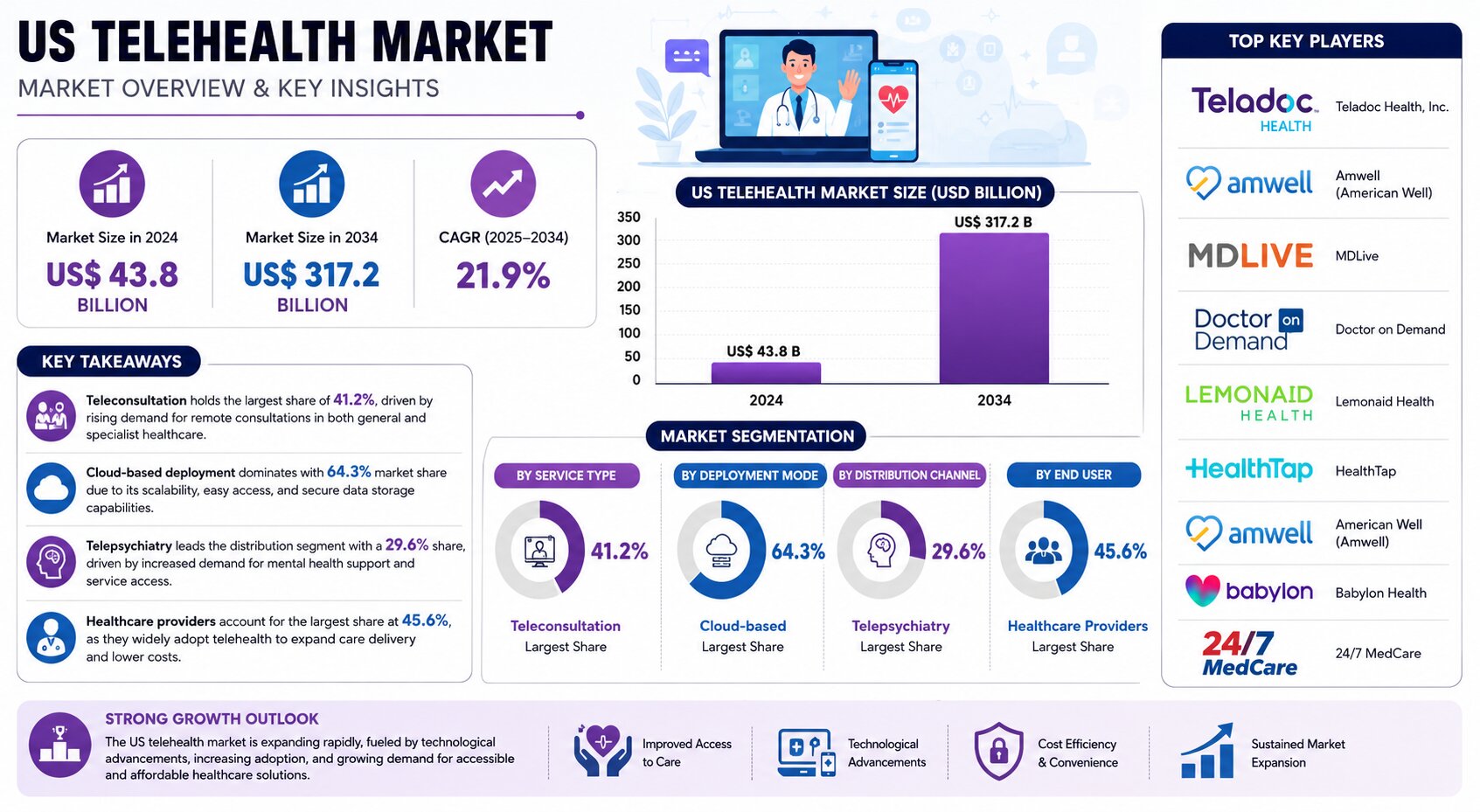
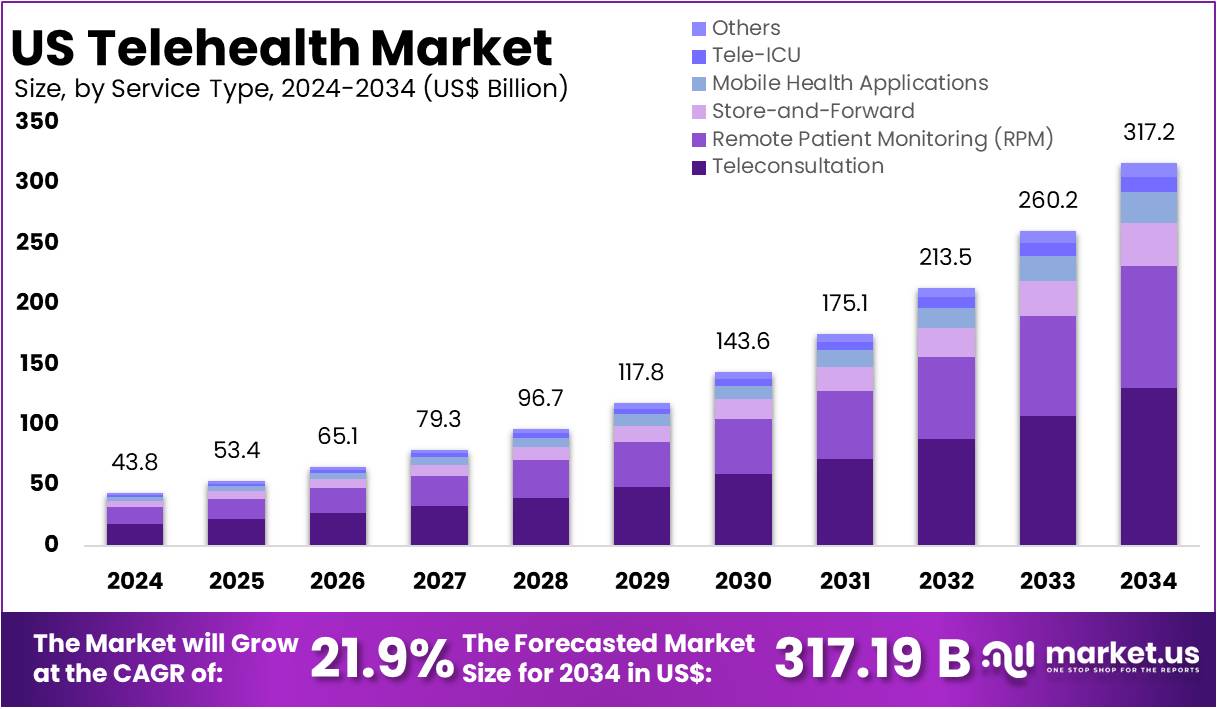
The US Telehealth Market size is expected to be worth around US$ 317.2 Billion by 2034 from US$ 43.8 Billion in 2024, growing at a CAGR of 21.9% during the forecast period from 2025 to 2034.
The U.S. telehealth landscape continues to evolve as healthcare providers, government agencies, and patients increasingly incorporate virtual care into routine service delivery. Telehealth is being used across primary care, chronic disease management, behavioral health, follow-up consultations, and specialist services, helping reduce travel barriers and expand access for patients who may face challenges reaching traditional healthcare facilities.
The Centers for Medicare & Medicaid Services (CMS) continues to maintain and update the Medicare telehealth framework, with its latest Medicare Telehealth Trends dataset covering utilization through the fourth quarter of 2025. The dataset provides information on telehealth use among Medicare Fee-for-Service beneficiaries and is updated quarterly, supporting ongoing assessment of virtual healthcare utilization in the United States.
Behavioral healthcare remains an important area for telehealth adoption. According to Telehealth.HHS.gov, a survey of mental health treatment facilities found that 80% offered care through telehealth, demonstrating the growing role of virtual platforms in behavioral health delivery.
Federal policy is also supporting continued access. Recent legislation extended many Medicare telehealth flexibilities through December 31, 2027, including home-based telehealth for non-behavioral healthcare and the removal of certain geographic restrictions.
As digital health infrastructure, reimbursement policies, and provider capabilities continue developing, telehealth is positioned to remain an important component of the U.S. healthcare delivery system, particularly for improving convenience, accessibility, and continuity of care.
Key Takeaways
- The U.S. Telehealth market is projected to reach USD 43.78 billion by 2024 and expand to USD 317.19 billion by 2034, reflecting substantial market growth.
- The market is expected to register a strong CAGR of 21.9% between 2024 and 2034, highlighting sustained expansion in telehealth adoption.
- Teleconsultation dominates the market with a 41.2% share, supported by increasing demand for convenient remote consultations across healthcare services.
- Cloud-based deployment holds the leading position with a 64.3% market share, driven by scalability, accessibility, and secure healthcare data storage.
- Telepsychiatry accounts for the largest distribution segment share at 29.6%, supported by growing demand for accessible mental health services.
- Healthcare providers represent the largest end-user segment with a 45.6% share, as providers increasingly adopt telehealth to broaden care delivery and improve cost efficiency.
Statistical Information
- 86.5% of U.S. office-based physicians reported using telemedicine in 2021, up sharply from 15.4% in 2019, demonstrating how rapidly virtual care became integrated into physician practices.
- 76.7% of primary care physicians and 73.1% of medical specialists said they could provide a similar quality of care through telemedicine as through in-person visits to some or a great extent.
- 65.5% of primary care physicians reported being satisfied with telemedicine technology for patient visits, while satisfaction reached 63.6% among medical specialists.
- 27.4% of medical specialists reported using telemedicine for 50% or more of their patient visits, showing particularly strong adoption among certain specialty-care providers.
- The AMA reports that more than 80% of physicians surveyed said telehealth improved patients’ access to care, while 62% said patients had higher satisfaction after telehealth was introduced.
- 63% of physicians reported that at least 75% of their virtual visits involved patients with whom they already had an established relationship, supporting telehealth’s role in ongoing rather than solely episodic care.
- 65% of telehealth patients cited convenience as a reason for using virtual care, followed by 46% who cited the ability to receive care quickly, according to a consumer survey reported by the American Hospital Association.
- 65% of telehealth patients experienced at least one barrier during their virtual visit; internet or cellular connectivity problems and limited services were each reported by 25% of patients.
- CDC data show telemedicine use among U.S. adults with diagnosed diabetes reached 39.4% in 2022, compared with 37.6% among adults with diagnosed prediabetes, highlighting the relevance of virtual care for chronic-disease management.
- 90% of consumers who had a virtual-care visit reported being very or somewhat satisfied, while 55% of people who did not use virtual care said they preferred seeing their doctor in person.
Market Segmentation Analysis
Service Type Analysis
Teleconsultation dominates the U.S. Telehealth Market, accounting for 41.2% of the market. This service enables patients to connect with healthcare professionals remotely through video consultations, phone calls, and digital communication platforms. Its convenience, accessibility, and ability to support patients in rural and underserved communities have strengthened adoption.
Teleconsultation is widely used for routine medical consultations, follow-up appointments, specialist care, mental health support, and urgent healthcare needs. The continued shift toward virtual care has further increased demand for remote consultations. By reducing travel requirements and improving access to healthcare professionals, teleconsultation provides a flexible care delivery option and remains the most widely adopted service type in the U.S. telehealth landscape.
Deployment Mode Analysis
Cloud-based deployment leads the U.S. Telehealth Market with a 64.3% market share, reflecting the growing preference for scalable and accessible digital healthcare infrastructure. Cloud-based platforms allow healthcare organizations to securely manage and access patient information across multiple locations while supporting real-time communication between providers and patients. Their flexibility reduces the need for extensive on-site infrastructure and enables organizations to expand telehealth capabilities more efficiently.
Cloud solutions can also integrate with electronic health records and other healthcare technologies, improving workflow and continuity of care. As healthcare providers seek cost-effective and adaptable technology, cloud-based deployment continues to gain importance across hospitals, clinics, specialty practices, and other healthcare organizations.
Application Analysis
Telepsychiatry represents the leading application segment in the U.S. Telehealth Market, holding a 29.6% market share. Its strong position is supported by increasing demand for accessible mental health services and the growing acceptance of virtual psychiatric care. Telepsychiatry enables patients to receive therapy, counseling, psychiatric evaluations, and medication management remotely, reducing geographic and transportation barriers. It is particularly valuable for individuals living in areas with limited access to mental health professionals.
Virtual appointments can also help address long waiting periods and improve convenience for patients seeking ongoing care. The broader adoption of telehealth platforms, greater awareness of mental health needs, and expanding digital care capabilities are supporting continued growth in telepsychiatry.
End User Analysis
Healthcare providers account for the largest end-user share in the U.S. Telehealth Market, representing 45.6% of the market. Hospitals, clinics, private practices, and specialty healthcare centers increasingly use telehealth technologies to expand access to medical services and improve operational efficiency. These solutions support remote consultations, chronic disease management, follow-up appointments, and remote patient monitoring while reducing reliance on in-person visits. Telehealth also allows providers to serve patients in rural and underserved locations more effectively.
By integrating virtual care into existing healthcare workflows, organizations can improve patient engagement and continuity of care. The growing demand for convenient, cost-efficient healthcare delivery continues to encourage providers to expand their telehealth capabilities across multiple medical specialties.
Business Opportunities
The U.S. Telehealth Market presents significant opportunities for technology providers, healthcare organizations, and digital health companies as virtual care expands across chronic disease management, behavioral health, and remote monitoring. Remote patient monitoring (RPM) is a particularly attractive opportunity because Medicare broadly covers RPM for chronic and acute conditions using connected devices such as blood-pressure monitors, glucose meters, weight scales, and pulse oximeters.
Businesses can develop integrated RPM platforms that combine connected devices, clinical dashboards, patient education, data analytics, and automated alerts. CMS’s new ACCESS model, launched in July 2026, further creates opportunities for technology-enabled chronic-care services involving remote monitoring, wearables, coaching, and medication management for conditions including diabetes, hypertension, depression, and chronic pain.
There is also scope for telehealth infrastructure, cybersecurity, interoperability, and virtual-care workflow solutions that help hospitals and clinics integrate digital services into existing systems. The American Hospital Association identifies technology selection, virtual-care strategy, and capacity expansion as important areas for healthcare organizations pursuing telehealth growth.
Emerging Trends
- Outcome-Based Virtual Care: Telehealth is moving toward models that connect digital care with measurable health outcomes. CMS launched the 10-year ACCESS model in July 2026, combining remote monitoring, wearables, coaching, lifestyle support, and medication management for chronic conditions.
- Remote Monitoring Beyond Video Visits: Connected devices are becoming a larger part of virtual care. Medicare requires qualifying RPM devices to transmit health information at least 2 days within a 30-day period, creating stronger demand for connected blood-pressure, glucose, weight, and oxygen-monitoring technologies.
- Store-and-Forward Telehealth: Telehealth is increasingly using asynchronous methods, allowing patients to send images, videos, or clinical information for later review. HRSA data show 14.94% of health centers used store-and-forward technology in 2024, expanding virtual care beyond live video appointments.
- Telehealth for Substance-Use Care: Virtual care is expanding beyond mental-health consultations into substance-use treatment. In 2024, 61.31% of HRSA-funded health centers reported using telemedicine for substance-use-disorder services, indicating growing integration into community-based behavioral healthcare.
- Virtual Specialty Access: Healthcare systems are using telehealth to connect patients with specialists who may not be locally available. VA reports that its virtual-care programs support specialty services including tele-eye, dermatology, sleep care, and remote wound care, strengthening access outside major medical centers.
Use Cases
- Maternal Mental Health: Telehealth is being used to reach pregnant and postpartum women who face shortages of specialized providers. HHS notes that 1 in 5 women experience a mental-health condition during or after pregnancy, creating an important use case for virtual screening, therapy, referrals, and ongoing support.
- Telehealth for Speech Therapy: Virtual speech-language therapy is becoming a practical specialty-care application. The VA reports that more than 98% of its speech-language pathologists provide some care virtually, with TeleSpeech appointments averaging about 8,000 per month.
- Home-Based Cardiac Monitoring: Virtual cardiac care is increasingly being delivered directly in patients’ homes. VA programs use home-based monitoring for cardiac conditions, while FY2024 initiatives added acute myocardial infarction and asthma to remote-monitoring disease protocols.
- Telehealth for Nutrition Care: Community health centers are using telehealth for dietary counseling alongside primary and behavioral healthcare. HRSA’s 2024 data show 34.88% of health centers used telemedicine for nutrition and dietary counseling, creating opportunities for remote lifestyle and chronic-disease support.
- Virtual Care for Rural Veterans: Telehealth is increasingly being used to overcome specialist shortages in rural communities. VA estimates 4.4 million Veterans live in rural communities, making home video visits, mobile applications, remote monitoring, and digital communication important tools for reducing travel and geographic barriers.
Recent Developments
- In April 2026, Amazon reported that virtual-care visits through Amazon One Medical had nearly tripled year over year, with a majority of those visits now coming through its Health AI experience, following the launch of its 24/7 AI-powered health agent on Amazon’s U.S. app and website.
- In March 2026, Amazon expanded Health AI to more U.S. customers through Amazon’s website and app, providing 24/7 AI-powered health guidance backed by One Medical clinicians, with capabilities including health-record explanations, prescription management, appointment booking, and connection to virtual care.
- In October 2025, Amazon One Medical expanded Pay-per-visit telehealth to children ages 2–11, covering conditions including pink eye, head lice, common skin problems, and certain medication renewals; message visits started at $29 and video consultations at $49.
- In August 2025, Amwell secured an extension of its Digital First contract through a Leidos-led partnership with the U.S. Defense Health Agency, continuing deployment of its technology-enabled care platform across the Military Health System and supporting scheduled virtual visits across the global Department of Defense enterprise.
- In February 2025, Teladoc Health agreed to acquire Catapult Health for $65 million in cash, plus up to $5 million in contingent consideration, adding at-home diagnostic testing and preventive-care capabilities to Teladoc’s integrated-care strategy.
Conclusion
The U.S. Telehealth Market is undergoing rapid transformation as healthcare providers, patients, and technology companies increasingly integrate virtual care into routine healthcare delivery. Growth is supported by expanding teleconsultation, cloud-based platforms, telepsychiatry, remote patient monitoring, and specialized virtual services.
Government policies, Medicare coverage extensions, and investments in digital healthcare infrastructure are further strengthening market opportunities. Emerging applications such as maternal mental health, nutrition counseling, cardiac monitoring, and rural healthcare demonstrate telehealth’s expanding role across diverse patient needs. Continued innovation in AI, connected devices, interoperability, and outcome-based care is expected to improve accessibility, convenience, and continuity while creating new opportunities across the U.S. healthcare ecosystem.




















