


Quick Navigation
Overview
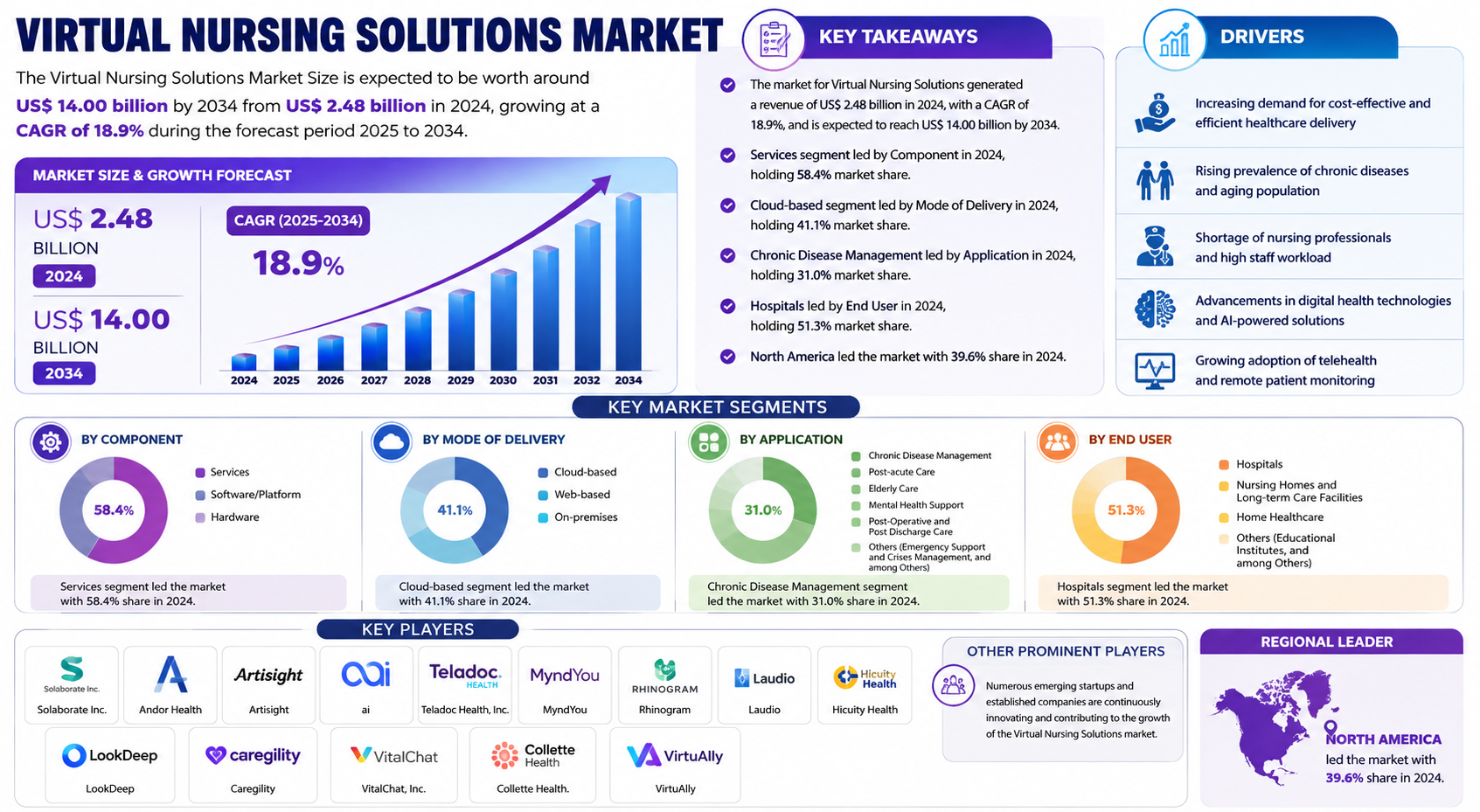
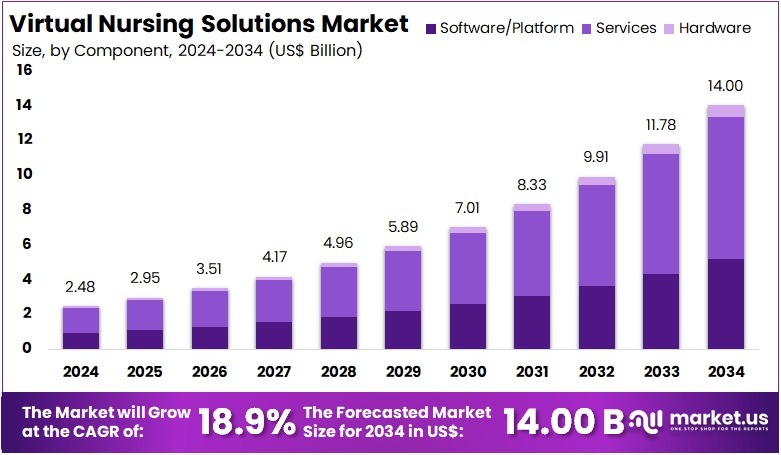
New York, NY – August 11, 2026 – The Global Virtual Nursing Solutions Market Size is expected to be worth around US$ 14.00 Billion by 2034 from US$ 2.48 Billion in 2024, growing at a CAGR of 18.9% during the forecast period 2025 to 2034.
Virtual nursing solutions are becoming an important part of modern healthcare as hospitals seek to improve patient care while addressing workforce shortages and rising demand for clinical services. These platforms connect experienced registered nurses with patients and bedside care teams through secure audio-video technology, allowing them to assist with patient admissions, discharge planning, medication education, documentation, care coordination, and remote monitoring.
By reducing administrative workloads, virtual nursing enables bedside nurses to spend more time on direct patient care, improving workflow efficiency and patient experience. Recent studies supported by the U.S. Department of Health and Human Services indicate that virtual nursing implementation has contributed to shorter emergency department wait times, more complete nursing documentation, and fewer interruptions during admission assessments.
The growing adoption of telehealth infrastructure is creating favorable conditions for virtual nursing programs worldwide. According to the U.S. Health Resources and Services Administration (HRSA), 95% of HRSA-funded health centers used telehealth to deliver primary care services in 2024, demonstrating the expanding digital healthcare ecosystem. In addition, CMS reported that 366 hospitals participated in the Acute Hospital Care at Home initiative, serving more than 31,000 patients by October 2024, highlighting the increasing acceptance of technology-enabled care delivery models beyond traditional hospital settings.
Healthcare providers are also integrating artificial intelligence, electronic health records, and remote patient monitoring tools with virtual nursing platforms to improve clinical decision-making and patient engagement. Continued investments in digital health infrastructure, supportive reimbursement policies, and the need to optimize nursing resources are expected to strengthen adoption across hospitals, specialty clinics, and home-based care settings, positioning virtual nursing as a key component of future healthcare delivery.
Key Takeaways
- In 2024, the global Virtual Nursing Solutions market was valued at US$ 2.48 billion and is projected to reach US$ 14.00 billion by 2034, expanding at a CAGR of 18.9% during the forecast period.
- The Component segment includes Software/Platform, Services, and Hardware, with the Services segment dominating the market in 2024 by accounting for 58.4% of the total revenue share.
- Based on Mode of Delivery, the market is categorized into Cloud-based, Web-based, and On-premises solutions. Among these, Cloud-based deployment held the leading position, capturing 41.1% of the market share in 2024.
- In terms of Application, the market comprises Chronic Disease Management, Post-acute Care, Elderly Care, Mental Health Support, Post-Operative and Post-Discharge Care, and Others. Chronic Disease Management emerged as the largest application segment, contributing 31.0% of the total market revenue in 2024.
- By End User, the market is segmented into Hospitals, Nursing Homes and Long-term Care Facilities, Home Healthcare, and Others. Hospitals remained the leading end-user segment, representing 51.3% of the overall market share in 2024.
- North America dominated the global Virtual Nursing Solutions market in 2024, accounting for 39.6% of the total market share.
Statistical Information
- 43% of U.S. hospitals have implemented some form of virtual nursing, where remote nurses support bedside teams using telehealth technologies to reduce workload and improve care coordination.
- About 40% of nurses reported experiencing high levels of burnout and considered leaving their positions, highlighting the need for virtual nursing models that reduce administrative burden.
- Analysis of the 2022 U.S. National Sample Survey of Registered Nurses, representing 2,789,399 registered nurses, found that 22% used telehealth or telenursing in inpatient or outpatient practice.
- Among registered nurses using telehealth, 67% delivered care through live videoconferencing, making it the most widely used virtual nursing communication method.
- The same national survey found that 66% of telehealth-utilizing nurses relied on telephone/audio consultations, demonstrating continued demand for low-barrier virtual nursing services.
- 31% of registered nurses providing telehealth services used text messaging or live chat to communicate with patients, reflecting increasing adoption of digital asynchronous care tools.
- HRSA reported that the U.S. registered nurse workforce increased by approximately 400,000 nurses between the 2018 and 2022 National Sample Survey of Registered Nurses, strengthening the workforce available for technology-enabled care models.
- During 2025, HRSA-supported health centers delivered 17.6 million virtual visits, representing 13% of all patient visits and 37% of all mental health visits, demonstrating sustained growth in virtual healthcare delivery that supports expansion of virtual nursing services.
Market Segmentation Analysis
Component Analysis
The Services segment accounted for 58.4% of the virtual nursing solutions market in 2024, driven by growing demand for implementation, workflow optimization, training, and clinical support services. Hospitals increasingly require service providers to integrate virtual nursing platforms with electronic health records and remote care systems.
According to AvaSure’s 2024 Inpatient Virtual Care Insight Survey, only 10% of hospital leaders reported fully integrating virtual nursing into routine care, while 74% believe it will become a core part of inpatient care, highlighting significant future growth potential.
Mode of Delivery Analysis
The Cloud-based segment held the largest share of 41.1% in 2024 due to its scalability, lower infrastructure costs, and ability to support remote clinical workflows. Cloud platforms enable healthcare organizations to rapidly deploy virtual nursing services while maintaining secure access to patient information.
In April 2023, AvaSure launched its Virtual Nursing Application and Care Model, supporting multiple hospital implementations and expanding cloud-enabled virtual care capabilities. These solutions help hospitals improve operational efficiency, workforce flexibility, and patient engagement across inpatient settings.
Application Analysis
Chronic Disease Management dominated the application segment with a 31.0% market share in 2024, supported by increasing demand for continuous remote monitoring and long-term patient engagement. Virtual nursing improves medication adherence, education, and follow-up care for patients with chronic illnesses, reducing avoidable hospital visits.
In December 2024, Virtua Health expanded its partnership with care.ai to deploy virtual nursing and AI-powered smart rooms across multiple hospitals, strengthening remote patient management and improving care coordination for complex patient populations.
End User Analysis
Hospitals remained the leading end-user segment, accounting for 51.3% of the global market in 2024. Healthcare providers are adopting virtual nursing to reduce clinician workload, improve patient safety, and support admissions, discharge planning, and patient education. Hospitals are also integrating virtual care into routine clinical workflows to enhance efficiency. According to AvaSure’s 2024 Inpatient Virtual Care Insight Survey, 46% of hospital leaders are piloting or have implemented inpatient virtual care programs, demonstrating growing adoption across acute care facilities.
Regional Analysis
North America dominated the Virtual Nursing Solutions Market in 2024, accounting for 39.6% of the global market share. The region’s leadership is supported by advanced digital healthcare infrastructure, widespread telehealth adoption, increasing investments in artificial intelligence, and continued efforts to address nursing workforce shortages.
Hospitals across the United States and Canada are integrating virtual nursing platforms to improve patient monitoring, streamline clinical workflows, reduce documentation burdens, and enhance care coordination. Supportive reimbursement policies and strong adoption of electronic health records further accelerate implementation across acute care settings.
A notable development occurred in March 2025, when Emory University Hospital Midtown became the first hospital within the Emory Healthcare system to deploy an AI-enabled virtual nursing program in collaboration with VirtuSense Technologies. The initiative combines telehealth, AI, and smart monitoring technologies to assist nurses with admissions, medication management, patient education, discharge planning, and fall prevention. Emory plans to expand the technology across eight inpatient units covering approximately 1,000 beds, reflecting the region’s growing commitment to technology-enabled nursing care and improved patient outcomes.

Business Opportunities
The Virtual Nursing Solutions market presents significant business opportunities as healthcare providers invest in digital care models to improve efficiency and address persistent nursing shortages. Hospitals are increasingly adopting virtual nursing platforms that integrate telehealth, electronic health records (EHRs), remote patient monitoring, and artificial intelligence, creating strong demand for software developers, cloud service providers, device manufacturers, and managed service vendors.
The U.S. Health Resources and Services Administration (HRSA) continues to expand telehealth programs, providing more than US$45 million annually through grants while supporting telehealth research, technical assistance, and healthcare access across underserved communities.
Further opportunities are emerging from favorable reimbursement policies and expanding Medicare telehealth coverage. The Centers for Medicare & Medicaid Services (CMS) continues to update telehealth services and reimbursement pathways, encouraging hospitals to invest in scalable virtual care infrastructure.
Technology companies can also capitalize by developing AI-powered clinical documentation, multilingual patient engagement tools, cybersecurity solutions, analytics platforms, and interoperable cloud-based nursing systems. Growing adoption among hospitals, long-term care facilities, rural health providers, and home healthcare organizations creates opportunities for strategic partnerships, subscription-based software models, implementation services, workforce training, and managed virtual nursing operations, positioning the market for sustained long-term commercial expansion.
Emerging Trends
- AI-powered virtual nursing is moving beyond video consultations. Hospitals are increasingly using artificial intelligence to assist nurses with clinical documentation, patient monitoring, decision support, and workflow automation. The U.S. Agency for Healthcare Research and Quality (AHRQ) identifies AI as a key technology for reducing clinician burden while improving care coordination and patient engagement across digital health systems.
- Hospital-at-Home programs are accelerating virtual nursing adoption. Healthcare organizations are expanding home-based acute care models where virtual nurses collaborate with multidisciplinary teams to monitor patients remotely, support discharge planning, and reduce unnecessary hospital stays. Research from NIHR shows these models are increasingly being adopted as safe alternatives to inpatient care.
- Cybersecurity is becoming a strategic investment area. As virtual nursing expands into patients’ homes through connected medical devices and smart technologies, healthcare providers are prioritizing secure telehealth infrastructure. The U.S. National Institute of Standards and Technology (NIST) released new guidance in 2025 addressing cybersecurity and privacy risks associated with Hospital-at-Home environments and connected devices.
- Telehealth is becoming a permanent part of hospital operations. According to the American Hospital Association, 86.9% of U.S. hospitals offered telehealth services in 2022, demonstrating that digital care has become a standard healthcare capability and creating strong demand for virtual nursing platforms integrated with hospital workflows.
- Digital health ecosystems are driving integrated nursing care. Healthcare providers are increasingly combining electronic health records, patient portals, wearable devices, remote monitoring, and AI into unified platforms. AHRQ highlights that these technologies improve care coordination, enhance patient engagement, and support clinical decision-making, expanding opportunities for virtual nursing services.
Use Cases
- Virtual admission and discharge management is becoming a common hospital workflow. Federal research reported in 2025 found that virtual nursing improved the completeness of admission documentation while reducing interruptions for bedside nurses, allowing more time for direct patient care and improving operational efficiency.
- Remote chronic disease monitoring is expanding through virtual nursing. Hospitals increasingly use connected devices, video consultations, and patient-generated health data to monitor patients with long-term conditions, enabling earlier intervention and reducing avoidable hospital utilization through continuous care management.
- Rural healthcare access is improving through virtual nursing. AHRQ highlights that telehealth enables patients in rural and underserved communities to access specialty consultations and nursing support without long-distance travel, helping address workforce shortages and geographic barriers to care.
- Virtual nursing supports multidisciplinary Hospital-at-Home programs. Clinical teams use remote nurses alongside physicians and therapists to monitor patients recovering at home, coordinate medications, perform virtual assessments, and facilitate earlier hospital discharge while maintaining continuity of care.
- Digital patient education and follow-up are becoming standard practice. Virtual nurses increasingly use secure video, messaging, and patient portals to educate patients, answer questions, reinforce treatment plans, and improve engagement after discharge, supporting better adherence and continuity of care across healthcare settings.
Recent Developments
- In May 2026, Collette Health entered a strategic partnership with Prime Healthcare, the fifth-largest for-profit health system in the United States, to expand virtual nursing, virtual observation, and integrated virtual care across Prime Healthcare hospitals.
- In February 2026, Andor Health received national group purchasing agreements with Premier, Inc. for its ThinkAndor® agentic AI platform, enabling Premier member hospitals to expand AI-enabled virtual care, clinical collaboration, and virtual nursing capabilities.
- In January 2026, Teladoc Health launched an enhanced 24/7 Care service powered by its Prism care delivery platform, enabling providers to treat a broader range of conditions, perform specialist consultations, identify preventive care gaps, and improve continuity of virtual care.
- In October 2025, Collette Health acquired Virtual Nursing Academy™ to help healthcare organizations accelerate virtual nursing implementation through standardized education, workforce training, and clinical best practices.
- In February 2025, Teladoc Health acquired Catapult Health for approximately US$65 million to strengthen its preventive care capabilities by adding at-home diagnostic testing and virtual wellness services to its integrated care platform.
Conclusion
The Virtual Nursing Solutions Market is poised for strong long-term growth as healthcare systems increasingly adopt digital technologies to address workforce shortages, improve patient outcomes, and enhance operational efficiency. Rising integration of artificial intelligence, cloud-based platforms, remote patient monitoring, and telehealth is transforming how nursing care is delivered across hospitals, home healthcare, and long-term care settings.
Favorable government support, expanding digital health infrastructure, and increasing investment in virtual care continue to accelerate market adoption. As providers prioritize scalable, patient-centered, and technology-enabled care models, virtual nursing solutions are expected to become an essential component of modern healthcare delivery worldwide.




















