


Quick Navigation
Report Overview
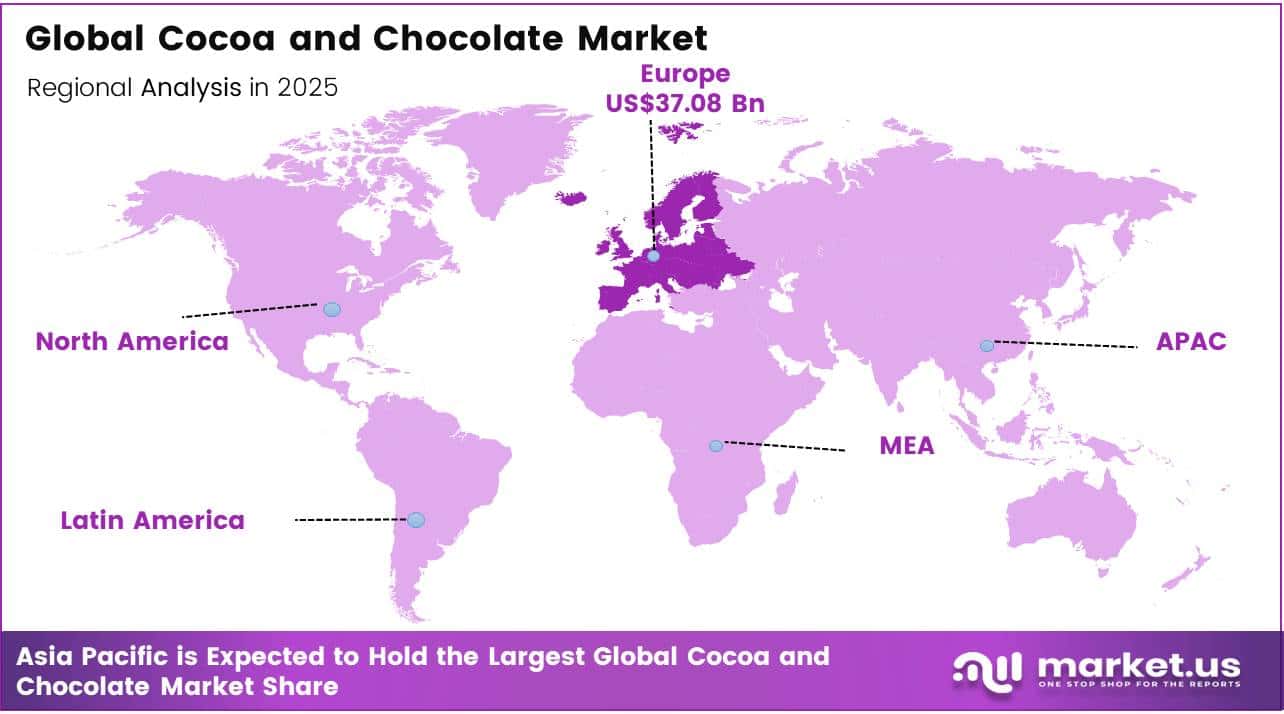
In 2025, the Global Cocoa and Chocolate Market was valued at USD 105.95 billion, and between 2026 and 2035, this market is estimated to register a CAGR of 5.71%, reaching about USD 189.38 billion by 2035. In 2025, Europe held a dominant market position, capturing more than a 35.0% share, holding USD 37.08 Billion revenue.
The cocoa and chocolate industry remains a major part of global food processing, supported by confectionery demand, product premiumization, and expanding use of cocoa ingredients in bakery, beverages, and snacks.
- The International Cocoa Organization estimated 2024/25 global cocoa production at 4.723 million tonnes, while grindings reached 4.628 million tonnes. Production increased 8.3%, but grindings declined 3.8%, showing that high bean costs continued to pressure processors and chocolate manufacturers. The season recorded a 48,000-tonne surplus, while ending stocks reached 1.320 million tonnes and the stocks-to-grindings ratio stood at 28.5%.
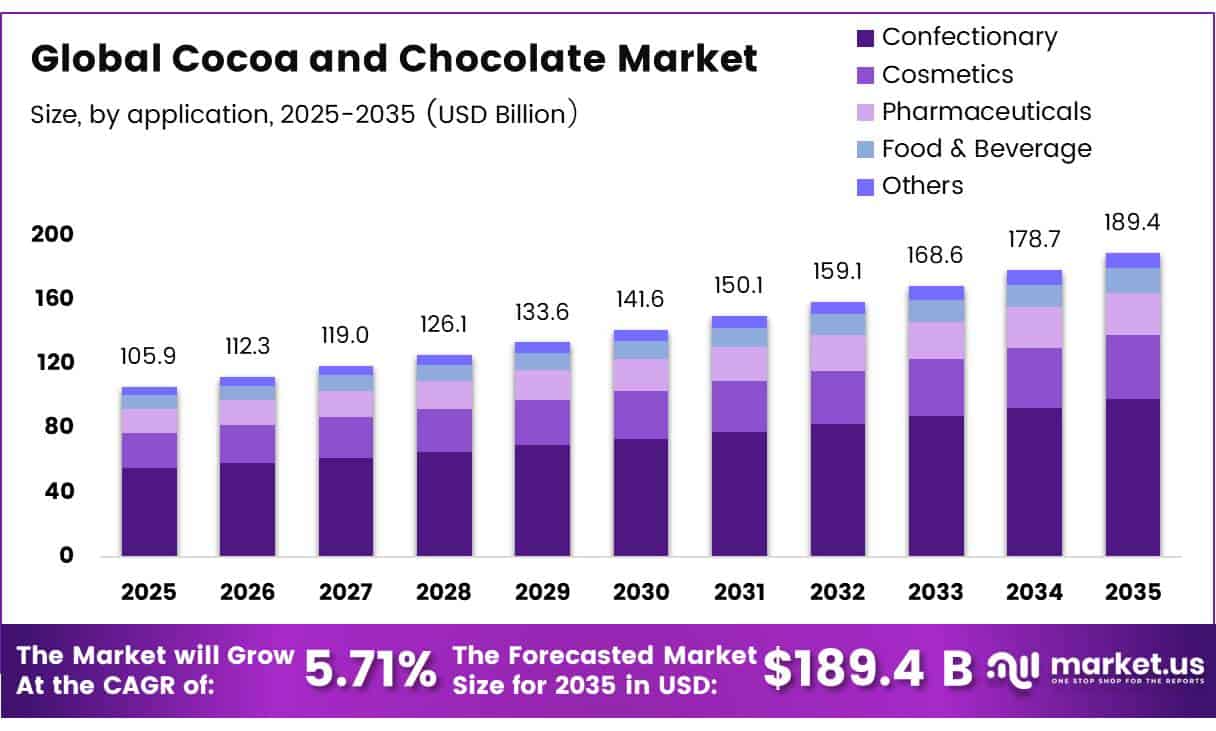
Future growth opportunities are expected in premium dark chocolate, lower-sugar formulations, certified cocoa, local processing, agroforestry, and digital traceability. EU members exported 867,000 tonnes of chocolate and chocolate bars outside the bloc in 2023, up 2% annually and 35% from 2013. The EU Deforestation Regulation will cover cocoa among seven commodities and apply from 30 December 2026 for large and medium operators, encouraging investment in geolocation, supplier verification, deforestation-free sourcing, and transparent supply networks worldwide.
Key Takeaways
- The global Cocoa and Chocolate market was valued at USD 105.95 billion in 2025.
- The global market is projected to grow at a CAGR of 5.71% and is estimated to reach USD 189.38 billion by 2035.
- On the basis of product type, the Milk/White Chocolate dominated the market, constituting 48.0% of the total market share.
- Based on the end user, the Retail dominated the Cocoa and Chocolate market, with a substantial market share of around 62.10%.
- Based on the By Application, Confectionary led the market, comprising 52.0% of the total market.
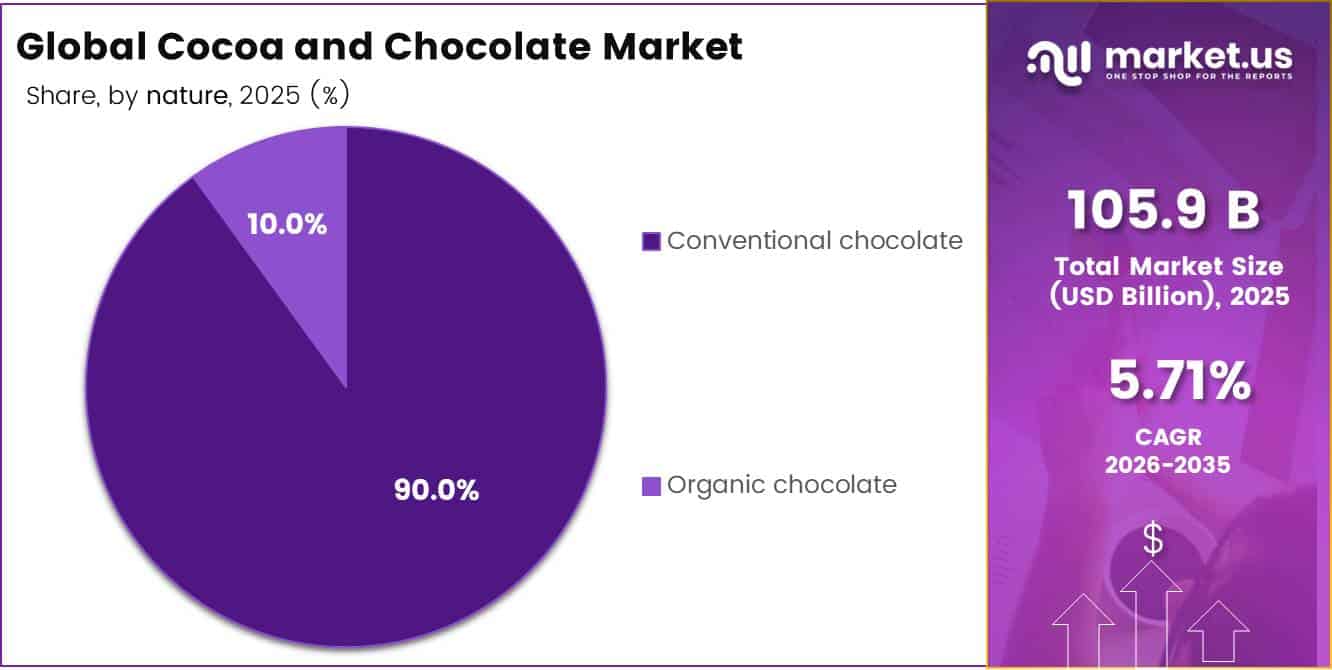
- Among the By Nature, the Conventional chocolate held a major share in the Cocoa and Chocolate market, 90% of the market share.
- In 2025, the Europe was the most dominant region in the Cocoa and Chocolate market, accounting for 35.0% of the total global consumption.
Product Type Analysis
Milk/White Chocolate represents dominant Segment in the Market.
Milk/white chocolate held the leading market position, capturing more than a 48.00% share. Its familiar sweetness, creamy texture, broad consumer acceptance, and extensive use in bars, confectionery, bakery products, gifting, and seasonal products supported its dominance. Eurostat reported that EU farms produced 161.8 million tonnes of raw milk in 2024, with 150.8 million tonnes delivered to dairies, supporting access to milk-based ingredients. FDA standards require white chocolate to contain at least 20% cocoa butter, 14% milk solids, and 3.5% milkfat, ensuring consistent product quality.
Dark chocolate is the fastest-growing segment, supported by premium positioning, higher cocoa content, reduced-sugar formulations, and rising interest in cocoa’s natural compounds. A 2024 study indexed by the U.S. National Library of Medicine reviewed 33 controlled trials involving 1,379 adults and found that cocoa consumption significantly improved selected oxidative-stress indicators. Stronger effects were observed at flavonoid intake above 450 mg per day, supporting continued innovation in high-cocoa products.
End User Analysis
Cocoa and Chocolates Are Mostly Utilized in the Retail.
Retail held the leading market position, capturing more than a 62.10% share. Supermarkets, convenience stores, specialist confectionery outlets, and online platforms make chocolate widely available for everyday purchases, gifting, and seasonal occasions. Retail also gives brands greater space for different pack sizes, flavours, and price points. Supporting this strong consumer channel, The U.S. Department of Agriculture reported that food-at-home expenditure reached USD 1.10 trillion in 2025. Separately, wholesale and retail establishments received a combined 20.1 cents from every dollar spent on domestically produced food in 2024, including 13.8 cents for retail and 6.3 cents for wholesale activities.
Industrial is the fastest-growing segment as food manufacturers increasingly use cocoa powder, cocoa butter, cocoa liquor, coatings, and compound chocolate across confectionery, bakery, dairy, beverage, and snack applications. Growth is supported by rising demand for convenient foods, premium desserts, chocolate-flavoured beverages, and ready-to-eat products. Manufacturers are also expanding into reduced-sugar, plant-based, clean-label, and sustainably sourced formulations to match changing consumer preferences.
Application Analysis
Confectionary Are the Most Widely Used Application.
Confectionery held the leading market position, capturing more than a 52% share. Demand remains strong across chocolate bars, filled products, coated snacks, spreads, gifting items, and seasonal confectionery. USDA trade data show that Canada purchased USD 1.17 billion of U.S. chocolate and cocoa products in 2024, while Mexico accounted for USD 362.64 million. These established trade flows reflect the scale and broad consumer reach supporting confectionery’s market leadership.
Cosmetics is the fastest-growing application as cocoa butter gains wider use in lip care, moisturizers, body creams, soaps, and protective skin formulations. In December 2025, the FDA completed safety reviews covering the 25 most commonly used PFAS in marketed cosmetics, increasing attention toward ingredient assessment and reformulation. By February 2026, more than 14,000 cosmetic manufacturing and processing facilities were registered with the FDA, showing the large production base available for cocoa-derived ingredients.
Nature Analysis
Conventional chocolate Held a Major Share of the Cocoa and Chocolate Market.
Conventional chocolate held the leading market position, capturing more than a 90% share. Its familiar taste, wide retail reach, competitive pricing, and established manufacturing base support strong demand across bars, confectionery, bakery coatings, spreads, and seasonal products. Between January and September 2025, EU exports of confectionery and chocolate increased by EUR 1.3 billion, or 16%, compared with the same period of 2024. This reflects the scale and resilience of mainstream chocolate production and international trade.
Organic chocolate is the fastest-growing segment as consumers increasingly seek certified ingredients, traceable cocoa, cleaner labels, and environmentally responsible sourcing. European Commission data show that EU imports of organic confectionery and chocolate increased from 44,092 tonnes in 2023 to 48,311 tonnes in 2024, representing growth of 9.6%. This upward movement indicates expanding commercial demand for certified organic chocolate products
Key Market Segments
By Product Type
- Dark Chocolate
- Milk/White Chocolate
- Industrial Chocolate
- Cocoa Butter
- Cocoa Powder
- Cocoa Liquor
- Cocoa Nibs
- Filled/Compound Chocolate
By End User
- Foodservice
- Retail
- Supermarkets/Hypermarkets
- Convenience Stores
- Online Retail Stores
- Specialty Stores
- Others
- Industrial
- Confectionery
- Bakery
- Dairy and Beverages
- Cosmetics and Personal Care
- Pharmaceuticals and Nutraceuticals
By Application
- Confectionary
- Cosmetics
- Pharmaceuticals
- Food & Beverage
- Others
By Nature
- Conventional chocolate
- Organic chocolate
Driver Analysis
Premium, high-cocoa portfolios
Premiumization is the most important value-growth lever because it shifts category economics away from unit-volume dependence toward higher revenue per kilogram, better gross-margin capture, and differentiated sourcing narratives. The 2023/24 cocoa deficit was estimated at 489,000 tonnes, while the subsequent 2024/25 season moved into a 48,000-tonne surplus; this volatility makes low-price, cocoa-intensive mass-market recipes commercially difficult and favors brands able to justify higher shelf prices through single-origin claims, sensory quality, high cocoa percentages, smaller pack formats, and gifting occasions.
The winning operating model is a tiered portfolio: protect entry price points through controlled pack sizes and recipe engineering, while using 60%–85% cocoa, origin-specific, organic, and responsibly sourced lines to rebuild contribution margin. This driver is strongest in North America, Europe, Japan, the GCC, and affluent APAC cities, where consumers can trade up even as overall consumption occasions become more selective; its estimated +1.1 percentage-point impact reflects mix-led value expansion rather than an assumption of proportional volume growth.
Drivers Impact Analysis
| Driver | (~) % Impact on CAGR Forecast | Geographic Relevance | Impact Timeline |
|---|---|---|---|
| Premium, high-cocoa portfolios | +1.1 pp | North America, EU, Japan, GCC, urban APAC | Medium term (2–4 years) |
| South Asian consumption expansion | +1.0 pp | India, South Asia, Southeast Asia | Medium term (2–4 years) |
| Traceable, deforestation-free cocoa | +0.8 pp | EU core, West Africa, Latin America | Short term (≤ 2 years) |
| Supply recovery and risk-managed sourcing | +0.7 pp | Global; Côte d’Ivoire, Ghana, EU processing hubs | Short term (≤ 2 years) |
| HFSS reformulation and compliant innovation | +0.6 pp | UK, EU, North America, Australia | Medium term (2–4 years) |
| Cocoa-content labeling and category upgrades | +0.4 pp | Brazil, Latin America, export suppliers | Medium term (2–4 years) |
Restraint Analysis
Climate-led crop volatility
Cocoa’s concentrated farm base creates a structural supply risk that constrains both volume availability and long-range capital planning: more than 90% of global production is supplied by up to 6 million smallholder farms, making the chain highly exposed to localized rainfall disruption, disease outbreaks, ageing trees, and limited farm-level reinvestment capacity.
The magnitude of the recent shock demonstrates the financial sensitivity: global cocoa production fell to an estimated 4.368 million tonnes in 2023/24, down 12.9% year on year, while grindings reached 4.818 million tonnes, leaving a 494,000-tonne deficit; although the 2024/25 balance subsequently improved to an estimated 48,000-tonne surplus, this does not remove the underlying biological and climate exposure.
West African output in 2025/26 was still expected to remain roughly 10% below normal in some outlooks, and a prolonged November-to-January dry period could lower yields by another 8%–10%, forcing manufacturers to reduce cocoa dosage, delay launches, cut promotional inventory, or shift to non-cocoa confectionery. The modeled -1.4 percentage-point CAGR effect reflects lower sell-through from constrained supply, emergency procurement costs, and delayed factory or brand investment—not merely a higher nominal commodity price.
Restraint Impact Analysis
| Restraint | (~) % Impact on CAGR | Geographic Relevance | Impact Timeline |
|---|---|---|---|
| Climate-led crop volatility | -1.4 pp | West Africa, EU, North America | Short term (≤ 2 years) |
| Cocoa-cost and hedge pressure | -1.2 pp | Global, import-dependent markets | Short term (≤ 2 years) |
| EUDR traceability burden | -0.8 pp | EU, West Africa, Latin America | Short term (≤ 2 years) |
| Affordability and downtrading | -0.8 pp | Europe, North America, APAC cities | Medium term (2–4 years) |
| HFSS marketing limits | -0.6 pp | UK, EU spill-over, Australia | Medium term (2–4 years) |
| Cadmium and quality controls | -0.5 pp | EU, Latin America, premium exports | Medium term (2–4 years) |
Opportunity Analysis
Origin processing JVs
A major white space lies in shifting value addition from import-market grinding hubs toward origin-country processing joint ventures, contract-manufacturing plants, and regional ingredient platforms—an opportunity distinct from baseline cocoa demand because it captures a larger share of the same bean’s value chain rather than merely selling more beans or chocolate. Côte d’Ivoire’s policy direction supports this pivot: the country is encouraging investment that could raise local processing to 70%–80% of national cocoa production by 2030, creating room for grinders, consumer-goods companies, development-finance institutions, and local partners to establish liquor, butter, powder, couverture, and semi-finished industrial ingredient capacity.
Our scenario assigns a +1.1 percentage-point upside where companies secure long-tenor bean supply, co-invest in fermentation and quality infrastructure, and sell higher-value ingredients into African, Middle Eastern, and European food systems; even a 5%–10% shift in a manufacturer’s procurement from imported semi-finished cocoa toward controlled origin processing can improve supply visibility, reduce exposure to intermediate-product tariffs, and capture processing margin.
Opportunity Impact Analysis
| Opportunity | (~) % Potential CAGR | Geographic Relevance | Execution Window |
|---|---|---|---|
| Origin processing JVs | +1.1 pp | Côte d’Ivoire, Ghana, EU | Medium term (2–4 years) |
| Cocoa-fruit circular products | +0.8 pp | West Africa, Vietnam, EU, APAC | Medium term (2–4 years) |
| Traceability-as-a-service | +0.7 pp | EU, West Africa, Latin America | Short term (≤ 2 years) |
| Identity-preserved cocoa | +0.7 pp | EU, North America, Japan | Short term (≤ 2 years) |
| Functional ingredient platforms | +0.6 pp | North America, EU, urban APAC | Medium term (2–4 years) |
| Compliant low-sugar formats | +0.5 pp | UK, EU, Australia, North America | Medium term (2–4 years) |
Challenges Analysis
Smallholder Productivity Renewal
The industry’s central long-term operational challenge is renewing productivity across millions of small farms while maintaining farmer participation, because more than 90% of global cocoa is produced by up to 6 million smallholders and the average farm is typically below 5 hectares, limiting cash flow, access to agronomy, mechanization, replanting finance, and resilience investment. The supply-chain consequence is a persistent yield gap: climate events, disease, ageing trees, and extended dry periods are amplified when farmers cannot fund pruning, rehabilitation, fertilizer, shade management, or improved planting material; in the 2025/26 season, an extended November-to-January dry period in West Africa was expected to have the potential to reduce yields by an additional 8%–10%.
This is not an immediate sales prohibition, but a compounding operating burden that creates volatile bean availability, higher origin differentials, lower factory-planning confidence, and repeated procurement crises; our -1.0 percentage-point friction estimate reflects delayed replanting cycles, inconsistent farm-gate quality, and the cost of supporting thousands of dispersed suppliers. Effective mitigation requires multi-year farm-service contracts, blended finance, digital payments, agronomy field teams, and productivity-linked premiums, with a realistic four-to-seven-year horizon because cocoa trees require several years before meaningful post-replant commercial output is achieved.
Challenges Impact Analysis
| Challenge | (~) % CAGR Friction | Geographic Relevance | Mitigation Horizon |
|---|---|---|---|
| Smallholder productivity renewal | -1.0 pp | Côte d’Ivoire, Ghana, Indonesia | Long term (≥ 4 years) |
| Fermentation quality consistency | -0.7 pp | West Africa, Latin America, Asia | Medium term (2–4 years) |
| Traceability data interoperability | -0.7 pp | EU hubs, West Africa, Latin America | Medium term (2–4 years) |
| Hedging liquidity management | -0.6 pp | Global processors, import markets | Short term (≤ 2 years) |
| Port-to-plant quality losses | -0.5 pp | West Africa–EU, APAC corridors | Medium term (2–4 years) |
| Responsible sourcing assurance | -0.5 pp | West Africa, EU, North America | Long term (≥ 4 years) |
Geopolitical Impact Analysis
West African Supply Reforms and EU Compliance Reshaping Cocoa Trade.
Ghana’s cocoa recovery programme is reshaping supply through plantation expansion, stronger farm incentives, and closer public oversight. In May 2025, the Ministry of Finance said production had fallen from 1 million tonnes to about 500,000 tonnes and announced plans to acquire 200,000 hectares to restore output. In October 2025, the producer price was raised to GH¢58,000 per tonne, a 12.27% increase over the August rate. These measures are shifting investment toward farm renewal, disease control, and organized plantations. For chocolate manufacturers, costs and delivery planning may become more closely tied to Ghana’s pricing decisions and production recovery.
EU regulation is reshaping cocoa procurement by changing which suppliers can retain access to European buyers. The EUDR covers seven commodities, including cocoa, and requires proof that products are legal and deforestation-free. Compliance begins on 30 December 2026 for large and medium operators and on 30 June 2027 for smaller businesses. This is pushing processors toward farm geolocation, digital traceability, due diligence, and verified sourcing partners. The EU expects the rules to reduce emissions linked to covered commodities by at least 32 million tonnes annually, while an initial EUR 70 million package supports partner countries. Compliant exporters may gain stronger market access, while poorly documented supply chains face higher costs or exclusion.
Regional Analysis
Europe Held the Largest Share of the Global Cocoa and Chocolate Market.
Europe held the leading market position, capturing more than a 35.00% share. The region benefits from an established confectionery industry, premium chocolate consumption, strong retail networks, seasonal gifting, and extensive processing capacity. During January–April 2025, EU exports of chocolate and confectionery increased by EUR 708 million, or 21%, compared with the same period of 2024. Chocolate export prices also rose 31%, highlighting the value and global reach of European products despite higher cocoa costs.
Asia Pacific is the fastest-growing region, supported by expanding urban consumption, online retail, gifting culture, and wider access to premium and imported chocolate. China’s official statistics showed that retail sales of grain, oil, and food by large enterprises increased 9.9% in 2024, while physical-goods online sales reached CNY 13.08 trillion, rising 6.5%. In Australia, chocolate represented 10.4% of energy available from discretionary foods in 2023–24, up 0.6 percentage points from 2018–19.
Key Regions and Countries Covered
- North America
- The US
- Canada
- Europe
- Germany
- France
- The UK
- Spain
- Italy
- Russia & CIS
- Rest of Europe
- APAC
- China
- Japan
- South Korea
- India
- ASEAN
- Rest of APAC
- Latin America
- Brazil
- Mexico
- Rest of Latin America
- Middle East & Africa
- GCC
- South Africa
- Rest of MEA
Key Players Analysis
Cocoa and chocolate manufacturers focus on strengthening product differentiation, processing efficiency, and supply chain control to remain competitive. A key priority is continuous recipe innovation, including the development of premium, high-cocoa, reduced-sugar, plant-based, and clean-label products that respond to changing consumer preferences. Companies also invest in advanced roasting, grinding, tempering, and moulding systems to improve flavour consistency, reduce waste, and support large-scale production.
Closer integration with cocoa farmers, cooperatives, and ingredient suppliers helps secure bean availability and manage price volatility during periods of tight supply. Strategic processing expansion, particularly near major cocoa-producing and high-consumption markets, enables manufacturers to lower logistics costs and respond faster to regional demand. Additionally, producers emphasize traceability, responsible sourcing, quality certification, and compliance with deforestation and food-safety rules. Long-term agreements with retailers, foodservice operators, and industrial buyers further strengthen demand visibility, while flexible product portfolios help companies serve confectionery, bakery, beverage, cosmetics, and other value-added applications.
The Major Players In The Industry
- Mondelēz International, Inc.
- Nestlé S.A.
- The Hershey Company
- Mars, Incorporated
- Ferrero Group
- Barry Callebaut AG
- Lindt & Sprüngli AG
- Meiji Holdings Co., Ltd.
- Ezaki Glico Co., Ltd.
- Fuji Oil Holdings Inc.
- Cargill, Incorporated
- Olam International Limited
- JDE Peet’s N.V.
- Orkla ASA
- Strauss Group Ltd.
- Grupo Nutresa S.A.
- Blommer Chocolate Company
- Guittard Chocolate Company
- TCHO Ventures, Inc.
- Valrhona SAS
- ECOM Agroindustrial Corporation Ltd.
- Cocoa Processing Company Ltd.
- Touton S.A.
- Niche Cocoa Industry Ltd.
- BD Associates Ghana Ltd.
- PLOT Enterprise Ghana Limited
Key Development
- In April 2025, The Hershey Company opened a 250,000-square-foot Reese’s chocolate-processing facility in Pennsylvania. The integrated plant completed a USD 1 billion supply-chain program that added 13 production lines and upgraded 11 existing lines.
- In July 2025, Mondelēz International opened a GBP 3.3 million consumer research centre in Bournville. The facility combines 50 trained chocolate tasters with artificial intelligence and virtual-reality tools to accelerate product testing and innovation.
Report Scope
| Report Features | Description |
|---|---|
| Market Value (2025) | USD 105.95 Bn |
| Forecast Revenue (2035) | USD 189.38 Bn |
| CAGR (2026-2035) | 5.71% |
| Base Year for Estimation | 2025 |
| Historic Period | 2020-2024 |
| Forecast Period | 2026-2035 |
| Report Coverage | Revenue Forecast, Market Dynamics, Competitive Landscape, Recent Developments |
| Segments Covered | By Product Type (Dark Chocolate, Milk/White Chocolate, Industrial Chocolate and Filled/Compound Chocolate), By End User (Foodservice, Retail and Industrial), By Application (Confectionary, Cosmetics, Pharmaceuticals, Food & Beverage and Others), By Nature (Conventional chocolate and Organic chocolate) |
| Regional Analysis | North America – The US & Canada; Europe – Germany, France, The UK, Spain, Italy, Russia & CIS, Rest of Europe; APAC– China, Japan, South Korea, India, ASEAN & Rest of APAC; Latin America– Brazil, Mexico & Rest of Latin America; Middle East & Africa– GCC, South Africa, & Rest of MEA |
| Competitive Landscape | Mondelēz International, Inc., Nestlé S.A., The Hershey Company, Mars, Incorporated, Ferrero Group, Barry Callebaut AG, Lindt & Sprüngli AG, Meiji Holdings Co., Ltd., Ezaki Glico Co., Ltd., Fuji Oil Holdings Inc., Cargill, Incorporated, Olam International Limited, JDE Peet’s N.V., Orkla ASA, Strauss Group Ltd., Grupo Nutresa S.A., Blommer Chocolate Company, Guittard Chocolate Company, TCHO Ventures, Inc., Valrhona SAS, ECOM Agroindustrial Corporation Ltd., Cocoa Processing Company Ltd., Touton S.A., Niche Cocoa Industry Ltd., BD Associates Ghana Ltd., PLOT Enterprise Ghana Limited. |
| Customization Scope | Customization for segments, region/country-level will be provided. Moreover, additional customization can be done based on the requirements. |
| Purchase Options | We have three licenses to opt for: Single User License, Multi-User License (Up to 5 Users), Corporate Use License (Unlimited Users and Printable PDF) |





































