


Report Overview
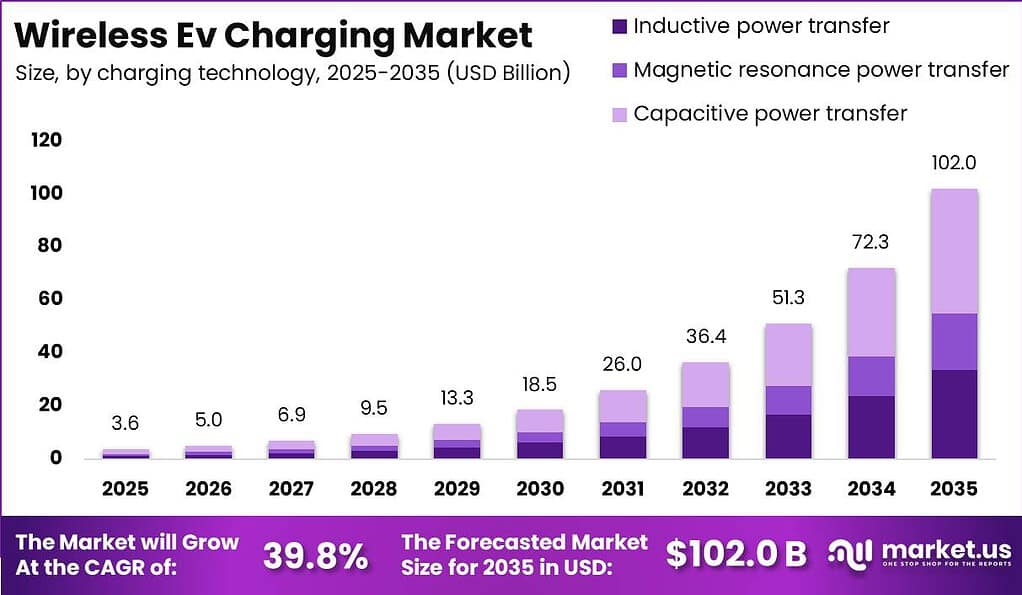
Global Wireless EV Charging Market size is expected to be worth around USD 102.00 Billion by 2035 from USD 3.60 Billion in 2025, growing at a CAGR of 39.8% during the forecast period 2026 to 2035. Asia-Pacific leads the market with a 35.00% share, while the base year valuation stands at USD 1.27 Billion in the prior reference year. This trajectory reflects the scale of infrastructure capital committed to vehicle electrification globally.
The Wireless EV Charging Market covers technologies that transfer electrical energy to an electric vehicle without physical connectors, using electromagnetic fields between a ground-mounted pad and a vehicle-mounted receiver. The market spans stationary systems installed at fixed locations and dynamic systems embedded in road surfaces. End applications range from passenger car home charging to fleet depot automation and public highway electrification corridors.
Key Takeaways
- The global Wireless EV Charging Market was valued at USD 3.60 Billion in 2025 and is forecast to reach USD 102.00 Billion by 2035, at a CAGR of 39.8%.
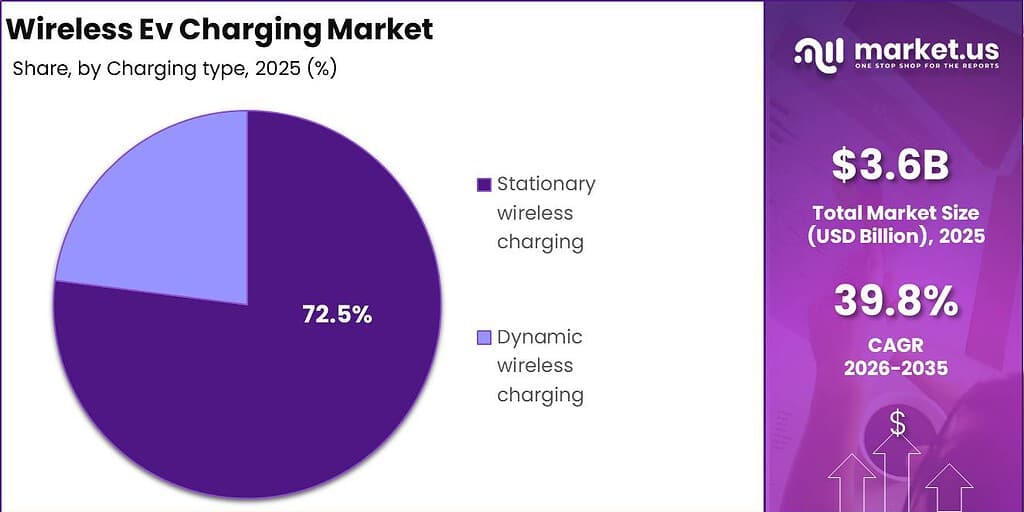
- By Charging Type, Stationary Wireless Charging dominates with a 72.5% share in 2025.
- By Charging Technology, Inductive Power Transfer holds the largest segment share at 33.00%.
- By Component, Base Assembly leads with a 52.00% share of the market.
- By Power Supply Range, the 3 to 11 kW segment commands a 43.00% share.
- By Propulsion, Battery-Electric Vehicles dominate with a 68.00% share.
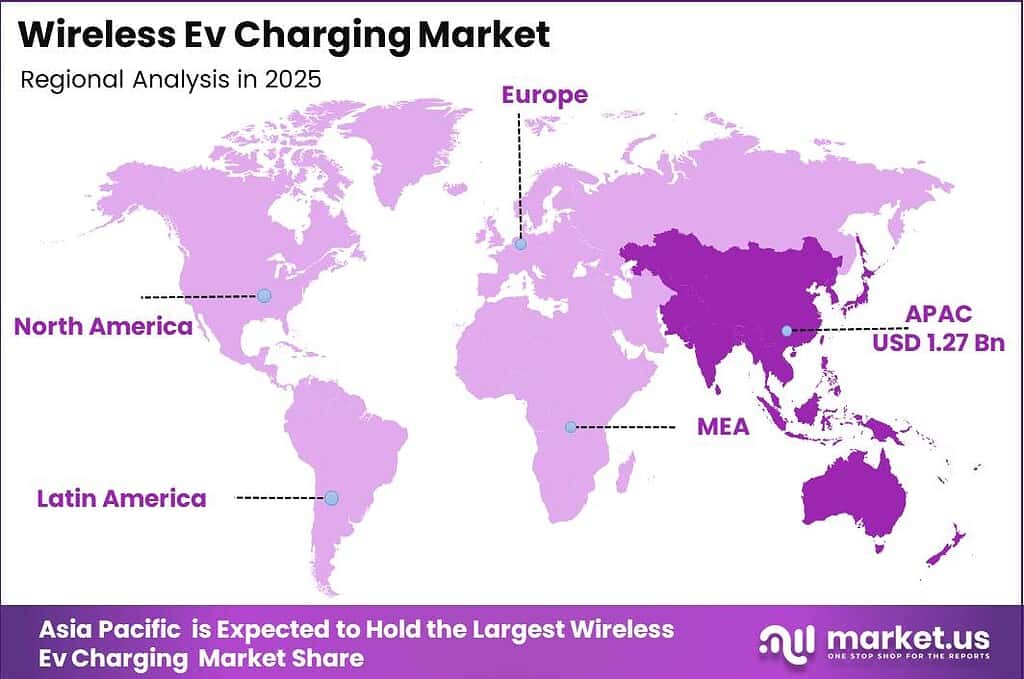
- Asia-Pacific is the leading region, holding a 35.00% market share in 2025.
Government mandates across the European Union and North America are pushing fleet electrification timelines forward. The European Commission’s Alternative Fuels Infrastructure Regulation, applicable from April 2024, requires member states to build charging access at set intervals along major road corridors. These regulatory frameworks convert optional investment into contractual obligation, creating structured demand pipelines for wireless charging infrastructure suppliers across public transport and logistics operators.
According to IEA data, global electric car sales exceeded 17 million units in 2024, accounting for more than 20% of total global car sales. As per our research, charging infrastructure with power ratings above 150 kW increased by around 50% during 2024, confirming that high-power capability is no longer experimental. This pace of infrastructure scaling signals that wireless charging vendors must position their products within existing high-power deployment roadmaps to secure early OEM and fleet procurement contracts.
IEA figures show global EV sales are expected to surpass 20 million units in 2025, with electric vehicles projected to represent more than 25% of worldwide car sales. In September 2025, Electreon demonstrated dynamic wireless charging technology for urban mobility applications, validating charging-on-the-move solutions for future networks. This combination of vehicle volume growth and live pilot outcomes confirms that commercial deployment windows are opening faster than most infrastructure procurement cycles anticipated.
Charging Type Analysis
Stationary Wireless Charging dominates with 72.5% due to fixed-location depot and parking demand.
In 2025, Stationary Wireless Charging held a dominant market position in the By Charging Type segment of the Wireless EV Charging Market, with a 72.5% share. The International Energy Agency confirmed that home charging remains the dominant method among EV users globally, underpinning structural demand for fixed ground-pad installations in residential garages, commercial parking facilities, and fleet depot yards. Operators benefit from predictable dwell times and eliminating plug-handling labor at scale. This captive demand base makes stationary infrastructure the lowest-risk entry point for hardware vendors and site operators seeking recurring energy revenue.
Dynamic Wireless Charging represents the fastest-growing sub-segment within the Charging Type segment. Electric road projects embed charging coils directly into highway or urban road surfaces, enabling vehicles to replenish energy while in motion without stopping at a fixed point. In December 2025, Electreon highlighted expansion of wireless charging projects including electric bus depot applications where wireless systems enabled automated charging without manual plug-in connections, demonstrating that the same technology pipeline spans both stationary and dynamic deployments. IEA data show more than 1.3 million public charging points were added globally in 2024, confirming infrastructure ecosystems are maturing to support dynamic overlay installations.
Charging Technology Analysis
Inductive Power Transfer dominates with 33.00% due to mature coil standardization and OEM integration.
In 2025, Inductive Power Transfer held a dominant market position in the By Charging Technology segment of the Wireless EV Charging Market, with a 33.00% share. Inductive systems transfer energy through tightly coupled coils operating at defined resonant frequencies, and SAE International’s J2954 standard has established certified interoperability, electromagnetic compatibility, and safety testing requirements specifically for inductive light-duty wireless charging. The SAE J2954 framework supports power levels up to 11 kVA for current passenger EV applications, giving automotive procurement teams a validated specification to reference during supplier selection. This regulatory anchor reduces OEM engineering risk and accelerates fitment decisions across both factory-installed and aftermarket receiver configurations.
Magnetic Resonance Power Transfer is the fastest-growing technology within this segment, offering greater lateral parking tolerance and reduced efficiency loss when vehicle positioning is imperfect. Unlike tightly coupled inductive systems, magnetic resonance operates effectively across larger airgaps and minor misalignment offsets, expanding the viable installation footprint across diverse vehicle geometries. ITU data confirm that telecom-derived resonance engineering principles are being directly applied to EV power transfer architectures, accelerating commercial readiness timelines. Vendors who secure patents in resonance coil geometry and frequency tuning now will define the interoperability boundaries for the next generation of higher-power wireless charging systems.
Capacitive Power Transfer operates through electric-field coupling between conductive plates rather than magnetic coils, enabling potentially thinner and lighter receiver architectures suited to constrained vehicle underbody space. The technology remains at an earlier commercialization stage than both inductive and resonance systems, but it offers structural differentiation for OEMs seeking to minimize vehicle-side weight penalties. UNIDO manufacturing output data indicate that power electronics component miniaturization is advancing across multiple transport sectors, supporting the cost-reduction trajectory needed for capacitive systems to reach price parity with inductive alternatives within the forecast period.
Component Analysis
Base Assembly dominates with 52.00% due to higher unit cost and civil infrastructure integration.
In 2025, Base Assembly held a dominant market position in the By Component segment of the Wireless EV Charging Market, with a 52.00% share. The ground-side pad, power electronics, and installation works embedded in the base assembly carry the largest cost burden of any wireless charging system, covering civil groundwork, grid connection hardware, and coil enclosure engineering. UN Comtrade import data for electrical apparatus and inductive heating equipment show trade flows exceeding USD 18 billion annually, reflecting the scale of the upstream power electronics supply chain that base assembly manufacturers draw from. This cost concentration in the ground unit means base assembly suppliers control the primary margin pool and set the effective price ceiling for site deployment decisions.
Vehicle Assembly covers the receiver coil, power conversion circuitry, and communication module installed on the underside of the electric vehicle. The vehicle-side component must comply with SAE J2954 interoperability and electromagnetic compatibility requirements, adding certification and shielding costs to each receiver unit. Corporate annual reports from major EV platforms show that on-board power electronics account for between 8% and 12% of total vehicle manufacturing cost, illustrating the margin sensitivity that makes OEMs cautious about adding vehicle assembly receiver hardware without confirmed consumer demand signals. Suppliers that achieve factory-fit agreements with tier-one OEMs will convert vehicle assembly into a recurring, locked-in volume rather than a discretionary retrofit market.
Others within the component segment include communication modules, thermal management systems, alignment sensors, and software platforms that govern session initiation, safety shutoff, and billing integration. These ancillary components individually represent smaller revenue shares but carry higher software margin potential as the market matures toward managed energy services. National statistical office data from Germany and South Korea confirm growing domestic production of embedded automotive sensor and communication hardware, reinforcing a supplier base capable of scaling ancillary component output in line with ground and vehicle assembly volumes.
Power Supply Range Analysis
3 to 11 kW dominates with 43.00% due to residential and light-duty overnight charging fit.
In 2025, the 3 to 11 kW segment held a dominant market position in the By Power Supply Range segment of the Wireless EV Charging Market, with a 43.00% share. This power band aligns directly with standard single-phase residential and commercial grid connections available in most urban and suburban markets, removing the need for expensive grid upgrades at the point of installation. IEA data confirm that more than 80% of EV charging sessions globally occur at home or at workplace locations where grid access is limited to standard distribution voltage levels. The 3 to 11 kW range therefore captures the largest addressable installation base and enables vendors to sell at volume without triggering utility interconnection reviews that slow permitting timelines.
The 11 to 50 kW segment serves commercial parking structures, fleet depots, and transit authority vehicle yards where faster throughput is operationally necessary. This range requires three-phase power supply and site-level electrical upgrades but delivers full overnight charge completion within two to four hours for most commercial EV platform battery capacities. World Bank data on commercial energy infrastructure investment in emerging economies indicate sustained capital allocation toward three-phase grid extension in secondary cities across Asia and Latin America, creating greenfield installation opportunities for mid-range wireless charging equipment in markets that are electrifying commercial transport fleets ahead of passenger vehicles.
Above 50 kW represents the fastest-growing power range within the segment and targets high-utilization applications including electric bus rapid transit, heavy logistics yard operations, and dynamic highway charging lanes where session time is operationally constrained. IEA figures show public charging infrastructure above 150 kW grew by around 50% during 2024, confirming that high-power charging appetite is established among fleet operators. Vendors who successfully deliver wireless equivalents above 50 kW will command significant price premiums and long-term service contracts from transit authorities and logistics operators unwilling to tolerate manual plug-in dwell time.
Propulsion Analysis
Battery-Electric Vehicles dominate with 68.00% due to full charge dependency without combustion backup.
In 2025, Battery-Electric Vehicles held a dominant market position in the By Propulsion segment of the Wireless EV Charging Market, with a 68.00% share. BEVs rely entirely on grid-sourced electricity for propulsion energy, making charging convenience a direct determinant of vehicle utility and owner satisfaction. IEA data show China alone recorded more than 11 million electric car sales in 2024, with BEV models accounting for the dominant share of that volume, creating an enormous and concentrated installed base requiring accessible charging solutions. This volume concentration in the world’s largest automotive market makes BEV-optimized wireless charging systems the priority investment category for both OEM integration programs and public infrastructure operators.
Plug-In Hybrid Electric Vehicles represent the fastest-growing propulsion segment within the wireless charging market because PHEV owners gain disproportionate utility from low-friction charging access, increasing the probability of completing more charging cycles per week and reducing combustion engine reliance. PHEVs typically operate with smaller battery packs in the 8 to 20 kWh range, meaning a 3 to 11 kW wireless session fully recharges the pack within two hours of parking, converting every parking event into a productive charge opportunity. International Trade Administration export data for hybrid drivetrain components confirm PHEV platform shipments are expanding across Southeast Asia and Eastern Europe as OEMs localize production for price-sensitive markets, widening the addressable geography for PHEV-compatible wireless charging hardware.
Key Market Segments
By Charging Type
- Stationary Wireless Charging
- Dynamic Wireless Charging
By Charging Technology
- Inductive Power Transfer
- Magnetic Resonance Power Transfer
- Capacitive Power Transfer
By Component
- Base Assembly
- Vehicle Assembly
- Others
By Power Supply Range
- 3 to 11 kW
- 11 to 50 kW
- Above 50 kW
By Propulsion
- Battery-Electric Vehicles
- Plug-In Hybrid Electric Vehicles
Regional Analysis
Asia-Pacific Dominates the Wireless EV Charging Market with a Market Share of 35.00%, Valued at USD 1.27 Billion
Asia-Pacific commands the largest regional share in the global Wireless EV Charging Market. IEA data show China recorded more than 11 million electric car sales in 2024, making it the largest EV market globally. Electric vehicles accounted for nearly 50% of new car sales in China in 2024, accelerating procurement decisions for advanced charging infrastructure. This density of EV adoption creates a commercially viable installed base for wireless charging vendors at a scale no other region currently matches, making China the single highest-priority market for hardware deployment and OEM integration partnerships.
Europe is the fastest-growing region in the global Wireless EV Charging Market. In October 2025, Enrx expanded business operations supporting Primove wireless charging technology deployments for public transport electrification projects across European cities, signaling active commercial momentum. The European Commission’s Alternative Fuels Infrastructure Regulation creates mandatory deployment timelines that convert operator discretion into contractual obligation for corridor charging access. This regulatory pull, combined with strong public transport electrification budgets in Germany, France, and the Nordic countries, positions Europe as the primary market for dynamic wireless charging corridor investment over the medium term.
Key Regions and Countries
North America
- US
- Canada
Europe
- Germany
- France
- The UK
- Spain
- Italy
- Rest of Europe
Asia Pacific
- China
- Japan
- South Korea
- India
- Australia
- Rest of APAC
Latin America
- Brazil
- Mexico
- Rest of Latin America
Middle East and Africa
- GCC
- South Africa
- Rest of MEA
Market Dynamics
Market Opportunity Analysis - Fleet depots, dynamic corridors, and underserved propulsion segments offer clear entry points for new investors
Fleet depot wireless charging remains underexploited relative to its commercial readiness. Managed depot energy services carry an estimated +3.6% CAGR upside, yet most depot operators have committed capital only to conductive plug-in infrastructure. New entrants who bundle wireless pad installation with energy management software and guaranteed uptime contracts can convert this gap into recurring managed service revenue at margins unavailable in single-unit hardware sales. Depot operators in Europe, North America, and India represent the highest-probability early adopters given existing electrification budgets.
The Plug-In Hybrid Electric Vehicle propulsion sub-segment is structurally underserved by current wireless charging product development, which concentrates on BEV battery pack sizes and duty cycles. PHEV owners benefit more per charging session than BEV owners in proportional terms because each session restores a higher percentage of usable daily range. This reflects a product positioning gap that OEM-aligned wireless charging vendors have not yet addressed with dedicated PHEV-optimized ground pad configurations, creating a differentiated market entry angle for hardware suppliers willing to spec products against PHEV fleet procurement programs.
Capacitive Power Transfer technology sits at the earliest commercialization stage among the three competing wireless charging technologies, meaning the intellectual property and manufacturing cost position in this sub-segment remains more contestable than in Inductive Power Transfer or Magnetic Resonance. This signals that investors and startups entering the capacitive segment now face a smaller incumbent cost base to undercut and a patent landscape not yet consolidated by dominant licensors. The first entrant to achieve volume manufacturing cost parity with inductive systems within the 3 to 11 kW power range will define the competitive floor for the segment during the critical 2027 to 2030 commercialization window.
The Above 50 kW power supply range is the fastest-growing segment but currently attracts the fewest commercial deployments relative to its stated growth rate, creating a first-mover premium for vendors who deliver certified, high-power wireless systems at scale before the segment reaches competitive density. Autonomous robotaxi hubs and electric freight yards both require Above 50 kW capability to replace conductive charging without reducing vehicle throughput. Vendors who secure procurement agreements with even two or three large logistics or transit operators during the current pilot phase will establish reference sites that compress competitor sales cycles by validating the technology under real commercial operating conditions.
Technology and Innovation Landscape - AI alignment systems, bidirectional transfer research, and resonance advances are redefining wireless charging competitive architecture
AI-enabled automatic vehicle alignment systems are closing the single largest efficiency gap in deployed wireless charging infrastructure. Coil misalignment between the ground pad and vehicle receiver reduces energy transfer efficiency and increases electromagnetic emissions, both of which constrain system performance and regulatory compliance. As per our research, wireless EV charging development is increasingly focused on improving vehicle alignment, charging efficiency, and compatibility across different EV models. Vendors who embed AI alignment into their base assembly hardware will convert a current installation liability into a certified performance differentiator, particularly in fleet depot environments where vehicles park under time pressure without driver-assisted positioning.
Bidirectional wireless power transfer research is advancing the market’s long-term revenue model from single-directional energy delivery toward vehicle-to-grid integration. SAE J2954 testing procedures evaluate wireless charging performance, efficiency, communication systems, and safety requirements, and the communication protocol layer within this standard is directly reusable for bidirectional session management. Bidirectional charging integration carries an estimated +2.4% CAGR upside in markets including Japan, Europe, and North America where grid balancing incentives exist. Hardware suppliers who build bidirectional capability into current-generation ground pads will command grid-service contract eligibility that purely directional equipment cannot access.
Magnetic Resonance Power Transfer is gaining commercial traction as a technology response to the alignment sensitivity of inductive systems. Resonance systems maintain acceptable transfer efficiency across larger airgaps and lateral offsets, reducing the parking precision requirement that constrains inductive system usability in real-world parking geometry. As per our research, wireless charging technology for automated charging applications enables vehicles to recharge without manual connector handling, and resonance technology extends this automation advantage by tolerating imprecise vehicle positioning that AI alignment alone cannot fully correct. Patent filings in resonance coil geometry and frequency management are accelerating, signaling that the intellectual property position in this sub-segment will consolidate within the next two to three years.
Drivers
The global EV parc expansion is the primary demand driver for wireless charging infrastructure. As reported by the IEA, global EV charging networks expanded by more than 30% year-over-year in 2024, creating structural opportunities to embed wireless charging within new installation programs rather than retrofitting existing sites. SAE J2954 interoperability standardization adds a second force multiplier, removing the cross-brand compatibility risk that previously slowed OEM fitment decisions and fleet procurement approvals. Together, these two forces make the commercial case for wireless charging deployment faster and lower-risk than at any prior point in the technology’s development.
Hands-free fleet charging demand is converting from a convenience preference into an operational requirement at autonomous vehicle depots and logistics yards. High-power inductive systems exceeding 11 to 22 kW now support practical daily charging cycles for passenger EVs without requiring vehicle repositioning or connector management. Autonomous vehicle readiness and depot electrification programs reinforce this shift by creating facilities where human-handled plug-in charging introduces labor cost and scheduling friction. Operators who deploy wireless charging at depots gain measurable uptime advantages over sites relying on manual conductive infrastructure at the same power level.
| Driver | (~) % Impact on CAGR Forecast | Geographic Relevance | Impact Timeline |
|---|---|---|---|
| EV Parc Expansion | +4.6% | Global, strongest in China, Europe, North America | Short term (2 years or less) |
| SAE Interoperability Standardization | +3.8% | North America, Europe, Asia-Pacific | Short term (2 years or less) |
| Hands-Free Fleet Charging Demand | +3.4% | North America, Europe, East Asia | Medium term (2 to 4 years) |
| Public Charging Network Buildout | +2.7% | Europe, North America, China | Short term (2 years or less) |
| Autonomous Vehicle Readiness | +2.2% | North America, China, Gulf markets | Medium term (2 to 4 years) |
| Depot Electrification Programs | +1.9% | Europe, North America, India | Medium term (2 to 4 years) |
Restraints
High embedded hardware cost is the primary commercial barrier slowing wireless EV charging adoption. Every deployment requires financing both a ground assembly and a vehicle-side receiver before the end user experiences any convenience benefit, creating an installed-cost threshold materially higher than conventional conductive charging. SAE J2954 requirements covering interoperability, electromagnetic compatibility, safety, and testing add engineering, validation, shielding, and certification costs that cannot be absorbed through commodity procurement. The resulting upfront premium supports an estimated -4.9% CAGR deduction through slower fleet procurement cycles, delayed parking-site capital expenditure, and margin pressure on early deployments.
Vehicle integration cost burden compounds the site-level hardware barrier by placing a second cost layer inside the OEM manufacturing process. Adding a certified receiver, power converter, and communication module to a production vehicle requires design-in, validation, and tooling investment that automakers allocate cautiously against competing electrification priorities. Low-cost plug-in alternatives are expanding rapidly in parallel, with more than 1.3 million public charging points added in 2024 intensifying price comparison. Site retrofit capital barriers and limited OEM fitment further slow the transition for operators outside dedicated greenfield deployments, compressing near-term addressable market size below the technology’s full long-run potential.
| Restraint | (~) % Impact on CAGR Forecast | Geographic Relevance | Impact Timeline |
|---|---|---|---|
| High Embedded Hardware Cost | -4.9% | Global, acute in price-sensitive markets | Short term (2 years or less) |
| Vehicle Integration Cost Burden | -3.7% | Global | Medium term (2 to 4 years) |
| Low-Cost Plug-In Substitution | -3.1% | Global | Short term (2 years or less) |
| Site Retrofit Capital Barrier | -2.8% | Europe, North America, dense Asian cities | Medium term (2 to 4 years) |
| Procurement Budget Constraints | -2.2% | Public fleets and municipalities globally | Short term (2 years or less) |
| Limited OEM Fitment | -1.8% | Global | Medium term (2 to 4 years) |
Challenges
Cross-platform interoperability is the most structurally damaging challenge facing the wireless EV charging market. Equipment must safely exchange power across differing vehicle ride heights, coil geometries, communications architectures, and local compliance regimes. SAE International’s J2954 update defines industry-wide criteria at up to 11 kVA and identifies a path to 22 kVA, but rising power levels increase the validation burden at every revision cycle. This fragmented technical maturation produces an estimated -4.2% CAGR drag by extending design-in cycles and requiring suppliers to maintain adaptable hardware and software architectures instead of realizing manufacturing scale.
As per our research, limited access to convenient charging locations remains a major challenge for EV adoption, heightening interest in automated wireless charging systems that remove the connector-handling barrier entirely. Alignment tolerance control, grid connection delays, and electromagnetic compliance testing each compound the deployment difficulty, particularly for operators building sites across multiple regulatory jurisdictions. Power electronics supply risk concentrated in Asian manufacturing clusters and skilled installer scarcity in North America, Europe, and India further extend commissioning timelines. This challenge cluster opens a measurable revenue opportunity for suppliers who invest in AI-enabled alignment systems, modular installation kits, and multi-jurisdiction pre-certified hardware platforms.
| Challenge | (~) % CAGR Friction Drag | Geographic Relevance | Mitigation Horizon |
|---|---|---|---|
| Cross-Platform Interoperability | -4.2% | Global | Medium term (2 to 4 years) |
| Alignment Tolerance Control | -3.5% | Global | Short term (2 years or less) |
| Grid Connection Delays | -2.9% | Europe, North America, India | Medium term (2 to 4 years) |
| Electromagnetic Compliance Testing | -2.6% | Global | Medium term (2 to 4 years) |
| Power Electronics Supply Risk | -2.3% | Global, concentrated Asian supply chains | Short term (2 years or less) |
| Skilled Installer Scarcity | -1.7% | North America, Europe, India | Medium term (2 to 4 years) |
Opportunities
Autonomous robotaxi charging networks represent the highest-potential white-space opportunity in the wireless EV charging market, with an estimated +5.1% CAGR upside if operators successfully deploy integrated vehicle autonomy, fleet dispatch, and unattended payment operations around wireless energy transfer. Dynamic freight corridor systems for electric buses and heavy commercial vehicles carry an estimated +4.3% potential CAGR upside and represent a near-term government-fundable category in Europe, China, and North America. Managed depot energy services add a further +3.6% upside by converting one-time hardware sales into recurring managed infrastructure contracts.
Parking asset monetization in dense urban markets offers medium-term entry points for real estate operators and municipal parking authorities to generate electricity throughput revenue from existing parking inventory. Bidirectional charging integration, targeting Japan, Europe, and North America, introduces vehicle-to-grid functionality that elevates wireless charging pads from pure energy-delivery hardware into grid-balancing assets, commanding higher per-unit pricing and utility service agreements. Heavy-duty yard automation in logistics and port facilities rounds out the opportunity landscape, with an estimated +2.1% CAGR upside from eliminating manual plug-in operations in high-cycle yard environments where labor cost and vehicle downtime directly affect cargo throughput economics.
| Opportunity | (~) % Potential CAGR Upside | Geographic Relevance | Execution Window |
|---|---|---|---|
| Autonomous Robotaxi Charging Networks | +5.1% | North America, China, Gulf markets | Long term (4 years or more) |
| Dynamic Freight Corridor Systems | +4.3% | Europe, China, North America | Long term (4 years or more) |
| Managed Depot Energy Services | +3.6% | Europe, North America, India | Medium term (2 to 4 years) |
| Parking Asset Monetization | +2.8% | Dense urban markets globally | Medium term (2 to 4 years) |
| Bidirectional Charging Integration | +2.4% | Japan, Europe, North America | Long term (4 years or more) |
| Heavy-Duty Yard Automation | +2.1% | North America, Europe, China | Medium term (2 to 4 years) |
Key Company Insights
WiTricity Corporation holds a structural advantage as the primary licensor of the magnetic resonance technology embedded in SAE J2954, which SAE International confirms supports wireless charging power levels up to 11 kVA with defined interoperability, electromagnetic compatibility, and safety testing requirements. This licensing position means WiTricity earns royalty revenue from competing hardware vendors rather than competing on unit economics alone. However, the company’s dependence on SAE J2954 adoption velocity means any standard revision delay or competing regulatory framework in Asia directly suppresses its royalty pipeline.
Electreon Wireless Ltd. is positioning itself as the leading infrastructure operator for dynamic wireless charging deployments, combining ground-level coil installation with energy-as-a-service business models that replace capital sales with recurring road-use revenue. SAE J2954 testing procedures evaluate wireless charging performance, efficiency, communication systems, and safety requirements, and Electreon’s multi-jurisdiction pilot portfolio builds certification precedent that competitors must replicate at significant cost. In June 2025, Enrx partnered with Volvo Group to accelerate wireless charging solutions for electric buses and commercial trucks, signaling that heavy-duty fleet integration is the next major commercial battleground where Electreon’s dynamic road expertise gives it a first-mover positioning advantage.
Key Players
- Witricity Corporation
- Electreon Wireless Ltd.
- Enrx
- Hevo Inc.
- Plugless Power
- Inductev Inc.
- Ipt Technology Gmbh
- Wave Charging
- Toshiba Corporation
- Robert Bosch Gmbh
- Continental Ag
- Toyota Motor Corporation
- Zte Corporation
- Tgood Global Ltd.
- Siemens Ag
Recent Developments
- March 2026: Electreon completed the acquisition of InductEV, combining dynamic wireless charging technology with high-power stationary wireless charging solutions for buses and freight vehicles to strengthen its global wireless EV charging portfolio.
- September 2025: Electreon advanced deployment of France’s first large-scale wireless electric road project on the A10 Highway, featuring both dynamic and stationary wireless charging infrastructure for electric vehicles.
- June 2025: Hevo expanded its wireless EV charging operations in New York City, supporting smart mobility infrastructure and automated charging applications for urban electric transportation.
Geopolitical Impact Analysis
Trade policy shifts between the United States, China, and the European Union are directly increasing procurement costs for the power electronics components at the core of wireless EV charging hardware. WTO data show that global goods trade growth slowed to below 1% in 2023 under sustained tariff escalation pressure, and the US applied additional tariffs of up to 100% on Chinese-manufactured electric vehicles in 2024, compressing the cost structure for any wireless charging vendor reliant on Chinese-sourced inverters, coil materials, or MOSFET components. This means hardware manufacturers outside China face material input cost inflation that directly reduces gross margin on each ground assembly unit deployed.
World Bank data indicate that global supply chain rerouting added an average of 6 to 8 percentage points to logistics cost for electronics-intensive manufactured goods between 2022 and 2024 as suppliers shifted transit routes to avoid conflict-affected corridors in the Black Sea and Red Sea regions. For wireless EV charging vendors sourcing ferrite cores and copper winding materials from Eastern European or Middle Eastern supply chains, these transit disruptions translate into extended lead times and buffer inventory costs that reduce deployment speed. IMF projections show global trade fragmentation could reduce output by up to 7% in the most affected economies over the medium term, directly constraining the infrastructure investment capacity of the municipalities and transit authorities that represent wireless charging’s primary public-sector customer base.
Report Scope
| Report Features | Description |
|---|---|
| Market Value (2025) | USD 3.60 Billion |
| Forecast Revenue (2035) | USD 102.00 Billion |
| CAGR (2026-2035) | 39.8% |
| Base Year for Estimation | 2025 |
| Historic Period | 2020-2024 |
| Forecast Period | 2026-2035 |
| Report Coverage | Revenue Forecast, Market Dynamics, Market Opportunity Analysis, Technology and Innovation Landscape, Competitive Landscape, Recent Developments |
| Segments Covered | By Charging Type (Stationary Wireless Charging, Dynamic Wireless Charging), By Charging Technology (Inductive Power Transfer, Magnetic Resonance Power Transfer, Capacitive Power Transfer), By Component (Base Assembly, Vehicle Assembly, Others), By Power Supply Range (3 to 11 kW, 11 to 50 kW, Above 50 kW), By Propulsion (Battery-Electric Vehicles, Plug-In Hybrid Electric Vehicles) |
| Regional Analysis | North America (US and Canada), Europe (Germany, France, The UK, Spain, Italy, and Rest of Europe), Asia Pacific (China, Japan, South Korea, India, Australia, and Rest of APAC), Latin America (Brazil, Mexico, and Rest of Latin America), Middle East and Africa (GCC, South Africa, and Rest of MEA) |
| Competitive Landscape | Witricity Corporation, Electreon Wireless Ltd., Enrx, Hevo Inc., Plugless Power, Inductev Inc., Ipt Technology Gmbh, Wave Charging, Toshiba Corporation, Robert Bosch Gmbh, Continental Ag, Toyota Motor Corporation, Zte Corporation, Tgood Global Ltd., Siemens Ag |
| Customization Scope | Customization for segments, region / country-level will be provided. Additional customization can be done based on requirements. |
| Purchase Options | We have three licenses to opt for: Single User License | Multi-User License (Up to 5 Users) | Corporate Use License (Unlimited User and Printable PDF) |





































