


Report Overview
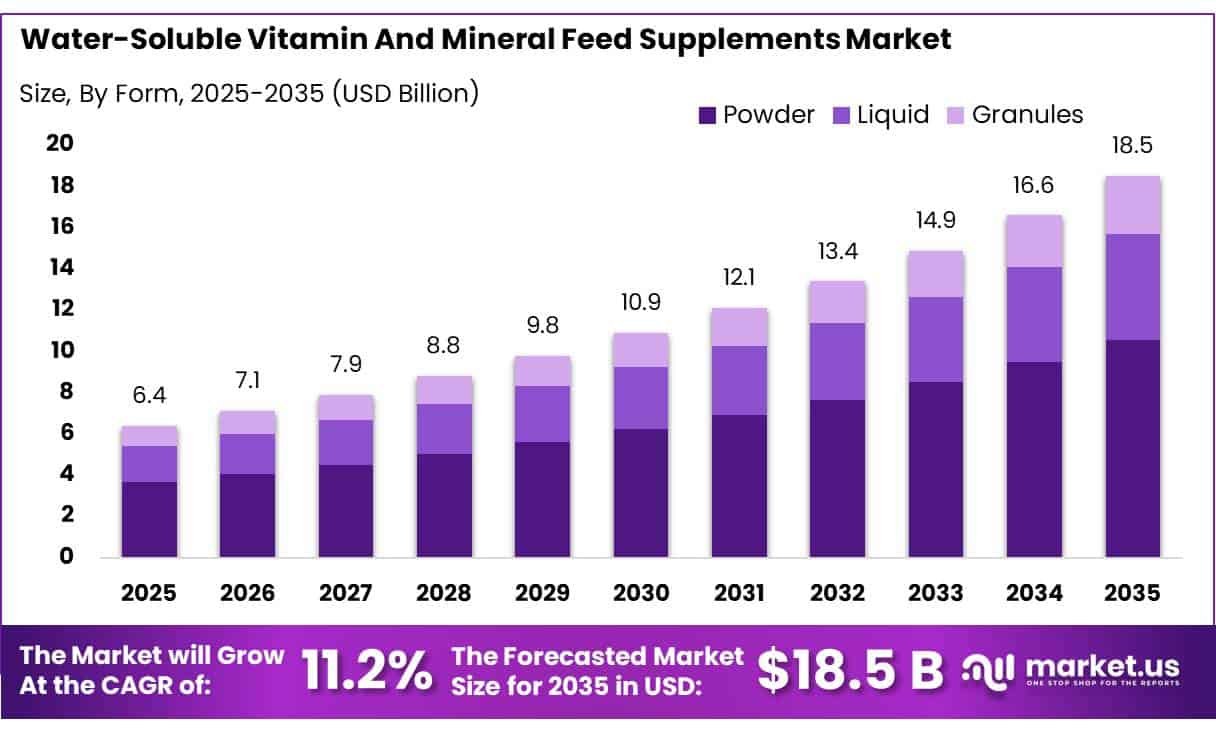
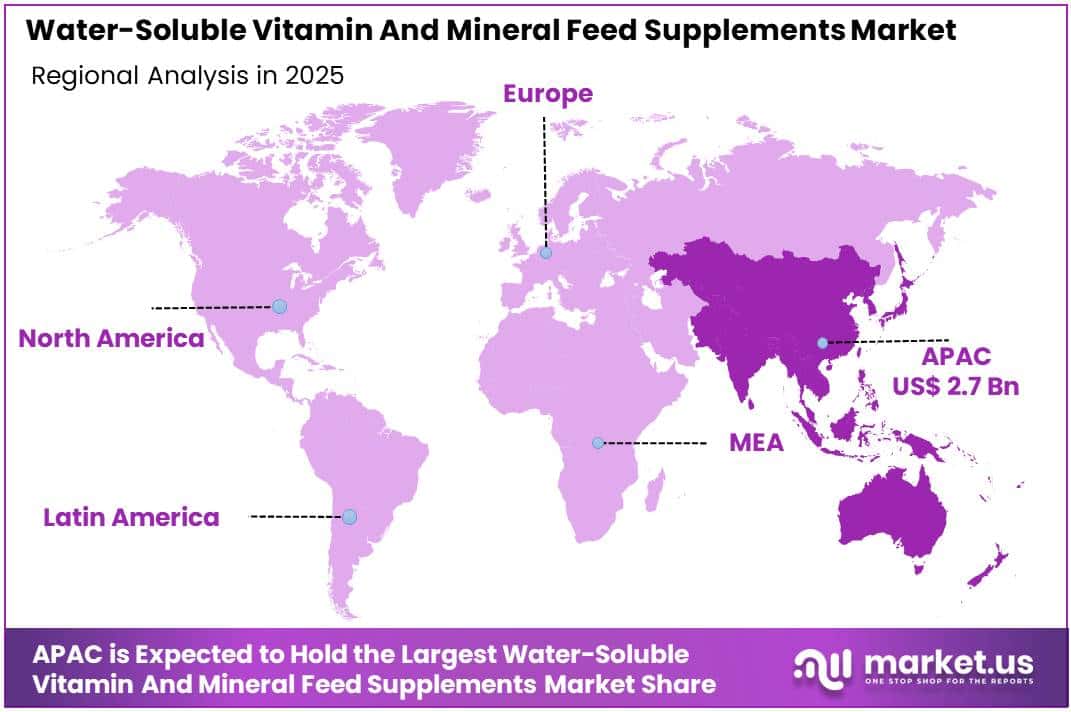
The Global Water-Soluble Vitamin And Mineral Feed Supplements Market size is expected to be worth around USD 18.5 Billion by 2035, from USD 6.4 Billion in 2025, growing at a CAGR of 11.2% during the forecast period from 2026 to 2035. In 2025, Asia Pacific held a dominant market position, capturing more than a 42.0% share, holding USD 2.7 Billion revenue.
Water-soluble vitamin and mineral feed supplements are becoming an important part of modern animal nutrition because they allow essential micronutrients to be delivered through drinking water or liquid feeding systems. These products are commonly used in poultry, swine, cattle, aquaculture, and young-animal nutrition, particularly during rapid growth, transportation, vaccination, heat stress, recovery, and periods of reduced feed intake.
- The International Feed Industry Federation expects world compound feed production to reach around 1.4 billion tonnes in 2025, while global commercial feed manufacturing generates annual turnover exceeding USD 500 billion. IFIF members represent more than 80% of worldwide compound feed production. This large organized feed system creates substantial opportunities for vitamin-mineral premixes and soluble nutritional formulations used alongside conventional compound feed.
Europe represents another established demand base. FEFAC expects EU27 industrial compound feed production to reach 147.5 million tonnes in 2025. Poultry feed is forecast at 50.653 million tonnes, pig feed at 47.339 million tonnes, and cattle feed at 41.585 million tonnes. Poultry feed production is expected to increase by 1.5% during the year. Intensive poultry and livestock systems offer practical opportunities for water-soluble supplements because centralized drinking systems allow nutrients to be provided quickly when feeding conditions or animal requirements change.
The micronutrient supply chain itself is already sizeable. IFIF’s 2024/25 industry review indicates that Brazil is expected to produce around 94 million tonnes of animal feed in 2025, alongside nearly 4 million tonnes of mineral supplements. The same industry review reported Chinese feed-grade vitamin production of 1.43 million tonnes in 2024. These volumes show that vitamins and minerals are established industrial feed inputs rather than small specialty ingredients, supporting further development of highly soluble, concentrated, and species-specific formulations.
Aquaculture creates another important growth opportunity. FAO reported that global aquaculture production of aquatic animals exceeded 100 million tonnes for the first time in 2024, with farm-gate value reaching USD 371 billion. The latest OECD-FAO outlook expects total fisheries and aquaculture production to reach 216 million tonnes by 2035. Source: FAO – SOFIA 2026
Key Takeaways
- Water-Soluble Vitamin And Mineral Feed Supplements Market size is expected to be worth around USD 18.5 Billion by 2035, from USD 6.4 Billion in 2025, growing at a CAGR of 11.2%.
- Vitamin B3 held a dominant market position, capturing more than a 26.00% share.
- Zinc held a dominant market position, capturing more than a 29.00% share.
- Powder held a dominant market position, capturing more than a 57.00% share.
- Poultry held a dominant market position, capturing more than a 36.00% share.
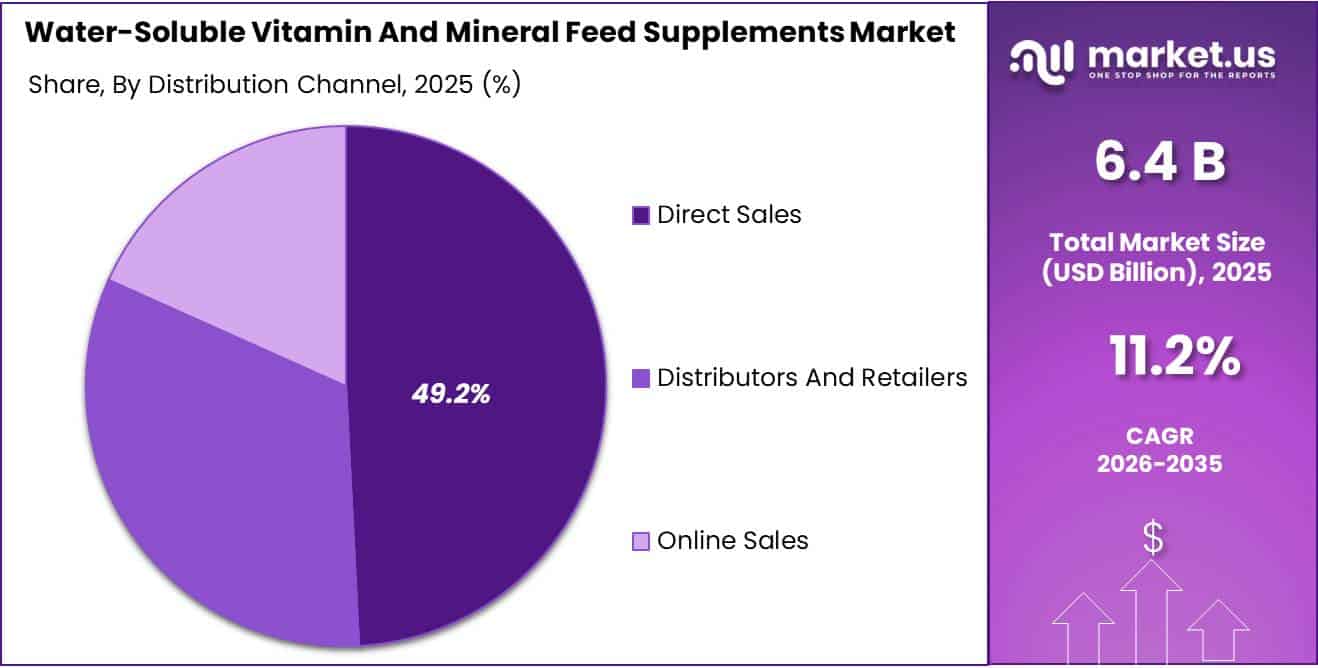
- Direct Sales held a dominant market position, capturing more than a 49.00% share.
- Asia Pacific held a dominant market position, capturing more than a 42.00% share and generating approximately USD 2.70 billion in revenue.
By Vitamin Type Analysis
Vitamin B3 dominates with more than 26.00% share as intensive livestock feeding supports steady micronutrient demand
In 2025, “Vitamin B3” held a dominant market position, capturing more than a 26.00% share. Vitamin B3, commonly supplied as niacin or niacinamide, is widely incorporated into livestock and poultry nutrition because it supports normal energy metabolism and helps maintain animal performance during intensive production. Its water-soluble nature also makes it practical for drinking-water supplementation when rapid nutrient delivery is required.
In 2025, EU industrial compound feed production reached 147.5 million tonnes, including 50.653 million tonnes of poultry feed, 47.339 million tonnes of pig feed, and 41.585 million tonnes of cattle feed. This large commercial feed base supports continued consumption of water-soluble vitamin formulations such as Vitamin B3. In the United States, USDA reported poultry-sector sales of USD 81.7 billion in 2025, including USD 44.6 billion from broilers, showing the scale of intensive animal production where vitamin supplementation remains important.
Vitamin B1 continues to hold an important position in the Water-Soluble Vitamin And Mineral Feed Supplements Market. Also known as thiamine, it is used in animal nutrition to support carbohydrate metabolism, nervous-system function, growth, and normal feed utilization. Water-soluble Vitamin B1 products can be particularly useful in drinking-water programs for young animals, stressed livestock, and production systems where feed intake can temporarily decline.
The European feed sector is expected to produce 152 million tonnes of industrial compound feed in 2026, including 51.588 million tonnes of poultry feed, 48.520 million tonnes of pig feed, and 45.358 million tonnes of cattle feed. This large feeding base provides a stable application environment for thiamine and other water-soluble micronutrients. EU rules also classify vitamins and minerals as nutritional feed additives and require authorized products to undergo safety assessment before use.
By Mineral Type Analysis
Zinc dominates with more than 29.00% share as intensive poultry production supports regular trace-mineral supplementation
In 2025, “Zinc” held a dominant market position, capturing more than a 29.00% share. Zinc remains widely used in water-soluble mineral supplements because it supports normal growth, immune function, skin integrity, enzyme activity, and reproductive performance across poultry and livestock. Large commercial poultry operations create a strong application base for rapid mineral delivery through drinking-water systems.
In 2025, U.S. producers raised 9.40 billion broilers, while total broiler live-weight production reached 62.2 billion pounds. These production volumes support consistent demand for trace-mineral supplementation during growth, stress, vaccination, and changing feeding conditions.
Manganese continues to hold an important position in the Water-Soluble Vitamin And Mineral Feed Supplements Market. It supports normal skeletal development, enzyme systems, nutrient metabolism, reproduction, and eggshell formation, making it important in poultry, swine, and cattle nutrition. Water-soluble formulations can provide flexible mineral delivery when animals require additional nutritional support.
In 2026, EU industrial compound feed production is forecast to reach 152 million tonnes, including 48.520 million tonnes of pig feed and 51.588 million tonnes of poultry feed. This sizeable feeding base provides a stable market for manganese and other trace-mineral supplements used in intensive livestock production.
Source: FEFAC – EU Compound Feed Production Market Forecast 2026
By Form Analysis
Powder dominates with more than 57.00% share as easy storage and bulk feed preparation support wider use
In 2025, “Powder” held a dominant market position, capturing more than a 57.00% share. Powder supplements are widely preferred because they are easy to store, transport, measure, and dissolve in drinking water or combine with feed programs. Their longer handling convenience also suits large poultry, swine, and cattle operations that require regular vitamin and mineral supplementation.
In 2025, EU industrial compound feed production was forecast at 147.5 million tonnes, including 50.653 million tonnes of poultry feed, 47.339 million tonnes of pig feed, and 41.585 million tonnes of cattle feed. Poultry feed production alone increased by 1.5%. This large organized feeding base supports demand for concentrated powder formulations that can be prepared according to farm requirements.
Liquid continues to hold an important position in the Water-Soluble Vitamin And Mineral Feed Supplements Market because it can be delivered directly through animal drinking-water systems and requires little preparation before use. This form is particularly useful in poultry operations, young-animal programs, transport periods, heat stress, vaccination programs, and situations where feed consumption temporarily falls.
USDA reported that the United States produced 9.40 billion broilers in 2025, representing an increase of 1%, while total broiler live weight reached 62.2 billion pounds, up 2%. Total U.S. poultry production and sales were valued at USD 81.7 billion, increasing 16% from the previous year. Such large-scale commercial poultry production creates a practical environment for liquid water-soluble vitamins and minerals that can be administered quickly across large flocks using centralized water systems.
By Livestock Analysis
Poultry dominates with more than 36.00% share as large commercial flocks require regular micronutrient support
In 2025, “Poultry” held a dominant market position, capturing more than a 36.00% share. Poultry remains the leading livestock segment because large commercial flocks require consistent vitamin and mineral intake to support growth, metabolism, immune function, egg production, and recovery during heat stress or vaccination. Water-soluble supplements are especially useful because nutrients can be delivered quickly through centralized drinking-water systems.
USDA reported that U.S. producers raised 9.40 billion broilers in 2025, up 1%, while broiler live-weight production reached 62.2 billion pounds, increasing 2%. The total value of U.S. poultry production and sales reached USD 81.7 billion, up 16%, showing the scale of commercial poultry operations supporting demand for soluble vitamin and mineral products.
Swine continues to hold an important position in the Water-Soluble Vitamin And Mineral Feed Supplements Market. Pig producers use soluble vitamins and minerals during weaning, transportation, feed changes, disease recovery, and periods of lower feed intake, when rapid nutrient delivery through drinking water can help maintain normal growth and metabolism.
As of December 2025, U.S. farms held 75.5 million hogs and pigs, including 69.6 million market hogs and 5.95 million breeding animals. Between September and November, producers weaned 35.0 million pigs, averaging 11.93 pigs per litter. By March 2026, U.S. inventory remained substantial at 74.3 million head, including 68.4 million market hogs. This large production base supports continued use of water-soluble micronutrient supplements across commercial swine operations.
By Distribution Channel Analysis
Direct Sales dominates with more than 49.00% share as large livestock operations favor bulk purchasing and direct supplier support
In 2025, “Direct Sales” held a dominant market position, capturing more than a 49.00% share. This channel is widely used by large poultry, swine, cattle, and feed-manufacturing businesses that require bulk volumes, consistent formulations, technical guidance, and scheduled deliveries of water-soluble vitamins and minerals. The scale of commercial feeding supports this model.
EU industrial compound feed production reached 147.5 million tonnes in 2025, including 50.653 million tonnes of poultry feed, 47.339 million tonnes of pig feed, and 41.585 million tonnes of cattle feed. U.S. poultry production and sales were valued at USD 81.7 billion in 2025, while producers raised 9.40 billion broilers, showing the size of intensive livestock operations that can benefit from direct procurement and supplier-managed nutritional programs.
Distributors And Retailers continue to play an important role in the Water-Soluble Vitamin And Mineral Feed Supplements Market because they provide local product availability, smaller pack sizes, multiple brands, and easier access for farms that do not purchase directly from manufacturers. Their role is particularly relevant in fragmented livestock regions where producers need vitamins and minerals quickly during weaning, transportation, heat stress, or changes in feed intake.
In December 2025, the United States had 75.5 million hogs and pigs, including 69.6 million market hogs and 5.95 million breeding animals. Iowa alone accounted for 25.3 million head, followed by Minnesota with 9.40 million and North Carolina with 7.90 million. In 2026, EU compound feed production is expected to reach 152 million tonnes, maintaining a broad customer base for regional feed distributors and agricultural retailers.
Key Market Segments
By Vitamin Type
- Vitamin B1
- Vitamin B2
- Vitamin B3
- Vitamin B5
- Vitamin B6
- Other Vitamins
By Mineral Type
- Zinc
- Manganese
- Selenium
- Copper
- Iron
- Other Minerals
By Form
- Powder
- Liquid
- Granules
By Livestock
- Poultry
- Swine
- Ruminants
- Aquaculture
- Other Livestock
By Distribution Channel
- Direct Sales
- Distributors And Retailers
- Online Sales
Driver Analysis
Intensive Poultry and Swine Output
Water delivery is commercially attractive because an affected flock or herd can receive a formulation within hours rather than waiting for a new feed batch to be manufactured and consumed over several days; for a 100,000-bird broiler operation consuming approximately 15,000–25,000 litres of drinking water daily near peak growth, a soluble product dosed at 0.25–1.00 g per litre can move 3.8–25 kg of functional micronutrient blend per day through existing drinker infrastructure.
The unit economics are compelling where a 1–2 point deterioration in feed-conversion ratio, a 0.5–1.5% mortality increase, or a 20–50 g decline in average final liveweight can erode farm contribution margin more than the cost of a short 3–7 day supplementation protocol; at a 100,000-bird cycle, a 40 g improvement in saleable liveweight represents roughly 4 metric tons of additional output before accounting for mortality avoidance.
The demand shift alters supplier economics from bulk feed-premix sales toward rapid-response veterinary-nutrition packages containing vitamin C, B-complex vitamins, electrolytes, vitamin E, selenium, zinc, iron, copper, manganese, and amino-acid-compatible carriers, sold through integrators, veterinarians, feed distributors, and farm-service networks with 15–35% higher realized margins than undifferentiated dry mineral premixes.
High-purity iron remains particularly important for young swine and poultry where deficiency risk can affect early growth and anemia outcomes, while stricter contaminant requirements favor documented specialty grades. This intensive-livestock driver is modeled to add approximately +1.7 percentage points to baseline CAGR across China, India, ASEAN, Brazil, the United States, and Europe through 2028–2030.
Drivers Impact Analysis
| Driver | (~) % Impact on CAGR Forecast | Geographic Relevance | Impact Timeline |
|---|---|---|---|
| Intensive Poultry and Swine Output | +1.7 pp | China, India, ASEAN, Brazil, U.S., EU | Medium term (2–4 years) |
| Aquaculture Feed Modernization | +1.5 pp | China, India, Vietnam, Indonesia, Chile, Norway | Medium term (2–4 years) |
| Antimicrobial-Reduction Nutrition Programs | +1.3 pp | EU, North America, China, Japan, Korea | Short term (≤ 2 years) |
| Heat-Stress and Disease Resilience | +1.2 pp | India, ASEAN, MENA, Brazil, Africa | Short term (≤ 2 years) |
| Precision Liquid-Dosing Expansion | +1.1 pp | North America, EU, China, Brazil, GCC | Medium term (2–4 years) |
| High-Purity Trace Mineral Demand | +1.0 pp | EU, U.S., Japan, Korea, export-feed hubs | Medium term (2–4 years) |
Restraint Analysis
Vitamin Feedstock Concentration Risk
China’s environmental-inspection campaigns and periodic plant shutdowns tied to emissions-compliance enforcement have historically triggered vitamin C and B-vitamin price spikes of 40–120% within single-quarter windows when even two or three major fermentation facilities are taken offline simultaneously, given that a handful of producers can collectively represent an estimated 60–80% of global supply for specific vitamin categories such as vitamin B2 or niacinamide.
For a premix manufacturer sourcing 500–2,000 metric tons of vitamin premix inputs annually, a sudden 50% price spike in a single B-vitamin component can add USD 1–4 million in unplanned input cost within a single procurement cycle, compressing gross margins by an estimated 300–700 basis points unless multi-month forward contracts or hedging arrangements are already in place, and even then, spot-market shortages can force premium-priced emergency procurement at 2–3 times contracted rates when contracted suppliers themselves face allocation constraints.
Diversification efforts toward alternative fermentation-capacity investment in India, Southeast Asia, and select European facilities remain nascent and typically require three-to-five-year capital-deployment timelines before meaningfully reducing reliance on the concentrated Chinese supply base. This feedstock-concentration exposure is estimated to deduct approximately -1.7 percentage points from baseline CAGR across China, the EU, North America, and global importing markets over the short term.
Restraint Impact Analysis
| Restraint | (~) % Impact on CAGR Forecast | Geographic Relevance | Impact Timeline |
|---|---|---|---|
| Vitamin Feedstock Concentration Risk | -1.7 pp | China, EU, North America, global importers | Short term (≤ 2 years) |
| Livestock and Feed-Commodity Volatility | -1.4 pp | North America, EU, China, Brazil, India | Short term (≤ 2 years) |
| Tightening Residue and Compliance Rules | -1.2 pp | EU, North America, China, Japan | Medium term (2–4 years) |
| Synthetic Vitamin Price Compression | -1.1 pp | Global; China, India, Southeast Asia | Medium term (2–4 years) |
| Heat-Labile Vitamin Stability Risk | -1.0 pp | Global; tropical Asia, Africa, LATAM | Medium term (2–4 years) |
| Antimicrobial and Additive Policy Pressure | -0.9 pp | EU, North America, China | Long term (≥ 4 years) |
Opportunity Analysis
Precision Microencapsulated Premixes
Recent technical reviews identify water-soluble vitamins as particularly vulnerable to oxidative and thermal degradation and note that non-thermal microencapsulation methods—including spray drying, freeze drying, coacervation, ionic gelation, electrospraying, and liposomal systems—can improve retention, release control, and physicochemical stability.
A conventional tropical-market premix may require 15–30% vitamin overage to ensure labeled potency after three to six months at temperatures above 30°C and high humidity, whereas a properly validated encapsulated formulation could reduce practical overage to roughly 5–12%, lowering active-loss exposure by 8–18 percentage points; at an inclusion cost of USD 4–12 per tonne of finished feed, the resulting savings can equal USD 0.30–1.50 per tonne while protecting performance consistency.
A production-scale encapsulation line requiring roughly USD 2–8 million of capital, supported by 12–24 months of species-specific stability, pellet-survival, and field-performance evidence, could make premium protected premixes commercially viable for poultry, swine, dairy, aquaculture, and calf-milk-replacer programs. If protected formats replace 10–18% of conventional water-soluble premix volume in tropical and high-intensity systems by 2030, they could add approximately +1.7 percentage points above baseline CAGR across Southeast Asia, India, Brazil, Mexico, Africa, the GCC, and other climate-exposed feed markets.
Opportunity Impact Analysis
| Opportunity | (~) % Potential CAGR Upside | Geographic Relevance | Execution Window |
|---|---|---|---|
| Precision Microencapsulated Premixes | +1.7 pp | Tropical APAC, LATAM, Africa, GCC | Medium term (2–4 years) |
| Livestock Health Outcome Contracts | +1.5 pp | North America, EU, China, Brazil | Short term (≤ 2 years) |
| Aquaculture Soluble Nutrient Systems | +1.4 pp | China, India, ASEAN, Chile, Norway | Medium term (2–4 years) |
| Waterline Dosing Platforms | +1.3 pp | India, ASEAN, Africa, LATAM, GCC | Medium term (2–4 years) |
| Trace-Mineral Bioavailability Platforms | +1.2 pp | EU, North America, China, Brazil | Long term (≥ 4 years) |
| Premix Roll-Up and Localization | +1.1 pp | India, ASEAN, LATAM, Africa | Medium term (2–4 years) |
Challenges Analysis
Heat and Humidity Potency Loss
In a tropical supply chain, a premix stored for 90–180 days at temperatures above 30°C and relative humidity above 65% can require formulation overages of roughly 15–30% for the most sensitive actives versus 5–10% under controlled conditions, while bag permeation, warehouse moisture, and repeated handling can add a further 2–8% potency dispersion between lots; at a finished premix inclusion cost of USD 5–15 per tonne of feed, this turns into USD 0.50–2.50 per tonne of avoidable nutrient cost or, if overage is not used, inconsistent flock performance and customer claims. The risk escalates during 25–45 day ocean transit and 15–60 day inland distribution across South and Southeast Asia, Africa, Latin America, and Gulf markets, where ambient containers and non-climate-controlled warehouses can expose products to multiple thermal cycles before use.
Suppliers must therefore use moisture-barrier packaging, UV-resistant multilayer bags, desiccant systems, warehouse targets near 20–25°C and below 50% relative humidity, stability-based expiry models, coated actives, and temperature-logging at shipment level; these interventions add an estimated 5–15% to conversion and logistics cost but are necessary to preserve label compliance and customer confidence. This stability-management burden imposes an estimated -1.3 percentage-point drag on attainable CAGR across climate-exposed livestock and aquaculture markets over the medium term.
Challenges Impact Analysis
| Challenge | (~) % CAGR Friction Drag | Geographic Relevance | Mitigation Horizon |
|---|---|---|---|
| Heat and Humidity Potency Loss | -1.3 pp | Tropical APAC, Africa, LATAM, GCC | Medium term (2–4 years) |
| Micro-Dosing Homogeneity Control | -1.1 pp | Global; India, China, ASEAN, Brazil | Medium term (2–4 years) |
| Multi-Ingredient Stability Conflicts | -1.0 pp | Global premix production hubs | Medium term (2–4 years) |
| Outcome-Validation Data Gaps | -0.9 pp | North America, EU, China, Brazil | Long term (≥ 4 years) |
| Technical Nutrition Talent Shortage | -0.9 pp | India, ASEAN, Africa, LATAM, GCC | Long term (≥ 4 years) |
| China-Linked Supply Synchronization | -1.0 pp | EU, Middle East, Africa, Americas | Medium term (2–4 years) |
Geopolitical Impact Analysis
Ongoing Wars Raise Feed Costs and Supply Risks for Water-Soluble Vitamin and Mineral Supplements
The Russia–Ukraine war and continuing Middle East conflict are affecting the Water-Soluble Vitamin And Mineral Feed Supplements Market through higher feed costs, shipping risks, and pressure on livestock producers. Feed manufacturers depend on grains, energy, fertilizers, vitamins, minerals, and international freight, so disruption across major trade routes can quickly increase production costs. FAO reported that global wheat prices increased 5.8% in July 2026 amid concerns over disrupted Black Sea export flows, while maize prices rose 3.6% as geopolitical and energy-market pressures increased.
Middle East disruption adds another supply-chain challenge. UNCTAD reported that ship transits through the Strait of Hormuz fell by about 95% during the 2026 crisis. The route normally carries around one-quarter of global seaborne oil trade, along with significant fertilizer volumes, directly affecting fuel, freight, and agricultural input costs. Ukraine also continues to face war-related damage to grain storage and logistics, with a 2026 support program covering farmers across 9 oblasts.
Regional Insights
Asia Pacific leads with 42.00% share and USD 2.70 billion, while Latin America shows strong growth potential
In 2025, Asia Pacific held a dominant market position, capturing more than a 42.00% share and generating approximately USD 2.70 billion in revenue. China provides a major regional demand base, producing 342.25 million tonnes of industrial feed in 2025, up 8.6% year over year. Feed-additive production reached 17.63 million tonnes, increasing 9.4%, while vitamin production rose 13.9% to 1.62 million tonnes. Pig-feed production alone reached 166.39 million tonnes, supporting substantial demand for micronutrient supplementation across intensive livestock operations.
OECD-FAO expects the region to remain an important and expanding meat-exporting base, supported by competitive feed supplies and productivity improvements. Brazil recorded 42.94 million cattle slaughtered in 2025, up 8.2%, while chicken slaughter reached 6.69 billion birds, increasing 3.1%. Hog slaughter climbed 4.3% to 60.69 million head, and raw-milk collection increased 8.5% to 27.51 billion litres. This expanding animal-production base creates stronger opportunities for water-soluble vitamin and mineral products used in poultry, swine, cattle, and intensive feeding programs.
Key Regions and Countries Insights
- North America
- US
- Canada
- Europe
- Germany
- France
- The UK
- Spain
- Italy
- Rest of Europe
- Asia Pacific
- China
- Japan
- South Korea
- India
- Australia
- Rest of APAC
- Latin America
- Brazil
- Mexico
- Rest of Latin America
- Middle East & Africa
- GCC
- South Africa
- Rest of MEA
Key Players Analysis
BASF SE maintains a strong position in animal nutrition through vitamins, feed additives, and micronutrient solutions for livestock and aquaculture. Its portfolio includes vitamins A, B2, B5, and E, with water-dispersible formulations suitable for drinking-water applications. In 2025, BASF’s Nutrition & Care segment generated EUR 6.509 billion in sales, including EUR 1.744 billion from Nutrition & Health. Segment investment reached EUR 662 million, while R&D spending totaled EUR 137 million, supporting continued feed-nutrition innovation.
Nutreco N.V. plays an important role in livestock nutrition through Trouw Nutrition and in aquaculture through Skretting. The company employs more than 11,000 people across over 40 countries, while Trouw Nutrition serves livestock customers in approximately 105 countries. In 2025, Nutreco secured a 4-year European-backed research grant for dairy nutrition, targeting a 10%–20% reduction in nitrogen emissions through improved feeding strategies.
Cargill, Incorporated remains a major animal-nutrition supplier through complete feeds, premixes, base mixes, concentrates, additives, vitamins, and minerals. Its animal-nutrition operation employs around 20,000 people at 280 locations across 40 countries and produces nearly 18 million metric tons of feed annually. In July 2025, Cargill agreed to acquire 100% of Mig-Plus, strengthening its premix and livestock-nutrition capabilities.
Top Key Players Outlook
- BASF SE
- Nutreco N.V.
- Cargill, Incorporated
- ADM
- Alltech, Inc.
- Adisseo
- Kemin Industries
- Lonza Group
- Evonik Industries
- DLG Group
- Novus International
- Zinpro Corporation
- Lallemand Animal Nutrition
- QualiTech
Recent Developments
- In January 2026, Adisseo launched a partnership program promoting amino-acid balancing in dairy nutrition; an evaluation covering 18 farms across 9 European countries estimated potential annual income improvement of EUR 293 per cow.
- In October 2025, ADM expanded its SINCRO precision-nutrition services across Mexico, Indonesia, and Europe, where one customer recorded a 10% rise in marketable egg production and more than USD 200,000 in additional annual profit.
Report Scope
| Report Features | Description |
|---|---|
| Market Value (2025) | USD 6.4 Bn |
| Forecast Revenue (2035) | USD 18.5 Bn |
| CAGR (2026-2035) | 11.2% |
| Base Year for Estimation | 2025 |
| Historic Period | 2020-2024 |
| Forecast Period | 2026-2035 |
| Report Coverage | Revenue Forecast, Market Dynamics, Competitive Landscape, Recent Developments |
| Segments Covered | By Vitamin Type (Vitamin B1, Vitamin B2, Vitamin B3, Vitamin B5, Vitamin B6, Other Vitamins), By Mineral Type ( Zinc, Manganese, Selenium, Copper, Iron, Other Minerals), By Form (Powder, Liquid, Granules), By Livestock (Poultry, Swine, Ruminants, Aquaculture, Other Livestock), By Distribution Channel (Direct Sales, Distributors And Retailers, Online Sales) |
| Regional Analysis | North America – US, Canada; Europe – Germany, France, The UK, Spain, Italy, Rest of Europe; Asia Pacific – China, Japan, South Korea, India, Australia, Singapore, Rest of APAC; Latin America – Brazil, Mexico, Rest of Latin America; Middle East & Africa – GCC, South Africa, Rest of MEA |
| Competitive Landscape | BASF SE, Nutreco N.V., Cargill, Incorporated, ADM, Alltech, Inc., Adisseo, Kemin Industries, Lonza Group, Evonik Industries, DLG Group, Novus International, Zinpro Corporation, Lallemand Animal Nutrition, QualiTech |
| Customization Scope | Customization for segments, region/country-level will be provided. Moreover, additional customization can be done based on the requirements. |
| Purchase Options | We have three licenses to opt for: Single User License, Multi-User License (Up to 5 Users), Corporate Use License (Unlimited User and Printable PDF) |





































