


Market Overview
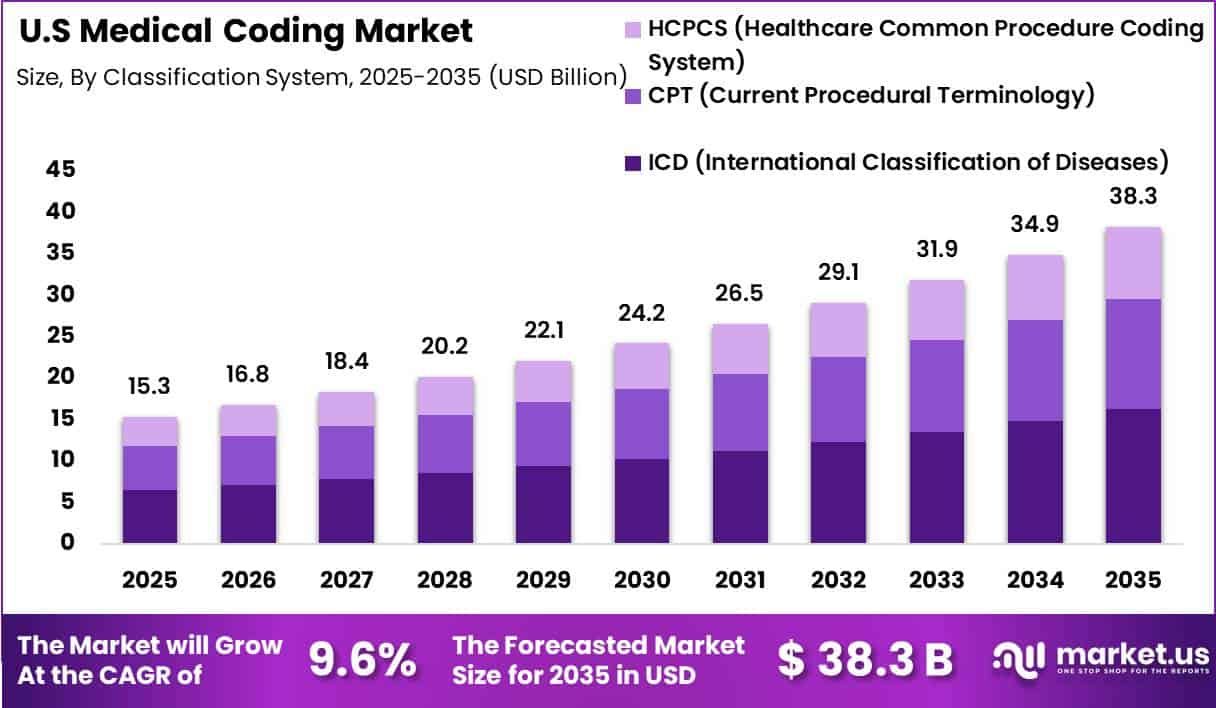
Global U.S Medical Coding Market size is expected to be worth around US$ 38.3 Billion by 2035 from US$ 15.3 Billion in 2025, growing at a CAGR of 9.6% during the forecast period from 2026 to 2035.
The U.S. medical coding market plays a critical role in healthcare administration by converting clinical diagnoses, procedures, and services into standardized codes used for claims processing, reimbursement, health records, and healthcare analytics.
The U.S. healthcare system relies on coding frameworks including ICD-10-CM for diagnoses, ICD-10-PCS for inpatient hospital procedures, and HCPCS and CPT codes for healthcare services and procedures. According to the Centers for Medicare & Medicaid Services (CMS), the U.S. healthcare industry transitioned from ICD-9 to ICD-10-CM and ICD-10-PCS on October 1, 2015, and ICD-10 applies to HIPAA-covered entities, not only Medicare and Medicaid providers.
The market is being shaped by increasing healthcare documentation requirements, complex reimbursement rules, expansion of electronic health records, and the need for accurate claims management. CMS continues to update coding systems annually; for FY 2026, ICD-10-CM and ICD-10-PCS updates apply across different periods beginning in October 2025 and April 2026, highlighting the continuous need for coder training and compliance.
Technology is also transforming coding workflows, with healthcare organizations increasingly exploring artificial intelligence, natural language processing, and automation to support documentation review, code assignment, quality checks, and revenue-cycle management.
As U.S. healthcare providers face growing administrative complexity, demand is expected to remain strong for skilled medical coders and technology-enabled coding solutions that improve accuracy, efficiency, and reimbursement compliance.
Key Takeaways
- Market Size: Global U.S Medical Coding Market size is expected to be worth around US$ 38.3 Billion by 2035 from US$ 15.3 Billion in 2025.
- Market Share: The market is growing at a CAGR of 9.6% during the forecast period from 2026 to 2035.
- Classification System: The ICD (International Classification of Diseases) segment dominates the U.S. medical coding market, accounting for 42.5% market share in 2025.
- Component: The Services segment dominates the U.S. medical coding market, accounting for 62.0% market share in 2025.
- End User: The Hospitals segment dominates the U.S. medical coding market, accounting for 48.5% market share in 2025.
- Mode of Delivery: The In-house Coding segment dominates the U.S. medical coding market, accounting for 55.0% market share in 2025.
Classification System Analysis
ICD (International Classification of Diseases) segment dominates the U.S. medical coding market.
The ICD (International Classification of Diseases) segment dominates the U.S. medical coding market, accounting for 42.5% market share in 2025. Its leading position is supported by its broad application in documenting diagnoses, tracking diseases, supporting healthcare statistics, and enabling consistent clinical data exchange.
ICD coding is essential across hospitals, clinics, and other healthcare settings, where accurate diagnosis classification is required for billing, reporting, and reimbursement processes.
The CPT (Current Procedural Terminology) segment holds a 35.0% share, reflecting its critical role in coding physician services, medical procedures, and outpatient care. CPT codes are widely used to communicate procedures and services provided to patients and support accurate claims processing.
Meanwhile, HCPCS (Healthcare Common Procedure Coding System) represents 22.5% of the market. HCPCS coding is particularly important for reporting healthcare products, supplies, medications, ambulance services, and procedures not fully covered by CPT codes.
Together, these classification systems form the foundation of medical coding workflows in the United States, with growing healthcare utilization and increasingly complex reimbursement requirements sustaining demand for accurate and standardized coding.
Component Analysis
Services segment dominates the U.S. medical coding market.
The Services segment dominates the U.S. medical coding market, accounting for 62.0% market share in 2025, while Software represents the remaining 38.0%. The strong position of services reflects the continued need for professional coding expertise across hospitals, physician practices, clinics, and other healthcare organizations.
Medical coding service providers support organizations with code assignment, documentation review, claims preparation, compliance monitoring, auditing, and revenue cycle management. Demand remains strong because healthcare providers must maintain coding accuracy while adapting to evolving reimbursement policies and regulatory requirements.
The Software segment is also expanding as healthcare organizations increasingly adopt technology to improve coding workflows and reduce manual workloads. Coding software can support automated code suggestions, documentation analysis, claims validation, compliance checks, and integration with electronic health records.
Artificial intelligence and natural language processing are further enhancing software capabilities by helping identify relevant clinical information from medical documentation. However, services continue to lead because complex cases often require human judgment and specialized expertise.
The combination of professional knowledge and technology-enabled automation is shaping the future of the U.S. medical coding ecosystem.
End User Analysis
Hospitals segment dominates the U.S. medical coding market.
The Hospitals segment dominates the U.S. medical coding market, accounting for 48.5% market share in 2025. Hospitals generate substantial volumes of complex patient records covering inpatient admissions, outpatient procedures, emergency care, surgeries, and specialized treatments. This broad range of clinical activity creates significant demand for accurate coding to support reimbursement, regulatory reporting, quality measurement, and revenue cycle management.
The Physician Offices & Clinics segment represents another important end-user group, driven by routine consultations, diagnostic services, chronic disease management, and outpatient procedures. These facilities increasingly rely on professional coding services and specialized software to improve claim accuracy and reduce administrative burdens.
Ambulatory Surgical Centers also contribute to market demand as more procedures shift from traditional hospital settings toward outpatient environments. Their coding requirements are supported by growing procedure volumes and the need for accurate documentation and reimbursement.
The Others category includes additional healthcare organizations and specialized care providers that require coding capabilities for billing, reporting, and compliance purposes. Overall, the increasing complexity of healthcare delivery and the need for accurate reimbursement across diverse care settings continue to drive demand for medical coding solutions throughout the U.S.
Mode of Delivery Analysis
The In-house Coding segment dominates the U.S. medical coding market.
The In-house Coding segment dominates the U.S. medical coding market, accounting for 55.0% market share in 2025, while Outsourced Coding represents 45.0%. In-house coding remains widely adopted by healthcare organizations that prefer to maintain direct control over coding operations, data security, workflow management, and quality assurance.
Large hospitals and integrated healthcare systems often maintain dedicated coding teams because of their high patient volumes and complex documentation requirements. Internal teams can also work closely with physicians, clinical documentation specialists, and revenue cycle departments to resolve coding issues efficiently.
However, Outsourced Coding is gaining importance as healthcare providers seek to control administrative costs, address coder shortages, and access specialized expertise.
External coding providers can support or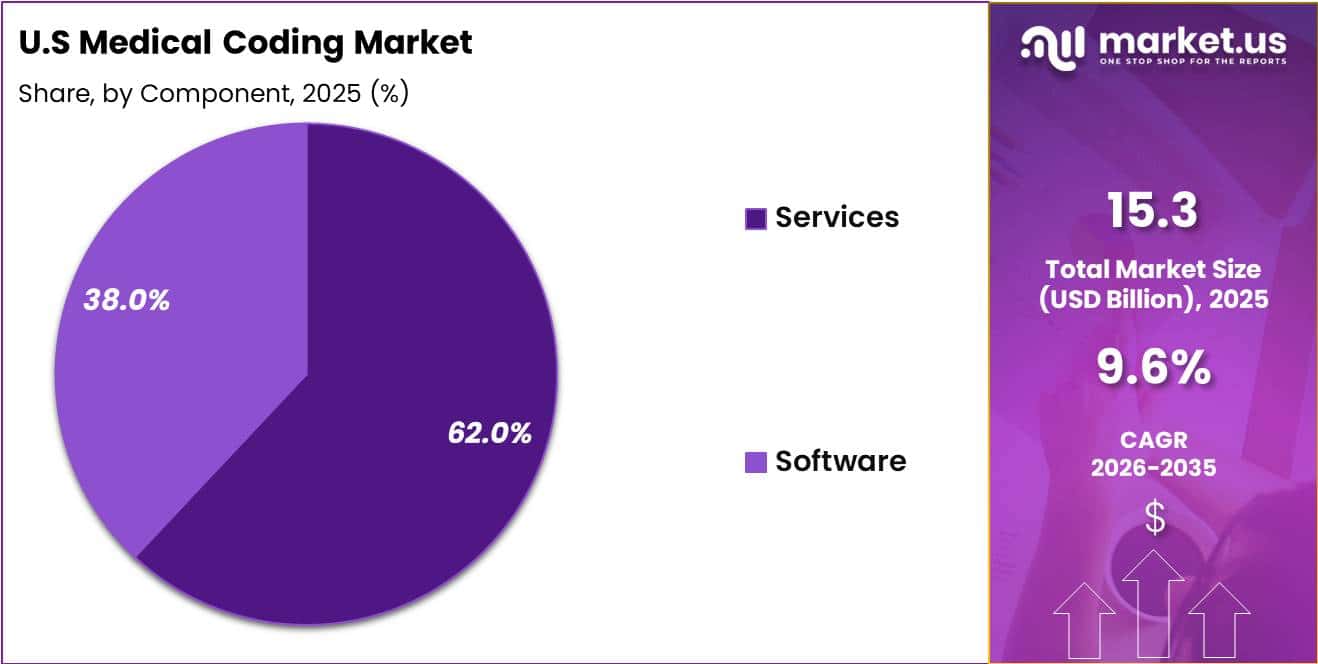
The market is therefore characterized by a balance between internal control and external expertise, with healthcare organizations selecting delivery models based on operational scale, workforce availability, cost considerations, data governance requirements, and coding complexity.
Key Market Segments
By Classification System
- ICD (International Classification of Diseases)
- CPT (Current Procedural Terminology)
- HCPCS (Healthcare Common Procedure Coding System)
By Component
- Services
- Software
By End User
- Hospitals
- Physician Offices & Clinics
- Ambulatory Surgical Centers
- Others
By Mode of Delivery
- In-house Coding
- Outsourced Coding
Driver
Chronic Disease Complexity and Multi Condition Encounter Growth.
A large share of the U.S. adult population lives with chronic disease, with a substantial proportion managing multiple coexisting conditions. This high prevalence makes chronic illness the primary driver of healthcare utilization and spending, increasing the importance of accurate documentation across care settings.
As patients accumulate more comorbidities, each clinical encounter becomes more complex, involving multiple diagnoses, medications, and longitudinal care considerations. This increases the demand for detailed clinical documentation, risk adjusted coding, and comprehensive care tracking across ambulatory, specialty, and inpatient settings.
For the medical coding and revenue cycle management market, value is shifting away from simple transactional coding toward higher complexity services such as hierarchical condition capture, risk adjustment support, and longitudinal care documentation.
These capabilities are increasingly important for reimbursement accuracy, audit protection, and population health management.
Overall, rising chronic disease complexity is structurally increasing diagnosis density per patient encounter, driving greater demand for advanced coding expertise and clinically informed documentation workflows.
| Driver | (~) % Impact on CAGR Forecast | Geographic Relevance | Impact Timeline |
|---|---|---|---|
| CMS code-set expansion and update velocity | +2.1% | U.S. national core, strongest in Medicare-heavy states and hospital markets | Short term (≤ 2 years) |
| Prior authorization interoperability and denial specificity | +1.6% | U.S. national core, especially MA, Medicaid, ACA exchange, integrated delivery corridors | Short term (≤ 2 years) |
| Chronic disease complexity and multi-condition encounter growth | +1.9% | U.S. national core, strongest in aging Sun Belt, Midwest, and high-Medicaid burden states | Medium term (2-4 years) |
| SDOH and HRSN documentation monetization | +1.2% | U.S. national core, strongest in Medicaid, safety-net, community health, urban underserved systems | Medium term (2-4 years) |
| AI-assisted documentation and coder productivity redesign | +1.4% | U.S. national core, led by large health systems, academic centers, and outsourced RCM hubs | Medium term (2-4 years) |
| Site-of-care and outpatient reimbursement complexity | +1.3% | U.S. national core, strongest in hospital outpatient, ASC, and physician enterprise networks | Medium term (2-4 years) |
Challenge
Chronic Coder Talent Gap in Healthcare Coding Markets.
The medical coding sector faces a persistent workforce shortage, which is estimated to reduce potential market growth by around 1.5 % age points. High vacancy rates often in the 25–30% range limit the ability of health systems to process claims efficiently, increasing delays, denial rates, and revenue cycle bottlenecks.
Demand for certified medical coders continues to grow faster than many other healthcare occupations, creating a structural imbalance between workforce supply and required capacity. This shortage is especially severe in rural and safety net systems, where staffing gaps can exceed 30%.
Operationally, new coders require 3–6 months to reach full productivity, and ongoing updates to coding systems such as ICD-10 and HCPCS further reduce effective output due to training time and rework requirements. This lowers usable productivity per full time equivalent and contributes to coding backlogs and extended accounts receivable cycles.
These constraints also increase denial rates and cash flow friction, limiting the ability of healthcare organizations to reinvest in process improvement and automation. Addressing the gap requires sustained workforce development, including structured training programs, expansion of remote coding roles, and selective outsourcing strategies.
Over time, AI assisted coding tools may help reduce routine workload, but human expertise will remain essential for complex cases and compliance oversight.
| Challenge | (~) % CAGR Friction Drag | Geographic Relevance | Mitigation Horizon |
|---|---|---|---|
| Chronic coder talent gap | -1.5% | U.S. hospital & RCM hubs | Long term (≥ 4 years) |
| Escalating documentation burden | -1.2% | Nationwide EHR-dense systems | Medium term (2–4 years) |
| High-velocity code-set changes | -0.9% | CMS-linked payer regions | Medium term (2–4 years) |
| Value-based audit & compliance pressure | -0.8% | Medicare/Medicaid heavy states | Medium term (2–4 years) |
| Fragmented IT & EHR interoperability | -0.7% | Multi-facility health systems | Long term (≥ 4 years) |
| Transition readiness for ICD-11 & advanced classifications | -0.6% | National coding & informatics programs | Long term (≥ 4 years) |
Restraints
Skilled Coder and Auditor Workforce Gap in Healthcare RCM.
The U.S. medical coding and auditing ecosystem is experiencing a structural imbalance between rising coding complexity and the available pool of experienced professionals, creating a sustained constraint on revenue cycle capacity.
Growth in healthcare utilization driven by chronic disease, outpatient expansion, and telehealth continues at mid single digit rates, while certified coder supply expands more slowly, alongside ongoing retirement and attrition among senior staff. This mismatch increases workload intensity for existing coders, often pushing volumes beyond sustainable benchmarks and contributing to higher error rates in complex evaluation and management E/M coding.
The result is increased rework, longer accounts receivable cycles, and reduced coding efficiency across health systems. To compensate, organizations are raising wages, expanding outsourcing, and investing in accelerated training programs, all of which increase operating expenses per claim.
These pressures particularly affect mid sized RCM firms that lack scale advantages, leading to margin compression and slower expansion. The workforce constraint also slows the adoption of advanced coding and automation platforms, since effective deployment still depends on experienced human oversight.
Overall, the shortage of skilled coders and auditors limits throughput, increases cost per encounter, and acts as a structural brake on growth in healthcare revenue cycle management markets.
| Restraint | (~) % Impact on CAGR Forecast | Geographic Relevance | Impact Timeline |
|---|---|---|---|
| Continuous code set expansions & guideline churn | -2.0% | U.S nationwide | Medium term (2-4 years) |
| Skilled coder & auditor workforce gap | -2.3% | U.S nationwide | Long term (≥ 4 years) |
| Slow EHR / AI coding tool interoperability | -1.6% | U.S nationwide | Medium term (2-4 years) |
| Payer policy tightening & denial rigor | -1.8% | U.S nationwide | Short to medium term (≤ 4 years) |
| Margin compression in provider & RCM vendors | -1.4% | U.S nationwide | Medium to long term (≥ 3 years) |
| Compliance risk from accelerating regulatory updates | -1.2% | U.S nationwide | Short term (≤ 2 years) |
Opportunity
AI-First Risk Adjustment Coding Platforms.
This opportunity involves using AI-native systems to improve risk adjustment coding accuracy by converting clinical documentation into audit-ready diagnosis codes, reducing reliance on manual chart review and legacy rules-based workflows.
Despite widespread EHR adoption in the U.S., much clinical data remains underused in traditional coding processes, leading to inefficiencies, incomplete documentation, and reimbursement leakage across Medicare and Medicare Advantage programs.
AI-driven platforms aim to improve coding speed and accuracy, enhance HCC capture, and reduce audit risk by automating abstraction of structured and unstructured data. This reduces coder workload and improves consistency in documentation.
The value proposition is strongest in risk-based reimbursement models, where accurate coding directly impacts revenue. Improved automation can reduce processing time per chart and increase reimbursement accuracy while lowering compliance exposure.
Overall, AI-first risk adjustment systems shift coding from manual, retrospective processes to automated, data-driven workflows that improve efficiency, accuracy, and financial performance.
| Opportunity | (~) % Potential CAGR Upside | Geographic Relevance | Execution Window |
|---|---|---|---|
| AI-first risk adjustment coding platforms | +2.0% | U.S. Medicare & MA core | Short to Medium term |
| Integrated ambulatory & home-care coding networks | +1.5% | U.S. suburban & rural | Medium term |
| Outcome-linked coding and shared-savings models | +1.2% | U.S. value-based care hot spots | Medium to Long term |
| Coding-driven denial prevention and admin cost takeout | +1.0% | U.S. hospital systems | Short term |
| Clinical documentation improvement (CDI)-embedded coding services | +0.8% | Nationwide acute & specialty | Short to Medium term |
| Specialty and complex-chronic virtual care coding hubs | +0.7% | U.S. high-burden chronic clusters | Medium term |
Key Player Analysis
The U.S. medical coding market is moderately fragmented, with competition driven by healthcare technology providers, coding specialists, and revenue cycle management companies. Among the leading participants, Optum360 LLC (UnitedHealth Group), 3M Health Information Systems, Nuance Communications Inc. (Microsoft), Cerner Corporation (Oracle), and Epic Systems Corporation are prominent players.
Competitive dynamics increasingly center on automation, coding accuracy, compliance, interoperability, and integration with electronic health record (EHR) systems.
These top players are strengthening their positions through R&D, AI-enabled coding solutions, natural language processing, strategic partnerships, and product innovation. Their competitive strategies focus on integrating medical coding with clinical documentation, EHR platforms, revenue cycle management, and compliance workflows.
Workflow integration helps healthcare organizations reduce manual processes, improve coding consistency, and accelerate reimbursement. In addition, ecosystem-based competition is becoming increasingly important, as companies seek to connect coding technologies with broader healthcare IT environments and create comprehensive platforms that support providers across clinical, administrative, and financial operations.
Top Key Players
- Optum360 LLC (UnitedHealth Group)
- 3M Health Information Systems
- Nuance Communications Inc. (Microsoft)
- Cerner Corporation (Oracle)
- Epic Systems Corporation
- Athenahealth Inc.
- R1 RCM Inc.
- Aviacode Inc. (iMedX)
- GeBBS Healthcare Solutions Inc.
- Precyse Solutions LLC
- MedPartners (MedData, Inc.)
- Maxim Health Information Services
- nThrive (Partners Healthcare Solutions)
- MRA Health Information Services
- CDI Corporation
- Others
Recent Developments
- In February 2026, Optum introduced AI-powered digital prior authorization solutions, including Digital Auth Complete and InterQual Auth Accelerator, aimed at improving the accuracy and speed of authorization workflows while reducing repetitive administrative work. The move reflects the wider shift toward AI-enabled automation across clinical documentation, coding, claims, and revenue-cycle processes.
- In February 2026, athenahealth expanded its AI-native platform with new agentic patient communication tools that allow patients to interact with virtual assistants for routine questions and scheduling. By embedding these capabilities directly into existing workflows, the company is extending automation beyond documentation into front-office and administrative operations.
- In March 2026, Microsoft highlighted new advancements in Microsoft Dragon Copilot at HIMSS 2026, including expanded AI capabilities, partner-built applications and agents, and role-based experiences for healthcare professionals. The development strengthens Microsoft’s position in AI-assisted clinical workflows and supports the broader movement toward automated documentation and coding-related processes.
- In March 2026, R1 continued to expand its AI-driven revenue-cycle strategy, building on its October 2025 acquisition of Phare Health. The acquisition brought AI-native capabilities for inpatient coding and clinical documentation improvement, strengthening R1’s ability to automate complex revenue-cycle activities and interpret clinical records for reimbursement workflows.
Report Scope
| Report Features | Description |
|---|---|
| Market Value (2025) | US$ 15.3 Billion |
| Forecast Revenue (2035) | US$ 38.3 Billion |
| CAGR (2026-2035) | 9.6% |
| Base Year for Estimation | 2025 |
| Historic Period | 2020-2024 |
| Forecast Period | 2026-2035 |
| Report Coverage | Revenue Forecast, Market Dynamics, Competitive Landscape, Recent Developments |
| Segments Covered | By Classification System (ICD (International Classification of Diseases), CPT (Current Procedural Terminology), HCPCS (Healthcare Common Procedure Coding System)), By Component (Services, Software), By End User (Hospitals, Physician Offices & Clinics, Ambulatory Surgical Centers, Others), By Mode of Delivery (In-house Coding, Outsourced Coding) |
| Regional Analysis | North America – The US, Canada; Europe – Germany, France, U.K., Italy, Spain, Russia & CIS, Rest of Europe; Asia Pacific – China, India, Japan, South Korea, ASEAN, Australia & New Zealand, Rest of Asia Pacific; Middle East & Africa – GCC, South Africa, Rest of Middle East & Africa; Latin America – Brazil, Mexico, Rest of Latin America |
| Competitive Landscape | Optum360 LLC (UnitedHealth Group), 3M Health Information Systems, Nuance Communications Inc. (Microsoft), Cerner Corporation (Oracle), Epic Systems Corporation, Athenahealth Inc., R1 RCM Inc., Aviacode Inc. (iMedX), GeBBS Healthcare Solutions Inc., Precyse Solutions LLC, MedPartners (MedData, Inc.), Maxim Health Information Services, nThrive (Partners Healthcare Solutions), MRA Health Information Services, CDI Corporation, Others |
| Customization Scope | Customization for segments, region/country-level will be provided. Moreover, additional customization can be done based on the requirements. |
| Purchase Options | We have three licenses to opt for: Single User License, Multi-User License (Up to 5 Users), Corporate Use License (Unlimited User and Printable PDF) |





































