


Report Overview
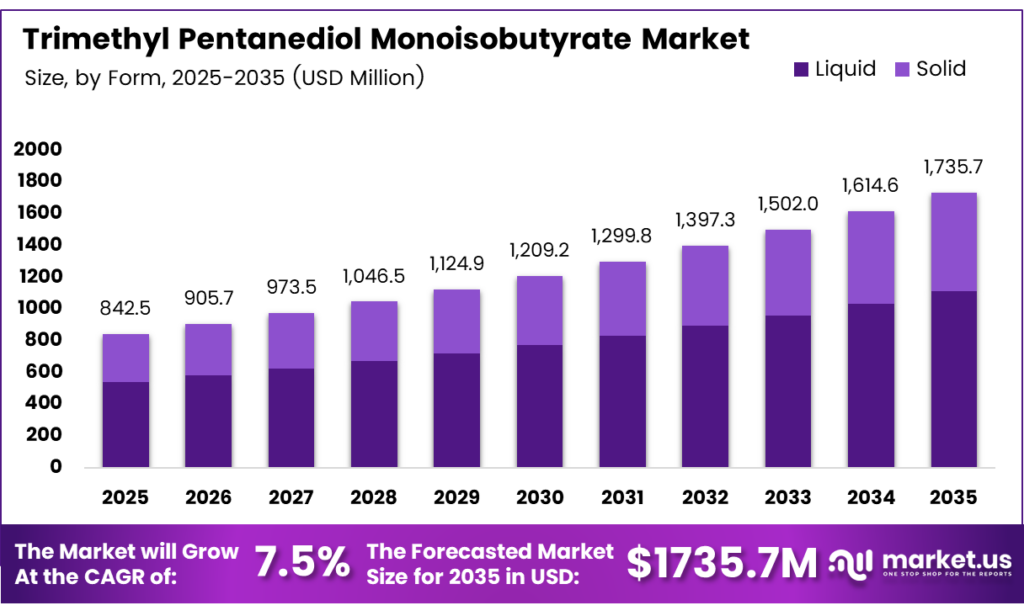
The Global Trimethyl Pentanediol Monoisobutyrate Market size is expected to be worth around USD 1,735.7 million by 2035 from USD 842.5 million in 2025, growing at a CAGR of 7.5% during the forecast period 2026 to 2035.
Trimethyl Pentanediol Monoisobutyrate (TMPD-MIB), commonly known as Texanol, is a specialty ester solvent widely used as a coalescing agent. It plays a key role in waterborne coatings, paints, and industrial formulations. Moreover, its low volatility and excellent film-forming properties make it a preferred ingredient across coatings and personal care applications.
The market serves a broad range of end-use industries. Industrial and automotive coatings rely heavily on this compound to achieve uniform film formation. Additionally, cosmetics, pharmaceutical, and food-grade applications continue to expand the functional scope of this specialty ester solvent across global markets.
The compound also demonstrates strong technical performance under various handling conditions. TMPD-MIB maintains a density of 0.95 g/mL at 25°C, which directly supports dosing accuracy and formulation mass-balancing in coatings and inks manufacturing processes.
Air exposure characteristics also reinforce regulatory awareness around the compound. According to the European Commission, 1 ppm of TMPD-MIB in air at 23°C corresponds to 8.90 mg/m³. This conversion factor supports life-cycle inventory assessments and guides safer formulation practices in building product applications.
Construction and infrastructure development programs across emerging economies drive increased consumption of architectural coatings. Therefore, demand for high-performance solvent additives like TMPD-MIB accelerates alongside urbanization trends. The automotive refinishing sector further reinforces this growth by requiring advanced solvent systems in repair and maintenance applications.
Key Takeaways
- The Global Trimethyl Pentanediol Monoisobutyrate Market is valued at USD 842.5 million in 2025 and is forecast to reach USD 1,735.7 million by 2035, growing at a CAGR of 7.5%.
- The Liquid segment dominates with a 83.5% market share in 2025.
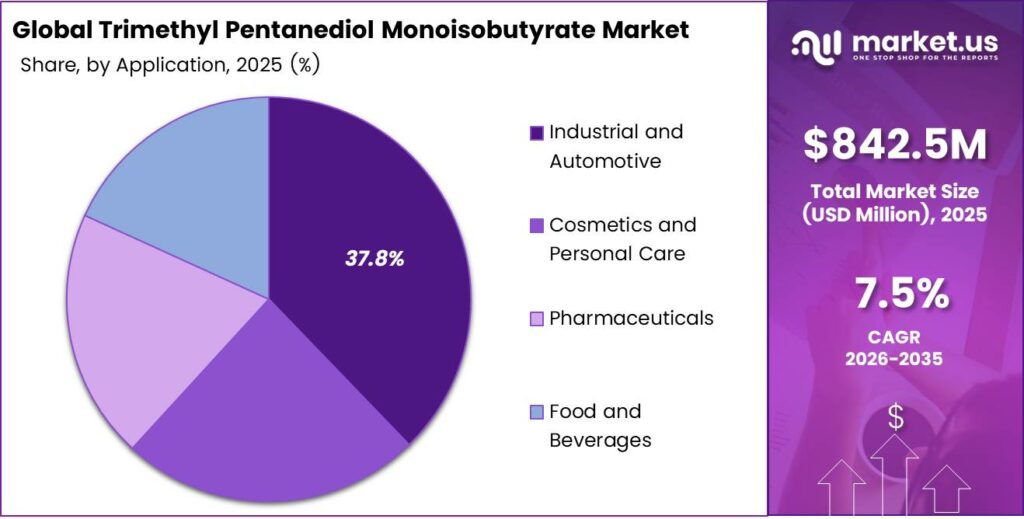
- Industrial and Automotive leads with a 37.8% share among all application segments.
- Direct Sales holds the largest share at 48.6%.
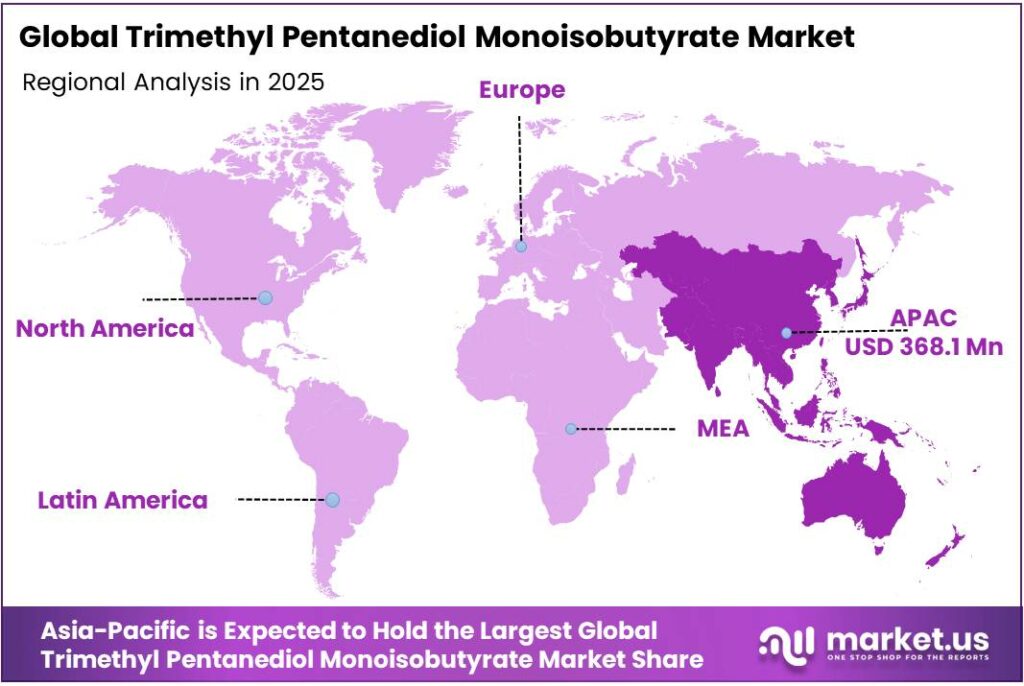
- Asia-Pacific dominates the regional landscape with a 43.7% market share, valued at USD 368.1 million.
By Form Analysis
Liquid dominates with 83.5% due to its ease of handling, compatibility with waterborne systems, and widespread industrial use.
In 2025, Liquid held a dominant market position in the By Form segment of the Trimethyl Pentanediol Monoisobutyrate Market, with a 83.5% share. Liquid TMPD-MIB offers superior blending efficiency in waterborne coatings and paint formulations. Moreover, its low melting point ensures the material remains pumpable under standard warehouse conditions, reducing handling constraints for coatings manufacturers globally.
The Solid form captures the remaining market share, serving niche applications where controlled-release or specific handling requirements apply. However, solid-form products face adoption barriers due to additional processing steps required before formulation use. Consequently, the liquid form continues to maintain a strong preference across industrial, personal care, and specialty chemical end-use segments.
By Application Analysis
Industrial and Automotive dominate with 37.8% due to high demand for coalescing agents in coatings, refinishing, and solvent-based industrial systems.
In 2025, Industrial and Automotive held a dominant market position in the By Application segment of the Trimethyl Pentanediol Monoisobutyrate Market, with a 37.8% share. Architectural coatings and automotive refinishing applications drive this segment’s leadership. Additionally, the growing preference for waterborne and low-VOC formulations in industrial settings continues to reinforce demand for high-performance coalescing agents.
Cosmetics and Personal Care represent a rapidly growing application area, leveraging TMPD-MIB’s emollient and solubilizing properties. Formulators incorporate it into skin care and hair care products for improved texture and stability. Therefore, this segment sees accelerating interest from personal care brands pursuing multifunctional specialty ester ingredients.
Pharmaceuticals utilize TMPD-MIB as a processing aid and excipient in select drug delivery systems. However, regulatory compliance and biocompatibility requirements create a relatively controlled pace of adoption in this segment. Nonetheless, innovation in topical and dermal formulations continues to open incremental opportunities for specialty ester use.
Food and Beverages represents the smallest application segment, where TMPD-MIB serves indirect contact roles in packaging coatings and ink formulations. Stringent food safety regulations govern its permissible use. Moreover, the expansion of sustainable packaging solutions creates modest but consistent demand growth for compliant specialty solvent systems in this category.
By Distribution Channel Analysis
Direct Sales dominates with 48.6% due to strong manufacturer-to-customer relationships and bulk procurement preferences in industrial segments.
In 2025, Direct Sales held a dominant market position in the By Distribution Channel segment of the Trimethyl Pentanediol Monoisobutyrate Market, with a 48.6% share. Large-scale coatings manufacturers and industrial buyers prefer direct procurement for cost efficiency and technical support. Moreover, direct sales channels enable customized supply agreements and quality assurance protocols critical to specialty chemical sourcing.
Distributors serve a vital role in reaching mid-sized and regional buyers who require flexible order quantities and localized service. Therefore, chemical distributors maintain extensive warehousing networks to ensure consistent product availability across emerging markets. This channel supports market penetration in geographies where manufacturers lack direct sales infrastructure.
Retail Sales account for the smallest share of distribution, primarily serving small-scale formulators and specialty buyers. However, the growth of online B2B platforms gradually extends retail-channel accessibility for specialty chemicals. Consequently, digital commerce adoption among chemical distributors continues to reshape the retail segment’s role in the overall supply chain.
Key Market Segments
By Form
- Liquid
- Solid
By Application
- Industrial and Automotive
- Cosmetics and Personal Care
- Pharmaceuticals
- Food and Beverages
By Distribution Channel
- Direct Sales
- Distributors
- Retail Sales
Emerging Trends
Shift Toward Bio-Based and Green Solvent Alternatives Gains Momentum
Chemical manufacturers increasingly prioritize bio-based and green alternatives to conventional solvent systems. Regulatory pressure and sustainability commitments drive formulators toward eco-friendly coalescing agents. Merck/Sigma-Aldrich updated its technical product specification for TMPD-MIB (Texanol), confirming a density of 0.95 g/mL at 25°C and a melting point of −50°C, providing coatings and ink formulators with precise handling and dosing reference data for industrial applications.
Waterborne Coating Technologies and Strategic Industry Collaborations Reshape the Market
High-solids and waterborne coating technologies gain rapid adoption across automotive, construction, and industrial sectors. Manufacturers focus on low-VOC performance to meet tightening environmental standards. Moreover, strategic collaborations and mergers among chemical producers strengthen supply chains and accelerate innovation in coalescing agent performance for next-generation coating formulations.
Drivers
Rising Demand for High-Performance Coalescing Agents in Waterborne Coatings
Waterborne coatings manufacturers rely on TMPD-MIB as a primary coalescing agent for achieving uniform film formation. Growing architectural coatings consumption, driven by expanding construction and infrastructure projects globally, reinforces this demand. TMPD-MIB maintains a melting point of −50°C, ensuring it remains liquid and pumpable under standard warehouse conditions, reducing operational costs for coatings plants.
Automotive Refinishing and Low-VOC Regulatory Trends Accelerate Adoption
The automotive refinishing sector fuels demand for advanced specialty solvent additives that meet performance and compliance requirements. Additionally, the global shift toward low-VOC formulations actively supports the use of specialty ester solvents like TMPD-MIB in paint systems. Consequently, regulatory frameworks in North America and Europe create a sustained growth environment for high-performance coalescing agent adoption.
Restraints
Raw Material Price Volatility Disrupts Production Cost Stability
Fluctuating raw material prices significantly impact TMPD-MIB production economics and profit margins for manufacturers. Petrochemical feedstock volatility introduces unpredictability into supply chain planning and cost forecasting. Therefore, producers struggle to maintain stable pricing, which creates procurement uncertainty for downstream buyers in coatings, personal care, and industrial markets.
Stringent Environmental Regulations Limit Chemical Solvent Utilization
Regulatory compliance requirements impose significant constraints on solvent application across multiple industries. An overall assessment factor of 100 applies to indoor concentration evaluations of TMPD-MIB, reflecting the stringent safety margins required in building product assessments. Consequently, manufacturers face increased compliance costs and formulation restrictions that limit broader market adoption.
Growth Factors
Eco-Friendly Coatings and Rapid Industrialization Open New Market Opportunities
Emerging demand for eco-friendly industrial coatings and sustainable chemical solutions creates significant new growth avenues for TMPD-MIB. Rapid industrialization in developing economies expands application markets across construction, automotive, and manufacturing sectors. Commercial coalescent mixtures contain approximately 40% of the diol backbone of TMPD-MIB, highlighting its structural importance in hybrid coalescent systems.
Personal Care Innovation and Packaging Industry Expansion Drive Demand
Innovation in personal care and cosmetic formulations increasingly utilizes specialty emollients and ester solvents for improved product performance. Additionally, the expansion of the packaging and printing ink industries requires advanced solvent systems with precise viscosity and adhesion properties. Therefore, TMPD-MIB gains growing relevance across diversified application categories beyond its core coatings market base.
Regional Analysis
Asia-Pacific Dominates the Trimethyl Pentanediol Monoisobutyrate Market with a Market Share of 43.7%, Valued at USD 368.1 Million
Asia-Pacific leads the global market with a 43.7% share, valued at USD 368.1 million in 2025. Rapid industrialization, expanding construction activity, and growing automotive production across China, India, and Southeast Asia drive this dominance. Moreover, the region’s large coatings manufacturing base and increasing adoption of waterborne paint technologies continue to reinforce Asia-Pacific’s leadership position.
North America represents a mature and technologically advanced market for TMPD-MIB. Stringent EPA and CARB regulations promoting low-VOC coatings actively support demand for specialty coalescing agents. Additionally, established automotive refinishing and architectural coatings industries maintain steady consumption. The region also drives innovation in sustainable formulation practices that benefit specialty ester solvent adoption.
Europe maintains a strong demand for TMPD-MIB, underpinned by rigorous environmental compliance standards across the coatings and construction sectors. The EU’s commitment to reducing VOC emissions accelerates the adoption of waterborne and high-solids formulations. Consequently, specialty ester solvents serve as critical performance components in compliant coating systems across Germany, France, and the UK.
The Middle East and Africa region shows moderate but growing demand for TMPD-MIB, driven by ongoing infrastructure development and expanding manufacturing sectors. Construction-led growth in GCC countries increases architectural coatings consumption. However, limited local production capacity and import dependency create supply chain constraints that partially moderate overall regional market growth.
Key Regions and Countries
North America
- US
- Canada
Europe
- Germany
- France
- The UK
- Spain
- Italy
- Rest of Europe
Asia Pacific
- China
- Japan
- South Korea
- India
- Australia
- Rest of APAC
Latin America
- Brazil
- Mexico
- Rest of Latin America
Middle East & Africa
- GCC
- South Africa
- Rest of MEA
Key Players Analysis
OXEA is a leading global producer of specialty chemicals, including oxo intermediates and derivatives that serve as precursors in ester solvent manufacturing. The company maintains a strong presence in the coatings and industrial chemicals supply chain. Moreover, OXEA’s integrated production capabilities and global distribution network allow it to serve diverse customer requirements across coatings, lubricants, and pharmaceutical markets effectively.
Eastman Chemical Company holds a prominent position in the TMPD-MIB market through its well-established Texanol coalescent product line. The company supplies coalescing agents to major waterborne coatings formulators worldwide. Additionally, Eastman’s ongoing investment in sustainable chemistry and low-VOC formulation solutions aligns with tightening environmental regulations, reinforcing its competitive advantage in the specialty ester solvent segment globally.
Univar Solutions operates as a major specialty chemical distributor connecting TMPD-MIB producers with end-use manufacturers across coatings, personal care, and industrial sectors. The company leverages an extensive global distribution infrastructure to ensure a reliable supply. Therefore, Univar’s broad customer relationships and technical service capabilities make it a critical intermediary in the TMPD-MIB supply chain across multiple geographies.
Hallstar focuses on specialty ester chemistry for personal care, industrial, and performance coating applications. The company develops high-performance emollient and coalescent solutions that address evolving formulation requirements. Consequently, Hallstar’s targeted expertise in bio-based and functional ester products positions it well to capture growing demand from sustainable cosmetics and eco-friendly coatings market segments worldwide.
Top Key Players in the Market
- OXEA
- Eastman Corporation
- Univar Solutions
- Hallstar
- Eastman Chemical Company
- Honeywell International Inc.
- Runtai Chemical Co.
- Shijiazhuang Xinlongwei Chemical Co., Ltd
Recent Developments
- In 2025, Eastman’s official product pages list Texanol ester alcohol as a major coalescent for latex paints, and Eastman’s technical literature explicitly states that the paint industry has long used 2,2,4-trimethyl-1,3-pentanediol monoisobutyrate as the standard coalescent for architectural paints.
- In 2025, OXEA describes itself as a global manufacturer of oxo intermediates and oxo performance chemicals, including alcohols, polyols, carboxylic acids, specialty esters, and amines used in coatings, lubricants, cosmetics, printing inks, and plastics. That makes it a strong upstream/adjacent player in TMPD monoisobutyrate-related chemistry, even though I did not find an official OXEA source stating that it sells TMPD monoisobutyrate itself.
Report Scope
| Report Features | Description |
|---|---|
| Market Value (2025) | USD 842.5 Million |
| Forecast Revenue (2035) | USD 1,735.7 Million |
| CAGR (2026-2035) | 7.5% |
| Base Year for Estimation | 2025 |
| Historic Period | 2020-2024 |
| Forecast Period | 2026-2035 |
| Report Coverage | Revenue Forecast, Market Dynamics, Competitive Landscape, Recent Developments |
| Segments Covered | By Form (Liquid, Solid), By Application (Industrial and Automotive, Cosmetics and Personal Care, Pharmaceuticals, Food and Beverages), By Distribution Channel (Direct Sales, Distributors, Retail Sales) |
| Regional Analysis | North America (US and Canada), Europe (Germany, France, The UK, Spain, Italy, and Rest of Europe), Asia Pacific (China, Japan, South Korea, India, Australia, and Rest of APAC), Latin America (Brazil, Mexico, and Rest of Latin America), Middle East & Africa (GCC, South Africa, and Rest of MEA) |
| Competitive Landscape | OXEA, Eastman Corporation, Univar Solutions, Hallstar, Eastman Chemical Company, Honeywell International Inc., Runtai Chemical Co., Shijiazhuang Xinlongwei Chemical Co., Ltd |
| Customization Scope | Customization for segments, region/country-level will be provided. Moreover, additional customization can be done based on the requirements. |
| Purchase Options | We have three licenses to opt for: Single User License, Multi-User License (Up to 5 Users), Corporate Use License (Unlimited Users and Printable PDF) |





































