Speech-driven Animation Market By Component (Hardware, Software, Services), By Deployment Mode (Cloud-based, On-Premises), By Application (Media & Entertainment (Film, Animation & VFX), Enterprise & Marketing (Corporate Training & E-learning, Advertising & Explainer Videos), Education & E-Learning, Healthcare, Others), By End-User (Professional Studios & Agencies, Individual Creators & Prosumers), By Regional Analysis, Global Trends and Opportunity, Future Outlook By 2025-2035
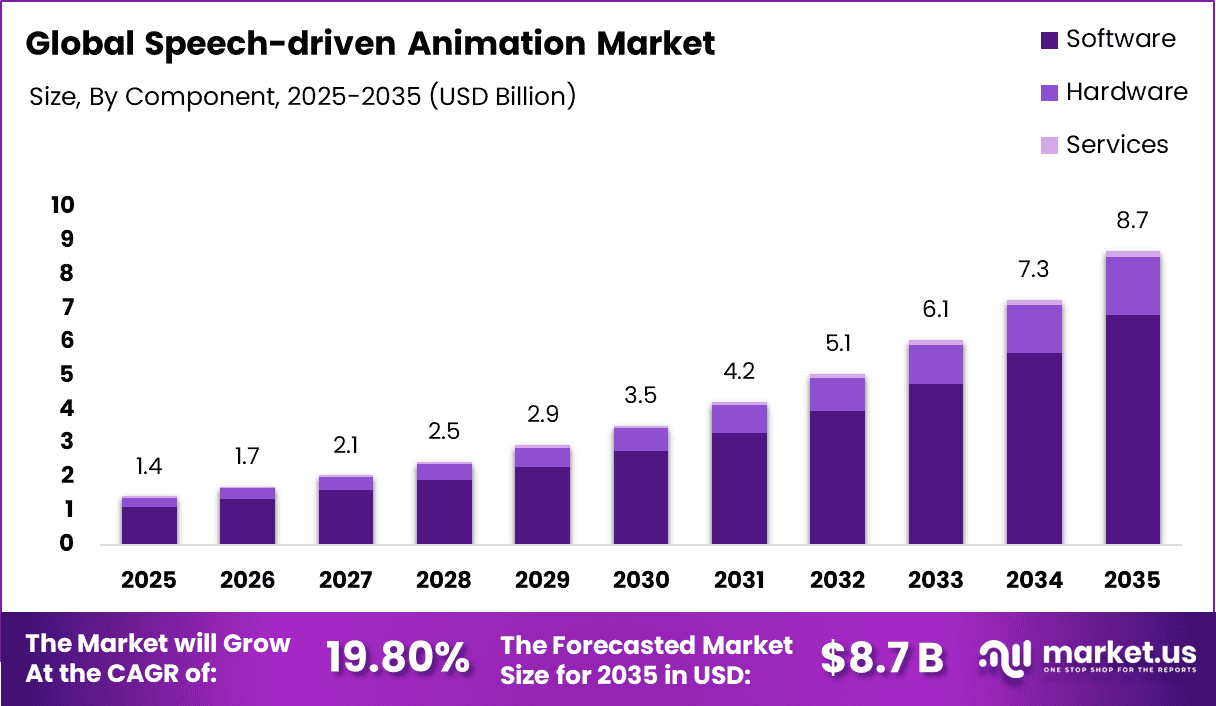
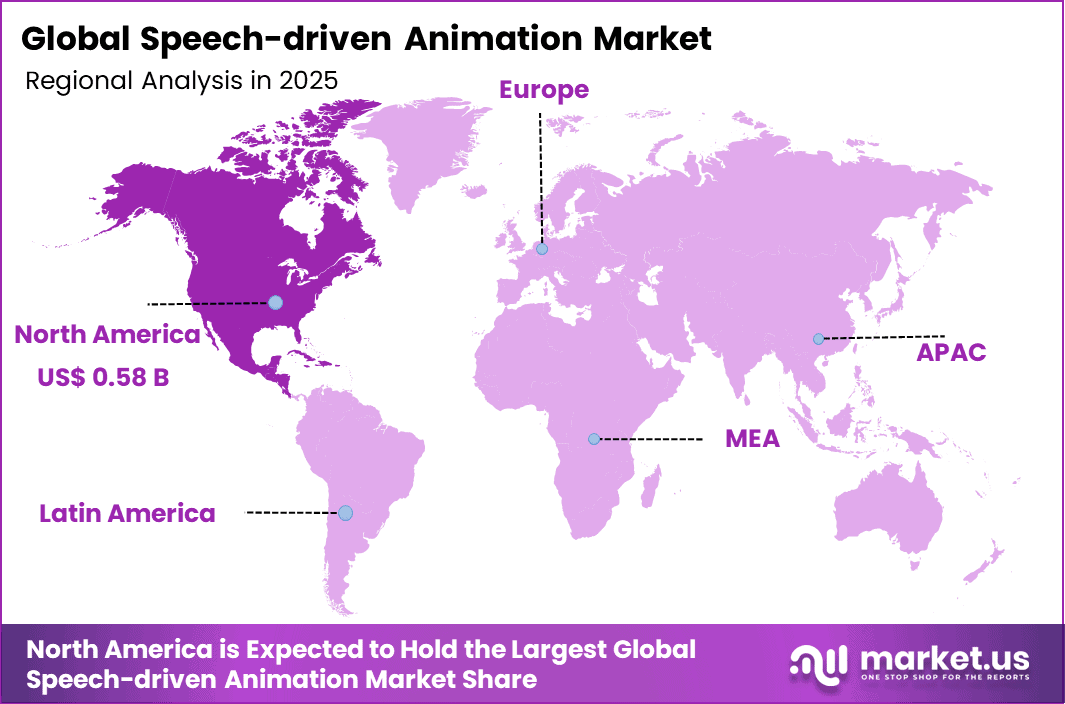
The Global Speech-driven Animation Market generated USD 1.4 billion in 2025 and is predicted to register growth from USD 1.7 billion in 2026 to about USD 8.7 billion by 2035, recording a CAGR of 19.80% throughout the forecast span. In 2025, North America held a dominant market position, capturing more than a 40.8% share, holding USD 0.58 Billion revenue.
Top Market Takeaways
Software commands 78.3%, automating lip-sync, facial expressions, and nonverbal cues from audio inputs for realistic digital avatars and real-time rendering.
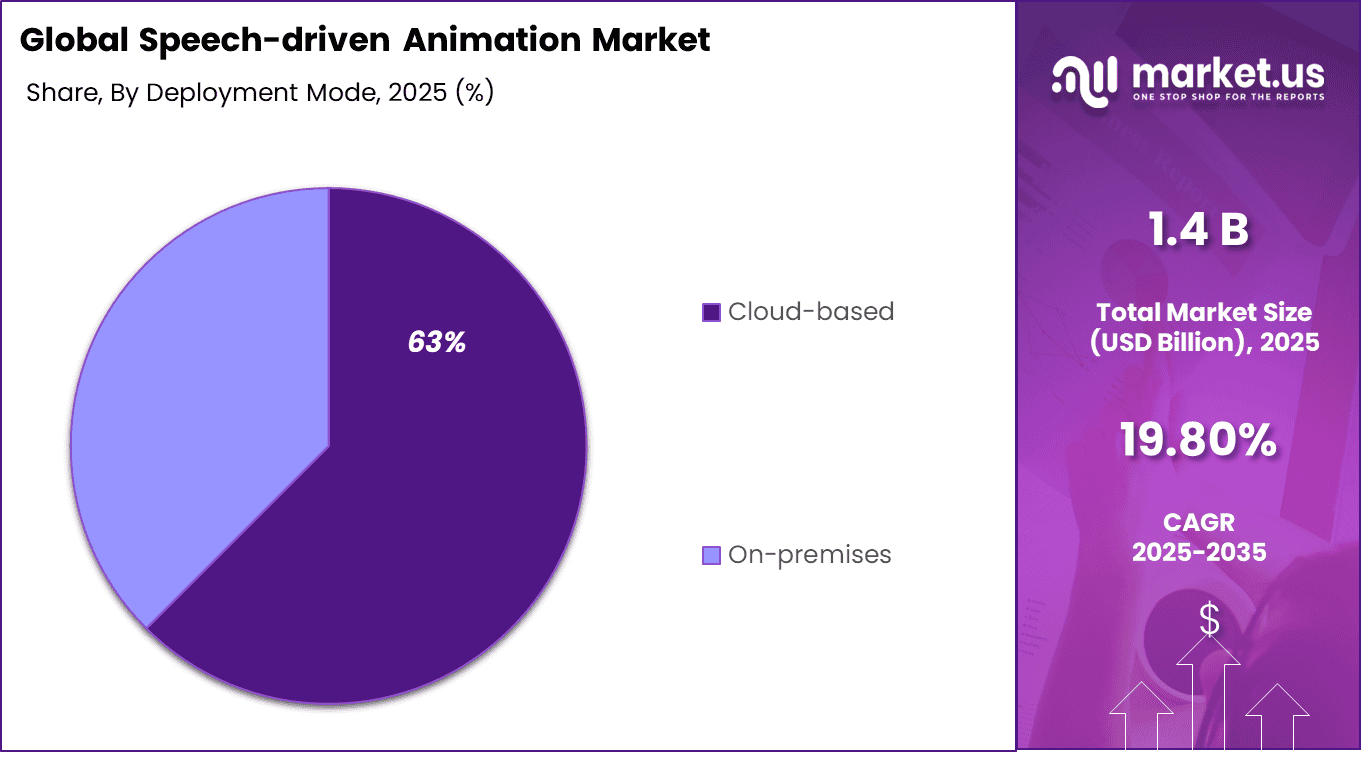
Cloud-based deployment holds 62.5%, enabling scalable processing, collaborative workflows, and integration with game engines or streaming platforms.
Media & entertainment captures 70.2%, powering films, games, and interactive experiences with phoneme-accurate animation and emotional performance mapping.
Professional studios & agencies lead end-users at 52.6%, leveraging tools for cost-effective voiceover localization, motion capture alternatives, and rapid prototyping.
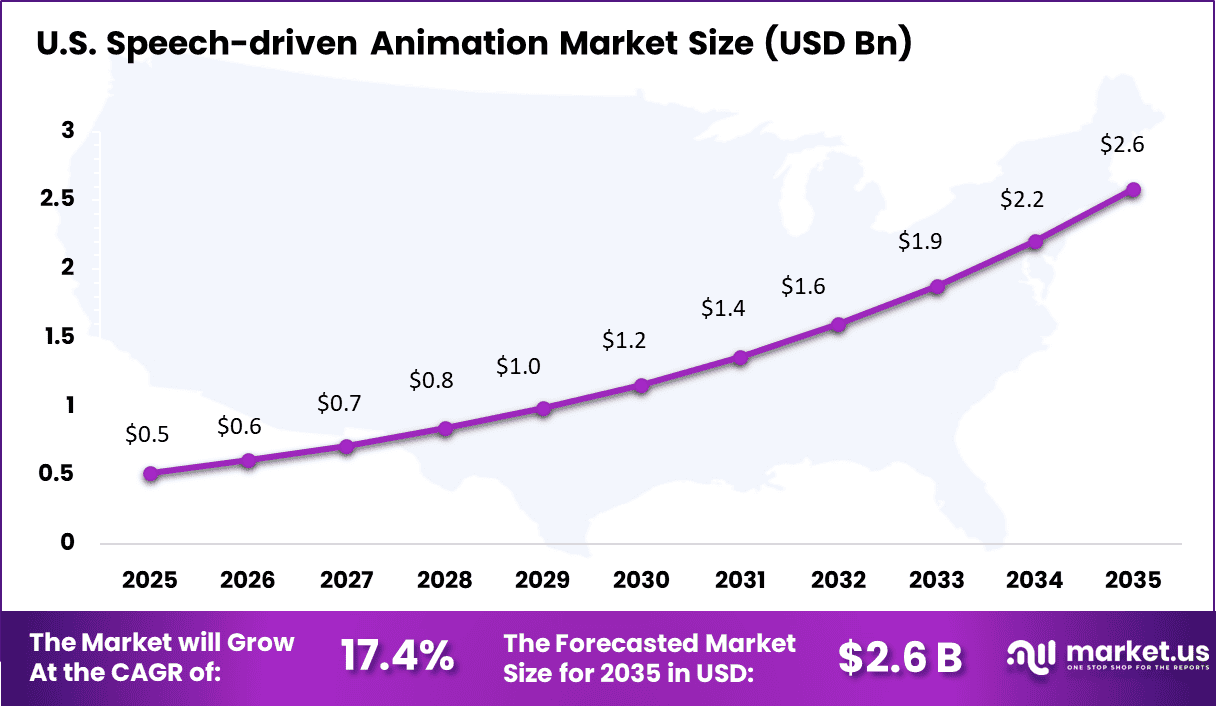
North America drives 40.8% global value, with U.S. market at USD 0.52 billion and 17.4% CAGR, fueled by Hollywood VFX pipelines and metaverse content creation.
Speech driven animation is a technology that uses voice input to generate facial expressions, lip movement, and character actions in real time or during content creation. It is widely used in gaming, film production, virtual assistants, and digital avatars to make interactions more natural and engaging.
Instead of manually animating characters frame by frame, creators can use spoken dialogue to drive animation, which saves time and improves realism. As digital content becomes more interactive and immersive, this technology is gaining importance in creating lifelike and responsive characters.
One of the main driving factors is the rapid growth of digital content creation across entertainment, marketing, and online platforms. Creators are looking for faster and more efficient ways to produce high quality animation, and speech driven tools help reduce production time and effort.
In addition, the increasing use of virtual avatars in customer interaction, gaming, and virtual environments is encouraging the adoption of this technology. Advances in voice recognition and artificial intelligence are also improving the accuracy of lip sync and emotional expression, making animations more realistic. The shift toward interactive and real time experiences is further supporting the use of speech driven animation systems.
Demand for speech driven animation solutions is rising as industries seek scalable and user friendly tools for content production. There is a strong preference for solutions that can deliver accurate lip synchronization, support multiple languages, and integrate with existing animation workflows.
Companies are also looking for tools that can handle real time processing for applications such as live streaming and virtual communication. The demand is particularly strong in sectors that rely on digital storytelling and user engagement. As audiences expect more realistic and interactive content, the need for efficient and intelligent animation solutions is expected to grow steadily.
Drivers Impact Analysis
Key Driver
Impact on CAGR Forecast (~%)
Geographic Relevance
Impact Timeline
Additional Insight
Rising adoption of AI-driven animation and content creation
+4.5%
North America, Europe, Asia Pacific
Medium to long term
AI simplifies animation workflows
Growing demand for virtual avatars and digital humans
+4.1%
Global
Medium term
Avatars enhance user engagement
Expansion of gaming, film, and media industries
+3.8%
Global
Medium to long term
Media growth increases animation demand
Increasing use in e-learning and virtual training
+3.3%
Global
Medium term
Interactive content boosts adoption
Rising popularity of metaverse and immersive experiences
+3.0%
Developed markets
Medium to long term
Immersive platforms require realistic animation
Restraints Impact Analysis
Key Restraint
Impact on CAGR Forecast (~%)
Geographic Relevance
Impact Timeline
Additional Insight
High cost of advanced animation software and tools
-3.2%
Emerging markets
Short to medium term
Cost limits adoption
Complexity in integrating speech and animation systems
-2.7%
Global
Medium term
Integration challenges persist
Dependence on high-quality speech input and data
-2.3%
Global
Medium term
Poor input affects output quality
Limited awareness in traditional industries
-1.9%
Developing regions
Medium term
Adoption remains slower
Data privacy and ethical concerns in AI-generated content
-1.6%
North America, Europe
Medium to long term
Concerns affect acceptance
By Component Analysis
The software segment accounted for 78.3% of the market share, reflecting its central role in enabling speech-to-animation conversion and real-time character rendering. This dominance is supported by the increasing demand for tools that can synchronize voice inputs with facial expressions and body movements. Software solutions provide flexibility, automation, and advanced editing capabilities, which are essential for creating realistic and engaging animated content.
Another factor driving this segment is the growing adoption of AI-based animation tools that improve accuracy and reduce production time. These platforms allow creators to generate animations efficiently without extensive manual effort. The ability to integrate with existing animation workflows further strengthens the importance of software in this market.
By Deployment Mode Analysis
The cloud-based segment held 63% share, driven by the need for scalable and accessible animation solutions. Cloud deployment allows users to process complex animation tasks without relying on high-end local hardware. This makes it easier for studios and creators to access powerful tools and collaborate remotely across different locations.
In addition, cloud platforms support faster updates and seamless integration with other digital tools. They enable efficient project management and resource sharing, which improves overall productivity. This flexibility has encouraged wider adoption of cloud-based deployment in speech-driven animation workflows.
By Application Analysis
The media and entertainment segment captured 70.2% of the market, driven by the increasing use of animated content in films, television, gaming, and digital media. Speech-driven animation helps creators produce realistic characters and immersive storytelling experiences. This technology is widely used to enhance content quality and reduce production time in creative projects.
Furthermore, the growing demand for digital content across streaming platforms and online channels has increased the need for efficient animation solutions. Studios are adopting advanced tools to keep up with content production requirements and audience expectations. This has strengthened the role of speech-driven animation in the media and entertainment industry.
By End-User Analysis
The professional studios and agencies segment accounted for 52.6% of the market share, reflecting their strong adoption of advanced animation technologies. These organizations require high-quality tools to produce detailed and realistic animations for various projects. Speech-driven animation software helps them streamline workflows and improve output consistency.
Moreover, studios and agencies are continuously investing in innovative technologies to stay competitive in the content production space. The ability to create high-quality animations quickly and efficiently gives them a strategic advantage. This has increased the demand for speech-driven animation solutions among professional users.
Investor Type Impact Analysis
Investor Type
Growth Sensitivity
Risk Exposure
Geographic Focus
Investment Outlook
Venture capital firms
Very high
High
US, Europe
Investing in AI animation startups
Private equity firms
High
Moderate
North America and Europe
Scaling digital content platforms
Corporate investors
Very high
Moderate
Global
Strategic investments in media and AI technologies
Institutional investors
Moderate to high
Moderate
Developed markets
Focus on stable media tech firms
Government and public funding bodies
Moderate
Low
Global
Supporting digital innovation initiatives
Technology Enablement Analysis
Technology
Impact on CAGR Forecast (~%)
Geographic Relevance
Impact Timeline
Additional Insight
Speech-to-animation AI engines
+4.7%
US, Europe
Medium to long term
Converts speech into animation automatically
Natural language processing for dialogue generation
+4.2%
Global
Medium term
Improves conversational realism
Real-time rendering and animation tools
+3.8%
Developed markets
Medium to long term
Enables faster content creation
Integration with AR/VR platforms
+3.5%
Global
Medium to long term
Supports immersive experiences
Cloud-based animation platforms
+3.1%
Global
Short to medium term
Enables scalable production workflows
Key Challenges
High cost of advanced software and tools limits adoption.
Need for powerful hardware to process speech and animation in real time.
Accuracy issues in lip-sync and facial expressions.
Limited support for different languages and accents.
Complex setup and learning curve for new users.
Integration challenges with existing animation and design tools.
Data privacy concerns when using voice data.
Dependence on high-quality audio input for best results.
Frequent updates required to improve performance and features.
Lack of skilled professionals in speech and animation technologies.
Emerging Trends
The speech driven animation market is evolving toward more realistic and automated content creation that closely mimics human expression. One of the key emerging trends is the use of AI based voice to animation engines that can convert spoken audio into accurate lip movements and facial expressions in real time. This is reducing the need for manual animation and speeding up production workflows.
Another important trend is the growing use of these tools in virtual avatars and digital humans, where speech synchronization plays a critical role in delivering natural interactions. There is also increasing adoption of multilingual voice processing, allowing a single animated character to speak different languages while maintaining synchronized expressions. In addition, cloud based platforms are enabling creators to generate animated content remotely and collaborate across teams more efficiently. The integration of emotional tone detection is further enhancing realism, as animations can now reflect mood and intent based on voice input.
Growth Factors
The growth of this market is driven by the rising demand for engaging digital content across entertainment, marketing, and communication platforms. As video content becomes more central to storytelling and user engagement, creators are looking for faster and more cost effective ways to produce high quality animations. The expansion of virtual communication, including online education and customer interaction, is also supporting demand for animated avatars that can communicate clearly and naturally.
Another major factor is the need to reduce production time and dependency on skilled animators, which is encouraging the use of automated tools. The increasing adoption of immersive technologies such as virtual and augmented environments is further creating opportunities for speech driven animation in interactive experiences. Additionally, the push toward personalized content is driving the need for scalable animation solutions that can adapt quickly to different voices and contexts, supporting continued growth in this market.
Key Market Segments
By Component
Hardware
Software
Services
By Deployment Mode
Cloud-based
On-Premises
By Application
Media & Entertainment
Film, Animation & VFX
Gaming
VTubing & Virtual Influencers
Enterprise & Marketing
Corporate Training & E-learning
Advertising & Explainer Videos
Education & E-Learning
Healthcare
Others
By End-User
Professional Studios & Agencies
Individual Creators & Prosumers
Enterprises
Academic & Research Institutions
Regional Analysis
North America accounted for 40.8% of the Speech-driven Animation market, supported by strong adoption of advanced content creation technologies and a well-established media and entertainment industry. The region is witnessing increasing use of speech-driven animation in gaming, film production, virtual avatars, and digital marketing, where realistic lip-sync and character expression are important.
Companies are focusing on improving animation workflows by integrating voice-based automation, which reduces manual effort and speeds up production timelines. In addition, growing demand for immersive digital experiences and interactive content is strengthening the adoption of speech-driven animation tools across various creative industries.
The U.S. market reached USD 0.52 Billion and is projected to grow at a CAGR of 17.4%, driven by rising demand for scalable and efficient animation solutions. Content creators and studios are increasingly adopting speech-driven technologies to produce high-quality animations with faster turnaround times.
The growth of virtual influencers, online gaming, and metaverse-related applications is also contributing to demand. Businesses are leveraging these tools to create engaging visual content for marketing, training, and entertainment purposes. This trend is expected to support strong growth in the US market over the coming years as digital content consumption continues to expand.
Key Regions and Countries
North America
US
Canada
Europe
Germany
France
The UK
Spain
Italy
Russia
Netherlands
Rest of Europe
Asia Pacific
China
Japan
South Korea
India
Australia
Singapore
Thailand
Vietnam
Rest of APAC
Latin America
Brazil
Mexico
Rest of Latin America
Middle East & Africa
South Africa
Saudi Arabia
UAE
Rest of MEA
Competitive Analysis
The competitive landscape of the Speech-driven Animation Market is driven by strong participation from global technology companies and AI platform providers. Companies such as Microsoft Corporation, Google LLC, IBM Corporation, Amazon Web Services (AWS), Apple Inc., NVIDIA Corporation, and Adobe Inc. focus on integrating speech recognition, artificial intelligence, and real-time rendering into animation tools.
These players offer advanced platforms that support voice-driven facial animation, virtual avatars, and content creation for gaming, media, and enterprise applications. Their strong research capabilities and large ecosystems help them maintain a leading position in the market.
At the same time, specialized companies such as Descript Inc., Speech Graphics Ltd., ObEN Inc., DeepMotion Inc., Soul Machines Ltd., Pinscreen Inc., and Synthesia Ltd. focus on niche solutions such as AI avatars, lip-sync animation, and digital humans. Companies like Facebook (Meta Platforms, Inc.), Baidu, Inc., and Tencent Holdings Ltd. are also expanding their presence by investing in virtual reality and metaverse-related applications. Competition in this market is driven by innovation in AI models, realism of animation, and ease of content creation, as demand grows for interactive and personalized digital experiences.
The future outlook for the Speech-driven Animation Market looks very promising as demand for realistic digital content continues to grow across entertainment, gaming, marketing, and virtual communication. The market is expected to expand with increasing use of AI technologies that can convert speech into natural facial expressions and character movements. Businesses and content creators are anticipated to adopt these tools to save time and reduce production costs. In the coming years, improvements in voice recognition, real-time rendering, and cloud-based platforms are expected to make speech-driven animation more accurate, scalable, and widely used across industries.
Recent Developments
January, 2026 – AWS Amazon Nova Reel creates 4K avatars from voice clones with head pose control. Bedrock foundation models generate scripts while S3 stores petabyte-scale training data; Twitch streamers monetize AI co-hosts automatically.
February, 2026 – Meta Codec Avatars 2.0 renders photoreal faces from audio in Horizon Worlds. Gaussian splatting compresses 100x while hand-tracking syncs gestures; Instagram Reels filters animate selfies talking back conversationally.
Report Scope
Report Features
Description
Market Value (2025)
USD 1.4 Billion
Forecast Revenue (2035)
USD 8.7 Billion
CAGR(2025-2035)
19.80%
Base Year for Estimation
2024
Historic Period
2020-2024
Forecast Period
2025-2035
Report Coverage
Revenue forecast, AI impact on Market trends, Share Insights, Company ranking, competitive landscape, Recent Developments, Market Dynamics and Emerging Trends
Segments Covered
By Component (Hardware, Software, Services), By Deployment Mode (Cloud-based, On-Premises), By Application (Media & Entertainment (Film, Animation & VFX), Enterprise & Marketing (Corporate Training & E-learning, Advertising & Explainer Videos), Education & E-Learning, Healthcare, Others), By End-User (Professional Studios & Agencies, Individual Creators & Prosumers)
Regional Analysis
North America – US, Canada; Europe – Germany, France, The UK, Spain, Italy, Russia, Netherlands, Rest of Europe; Asia Pacific – China, Japan, South Korea, India, New Zealand, Singapore, Thailand, Vietnam, Rest of Latin America; Latin America – Brazil, Mexico, Rest of Latin America; Middle East & Africa – South Africa, Saudi Arabia, UAE, Rest of MEA
Competitive Landscape
Microsoft Corporation, Google LLC, IBM Corporation, Amazon Web Services (AWS), Apple Inc., Adobe Inc., Facebook (Meta Platforms, Inc.), NVIDIA Corporation, Baidu, Inc., Tencent Holdings Ltd., Descript Inc., Speech Graphics Ltd., ObEN Inc., DeepMotion Inc., Soul Machines Ltd., Pinscreen Inc., Synthesia Ltd., Others
Customization Scope
Customization for segments, region/country-level will be provided. Moreover, additional customization can be done based on the requirements.
Purchase Options
We have three license to opt for: Single User License, Multi-User License (Up to 5 Users), Corporate Use License (Unlimited User and Printable PDF)