


Report Overview
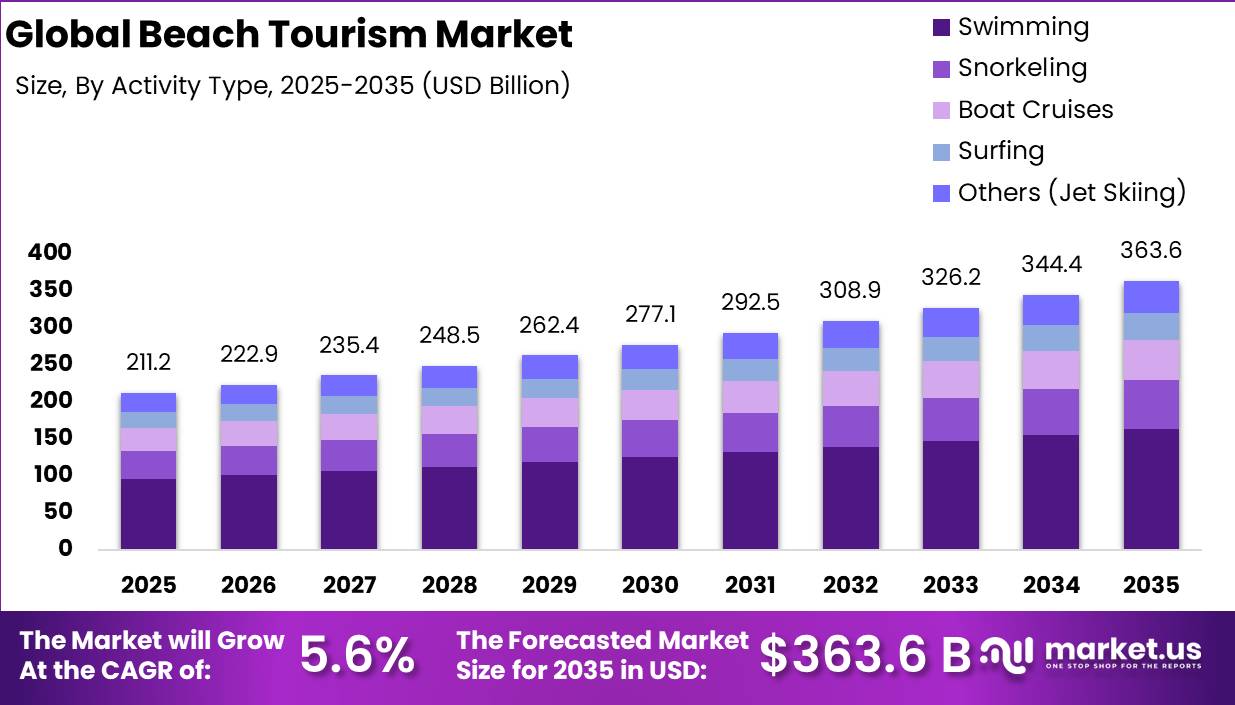
Global Beach Tourism Market size is expected to be worth around USD 363.6 Billion by 2035 from USD 211.2 Billion in 2025, growing at a CAGR of 5.6% during the forecast period 2026 to 2035.
Beach tourism covers all leisure, recreational, and hospitality activity centered on coastal and shoreline destinations. The market spans domestic and international travel, resort accommodation, water-based recreation, cruise excursions, and coastal dining. Operators range from large integrated resort chains to boutique coastal lodges, online travel agencies, and cruise lines serving beachfront destinations.
Key Takeaways
- The global beach tourism market is valued at USD 211.2 Billion in 2025 and is forecast to reach USD 363.6 Billion by 2035 at a CAGR of 5.6%.
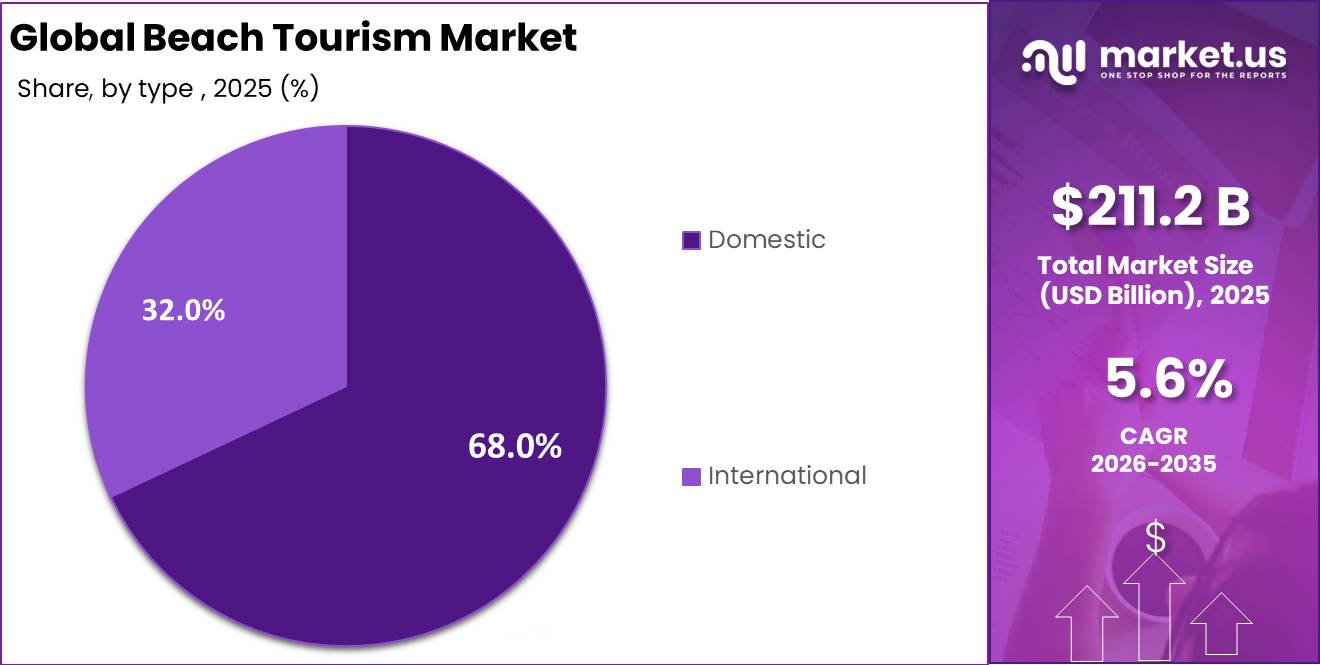
- Domestic travel dominates the By Type segment with a 68.0% share in 2025.
- Swimming and Sunbathing leads the By Activity Type segment with a 45.0% share in 2025.
- The 26 to 35 Years age group holds the top position in the By Age Group segment with a 32.0% share in 2025.
- Family travelers dominate the By Traveler Type segment with a 45.0% share in 2025.
- Online Travel Agencies lead the By Booking Channel segment with a 55.0% share in 2025.
- Peak Season dominates the By Season segment with a 70.0% share in 2025.
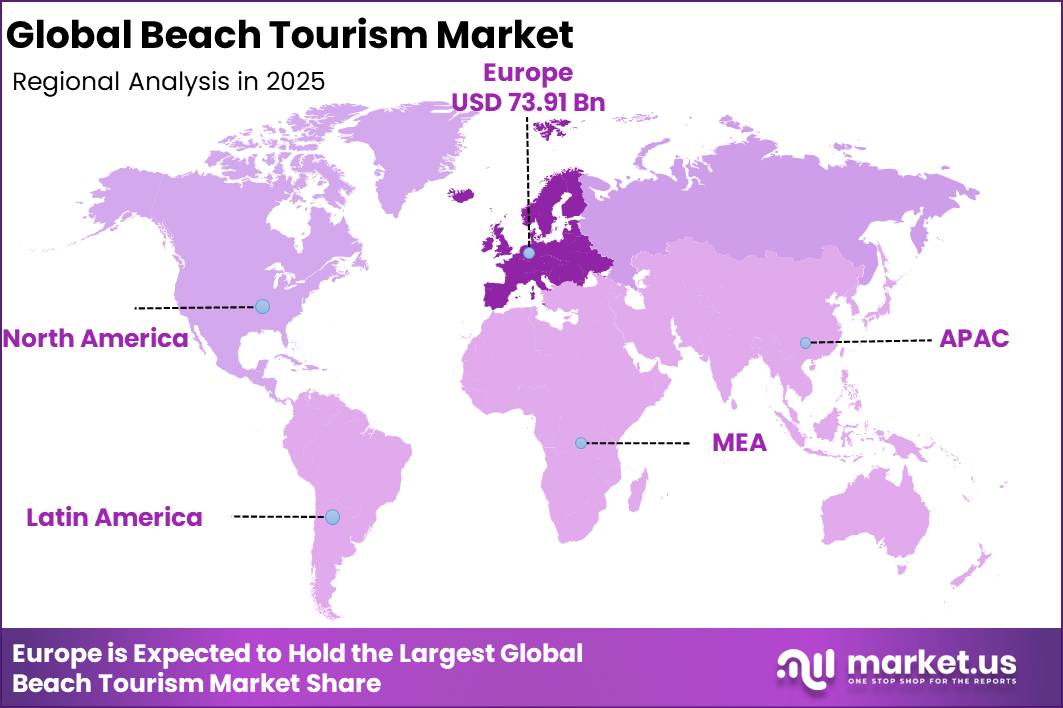
- Europe is the dominant region, holding a 35.0% market share valued at USD 7.39 Billion in 2025.
Government investment in coastal infrastructure is reshaping destination competitiveness. The EU Blue Economy framework actively channels public funds into coastal asset protection and tourism modernization. Red Sea Global confirmed its takeover of Sindalah Island in June 2026, demonstrating how state-backed megaprojects are becoming primary tools for expanding high-yield beach tourism capacity in emerging regions.
According to the EU Blue Economy Observatory, coastal areas across the European Union recorded almost 1.5 billion tourist accommodation nights in 2024, representing a 3.6% increase from 2023. This volume signals durable consumer preference for coastal stays. Investors targeting European beachfront assets face a market where occupancy density is already high and supply constraints support premium pricing.
The EU Blue Economy Observatory also reports that coastal destinations accounted for 42% of total EU tourist accommodation bed capacity in 2024, equivalent to approximately 12.5 million bed places. This concentration means coastal hospitality absorbs a disproportionate share of European travel spend. New entrants must compete against an entrenched inventory base, making differentiation through experience and sustainability central to any viable market strategy.
Type Analysis
Domestic dominates with 68.0% due to lower cost barriers and shorter trip planning cycles.
In 2025, Domestic travel held a dominant market position in the By Type segment of the Beach Tourism Market, with a 68.0% share. The EU Blue Economy Observatory found that foreign tourists generated 58% of all tourism activity in EU coastal regions during 2024, confirming that international demand is structurally strong in Europe even as domestic volumes lead globally. This contrast signals that coastal markets with strong inbound infrastructure can monetize both traveler cohorts effectively.
International travel accounts for the remaining 32.0% of the By Type segment. UNEP data indicates that tourism contributes approximately 10% of global GDP and supports approximately 1 in every 10 jobs worldwide. This scale means international beach tourism is not a niche flow but a structural pillar of national income in coastal economies. Destinations that capture more international arrivals gain outsized economic leverage relative to their geographic size.
Activity Type Analysis
Swimming and Sunbathing dominates with 45.0% due to universal accessibility and zero specialized equipment cost.
In 2025, Swimming and Sunbathing held a dominant market position in the By Activity Type segment of the Beach Tourism Market, with a 45.0% share. This activity requires no booking intermediary, specialized gear, or skill certification, which makes it the default behavior for the broadest cross-section of beachgoers. Coastal and maritime tourism operators who anchor offerings around passive beach experiences serve the largest addressable volume but face intense price competition and low differentiation risk.
Snorkeling and Scuba Diving holds a 18.0% share in the By Activity Type segment. The Cruise Lines International Association reports that global cruise passenger volume reached 31.7 million travelers in 2023, exceeding 2019 levels by 7%. As cruise itineraries increasingly incorporate guided dive excursions at reef destinations, dive operators on Caribbean and Indo-Pacific routes gain a captive, high-spending consumer base. Royal Caribbean Group announced its first European private shore destination, the Royal Beach Club Santorini in Greece in October 2025, signaling that cruise lines are accelerating investment in shore-side activity infrastructure.
Boat Cruises and Yachting holds a 15.0% share. The Cruise Lines International Association data also shows that 27% of cruise passengers in 2023 were first-time cruisers. This new entrant pool represents a conversion opportunity for yachting and private charter operators who can capture upgraders seeking more exclusive coastal experiences after their first mainstream cruise.
Surfing and Windsurfing accounts for 10.0% of the By Activity Type segment, while Others including Jet Skiing, Parasailing, Fishing, and Volleyball collectively hold the remaining 12.0%. The Cruise Lines International Association further reports that expedition cruise passenger volume increased by 71% between 2019 and 2023. This shift toward adventure-oriented coastal travel supports growth across niche water sports, creating room for specialized operators beyond the mass swimming and sunbathing category.
Age Group Analysis
26-35 Years dominates with 32.0% due to high digital engagement and disposable income mobility.
In 2025, the 26 to 35 Years age group held a dominant market position in the By Age Group segment of the Beach Tourism Market, with a 32.0% share. This cohort combines digital-native booking behavior with peak early-career spending capacity. Platforms and resorts that optimize mobile discovery, flexible cancellation, and experience-led packages capture this demographic most effectively and build the loyalty pipeline for longer-term repeat travel.
Traveler Type Analysis
Family dominates with 45.0% due to school calendar travel cycles and multi-person booking value.
In 2025, Family travelers held a dominant market position in the By Traveler Type segment of the Beach Tourism Market, with a 45.0% share. The EU Blue Economy Observatory notes that nearly 30% of the 920 million tourism trips taken by EU residents in 2022 were influenced by the coastal characteristics of the destination. Family groups disproportionately drive this coastal pull, as beach environments reduce the planning complexity of entertaining mixed-age groups. Resorts that offer integrated children’s programming alongside adult amenities capture the highest revenue-per-booking in this segment.
Booking Channel Analysis
Online Travel Agencies dominate with 55.0% due to price comparison tools and consolidated inventory access.
In 2025, Online Travel Agencies held a dominant market position in the By Booking Channel segment of the Beach Tourism Market, with a 55.0% share. Booking.com data shows that 85% of travelers globally consider sustainable travel important when making travel decisions. This consumer expectation is now a booking filter, not merely a preference. OTAs that prominently display sustainability credentials in search results gain a structural conversion advantage over those that do not surface this information.
Direct Booking, Offline Travel Agents, and Others collectively account for the remaining 45.0% of the By Booking Channel segment. Booking.com data also shows that more than 100 million room nights were booked at sustainability-certified accommodations through its platform during 2025. This volume confirms that eco-certification is becoming a mainstream booking trigger, not a niche filter. Hotels and resorts that invest in recognized green certification standards can redirect a measurable share of OTA-driven demand toward their own direct channels.
Season Analysis
Peak Season dominates with 70.0% due to school holiday synchronization and favorable weather certainty.
In 2025, Peak Season held a dominant market position in the By Season segment of the Beach Tourism Market, with a 70.0% share. Booking.com research shows that 43% of travelers plan to avoid crowded tourist destinations. This behavioral signal creates a structural opening for off-season coastal products, particularly in temperate and Mediterranean regions where shoulder months offer viable conditions. Operators who invest in year-round amenity programming can shift occupancy curves and reduce the revenue volatility that peak-season dependence creates.
Key Market Segments
By Type
- Domestic
- International
By Activity Type
- Swimming and Sunbathing
- Snorkeling and Scuba Diving
- Boat Cruises and Yachting
- Surfing and Windsurfing
- Others
- Jet Skiing
- Parasailing
- Fishing
- Volleyball
By Age Group
- 26–35 Years
- 36–45 Years
- 46–60 Years
- 15–25 Years
- 61 Years and Above
By Traveler Type
- Family
- Couple
- Group
- Solo
By Booking Channel
- Online Travel Agencies
- Direct Booking
- Offline Travel Agents
- Others
By Season
- Peak Season
- Off-Season
Regional Analysis
Europe Dominates the Beach Tourism Market with a Market Share of 35.0%, Valued at USD 7.39 Billion
Europe holds the leading position in the global beach tourism market through its combination of high-density coastal infrastructure, intra-regional air connectivity, and a mature outbound travel culture. The Mediterranean basin anchors demand across France, Spain, Italy, and Greece, while regulatory frameworks under the EU Blue Economy initiative sustain continued public investment in coastal destination quality and environmental standards.
Asia Pacific represents a high-growth regional opportunity driven by a large and rapidly expanding middle class across China, India, Southeast Asia, and Australia. The region still lagged 13% below 2019 international arrival levels as of 2024, creating a defined catch-up trajectory that beach-heavy destinations in Southeast Asia and Pacific islands are positioned to capture as air routes expand and visa friction decreases. In January 2026, Indian Hotels Company Limited secured a 51% stake in Brij Hospitality to accelerate boutique coastal retreats across India, signaling that domestic capital is actively building beachfront inventory to meet anticipated demand.
North America sustains strong beach tourism volumes through domestic coastal travel along Florida, Hawaii, the Gulf Coast, and the Caribbean gateway markets. In July 2025, Carnival Cruise Line opened Celebration Key on Grand Bahama Island, a USD 600 million purpose-built port destination. This investment illustrates how cruise-linked beach infrastructure is extending land-based spend per visitor across Caribbean coastal economies.
Key Regions and Countries
North America
- US
- Canada
Europe
- Germany
- France
- The UK
- Spain
- Italy
- Rest of Europe
Asia Pacific
- China
- Japan
- South Korea
- India
- Australia
- Rest of APAC
Latin America
- Brazil
- Mexico
- Rest of Latin America
Middle East and Africa
- GCC
- South Africa
- Rest of MEA
Market Dynamics
Market Opportunity Analysis - Underexploited segments and emerging regions offer high-yield entry points for coastal tourism investors
The Off-Season segment currently captures only 30% of beach tourism bookings globally, yet shoulder-period coastal conditions across Mediterranean and Southeast Asian destinations remain commercially viable. Operators who build year-round programming and flexible pricing into their coastal properties can shift occupancy away from the peak-only revenue model and access a demand cohort that currently defaults to non-beach alternatives due to crowd avoidance preferences.
The 36 to 45 Years and 46 to 60 Years age groups represent underpenetrated segments within the By Age Group breakdown. These cohorts carry higher disposable income than the dominant 26 to 35 group but receive proportionally less product development attention from beach resorts. Wellness-led coastal packages, private beach access, and low-density retreat formats directly address the preference profiles of these higher-yield travelers and can deliver superior revenue per occupied room.
Solo and Group traveler types remain secondary to the dominant Family segment, yet both cohorts exhibit distinct spending patterns that current coastal resort products underserve. Group travel supports higher-margin event and buyout business, while solo travel intersects directly with the bleisure hub opportunity identified in Task 8. Destinations that develop purpose-built solo and small-group coastal products can capture growing demand from remote workers and experience-first travelers without expanding physical footprint.
The Middle East and Africa region holds significant structural upside relative to its current market penetration. State-backed coastal megaprojects in the Red Sea and Gulf corridors are formalizing destinations that previously lacked investable infrastructure. Africa’s Indian Ocean coastlines, including Zanzibar, the Seychelles, and Mozambique, attract early-stage investor interest but remain underbuilt relative to their natural asset quality, creating acquisition and development windows before institutional capital reprices these markets.
Technology and Innovation Landscape - AI personalization, sustainability integration, and resilience infrastructure are redefining competitive positioning in beach tourism
AI-powered dynamic travel planning is emerging as the primary technology differentiator in beach tourism distribution. Platforms that deploy AI to personalize coastal vacation itineraries based on weather forecasts, crowd data, and traveler preference history can convert higher-intent browsers into confirmed bookers. This capability directly addresses the 43% of travelers who plan to avoid crowded destinations, giving AI-enabled OTAs a measurable booking conversion advantage over static catalog platforms.
Sustainability rating integration into beach resort booking decisions represents a technology-driven structural shift in how coastal inventory is discovered and selected. Online Travel Agencies that embed verified eco-certification scores into search ranking algorithms shift demand toward rated properties without requiring travelers to actively filter for green options. This passive sustainability routing raises the competitive floor for all coastal operators and creates a technology dependency between resort operators and platform providers.
Parametric insurance technology is gaining adoption among coastal resort operators and cruise line shore excursion businesses facing rising weather volatility. Unlike traditional indemnity policies, parametric structures trigger automatic payouts when predefined weather thresholds, such as wind speed or rainfall levels, are crossed, removing the loss assessment delay that traditionally disrupts operational cash flow after weather events. This technology directly reduces the CAGR friction identified in the challenge analysis and makes coastal assets more financeable for lenders and private equity buyers.
Short-form video content on social media platforms is functioning as a demand-generation technology for previously unknown coastal destinations. Destinations that invest in digital content production infrastructure and creator partnerships can compress the discovery-to-booking cycle for new visitor cohorts. This makes social media strategy an operational investment decision with measurable demand-side returns, not merely a marketing cost for beach tourism operators seeking to diversify their source market mix.
Drivers
UN Tourism estimated 1.4 billion international tourists in 2024, up 11% over 2023, with global arrivals at 99% of pre-pandemic levels and tourism receipts reaching approximately USD 1.6 trillion. Beach holidays sit within the first-wave discretionary categories consumers restore as travel uncertainty eases. This demand pattern gives coastal destination operators a reliable lead indicator for capacity planning and pricing strategy across 2025 and 2026.
Regionally, the Middle East reached 32% above 2019 arrival levels in 2024, while Africa exceeded 2019 by 7% and Europe stood 1% above. Asia-Pacific still lagged 13% below 2019, representing the largest single catch-up opportunity in the market. By the first half of 2025, global arrivals were already 5% above the same period in 2024 and 4% above 2019 levels. Operators in under-recovered coastal markets can use this recovery trajectory to justify near-term capacity investment before peak rebound demand prices out entry-level assets.
| Driver | (~) % Impact on CAGR Forecast | Geographic Relevance | Impact Timeline |
|---|---|---|---|
| Air connectivity recovery for coastal gateways | +1.4% | APAC corridors, Mediterranean EU, Middle East hubs, Latin America leisure routes | Short term |
| International arrivals normalization and beach demand rebound | +1.2% | Europe core, Middle East, Africa coasts, Asia-Pacific islands, Caribbean | Short term |
| Premium resort and experiential spend mix-up | +0.9% | Indian Ocean islands, Southeast Asia, Southern Europe, Mexico, GCC beach clusters | Medium term |
| Domestic and short-haul substitution into beach trips | +0.8% | India, Brazil, China, Japan, intra-Europe, ASEAN | Short term |
| Sustainability certification and coastal asset upgrading | +0.6% | EU beaches, India, Mediterranean, selected Africa and Latin America shorelines | Medium term |
| Public-private coastal infrastructure and destination formalization | +0.7% | Middle East mega-destinations, Southeast Asia, Africa coast belts, South America spill-over | Long term |
Restraints
Physical climate deterioration is the most structurally damaging restraint facing beach tourism because it directly degrades the core asset being sold. A Caribbean analysis found that with a 1 meter sea-level rise, 29% of 900 coastal resorts across 19 countries could face partial or full inundation, and as many as 60% could face erosion risk. European climate-tourism research indicates coastal tourism in southern Europe could decline around 10% under 3 to 4 degrees of warming.
For operators, climate risk translates into shorter monetizable beach frontage, higher annual spending on beach nourishment and protective works, more weather-related closure days, and weaker peak-season pricing power. Climate damage also compresses margins through recurring remediation costs, raises financing costs for exposed properties, and delays new coastal capital expenditure as lenders increasingly discount projected occupancy in erosion-prone zones. This restraint structurally limits revenue growth independent of demand levels.
| Restraint | (~) % Impact on CAGR Forecast | Geographic Relevance | Impact Timeline |
|---|---|---|---|
| Climate erosion & heat stress | -1.4% | Caribbean, Mediterranean, Indian Ocean, Pacific islands | Long term |
| Travel cost inflation | -1.2% | North America outbound, EU outbound, APAC long-haul corridors | Short term |
| Overtourism caps & access rules | -0.9% | Southern Europe, island beaches, protected coastal zones | Medium term |
| Water scarcity & utility stress | -0.8% | Mediterranean, MENA resorts, small islands, coastal India | Medium term |
| Labor shortages & wage pressure | -0.7% | North America, EU, Caribbean, high-season APAC beaches | Short term |
| Insurance and resilience CapEx burden | -0.6% | Hurricane belts, wildfire-prone coasts, erosion-exposed resort strips | Medium term |
Challenges
Climate-sensitive insurance and logistics represent a growing operational friction for beach hotels and coastal resort assets, particularly in hurricane and typhoon-prone regions and remote island destinations. Insurance costs for coastal properties in high-risk zones have risen by double-digit percentages in recent renewal cycles, while higher deductibles for wind and flood damage shift greater loss exposure directly onto operators. This forces partial self-insurance and requires larger liquidity buffers that constrain capital available for renovation and expansion.
Weather disruptions are also increasing logistics lead-time variability by several days during storm seasons, raising working capital needs by mid-single-digit percentages as businesses stockpile food, fuel, and maintenance supplies. These pressures are estimated to reduce potential beach tourism CAGR by around 0.6 percentage points, with the strongest impact concentrated in small island and highly exposed coastal economies. Operators adopting parametric insurance structures and resilience upgrades can partially offset these friction costs and convert climate risk management into a competitive differentiator.
| Challenge | (~) % CAGR Friction Drag | Geographic Relevance | Mitigation Horizon |
|---|---|---|---|
| Climate-driven coastal risk | -1.2% | Small island & low-lying coasts (Caribbean, Indian Ocean, Pacific, SE Asia) | Long term (≥ 4 years) |
| Overtourism & resident backlash | -0.9% | Mediterranean & European beach hubs, select Asian hotspots | Medium term (2-4 years) |
| Cost inflation & labor tightness | -1.0% | North America, Europe, high-cost APAC beach economies | Medium term (2-4 years) |
| Coastal infrastructure & ecosystem limits | -0.8% | Densely built beach corridors in Europe, Asia, Latin America | Long term (≥ 4 years) |
| Climate-sensitive insurance & logistics | -0.6% | Hurricane/typhoon belts, exposed archipelagos, remote coasts | Medium term (2-4 years) |
| Regulatory sustainability compliance creep | -0.5% | EU coastal states, selective Asian and island regulators | Long term (≥ 4 years) |
Opportunities
The bleisure beach hub model converts coastal destinations into 14 to 45-day hybrid work-living products bundling accommodation, coworking, transport, insurance, and local experience subscriptions for remote professionals. A destination shifting even 8% to 10% of annual room nights from 4-night leisure breaks to 21-night mixed-use stays can lift total guest spend by 1.7x to 2.3x through ancillary services. Shoulder-season occupancy can improve by 600 to 1,000 basis points in markets with strong broadband and visa flexibility.
This structural shift can plausibly add around 1.8 percentage points above baseline CAGR in qualifying destinations. Sustainable tourism certification and eco-destination development amplify this upside further. Wellness beach clusters carry a +2.1% potential CAGR upside, while climate-resilient roll-up strategies in hurricane and Indian Ocean markets carry +2.3%. Early movers who combine bleisure positioning with resilience infrastructure and sustainability ratings capture the highest-yield and most defensible revenue per coastal asset.
| Opportunity | (~) % Potential CAGR Upside | Geographic Relevance | Execution Window |
|---|---|---|---|
| Bleisure beach hubs | +1.8% | Southern Europe, Caribbean, SE Asia, GCC | Short term |
| Wellness beach clusters | +2.1% | EU Med, Thailand, Bali, India, Mexico | Medium term |
| Cruise-to-shore capture | +1.4% | Caribbean, Med, Alaska gateway coasts, APAC islands | Short term |
| Blue premium beaches | +1.6% | EU, India, MENA, island economies | Medium term |
| Climate-resilient roll-ups | +2.3% | Florida, Caribbean, Med, Indian Ocean, Pacific | Long term |
| MPA and blue-carbon monetization | +1.2% | Island states, ASEAN coasts, East Africa, Latin America | Long term |
Key Company Insights
Booking Holdings Inc. controls the largest online beach travel distribution network globally, with Online Travel Agencies now capturing 55% of all beach tourism bookings. The EU Blue Economy Observatory confirms that coastal tourism generated 36.5% of total EU Blue Economy GVA, a market where Booking Holdings commands disproportionate intermediary influence. This scale creates a structural moat, but increasing pressure toward direct sustainable tourism bookings threatens their take-rate over time.
Expedia Group, Inc. competes directly in the OTA-dominated booking channel with a strategy built around bundled travel packages combining beach accommodation, flights, and activities. Booking.com data shows 74% of travelers consider extreme weather risks when selecting destinations, and 31% have cancelled or changed plans due to extreme weather events. In May 2026, Nihi opened its Nihi Rote boutique surf destination on Indonesia’s Rote Island, representing the type of premium coastal inventory Expedia targets for its high-margin package products. Expedia’s ability to surface weather-resilient alternatives in real time is a growing differentiator in this environment.
Key Players
- Booking Holdings Inc.
- Expedia Group, Inc.
- Trip.com Group Limited
- Airbnb, Inc.
- Thomas Cook (India) Limited
- TUI Group
- Cox and Kings Ltd.
- Kuoni Group
- Abercrombie and Kent Group
- Sandals Resorts International
- Club Med
- Four Seasons Hotels and Resorts
- Hilton Worldwide Holdings Inc.
- Marriott International, Inc.
- Accor SA
- Others
Recent Developments
- June 1, 2026 – Carnival Cruise Line unveiled the grand expansion of its private destination RelaxAway at Half Moon Cay, adding a new pier for Excel-class ships, an island-wide tram network, and new dining venues including the Orchid Beach Grill.
- July 2, 2025 – Pursuit Attractions and Hospitality acquired the luxury Tabacón Thermal Resort and Spa in Costa Rica’s Arenal region for USD 111 million, marking its strategic entry into Central American leisure tourism.
- September 25, 2025 – Affiliates of KSL Capital Partners acquired The Westin Hilton Head Island Resort and Spa in South Carolina for USD 199.8 million, taking control of the 420-room wellness-focused beachfront property.
- December 23, 2025 – Royal Caribbean International opened the Royal Beach Club Paradise Island in Nassau, Bahamas, debuting a 17-acre island experience featuring swim-up bars, private beach access, and a signature two-story Floating Flamingo bar.
- March 2026 – Construction disclosures confirmed that Sindalah Island, a high-end yachting resort and marina hub in the Red Sea, remains targeted for its soft launch rollout as part of Saudi Arabia’s Vision 2030 program.
- June 2026 – Australian operator Morris Group secured the long-term lease of Double Island from the Queensland Government, announcing an A$40 million (USD 26 million) environmental redevelopment program to revitalize the coastal destination.
Report Scope
| Report Features | Description |
|---|---|
| Market Value (2025) | USD 211.2 Billion |
| Forecast Revenue (2035) | USD 363.6 Billion |
| CAGR (2026-2035) | 5.6% |
| Base Year for Estimation | 2025 |
| Historic Period | 2020-2024 |
| Forecast Period | 2026-2035 |
| Report Coverage | Revenue Forecast, Market Dynamics, Market Opportunity Analysis, Technology and Innovation Landscape, Competitive Landscape, Recent Developments |
| Segments Covered | By Type (Domestic, International), By Activity Type (Swimming and Sunbathing, Snorkeling and Scuba Diving, Boat Cruises and Yachting, Surfing and Windsurfing, Others including Jet Skiing, Parasailing, Fishing, Volleyball), By Age Group (26-35 Years, 36-45 Years, 46-60 Years, 15-25 Years, 61 Years and Above), By Traveler Type (Family, Couple, Group, Solo), By Booking Channel (Online Travel Agencies, Direct Booking, Offline Travel Agents, Others), By Season (Peak Season, Off-Season) |
| Regional Analysis | North America (US and Canada), Europe (Germany, France, The UK, Spain, Italy, and Rest of Europe), Asia Pacific (China, Japan, South Korea, India, Australia, and Rest of APAC), Latin America (Brazil, Mexico, and Rest of Latin America), Middle East and Africa (GCC, South Africa, and Rest of MEA) |
| Competitive Landscape | Booking Holdings Inc., Expedia Group Inc., Trip.com Group Limited, Airbnb Inc., Thomas Cook (India) Limited, TUI Group, Cox and Kings Ltd., Kuoni Group, Abercrombie and Kent Group, Sandals Resorts International, Club Med, Four Seasons Hotels and Resorts, Hilton Worldwide Holdings Inc., Marriott International Inc., Accor SA, Others |
| Customization Scope | Customization for segments, region/country-level will be provided. Additional customization can be done based on requirements. |
| Purchase Options | We have three licenses to opt for: Single User License, Multi-User License (Up to 5 Users), Corporate Use License (Unlimited User and Printable PDF) |





































