


Report Overview
The Global Resource Booking Software Market size is expected to be worth around USD 6.26 billion by 2035, from USD 1.52 billion in 2025, growing at a CAGR of 15.2% during the forecast period from 2025 to 2035. North America held a dominant market position, capturing more than 38.5% share and generating USD 0.58 billion in revenue.
Resource Booking Software refers to a digital system that enables organizations to reserve and manage shared assets such as meeting rooms, desks, equipment, and facilities. It provides real-time visibility, scheduling controls, and usage tracking, helping teams coordinate resources efficiently, reduce conflicts, and improve space utilization across workplaces, institutions, and service environments.
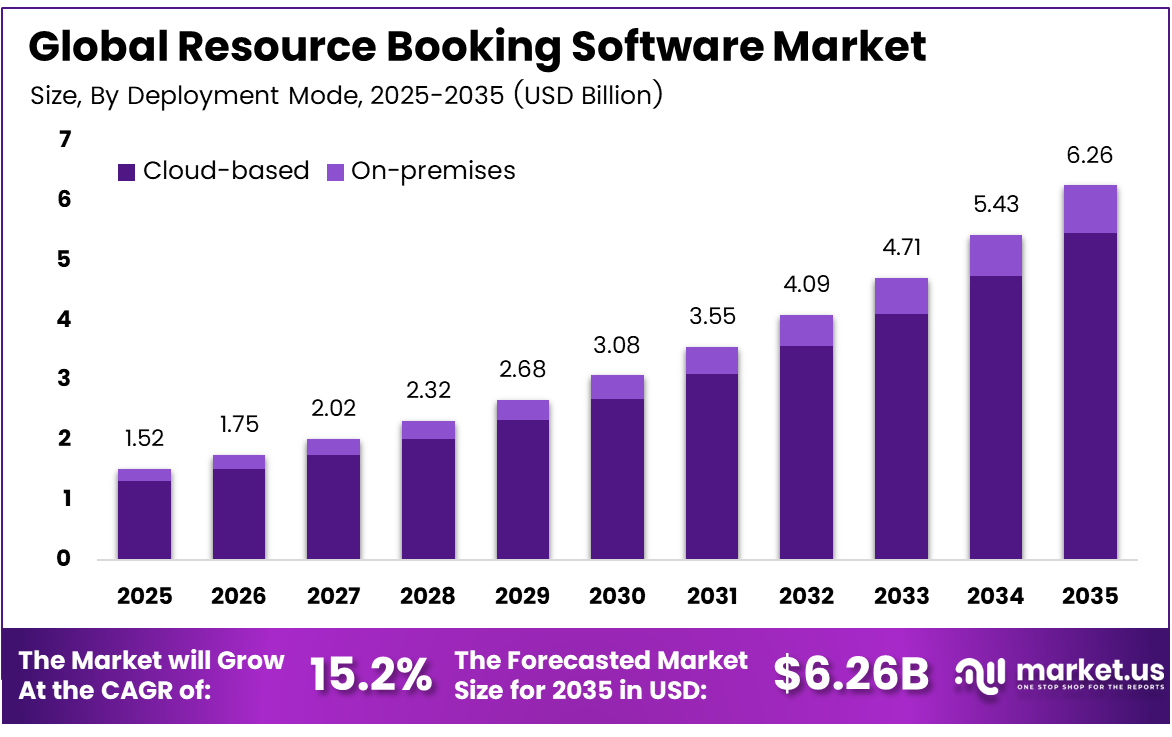
Hybrid work models and rising space costs are shaping the adoption of resource booking platforms. Organizations face pressure to improve utilization, as occupancy analytics indicate 30 to 50% of desks remain unused on typical days. There is also demand for smoother employee experiences, reduced communication overload, and clear visibility of resource usage across offices and facilities.
The market for Resource Booking Software is driven by the growing need to manage shared spaces and assets efficiently in modern workplaces. Organizations are adopting these tools to support hybrid work, reduce unused capacity, and improve coordination. Increasing focus on digital workplace solutions and employee convenience is also encouraging businesses to shift toward automated and centralized booking systems.
Demand is expanding across corporate offices, education, healthcare, and hospitality, which together represent over 70% of deployments. Universities schedule classrooms and labs efficiently, hospitals manage high-value assets like scanners and consultation rooms, and hotels streamline booking of event spaces. Growth is supported by increasing shared infrastructure and centralized scheduling requirements.
For instance, in February 2026, YouCanBookMe ramped up marketing of its online scheduling platform, emphasizing advanced team features like round-robin allocation, custom-branded booking pages, and payment integration. Positioning itself as a flexible alternative to larger U.S. rivals, it is targeting organizations that need more granular control over complex booking rules and workflows.
Key Takeaway
- In 2025, the Cloud-based segment held a dominant market position, capturing a 87.3% share of the Global Resource Booking Software Market.
- In 2025, the Large Enterprises segment held a dominant market position, capturing a 58.9% share of the Global Resource Booking Software Market.
- In 2025, the Meeting Room & Desk Booking segment held a dominant market position, capturing a 46.2% share of the Global Resource Booking Software Market.
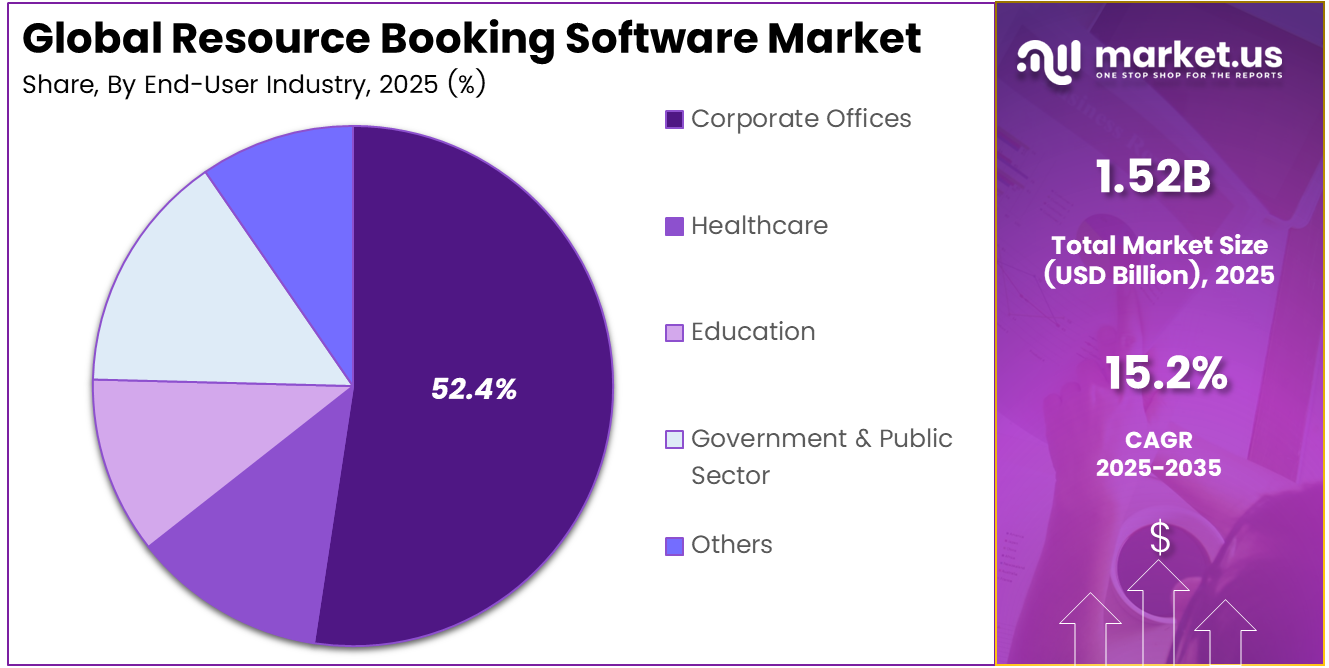
- In 2025, the Corporate Offices segment held a dominant market position, capturing a 52.4% share of the Global Resource Booking Software Market.
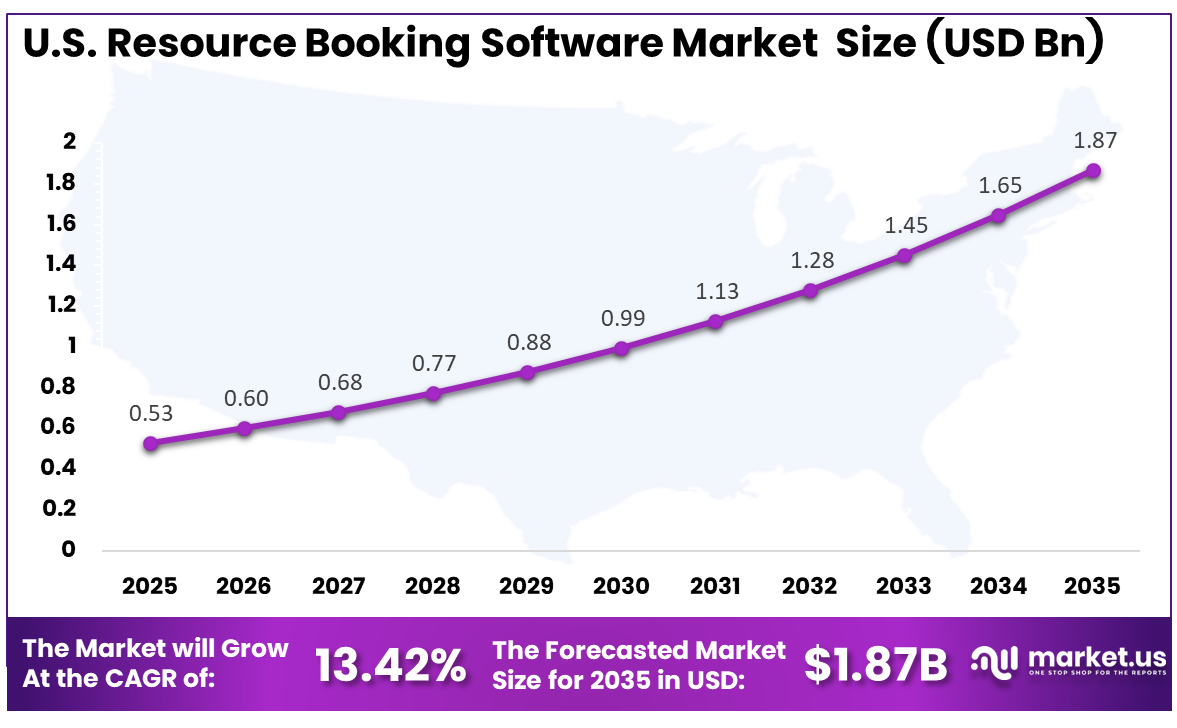
- The U.S. Resource Booking Software Market was valued at USD 0.53 billion in 2025, with a robust CAGR of 13.42%.
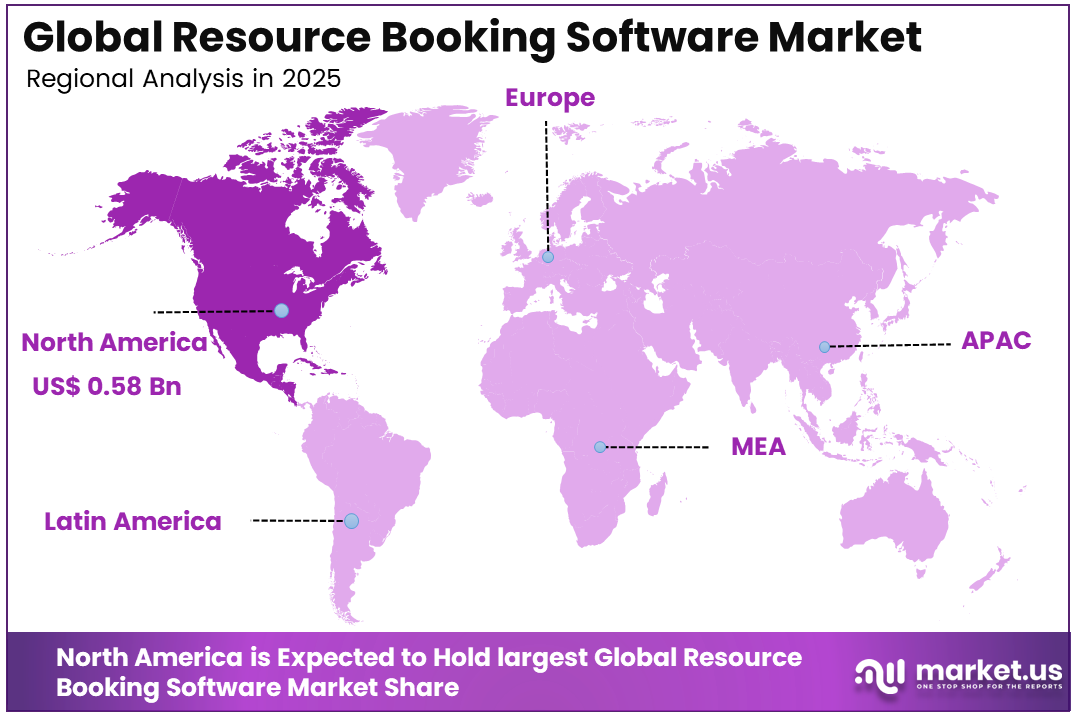
- In 2025, North America held a dominant market position in the Global Resource Booking Software Market, capturing more than a 38.5% share.
Role of Generative AI
Generative AI is being adopted as an intelligent planner that can interpret constraints and process unstructured requests to create optimized booking schedules quickly. Studies indicate it can reduce scheduling time by 70–80% and improve operational efficiency by 20–30%, which directly enhances resource allocation accuracy and responsiveness.
Organizations integrating generative AI into workflows report productivity gains of around 3.3% annually and automation potential reaching 70% of routine tasks. In booking systems, this leads to fewer manual interactions, quicker conflict handling, and automated suggestions for assigning resources or assets based on real-time requirements.
Investment and Business Benefits
Investment activity is increasing in AI-driven scheduling, IoT-based occupancy sensing, and specialized tools for coworking and public sector facilities, where digital booking adoption remains below 50%. Strong interest is seen in API first platforms that integrate booking systems with energy management, security infrastructure, and workplace experience solutions to create connected operational environments.
Organizations benefit from improved utilization, reduced operational costs, and enhanced user satisfaction through real-time booking insights. Dashboards highlight peak usage periods and bottlenecks across resources. Facilities teams leverage this data to optimize space allocation, reduce energy consumption in low usage zones, and align maintenance and cleaning schedules with actual occupancy patterns.
Regional Analysis
In 2025, North America held a dominant market position in the Global Resource Booking Software Market, capturing more than 38.5% share and generating USD 0.58 billion in revenue. This dominance is due to the strong adoption of hybrid work models, advanced corporate infrastructure, and high spending on digital workplace platforms across North America. Companies in the region are using resource booking software to manage desks, rooms, equipment, and shared facilities more efficiently. The presence of large enterprises, mature cloud adoption, and rising focus on employee workplace experience further support the region’s leading market position.
For instance, in February 2026, Skedda launched Booking Approvals for high-demand spaces, allowing admins to require approval workflows, manage requests in a dedicated dashboard, and control access using tools like Okta SCIM, which supports fair usage and policy-driven space management for offices and campuses across North America.
U.S. Resource Booking Software Market Size
The market for Resource Booking Software within the U.S. is growing tremendously and is currently valued at USD 0.53 billion; the market has a projected CAGR of 13.42%. The market is growing due to the wider adoption of hybrid work, flexible office layouts, and digital workplace tools across U.S. businesses. Companies are using resource booking software to manage desks, meeting rooms, equipment, and shared spaces more efficiently. Rising office costs are also pushing firms to improve space utilization, reduce unused capacity, and create smoother employee experiences through real-time booking and visibility.
For instance, in March 2026, Microsoft enhanced multi-resource booking in Dynamics 365 Project Operations, allowing resource managers to book multiple people or assets in a single action instead of handling them one by one. This update streamlines complex staffing scenarios and strengthens Microsoft’s position as a core enterprise resource booking provider across North America.
Key Regions and Countries
North America
- US
- Canada
Europe
- Germany
- France
- The UK
- Spain
- Italy
- Russia
- Netherlands
- Rest of Europe
Asia Pacific
- China
- Japan
- South Korea
- India
- Australia
- Singapore
- Thailand
- Vietnam
- Rest of APAC
Latin America
- Brazil
- Mexico
- Rest of Latin America
Middle East & Africa
- South Africa
- Saudi Arabia
- UAE
- Rest of MEA
Deployment Mode Analysis
In 2025, the Cloud-based segment held a dominant market position, capturing a 87.3% share of the Global Resource Booking Software Market. This dominance is due to the growing need for flexible and remote access solutions across modern workplaces. Cloud-based systems allow users to book resources from any location, which supports hybrid work models. Organizations prefer platforms that are easy to deploy and manage without heavy infrastructure requirements or technical complexity.
Cloud solutions also offer continuous updates and better integration with existing workplace tools. This improves overall efficiency and ensures smooth coordination across teams. As businesses focus on scalability and cost control, cloud-based booking systems provide a reliable option that supports expansion while maintaining consistent performance across multiple locations.
For instance, in April 2026, Google announced a feature that lets organizations book Workspace resources directly from third-party calendars, reducing friction between different scheduling tools. This step strengthens cloud-based booking by letting employees reserve rooms and shared spaces from the tools they already use, without switching between multiple apps.
Organization Size Analysis
In 2025, the Large Enterprises segment held a dominant market position, capturing a 58.9% share of the Global Resource Booking Software Market. This dominance is due to the complex operational structure of large enterprises, where multiple teams and locations require coordinated resource management. These organizations deal with higher volumes of bookings and need systems that provide clear visibility and structured control over shared spaces and assets across departments.
Large enterprises also focus on improving internal efficiency and employee experience. Resource booking software helps reduce scheduling conflicts and ensures better utilization of available assets. The ability to manage resources centrally supports decision-making and allows organizations to maintain smooth operations across large-scale business environments.
For instance, in March 2026, Microsoft’s bulk operations for bookings on the schedule board were designed with complex enterprise environments in mind, where managers handle many reservations at once. The update helps large organizations clean up conflicts faster, move entire blocks of bookings, and keep their resource plans aligned with shifting project needs.
Application Analysis
In 2025, the Meeting Room & Desk Booking segment held a dominant market position, capturing a 46.2% share of the Global Resource Booking Software Market. This dominance is due to the shift toward flexible work environments where employees no longer have fixed seating or meeting schedules. Organizations require systems that help manage shared desks and meeting spaces efficiently, ensuring availability and reducing confusion during daily operations within modern office setups.
Booking tools for desks and meeting rooms improve planning and support better use of office space. Employees can reserve spaces in advance, which reduces overlap and waiting time. This structured approach enhances productivity and allows organizations to maintain a balanced and organized workplace environment that supports collaboration and flexibility.
For instance, in April 2026, software listings and recent product material highlight Robin’s focus on helping users find and reserve conference rooms and desks using a cloud interface. The platform continues to refine how workers book spaces via web and mobile, illustrating ongoing innovation around everyday room and desk booking use cases.
End-User Industry Analysis
In 2025, the Corporate Offices segment held a dominant market position, capturing a 52.4% share of the Global Resource Booking Software Market. This dominance is due to the increasing need for organized workspace management within corporate environments. Offices handle multiple meetings, team collaborations, and shared resources daily, making it essential to have a system that ensures smooth coordination and reduces scheduling conflicts across different departments and functions.
Corporate offices benefit from improved visibility and control over resource usage through booking platforms. This helps in optimizing space, managing employee flow, and enhancing overall workplace experience. As companies aim to improve efficiency, these systems support better planning and contribute to more structured and productive office operations.
For instance, in March 2026, Skedda’s recent updates, such as delegated space management and automation through integrations like Zapier, are framed around keeping seating plans accurate in active workplaces. Corporate offices benefit from these changes because they often juggle different teams, policies, and recurring bookings across multiple floors and buildings.
Key Market Segments
By Deployment Mode
- Cloud-based
- On-premises
By Organization Size
- Large Enterprises
- Small and Medium-sized Enterprises (SMEs)
By Application
- Meeting Room & Desk Booking
- Equipment & Asset Scheduling
- Vehicle & Fleet Management
- Employee & Contractor Scheduling
- Others
By End-User Industry
- Corporate Offices
- Healthcare
- Education
- Government & Public Sector
- Others
Emerging Trends
Vendors are transforming booking platforms into intelligent systems that align skills, availability, and priorities dynamically rather than relying on fixed rules. Evidence from staffing applications shows AI-driven booking can reduce manual allocation effort by up to 70%, while improving utilization by minimizing idle time and mismatched assignments.
Another trend is the integration of booking data with utilization analytics to support better decision-making. Surveys indicate more than 60% of large enterprises are adopting or testing AI for scheduling and capacity planning. This trend is strengthening the role of advanced analytics in shaping future resource booking platform development.
Growth Factors
Hybrid work continues to drive demand as organizations treat desks, rooms, and shared assets as managed inventory requiring structured booking. Research links this shift to strong double-digit growth across scheduling and reservation tools, supported by increasing reliance on digital and mobile self-service systems for workplace coordination.
System integration is also accelerating adoption. When booking platforms connect with ERP, HR systems, and collaboration tools, usage increases significantly. Industry observations show cloud and SaaS deployments account for a majority of new implementations in related booking software segments, reflecting preference for flexible, scalable, and low-maintenance digital solutions.
Market Dynamics
Drivers - Shift to Hybrid and Flexible Work
Organizations are increasingly adopting hybrid work models where employees split time between home and office. This creates a strong need for structured systems to manage desks, meeting rooms, and shared resources. Resource booking software helps employees plan their workdays and ensures that spaces are available when needed.
Flexible work patterns also push companies to rethink how office space is used. Instead of fixed seating, workplaces now depend on shared environments. Booking platforms provide visibility into availability and help reduce confusion, enabling smoother coordination while supporting productivity and collaboration across teams.
For instance, in September 2025, Envoy promoted its desk booking solution as a way to let employees reserve hot desks, coordinate office days with colleagues, and maintain flexibility in hybrid workplaces. This reflects how firms moving away from fixed seating need intuitive booking tools to keep shared spaces organized and to strengthen in-office collaboration without reverting to rigid attendance rules.
Restraint - Integration Complexity
Many organizations face challenges when integrating booking software with existing systems such as calendars, access control, and workplace tools. These systems often operate on different platforms, making it difficult to create a seamless experience. As a result, deployment may require additional time, effort, and coordination across multiple teams.
This complexity can slow adoption and reduce efficiency gains. Employees may face inconsistencies if systems are not fully connected. Organizations must invest in a proper setup and alignment to ensure smooth data flow and functionality. Without this, the full benefits of resource booking platforms may not be realized effectively.
For instance, in September 2024, Skedda’s roadmap emphasized stronger booking rules and automations, which often rely on external identity and calendar services. In environments where different departments use different tools, aligning these systems can be challenging, and if synchronization is not reliable, organizations may hesitate to push all resource scheduling through a single platform.
Opportunities - Smart Space Management
There is a growing opportunity in using booking data to improve how spaces are planned and utilized. Organizations can track usage patterns and identify underused areas, allowing them to redesign layouts and optimize space allocation. This helps reduce waste and supports better decision-making in workplace management.
Smart space management also improves operational efficiency. Facilities teams can align cleaning, maintenance, and energy use with actual occupancy levels. By connecting booking systems with analytics tools, organizations gain deeper insights into workplace behavior, helping them create more efficient and user-friendly environments.
For instance, in January 2025, OfficeRnD launched Data Hub as an analytics layer to interpret workspace metrics and support data-informed decisions. With refreshed data, filtering, and customizable dashboards, operators can analyze desk and room usage in detail, identifying opportunities to resize or reconfigure spaces based on real booking and attendance patterns.
Challenges - Data Privacy Concerns
Data privacy concerns are a major challenge as booking systems collect information about employee presence and behavior. Organizations must ensure that personal and usage data is handled securely. Any gaps in data protection can reduce trust and make employees hesitant to use these systems regularly.
Compliance with data protection regulations adds another layer of complexity. Companies must follow strict guidelines on how data is stored, accessed, and shared. Ensuring transparency and clear policies is important to maintain user confidence and support wider adoption of resource booking platforms across different regions and industries.
For instance, in August 2023, Robin’s smart booking features analyze meeting behavior to offer recommendations, which naturally involves processing usage data. Customers operating under strict privacy regimes must ensure this data remains appropriately anonymized or aggregated, and any missteps could make staff wary of using the system to plan their office days.
Key Players Analysis
One of the leading players in March 2026, Microsoft expanded its booking capabilities in Dynamics 365 Project Operations and Field Service, allowing users to book multiple resources and edit requirement groups faster in one flow. This strengthens Microsoft’s 365-centric workplace stack, making it easier for enterprises to orchestrate people, rooms, and equipment inside familiar tools like Outlook and Teams.
Top Key Players in the Market
- Microsoft Corporation
- Google LLC
- Robin Powered, Inc.
- Skedda, Inc.
- Envoy, Inc.
- OfficeRnD
- Cobot
- Squire
- Appointy Software, Inc.
- Setmore
- Booker Software, Inc.
- ScheduleOnce
- Calendly, LLC
- YouCanBookMe, Ltd.
- Others
Recent Developments
- In April 2026, Robin continued to be highlighted among the top desk and room booking platforms for hybrid workplaces, featuring in independent 2026 rankings alongside Skedda, Envoy, OfficeRnD, and others. Its focus on utilization analytics, policy-based bookings, and calendar integrations is helping North American firms optimize office footprints rather than expand physical space.
- In April 2026, OfficeRnD featured prominently in the 2026 rankings of leading desk booking platforms used by coworking and flex-space operators. Its roadmap continues to center on unifying contracts, billing, and space reservations, positioning it as the operating layer for operators monetizing every seat, room, and shared resource in a hybrid economy.
Report Scope
| Report Features | Description |
|---|---|
| Market Value (2025) | USD 1.52 Billion |
| Forecast Revenue (2035) | USD 6.26 Billion |
| CAGR (2026-2035) | 15.2% |
| Base Year for Estimation | 2025 |
| Historic Period | 2020-2024 |
| Forecast Period | 2026-2035 |
| Report Coverage | Revenue Forecast, Market Dynamics, Competitive Landscape, Recent Developments |
| Segments Covered | By Deployment Mode (Cloud-based, On-premises), By Organization Size (Large Enterprises, Small and Medium-sized Enterprises (SMEs)), By Application (Meeting Room & Desk Booking, Equipment & Asset Scheduling, Vehicle & Fleet Management, Employee & Contractor Scheduling, Others), By End-User Industry (Corporate Offices, Healthcare, Education, Government & Public Sector, Others) |
| Regional Analysis | North America (US and Canada), Europe (Germany, France, The UK, Spain, Italy, and Rest of Europe), Asia Pacific (China, Japan, South Korea, India, Australia, and Rest of APAC), Latin America (Brazil, Mexico, and Rest of Latin America), Middle East & Africa (GCC, South Africa, and Rest of MEA) |
| Competitive Landscape | Microsoft Corporation, Google LLC, Robin Powered, Inc., Skedda, Inc., Envoy, Inc., OfficeRnD, Cobot, Squire, Appointy Software, Inc., Setmore, Booker Software, Inc., ScheduleOnce, Calendly, LLC, YouCanBookMe, Ltd., Others |
| Customization Scope | Customization at the segment and region/country levels will be provided. Moreover, customization can be tailored to the requirements. |
| Purchase Options | We have three licenses to opt for: Single User License, Multi-User License (Up to 5 Users), Corporate Use License (Unlimited Users and Printable PDF) |





























