


Global Pyrolysis Oil Market By Raw Material (Waste Plastics, Waste Tires, Biomass, and Others), By Application (Chemicals, Fuels, and Others), By Region and Companies - Industry Segment Outlook, Market Assessment, Competition Scenario, Trends and Forecast 2026-2035
- Published date: Mar 2026
- Report ID: 181726
- Number of Pages: 385
- Format:
-
keyboard_arrow_up
Quick Navigation
Report Overview
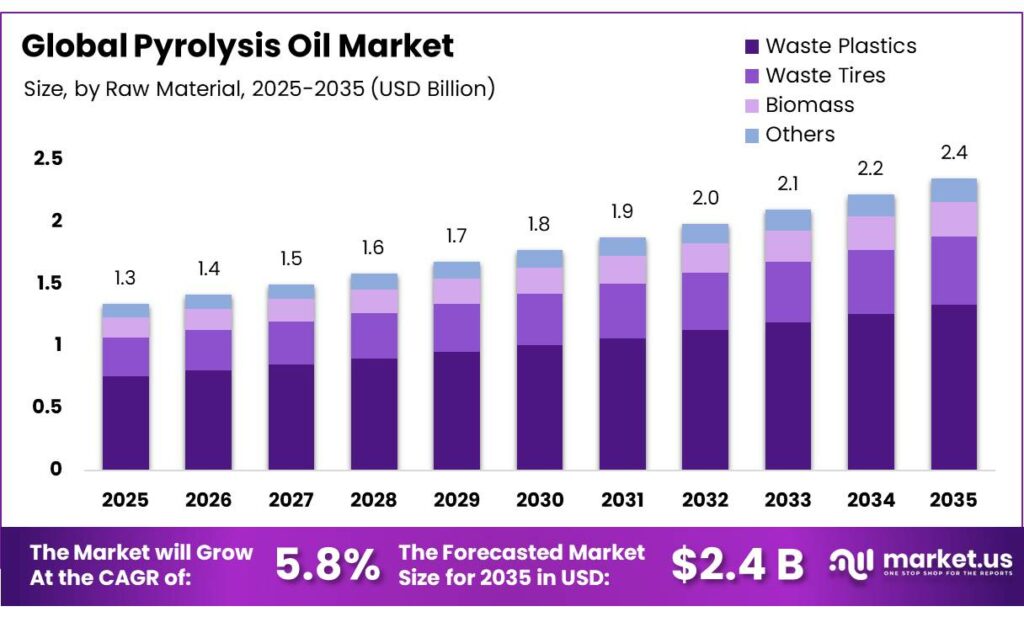
The Global Pyrolysis Oil Market size is expected to be worth around USD 2.4 Billion by 2035, from USD 1.3 Billion in 2025, growing at a CAGR of 5.8% during the forecast period from 2026 to 2035. In 2025, Asia Pacific held a dominant market position, capturing more than a 44.7% share, holding USD 2.7 billion revenue.
Pyrolysis oil is a dark, viscous liquid produced by heating organic materials, such as biomass, waste plastics, or used tires, to high temperatures in an oxygen-free environment. This process, called pyrolysis, breaks down complex molecular chains into a synthetic crude that can be used as fuel or refined into chemicals.
- Utilizing pyrolysis for plastic waste management can reduce greenhouse gas (GHG) emissions by 40%, mitigating an estimated 3.5 tons of CO2-equivalent per ton of processed plastic.
The pyrolysis oil market is primarily driven by the growing demand for alternative, sustainable energy sources and waste management solutions. As a product of the pyrolysis process, which converts waste materials such as plastics into oil, pyrolysis oil is gaining prominence due to its potential as a renewable fuel. Europe, with its strong environmental policies such as the Circular Economy Action Plan and Renewable Energy Directive, is the largest market for pyrolysis oil, focusing on reducing plastic waste and increasing the use of alternative fuels.
- Pyrolytic oil from plastics (WPO) exhibits a Higher Heating Value (HHV) of approximately 37.85 MJ/kg to 42 MJ/kg, closely approximating conventional diesel (approximately 45 MJ/kg). Similarly, in compression ignition (CI) engines, blends of up to 44.1% wood pyrolysis oil (WPO) with oxygenated compounds have demonstrated reliable operation without major component failure.
Despite high capital and operational costs associated with pyrolysis plant setup and energy consumption, technological advancements, such as catalytic and microwave-assisted pyrolysis, are improving efficiency and scalability. Pyrolysis oil is primarily used for fuel production, owing to its higher energy content and ease of refinement compared to other pyrolysis products like chemicals or biomass-derived oils. The market is further supported by governmental incentives and regulations promoting waste-to-energy solutions, particularly in the context of circular economy goals.
Key Takeaways:
- The global pyrolysis oil market was valued at USD 1.3 billion in 2025.
- The global pyrolysis oil market is projected to grow at a CAGR of 5.8% and is estimated to reach USD 2.4 billion by 2035.
- Based on the raw material, waste plastics pyrolysis oil dominated the market, with a market share of around 56.7%.
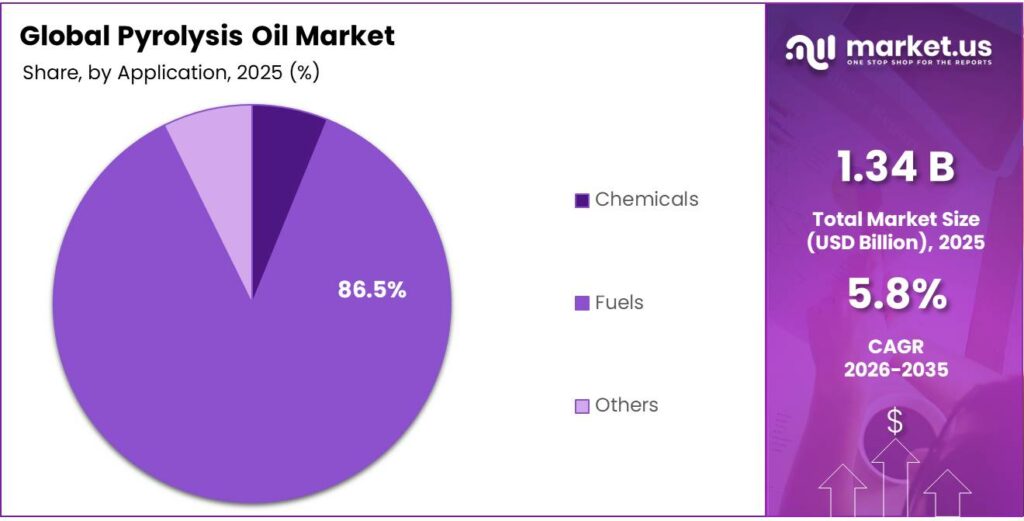
- Among the applications of pyrolysis oil, fuels held a major share in the market, 86.5% of the market share.
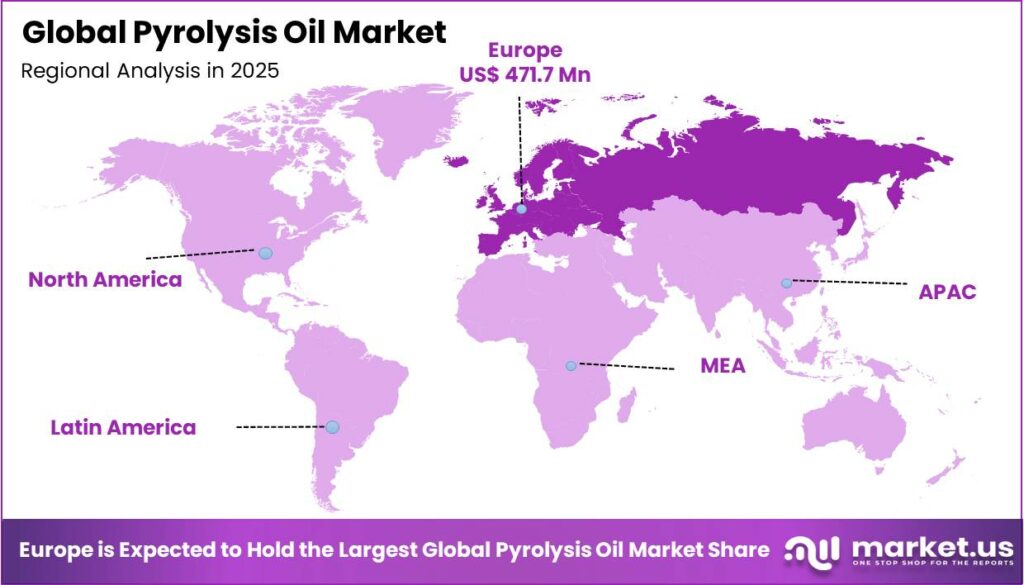
- In 2025, Europe was the most dominant region in the pyrolysis oil market, accounting for around 35.2% of the total global consumption.
Raw Material Analysis
Waste Plastics Pyrolysis Oil Held the Largest Share in the Market.
The pyrolysis oil market is segmented based on compound type into waste plastics, waste tires, biomass, and others. The waste plastics pyrolysis oil dominated the market, comprising around 56.7% of the market share, primarily due to the uniformity and higher energy content of plastic waste. Plastics, especially those used in packaging and consumer goods, are abundant and often difficult to recycle through traditional methods, making pyrolysis a more viable solution. The oil produced from plastics has similar characteristics to petroleum-based fuels, making it easier to refine and use in energy generation or as industrial feedstock.
In contrast, waste tires and biomass can have more complex compositions, leading to higher processing costs and less consistent output. Additionally, while biomass pyrolysis oil is useful, it often requires more specialized applications due to its higher oxygen content and lower calorific value compared to plastic-derived oil. These factors make plastic pyrolysis oil more versatile and economically attractive for large-scale use.
Application Analysis
Pyrolysis Oil is Mostly Utilized for Fuels.
Based on the applications of pyrolysis oil, the market is divided into chemicals, fuels, and others. The fuels dominated the pyrolysis oil market, with a market share of 86.5%, due to their composition and the current technological limitations in upgrading the oil for chemical production. Pyrolysis oil from waste plastics or biomass contains a mixture of hydrocarbons, but it additionally includes impurities such as water, oxygenated compounds, and heavy metals, making it less suitable for chemical feedstocks without extensive refining. The refining process to convert pyrolysis oil into high-value chemicals is complex and costly, limiting its appeal for chemical production.
On the contrary, pyrolysis oil can be more readily processed into fuels, which are in high demand for energy generation and industrial applications. Its chemical properties, such as its relatively high energy density, make it a more straightforward and cost-effective alternative to traditional fossil fuels, aligning with global efforts to reduce reliance on petroleum-based fuels.
Key Market Segments:
By Raw Material
- Waste Plastics
- Waste Tires
- Biomass
- Others
By Application
- Chemicals
- Fuels
- Others
Drivers
Circular Plastics Economy Drives the Pyrolysis Oil Market.
The circular plastics economy is a critical driver of the pyrolysis oil market, as increasing efforts to reduce plastic waste and promote recycling bolster demand for alternative recycling technologies. Pyrolysis, a thermal decomposition process, is increasingly seen as a viable solution to convert non-recyclable plastics into valuable pyrolysis oil. This oil can be further refined into fuels or chemicals, aligning with global objectives to reduce dependency on virgin fossil resources.
Traditional plastic production accounts for approximately 4% of global oil and gas as direct feedstock, with an additional 3-4% consumed for processing energy. In circular scenarios, this hydrocarbon demand in the petrochemical sector is projected to decrease by 5-10% by 2050 compared to business-as-usual, as recycled inputs displace virgin materials. Pyrolysis facilitates this by converting 50%-75% of plastic waste into liquid fuels, with specialized fast pyrolysis yielding up to 85%.
Governments worldwide are mandating stronger waste management policies. For instance, the European Union’s Circular Economy Action Plan stresses the need for innovation in recycling, including advanced chemical recycling methods such as pyrolysis. Similarly, the U.S. Environmental Protection Agency (EPA) advocates for technologies that convert waste into useful products, acknowledging pyrolysis as a promising approach to handling plastic waste effectively. As the global push for plastic waste reduction accelerates, pyrolysis technology’s ability to address circular economy goals will further consolidate its market position, attracting both governmental and industrial support.
Restraints
High Capital Expenditure (CAPEX) And High Operational Expenditure (OPEX) Might Hamper the Demand for Pyrolysis Oil.
High capital expenditure (CAPEX) and operational expenditure (OPEX) represent significant structural barriers to the scalability of the pyrolysis oil market, driven by technical complexity and energy intensity. Pyrolysis plants require substantial upfront investment for equipment such as reactors, distillation units, and storage facilities. Additionally, the complexity of maintaining high-temperature, high-pressure systems contributes to elevated OPEX.
The U.S. EPA highlights that energy consumption during the pyrolysis process, primarily for heating, adds high operational costs, which can account for up to 40% of total operational expenses. These financial barriers are compounded by uncertainties surrounding feedstock availability and the need for specialized workforce training. For instance, in the EU, some projects face delays due to high operational costs in waste feedstock collection and preprocessing. While pyrolysis holds potential, its economic viability remains closely tied to overcoming these high CAPEX and OPEX hurdles.
Opportunity
Application of Pyrolysis Oil as an Alternative Fuel Source Creates Opportunities in the Market.
The integration of pyrolysis oil as an alternative fuel source presents a high-potential opportunity for decarbonizing industrial heat and heavy transport, leveraging its favorable energy density compared to raw biomass. It is driven by the global shift towards reducing fossil fuel dependency. Pyrolysis oil, derived from non-recyclable plastics and other waste, has been demonstrated to have fuel characteristics suitable for use in power generation and industrial heating.
According to the U.S. Department of Energy, pyrolysis oil can be used as a substitute for conventional heating oil in industrial boilers, reducing reliance on petroleum-based fuels. Tire-derived pyrolysis oil (TPO) displays exhaust exergy values approximately 1.2 times higher than standard diesel (D100), indicating a greater potential for energy recovery from exhaust heat.
In the EU, there is an increase in the use of alternative fuels, including pyrolysis oil, as part of broader efforts to meet emissions reduction targets. Similarly, the International Renewable Energy Agency (IRENA) recognizes the potential of pyrolysis oil to reduce greenhouse gas emissions in certain industrial applications, especially in energy-intensive sectors. This shift is supported by advancements in refining technologies, enhancing the viability of pyrolysis oil as a sustainable energy source for various industrial sectors.
Trends
Technological Advancements in Pyrolysis Techniques.
Technological advancements in pyrolysis techniques are a key trend shaping the pyrolysis oil market, enhancing the efficiency and scalability of waste-to-oil processes. These advancements are characterized by a shift toward fast pyrolysis (FP) and catalytic fast pyrolysis (CFP) to maximize liquid yields and improve oil quality for refinery integration.
Modern reactor designs have significantly increased liquid output by optimizing heating rates and residence times. The evolution of pyrolysis technologies is focused on improving feedstock flexibility, reactor design, and energy consumption efficiency. The recent developments in microwave-assisted pyrolysis (MAP) have been shown to significantly reduce processing time and energy consumption, potentially making the process more cost-competitive.
Furthermore, the adoption of catalysts and advanced heating methods addresses traditional oil instability and high acidity. Non-catalytic bio-oil often contains high acid values (approx. 120 mg KOH/g). The application of bifunctional catalysts such as SBA-15-MgO-Zn can reduce acidity to nearly zero while increasing liquid yields by an additional 15%. These improvements in process efficiency could facilitate broader adoption of pyrolysis oil as an alternative fuel source. The growing focus on integrating renewable energy with pyrolysis technologies further aligns with regulatory goals, such as those in the EU’s Renewable Energy Directive, which mandates the use of sustainable fuels in power and industrial sectors.
Geopolitical Impact Analysis
Geopolitical Tensions Are Impacting the Pyrolysis Oil Market.
The geopolitical tensions are impacting the pyrolysis oil market by influencing feedstock availability, energy prices, and international trade dynamics. In regions affected by conflict or economic instability, disruptions in the supply of waste plastics and other feedstocks for pyrolysis processes are increasingly common. For instance, disruptions in global shipping routes, exacerbated by the Russia-Ukraine conflict, have led to delays in transporting waste materials. This has created logistical challenges for pyrolysis plant operators relying on international supply chains for feedstocks.
Additionally, rising energy prices due to geopolitical conflicts, especially the energy crisis in Europe, are increasing operational costs for pyrolysis plants. The European Commission’s 2022 assessment on energy security highlighted that spikes in natural gas prices significantly affect energy-intensive processes such as pyrolysis. The resulting rise in operational expenditure (OPEX) could limit the economic feasibility of scaling up pyrolysis oil production in affected regions.
On the contrary, geopolitical uncertainty accelerated the shift towards alternative energy sources. The European Union’s Green Deal and its push for energy independence from fossil fuels have led to greater support for renewable technologies, including waste-to-fuel processes such as pyrolysis, creating a policy-driven market for pyrolysis oil.
Regional Analysis
Europe Held the Largest Share of the Global Pyrolysis Oil Market.
In 2025, Europe dominated the global pyrolysis oil market, holding about 35.2% of the total global consumption. Europe remains the largest market for pyrolysis oil, driven by stringent environmental regulations, waste management strategies, and the push for sustainable energy sources. The European Union’s Circular Economy Action Plan emphasizes the need for advanced recycling technologies, including pyrolysis, to tackle plastic waste.
The EU’s commitment to reducing plastic waste by 50% by 2030 and the promotion of alternative fuels under the Renewable Energy Directive 2018/2001 are key drivers of pyrolysis oil adoption. In countries such as Germany and the Netherlands, national and regional policies are incentivizing the development of pyrolysis plants. Furthermore, projects such as the Horizon 2020-funded Plastics2Fuel initiative highlight Europe’s leadership in advancing pyrolysis oil technologies, further positioning the region as a key player in the global market for alternative fuels derived from waste.
Key Regions and Countries
- North America
- The US
- Canada
- Europe
- Germany
- France
- The UK
- Spain
- Italy
- Russia & CIS
- Rest of Europe
- APAC
- China
- Japan
- South Korea
- India
- ASEAN
- Rest of APAC
- Latin America
- Brazil
- Mexico
- Rest of Latin America
- Middle East & Africa
- GCC
- South Africa
- Rest of MEA
Key Players Analysis
Manufacturers of pyrolysis oil focus on several strategic activities, including investing in advanced technologies to improve the efficiency and scalability of pyrolysis processes. The companies are increasingly adopting catalytic and microwave-assisted pyrolysis methods to increase yield and reduce energy consumption. Similarly, securing a stable and diversified feedstock supply is crucial, with manufacturers entering partnerships for waste collection and supply chain optimization.
Additionally, manufacturers prioritize compliance with environmental regulations, aligning with policies such as the EU’s Circular Economy Action Plan. Developing products that meet sustainability criteria, such as low-emission fuels, can give companies a distinct advantage. Moreover, strengthening relationships with governments and stakeholders through grants, subsidies, or public-private partnerships facilitates market entry and expansion.
The Major Players in The Industry
- Agilyx
- Alterra Energy, LLC
- Arbios Biotech
- Bioenergy AE Côte-Nord
- BTG Bioliquids
- Kerry Group plc
- New Energy Kft.
- New Hope Energy
- Nexus Circular
- Plastic Energy
- Pyrocell (Setra)
- Scandinavian Enviro Systems AB
- Trident Fuels Pty Ltd
- Twence
- Viridor Limited
- Other Key Players
Key Development:
- In April 2023, BioBTX B.V., a global leader in renewable aromatics technology, and Agilyx ASA, a prominent company in post-consumer plastics recycling, entered into a strategic collaboration. The partnership aimed to explore the scaling-up of BioBTX technology at a commercial demonstration plant for the production of renewable aromatic chemicals, specifically benzene, toluene, and xylene.
- In May 2025, Alterra, a global leader in advanced plastic recycling technologies, announced the successful implementation of its pyrolysis oil in Australia, which represents a significant advancement towards establishing a circular economy for plastics, according to the company.
Report Scope
Report Features Description Market Value (2025) US$1.3 Bn Forecast Revenue (2035) US$2.4 Bn CAGR (2025-2035) 5.8% Base Year for Estimation 2025 Historic Period 2021-2024 Forecast Period 2025-2035 Report Coverage Revenue Forecast, Market Dynamics, Competitive Landscape, Recent Developments Segments Covered By Product Type (Oxidation Control Chemicals and Corrosion-Control Chemicals), By End-Use (Municipal Water Treatment and Industrial Water Treatment) Regional Analysis North America – The US & Canada; Europe – Germany, France, The UK, Spain, Italy, Russia & CIS, Rest of Europe; APAC– China, Japan, South Korea, India, ASEAN & Rest of APAC; Latin America– Brazil, Mexico & Rest of Latin America; Middle East & Africa– GCC, South Africa, & Rest of MEA Competitive Landscape Agilyx, Alterra Energy, LLC, Arbios Biotech, Bioenergy AE Côte-Nord, BTG Bioliquids, Kerry Group plc, New Energy Kft., New Hope Energy, Nexus Circular, Plastic Energy, Pyrocell (Setra), Scandinavian Enviro Systems AB, Trident Fuels Pty Ltd, Twence, Viridor Limited, and Other Players. Customization Scope Customization for segments, region/country-level will be provided. Moreover, additional customization can be done based on the requirements. Purchase Options We have three licenses to opt for: Single User License, Multi-User License (Up to 5 Users), Corporate Use License (Unlimited Users and Printable PDF) 
-
-
- Agilyx
- Alterra Energy, LLC
- Arbios Biotech
- Bioenergy AE Côte-Nord
- BTG Bioliquids
- Kerry Group plc
- New Energy Kft.
- New Hope Energy
- Nexus Circular
- Plastic Energy
- Pyrocell (Setra)
- Scandinavian Enviro Systems AB
- Trident Fuels Pty Ltd
- Twence
- Viridor Limited
- Other Key Players
Our Clients

- 181726
- Mar 2026






