


Report Overview
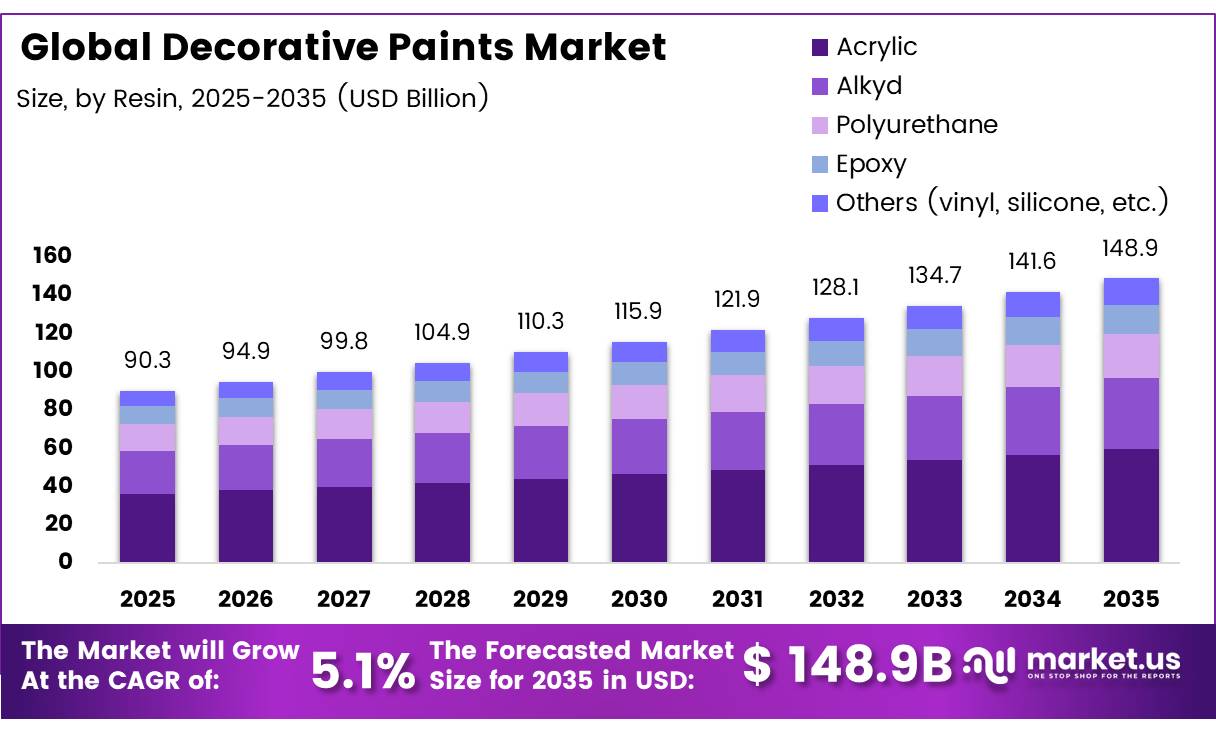
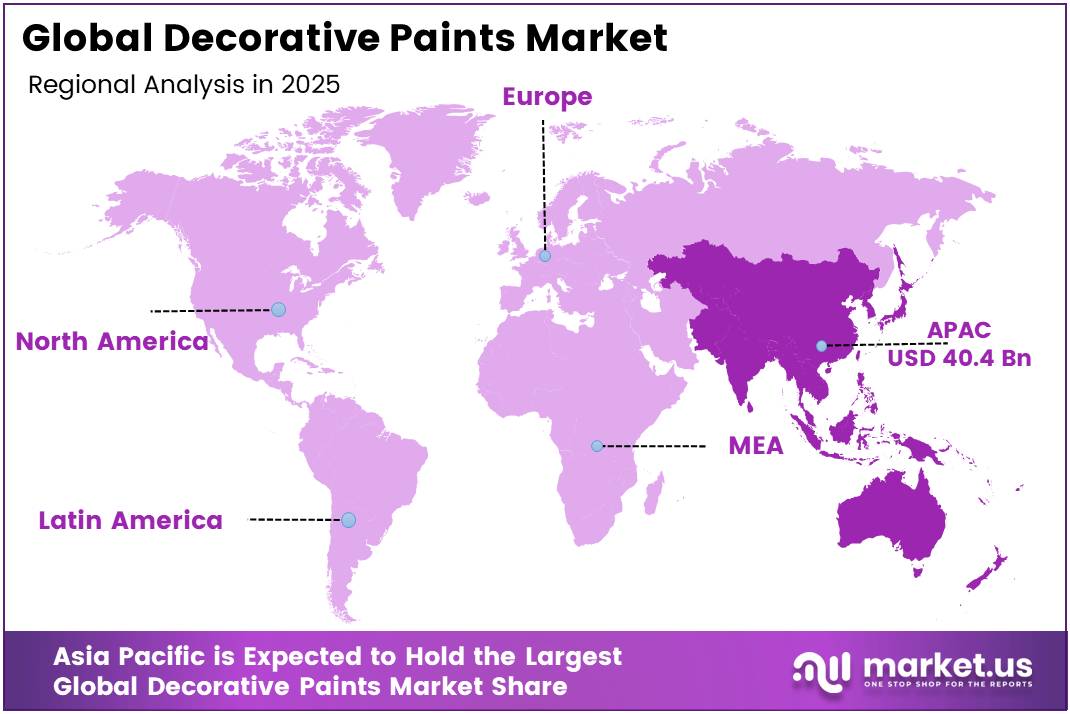
In 2025, the Global Decorative Paints Market was valued at US$ 90.3 billion, and between 2026 and 2035, this market is estimated to register a CAGR of 5.1%, reaching about US$ 148.9 billion by 2035. In 2025, Asia Pacific led the market, achieving over 44.8% share with a revenue of US$ 40.46 Billion.
Decorative paints are architectural coatings applied to walls, ceilings, façades, wood and metal to improve appearance while providing resistance to moisture, stains and weathering. The sector benefits from construction, renovation and routine property maintenance.
- In April 2026, the American Coatings Association reported that U.S. paint and coatings shipments reached USD 33.2 billion in 2024, supported by 53,400 establishments and 312,000 workers.
- Demand remains connected to residential and commercial building activity. In July 2026, the U.S. Census Bureau reported May construction spending of USD 2.210 trillion at an annualised rate, including USD 930.2 billion for private residential construction and USD 541.2 billion for public construction. Housing permits also reached an annualised 1.413 million units.
Environmental regulation is accelerating the shift toward water-based, low-odour and lower-VOC decorative paints. The U.S. Environmental Protection Agency estimates that architectural-coating standards reduce VOC emissions by 113,500 tons annually, creating incentives for reformulation and advanced binder technologies.
Future opportunities will expand through renovation, premium washable finishes, digital colour tools and bio-based ingredients. Around 75% of EU buildings have poor energy performance, while the renovation rate remains near 1%; European policy aims to double that rate by 2030.
Key Takeaways
- The global decorative paints market was valued at US$90.3 billion in 2025.
- The global decorative paints market is projected to grow at a CAGR of 5.1% and is estimated to reach US$148.9 billion by 2035.
- On the basis of resin, acrylic dominated the global decorative paints market, constituting 40.1% of the total market share in 2025.
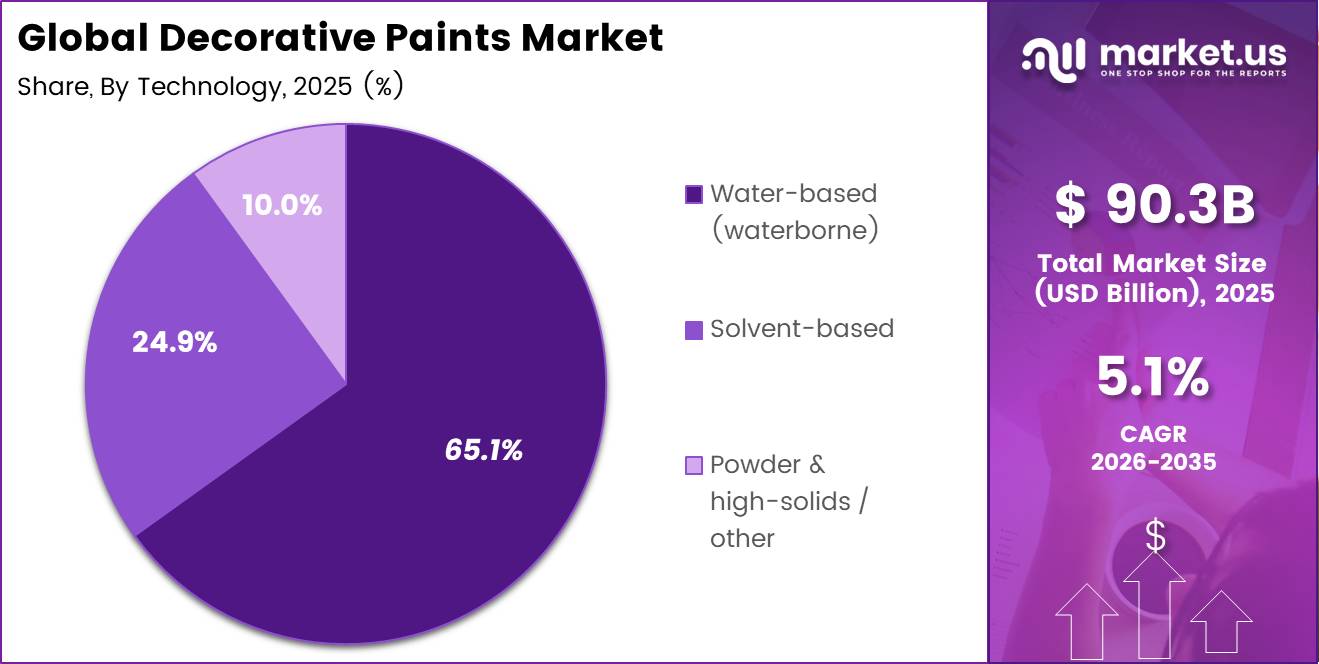
- Based on the technology, water-based (waterborne) dominated the decorative paints global decorative paints market, with a substantial market share of around 65.1% in 2025.
- Based on the application, residential (architectural) led the global decorative paints market, comprising 60.1% of the total market in 2025.
- In 2025, the Asia Pacific was the most dominant region in the decorative paints market, accounting for 44.8% of the total global consumption.
Resin Analysis
Acrylic represents dominant Segment in the Market.
Acrylic resins command the largest share of 40.1% the global decorative paints market by resin type, a position built on formulation compatibility with water-based platforms that environmental compliance frameworks now structurally mandate across major end-use markets. The segment’s commercial durability was reinforced in September 2024, Engineered Polymer Solutions launched a new all-acrylic resin polymer explicitly engineered for flat-through-semi-gloss interior and exterior architectural coatings, a product-level investment that confirmed sustained industry confidence in acrylic’s central position regardless of competing resin platforms gaining commercial attention.
The substrate versatility of acrylic, its ability to adhere reliably across renovation projects where surface conditions are variable and preparation is minimal, gives it a structural advantage in the repaint cycle that no alternative resin has neutralized at comparable cost. For paint manufacturers, acrylic resin sourcing strategy remains the single most consequential raw-material procurement decision, with offtake contract structures and supplier concentration risk carrying direct implications for gross margin stability.
Polyurethane resin is the fastest-growing segment within decorative and architectural paints, driven by superior scratch resistance, gloss retention, thermal stability, and adhesion performance in applications where standard acrylic formulations reach their technical limits. Demand from Saudi Arabia’s petrochemical sector construction programme and premium commercial facade specifications across the Gulf Cooperation Council is pulling polyurethane into architectural applications that previously defaulted to commodity waterborne systems, because ambient temperature and humidity conditions during application in the region produce performance outcomes that acrylic emulsions cannot reliably match.
Application Analysis
Residential (architectural) Are the Most Widely Used as application.
Residential applications account for the largest share of 60.1% decorative paint consumption globally, sustained by the fundamental economics of repaint frequency: owner-occupied housing generates recurring demand irrespective of new construction cycles, and maintenance repaints constitute a volume floor that commercial project cycles cannot replicate. The National Association of Realtors’ published 2025 data confirmed that interior repainting remains the single most common pre-sale renovation activity among U.S. home vendors, occurring in approximately 63% of residential transactions, a statistic that mechanically ties paint volumes to housing turnover even in a suppressed transaction environment.
The commercial consequence for manufacturers is that residential architectural paint demand carries a relatively low cyclical floor: even when mortgage origination volumes decline, deferred maintenance repaints and rental property turnover sustain baseline volume that provides earnings stability disproportionate to the application segment’s size.
Residential is the fastest growing segment in the market, driven by a structural behavioral shift in how homeowners in mature markets allocate renovation budgets. Asian Paints issued a formal corporate response through its investor communications platform in February 2026 following India’s Union Budget 2026-27, explicitly addressing how residential construction stimulus spending would translate into near-term paint volume demand across the company’s domestic network, a response that confirmed the company’s operational positioning toward the premium residential segment rather than commodity volume.
Technology Analysis
Water‑based (waterborne) Held a Major Share of the Decorative Paints Market.
Water-based paints held the leading position with a 65.1% market share. Their strength comes from low odour, quick drying, easier clean-up and improved acrylic and latex chemistry that supports washable interiors and durable exterior finishes. This makes them suitable for homes, offices, schools and repainting projects where spaces must return to use quickly. In August 2025, according to the U.S. Bureau of Labor Statistics, construction and maintenance painters held 342,200 jobs in 2024. Employment is projected to reach 355,200 by 2034, with approximately 28,100 openings annually, indicating a broad application workforce and steady decorative coating demand.
Powder and high-solids coatings represent the growing category, particularly for decorative metal doors, railings, frames and fixtures requiring thicker coverage and strong wear resistance. Their lower solvent dependence and efficient material use suit projects seeking cleaner application and longer service life. According to the U.S. Department of Energy, qualifying federal new buildings and major renovations must target 90% lower onsite fossil-fuel energy use during FY2025–FY2029 and 100% from FY2030, encouraging durable, lower-emission building finishes.
Key Market Segments
By Resin
- Acrylic
- Alkyd
- Polyurethane
- Epoxy
- Others (vinyl, silicone, etc.)
By Application
- Residential (architectural)
- Non‑residential / commercial
- Industrial / infrastructure decorative
By Technology
- Water‑based (waterborne)
- Solvent‑based
- Powder & high‑solids / other
Driver Analysis
Repaint cycle resilience and pro-channel recovery
Sherwin-Williams reported 2025 Paint Stores Group sales growth led by protective and marine, residential repaint, and commercial demand, while its Consumer Brands segment still faced softer DIY conditions, which implies that the healthiest decorative-paints demand pool in 2026 is professional repaint rather than discretionary DIY refresh.
That matters because repaint jobs usually carry better mix, faster inventory turns, and lower customer-acquisition cost than greenfield construction; even a 1–2 month improvement in project conversion or contractor utilization can lift sell-out without requiring a broad housing boom, especially in North America and Western Europe where existing housing stock is large and maintenance cycles are established.
The driver adds roughly +1.4 percentage points to forward CAGR because it supports steadier gallon throughput, allows producers to push premium interior/exterior tiers through pro dealers, and reduces revenue volatility relative to new-build-linked demand, with the strongest near-term monetization in store-led and contractor-led channels.
Drivers Impact Analysis
| Driver | (~) % Impact on CAGR | Geographic Relevance | Impact Timeline |
|---|---|---|---|
| Repaint cycle resilience and pro-channel recovery | +1.4% | North America core, Western Europe, urban APAC | Short term (≤ 2 years) |
| Low-VOC waterborne conversion and compliance reformulation | +1.1% | EU, North America, China top-tier cities, India metros | Medium term (2-4 years) |
| Premiumization through texture, washability, and weather-shield products | +1.0% | India, Southeast Asia, Middle East, Latin America | Medium term (2-4 years) |
| Urban housing completion and renovation backlog release | +1.3% | India, ASEAN, Middle East, Southern Europe | Short term (≤ 2 years) |
| Raw-material normalization improving affordability and SKU expansion | +0.8% | Global, strongest in North America, EU, India | Short term (≤ 2 years) |
| Digital color tools and contractor ecosystem formalization | +0.7% | North America, EU, India, Brazil | Long term (≥ 4 years) |
Restraint Analysis
TiO2 and resin cost volatility
Titanium dioxide and petrochemical-derived resins remain the dominant raw-material cost buckets for decorative paints, with various industry analyses indicating that TiO2 alone can account for around one-fifth to one-quarter of total production cost and that global paints and coatings values around 2025–2026 in the 90–100 billion USD range are still highly exposed to commodity cycles.
When TiO2 spot prices move by triple-digit dollars per ton over a few quarters and solvent or acrylic-mononer prices swing with crude and refinery spreads, gross-margin volatility can reach 200–300 basis points year-on-year for major producers, forcing tactical list-price increases of 3–6 percent and frequent discount reconfigurations that distributors and small retailers struggle to pass through.
This dynamic compresses working capital and undermines long-term pricing discipline: if distributors pull forward purchases before price hikes and then destock when input prices ease, volume visibility deteriorates, raising the risk of overproduction or idle capacity and directly weighing on CAGR by delaying smaller capacity additions and SKU launches, particularly in cost-sensitive Asia and Latin America where affordable distemper and economy emulsions set the demand floor.
Restraint Impact Analysis
| Restraint | (~) % Impact on CAGR | Geographic Relevance | Impact Timeline |
|---|---|---|---|
| TiO2 and resin cost volatility | -1.4% | North America, EU, Asia | Short term (≤ 2 years) |
| VOC/chemical regulation compliance cost | -1.2% | EU, North America, China | Medium term (2-4 years) |
| Housing and macro demand cyclicality | -1.0% | North America, EU, Latin America | Short term (≤ 2 years) |
| Fragmented retail and informal applicator channels | -0.9% | India, ASEAN, Africa | Medium term (2-4 years) |
| Supply-chain and logistics inefficiencies | -0.8% | India, ASEAN, global trade lanes | Short term (≤ 2 years) |
| Capex and innovation payback risk | -0.7% | Global tier-1 producers | Long term (≥ 4 years) |
Opportunity Analysis
Health-protective and antimicrobial interior ranges
While low-VOC and eco-friendly paints are already baseline drivers, the commercialization of explicitly health-protective interior lines anti-bacterial, anti-viral, allergen-reducing, or air-purifying remains underdeveloped and represents a distinct future opportunity that treats walls and ceilings as part of the indoor health stack rather than just décor.
Scientific and niche commercial products have shown that incorporating antimicrobial agents or photocatalytic additives can measurably reduce surface microbial load or break down certain pollutants, but penetration into mainstream decorative SKUs is still low, and pricing models rarely capitalize on the willingness of hospitals, schools, and premium residential customers to pay 20–40 percent more for coatings that can plausibly extend cleanliness cycles or contribute to healthier indoor environments.
With global decorative market value expected to add tens of billions of dollars by 2035, carving out even 3–5 percent of that incremental space for health-centric interior products could yield several billion dollars of new revenue pools; the key is to build credible testing data, secure health and building-certification endorsements, and design clear per-room propositions that allow higher gross margins and repeat repaint cycles of 3–5 years, cumulatively adding around 1.1 percentage points of CAGR upside over the medium term in North America, Europe, and large emerging metros.
Opportunity Impact Analysis
| Opportunity | (~) % Potential CAGR | Geographic Relevance | Execution Window |
|---|---|---|---|
| Heat-reflective and cool-roof decorative systems | +1.3% | APAC emerging, Middle East, Southern Europe | Medium term (2-4 years) |
| Health-protective and antimicrobial interior ranges | +1.1% | North America, EU, India metros | Medium term (2-4 years) |
| Service-led repaint and subscription models | +1.0% | India, ASEAN, Latin America | Short term (≤ 2 years) |
| Digital design, color-as-a-service, and data monetization | +0.9% | North America, EU, India, China | Long term (≥ 4 years) |
| Rural and Tier-3/4 penetration via micro-packs | +0.8% | India, Africa, Southeast Asia hinterland | Medium term (2-4 years) |
| Bio-based binders and circular-packaging ecosystems | +0.7% | EU, North America, Japan | Long term (≥ 4 years) |
Challenges Analysis
Volatile, complex supply chains
Decorative paints producers operate in a structurally complex supply-chain environment where titanium dioxide, solvents, resins, packaging metals, and plastics often move across multiple continents and where lead times can stretch from 4–6 weeks in regional sourcing to 10–14 weeks for intercontinental shipments, as highlighted by supply-chain management analyses in the coatings sector that emphasize the need for ERP-enabled forecasting, on-time-delivery monitoring, and inventory-turn optimization.
The friction comes less from outright shortages and more from volatility in transit times, port congestion, and supplier reliability, which increases safety-stock requirements by several days of demand, ties up working capital, and raises logistics cost per liter; for example, an additional week of average raw-material inventory on a 90+ billion USD decorative coatings base implies billions of dollars locked in working capital globally, while each 1–2 day swing in lead time increases the standard deviation of service levels and forces conservative planning.
Strategically, companies must redesign plant footprints, dual-source critical inputs, implement advanced planning systems, and set differentiated service levels for core versus tail SKUs; these initiatives require multi-year capex and organizational change and while they can eventually reduce friction, in the medium term they absorb management bandwidth and IT budgets, producing an estimated drag of around 1.1 percentage points on the sector’s maximum attainable CAGR as the industry climbs the learning curve from traditional, manual planning to resilient, digitally coordinated supply networks.
Challenges Impact Analysis
| Challenge | (~) % CAGR Friction | Geographic Relevance | Mitigation Horizon |
|---|---|---|---|
| Volatile, complex supply chains | -1.1% | Global trade lanes, APAC corridors | Medium term (2-4 years) |
| Fragmented, hyper-competitive market | -1.0% | India, emerging APAC, Latin America | Long term (≥ 4 years) |
| Skilled applicator and talent gaps | -0.9% | GCC, India, EU, North America | Long term (≥ 4 years) |
| Digital transformation execution risk | -0.8% | North America, EU, India | Medium term (2-4 years) |
| Pricing power versus input inflation | -0.9% | North America, EU, India | Short term (≤ 2 years) |
| ESG disclosure and compliance complexity | -0.7% | EU regulatory hubs, global majors | Long term (≥ 4 years) |
Geopolitical Impact Analysis
Red Sea Disruption Has Permanently Redrawn the Decorative Paints Supply Chain Map
The Houthi interdiction campaign in the Red Sea, which the U.S. Department of Defense confirmed had diverted over 90% of container traffic away from the Suez Canal route by January 2025, added an average of 14 days and approximately USD 800 to USD 1,200 per container to the cost of shipments rerouted via the Cape of Good Hope. The UNCTAD Trade and Development Report 2025 identified chemical and coatings sector companies in Germany and the Netherlands among the most affected European industries by Red Sea rerouting, given their structural dependence on east-west chemical feedstock flows.
The medium-term commercial response has moved beyond hedging into capital expenditure decisions that carry multi-year lock-in implications. Several European pigment distributors accelerated discussions with processing intermediaries in Morocco and Tunisia through 2025, seeking shorter maritime supply routes insulated from Gulf of Aden security conditions.
In India, paint manufacturers evaluating domestic feedstock sourcing entered formal discussions with Reliance Industries following that company’s expanded output from the Dahej petrochemical complex, disclosed in Reliance’s FY2025 Annual Report, reducing dependence on shipping lanes passing through exposed Gulf transit corridors. Both shifts represent a structural reorientation of the raw-material procurement map, and the supplier relationships being formalised now will govern input cost structures and supply security for the manufacturers that move earliest across the next decade.
Regional Analysis
Asia Pacific Held the Largest Share of the Global Decorative Paints Market.
Asia Pacific held the leading position with a 44.8% market share. Its strength comes from a large housing stock, rapid urban expansion and frequent repainting across densely populated cities. Decorative paints are widely used in apartments, commercial buildings and public infrastructure, while demand is gradually shifting toward washable, weather-resistant and low-odour finishes.
In January 2026, according to China’s National Bureau of Statistics, real-estate enterprises had 6,598.90 million square metres of building space under construction in 2025, including 4,601.23 million square metres of residential space. This extensive construction base supports recurring consumption of primers, interior emulsions and exterior coatings.
The Middle East and Africa represents the growing regional market, supported by housing programmes, new urban communities and investment in tourism and commercial infrastructure. Hot climates also encourage demand for coatings offering heat, ultraviolet and dust resistance. In April 2026, Saudi Vision 2030 reported that the national homeownership rate reached 66.24% in 2025, exceeding its 65% annual target, while more than 851,400 Saudi families owned homes. These developments are expanding the addressable base for new painting and residential maintenance.
Key Regions and Countries Covered
- North America
- The US
- Canada
- Europe
- Germany
- France
- The UK
- Spain
- Italy
- Russia & CIS
- Rest of Europe
- APAC
- China
- Japan
- South Korea
- India
- ASEAN
- Rest of APAC
- Latin America
- Brazil
- Mexico
- Rest of Latin America
- Middle East & Africa
- GCC
- South Africa
- Rest of MEA
Key Players Analysis
Decorative paint manufacturers compete primarily through formulation expertise, distribution network depth, and supply chain resilience rather than product availability alone. Companies increasingly prioritize low-VOC and premium-performance coating technologies that align with tightening environmental standards and evolving contractor requirements.
Product differentiation is increasingly linked to durability, stain resistance, color retention, and application efficiency, as these characteristics directly influence repaint cycles and contractor labor costs. Manufacturers also continue expanding digital color-matching capabilities and automated tinting systems, enabling retailers and dealers to improve customer conversion rates while reducing inventory complexity across thousands of stock-keeping units.
Competitive advantage is increasingly determined by control over raw material procurement, dealer network penetration, and manufacturing flexibility. Leading producers strengthen resilience through long-term sourcing arrangements for titanium dioxide, acrylic resins, and specialty additives, helping mitigate input cost volatility and improve production planning. Regional manufacturing expansion allows companies to shorten delivery timelines and maintain service levels during supply disruptions, while investments in production automation improve batch consistency and operating efficiency.
The Major Players In The Industry
- The Sherwin‑Williams Company
- PPG Industries, Inc.
- AkzoNobel N.V.
- Nippon Paint Holdings Co., Ltd.
- Asian Paints Limited
- Kansai Paint Co., Ltd.
- Jotun A/S
- BASF Coatings GmbH (BASF SE)
- RPM International Inc.
- Masco Corporation
- Axalta Coating Systems Ltd.
- Berger Paints India Limited
- Dulux
- Hempel A/S
- Other Key Players
Key Development
- In February 2026, Asian Paints issued a formal corporate response through its investor communications platform confirming the company’s assessment of residential construction stimulus as a direct near-term volume catalyst, and reaffirming planned capacity utilisation increases at its existing manufacturing network to address anticipated demand from the affordable housing completion pipeline across Indian urban centres.
- In October 2025, Sherwin-Williams completed the USD 1.15 billion acquisition of BASF’s Brazilian decorative paints business, including the Suvinil brand, as confirmed by BASF Media Relations in October 2025, giving Sherwin-Williams a commanding manufacturing and brand presence in Latin America’s largest decorative paints market and establishing a direct distribution infrastructure serving Brazilian trade and retail channels that the company had previously accessed only through limited partnership arrangements.
Report Scope
| Report Features | Description |
|---|---|
| Market Value (2025) | USD 90.3 Bn |
| Forecast Revenue (2035) | USD 148.9 Bn |
| CAGR (2026-2035) | 5.1% |
| Base Year for Estimation | 2025 |
| Historic Period | 2020-2024 |
| Forecast Period | 2026-2035 |
| Report Coverage | Revenue Forecast, Market Dynamics, Competitive Landscape, Recent Developments |
| Segments Covered | By Resin (Acrylic, Alkyd, Polyurethane, Epoxy, and Others), By Technology (Water-based (waterborne), Solvent-based, and Powder & high-solids / other), By Application (Residential (architectural), Non-residential / commercial, and Industrial / infrastructure decorative) |
| Regional Analysis | North America – The US & Canada; Europe – Germany, France, The UK, Spain, Italy, Russia & CIS, Rest of Europe; APAC– China, Japan, South Korea, India, ASEAN & Rest of APAC; Latin America– Brazil, Mexico & Rest of Latin America; Middle East & Africa– GCC, South Africa, & Rest of MEA |
| Competitive Landscape | The Sherwin‑Williams Company PPG Industries, Inc. AkzoNobel N.V. Nippon Paint Holdings Co., Ltd. Asian Paints Limited Kansai Paint Co., Ltd. Jotun A/S BASF Coatings GmbH (BASF SE) RPM International Inc. Masco Corporation Axalta Coating Systems Ltd. Berger Paints India Limited Dulux Hempel A/S Others. |
| Customization Scope | Customization for segments, region/country-level will be provided. Moreover, additional customization can be done based on the requirements. |
| Purchase Options | We have three licenses to opt for: Single User License, Multi-User License (Up to 5 Users), Corporate Use License (Unlimited Users and Printable PDF) |





































